How we make this list: we compare pricing pages, product documentation and public user reviews. Rankite is independent; if a vendor ever pays for a featured spot, that listing is clearly labeled Partner.
Key takeaways
- How many spreadsheets stand between you and knowing where your freight is right now? If the answer is more than zero, a transportation management system will pay for itself in fewer surprises alone.
- Oracle, SAP, Blue Yonder, and Manhattan dominate the enterprise tier: deep functionality, global scale, and pricing that starts with a conversation, not a price list.
- Descartes and Shipwell are the most approachable picks for mid-size shippers, with faster implementations and friendlier starting points than the enterprise giants.
- project44 leads on real-time visibility across carriers and modes, while CargoWise is the standard for freight forwarders running global operations on one platform.
- MercuryGate has rebranded to Infios, and e2open is now part of WiseTech Global. Both products continue under their existing names for now.
Quick comparison
| Tool | Best for | Starting price | Free plan |
|---|
 Oracle Transportation Management Oracle Transportation Management | Global enterprises already running Oracle for finance or ERP | See website (quote-based) | No |
 SAP Transportation Management SAP Transportation Management | SAP-centric companies that need TM inside S/4HANA | See website (quote-based) | No |
 Blue Yonder Blue Yonder | Retailers and manufacturers wanting AI-driven planning plus execution | See website (quote-based) | No |
 Manhattan Associates Manhattan Associates | Retail and grocery leaders wanting unified WMS and TMS on one cloud platform | See website (quote-based) | No |
 Descartes Descartes | Mid- to high-volume shippers in North America and Europe | See website (quote-based) | No |
 Infios (formerly MercuryGate) Infios (formerly MercuryGate) | Shippers, 3PLs, and brokers wanting multimodal TMS with deep configurability | See website (quote-based) | No |
 E2open E2open | Global companies needing TMS tied into a multi-enterprise supply chain network | See website (quote-based) | No |
 WiseTech CargoWise WiseTech CargoWise | Freight forwarders and 3PLs running global forwarding operations | See website (quote-based) | No |
 project44 project44 | Shippers that need real-time visibility across every mode and carrier | See website (quote-based) | No |
 Shipwell Shipwell | Mid-size shippers wanting a modern, usable TMS without enterprise overhead | See website (quote-based) | No |
Is your product missing or out of date?
We review this list regularly. Vendors can request a listing, send updated pricing or ask about featured placement.
The top 10 logistics software
#1
Oracle Transportation Management
Best for: Global enterprises already running Oracle for finance or ERP
Visit oracle.com
Starting priceSee website (quote-based)
Free planNo
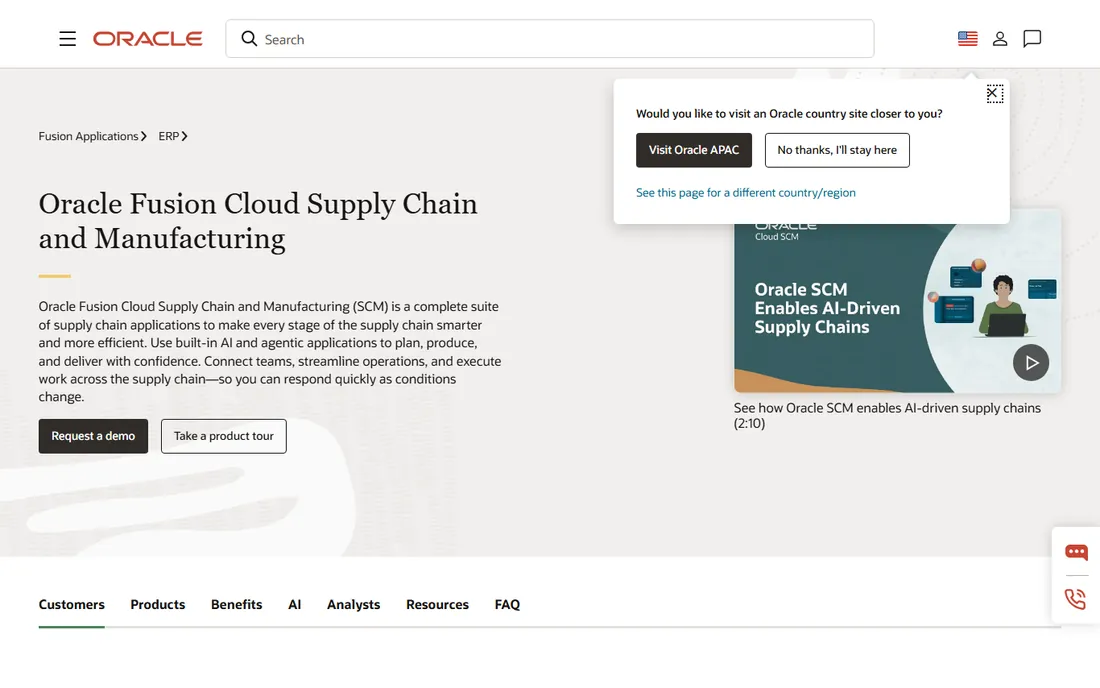
Oracle Transportation Management, part of Oracle Fusion Cloud, is the default choice for large shippers that already run Oracle. It handles the full cycle: order management, rate management, shipment planning, booking and tendering, carrier communication, event management, freight audit, and settlement, across every mode of transport. The machine learning layer predicts transit times and adapts plans as conditions change, which is where the platform has pulled ahead of older on-premise TMS products.
The honest catch is the buying and implementation experience. Everything is quote-based, rollouts run for months, and you will want consultants. Oracle's own materials position it for complex global networks, and that is accurate: this is not a tool for a company running 50 truckloads a month. But if you move serious volume across borders and already live in Oracle Fusion, no competitor integrates as deeply.
What we like- Named a Gartner TMS Leader for the 19th time
- Machine learning for transit-time prediction
- Covers all modes from parcel to multi-leg ocean and rail
Watch out for- Pricing only by quote
- Implementations are long and consultant-heavy
- Best value inside the Oracle stack
#2
SAP Transportation Management
Best for: SAP-centric companies that need TM inside S/4HANA
Visit sap.com
Starting priceSee website (quote-based)
Free planNo
SAP Transportation Management is the answer for companies whose supply chain already runs on SAP. As part of S/4HANA, it shares master data, financial postings, and warehouse processes with the rest of the ERP, which eliminates entire categories of integration work. Recent releases have deepened the tie between TM and warehouse management for intercompany scenarios, including automatic freight cost posting and stock-in-transit valuation. For complex, multi-entity shippers, that depth matters.
The trade-offs are familiar to anyone who has bought SAP: pricing by quote, long implementations, and a product that rewards full commitment to the SAP ecosystem. SAP has also introduced a lighter SaaS product, SAP Logistics Management, aimed at smaller shipping operations that need warehousing plus transportation dispatching without the full TM footprint. If you are an SAP shop choosing a TMS, the shortlist starts and usually ends here.
What we like- Native integration with S/4HANA and EWM
- Strong intercompany and multi-entity support
- Deep planning and optimization
Watch out for- Quote-only pricing
- Heavyweight implementation
- SAP lock-in is real
#3
Blue Yonder
Best for: Retailers and manufacturers wanting AI-driven planning plus execution
Visit blueyonder.com
Starting priceSee website (quote-based)
Free planNo
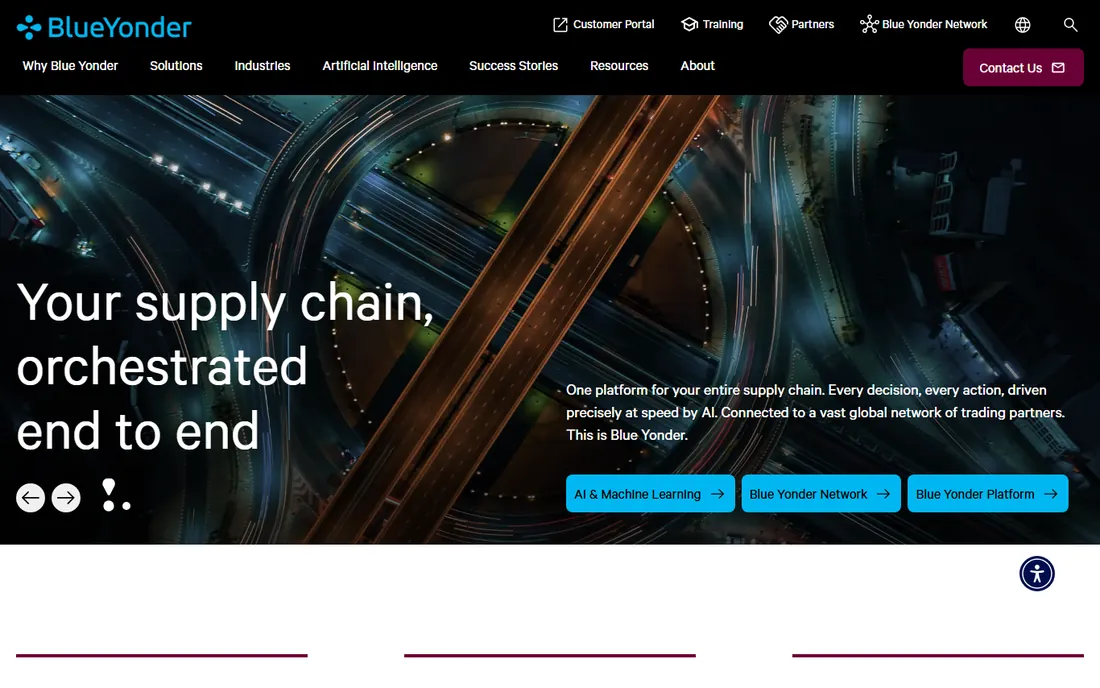
Blue Yonder, formerly JDA, positions itself as the AI company for supply chain, and the numbers back the ambition: the platform generates over 20 billion machine learning predictions per day across planning and execution. Its transportation management sits inside a wider platform covering demand planning, warehouse management, and order orchestration, with a multi-enterprise network connecting trading partners across tiers. For retailers and consumer goods companies, that combination of planning intelligence and execution is the core pitch.
The platform serves 3,000+ customers and holds leadership positions across multiple Gartner Magic Quadrants. The catch is that you buy into an enterprise relationship: quote-based pricing, significant implementation effort, and a product whose breadth can overwhelm a team that just needs to tender loads and track them. Companies with complex, high-volume networks and an appetite for AI-driven optimization get the most from it.
What we like- AI and ML delivering 20 billion predictions daily
- End-to-end planning-to-execution platform
- 3,000+ customers and repeated Gartner leadership
Watch out for- Enterprise pricing and sales cycle
- Broad platform takes time to learn
- Overkill for simple point-to-point freight
#4
Manhattan Associates
Best for: Retail and grocery leaders wanting unified WMS and TMS on one cloud platform
Visit manh.com
Starting priceSee website (quote-based)
Free planNo
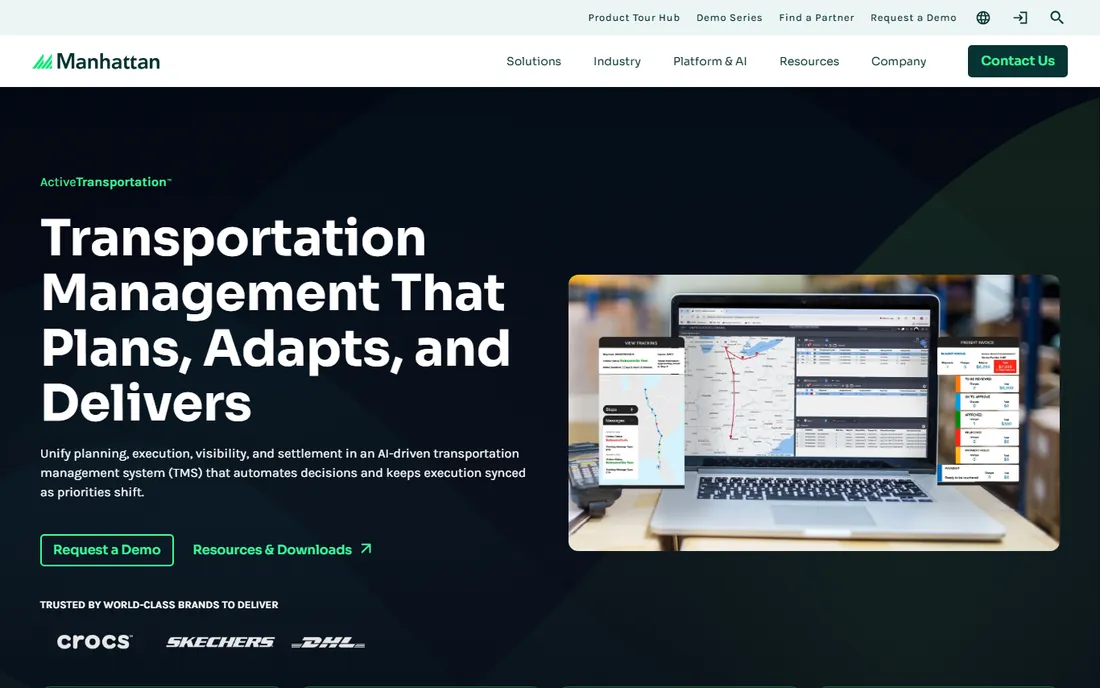
Manhattan Active Transportation Management stands out architecturally: it is built on cloud-native microservices and never needs upgrading, with new features arriving automatically every 90 days. The bigger strategic point is unification. Warehouse management, transportation management, and yard management run on one platform with shared data, which closes the gaps that appear when those systems are merely integrated. Manhattan claims the industry's fastest shipment planning engine, with continuous optimization that re-solves as orders change.
The product comes in Essentials, Enterprise, and Enterprise Premier editions, which gives growing companies a path in. The customer base skews toward retail, grocery, and omnichannel leaders (the published case work includes names like Giant Eagle, with reported reductions in empty and total miles). Pricing is quote-based and positioned at the premium end. If your operation centers on distribution-heavy retail, Manhattan deserves a hard look.
What we like- Cloud-native microservices with no upgrade cycles
- Unified warehouse, transportation, and yard management
- Tiered editions from Essentials to Enterprise Premier
Watch out for- Premium pricing
- Strongest in retail and grocery, thinner elsewhere
- Still an enterprise sale
#5
Descartes
Best for: Mid- to high-volume shippers in North America and Europe
Visit descartes.com
Starting priceSee website (quote-based)
Free planNo
Descartes pitches itself as the TMS you can actually get live quickly, and the product is built for that: a modular, multimodal system covering booking, tracking, rating, load optimization, dock scheduling, yard management, and freight audit, aimed at medium and high volume shippers in North America and Europe. You start with the standard capabilities and add advanced modules as needed, rather than implementing a monolith. Descartes was named a Leader in transportation management by G2 and the top cloud-based TMS provider in ARC Advisory Group's 2025 report.
The honest framing: this is still quote-based enterprise software, not a self-serve product, but the sales and implementation motion is lighter than Oracle or SAP. The focus is squarely on shippers rather than freight forwarders or brokers. For a mid-size manufacturer or distributor outgrowing spreadsheets and carrier portals, Descartes hits a practical middle ground between power and time-to-value.
What we like- Faster implementation than enterprise alternatives
- Modular design you can expand
- Named a G2 TMS Leader and top cloud TMS by ARC Advisory
Watch out for- Quote-based pricing
- Shipper-focused rather than forwarder-focused
- Advanced modules add cost
#6
Infios (formerly MercuryGate)
Best for: Shippers, 3PLs, and brokers wanting multimodal TMS with deep configurability
Visit mercurygate.com
Starting priceSee website (quote-based)
Free planNo

MercuryGate has rebranded as Infios, and mercurygate.com now carries the new identity, so expect to see both names during the transition. The product itself is a long-established SaaS TMS serving shippers, 3PLs, freight forwarders, brokers, and carriers, notable for natively supporting every transportation mode, parcel, LTL, truckload, air, ocean, rail, and intermodal, on a single platform. The configurable workflow engine lets each customer run parcel and complex multi-leg international shipments through the same system.
With 5,000+ customers across 70+ countries, it is one of the most widely deployed independent TMS platforms. The configurability is a double-edged sword: you can shape it to unusual operating models, but that flexibility takes professional-services time to realize. Pricing is quote-based. If your operation spans modes and business types, shortlist it, and just be aware the vendor now calls itself Infios.
What we like- Native support for all modes on one platform, from parcel to intermodal
- 5,000+ customers
- Highly configurable workflows
Watch out for- Recent rebrand from MercuryGate creates confusion
- Quote-only pricing
- Configuration depth means longer setup
#7
E2open
Best for: Global companies needing TMS tied into a multi-enterprise supply chain network
Visit e2open.com
Starting priceSee website (quote-based)
Free planNo
E2open's pitch is the network, not just the software: more than 400,000 manufacturing, logistics, channel, and distribution partners connected on one multi-enterprise platform, tracking over 12 billion transactions a year. Its transportation management covers planning, carrier procurement, rating, tendering, tracking, and settlement across all modes, and it sits alongside demand planning, supply management, global trade, and channel applications. Note that WiseTech Global has acquired e2open, so expect the roadmaps to converge over time.
That breadth is the differentiator and the complication. If your logistics problems are tangled up with planning and trade compliance, buying them on one platform has real appeal. If you need a focused TMS, the suite can feel like more than you asked for, and pricing is entirely quote-driven. Large global shippers with complex partner ecosystems are the natural audience.
What we like- Network of 400,000+ connected partners and 12 billion annual transactions
- TMS plus planning, trade, and channel in one platform
- Strong ocean and parcel heritage
Watch out for- Quote-based pricing
- Broad suite can be complex to scope
- WiseTech acquisition integration still settling
#8
WiseTech CargoWise
Best for: Freight forwarders and 3PLs running global forwarding operations
Visit cargowise.com
Starting priceSee website (quote-based)
Free planNo
CargoWise is the operating system of the freight forwarding world. WiseTech Global's platform centralizes forwarding, customs, warehousing, and transport execution for logistics providers operating across 193 countries, with 30 languages and 162 currencies supported. More than 17,000 organizations run on it, including many of the world's largest forwarders, and WiseTech's recent Value Packs aim to make the packaging simpler, more transparent, and more predictable than the old module-by-module model.
The honest framing for shippers: CargoWise is built for companies that sell logistics services, not companies that buy freight. A manufacturer choosing a TMS will usually find Oracle, Blue Yonder, or Descartes a better fit. But if you are a forwarder or 3PL, this is the category standard, with compliance depth and global reach nobody else matches. Pricing is quote-based and onboarding is a real project.
What we like- Single platform for global forwarding across 193 countries, 30 languages, 162 currencies
- 17,000+ organizations
- New Value Packs simplify packaging
Watch out for- Quote-based pricing
- Built for forwarders more than pure shippers
- Deep product means serious onboarding
#9
project44
Best for: Shippers that need real-time visibility across every mode and carrier
Visit project44.com
Starting priceSee website (quote-based)
Free planNo
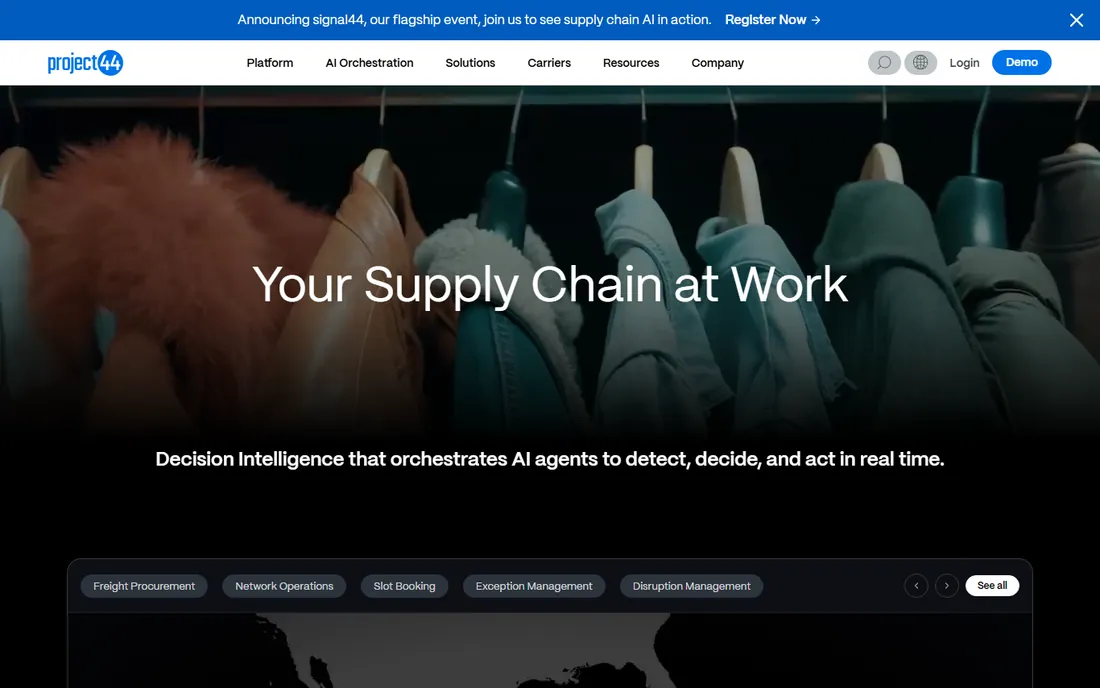
project44 built the largest real-time visibility network in freight: 282,000 connected carriers, over 1.5 billion shipments a year, 700 million logistics events processed daily, and predictive analytics layered on top. The platform now extends beyond tracking into intelligent transportation management, yard management, and e-commerce logistics, with AI agents that detect disruptions and act on them. Customer results are concrete: the company cites cases like $16 million in avoided costs during the Baltimore Bridge collapse through real-time rerouting.
The catch is positioning and price. This is enterprise software with enterprise pricing (independent estimates put the base platform around $15,000 per year before volume), and its deepest strength remains visibility rather than core TMS planning. If your pain is "where is my freight and what do we do about delays," project44 is the leader. If your pain is "plan and tender 500 loads a week," pair it with or prefer a planning-centric TMS.
What we like- Largest visibility network at 282,000+ carriers and 1.5 billion annual shipments
- Predictive ETAs and AI exception management
- Expanding into intelligent TMS
Watch out for- Enterprise pricing (third-party estimates from ~$15,000/year base)
- Visibility-first heritage
- Overkill if you only need basic tracking
#10
Shipwell
Best for: Mid-size shippers wanting a modern, usable TMS without enterprise overhead
Visit shipwell.com
Starting priceSee website (quote-based)
Free planNo
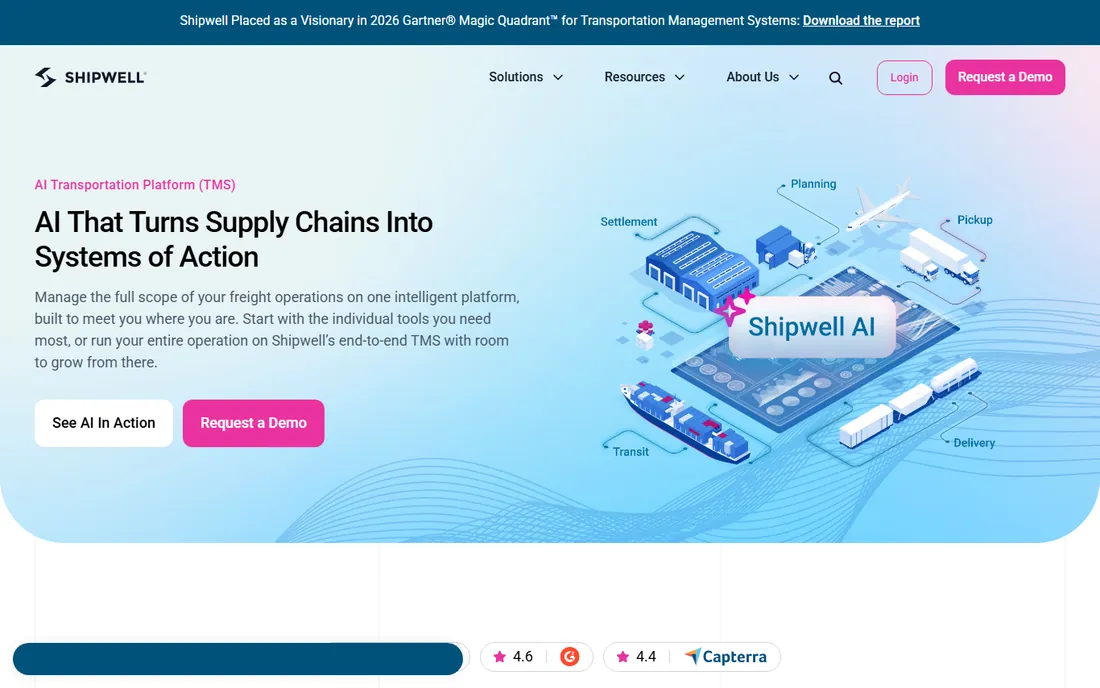
Shipwell is the modernizer of this list: a cloud-native, AI-powered TMS that Gartner has ranked #1 for ease of use, designed for shippers who find the enterprise platforms heavy. It covers load optimization, settlements, pricing intelligence, visibility, RFP automation, and dock scheduling across truckload, LTL, intermodal, drayage, and parcel, with ocean and air booking on the roadmap. The modular design lets you adopt a single tool or the full platform, and AI workers handle track-and-trace monitoring and natural-language order creation.
Historically Shipwell offered free core rating, booking, and tracking with paid add-ons; the current motion is sales-led with quote-based pricing, so confirm the commercial model on a demo. It will not match Oracle or Manhattan on global complexity, but for mid-size shippers, food and beverage companies, and growing manufacturers, it delivers the most usable TMS experience at this end of the market.
What we like- Ranked #1 for ease of use by Gartner
- Modular, start with one tool or take the full platform
- AI workers for track-and-trace and order creation
Watch out for- Pricing is now sales-led and quote-based
- Ocean and air booking still on the roadmap
- Smaller vendor than the enterprise giants
These get mixed together constantly, so here is the plain version. A transportation management system plans and executes freight: it picks carriers, tenders loads, tracks shipments, audits invoices, and settles payment. A visibility platform watches freight in motion: it aggregates carrier data into live tracking, predictive ETAs, and exception alerts, usually across whatever TMS you already run. Forwarder software like CargoWise runs the business of selling logistics: forwarding operations, customs brokerage, and customer billing.
In practice they overlap and integrate. project44 sells visibility that now reaches into TMS workflows; the big TMS vendors all bundle visibility; CargoWise includes execution but not shipper-side planning. Buy the category that matches your actual pain. If loads are not getting planned and tendered efficiently, you need a TMS. If loads disappear after tendering, you need visibility. If you are a forwarder, you probably need CargoWise regardless.
How to choose logistics software without buying the wrong tier
Start with your modes and volume, because they determine everything else. A company running domestic truckload has different needs than one running ocean, air, and intermodal across continents, and vendors sort themselves accordingly: Shipwell and Descartes for mid-size domestic-heavy operations, Oracle, SAP, Blue Yonder, and Manhattan for global complexity, CargoWise for forwarders, project44 for visibility everywhere.
Next, be honest about implementation appetite. Enterprise TMS rollouts run six to eighteen months with consultants; mid-market options like Descartes and Shipwell go live far faster. Ask every vendor for reference customers at your volume and in your industry, and ask what the first 90 days actually look like.
Then examine the commercial model. Nearly everything here is quote-based, which means the price depends on shipment volume, modes, users, and modules. Push for all-in pricing including implementation, integrations (EDI, ERP, telematics), and carrier onboarding, because those are where budgets break. Finally, check the network effects: a TMS is only as good as its carrier connections, so ask how many of your actual carriers are already integrated before you sign.
How we chose
We selected ten established logistics software platforms covering transportation management, supply chain visibility, and freight forwarding, prioritizing vendors with significant customer bases and analyst recognition. In October 2026 we verified each vendor's homepage and confirmed current product positioning, including MercuryGate's rebrand to Infios and WiseTech's acquisition of e2open. Pricing in this category is almost entirely quote-based, so we marked it as such rather than repeating third-party estimates. We did not run hands-on trials; assessments reflect vendor-published capabilities and widely reported market feedback.
Frequently asked questions
How much does logistics software cost?
Almost every enterprise TMS and visibility platform is priced by quote, based on shipment volume, modes, users, and modules. Independent estimates put project44's base platform around $15,000 per year, while full enterprise TMS deployments commonly run into six figures annually including implementation. Mid-market options cost less but still require a sales conversation. Treat any public number as a rough signal and get a written quote scoped to your volume.
What is the difference between a TMS and supply chain visibility software?
A TMS plans and executes freight: carrier selection, tendering, tracking, audit, and settlement. Visibility software tracks freight in motion with live status, predictive ETAs, and exception alerts, usually connecting to your existing TMS. Many shippers run both: the TMS runs the operation, the visibility layer watches it. project44 leads the visibility category; Oracle, SAP, Blue Yonder, and Manhattan lead the TMS category.
How long does it take to implement a TMS?
Enterprise platforms typically take six to eighteen months with consultant support, depending on modes, countries, and ERP integration complexity. Mid-market options like Descartes and Shipwell can go live in weeks to a few months for standard domestic use cases. The biggest schedule risks are dirty carrier and rate data, EDI integration backlogs, and scope creep, so ask vendors for a phased plan with a defined go-live milestone.
Is there good logistics software for small businesses?
Yes, but manage expectations. Shipwell and Descartes are the most accessible names on this list for mid-size shippers. True small businesses moving a handful of loads a week are usually better served by carrier portals, freight marketplaces, or lighter shipping tools than by a full TMS. SAP's newer Logistics Management SaaS product also targets smaller operations that need warehousing plus transportation dispatching.
Do these platforms integrate with my ERP and carriers?
Yes, integration is table stakes. Expect prebuilt connectors or APIs for major ERPs (SAP, Oracle, NetSuite), EDI support for carriers, and telematics or ELD integrations for tracking. The quality varies: ask each vendor how many of your specific carriers are already live on their network, because onboarding a long tail of small carriers is where timelines slip.
What happened to MercuryGate?
MercuryGate rebranded as Infios. The website at mercurygate.com now carries the Infios identity, covering order, warehouse, and transportation management under an "Intelligent Supply Chain Execution" banner. The TMS product continues; only the corporate brand changed. Similarly, e2open has been acquired by WiseTech Global but continues to operate under its own name.
Sources we checked (10)
- https://www.oracle.com/scm/logistics/transportation-management/
- https://www.sap.com/products/transportation-logistics.html
- https://blueyonder.com/
- https://www.manh.com/solutions/supply-chain-management-software/transportation-management
- https://www.descartes.com/solutions/transportation-management/tms
- https://mercurygate.com/
- https://www.e2open.com/
- https://cargowise.com/
- https://www.project44.com/
- https://shipwell.com/
Is your product missing or out of date?
We review this list regularly. Vendors can request a listing, send updated pricing or ask about featured placement.

Shihab Mia · Founder, Rankite
Shihab has spent more than a decade helping SaaS and e-commerce brands grow through search. He writes Rankite's software buying guides from pricing pages, documentation and public user reviews. More about Shihab.