How we make this list: we compare pricing pages, product documentation and public user reviews. Rankite is independent; if a vendor ever pays for a featured spot, that listing is clearly labeled Partner.
Key takeaways
- QuickBooks Online remains the default choice in the US, mainly because most American accountants and bookkeepers already work in it.
- Free options are real: Wave costs nothing for core accounting, and Zoho Books is free for businesses under $50K in annual revenue.
- Most paid plans run $20 to $40 per month for small businesses; expect $100 or more as you add users, payroll, and inventory.
- Xero is the strongest QuickBooks alternative, with unlimited users on every plan and solid multi-currency support.
- Ask your accountant what they use before you buy. Their preference will save you more money than any feature comparison.
Quick comparison
| Tool | Best for | Starting price | Free plan |
|---|
 QuickBooks Online QuickBooks Online | US small businesses with a QuickBooks accountant | $38 per month (Simple Start) | Free trial |
 Xero Xero | Growing businesses needing unlimited users | $25 per month (Early) | Free trial |
 FreshBooks FreshBooks | Freelancers and service businesses | $23 per month (Lite) | Free trial |
 Wave Wave | Solopreneurs wanting free accounting | $0 (Starter) | Yes |
 Zoho Books Zoho Books | Budget-conscious businesses in the Zoho ecosystem | $15 per month (Standard, billed annually) | Yes (revenue under $50K) |
 Patriot Software Patriot Software | Simple, affordable US accounting and payroll | $20 per month (Accounting Basic) | Free trial (30 days) |
 Kashoo Kashoo | Straightforward accounting for non-accountants | See website | Free trial (14 days) |
 AccountEdge AccountEdge | Desktop accounting for Mac and Windows | $20 per month (Pro) | Free trial |
 Sage Sage | Established businesses wanting a big-brand suite | See website | Free trial |
 NetSuite NetSuite | Mid-size companies outgrowing small-business tools | See website | No |
Is your product missing or out of date?
We review this list regularly. Vendors can request a listing, send updated pricing or ask about featured placement.
The top 10 accounting software in the USA
Starting price$38 per month (Simple Start)
Free planFree trial
QuickBooks Online is the default accounting software for American small businesses, and the reason is network effects. Your accountant almost certainly uses it, your bookkeeper knows it, and most banks, payroll providers, and apps integrate with it. Simple Start begins at $38 per month, with Essentials, Plus, and Advanced tiers scaling up as you add users and features.
The product itself is strong: automated bank feeds, invoicing, bill pay, inventory tracking on higher plans, cash flow forecasting, and AI-assisted categorization. For a growing business that needs payroll, project tracking, or multi-user access, QuickBooks scales further than any rival on this list.
The honest catch is cost creep. Simple Start covers one user with tight limits, and most businesses land on Plus or higher, plus payroll and payment processing fees. A realistic all-in cost for a small team runs well past $100 per month. Still, if your accountant works in QuickBooks, matching them is worth more than saving on software.
What we like- Largest US accountant network
- Deep reporting and 800+ integrations
- Strong payroll and inventory options
Watch out for- Price climbs fast with users and add-ons
- Entry plan is limited to one user
#2
Xero
Best for: Growing businesses needing unlimited users
Visit xero.com
Starting price$25 per month (Early)
Free planFree trial
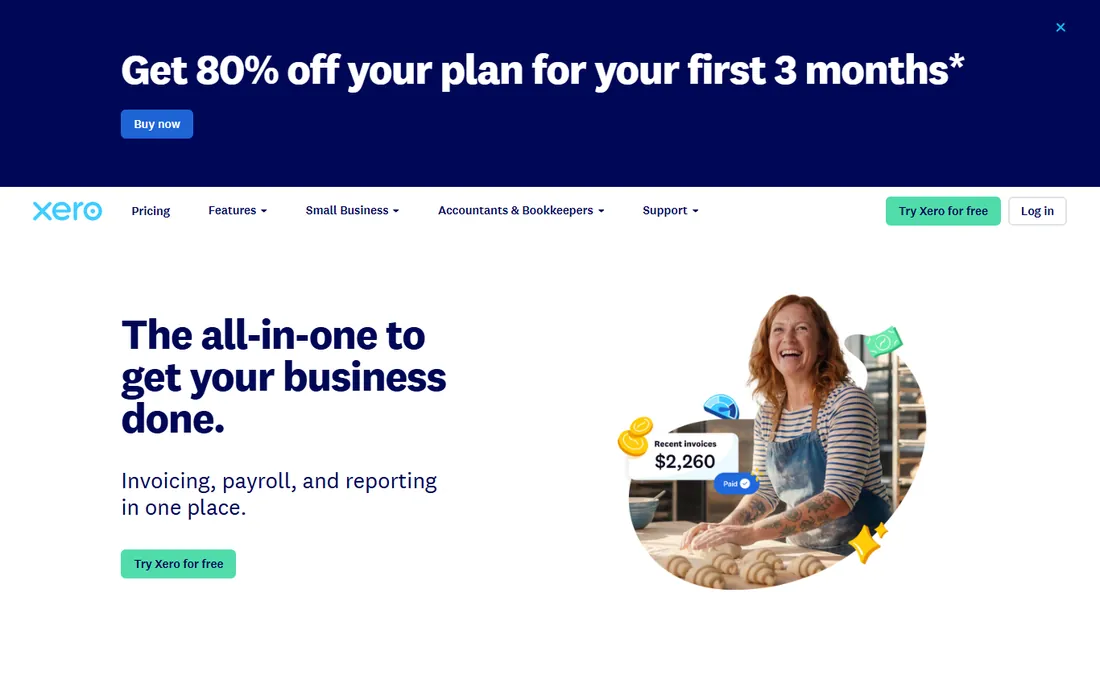
Xero is the closest like-for-like QuickBooks alternative and the strongest pick for teams where several people need accounting access. Every plan includes unlimited users at no extra charge, which makes its $55-per-month Growing plan dramatically cheaper than QuickBooks Plus once you count seats. Early starts at $25 per month with caps on invoices and bills.
The software is genuinely pleasant to use, with bank reconciliation that reviewers consistently praise, solid invoicing, expense claims, and multi-currency on the Established tier. Its AI assistant JAX helps with invoicing and cash flow questions, and the app marketplace connects over a thousand integrations.
The tradeoff for US buyers is payroll. Unlike QuickBooks, Xero has no built-in US payroll and relies on integrations like Gusto. The Early plan's transaction caps also mean most active businesses need at least Growing. But for multi-user teams that want clean software without per-seat pricing, Xero is the best value here.
What we like- Unlimited users on every plan
- Clean interface with strong bank reconciliation
- Good multi-currency support
Watch out for- Entry plan caps invoices and bills
- US payroll requires a third-party integration
Starting price$23 per month (Lite)
Free planFree trial
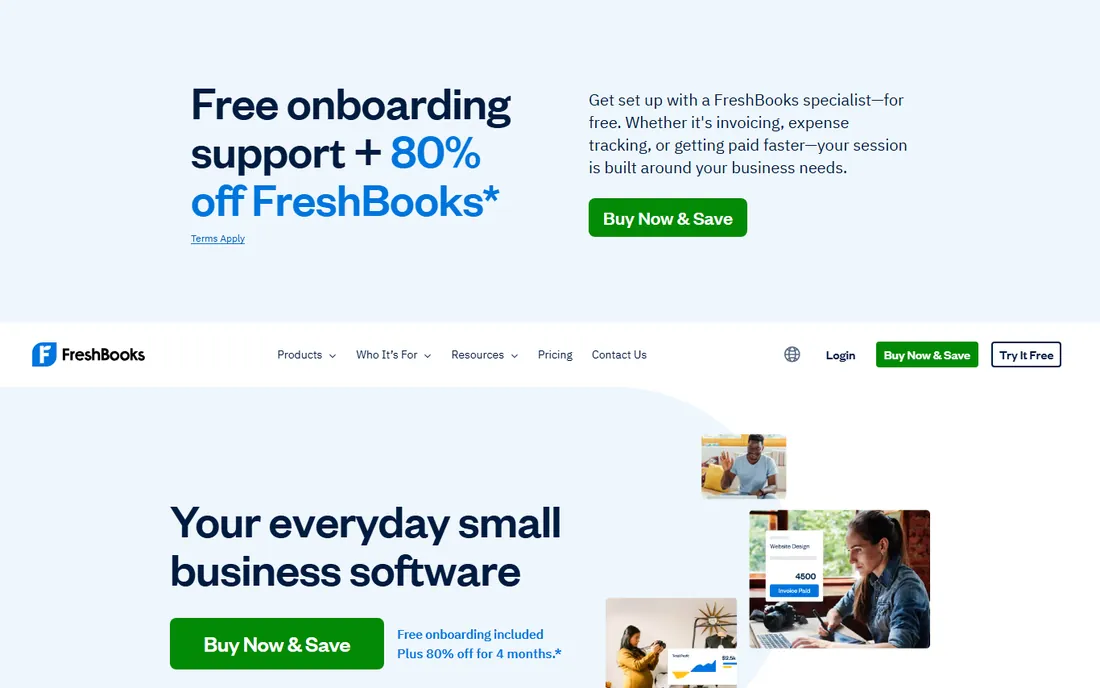
FreshBooks is built for people who bill clients: freelancers, consultants, agencies, and service businesses. Invoicing is the best in the business, with professional templates, automated reminders, and online payments. Time tracking ties hours straight to invoices, and the interface is the friendliest here for anyone who is not an accountant.
Lite starts at $23 per month for up to five billable clients, with Plus and Premium tiers expanding the client count. For a solo consultant or small agency, the workflow from time entry to paid invoice is smoother than anything else on this list.
The catch is the client-based pricing. That five-client cap on Lite is easy to hit, and businesses with many small customers get pushed toward Premium quickly. Reporting is also thinner than QuickBooks or Xero, so inventory-heavy or complex businesses will feel the limits. For service businesses that live in invoices, though, FreshBooks is hard to beat.
What we like- Best-in-class invoicing and client experience
- Simple time tracking
- Easy for non-accountants
Watch out for- Client caps on lower tiers push costs up
- Reporting is basic compared to QuickBooks or Xero
Starting price$0 (Starter)
Free planYes
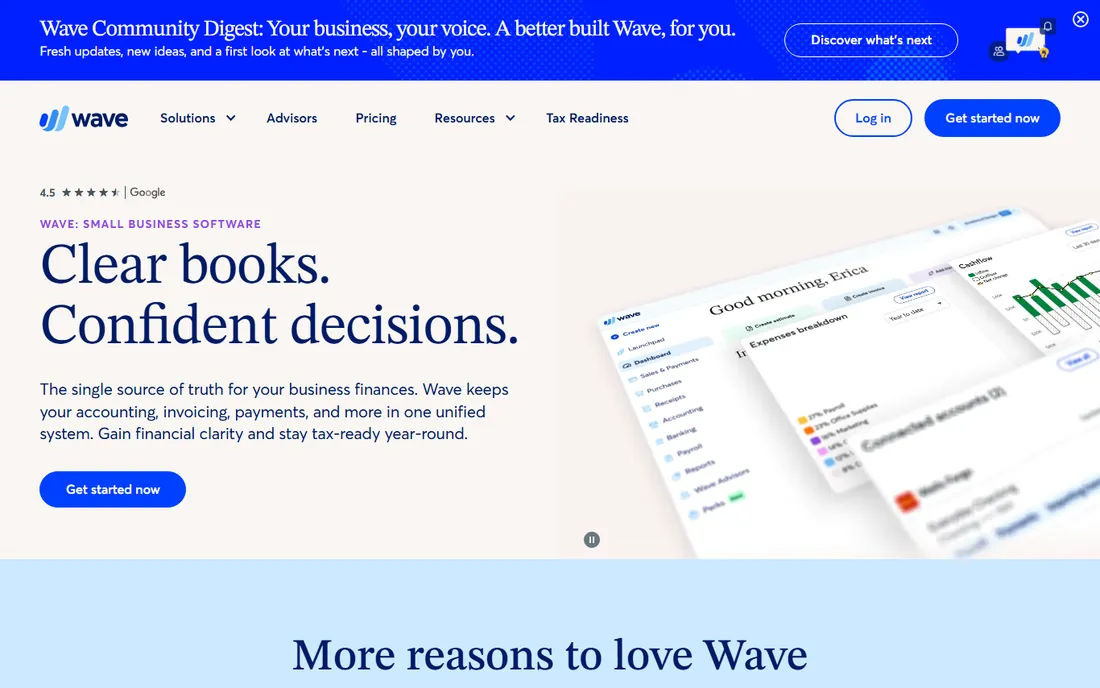
Wave is the rare product that is genuinely free: accounting, invoicing, expense tracking, and receipt scanning cost nothing on the Starter plan, with no trial clock ticking. For freelancers and very small businesses, it covers the essentials without a monthly bill. Paid add-ons like payroll and payment processing are there when you need them.
The software is designed for owners, not accountants, so setup is quick and the dashboard stays readable. Unlimited users are included, which is unusual at this price, and bank connections keep transactions flowing in automatically.
The honest catch is depth. Wave lacks the advanced reporting, inventory, and project accounting of paid tools, and businesses that outgrow the basics will need to migrate. Customer support is also lighter than what QuickBooks or Xero provide. But as a free starting point, nothing else comes close.
What we like- Core accounting and invoicing free forever
- Unlimited users
- Simple enough for non-accountants
Watch out for- Limited advanced features
- Payroll and payments cost extra
- Support is thinner than paid rivals
#5
Zoho Books
Best for: Budget-conscious businesses in the Zoho ecosystem
Visit zoho.com
Starting price$15 per month (Standard, billed annually)
Free planYes (revenue under $50K)
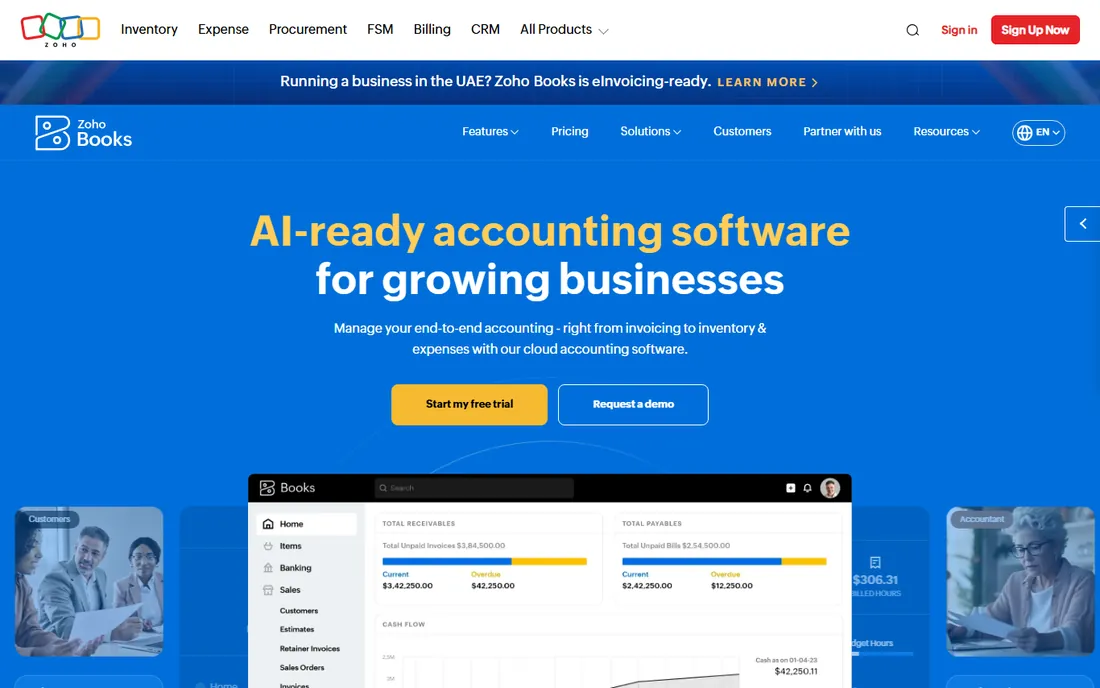
Zoho Books gives you the most accounting per dollar on this list. The free plan covers businesses with under $50K in annual revenue with real double-entry accounting, and paid plans start at just $15 per month for Standard on annual billing. Professional and Premium tiers add inventory, purchase orders, and automation at prices competitors charge for basics.
Feature depth is impressive for the money: invoicing, bank reconciliation, expense tracking, projects, multi-currency, and over 70 reports. If you already use Zoho CRM or other Zoho apps, the integration is smooth and the combined value is hard to match.
The tradeoff is ecosystem, not software. Fewer US accountants work in Zoho Books than in QuickBooks or Xero, so you may need to export reports or switch accountants. But for cost-conscious businesses comfortable managing their own books, Zoho Books is the value champion.
What we like- Generous free plan
- Full double-entry accounting at low prices
- Deep integration with Zoho apps
Watch out for- Smaller US accountant network
- Support quality varies by plan
Starting price$20 per month (Accounting Basic)
Free planFree trial (30 days)
Patriot Software is a US company building simple accounting and payroll for American small businesses, and its pitch is clarity. Accounting Basic costs $20 per month with unlimited invoices and no per-user charges; Premium at $30 adds estimates, recurring invoices, and receipt management. Payroll runs in the same login starting at $17 per month plus per-worker fees.
The software does the fundamentals well: invoicing, bill pay, bank reconciliation, and financial reports, with a patented toggle between cash and accrual accounting. US-based support is free on every plan, which reviewers consistently praise.
The catch is scope. There is no inventory management, no multi-currency, and the interface is deliberately plain. If you sell products or operate internationally, this is the wrong tool. For US service businesses that want simple books and payroll from one vendor, Patriot is refreshingly honest about what it does.
What we like- Straightforward pricing with no per-user fees
- US-based support
- Accounting and payroll under one login
Watch out for- No inventory management
- No multi-currency
- Plain interface
#7
Kashoo
Best for: Straightforward accounting for non-accountants
Visit kashoo.com
Starting priceSee website
Free planFree trial (14 days)
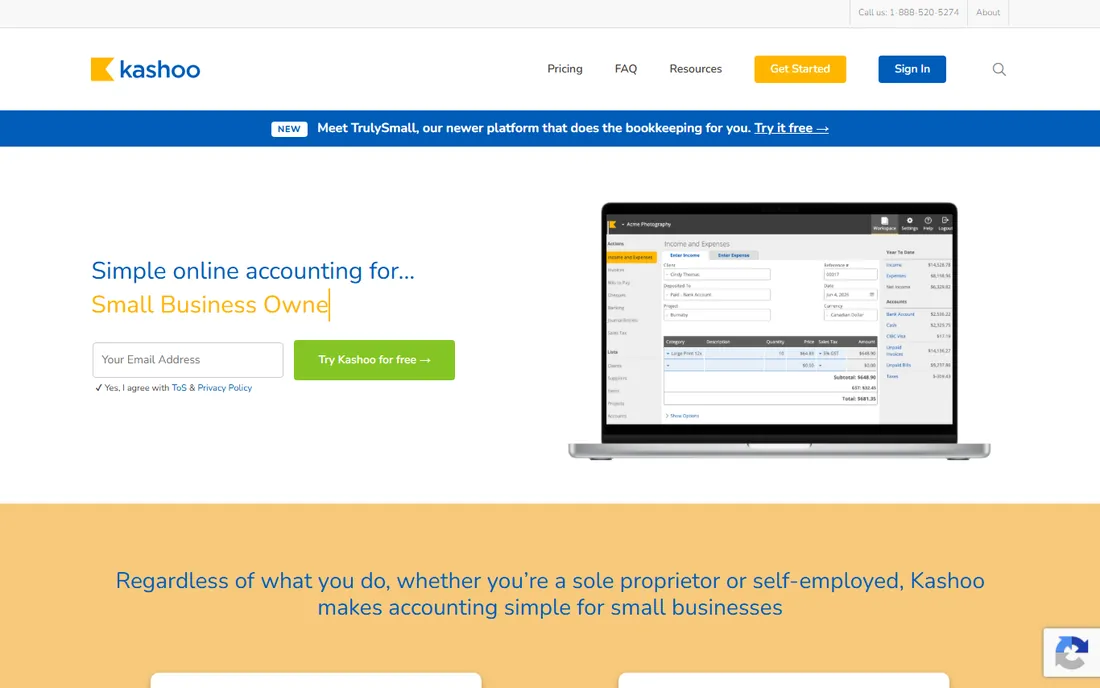
Kashoo is a Canadian company whose accounting software is designed for business owners who find QuickBooks intimidating. The interface strips accounting down to plain language, with automatic bank imports, invoicing, expense tracking, and multi-currency support. Unlimited users are included, so your accountant and bookkeeper cost nothing extra.
Project tracking, sales tax handling, and integrations with Square and Stripe cover the needs of typical service businesses and freelancers. A 14-day free trial with no credit card required makes it easy to test.
The honest catch is transparency and scale. The homepage does not publish pricing, so you have to start a trial or talk to sales to see costs, and the feature set is thinner than QuickBooks, Xero, or Zoho Books. For owners who want the simplest possible books, that simplicity is the point.
What we like- Simple interface built for owners
- Unlimited users included
- Multi-currency and project tracking
Watch out for- Pricing not published on the homepage
- Smaller feature set than the big players
Starting price$20 per month (Pro)
Free planFree trial
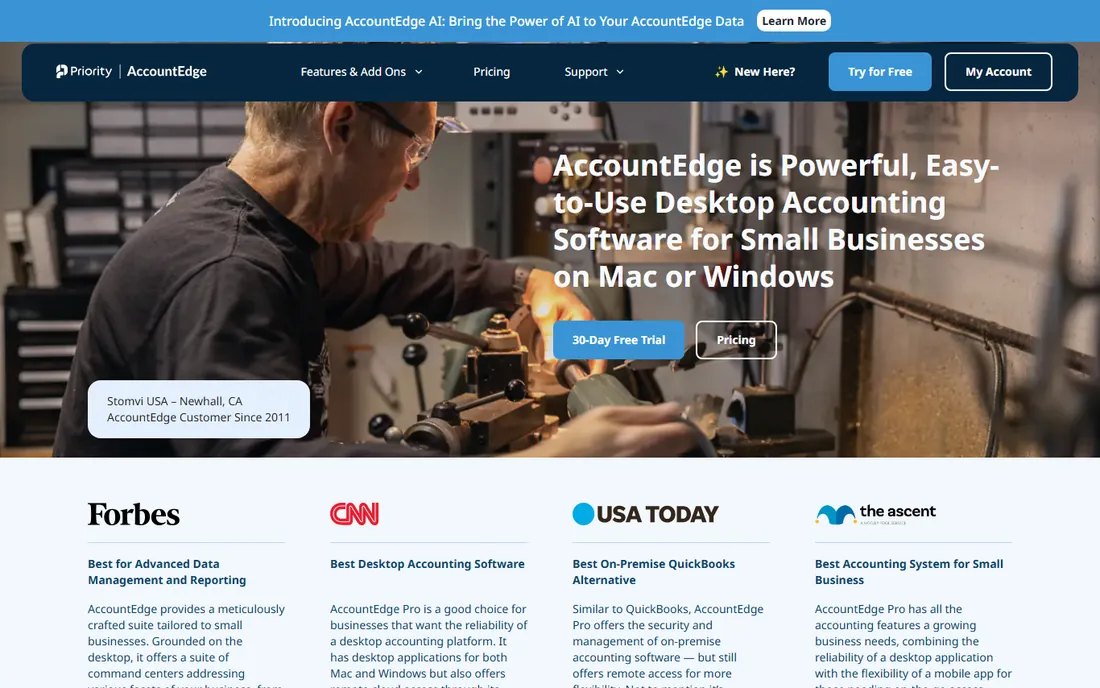
AccountEdge is for businesses that want their accounting on their own computers. The Pro plan at $20 per month gives single-user desktop software for Mac or Windows with deep features: invoicing, inventory management, payroll, time billing, and hundreds of reports. It has served small businesses since 1989, and long-time users praise its depth.
Unlike cloud tools, your data lives with you, which matters to owners wary of subscriptions holding their books hostage. Network Edition at $30 per month adds multi-user access, and hosted options exist for remote teams.
The tradeoff is modernity. AccountEdge is desktop-first, so mobile access and third-party integrations lag behind cloud rivals, and remote access requires add-ons starting at $15 per month. For businesses that prefer owning their software and working offline, it remains the best desktop option.
What we like- Full-featured desktop software you control
- Strong inventory and time billing
- Mac and Windows native
Watch out for- Desktop-first in a cloud world
- Remote access costs extra
- Smaller integration ecosystem
#9
Sage
Best for: Established businesses wanting a big-brand suite
Visit sage.com
Starting priceSee website
Free planFree trial
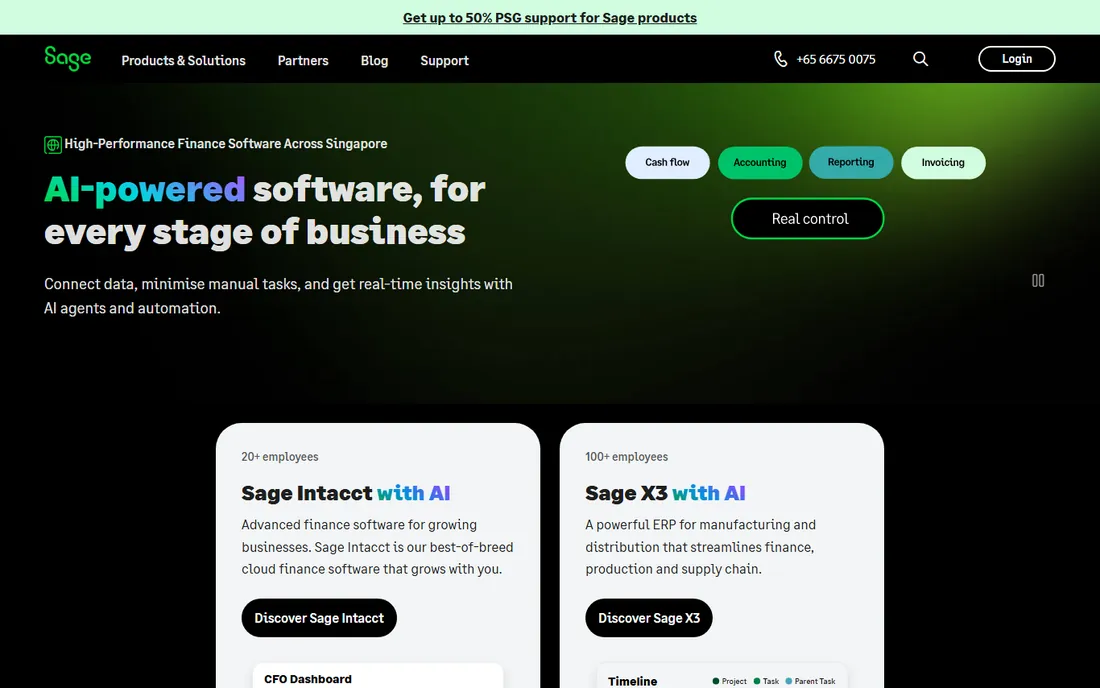
Sage is one of the world's largest business software companies, and its accounting lineup spans from small-business tools to Sage Intacct for mid-size finance teams. For US businesses, the appeal is a vendor that can grow with you: start small and move up to serious financial management without switching companies.
Sage Intacct, its flagship cloud product, is genuinely powerful for multi-entity accounting, with AI automation and strong audit controls. The brand carries weight with accountants and auditors, and Sage's partnerships, including recognition from the AICPA, signal credibility.
The catch for small businesses is clarity. The homepage leads with enterprise products, and US pricing for the small-business accounting tiers is not published upfront. The product lineup across regions is also confusing. Sage makes most sense for businesses that expect to scale into mid-market finance, not for freelancers picking their first tool.
What we like- Huge global brand with deep product range
- Strong for scaling businesses
- AICPA-recognized finance tools
Watch out for- US small-business pricing not clearly published
- Product lineup can be confusing
#10
NetSuite
Best for: Mid-size companies outgrowing small-business tools
Visit netsuite.com
Starting priceSee website
Free planNo
NetSuite, owned by Oracle, is not really small-business accounting software. It is a cloud ERP that includes financials alongside CRM, inventory management, ecommerce, and HR. It belongs on this list because it is where successful small businesses go when QuickBooks stops being enough.
The value is unification: one system for accounting, orders, inventory, and customer data, with multi-subsidiary and multi-currency support built in. Companies with complex operations, multiple locations, or serious growth plans get a platform that scales for years.
The honest catch is everything else. Pricing is quote-based and enterprise-level, implementation takes months with consultants, and there is no free trial in the usual sense. If you have twenty employees and simple books, NetSuite will bury you. If you are outgrowing QuickBooks and need real ERP, start the conversation.
What we like- Full ERP beyond accounting: CRM, inventory, ecommerce
- Scales to hundreds of users
- Strong for multi-subsidiary businesses
Watch out for- Quote-based enterprise pricing
- Implementation is a project, not a signup
- Overkill for small businesses
How we chose
We focused on accounting software widely used by US small and mid-size businesses, from free tools to full ERP. We checked current pricing on vendor homepages and recent vendor-published pricing data, read documentation for feature scope and platform support, and weighed public reviews from G2, Capterra, and Reddit. We favored tools with verifiable current homepages and clear US availability, and we included both cloud and desktop options since some businesses still prefer owning their software.
What to check before you buy accounting software
Ask your accountant first. This advice appears in every honest accounting guide because it matters most. If your CPA works in QuickBooks, buying Xero creates friction on every tax return and monthly close. Their preference should weigh heavily unless you have a strong reason to differ.
Match the software to your business model. Service businesses live in invoicing and time tracking, where FreshBooks and Wave shine. Product businesses need inventory, which points to QuickBooks Plus, Zoho Books Professional, or AccountEdge. Businesses with employees need payroll, which QuickBooks, Patriot, and Xero handle differently.
Count the real monthly cost, not the headline price. Entry plans are cheap; the price you actually pay includes extra users, payroll, payment processing fees, and the tier you will need in six months. Map your needs a year out and price that plan.
Finally, test the bank feed. Automatic bank imports and reconciliation are where accounting software earns its keep, and feed reliability varies by bank and vendor. Connect your actual accounts during the free trial and confirm transactions import cleanly before you commit.
When to move from small-business accounting to ERP
Most businesses start with tools like QuickBooks, Xero, or Wave and do fine for years. The signals that you have outgrown them are consistent: you need consolidated reporting across multiple entities, inventory management across warehouses, approval workflows, or audit controls your current tool cannot provide.
NetSuite and Sage Intacct exist for this transition. They cost more and take longer to implement, but they replace a patchwork of accounting software, spreadsheets, and add-ons with one system. The mistake is moving too early, when the complexity costs more than the spreadsheets did, or too late, when the business is making decisions on unreliable numbers.
A practical rule: if your month-end close takes more than a week because of workarounds, start evaluating ERP. If it takes two days, stay where you are.
Frequently asked questions
What is the best accounting software for a small business in the USA?
QuickBooks Online is the most common answer because most US accountants use it. Xero is the best alternative for teams needing unlimited users, FreshBooks suits freelancers, and Wave is the best free option. The right choice depends on your business type and your accountant's preference.
How much does accounting software cost per month?
Free options like Wave cost nothing for core accounting. Most small businesses pay $20 to $40 per month for plans like QuickBooks Simple Start, Xero Early, or Zoho Books Standard. Expect $100 or more per month once you add users, payroll, and inventory features.
Is free accounting software good enough?
For freelancers and very small businesses, yes. Wave's free plan covers invoicing, expenses, and reports, and Zoho Books is free under $50K in revenue. Growing businesses usually need paid features like payroll, inventory, or multi-user access.
Can I do my own accounting without an accountant?
Software handles the day-to-day bookkeeping, but most businesses still benefit from an accountant for tax planning, year-end close, and compliance. Many accountants offer affordable monthly packages for small businesses using cloud software they can access directly.
What is the difference between cash and accrual accounting?
Cash accounting records income and expenses when money changes hands; accrual accounting records them when earned or incurred. Most small businesses use cash accounting for simplicity, but accrual gives a truer picture as you grow. Patriot Software lets you toggle between both views.
How hard is it to switch accounting software?
Migration is easier than it used to be. Most vendors offer free migration tools or services from QuickBooks and spreadsheets. The painful part is usually historical data cleanup and retraining staff, so plan the switch during a quiet period, not at year-end.
Sources we checked (12)
- https://quickbooks.intuit.com/
- https://www.xero.com/
- https://www.freshbooks.com/
- https://www.waveapps.com/
- https://www.zoho.com/books/
- https://www.patriotsoftware.com/
- https://kashoo.com/
- https://accountedge.com/
- https://sage.com/
- https://netsuite.com/
- https://www.spotsaas.com/blog/best-quickbooks-alternatives-2026
- https://www.techrepublic.com/article/quickbooks-online-reviews/
Is your product missing or out of date?
We review this list regularly. Vendors can request a listing, send updated pricing or ask about featured placement.

Shihab Mia · Founder, Rankite
Shihab has spent more than a decade helping SaaS and e-commerce brands grow through search. He writes Rankite's software buying guides from pricing pages, documentation and public user reviews. More about Shihab.