How we make this list: we compare pricing pages, product documentation and public user reviews. Rankite is independent; if a vendor ever pays for a featured spot, that listing is clearly labeled Partner.
Key takeaways
- The billing model matters more than the feature list: Zapier charges per task ($19.99 per month for 750 tasks), Make charges per operation ($9 per month for 10,000), and n8n charges per workflow run regardless of step count.
- Make at $9 per month is the best price-to-power ratio for visual builders. n8n is free if you self-host and cheapest at scale for technical teams.
- Zapier still has the widest app catalog and the fastest setup for non-technical teams, but multi-step workflows burn quota fast.
- Workato and Tray.ai are quote-only for enterprise tiers: budget a sales cycle and model credit consumption before committing.
Quick comparison
| Tool | Best for | Starting price | Free plan |
|---|
 Zapier Zapier | Non-technical teams that want the widest app coverage | $19.99 per month billed annually (Professional, 750 tasks/month) | Yes (free plan: 100 tasks/month) |
 Make Make | Freelancers, agencies and SMB ops teams | $9 per month billed annually (Core, 10,000 credits/month) | Yes (free plan: 1,000 credits/month, 2 active scenarios) |
 n8n n8n | Technical teams that want maximum power without per-step billing | 20 EUR per month billed annually (Cloud Starter, 2,500 executions/month) | Yes (self-hosted Community Edition: free, unlimited executions) |
 Workato Workato | Large enterprises standardizing automation with governance | From $75 per month (Pro, 2,500 credits); enterprise tiers custom-quoted | No (self-serve trial; enterprise is sales-led) |
 Microsoft Power Automate Microsoft Power Automate | Organizations already on Microsoft 365 | $15 per user/month billed annually (Premium) | Yes (free for work/school accounts: standard connectors, daily action limit) |
 Tray.ai Tray.ai | Mid-market to enterprise teams needing flexible iPaaS | See website (Pro, Team and Enterprise priced via demo/sales call) | No (trial/demo via sales) |
 Activepieces Activepieces | Teams that want open-source automation with a permissive license | $16 per month billed annually (Cloud Plus, 10,000 credits/month) | Yes (self-hosted Community Edition free under MIT license; Cloud Free: 1,000 credits/month) |
 Pipedream Pipedream | Developers who want real code inside automation steps | $29 per month billed annually (Basic, 2,000 credits/month) | Yes (free plan: 100 credits/month) |
 Integrately Integrately | SMBs that want Zapier-style automation with quicker setup | $19.99 per month billed annually (Starter, 2,000 tasks/month) | Yes (free plan: 100 tasks/month, 5 automations) |
 Albato Albato | SMBs and mid-market teams wanting transparent transaction billing | $15 per month billed annually (Pro, 1,000 transactions/month) | Yes (free plan: 100 transactions/month) |
Is your product missing or out of date?
We review this list regularly. Vendors can request a listing, send updated pricing or ask about featured placement.
The best workflow automation software
Somewhere in your company, someone copies data from one app to another by hand. They export the CSV, clean it up, import it somewhere else, and do it again next week. Workflow automation software exists to kill that job: it connects your apps and moves the data on a trigger, on a schedule, or when an event fires. The trap is the billing. One vendor charges per task, another per operation, another per full workflow run, and the same automation can cost $9 or $200 a month depending on which model you pick. These ten cover the real market, from free self-hosted to enterprise iPaaS.
#1
Zapier
Best for: Non-technical teams that want the widest app coverage
Visit zapier.com
Starting price$19.99 per month billed annually (Professional, 750 tasks/month)
Free planYes (free plan: 100 tasks/month)
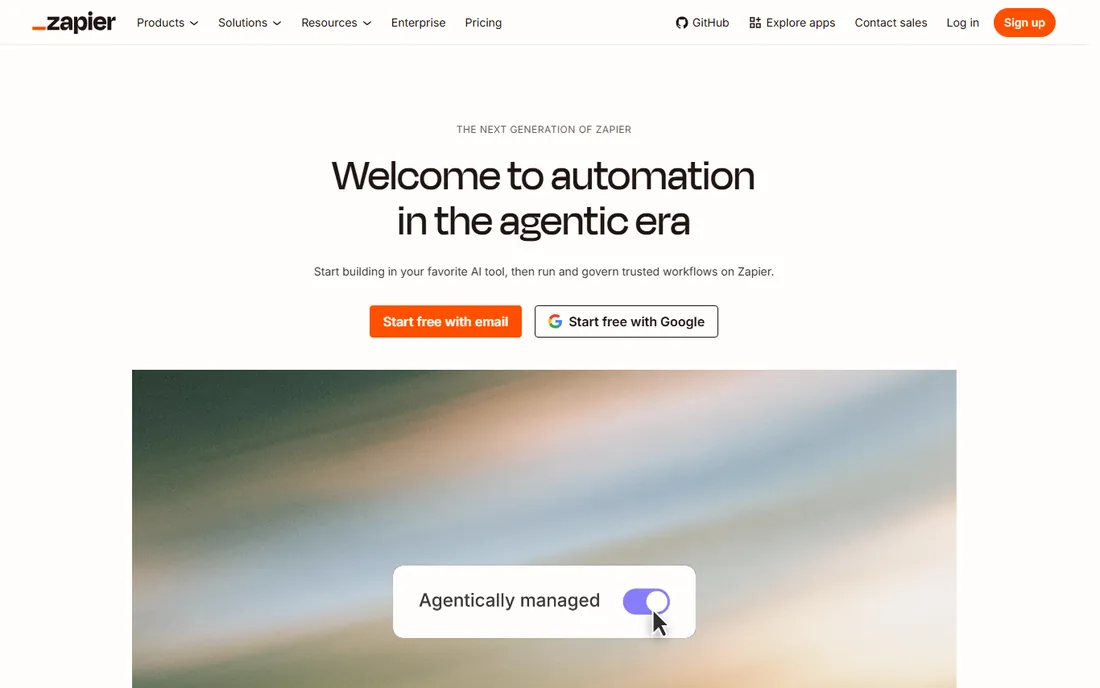
Zapier is the default because it connects everything. If two apps exist, Zapier probably connects them, and a non-technical marketer can build a working automation in minutes. The catalog (thousands of apps) and reliability are the reasons it stays on top despite the price.
The unit economics are the catch. One task equals one successful action step, so a 10-step workflow running 10,000 times needs 100,000 tasks, and the jump from Professional ($19.99) to Team ($69) is steep. Model your volume in tasks, not plans, before you commit. Free covers 100 tasks a month with 2-step Zaps: enough to prove value, not enough to run a business on.
What we like- Largest app catalog with the fastest time to value
- Triggers, filters and Formatter steps do not count as tasks
- Copilot-assisted building plus Tables and Interfaces
Watch out for- Per-task billing punishes multi-step workflows
- Multi-step Zaps locked behind paid plans
#2
Make
Best for: Freelancers, agencies and SMB ops teams
Visit make.com
Starting price$9 per month billed annually (Core, 10,000 credits/month)
Free planYes (free plan: 1,000 credits/month, 2 active scenarios)
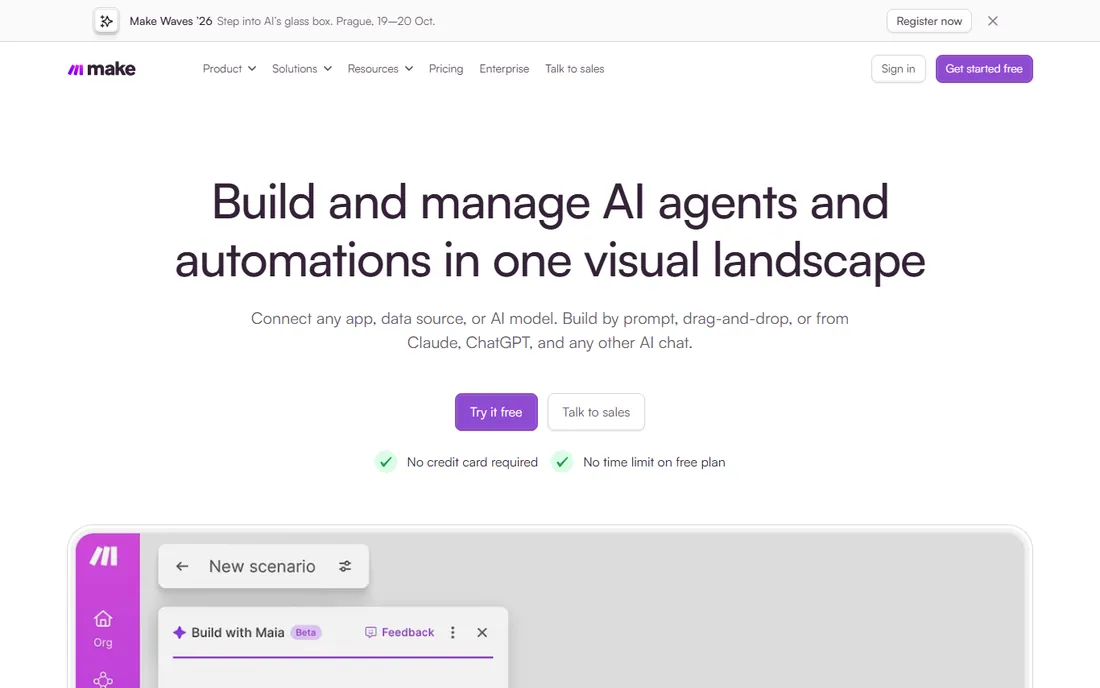
Make is what Zapier would cost if it were priced for the rest of us. Core at $9 per month billed annually gives 10,000 credits with unlimited scenarios, and the visual canvas handles real branching, error handling and data transformation that Zapier gates behind higher tiers. Bring-your-own AI keys on all paid plans sidesteps AI credit markups.
The learning curve is real: budget hours to learn modules and error handling. And a 10-step scenario running 1,000 times eats the whole Core bucket, so the credit math still matters. For visual builders who want power without the Zapier bill, this is the value king.
What we like- Best price-to-power ratio: 10,000 operations and unlimited scenarios at $9
- Visual canvas with true branching and error handling
- One credit per module action
Watch out for- Steeper learning curve than Zapier
- Complex scenarios burn credits per module step
#3
n8n
Best for: Technical teams that want maximum power without per-step billing
Visit n8n.io
Starting price20 EUR per month billed annually (Cloud Starter, 2,500 executions/month)
Free planYes (self-hosted Community Edition: free, unlimited executions)
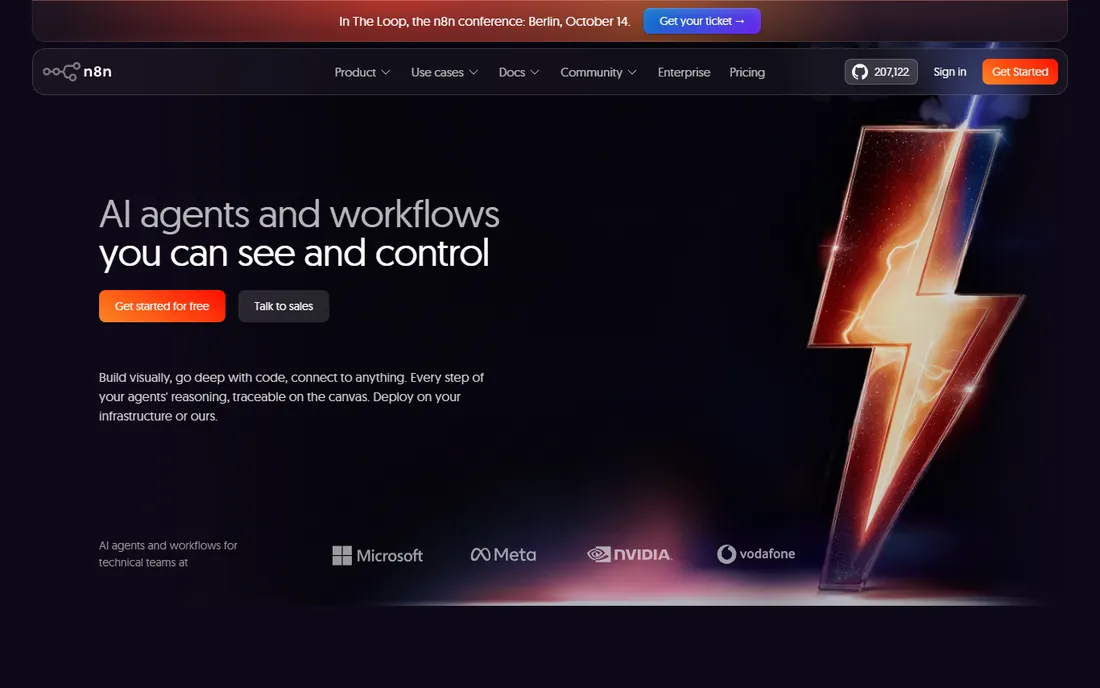
n8n rewrites the billing math. One execution equals one full workflow run, so a 20-node workflow processing 500 records costs one execution versus roughly 10,000 tasks on Zapier. The self-hosted Community Edition has no vendor execution limit: your cost is a $5 to $15 per month VPS. Native code at every node plus AI agent nodes make it the developer's choice.
You maintain the server, and the fair-code license restricts building commercial hosted products on it. The catalog (~400 official nodes) is smaller than Zapier's. For technical teams running serious volume, the savings are dramatic enough to justify the ops overhead.
What we like- One execution equals one full workflow run regardless of step count
- Fair-code license with full self-hosting
- Native JavaScript and Python at every node
Watch out for- Smaller catalog than Zapier with a steep learning curve for non-developers
- Cloud concurrency caps on lower tiers
#4
Workato
Best for: Large enterprises standardizing automation with governance
Visit workato.com
Starting priceFrom $75 per month (Pro, 2,500 credits); enterprise tiers custom-quoted
Free planNo (self-serve trial; enterprise is sales-led)
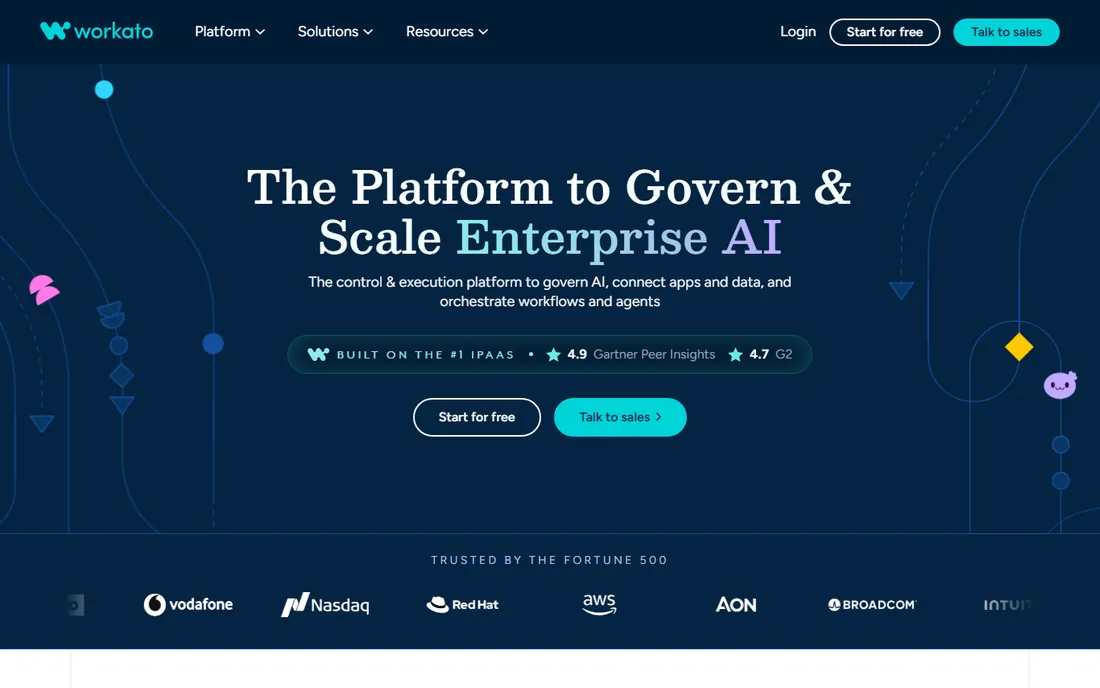
Workato is the enterprise answer to Zapier sprawl. Pre-certified connectors for SAP, Workday, NetSuite and Salesforce, governance and SLAs, and the new AIRO agentic layer with Enterprise MCP for AI agent workflows. The recipe builder is genuinely usable by business users, which MuleSoft never managed.
The procurement wall is the price of admission: no published enterprise number, and buyer-reported first-year contracts run into the tens of thousands for 10 to 50 recipes. The self-serve Pro ladder ($75 for 2,500 credits up) suits small teams with predictable volume but caps at 3 users per workspace. Model credit consumption carefully before committing.
What we like- 1,200-plus pre-certified enterprise connectors
- AIRO agentic orchestration and Agent Studio
- Far more accessible than MuleSoft for business users
Watch out for- Enterprise pricing is sales-led and opaque
- Credits expire monthly with no rollover
#5
Microsoft Power Automate
Best for: Organizations already on Microsoft 365
Visit microsoft.com
Starting price$15 per user/month billed annually (Premium)
Free planYes (free for work/school accounts: standard connectors, daily action limit)
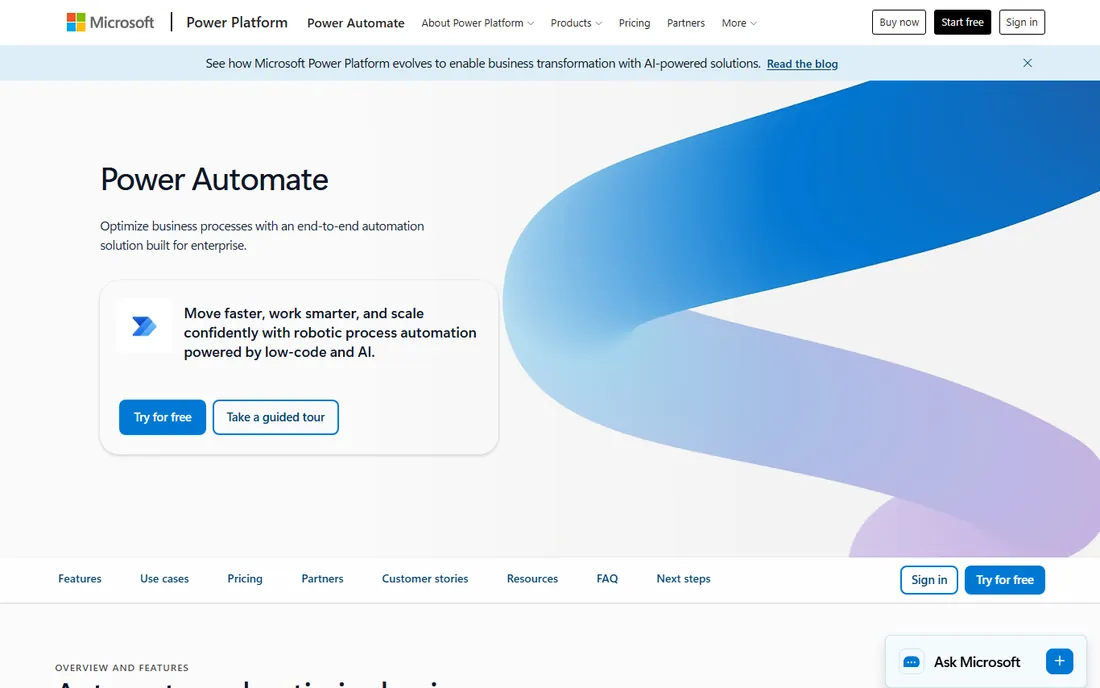
If your company runs on Microsoft 365, Power Automate is already in the building. Teams, SharePoint, Excel and Dataverse automation work out of the box, Premium adds desktop RPA with one bot included and 5,000 AI Builder credits a month, and per-bot Process licensing ($150 per bot per month) covers unattended shared workflows without per-user seats.
The license math needs a spreadsheet: Premium at $15 per user, Process at $150 per bot, Hosted Process at $215 per bot, Process Mining as a $5,000 per tenant per month add-on. Outside the Microsoft stack, its advantages fade. For Microsoft shops, though, the native depth is unmatched.
What we like- Native to Microsoft 365 and Dynamics with 1,000-plus connectors
- Desktop RPA and AI Builder credits included
- Per-bot licensing covers unattended shared workflows
Watch out for- Capabilities diminish outside the Microsoft ecosystem
- Licensing is genuinely complicated
#6
Tray.ai
Best for: Mid-market to enterprise teams needing flexible iPaaS
Visit tray.ai
Starting priceSee website (Pro, Team and Enterprise priced via demo/sales call)
Free planNo (trial/demo via sales)
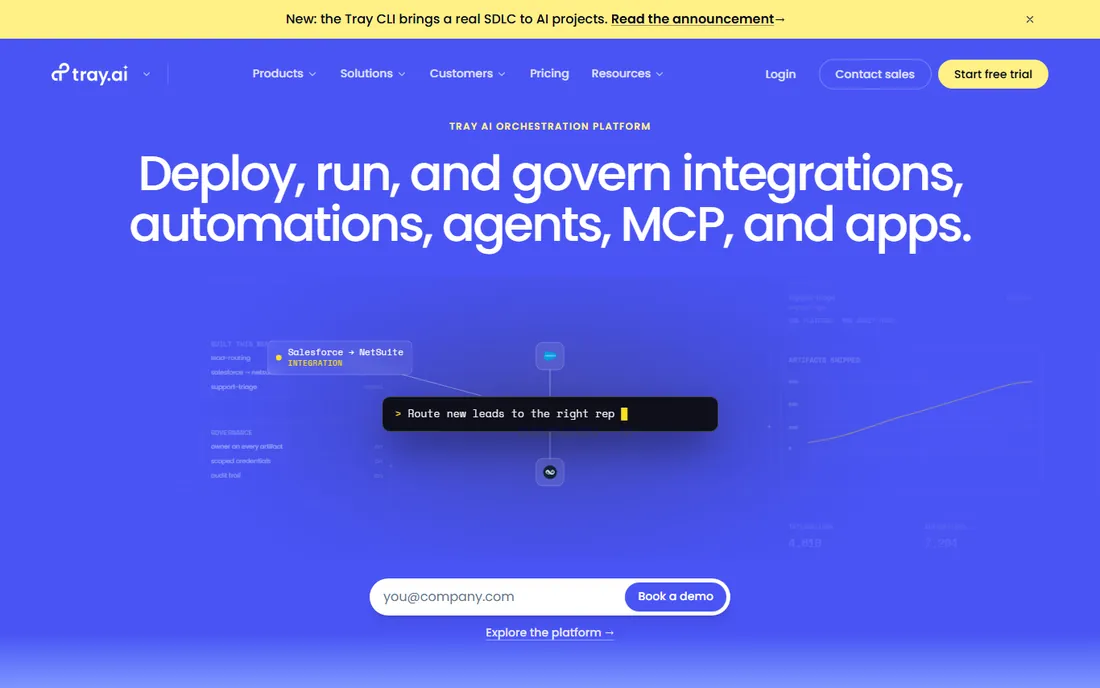
Tray.ai sits between Zapier simplicity and Workato enterprise weight. The low-code builder has pro-code escape hatches, 700-plus connectors, and the Merlin Agent Builder for AI agent workflows. Tray Embedded gives SaaS vendors a branded integration marketplace.
As of late 2026 the pricing page shows no prices for the core tiers: each routes to a demo call, and AI agent features cost extra. Budget professional services for complex rollouts. If you need more flexibility than Zapier but cannot justify Workato's price, this is the conversation to have, just have it with a clear scope.
What we like- AI-ready iPaaS with 700-plus connectors plus agent builder
- Flexible low-code builder with strong API support
- Tray Embedded for SaaS vendors
Watch out for- No public pricing for the core iPaaS
- Meters count every executed step plus AI tokens
#7
Activepieces
Best for: Teams that want open-source automation with a permissive license
Visit activepieces.com
Starting price$16 per month billed annually (Cloud Plus, 10,000 credits/month)
Free planYes (self-hosted Community Edition free under MIT license; Cloud Free: 1,000 credits/month)
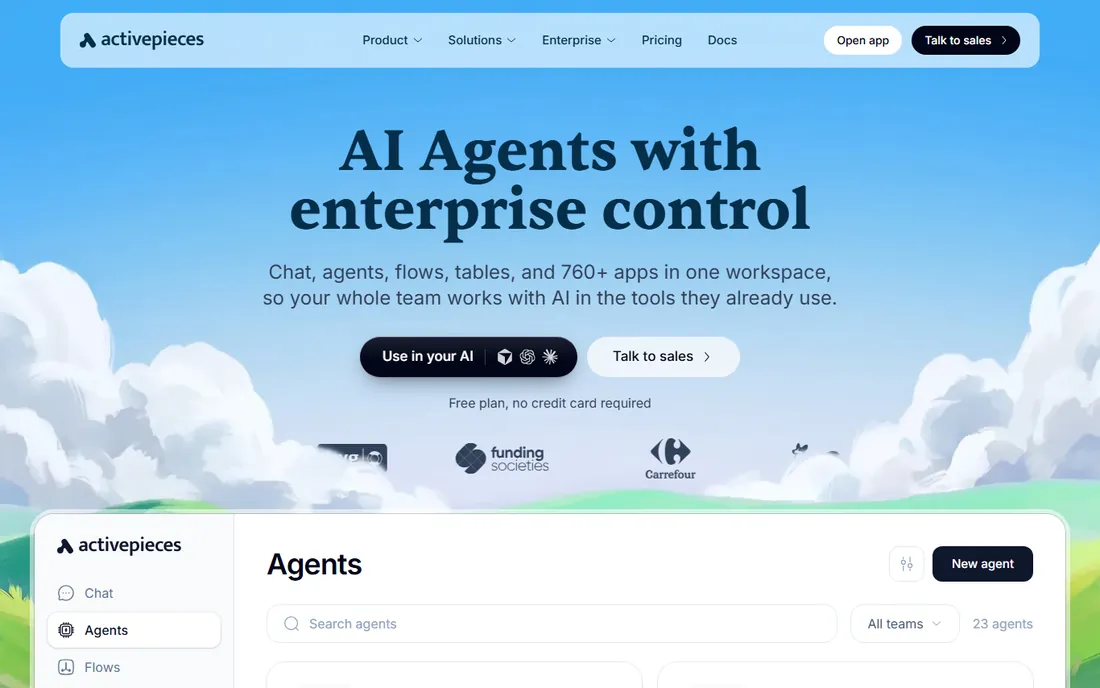
Activepieces is the friendly open-source alternative. The MIT license means you can build commercial products on it (unlike n8n's fair-code license), one credit equals one flow run regardless of step count, and the interface is cleaner and faster for non-developers to learn. Cloud Plus at $16 per month billed annually covers 10,000 credits and 5 users.
The catalog is the trade: a few hundred pieces versus n8n's thousand-plus nodes, with many community-contributed. Self-hosting runs $6 to $12 a month on a small VPS. For teams that want open source without the n8n learning curve, this is the easier on-ramp.
What we like- MIT-licensed open source, genuinely permissive for commercial use
- One credit per flow run regardless of step count
- Cleaner UI than n8n for non-developers
Watch out for- Smaller integration catalog than n8n
- White-label starts at $36,000 per year
#8
Pipedream
Best for: Developers who want real code inside automation steps
Visit pipedream.com
Starting price$29 per month billed annually (Basic, 2,000 credits/month)
Free planYes (free plan: 100 credits/month)
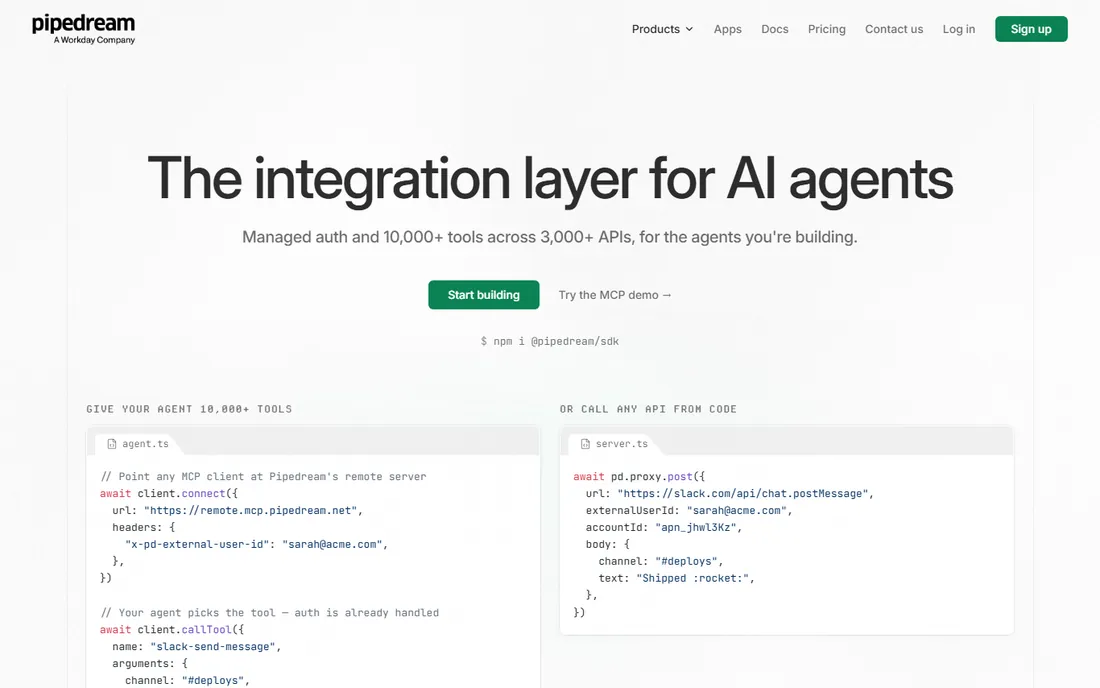
Pipedream is automation for people who write code. You write actual Node.js or Python inside steps, connect 3,000-plus prebuilt components, and pay for compute time rather than steps. The free tier is generous for development and testing, and the model shines for API-heavy and AI-agent workflows.
It is not for non-technical teams, full stop. Cheaper plans also cap objects: 3 workflows and 3 accounts on Free, 10 and 5 on Basic ($29). If your team thinks in code, the compute-based billing and real debugging beat every visual builder here.
What we like- Code-first with real Node.js and Python inside steps
- Compute-based billing, not per-step
- Generous free tier for developers
Watch out for- Assumes you can read and write code
- Cheaper plans cap workflows and connected accounts
Starting price$19.99 per month billed annually (Starter, 2,000 tasks/month)
Free planYes (free plan: 100 tasks/month, 5 automations)
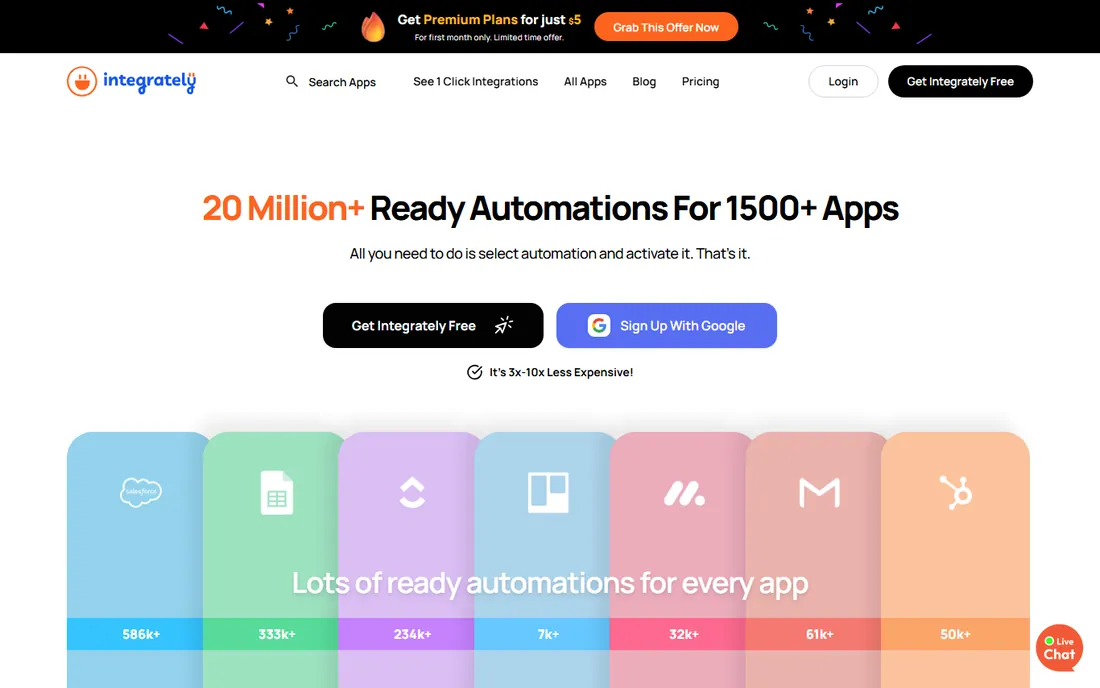
Integrately's pitch is speed: 1-click automation templates across 1,000-plus apps, with triggers that do not consume tasks. At $19.99 per month billed annually you get 2,000 tasks and 20 automations, versus Zapier's 750 tasks at the same price. Branching, webhooks and filters come from the Starter tier.
Depth is the trade. Complex multi-branch logic and niche apps are weaker than Make or Zapier. For straightforward multi-step syncs between popular SaaS tools, it is the fastest path from signup to working automation.
What we like- 1-click automations across 1,000-plus apps
- Triggers are free with generous task allowances
- Branching, webhooks and filters from Starter
Watch out for- Smaller catalog and less mature builder for complex logic
- Unlimited users need the Growth plan
#10
Albato
Best for: SMBs and mid-market teams wanting transparent transaction billing
Visit albato.com
Starting price$15 per month billed annually (Pro, 1,000 transactions/month)
Free planYes (free plan: 100 transactions/month)
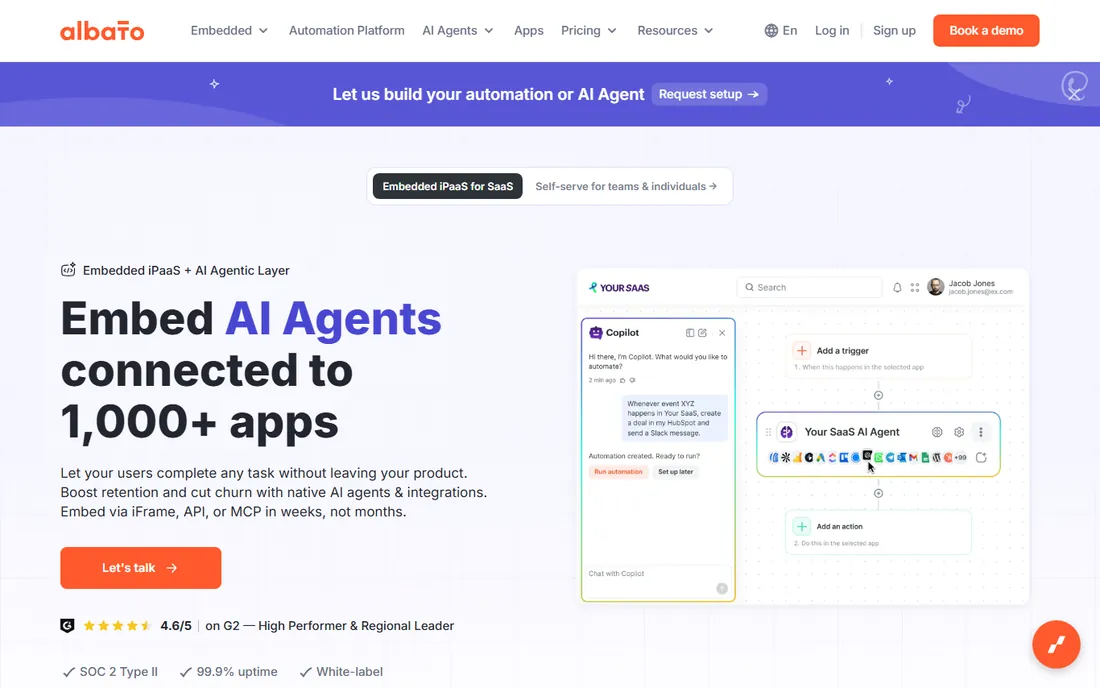
Albato keeps the pricing honest: Pro at $15 per month billed annually includes unlimited automations and steps with 1,000 transactions, and extra transactions auto-bill at about $0.033 each so nothing ever stops mid-flow. Built-in AI agents and data migration tools round out the package.
The ecosystem is younger, with fewer apps and templates than Zapier, and the free tier's 2-step cap limits real testing. For teams that want predictable transaction billing without automation or step caps, the structure is refreshingly simple.
What we like- Unlimited automations and steps on paid plans
- Built-in AI agents and data migration tools
- Automatic overage handling so automations never stop
Watch out for- Newer, smaller ecosystem than Zapier or Make
- Free plan caps automations at 2 steps
How we chose
We started with the tools teams actually evaluate: the no-code leaders, the visual value picks, the self-hosted open-source options, the developer-first platforms, and the enterprise iPaaS vendors. For each candidate we opened the vendor's own pricing page, checked the billing unit (tasks, operations, executions, credits, transactions) against documentation, and read public reviews on G2, Capterra and practitioner discussion on Reddit. Where a price could not be verified on the vendor's page we wrote "See website" rather than guessing. This category reprices often, so re-check the vendor page before you buy.
The task vs. execution billing trap
The single most expensive misunderstanding in this category is the billing unit. A task (Zapier), an operation (Make), an execution (n8n), a credit (Workato, Activepieces, Pipedream) and a transaction (Albato, Integrately) are not the same thing. A 10-step workflow that runs 1,000 times a month costs 10,000 tasks on Zapier, 10,000 operations on Make, 1,000 executions on n8n, and 1,000 transactions on Albato.
Before you compare prices, estimate your monthly volume in each vendor's unit. Count your workflows, multiply by average steps, multiply by monthly runs. Then price the tier that covers it. The cheapest sticker price often belongs to the most expensive billing unit for your workload.
How to pick without overpaying
Match the tool to the builder, not just the budget. Non-technical teams should shortlist Zapier, Make or Integrately and trial all three on a real workflow. Technical teams should compare n8n (self-hosted free) against Pipedream (code-first cloud) on total cost including ops time. Microsoft shops should check what Power Automate already covers before buying anything else.
Then check the gates that matter to you: premium connectors, SSO, AI features and embedded options all sit on higher tiers or add-ons across this list. And watch the free tier limits: step caps, workflow caps and polling intervals are designed to push you to paid. Trial on your actual volume, not the vendor's demo data.
Frequently asked questions
What is the cheapest workflow automation software?
n8n and Activepieces are free if you self-host (server costs run $5 to $15 a month). Among cloud tools, Make at $9 per month billed annually gives 10,000 operations, and Albato at $15 gives 1,000 transactions with unlimited steps. Zapier's free plan covers 100 tasks a month.
Zapier vs. Make: which should I choose?
Choose Zapier if you need the widest app catalog and the fastest setup for non-technical users. Choose Make if you want visual building with real branching at a fraction of the cost: $9 per month for 10,000 operations versus $19.99 for 750 tasks on Zapier. Heavy multi-step users almost always save with Make.
What is the difference between tasks, operations and executions?
A task (Zapier) is one successful action step. An operation (Make) is one module action. An execution (n8n) is one full workflow run regardless of step count. So a 10-step workflow run once costs 10 tasks, 10 operations, or 1 execution. This is why n8n is dramatically cheaper for complex workflows at scale.
Do I need the enterprise iPaaS tools?
Only at enterprise scale or with enterprise systems. Workato and Tray.ai make sense when you need SAP, Workday or NetSuite connectors, governance, SLAs and audit trails. For syncing SaaS apps, Zapier, Make, n8n or Activepieces do the job at a fraction of the cost and procurement effort.
Can I self-host workflow automation?
Yes. n8n's Community Edition and Activepieces' Community Edition are both free to self-host, with unlimited executions on n8n and unlimited runs on Activepieces. Budget $5 to $15 a month for a VPS plus your maintenance time. Note the license difference: Activepieces is MIT (permissive), n8n is fair-code (restricts commercial hosting).
Sources we checked (12)
- https://zapier.com/pricing
- https://www.make.com/pricing
- https://n8n.io/pricing/
- https://www.workato.com/pricing
- https://www.microsoft.com/en-us/power-platform/products/power-automate
- https://tray.ai/pricing/
- https://www.activepieces.com/pricing
- https://pipedream.com/pricing/
- https://integrately.com/pricing/
- https://www.albato.com/pricing/
- https://www.g2.com/categories/workflow-automation
- https://www.capterra.com/workflow-automation-software/
Is your product missing or out of date?
We review this list regularly. Vendors can request a listing, send updated pricing or ask about featured placement.

Shihab Mia · Founder, Rankite
Shihab has spent more than a decade helping SaaS and e-commerce brands grow through search. He writes Rankite's software buying guides from pricing pages, documentation and public user reviews. More about Shihab.