How we make this list: we compare pricing pages, product documentation and public user reviews. Rankite is independent; if a vendor ever pays for a featured spot, that listing is clearly labeled Partner.
Key takeaways
- NetSuite, Acumatica, SAP Business One, and Epicor Prophet 21 are the full ERP options for distributors that need inventory, warehousing, and financials in one system.
- QuickBooks Enterprise and Sage Intacct fit smaller distributors that need strong accounting first and lighter operational depth.
- DDI System Inform and Blue Link ERP are purpose-built for wholesale distributors, with industry workflows that generic ERPs only add through customization.
- Fishbowl is the inventory-first pick for distributors already committed to QuickBooks or Xero that need warehouse control without a full ERP swap.
- None of the ERP vendors publish complete pricing; expect quote-based annual contracts, and ask about per-user fees, implementation, and module add-ons before comparing.
A distributor in Ohio takes an order by phone, checks stock in a spreadsheet, emails the warehouse, then re-enters everything into the accounting system at the end of the day. By Friday, nobody trusts the inventory numbers and the accountant is reconciling three versions of the same shipment. This is the exact problem wholesale distribution accounting software exists to solve: one system where the order, the inventory movement, and the ledger entry are the same event. The nine platforms below cover the full range, from enterprise ERP suites to focused tools for smaller distributors.
Quick comparison
| Tool | Best for | Starting price | Free plan |
|---|
 NetSuite NetSuite | growing distributors needing a full cloud ERP suite | See website | No |
 Acumatica Acumatica | mid-size distributors wanting flexible licensing | See website | No |
 SAP Business One SAP Business One | small to mid-size distributors in the SAP orbit | See website | No |
 Epicor Prophet 21 Epicor Prophet 21 | distributors needing deep distribution workflows | See website | No |
 QuickBooks Enterprise QuickBooks Enterprise | smaller distributors staying in the QuickBooks world | See website | No |
 Sage Intacct Sage Intacct | finance-led distributors needing strong accounting | See website | No |
 DDI System Inform DDI System Inform | wholesale distributors wanting industry-specific ERP | See website | No |
 Blue Link ERP Blue Link ERP | small to mid-size distributors needing affordable ERP | See website | No |
 Fishbowl Fishbowl | QuickBooks and Xero users needing inventory and warehouse control | See website | No |
Is your product missing or out of date?
We review this list regularly. Vendors can request a listing, send updated pricing or ask about featured placement.
The best wholesale distribution accounting software
#1
NetSuite
Best for: growing distributors needing a full cloud ERP suite
Visit netsuite.com
Starting priceSee website
Free planNo
NetSuite is the cloud ERP most growing distributors evaluate first, and for good reason. Financials, inventory, warehouse management, and order processing live in one database, so a sales order automatically reserves stock, posts to the ledger, and feeds purchasing forecasts. Multi-location distributors get real-time visibility without month-end spreadsheet archaeology. The SuiteApps marketplace adds distribution-specific extensions for EDI, 3PL, and advanced warehousing.
The cost conversation is where buyers hesitate. NetSuite prices by quote, with a base platform fee plus per-user charges, and implementation routinely involves partner consultants. Reviewers say the system is powerful but rarely cheap, and smaller distributors sometimes find they are paying for breadth they do not use yet. It fits best when the business has outgrown entry-level accounting and needs one system to scale on.
What we like- Unified financials, inventory, and order management
- Large partner ecosystem for distribution add-ons
- True multi-subsidiary support
Watch out for- Quote-only pricing with implementation costs that add up
- Customization often needs consultants
Starting priceSee website
Free planNo
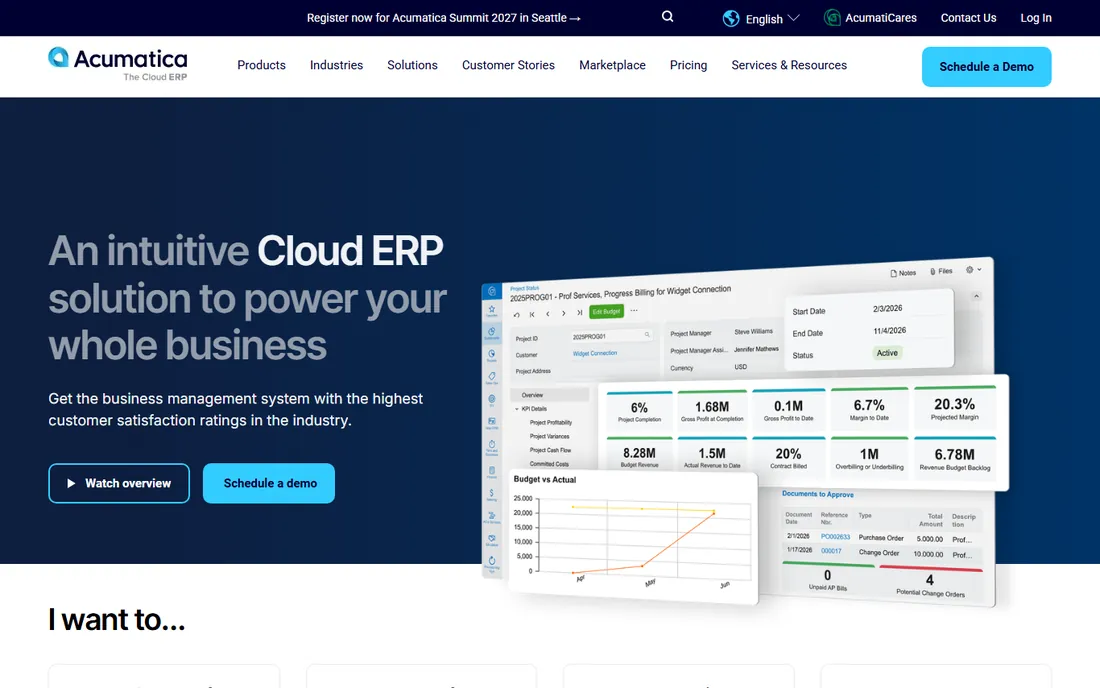
Acumatica appeals to distributors that dislike per-user pricing. Its licensing is based on resource consumption, so adding warehouse staff who only scan barcodes does not multiply the bill the way per-seat models do. The distribution edition covers inventory, order management, purchasing, and CRM, and reviewers praise the modern interface compared with older ERP systems.
It is still an ERP implementation, not a quick signup. Buyers work through reseller partners, and the quality of that partner shapes the outcome more than the software itself. The ecosystem of add-ons is smaller than NetSuite's, so unusual requirements may need custom development. For mid-size distributors that want cloud ERP without per-seat penalties, Acumatica is a serious alternative.
What we like- Consumption-based licensing instead of per-user fees
- Strong distribution edition with warehouse features
- Open API for integrations
Watch out for- Implementation still requires a partner
- Smaller marketplace than NetSuite
#3
SAP Business One
Best for: small to mid-size distributors in the SAP orbit
Visit sap.com
Starting priceSee website
Free planNo

SAP Business One gives smaller distributors the SAP name with accounting depth that auditors respect. It handles multi-currency, landed costs, and batch tracking well, which matters for distributors importing goods. Companies that plan to grow into larger SAP systems later like the upgrade path, since data and processes can migrate upward.
Reviewers describe the user experience as functional rather than delightful, and heavy customization tends to require certified partners. Pricing is quote-based through those partners, and total cost depends heavily on user count and modules. It suits distributors that value financial rigor and the SAP ecosystem over modern usability.
What we like- Respected financial controls and audit trails
- Broad international and multi-currency support
- Large partner network
Watch out for- Interface feels dated next to cloud-native rivals
- Customization and upgrades need partner help
#4
Epicor Prophet 21
Best for: distributors needing deep distribution workflows
Visit epicor.com
Starting priceSee website
Free planNo
Prophet 21 is one of the few ERPs designed from the ground up for distributors rather than adapted from manufacturing or generic accounting. It handles the realities of the trade: complex pricing matrices, rebates, lot and serial tracking, and vendor-managed inventory. Distributors that live on thin margins appreciate how precisely it tracks cost and profitability per order.
That depth comes with weight. Implementations are measured in months, and the price reflects an enterprise product. Reviewers say the payoff is real for distributors with complex operations, but smaller companies find it more system than they need. If distribution is all you do and you plan to stay in it, Prophet 21 is purpose-built for the job.
What we like- Built specifically for wholesale distribution processes
- Strong inventory and supply chain depth
- Good EDI and vendor management
Watch out for- Implementation is a major project
- Pricing is enterprise-grade
Starting priceSee website
Free planNo
QuickBooks Enterprise is the step up for distributors that have outgrown QuickBooks Online but are not ready for ERP. It raises the limits on users, list items, and data size, and adds features like advanced inventory, barcode scanning, and enhanced reporting. For a distributor doing straightforward buy-sell with a few locations, it can carry the business for years.
Reviewers are clear about its ceiling. It remains an accounting system with inventory attached, not an ERP with deep warehouse or manufacturing workflows. Companies with complex distribution needs eventually hit walls around automation and multi-entity operations. It is the pragmatic choice when the accounting team knows QuickBooks and the operational complexity is moderate.
What we like- Familiar QuickBooks accounting with more capacity
- Advanced inventory features like bin tracking
- Lower cost than full ERP
Watch out for- Still accounting-first, not a true ERP
- Multi-location depth lags dedicated systems
#6
Sage Intacct
Best for: finance-led distributors needing strong accounting
Visit sage.com
Starting priceSee website
Free planNo
Sage Intacct is the accountant's favorite on this list. Its dimensional chart of accounts lets finance teams slice profitability by location, product line, or customer without contorting the ledger, and multi-entity consolidation is genuinely strong. Distributors with several warehouses or subsidiaries get clean financials without manual consolidation work.
It is less of a distribution operations system out of the box. Inventory and order management exist but reviewers often pair Intacct with dedicated inventory or 3PL tools for the warehouse side. Pricing is quote-based and aimed at mid-market budgets. Choose it when the finance function leads the buying decision and operational tools will integrate around it.
What we like- Excellent multi-entity and dimensional accounting
- Strong financial reporting
- True cloud architecture
Watch out for- Distribution operations need add-ons or integrations
- Quote-based pricing
#7
DDI System Inform
Best for: wholesale distributors wanting industry-specific ERP
Visit ddisystem.com
Starting priceSee website
Free planNo
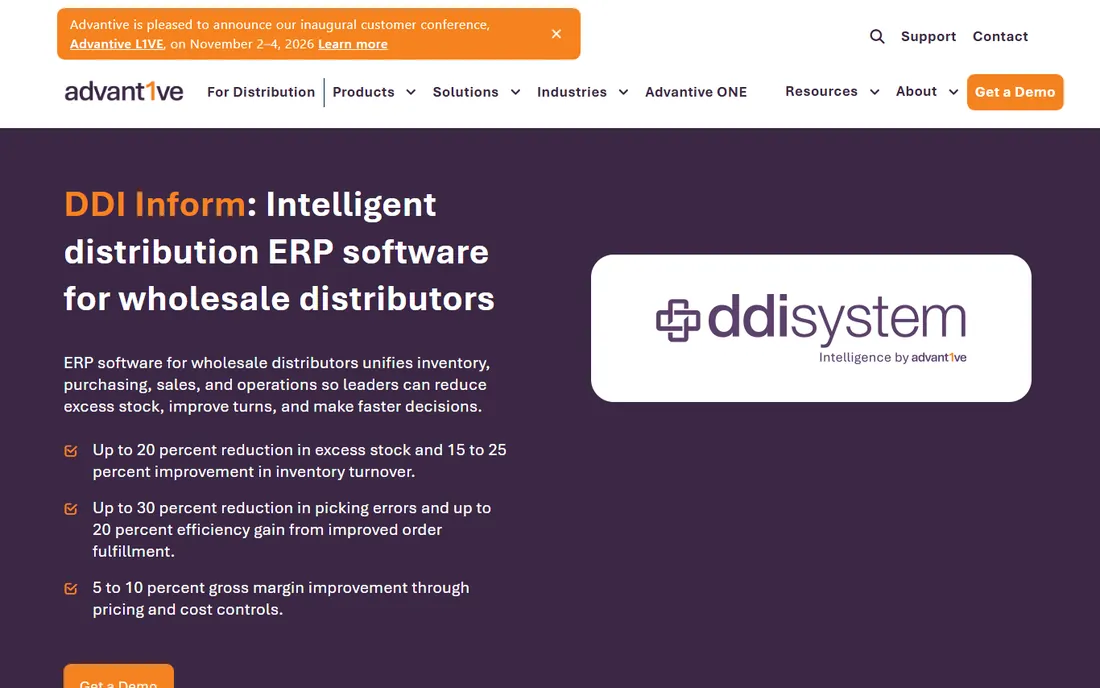
DDI System's Inform ERP is built exclusively for wholesale distributors, and it shows in the details. Pricing contracts, customer-specific catalogs, and rebate tracking work the way distributors actually negotiate, not as custom fields bolted onto a generic system. Reviewers mention responsive support from a team that knows the distribution business.
The tradeoff is vendor size. DDI is a focused company, now part of Advantive, with a smaller partner ecosystem than the giants. Integrations beyond the core distribution workflow may need more effort, and hiring staff who already know the system is harder. For a distributor that wants software shaped like its business on day one, that specialization is the selling point.
What we like- Workflows designed around wholesale distribution
- Strong pricing and rebate management
- Personal support from a focused vendor
Watch out for- Smaller vendor with a narrower ecosystem
- Less name recognition for hiring
Starting priceSee website
Free planNo

Blue Link ERP targets the distributor that finds NetSuite and Epicor too expensive and QuickBooks too thin. It bundles accounting, inventory management, order processing, warehouse management, and CRM in one cloud system, with customization available for industry-specific needs. Reviewers from small distributors praise the personal support that comes from a smaller, owner-managed vendor.
Geography is a hard limit: Blue Link serves businesses in North America and the Caribbean. The feature set is also narrower than enterprise ERP, so very complex operations may outgrow it. For an independent distributor that wants one affordable system covering the core workflows, it hits a gap the big vendors leave open.
What we like- All-in-one ERP aimed at smaller distributors
- Accounting plus inventory in one package
- More accessible pricing than tier-one ERP
Watch out for- Serves North America and the Caribbean only
- Smaller feature depth than enterprise suites
Starting priceSee website
Free planNo
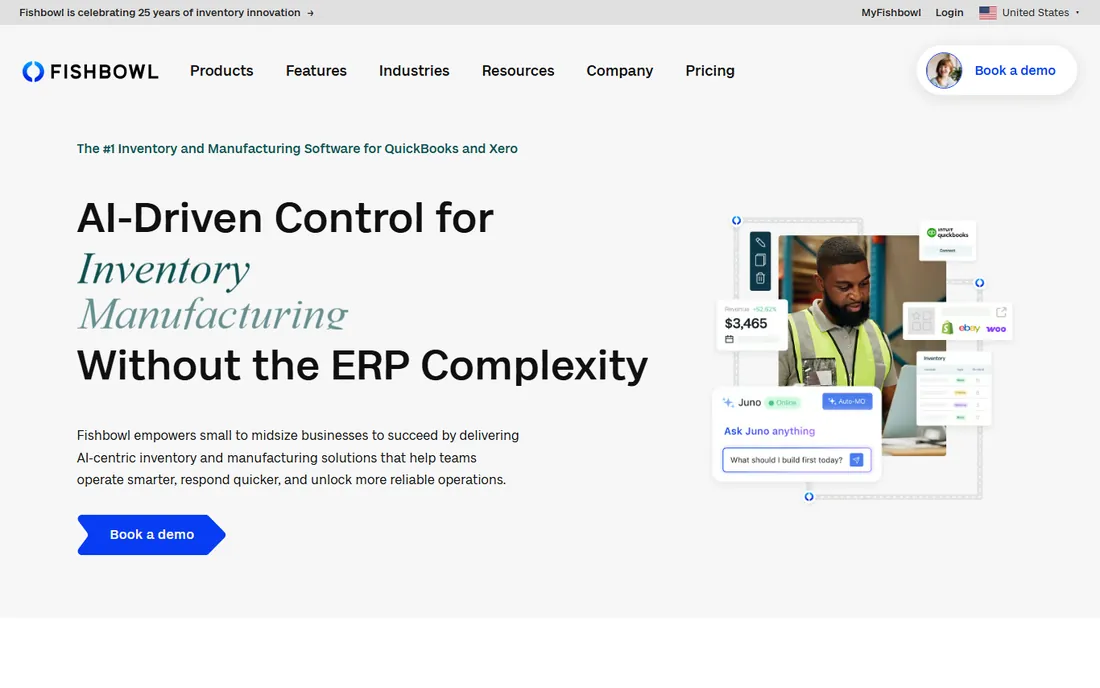
Fishbowl takes a different approach: instead of replacing the accounting system, it becomes the inventory and warehouse brain alongside QuickBooks or Xero. It adds multi-location tracking, barcode scanning, order fulfillment, and light manufacturing, then syncs the financial postings back. Distributors that like their accounting setup but need real warehouse control find this combination practical.
Reviewers note that you are managing two systems, not one, and the sync between them needs attention during setup. It also means reporting across inventory and finance requires both sides to be configured well. For distributors committed to QuickBooks that need operational depth without an ERP migration, Fishbowl is the established answer.
What we like- Deep inventory features that sit on top of QuickBooks or Xero
- Barcode, multi-warehouse, and manufacturing support
- One-time and subscription options historically
Watch out for- Accounting stays in QuickBooks, so it is not a full ERP
- Implementation help often needed
How we chose
We focused on systems that distributors actually buy for the combined job of accounting and distribution operations: inventory accuracy, order management, purchasing, warehousing, and financial reporting in connected workflows. Candidates came from ERP analyst coverage, distributor trade discussions, and review sites including G2, Capterra, and Software Advice. We verified that each product exists today under its current name and that its homepage resolves to the vendor's real site. DDI System now operates as part of Advantive and Cartegraph-style consolidation continues across the market, so we checked for acquisitions that would change what buyers get. Pricing for ERP in this category is almost entirely quote-based, so we report "See website" rather than repeating third-party estimates. We did not test the software hands-on.
Implementation is the real price tag
ERP buyers consistently underestimate the project around the software. For NetSuite, Acumatica, SAP Business One, and Epicor, implementation through a partner is the norm, and reviewers describe timelines of three to twelve months depending on data cleanliness and customization. Ask every vendor for a fixed-scope implementation estimate, not just the subscription quote, and find out what data migration actually includes. The distributors that report the smoothest go-lives are the ones that cleaned their item masters and customer records before the project started, not during it.
Contract structure matters as much as the monthly number. Per-user pricing punishes companies with many warehouse scanners and part-time users, which is one reason Acumatica's consumption model gets attention. Ask how users are counted, whether read-only or shop-floor users need full licenses, and what each additional module costs. Also confirm the renewal terms: several reviewers describe first-year discounts that disappear at renewal. Get the year-two price in writing before you sign year one.
Red flags we kept seeing in reviews
The most common regret is buying for the company you hope to become instead of the one you are. A 20-person distributor does not need the same system as a 500-person one, and reviewers who overspent describe years of paying for unused modules. Start from your actual transaction volume, location count, and EDI requirements. A second red flag is customization without discipline. Every custom workflow is a future upgrade cost, so push back on custom development for processes the standard system handles adequately.
Data migration deserves its own warning. Distributors accumulate years of messy item records, duplicate customers, and inconsistent units of measure. Vendors quote migration as a line item, but reviewers say the real work is internal cleanup that no vendor can do for you. Finally, check the vendor's health and direction. Consolidation is active in this market, and a product that gets acquired can change pricing or roadmap. Ask about the product's investment future directly, and weigh the answer.
Frequently asked questions
Should a small distributor buy ERP or stick with QuickBooks?
If inventory is accurate, orders flow cleanly, and month-end closes without heroics, QuickBooks Enterprise plus a tool like Fishbowl can be enough. Consider ERP when you add locations, need EDI with big customers, or spend real money reconciling systems every month.
How long does ERP implementation take for a distributor?
Reviewers report three to six months for mid-market systems like NetSuite or Acumatica with a good partner, and six to twelve months for deeper platforms like Epicor Prophet 21. Data cleanup is usually the longest pole, not software configuration.
What does wholesale distribution ERP typically cost?
Vendors price by quote based on users, modules, and entities. Reviewers describe wide ranges, and third-party estimates vary too much to repeat reliably. Get at least three quotes, and always compare the full first-year cost including implementation, not just the subscription.
Do I need EDI capability?
If you sell to large retailers or government buyers, yes, and confirm it early. EDI requirements can force system choices late in a project. Prophet 21, NetSuite, and Acumatica all have established EDI paths; smaller systems may need third-party add-ons.
Can these systems handle lot tracking and expiration dates?
Most on this list can. Food, pharma, and chemical distributors should verify lot, serial, and expiry workflows specifically during demos, since depth varies. Blue Link, Prophet 21, and Fishbowl all get mentioned positively for this by reviewers in regulated distribution.
What happens to my data if I switch systems later?
Ask before signing. Confirm you can export master data and full transaction history in usable formats, and find out whether the vendor charges for extraction assistance. Cloud ERP contracts sometimes make leaving harder than joining.
Sources we checked (9)
- https://netsuite.com/
- https://www.acumatica.com/
- https://www.sap.com/
- https://epicor.com/
- https://quickbooks.intuit.com/
- https://sage.com/
- https://www.ddisystem.com/
- https://bluelinkerp.com/
- https://fishbowlinventory.com/
Is your product missing or out of date?
We review this list regularly. Vendors can request a listing, send updated pricing or ask about featured placement.

Shihab Mia · Founder, Rankite
Shihab has spent more than a decade helping SaaS and e-commerce brands grow through search. He writes Rankite's software buying guides from pricing pages, documentation and public user reviews. More about Shihab.