How we make this list: we compare pricing pages, product documentation and public user reviews. Rankite is independent; if a vendor ever pays for a featured spot, that listing is clearly labeled Partner.
Key takeaways
- Lakera and Enkrypt AI defend AI apps at runtime against prompt injection, jailbreaks and data leaks, with Lakera claiming sub-50ms detection latency.
- HiddenLayer and Giskard focus on testing before deployment: HiddenLayer scans third-party models for hidden risks, while Giskard offers an open-source red teaming library.
- Prompt Security and Prisma AIRS govern AI use across the company, from employees pasting data into public chatbots to agents calling internal tools.
- Trustible and Cranium AI sit on the governance side, tracking every AI model and vendor so audits and regulators get real evidence.
- Every enterprise platform here is priced by quote; budget for a sales-led process and ask for a trial against your own threat scenarios.
Quick comparison
| Tool | Best for | Starting price | Free plan |
|---|
 Lakera Lakera | Runtime prompt injection defense for GenAI apps | See website | No |
 Prompt Security Prompt Security | Governing employee use of public AI tools | See website | No |
 Palo Alto Networks Prisma AIRS Palo Alto Networks Prisma AIRS | Securing the full AI lifecycle in one platform | See website | No |
 HiddenLayer HiddenLayer | Model scanning and lifecycle AI security | See website | No |
 Cranium AI Cranium AI | AI discovery plus governance in one loop | See website | No |
 Trustible Trustible | AI governance, risk and compliance evidence | See website | No |
 Enkrypt AI Enkrypt AI | Continuous red teaming and model safety scoring | See website | No |
 Giskard Giskard | Developer-led AI red teaming and testing | See website | Yes (open-source library) |
Is your product missing or out of date?
We review this list regularly. Vendors can request a listing, send updated pricing or ask about featured placement.
The best LLM security software
#1
Lakera
Best for: Runtime prompt injection defense for GenAI apps
Visit lakera.ai
Starting priceSee website
Free planNo
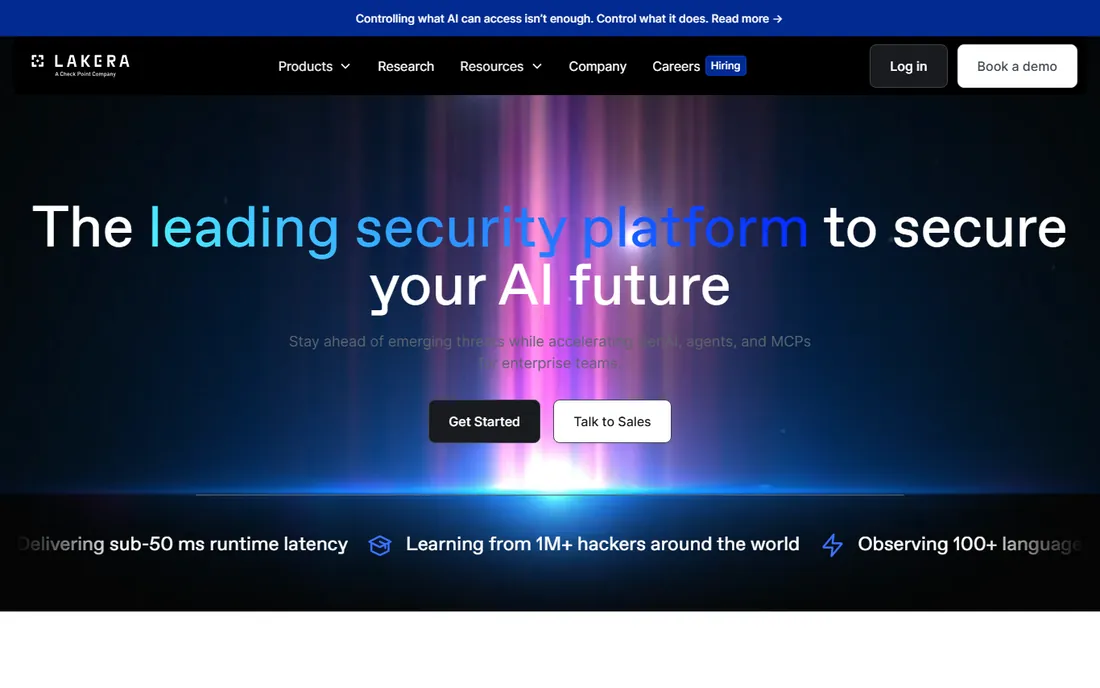
Lakera builds guard models that sit in front of your LLM and inspect prompts and responses in real time. The claim that matters: detection in under 50 milliseconds, fast enough to run on every request without users noticing. It blocks prompt injections, jailbreaks and data leakage before they reach your application, and it learns from an attack dataset built with over a million hackers.
The platform targets enterprise teams shipping GenAI products and agents, with customers including Dropbox and Pearson named on its site. Policies can be tuned centrally without changing application code, and it works across models and modalities, covering chatbots and voice bots alike.
Lakera does one job and does it well. It will not inventory your shadow AI, run your compliance audits or red team your models. Pair it with a testing tool before launch and a governance platform for the paperwork, and you get a complete picture.
What we like- Purpose-built guard models with sub-50ms latency
- Trained on data from 1M+ hackers
- Supports 100+ languages in real time
Watch out for- Pricing is not public
- Runtime defense only, no governance features
Starting priceSee website
Free planNo
Prompt Security started with a simple problem: employees paste source code, customer lists and financials into public chatbots every day. Its platform discovers which AI tools are in use across the company, inspects prompts in real time and blocks sensitive data from leaving. That covers the two biggest enterprise AI risks: shadow AI adoption and accidental data exposure.
The company also publishes open-source tools like ps-fuzz, which tests system prompts against sixteen attack types across sixteen providers, and ClawSec, a security skill suite for AI agents. Its research blog and PromptCast podcast are genuinely useful for security teams trying to understand agentic attack surfaces.
Note the ownership change: Prompt Security is now part of SentinelOne, which its site brands as "From SentinelOne." The product continues under its own name, but expect integration with SentinelOne's wider security platform over time.
What we like- Visibility into prompts employees send to public AI apps
- Flags secrets and sensitive data in real time
- Ships open-source security tools
Watch out for- Now part of SentinelOne, so the standalone roadmap may shift
- Best for enterprises, not solo developers
#3
Palo Alto Networks Prisma AIRS
Best for: Securing the full AI lifecycle in one platform
Visit protectai.com
Starting priceSee website
Free planNo
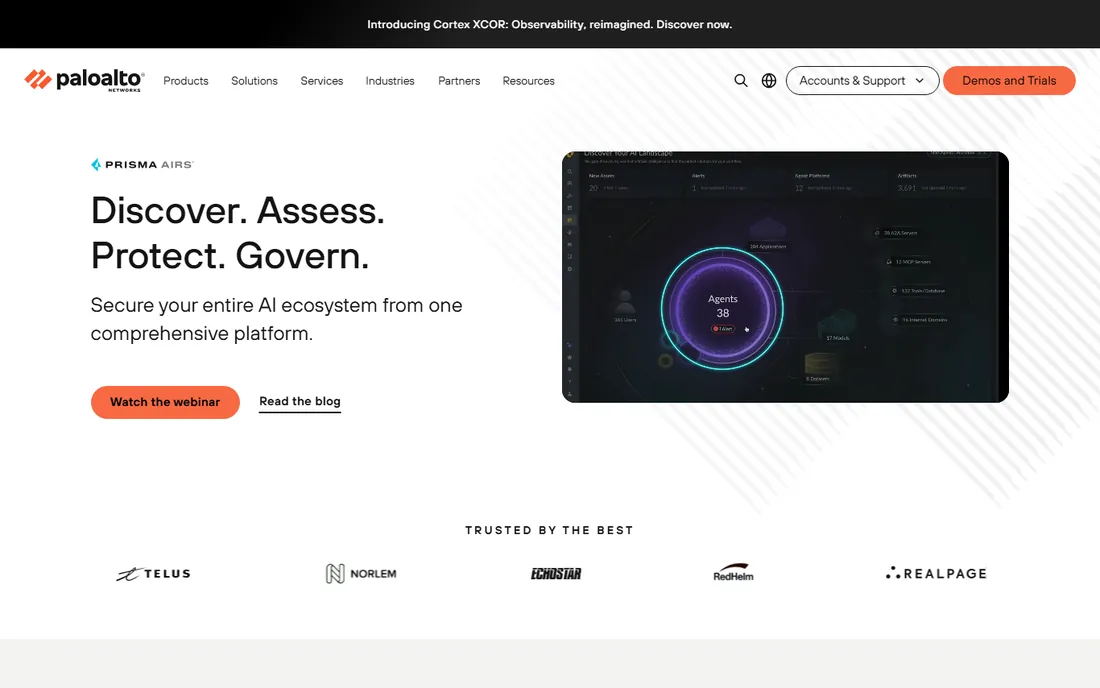
Protect AI built one of the first platforms for securing AI models and applications, then Palo Alto Networks acquired it and folded the technology into Prisma AIRS. The old protectai.com domain now serves the Prisma AIRS product page, so if you go looking for the standalone Protect AI site, this is where you land.
The platform covers the whole lifecycle: discovering AI apps, agents and models in the environment, scanning third-party models for tampering and malicious code, red teaming applications with simulated attacks, and enforcing runtime guardrails on live traffic. An AI gateway acts as the control plane for every AI interaction.
For Palo Alto Networks customers, this is the obvious pick: it slots into existing procurement and support relationships. New buyers should budget for enterprise sales cycles and compare the per-module pricing against point tools before committing.
What we like- Covers discovery, red teaming, runtime defense and posture in one suite
- Backed by Palo Alto Networks' distribution and support
- Model scanning for tampered models
Watch out for- Enterprise pricing and sales process
- The Protect AI branding is being retired
Starting priceSee website
Free planNo
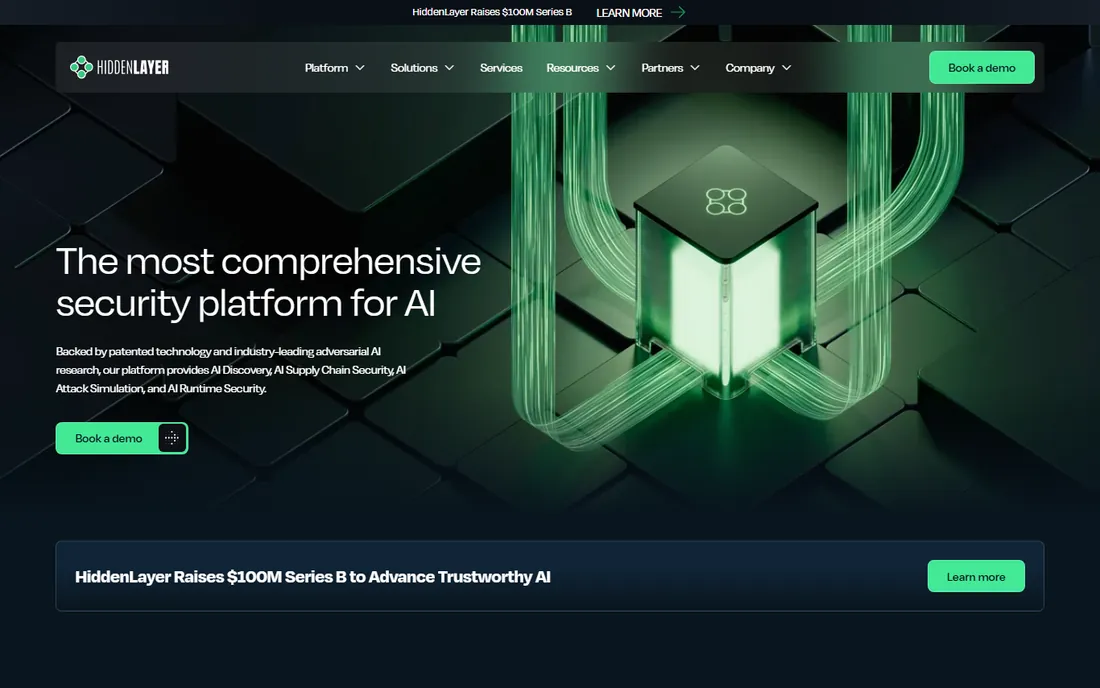
HiddenLayer's core strength is model security: scanning third-party and open-source models for hidden risks before they enter your pipeline. A poisoned model is one of the hardest attacks to catch, and it happens before any prompt is ever sent. From there the platform extends to red teaming, runtime guardrails and protection for agentic systems and MCP servers.
The company positions itself as a full-lifecycle platform covering agentic, generative and predictive AI. It cites a 75% reduction in exposure to AI exploits and more than 50 CVEs disclosed through its security research, which suggests the research team is finding real vulnerabilities in the wild.
HiddenLayer fits enterprises with serious AI supply chains: teams pulling open-source models, fine-tuning in-house and deploying agents that act autonomously. Smaller teams will find the sales process and platform scope heavier than they need.
What we like- Detects tampering in third-party and open-source models
- Covers the full AI lifecycle from build to runtime
- 30+ issued patents in AI security
Watch out for- Enterprise focus with no public pricing
- Platform breadth means longer onboarding
#5
Cranium AI
Best for: AI discovery plus governance in one loop
Visit cranium.ai
Starting priceSee website
Free planNo
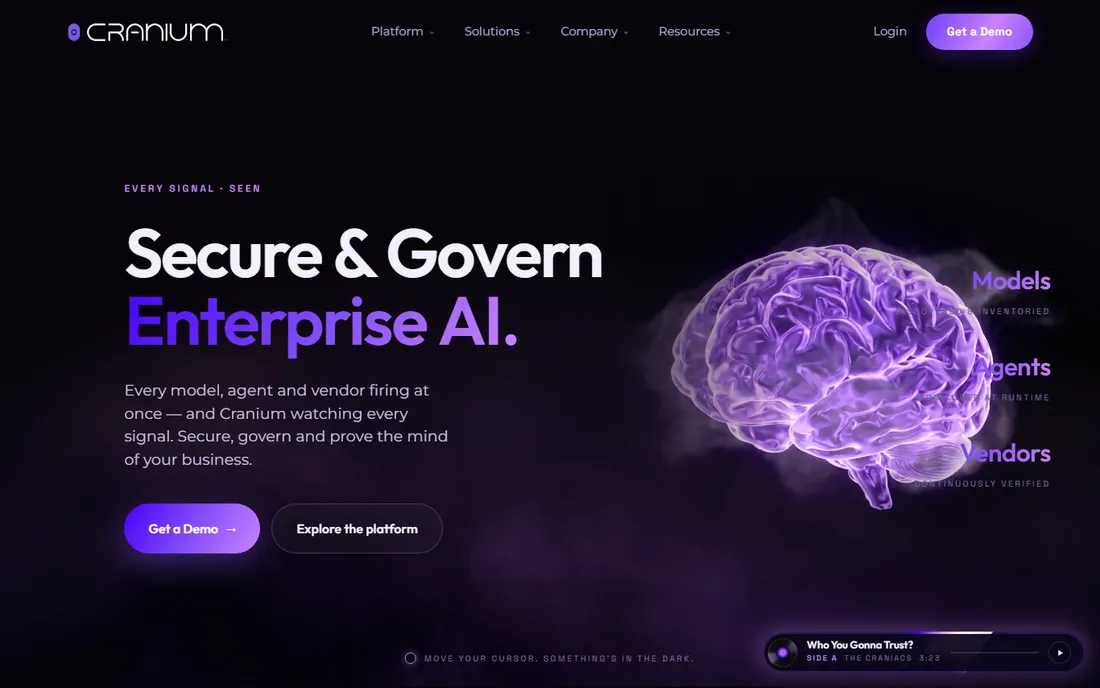
Cranium organizes its platform as the "AI Trust Loop": discover every model, agent and vendor, observe their behavior and cost, govern them against policy, secure them with adversarial testing, then prove compliance with audit-ready evidence. The loop runs continuously, so a new model deployment re-triggers discovery and testing automatically.
The governance side is genuinely useful: controls map to NIST AI RMF, the EU AI Act and internal standards, and the platform generates Cranium AI Cards as shareable trust evidence for customers and regulators. The red teaming module stress-tests models before and after deployment.
Cranium is a good fit for companies that need security and compliance in one purchase rather than two. Named a Gartner Cool Vendor for AI cybersecurity and governance in 2025, it has the analyst validation procurement teams look for. Ask for a demo against your own agent inventory to judge the discovery depth.
What we like- One platform covering discovery, observability, governance and red teaming
- Maps controls to NIST AI RMF and the EU AI Act
- Strong analyst recognition
Watch out for- Pricing is quote-based
- Broad scope means depth varies by module
Starting priceSee website
Free planNo
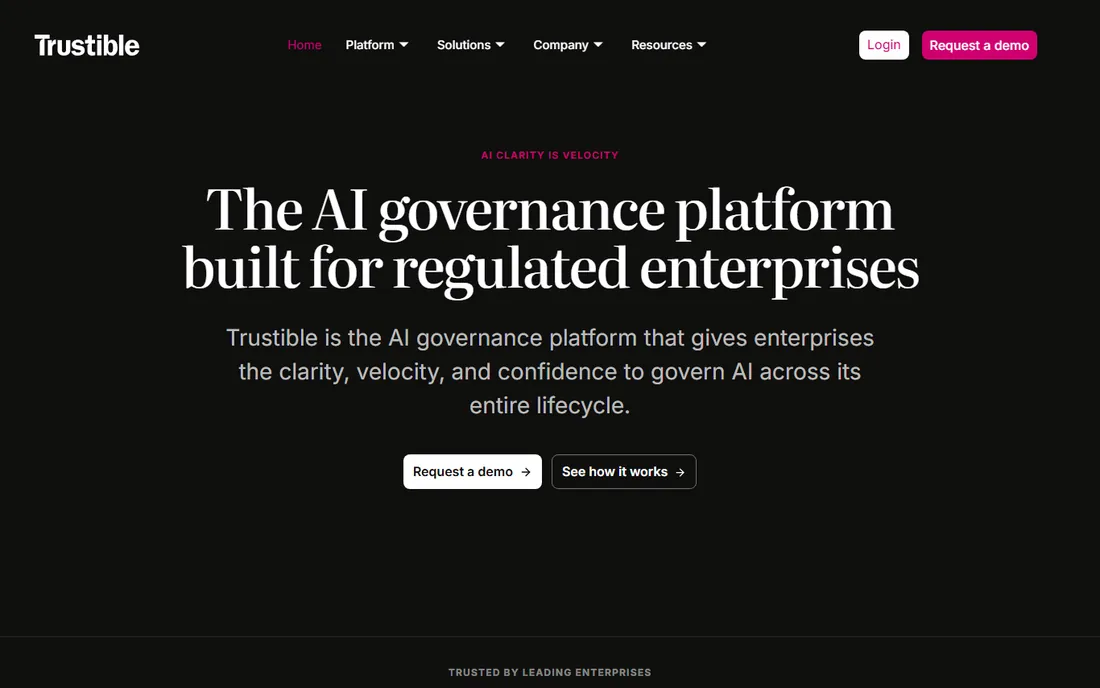
Trustible (previously known as CalypsoAI) is the governance specialist on this list. It centralizes AI intake, risk scoring, vendor reviews and regulatory mapping in one system of record. Low-risk use cases get auto-approved in minutes; high-risk ones get full review workflows. Controls map to the EU AI Act, NIST AI RMF and ISO 42001, so evidence is ready when auditors ask.
The platform claims 10x faster AI intake and 60% shorter cycle times, backed by customer stories from regulated industries like defense and healthcare. Implementation follows a 30-60-90 day plan with named advisors, which tells you this is a program, not a plug-in.
Buy Trustible when the problem is oversight: too many AI projects, unclear ownership, scattered documentation. It pairs well with a runtime defense tool like Lakera, which handles the attacks while Trustible handles the auditors.
What we like- Risk-based intake routes AI use cases automatically
- Audit-ready evidence generated as work happens
- Mentioned in the 2026 Gartner Magic Quadrant for AI Governance
Watch out for- Governance-focused, not a runtime security tool
- Implementation takes 30 to 90 days
Starting priceSee website
Free planNo
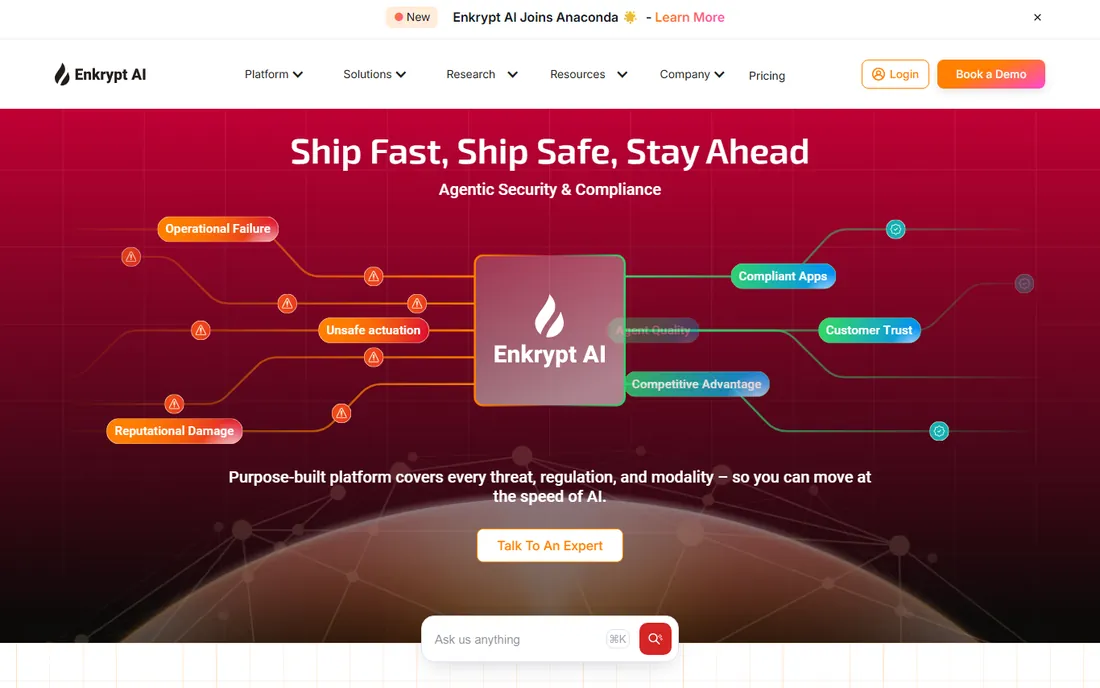
Enkrypt AI's pitch is speed: ship AI fast without shipping it unsafe. Its platform runs continuous red teaming with dynamic attacks tailored to your use case, catching security, safety and brand risks that static tests miss. Real-time guardrails block threats in production and learn from every prompt.
The standout feature is the industry's first LLM Safety Leaderboard, which benchmarks over 200 models with continuous red teaming. That helps teams choose a base model with evidence instead of vibes, and it doubles as a differentiator when procurement asks how you evaluated model risk.
Enkrypt AI covers detect, remove, monitor and comply in one platform, with Gartner Cool Vendor recognition in AI security for 2025. It suits teams that want red teaming and guardrails from one vendor and are comfortable buying from a newer name.
What we like- Continuous red teaming that adapts to your use case
- LLM Safety Leaderboard benchmarks 200+ models
- Compliance guardrails translate policy into protection
Watch out for- Newer vendor with less enterprise track record
- Pricing not published
Starting priceSee website
Free planYes (open-source library)
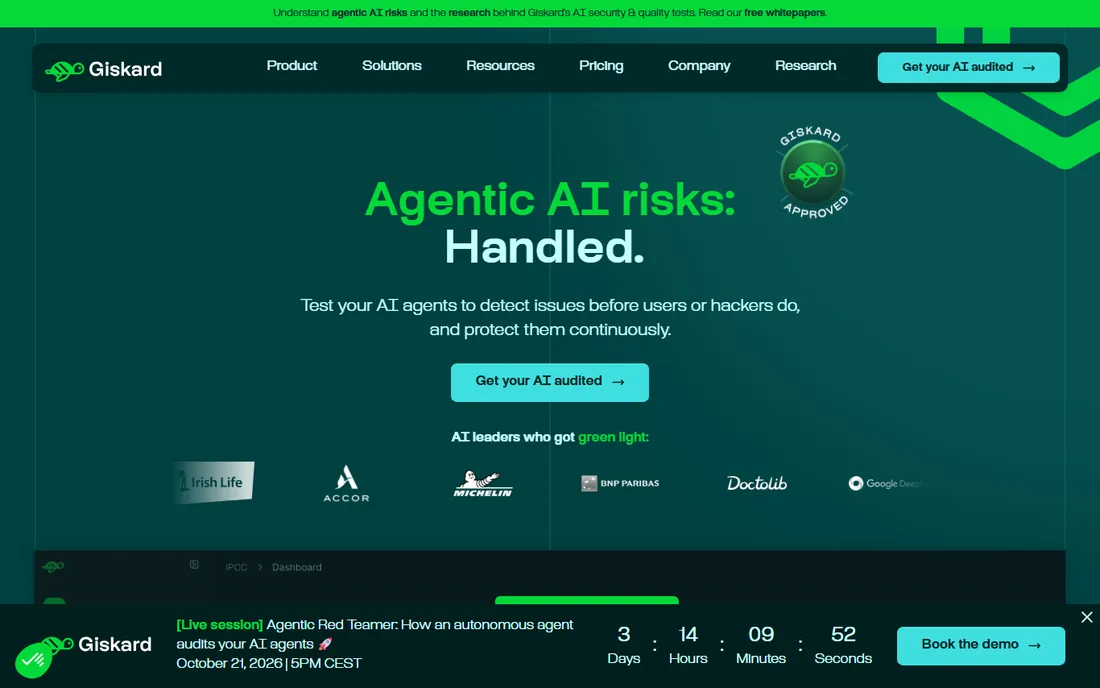
Giskard is the developer-first option. Its open-source library is already popular for LLM testing, and the enterprise Hub turns that into managed red teaming: automated vulnerability detection across prompt injection, data disclosure, hallucinations, bias and dozens more categories. Testing is black-box, so the Hub only needs your agent's API endpoint, not its internals.
Every assessment produces a full vulnerability report ranked by severity, a signed go or no-go deployment recommendation, and remediation guidance that the team manages through to re-testing. European data residency options, RBAC, SOC 2 Type II and HIPAA compliance check the enterprise boxes.
Giskard is the right starting point for engineering teams that want to run red teaming themselves before buying a bigger platform. The open-source tier costs nothing, and the Hub adds managed assessments, expert review and on-premise installation for sensitive workloads.
What we like- Open-source testing library developers already know
- Black-box testing needs only an API endpoint
- Detailed vulnerability reports with go or no-go verdicts
Watch out for- Enterprise Hub pricing is not public
- Conversational agents are the main supported type
How we chose
We focused on products built specifically for LLM and AI application security, not general cybersecurity tools with an AI checkbox. Every tool above exists today and sells to teams shipping or governing AI products. We opened each vendor's homepage to confirm the current name, ownership and URL, noting where acquisitions changed the picture: Protect AI now lives inside Palo Alto Networks' Prisma AIRS, Prompt Security is now part of SentinelOne, and Trustible was previously known as CalypsoAI. We reviewed product documentation, analyst mentions, public customer references and each vendor's stated capabilities around prompt injection defense, red teaming, model scanning and governance. We left out Aim Security because its domain now serves an unrelated company, and replaced it with Giskard, which is an established open-source and enterprise red teaming platform.
What to check before you buy LLM security software
Start by naming the threat you are actually worried about. Runtime defense tools (Lakera, Enkrypt AI, Prisma AIRS) stop prompt injections and data leaks on live traffic. Testing tools (HiddenLayer, Giskard) find vulnerabilities before deployment. Governance platforms (Trustible, Cranium AI) prove to auditors and regulators that AI use is controlled. Most companies need at least two of the three, and no single product covers all of them equally well.
Ask every vendor for a trial against your own attacks. Run your nastiest prompt injections, your real system prompts and your actual data through the demo. Vendor benchmarks are marketing; your threat model is the test that matters. Check latency budgets too: runtime guardrails add milliseconds to every request, and some applications cannot afford them.
Finally, confirm deployment options. Regulated industries often need the security layer inside their own cloud or on-premise, not as SaaS. Giskard, Cranium and HiddenLayer all discuss enterprise deployment options, but get the specifics in writing before you sign.
Pairing runtime defense with governance
The pattern we see working is a two-layer stack. Lakera or Enkrypt AI guards the live application: every prompt and response gets inspected, attacks get blocked, and incidents get logged. Trustible or Cranium AI sits above it: every model, agent and vendor gets inventoried, risk-scored and mapped to frameworks, and the incident logs from the runtime layer become audit evidence.
This pairing matters because security and compliance answer different questions. Runtime defense answers "did anything bad happen just now." Governance answers "can you prove it has been safe all year." Buyers who purchase only one usually end up buying the other within twelve months, so negotiate both together if you can.
Frequently asked questions
What is LLM security software?
Software that protects applications built on large language models from AI-specific threats. It includes runtime guardrails that block prompt injections and data leaks, red teaming tools that test models for vulnerabilities before deployment, model scanners that check third-party models for tampering, and governance platforms that track AI use for compliance.
How is LLM security different from traditional cybersecurity?
Traditional tools protect networks, endpoints and data at rest. LLM security addresses threats unique to AI systems: prompt injection that overrides system instructions, jailbreaks that bypass safety training, data leakage through model outputs, poisoned training data, and agents that misuse their tools. Firewalls and endpoint agents cannot see these attacks.
Do I need LLM security if I only use ChatGPT through the vendor's app?
Yes, at least basic governance. Employees paste sensitive data into public AI tools constantly. Tools like Prompt Security discover which AI apps your company uses and block secrets and customer data from leaving. If you are building your own AI features, you also need runtime defense and red teaming.
What does LLM security software cost?
Enterprise platforms (Lakera, HiddenLayer, Cranium, Trustible, Enkrypt AI, Prisma AIRS) are priced by quote and typically run into five or six figures annually depending on usage. Giskard's open-source library is free, with the enterprise Hub priced by quote. Expect a sales-led process everywhere except Giskard's open-source tier.
Can open-source tools replace commercial LLM security platforms?
For testing, partly. Giskard's open-source library and tools like Garak or Promptfoo give developers real red teaming capability for free. For runtime protection at scale, audit evidence and enterprise support, commercial platforms still win. Many teams use open-source tools in development and commercial platforms in production.
How do I test an LLM security vendor before buying?
Give them your hardest cases: real prompt injections that worked on your app, your actual system prompts, and scenarios involving your sensitive data. Measure detection rates, false positives and added latency. A vendor that only demos on its own benchmarks is hiding something.
Sources we checked (8)
- https://www.lakera.ai
- https://prompt.security/
- https://protectai.com/
- https://hiddenlayer.com/
- https://cranium.ai/
- https://trustible.ai/
- https://enkryptai.com/
- https://giskard.ai/
Is your product missing or out of date?
We review this list regularly. Vendors can request a listing, send updated pricing or ask about featured placement.

Shihab Mia · Founder, Rankite
Shihab has spent more than a decade helping SaaS and e-commerce brands grow through search. He writes Rankite's software buying guides from pricing pages, documentation and public user reviews. More about Shihab.