How we make this list: we compare pricing pages, product documentation and public user reviews. Rankite is independent; if a vendor ever pays for a featured spot, that listing is clearly labeled Partner.
Key takeaways
- Deel and Remote both charge $599 per employee per month for EOR, making them the premium, full-coverage picks with owned entities in most major markets.
- Papaya Global and Multiplier undercut them: Papaya starts EOR at $499 and Multiplier at $459 a month on annual contracts, with Papaya adding same-day payments in 130-plus currencies.
- Plane is the cheapest way to test global hiring: $499 per EOR hire a month, $39 per contractor, and a free HRIS, with API-first tooling developers like.
- Oyster sits at the premium end at $699 an employee a month, pitching human HR support and B Corp credentials for teams that want hand-holding.
- Pebl (formerly Velocity Global), Rippling and G-P publish no starting prices, so budget time for demos and quotes alongside the priced options.
Quick comparison
| Tool | Best for | Starting price | Free plan |
|---|
 Deel Deel | Full-coverage EOR with the biggest country footprint | $599/employee/month (EOR) | No |
 Remote Remote | EOR with owned entities and no setup fees | $599/employee/month (EOR) | No |
 Papaya Global Papaya Global | EOR plus same-day global payments | $499/employee/month (EOR) | No |
 Multiplier Multiplier | Lower-cost EOR for APAC-heavy hiring | $459/employee/month (EOR, annual) | No |
 Oyster Oyster | Human-first EOR with strong HR support | $699/employee/month (EOR) | No |
 Plane Plane | Cheapest entry point with free HRIS | $499/EOR hire/month | No |
 Pebl Pebl | Established EOR with 185+ country coverage | See website | No |
 Rippling Rippling | EOR inside a full HR, IT and finance platform | See website | No |
 G-P G-P | Enterprise-grade EOR with analyst recognition | See website | No |
Is your product missing or out of date?
We review this list regularly. Vendors can request a listing, send updated pricing or ask about featured placement.
The best EOR software for tech startups
#1
Deel
Best for: Full-coverage EOR with the biggest country footprint
Visit deel.com
Starting price$599/employee/month (EOR)
Free planNo
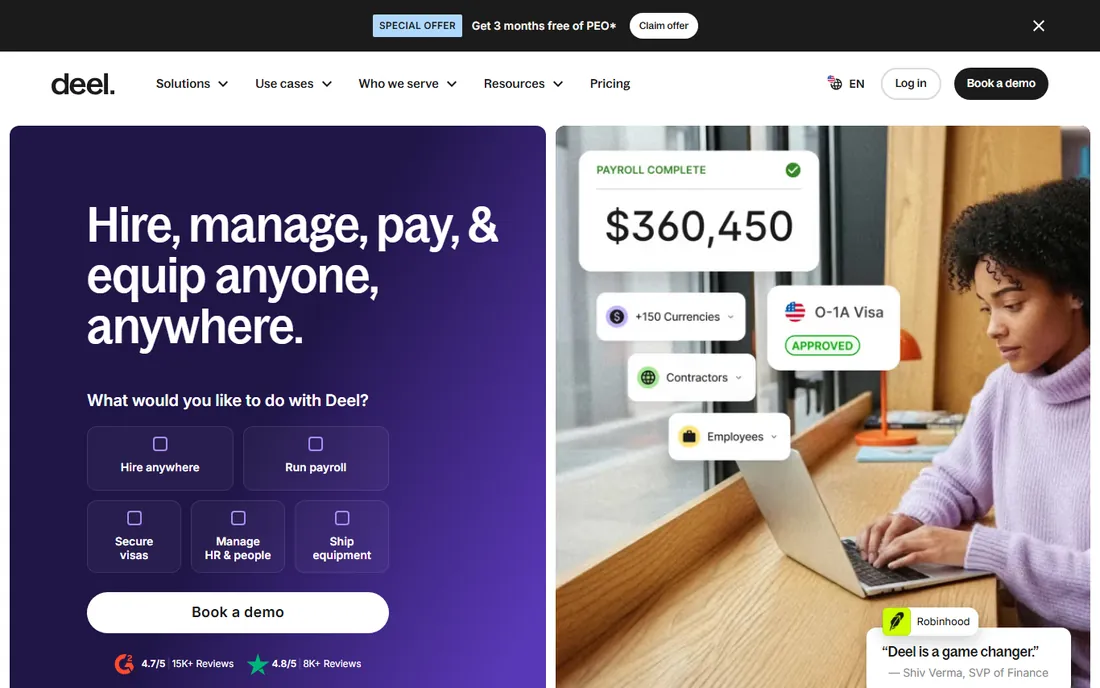
Deel is the default EOR for tech startups that want to hire anywhere without thinking about entities. Its EOR service at $599 an employee a month covers compliant contracts, payroll, benefits, taxes and HR support in more than 130 countries, plus immigration services for relocating hires. For US teams it also runs a PEO at $125 an employee a month with benefits included.
The scale matters: 40,000-plus customers and over $20 billion in processed payroll mean Deel has likely already hired in the country you are targeting. That institutional knowledge shows up in edge cases like terminations, equity for international employees and contractor-to-employee conversions.
The price is the top of the mid-market. If you are hiring one engineer in Portugal, Deel works but you pay the full rate. Where Deel wins is breadth: startups that will hire in five countries this year get one contract and one dashboard instead of five vendors.
What we like- EOR in 130+ countries with benefits and immigration support
- US PEO option at $125 an employee a month
- 40,000+ customers including many startups
Watch out for- Premium pricing
- The platform's breadth can feel heavy for a first hire
Starting price$599/employee/month (EOR)
Free planNo
Remote's big differentiator is infrastructure: it operates through its own entities rather than relying on in-country partners, which means one accountable party when payroll or compliance goes wrong. EOR starts at $599 an employee a month with no setup fees, no onboarding fees and no deposit in most cases, and the platform itself is included free.
For startups, the contractor side is attractive. Contractor management starts at $29 a contractor a month (you only pay for active months), and Contractor of Record at $325 a month covers misclassification risk with uncapped indemnity. A startup can begin with contractors and convert them to EOR employees in the same dashboard.
Remote covers 90-plus countries for EOR, which is solid but narrower than Deel or G-P. If your target countries are covered, the owned-entity model and transparent pricing make it a strong pick.
What we like- Owned entities instead of third-party partners
- No setup, onboarding or platform fees
- Contractor management from $29 a month
Watch out for- Same premium price as Deel
- 90+ EOR countries is fewer than some rivals
Starting price$499/employee/month (EOR)
Free planNo

Papaya Global undercuts Deel and Remote at $499 an employee a month for EOR while adding one of the strongest payments engines in the category. Its OnePay network delivers 95% of payments same-day across 160-plus countries, and Papaya guarantees the land date: if a payment is late, that is their problem, not yours.
The platform bundles EOR, global payroll (from $29 an employee a month where you own entities), contractor management (from $5 a contractor a month) and a Contractor of Record option at $295. Papaya assumes full compliance liability and backs contractor classification decisions, absorbing misclassification risk.
Papaya positions itself as enterprise-grade, and the sales process reflects that. But the transparent starting prices and the payments strength make it worth a demo for any startup hiring across multiple continents.
What we like- EOR from $499 with full liability coverage
- Payments land same-day in most markets
- Payroll plus EOR in one platform
Watch out for- Enterprise-leaning sales process
- The platform has many modules to learn
Starting price$459/employee/month (EOR, annual)
Free planNo
Multiplier offers the lowest published EOR price here: $459 an employee a month on annual contracts ($499 monthly), with Growth plans at $519. The fee covers compliant employment, contracts, payroll, taxes, benefits and HR support across 150-plus countries. Global payroll where you own entities starts at just $20 an employee a month.
The company has deep roots in Asia-Pacific hiring, which suits startups hiring engineers in India, Southeast Asia or Australia. There is no minimum headcount, so a single hire works fine, and most employees onboard in days.
The trade-off is brand familiarity: US and European finance teams may not know Multiplier, which can slow procurement. And the headline $459 requires an annual commitment. Still, for cost-conscious startups, it is the value leader.
What we like- Cheapest published EOR rate on this list
- Strong in Asia-Pacific markets
- No minimum headcount
Watch out for- Annual contract needed for the $459 rate
- Brand is less known in the US and Europe
Starting price$699/employee/month (EOR)
Free planNo
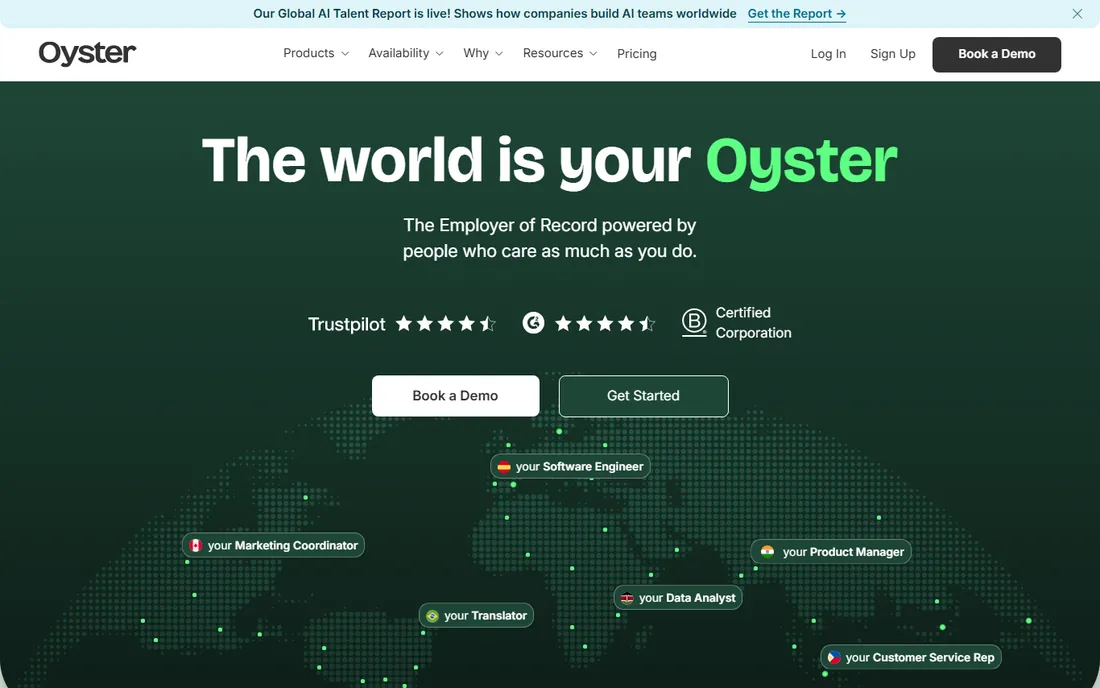
Oyster sells the human side of global employment. Instead of a pure self-serve platform, you get HR experts who work as an extension of your team, guiding you through sensitive situations like performance issues and terminations across cultures. Hiring covers 180-plus countries with onboarding in as little as 48 hours.
Pricing is premium: $699 an employee a month for EOR and $29 a contractor a month. In return you get predictable pricing with no extra fees when someone leaves, which some competitors charge for, and the only B Corp certification among major EORs.
Oyster suits startups where the founders want a partner, not a portal: first-time global employers, teams in tricky jurisdictions, or companies where employee experience is a selling point. If you are comfortable managing the process yourself, the cheaper options deliver the same compliance.
What we like- Named HR experts as an extension of your team
- Hire in 180+ countries
- B Corp certified with no offboarding fees
Watch out for- Highest published EOR price on this list
- Premium positioning for a startup budget
Starting price$499/EOR hire/month
Free planNo
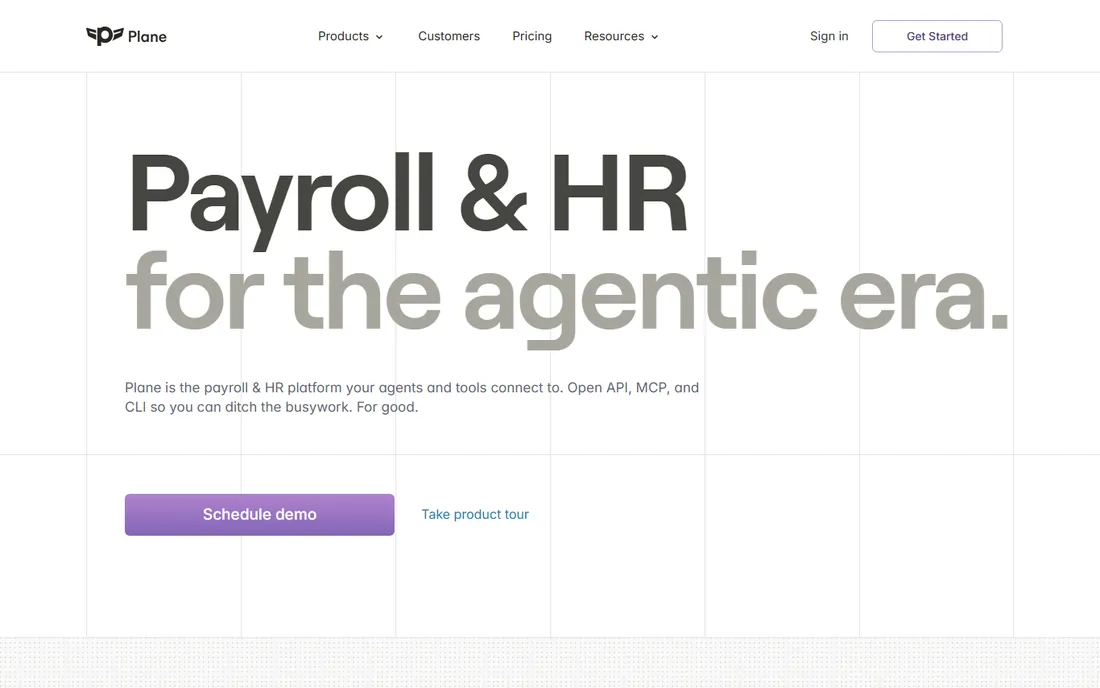
Plane, formerly known as Pilot, is the developer-friendly EOR. Every plan includes API, CLI and MCP access, so your tools and agents can read payroll data, trigger runs and onboard contractors programmatically. The HRIS itself is free; you pay per worker type: $39 per contractor, $19 per US employee and $499 per EOR hire a month.
Contractors in 240-plus countries get paid through local rails into their own bank accounts with contractor-friendly exchange rates, no e-wallet in the middle. US employees and global contractors can sit on the same payroll run, and accounting automation posts journal entries to QuickBooks after every run.
The EOR footprint covers 100-plus countries, narrower than Deel or G-P, and the EOR product is newer than Plane's contractor roots. For a startup whose first global hire is a contractor who might convert, Plane is the cheapest credible starting point.
What we like- Free HRIS with paid modules
- API, CLI and MCP access on every plan
- Local payment rails with fair exchange rates
Watch out for- Smaller country footprint (100+ for employees)
- EOR is newer than its contractor product
Starting priceSee website
Free planNo
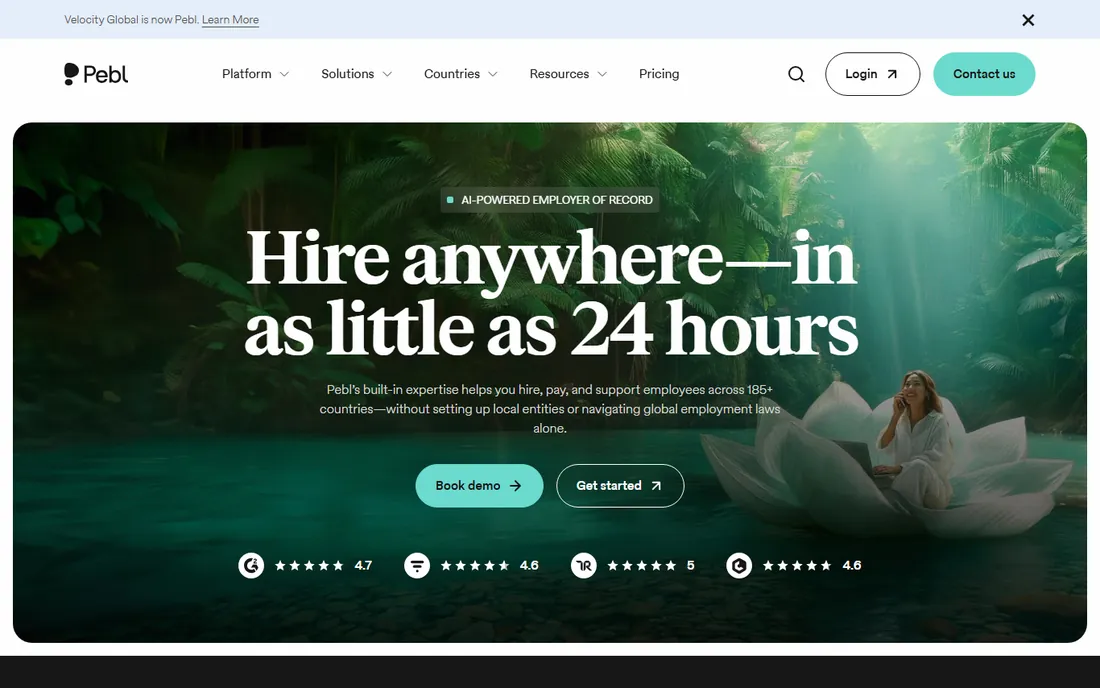
Velocity Global has rebranded as Pebl, and the old domain now serves the new brand. The pitch is speed and support: hire in as little as 24 hours across 185-plus countries, with 90% of employees supported through Pebl-owned entities for consistent benefits and on-time pay. An AI assistant called Alfie answers compliance questions around the clock, backed by in-house experts.
The company claims 99.9% payroll accuracy, number-one compliance ratings on G2 and more than 1,500 customers, with twelve-plus years of compliance expertise. That track record makes Pebl a safe choice for startups whose investors or boards want a proven vendor.
The downside is pricing opacity: no starting prices are published, so you will negotiate. Mention the rebrand to your finance team early, since invoices and contracts now say Pebl.
What we like- 185+ countries with 90% employed through owned entities
- 24-hour onboarding in many markets
- AI assistant plus human experts
Watch out for- No published pricing
- Rebrand from Velocity Global may confuse procurement
Starting priceSee website
Free planNo
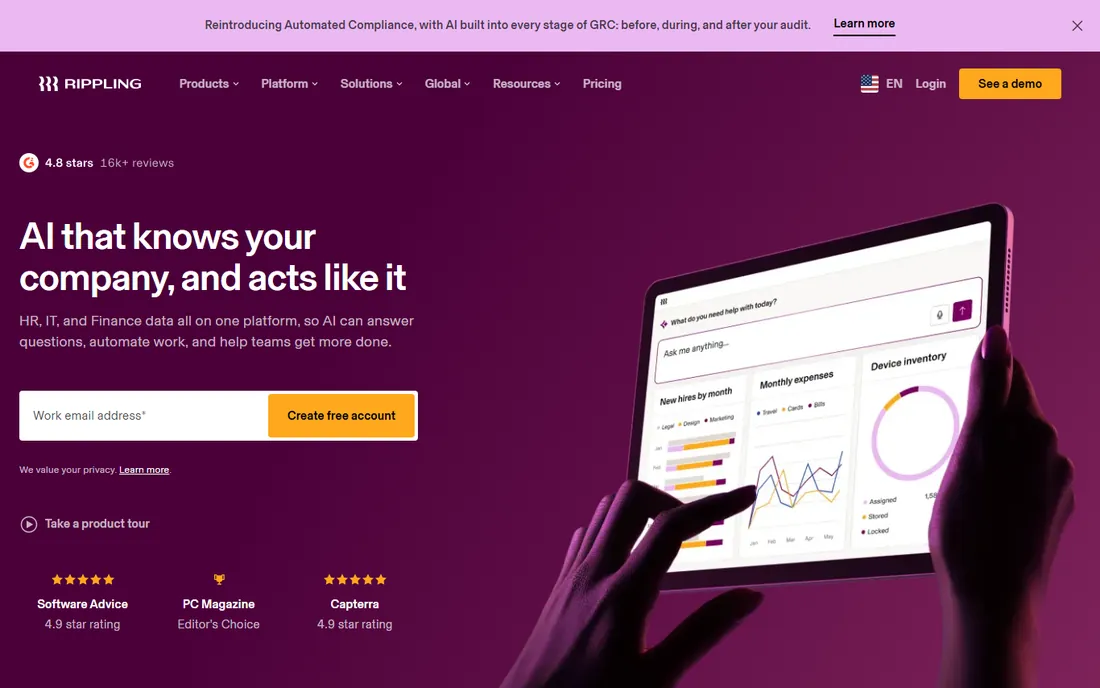
Rippling is not an EOR specialist; it is a workforce platform that includes EOR among dozens of products. The value is unification: HR, IT, payroll, expenses, benefits and device management share one data layer, so onboarding a hire in a new country can provision accounts, order a laptop and enroll benefits in one workflow.
Global EOR runs on the same platform as domestic payroll, which suits startups planning to build a real people-ops function rather than just pay contractors. The AI layer answers workforce questions and automates admin across every app.
Pricing is quote-based and modular: each product bills per employee per month on top of a required platform fee. If you only need to hire two engineers abroad, a pure EOR is cheaper and simpler. If you want one system to run the whole company, Rippling is the category leader.
What we like- One system for HR, IT, payroll and finance with shared data
- Global workforce management without manual work
- Strong automation and AI
Watch out for- Quote-based pricing with a platform fee
- Overkill if you only need EOR
#9
G-P
Best for: Enterprise-grade EOR with analyst recognition
Visit g-p.com
Starting priceSee website
Free planNo
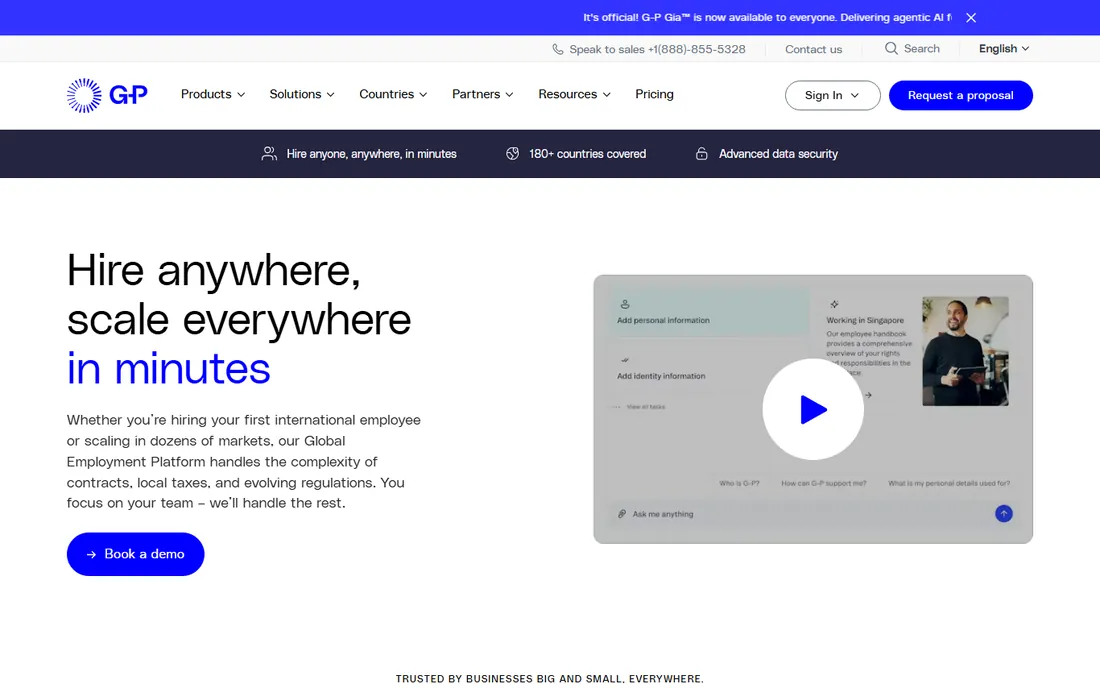
G-P, formerly known as Globalization Partners, invented the modern EOR category and still leads it in analyst rankings: Everest Group, NelsonHall and IEC all rate it number one. EOR covers 180-plus countries with 99% payroll accuracy, and the G-P Gia AI assistant generates compliant HR documents and answers compliance questions in seconds.
The platform is API-first and integrates with existing HCM and payroll tools, so it can slot into a startup's stack or serve as the system of record. G-P Contractor handles contractor hiring in 190-plus countries with misclassification guidance.
Like most enterprise EORs, G-P publishes no pricing. Expect a sales-led process and pricing that reflects the premium positioning. It is the safe board-approved choice when compliance cannot be a question mark.
What we like- EOR in 180+ countries with top analyst ratings
- G-P Gia AI for compliance guidance
- API-first platform with HCM integrations
Watch out for- No published pricing
- Enterprise focus can mean slower onboarding for tiny teams
How we chose
We focused on EOR providers that actively serve tech startups hiring engineers and product people abroad, not just enterprise HR departments. Every product above exists today and offers employer-of-record services. We opened each vendor's homepage to confirm the current name, URL and ownership, noting two rebrands: Velocity Global is now Pebl, and Pilot is now Plane. We pulled starting prices from each vendor's own pricing page on October 14, 2026, and wrote "See website" where the vendor publishes no prices. We checked public reviews on G2 and Capterra, each vendor's documentation for country coverage and entity ownership, and how each product fits startup realities like contractor-to-employee conversion and tight budgets. We replaced Omnipresent, whose site could not be verified, with G-P, the category's analyst-recognized leader.
What to check before you pick an EOR for your startup
Start with the countries, not the platform. Every EOR covers the popular markets, but coverage quality varies: owned entities beat third-party partners for accountability, and some vendors adjust pricing for about 11% of countries with complex local rules. Confirm your exact target countries and get the per-country price in writing before signing.
Read the fee schedule beyond the headline. The monthly per-employee fee is only part of it. Ask about offboarding fees (Oyster charges none), security deposits, benefits markups, FX margins on payroll, and what happens to pricing when a contractor converts to an employee. Remote's no-deposit, no-setup-fee model is the cleanest we saw.
Check who holds the compliance risk. The whole point of an EOR is that the vendor is the legal employer. Confirm indemnity terms for misclassification and payroll errors in the contract, not just the marketing page. Papaya and Remote both publish indemnity details; get the same in writing from anyone else.
Finally, plan the exit. Startups get acquired, open their own entities, or move vendors. Ask how long offboarding takes, what data you can export, and whether the EOR helps transfer employees to your own entity. A vendor that makes leaving hard will make everything hard.
EOR versus contractors versus your own entity
Most startups follow the same path: contractors first, EOR when the role becomes core, own entity when a country has enough people to justify it. Contractors cost $5 to $39 a month per person on these platforms but carry misclassification risk if they work like employees. EOR at $459 to $699 a month removes that risk and opens up benefits and equity.
Your own entity makes sense around 5 to 10 employees in one country, when entity costs drop below total EOR fees. Until then, the EOR premium buys speed: onboarding in days versus months of entity setup. Run the math per country every six months, because the crossover point arrives faster than founders expect.
Frequently asked questions
What is EOR software?
Employer of Record software lets you hire employees in countries where you have no legal entity. The EOR becomes the legal employer, handling contracts, payroll, taxes, benefits and compliance, while you manage the person's day-to-day work. You pay a monthly fee per employee, typically $459 to $699.
How much does EOR cost for a startup?
Published starting prices we verified: Multiplier from $459, Papaya Global from $499, Plane at $499, Deel and Remote at $599, and Oyster at $699 per employee per month. Pebl, Rippling and G-P do not publish prices. Contractor management is far cheaper, from $5 to $39 a month, but carries misclassification risk.
Is it better to hire contractors or use an EOR?
Contractors are cheaper and faster for short-term or part-time work, but if they work full-time on your roadmap, most countries treat them as employees and you risk misclassification fines. EOR is the safer choice for core team members you want to keep. Many startups start contractors on a platform like Remote or Plane and convert the keepers to EOR.
Which EOR is best for hiring engineers in Eastern Europe or Latin America?
Deel, Remote, Papaya Global and G-P all have strong coverage in both regions. For cost, Multiplier is competitive. Confirm the specific country before choosing, since employment costs, benefits and termination rules vary enormously between, say, Poland and Brazil, and some vendors adjust pricing for complex markets.
Can I give equity to international employees hired through an EOR?
Usually yes, but the tax treatment varies by country and the EOR's ability to administer equity differs. Ask specifically about stock options or RSUs for your target countries during the sales process, and get tax guidance for each jurisdiction. This is one area where the premium vendors (Deel, Remote, Papaya) tend to have deeper support.
How long does it take to onboard an employee through an EOR?
Most vendors onboard in days, not weeks: Oyster cites as little as 48 hours, Pebl as little as 24 hours in some markets. Complex countries with work permits or strict registration can take longer. Start the process as soon as the offer is signed, and ask for a country-specific timeline before you commit to a start date.
Sources we checked (9)
- https://www.deel.com/pricing/
- https://remote.com/pricing
- https://www.rippling.com/pricing
- https://oysterhr.com/
- https://velocityglobal.com
- https://www.papayaglobal.com/pricing/
- https://www.usemultiplier.com/pricing
- https://plane.com
- https://g-p.com/
Is your product missing or out of date?
We review this list regularly. Vendors can request a listing, send updated pricing or ask about featured placement.

Shihab Mia · Founder, Rankite
Shihab has spent more than a decade helping SaaS and e-commerce brands grow through search. He writes Rankite's software buying guides from pricing pages, documentation and public user reviews. More about Shihab.