How we make this list: we compare pricing pages, product documentation and public user reviews. Rankite is independent; if a vendor ever pays for a featured spot, that listing is clearly labeled Partner.
Key takeaways
- Datasite and SS&C Intralinks remain the default for large-cap, banker-led deals, but both price per project with no public rates, and mid-market teams routinely overpay for capacity they never touch.
- If you want a number before the sales call, shortlist Ansarada (from $69/month), CapLinked ($399/month) and SecureDocs ($250/month), the only established vendors here with published pricing.
- DealRoom is the pick when diligence is only half the job: it runs pipeline, diligence and post-merger integration in one workspace instead of bolting a data room onto spreadsheets.
- Drooms is the strongest option for European transactions that need EU-hosted data and GDPR posture as a first-class feature rather than a checkbox.
Quick comparison
| Tool | Best for | Starting price | Free plan |
|---|
 Datasite Datasite | Large-cap banker-led M&A | See website (custom quote per project) | No |
 SS&C Intralinks SS&C Intralinks | Cross-border enterprise deals | See website (custom quote per project) | No |
 Firmex Firmex | Mid-market advisory firms running concurrent mandates | See website (quote-based; subscription or per-project) | Free trial |
 Ansarada Ansarada | Sell-side preparation with AI bidder scoring | $69/month (Essentials 50 MB, 12-month term) | Free trial (free preparation phase until the deal goes live) |
 Ideals Ideals | Mid-market teams that value usability and support | See website (quote-based, storage-priced) | Free trial |
 DealRoom DealRoom | Corporate development teams managing pipeline through integration | See website (custom quote) | Free trial |
 CapLinked CapLinked | Mid-market M&A on a flat monthly fee | $399/month (Team plan) | Free trial (14 days) |
 SecureDocs SecureDocs | Small teams that want a room live today | $250/month (12-month plan, billed annually) | Free trial (14 days) |
 Drooms Drooms | European M&A, real estate and asset transactions | From €0/month (Drooms Hub) | Free trial |
 DFIN Venue DFIN Venue | SEC-regulated transactions and IPO preparation | See website (custom quote) | No |
Is your product missing or out of date?
We review this list regularly. Vendors can request a listing, send updated pricing or ask about featured placement.
The best VDR software for mergers and acquisitions
Starting priceSee website (custom quote per project)
Free planNo

Datasite is the room the bulge-bracket banks default to, and on a $500M-plus process that default carries weight. Buy-side advisers already know the interface, permissions handle staged disclosure across dozens of bidder groups, and the AI does useful work: automated redaction catches personal data across thousands of pages, and semantic search understands deal terminology instead of matching keywords. With 16,000-plus transactions a year on the platform, your edge case has been seen before.
The trade is cost and weight: custom per-transaction pricing means a sales conversation before you upload a single file. For a lower-middle-market deal, that buys formality your bidders did not ask for.
What we like- AI redaction and document categorization built for huge document sets
- Full deal-lifecycle platform from preparation to post-close
- 24/7/365 support in 20+ languages
Watch out for- Custom per-project pricing with no public rates
- Sized and priced for big deals
- Steeper learning curve for infrequent users
Starting priceSee website (custom quote per project)
Free planNo
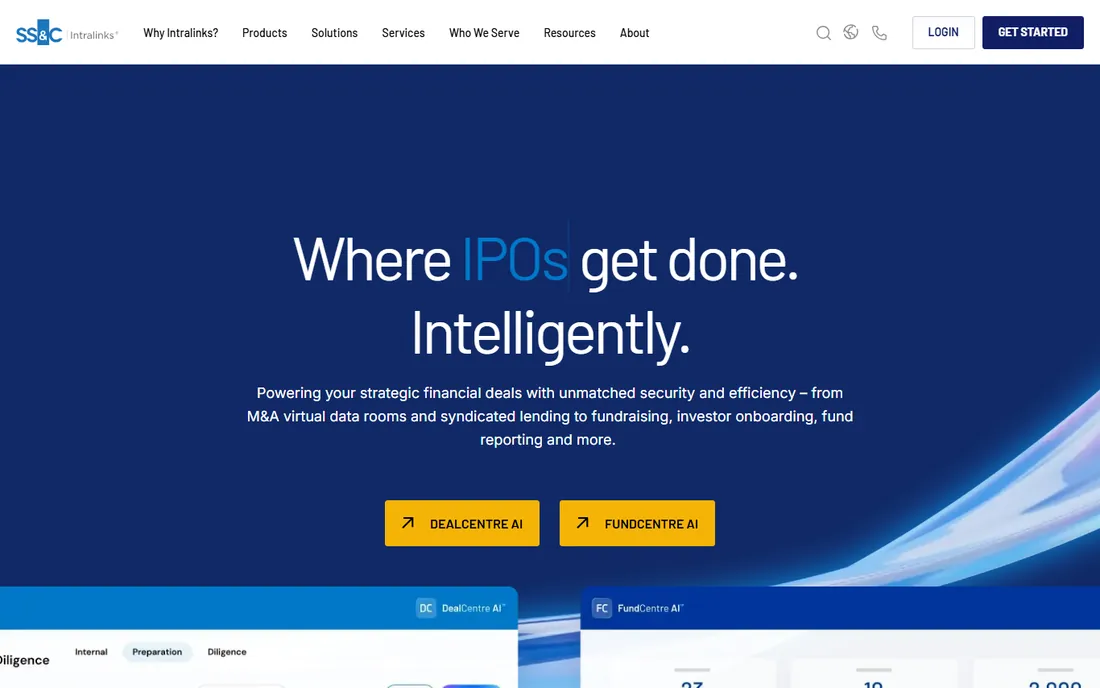
Intralinks pioneered the virtual data room more than 20 years ago, and its deepest advantage is still post-download control. UNshare lets you revoke access to a document after a bidder has downloaded it, which matters on cross-border deals where a withdrawn bidder holding live copies is a genuine risk. The platform has facilitated over $35 trillion in transactions, so counterparty IT reviews rarely raise an eyebrow.
That pedigree comes with old-school enterprise buying: no pricing page and negotiated per-project quotes. Intralinks fits regulated, multi-jurisdiction deals where the strongest security credentials justify the effort. For a straightforward domestic sale, newer vendors deliver the same workflow with less friction.
What we like- UNshare information rights management controls documents after download
- First VDR provider to earn ISO 27701 certification
- DealCentre AI adds summarization and Q&A assistance
Watch out for- No published pricing and a lengthy sales process
- Per-page model can inflate costs on document-heavy deals
- Interface feels dated next to newer platforms
#3
Firmex
Best for: Mid-market advisory firms running concurrent mandates
Visit firmex.com
Starting priceSee website (quote-based; subscription or per-project)
Free planFree trial
Firmex has become the workhorse of mid-market advisory shops because of its subscription model: one annual agreement covers unlimited data rooms, so the fifth concurrent mandate costs effectively nothing extra. The interface is deliberately plain, and external reviewers need no training.
The honest limitation is ambition. Firmex does the core VDR job well and adds little beyond it: no AI document Q&A, no bidder engagement scoring, and pricing stays behind the sales conversation. If your deals are standard diligence processes and your priority is predictable cost across many mandates, that restraint is a feature. If you want the platform to analyze documents for you, look at Ansarada or Datasite.
What we like- Subscription option covers unlimited rooms and users for firms with steady deal flow
- Clean interface with minimal training
- SOC 2, GDPR and HIPAA compliance
Watch out for- No published pricing
- Limited AI and automation compared with newer rivals
- Very large document sets can slow the interface
Starting price$69/month (Essentials 50 MB, 12-month term)
Free planFree trial (free preparation phase until the deal goes live)
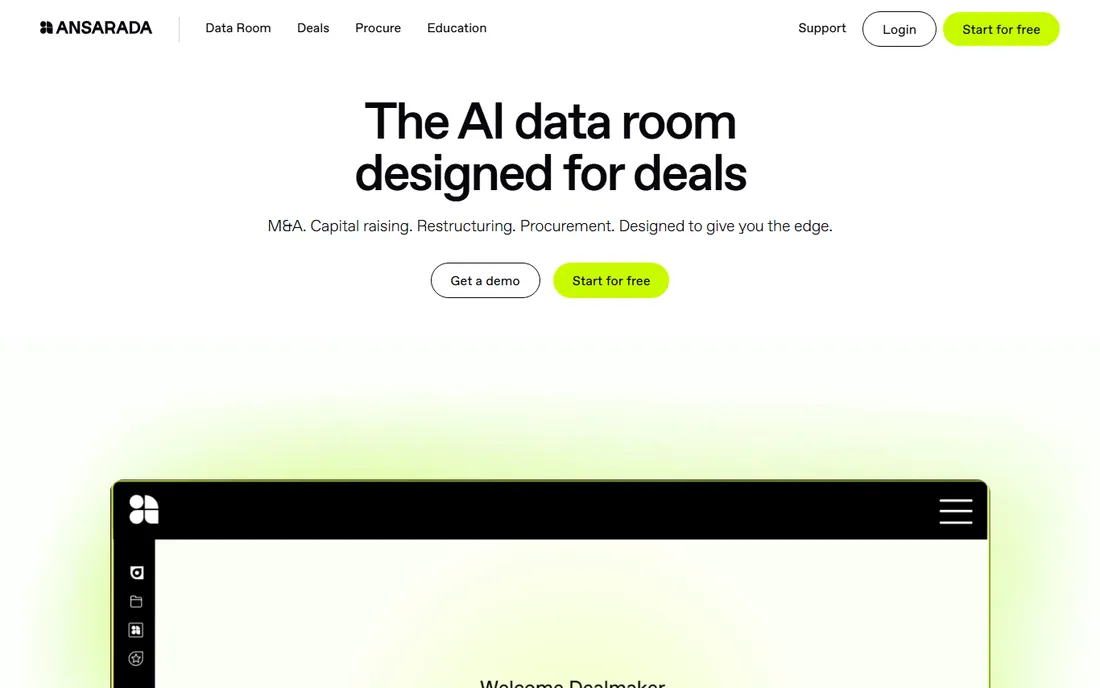
Ansarada wins the transparency contest. Pricing starts at $69 a month for a 50 MB Essentials room on a 12-month term and scales to $5,134 a month for 20 GB, all published on its own site. Better still, setup is free: you pay nothing until the deal goes live, defined as inviting an external guest or 90 days after creation. For a sell-side team organizing documents before committing budget, that free preparation window is genuinely useful.
The AI layer differentiates the live room: AI-Sort classifies uploads automatically, AiDA answers questions across the document set, and bidder engagement scoring predicts which reviewers are seriously engaged. The catch is the storage meter, which climbs fast on document-heavy deals. Note that Datasite acquired Ansarada in August 2024 for about A$236 million, so confirm the roadmap before signing multi-year terms.
What we like- Fully published pricing with no sales call required
- Free setup and preparation until you invite an external guest
- Unlimited users on every plan
Watch out for- Storage-based tiers get expensive fast at higher volumes
- Datasite acquired the company in 2024, so long-term product direction is uncertain
Starting priceSee website (quote-based, storage-priced)
Free planFree trial
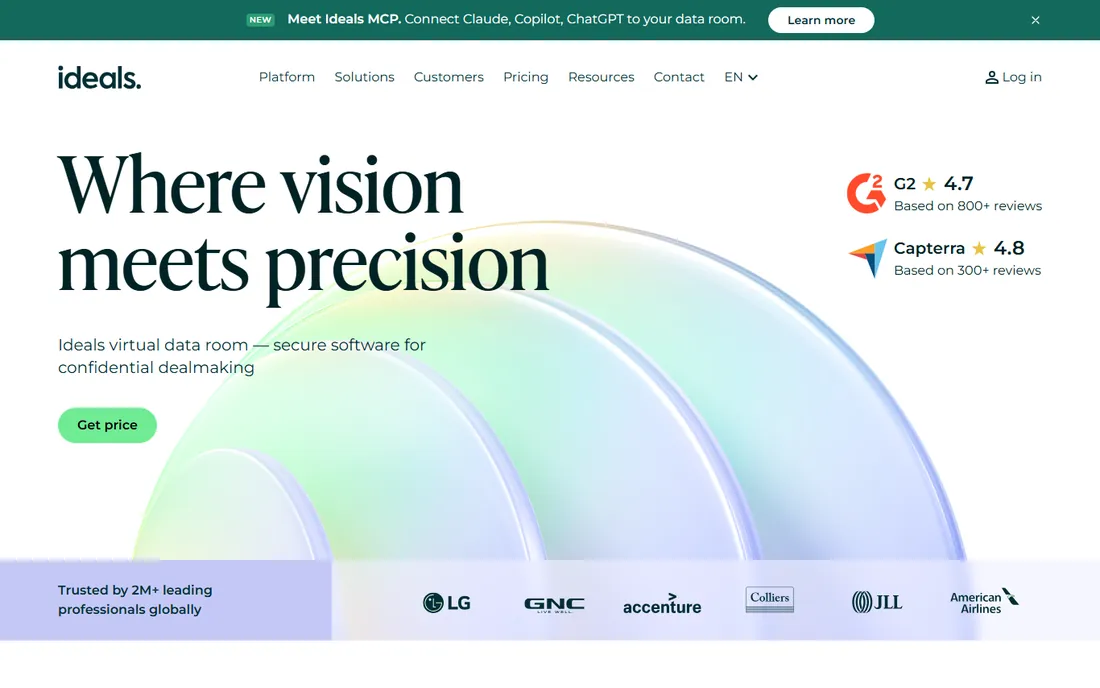
Ideals, rebranded from iDeals in late 2024, is the room deal teams recommend to each other. The interface needs no training for outside reviewers, support answers around the clock in dozens of languages, and pricing charges for storage used rather than pages uploaded, which removes the most hated meter in the industry. Plans run Core (single project), Premier (larger transactions) and Enterprise (multi-project), with a fully functional free trial.
The gap between marketing and buying is the price list: dollar figures still require a sales conversation, with third-party reports putting entry around $500 a month. That remains far below the enterprise tier. Pick Ideals when your seller-side team is small, your reviewers are non-technical, and you want the room to disappear into the background.
What we like- Consistently top-rated for ease of use across G2 and Capterra
- 24/7 multilingual support
- Storage-based pricing avoids per-page surprises
Watch out for- No published dollar figures despite the transparency positioning
- Lower tiers scope to a single project
#6
DealRoom
Best for: Corporate development teams managing pipeline through integration
Visit dealroom.net
Starting priceSee website (custom quote)
Free planFree trial
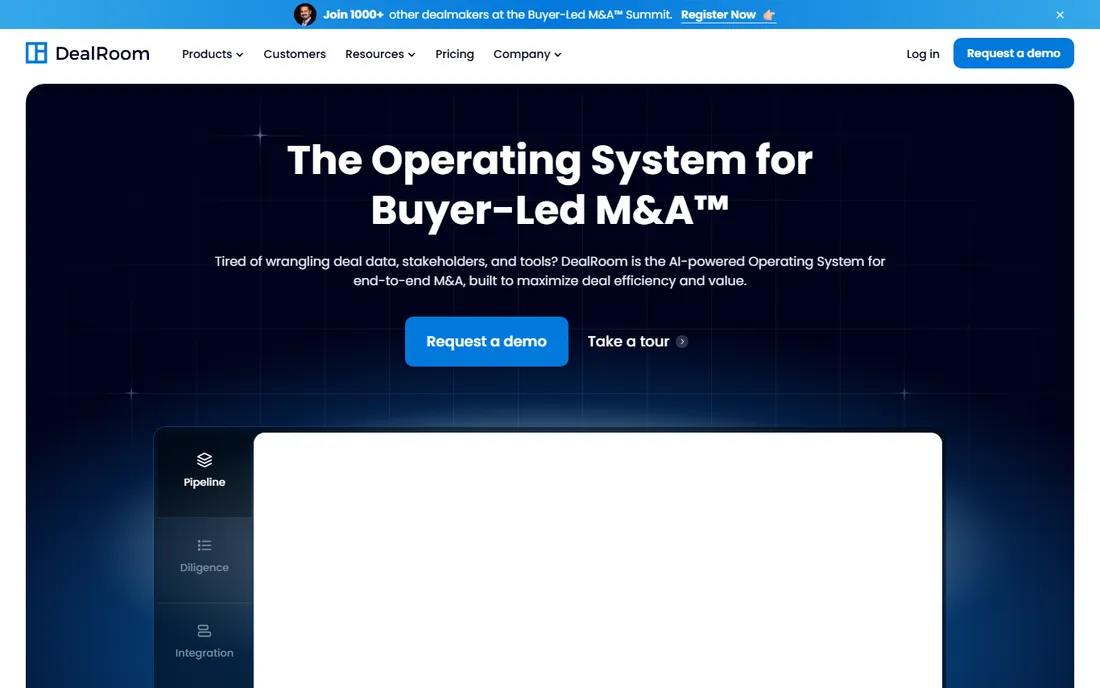
DealRoom is an M&A operating system that happens to include a data room. Corporate development teams running serial acquisitions live in it: sourcing notes, pipeline stages, diligence requests, document sharing and integration milestones sit in one workspace instead of scattered across spreadsheets, inboxes and a rented VDR. Diligence requests route to owners, overdue items get flagged, and Q&A stays inside the same system as the documents.
That breadth is the buying decision: a one-deal team pays for pipeline tooling it will never open, while a serial acquirer often spends less consolidating its stack into DealRoom. Evaluate it against your whole M&A tooling spend, not against a single-project room.
What we like- Unifies pipeline tracking, diligence and post-merger integration in one system
- Diligence request workflows reduce email chasing
- AI summaries keep stakeholders aligned
Watch out for- Enterprise-grade pricing above single-project VDRs
- More platform than a one-deal team needs
- Longer implementation than a pure data room
Starting price$399/month (Team plan)
Free planFree trial (14 days)
CapLinked competes on a simple promise: one flat monthly price, no per-page meter, no per-user surcharges. The Team plan costs $399 a month with 5 GB of storage and unlimited guest users; Enterprise starts at $500 a month or $5,000 a year. The entry tier includes granular permissions, dynamic watermarking, structured Q&A, OCR search, activity tracking and SOC 2 security, and a 14-day trial needs no sales call.
The standout is FileProtect, the DRM layer that persists after download: block printing and forwarding, and remotely shred files from a bidder who walks away. The limitation is scope, since 5 GB fills fast on document-heavy deals. For controlled mid-market processes where leakage control matters most, the value is hard to beat.
What we like- Published flat pricing with no long-term contract on Team
- FileProtect DRM blocks printing and re-sharing with remote shred
- Unlimited guest users
Watch out for- 5 GB storage cap on the Team plan
- Analytics are basic compared with AI-led rivals
- Utilitarian interface
Starting price$250/month (12-month plan, billed annually)
Free planFree trial (14 days)
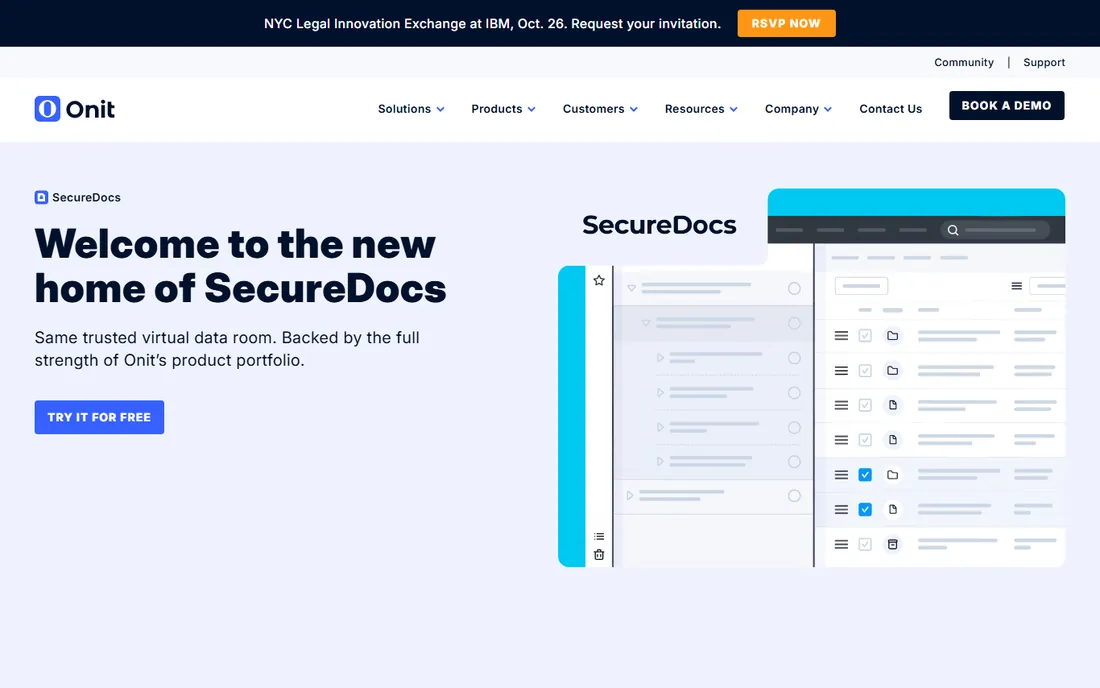
SecureDocs is the fastest path from decision to live data room here. Signup is self-serve, the room is ready in about ten minutes, and pricing is two flat options: $250 a month on a 12-month term or $400 a month on a 3-month term, both covering unlimited users and unlimited documents. No meters to watch, no renewal ambush, which is why startups and small advisory firms keep choosing it for fundraises and single-asset sales.
SecureDocs now sits inside Onit’s portfolio, adding stability without changing the product. The trade-offs are honest: reporting covers views and downloads rather than engagement intelligence, and the feature set stops well short of AI-assisted review.
What we like- Ten-minute self-serve setup with no sales call
- Flat fee covers unlimited users and unlimited documents
- 24/7 support included
Watch out for- Reporting is basic next to analytics-led platforms
- Fewer advanced controls for complex multi-party processes
- Not built for IPO-scale diligence
#9
Drooms
Best for: European M&A, real estate and asset transactions
Visit drooms.com
Starting priceFrom €0/month (Drooms Hub)
Free planFree trial
Drooms is Europe’s answer to the US VDR incumbents, with 20-plus years of history and a client list heavy on real estate, infrastructure and financial sponsors. The pitch is sovereignty: European ownership, georedundant EU servers, ISO 27001 and 27018 certification and TÜV auditing, which simplifies procurement for EU-regulated sellers. Its in-house AI handles the tedious parts of setup: automatic document structuring, name suggestions, instant translation and an AI assistant that answers questions from the document set.
Pricing follows the Drooms Hub model: one subscription for unlimited projects, paying for storage and users rather than per room, starting from €0 a month. In practice, serious diligence still lands on a quoted Enterprise tier. Choose Drooms when the deal’s center of gravity is European and data residency is a diligence topic in itself.
What we like- 100% European-owned with EU-hosted servers and GDPR-first posture
- In-house AI suite for auto-structuring, translation and Q&A
- One subscription covers unlimited projects
Watch out for- Enterprise pricing is quote-based and climbs quickly
- The entry tier’s storage allowance is tight for real diligence
Starting priceSee website (custom quote)
Free planNo
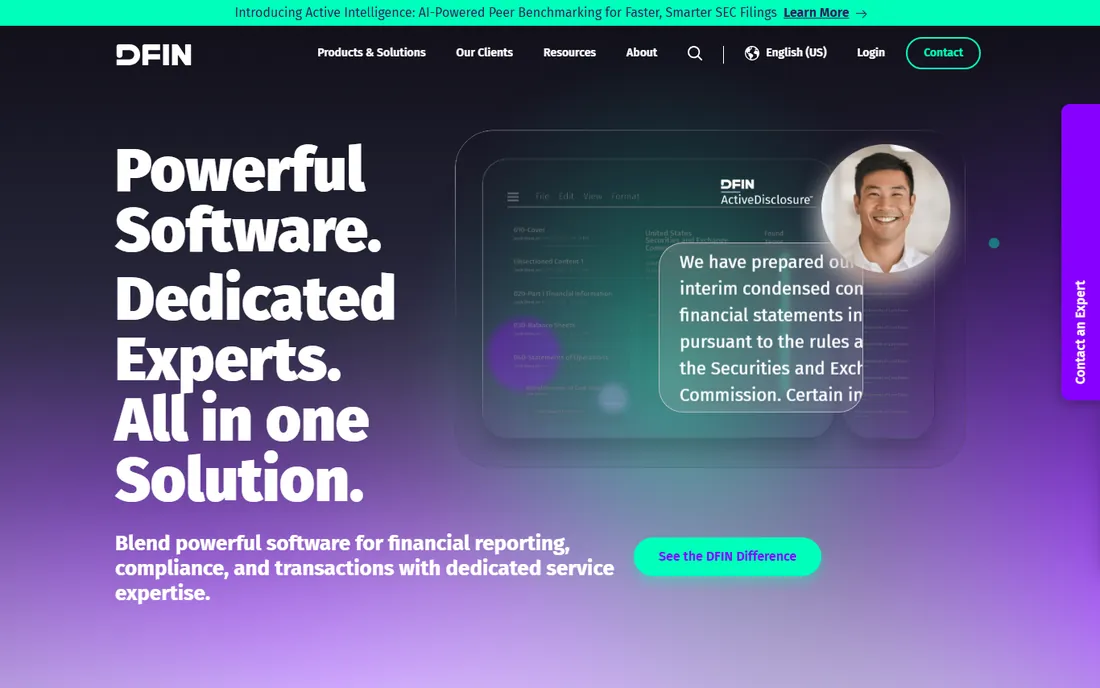
Venue is the data room of Donnelley Financial Solutions, the top SEC filing agent, and that lineage defines its niche. When diligence runs alongside an IPO prospectus or M&A-related SEC filings, Venue connects to DFIN’s ActiveDisclosure platform so the team is not re-uploading the same documents into two systems. The platform was comprehensively rebuilt in September 2025 with self-launch rooms, intelligent permissioning and real-time insights, plus an Active Intelligence AI layer.
Security aligns to ISO 27001 and SOC 2 Type II with SSO and MFA. The buying reality is enterprise: custom quotes and a sales-led process. For a capital-markets transaction with filings in scope, the DFIN integration is a genuine advantage. For a private sale with no filing component, the pure-play vendors above move faster.
What we like- Rebuilt in 2025 on a modern architecture with self-launch rooms
- Active Intelligence AI adds document translation and summaries
- Connects to DFIN’s SEC filing tools
Watch out for- Quote-only pricing
- The broader DFIN suite can feel like overkill for a simple sale
- Fewer third-party reviews than pure-play vendors
How we chose
We started from the shortlists used in 2026 M&A practice: enterprise incumbents, mid-market platforms with the strongest reviewer sentiment, and specialists for European, regulated and serial-acquirer niches. Every product above exists today and was checked against its vendor’s current site in October 2026. Pricing comes from vendor-published pages where they exist; otherwise we say the price is quote-based instead of repeating third-party estimates. We did not run test deals in each room, and we say that plainly.
What to check before you sign
A data room contract is short, but four clauses decide whether you overpay or leak documents.
The pricing meter
VDR vendors meter four different things: pages, storage, users and projects. Per-page pricing punishes thorough preparation, because every page you upload to organize the room costs money before a bidder sees it. Storage-based pricing is more predictable but climbs steeply at higher tiers. Flat monthly fees are the easiest to budget. Per-user fees deserve skepticism: some vendors charge for every external reviewer, which taxes you for running a competitive process. Ask for the all-in cost of your expected page count, user count and timeline in writing.
Security and compliance posture
Minimum viable diligence security in 2026 means AES-256 encryption, granular permissions down to the document level, dynamic watermarking, two-factor authentication and a complete audit trail. Regulated deals add SOC 2 Type II and ISO 27001 as baseline expectations. If bidders will download documents, ask specifically about post-download controls, since standard permissions stop working the moment a file leaves the room.
Q&A and permission workflows
Check whether questions route to named experts, whether answers need approval before release, and whether repeated questions collapse into a shared FAQ. On permissions, verify that access can be staged by bidder group and changed mid-process without re-uploading documents. A room that forces you to manage access in spreadsheets has failed at its one job.
Support during the live deal
Diligence does not keep business hours. Verify 24/7 human support, the languages covered, and whether every user or only admins can reach it.
Per-page versus flat-fee: the math that decides your invoice
The pricing model matters more than the headline rate. On a per-page platform, a 10,000-page document set can generate $4,000 to $8,500 in upload charges alone at commonly reported rates, before storage, users or extensions. That meter also taxes preparation: every draft you upload to organize the room adds cost. Storage-based pricing removes the page penalty but replaces it with tier cliffs, where crossing into the next bucket can double the monthly fee. Flat monthly fees are the most predictable, with storage caps and overage rates hiding in the fine print. When comparing a quoted enterprise room against a flat-fee alternative, model your real document set through both meters, add the cost of a two-month extension, and ask each vendor for the archive export fee at close.
Frequently asked questions
What is a virtual data room in M&A?
A virtual data room is a secure online workspace where a seller shares confidential documents with vetted bidders during due diligence. Unlike generic file sharing, a VDR provides granular permissions, audit trails, watermarking, structured Q&A and compliance certifications built for high-stakes transactions. It is the standard venue for M&A diligence and fundraising.
How much does a virtual data room cost for M&A?
It ranges from $250 a month for a flat-fee room to six figures per deal on enterprise platforms. Mid-market rooms with published pricing typically run $250 to $500 a month, while Datasite and Intralinks quote per project and commonly land in the tens of thousands for large-cap processes. Model your page count, user count and timeline through each vendor’s pricing meter before comparing.
Which VDR is best for a small M&A deal?
SecureDocs and CapLinked fit small deals best: both offer flat monthly pricing, self-serve setup and unlimited guest users, so a contained sale costs a few hundred dollars a month. Ansarada’s free preparation phase also helps if you want to organize documents before spending anything. Skip the enterprise incumbents for small deals; their minimum engagement dwarfs the transaction’s needs.
Do I need a VDR, or is secure file sharing enough?
For any process with multiple external parties reviewing confidential documents, use a VDR. File-sharing tools lack granular permissions, audit trails, Q&A workflows and compliance certifications, and they offer no post-download controls. Internal collaboration with no external reviewers is the only case where plain file sharing suffices.
What is the difference between Datasite and Intralinks?
Both are enterprise VDRs for large, complex deals, and both price per project without public rates. Datasite leads on AI-assisted workflows such as automated redaction and document categorization, plus full deal-lifecycle coverage from preparation to post-close. Intralinks’ signature strength is post-download information rights management, letting you revoke access to downloaded documents. For cross-border regulated deals, Intralinks’ IRM is the tiebreaker; for AI-heavy diligence at scale, Datasite has the edge.
Sources we checked (11)
- https://www.datasite.com/en/resources/faqs
- https://intralinks.com/
- https://firmex.com/
- https://www.ansarada.com/article/pricing-guide
- https://idealsvdr.com/
- https://dealroom.net
- https://www.caplinked.com/blog/virtual-data-room-pricing/
- https://securedocs.com/
- https://drooms.com/drooms-hub/
- https://www.dfinsolutions.com
- https://www.peony.ink/blog/virtual-data-room-cost-guide
Is your product missing or out of date?
We review this list regularly. Vendors can request a listing, send updated pricing or ask about featured placement.

Shihab Mia · Founder, Rankite
Shihab has spent more than a decade helping SaaS and e-commerce brands grow through search. He writes Rankite's software buying guides from pricing pages, documentation and public user reviews. More about Shihab.