How we make this list: we compare pricing pages, product documentation and public user reviews. Rankite is independent; if a vendor ever pays for a featured spot, that listing is clearly labeled Partner.
Key takeaways
- Veriff, Sumsub and iDenfy publish self-serve pricing, which makes them the fastest to evaluate: $0.80 to $1.35 per verification with monthly minimums from $49 to $149.
- Jumio, Entrust, Trulioo and Alloy are quote-only enterprise sales, built for banks and large fintechs that need bundled AML, global data coverage or decisioning orchestration.
- Persona is the workflow pick, with a visual builder and a genuinely free Starter plan, but paid plans start at $250 per month on annual terms.
- The billing unit matters more than the headline rate: Sumsub and iDenfy charge only for successful verifications, while per-attempt pricing bills you for fraud attempts too.
Quick comparison
| Tool | Best for | Starting price | Free plan |
|---|
 Jumio Jumio | Banks and regulated enterprises needing bundled AML | See website | No |
 Veriff Veriff | Consumer platforms that need fast self-serve onboarding | $0.80 per verification ($49/month minimum) | Free trial (15 days) |
 Sumsub Sumsub | Crypto, fintech and marketplaces wanting KYC, KYB and AML in one API | $1.35 per verification ($149/month minimum) | Free trial (14 days) |
 Persona Persona | Teams building custom onboarding workflows | From $250/month (Essential plan, 12-month term) | Yes |
 Entrust Identity Verification Entrust Identity Verification | Enterprises already using Entrust security products | See website | No |
 Trulioo Trulioo | Global enterprises verifying people and businesses against data | See website | No |
 Alloy Alloy | Banks and fintechs orchestrating identity decisions across many sources | See website | No |
 iDenfy iDenfy | Cost-conscious teams that only want to pay for approved checks | $1.35 per verification ($135/month minimum) | Free trial (14 days) |
Is your product missing or out of date?
We review this list regularly. Vendors can request a listing, send updated pricing or ask about featured placement.
The best KYC onboarding software
Every KYC vendor promises fast, accurate, compliant onboarding. The differences that move your budget are duller: how a check is priced, what counts as billable, and whether sanctions screening ships in the same contract or arrives as a second invoice. Get those three answers in writing before you compare demo videos.
The eight platforms below cover the real shapes of this market. Veriff, Sumsub and iDenfy sell self-serve verification with published per-check pricing. Persona sells the workflow layer around verification. Jumio, Entrust, Trulioo and Alloy sell enterprise contracts where identity checks come bundled with AML screening, global data or decisioning orchestration. Start from which shape you are buying, then pick the vendor.
#1
Jumio
Best for: Banks and regulated enterprises needing bundled AML
Visit jumio.com
Starting priceSee website
Free planNo
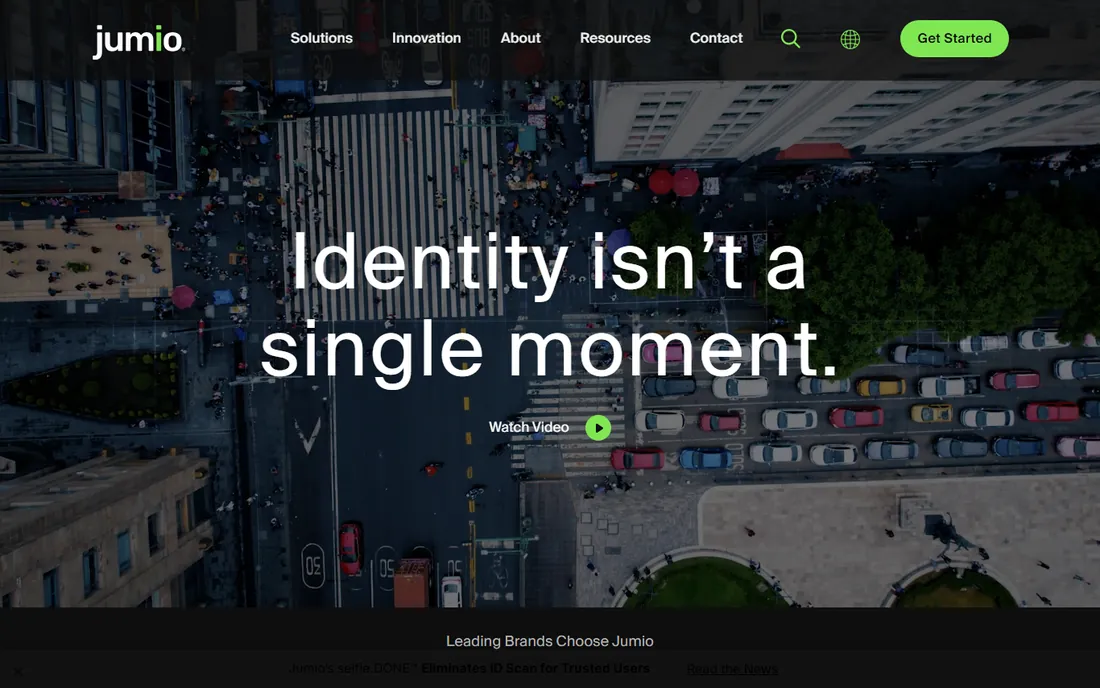
Jumio is the incumbent. Founded in 2010, it has spent 15 years becoming the safe enterprise pick for banks that cannot afford a compliance miss. The KYX platform combines document verification, biometric liveness and face match with watchlist screening and transaction monitoring, and the Identity Graph connects signals across customers and time to surface fraud patterns a single check would miss. Third-party contract data puts per-verification costs roughly between $1.50 and $8 depending on volume, with mid-size contracts landing around $2 to $5.
That positioning is also the limitation. There is no self-serve signup and no free tier, minimum monthly commits are standard, and the sales cycle is an enterprise procurement process. If you run fewer than a few thousand verifications a month, Jumio will tell you so itself by quoting accordingly. For large regulated institutions that want one vendor covering identity and AML with audit-ready evidence, it remains the reference point the others are measured against.
What we like- More than 5,000 ID types across 200-plus countries
- Identity Graph flags reused and synthetic identities
- AML screening with PEP and adverse media bundled in
Watch out for- Custom enterprise pricing among the most expensive
- No self-serve tier for low volumes
- Interface feels dated next to newer rivals
#2
Veriff
Best for: Consumer platforms that need fast self-serve onboarding
Visit veriff.com
Starting price$0.80 per verification ($49/month minimum)
Free planFree trial (15 days)
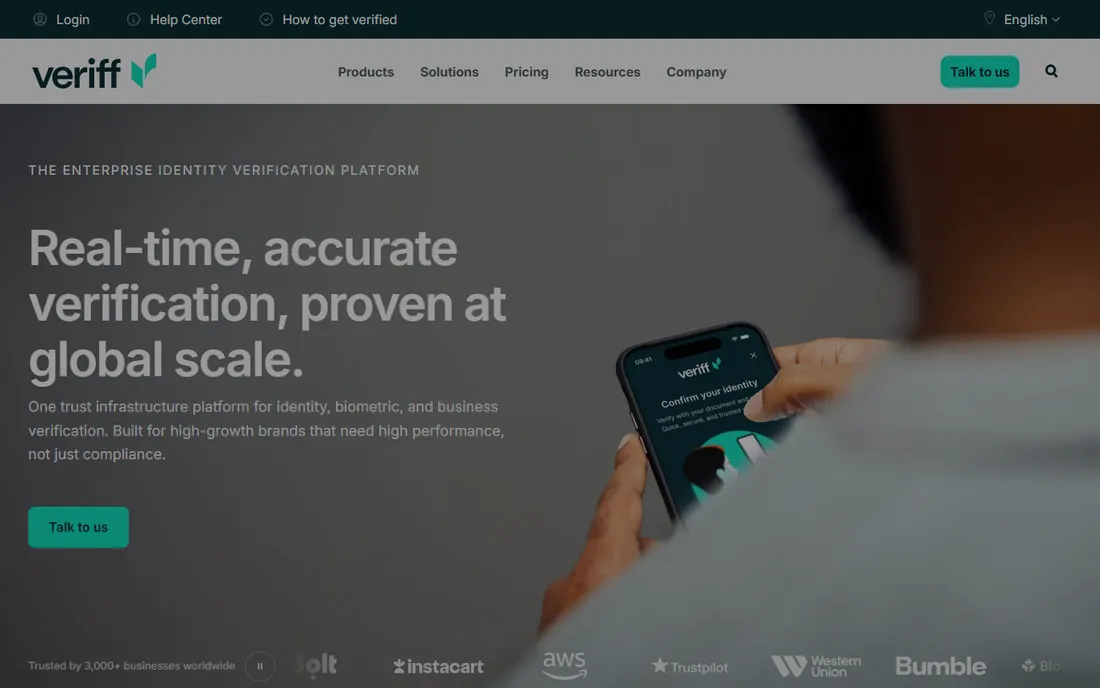
Veriff wins the deals where the signup flow itself is the product. Marketplaces, fintech apps and crypto platforms choose it for conversion: six-second average decisions, a document library covering 230-plus countries, and a verification UX tuned to keep legitimate users from dropping off. Pricing is public and self-serve: Essential at $0.80 per verification with a $49 monthly minimum, Plus at $1.39 with $99 minimum, Premium at $1.89 with $209 minimum. The 15-day trial covers up to 50 real sessions with no credit card, which lets engineering validate pass rates before committing budget.
The trade-off is scope. Veriff is a verification specialist, not a compliance suite: AML screening, ongoing monitoring and transaction oversight are not the core, so heavier compliance programs pair it with a second tool. Per-check pricing also rewards volume commitments, which means the headline $0.80 assumes you can forecast demand. For teams optimizing onboarding conversion at scale, it is the sharpest tool here.
What we like- Published self-serve tiers from $0.80 per verification
- 15-day free trial runs on real verifications
- 13,500-plus document types with roughly 98 percent automation
Watch out for- AML screening is an add-on rather than bundled
- Rates improve only with volume commitments
- Business verification depth is still catching up after the Vespia acquisition
#3
Sumsub
Best for: Crypto, fintech and marketplaces wanting KYC, KYB and AML in one API
Visit sumsub.com
Starting price$1.35 per verification ($149/month minimum)
Free planFree trial (14 days)

If you want one contract covering identity checks, business verification, AML screening and transaction monitoring, Sumsub is the fullest stack on this list. The Basic plan at $1.35 per verification with a $149 monthly minimum covers ID verification, liveness and reusable KYC; the Compliance plan at $1.85 with a $299 minimum adds AML screening, ongoing monitoring and proof-of-address checks. Pricing is published on its own site, the 14-day trial includes 50 free checks, and you pay only for successful verifications, not abandoned sessions.
Sumsub's honest weaknesses are infrastructure-shaped. It is cloud-only, and buyers with strict data sovereignty requirements have flagged the limited residency options. Reviewers also rate its document OCR below the best in class. But for mid-market fintech, crypto and marketplaces that would otherwise stitch together four vendors, the single-API arithmetic usually wins.
What we like- Full compliance stack behind one contract and one API
- Published pricing with a 14-day trial
- Billed only for successful verifications
Watch out for- Cloud-only with limited data residency options
- OCR quality draws some criticism
- The Compliance tier needed for AML screening costs more per check
Starting priceFrom $250/month (Essential plan, 12-month term)
Free planYes
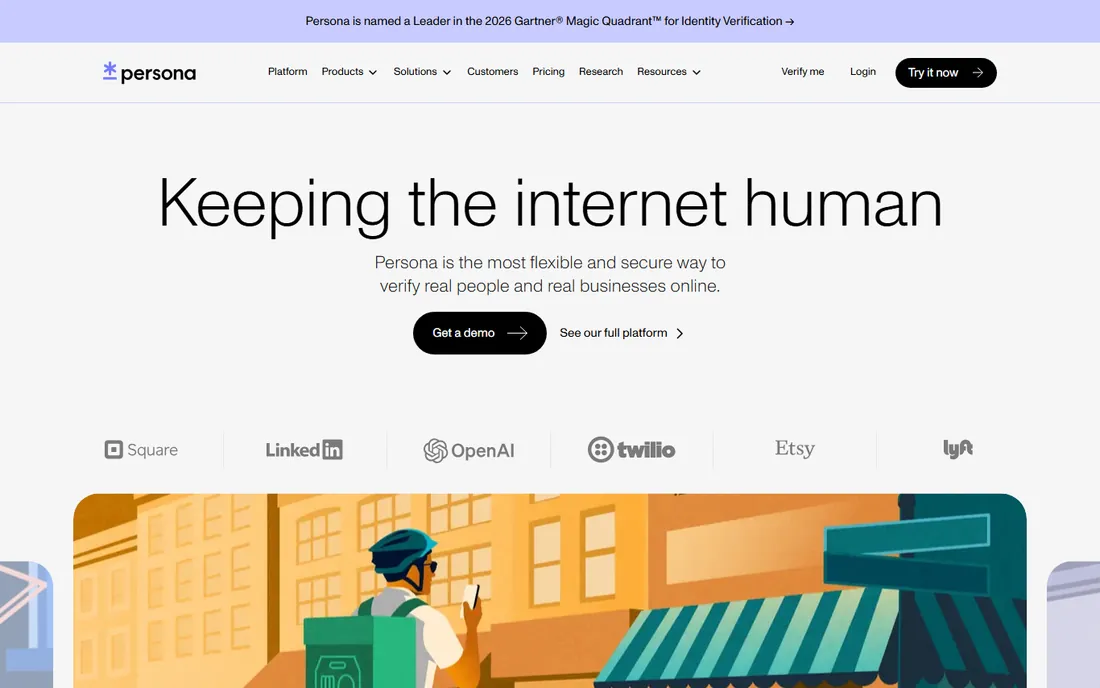
Persona is for teams that think of onboarding as a workflow to design, not an API to call. Its building blocks let compliance and product teams assemble verification steps, risk rules, watchlist checks and manual review queues in a visual builder, then change them without an engineering sprint. Coverage spans 200-plus countries, pairing verification with fraud signals, Graph network analysis and case investigation tools.
The pricing reflects that breadth. The free Starter plan is genuinely useful at 500 government ID verifications a month, and the startup program extends free access for eligible early-stage companies. But the paid Essential plan starts at $250 per month with a 12-month commitment, and costs rise with verification types and volume. Persona earns its price when onboarding logic is a living thing your team iterates on; if you just need document checks at the lowest per-unit cost, simpler APIs are cheaper.
What we like- Visual workflow builder usable by non-technical teams
- Free Starter plan with 500 verifications monthly
- Strong fraud signals with case management and reporting
Watch out for- Paid plans start at $250 per month on annual terms
- Usage costs scale quickly with volume
- Premium pricing next to simpler verification APIs
#5
Entrust Identity Verification
Best for: Enterprises already using Entrust security products
Visit onfido.com
Starting priceSee website
Free planNo
Onfido became Entrust Identity Verification when Entrust closed the acquisition in April 2024, and the transition is still visible: the product pages carry Entrust branding while living on onfido.com, and the SDKs were re-released under the Entrust name in early 2026. You get a mature verification engine with strong capture guidance that reduces retakes, AI document and biometric checks with deepfake detection, and Workflow Studio, a no-code builder for branching flows by risk, geography or product.
Entrust sells through its enterprise sales team with tailored quotes, and there are no public self-serve plans. The natural buyer is an organization already using Entrust for certificates, signing or workforce identity that wants verification inside the same vendor relationship, with eIDAS 2.0 and qualified signature support for European deployments. Everyone else should compare it against Jumio on the enterprise side and Veriff on the conversion side before engaging sales.
What we like- No-code Workflow Studio for risk-based verification flows
- More than 2,500 document types across 195 countries
- Extends to biometric authentication and account recovery
Watch out for- Quote-only enterprise pricing with no public tiers
- The Onfido rebrand is still settling in 2026
- Compliance orchestration beyond verification needs more of the Entrust suite
#6
Trulioo
Best for: Global enterprises verifying people and businesses against data
Visit trulioo.com
Starting priceSee website
Free planNo
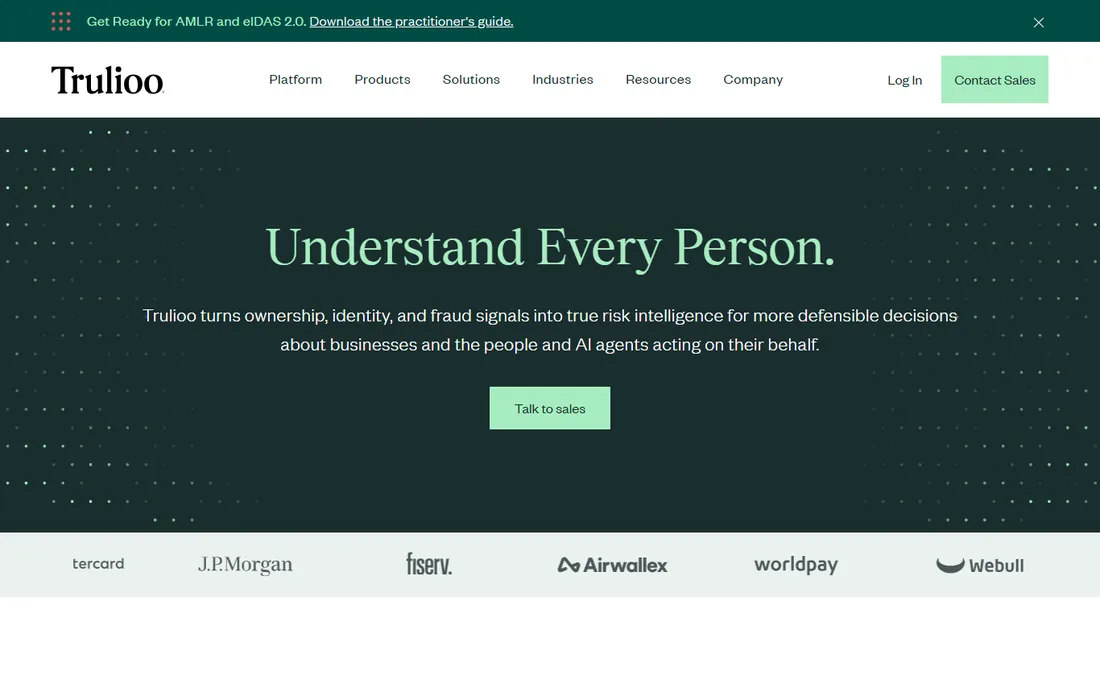
Trulioo takes a different route from the document-selfie vendors: it verifies people against data. The GlobalGateway API matches identity attributes against more than 450 data sources across 195 countries, covering 14,000 ID documents and 700 million business entities with screening against 6,000-plus watchlists. That makes it the pick when customers are hard to reach with a phone camera, when you need business verification (KYB) alongside person verification, or when compliance demands authoritative data-source matching.
The cost of that breadth is enterprise process. Pricing is quote-based, onboarding is a proper integration project with workflow configuration, and the end-user experience is less tuned for consumer conversion than Veriff or Persona. Trulioo fits global enterprises, payment platforms and marketplaces expanding across borders where local data coverage decides pass rates. If your flow is a selfie and a driver's license in one country, you are paying for coverage you will not use.
What we like- Single GlobalGateway API into more than 450 data sources
- Person verification plus business verification plus 6,000 watchlists
- Strongest non-documentary verification coverage
Watch out for- Quote-based enterprise pricing
- Less consumer-UX polish than selfie-first vendors
- Integration is a project, not an afternoon
#7
Alloy
Best for: Banks and fintechs orchestrating identity decisions across many sources
Visit alloy.com
Starting priceSee website
Free planNo
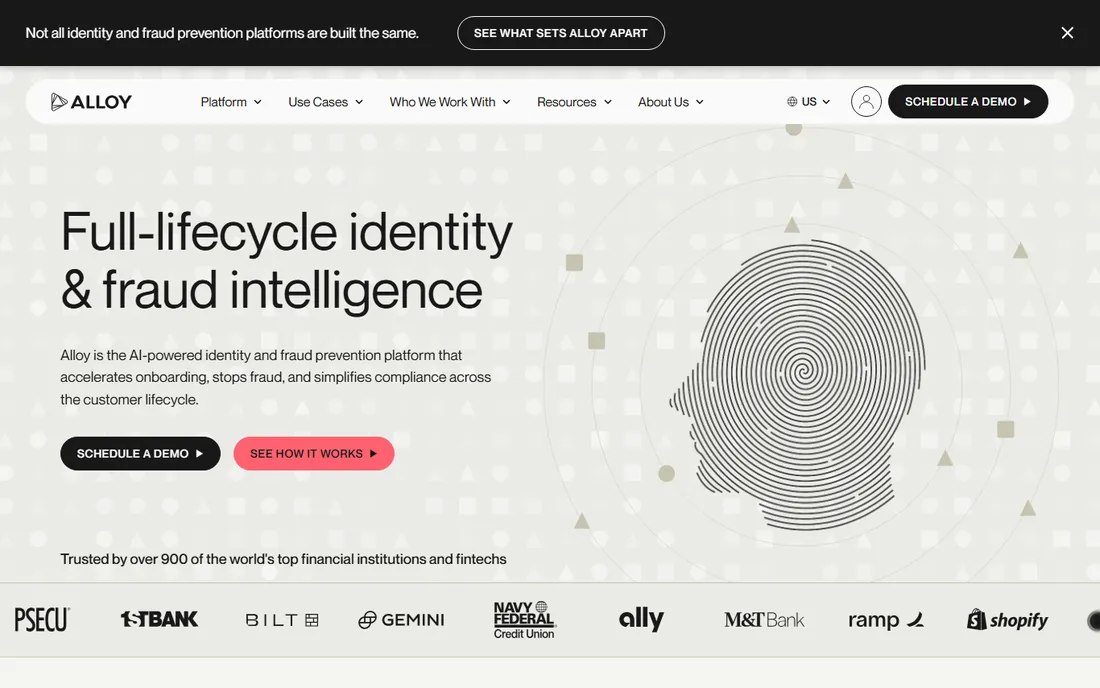
Alloy does not want to be your verification vendor. It wants to be the decisioning layer above all of them. The platform plugs into more than 270 data sources for KYC, KYB, AML, fraud and credit, then runs applicant decisions through rules your risk team configures, with case management and investigation tooling for the exceptions. Alloy cites 98 percent auto-decisioned applicants and sharply reduced manual reviews at client banks.
This is orchestration software with enterprise economics: custom pricing, an implementation that touches your onboarding flow end to end, and the most value for US financial institutions with complex compliance obligations. A startup that needs 500 ID checks a month should not be here; a bank running ten data vendors through spreadsheets probably should. Evaluate Alloy against building the same orchestration in-house, because that is the real alternative.
What we like- One API orchestrating more than 270 identity, fraud and compliance data sources
- High auto-decision rates with full audit trails
- Coverage from onboarding through ongoing monitoring
Watch out for- Enterprise sales cycle with custom pricing
- Deepest value in US financial services
- Overkill if you only need document verification
#8
iDenfy
Best for: Cost-conscious teams that only want to pay for approved checks
Visit idenfy.com
Starting price$1.35 per verification ($135/month minimum)
Free planFree trial (14 days)
iDenfy's pitch is arithmetic: you pay only when a check approves, never for failed attempts, retries or abandoned sessions. For businesses with high fraud rates or messy traffic, that billing unit can beat a lower headline per-check price elsewhere. Self-serve starts at $1.35 per verification with a $135 monthly minimum, no sales call required, and the 14-day trial includes 10 real verifications plus a sandbox. Enterprise tiers drop to $0.55 to $0.75 per approved verification with a dedicated manager and SLAs.
The platform covers 16,000-plus document types across 200-plus countries with 3D liveness and biometric matching, plus human reviewers in the loop. The honest catches are scale-shaped: the monthly minimum prices out hobby projects, and iDenfy lacks the analyst coverage and reference-customer depth of Jumio or Veriff. For price-sensitive teams doing real volume, the pay-per-approved model is the most buyer-friendly billing on this list.
What we like- Pay-per-approved billing means failed checks cost nothing
- Self-serve signup with published pricing
- Human expert review backs the AI on verifications
Watch out for- $135 monthly minimum on the self-serve tier
- Smaller brand with a thinner analyst footprint
- The lowest per-check rates require enterprise volume
Per-verification vs. per-approved: why the billing unit matters
Two vendors can both charge "$1.35 per verification" and produce wildly different invoices, because "verification" does not mean the same thing everywhere. Per-attempt billing charges for every session submitted, including fraud attempts, duplicates and users who photograph their thumb. Per-approved billing, used by Sumsub and iDenfy, charges only when a check completes successfully.
Which one is cheaper depends on your traffic. Clean traffic with high pass rates makes the distinction academic. High-fraud segments, emerging markets with low-quality document photos, or flows with no retry limits can easily see 20 to 40 percent of attempts fail, and per-attempt pricing quietly multiplies the headline rate. When you request quotes, ask for the definition of a billable event in writing, ask how retries and resubmissions are counted, and model the cost at your actual pass rate, not the vendor's benchmark.
How to read a KYC quote without getting burned
What counts as a billable verification
Pin down the billing event before anything else: submitted session, completed check, approved check, or per data-source hit. Some vendors bill add-on checks, AML screening, proof of address, device intelligence, separately per event. A quote that looks cheap on identity verification can double once the checks your compliance officer actually requires are added.
Monthly minimums and volume commitments
Self-serve plans from $49 to $299 a month in minimums look small until your volume dips seasonally and you pay for checks you did not run. Enterprise contracts invert the problem: steep discounts tied to annual volume commits that become penalties if you miss. Forecast honestly, negotiate the commit down rather than the per-check rate up, and confirm what happens to unused volume.
AML screening: included or a second contract
This is the most expensive ambiguity in KYC buying. Jumio bundles PEP, sanctions and adverse-media screening; Sumsub includes it from the Compliance tier; Veriff and Persona treat it as an add-on or a separate workflow. If your regulator expects ongoing monitoring rather than one-time screening, confirm that specifically, because one-time and ongoing are priced as different products.
Data retention and where PII lives
Ask how long biometric and document data is retained, where it is stored, and how deletion works. Regulated buyers should confirm SOC 2 Type II and ISO 27001 reports, GDPR data-processing terms, and whether EU data residency is available. These answers belong in the contract, not the sales deck.
How we chose
We compared platforms on document and country coverage, verification methods (document, biometric, liveness, data-source), AML and ongoing-monitoring depth, integration effort, and pricing transparency, weighted for small and mid-size US buyers rather than only enterprise banks. Research used vendor pricing pages and documentation, 2026 comparison guides, and public reviews on G2 and Capterra, with extra attention to what reviewers named as limitations. No vendor paid for placement.
Frequently asked questions
How much does KYC onboarding software cost?
Self-serve plans run $0.80 to $1.85 per verification with $49 to $299 monthly minimums (Veriff, Sumsub, iDenfy). Enterprise contracts are quote-based and typically land far higher, with third-party data putting mid-size deals around $2 to $5 per verification and large commitments with six-figure annual minimums. Always add AML screening, which is frequently a separate line item.
What is the difference between per-verification and per-approved pricing?
Per-verification (or per-attempt) billing charges for every check submitted, including failures and fraud attempts. Per-approved billing charges only when a check completes successfully. Sumsub and iDenfy use per-approved-style billing. If your pass rates are low, per-approved pricing is usually cheaper even at a higher headline rate.
Do I need AML screening bundled with identity verification?
It depends on your regulator and risk. Banks, lenders, crypto and money-transmitter businesses generally need sanctions, PEP and adverse-media screening plus ongoing monitoring, not just ID checks. Bundled suites (Jumio, Sumsub Compliance) simplify procurement; verification specialists (Veriff) expect you to bring a separate AML tool. Confirm the requirement with your compliance counsel before choosing.
How long does it take to integrate a KYC API?
Self-serve vendors with hosted flows and drop-in widgets (Veriff, Sumsub, Persona, iDenfy) can go live in days for a standard integration. Enterprise platforms with custom workflows, multiple data sources and compliance review (Jumio, Entrust, Trulioo, Alloy) typically take weeks to months including testing and legal review. The sandbox tells the truth: run your real document sample through it before signing.
Can a small startup use these enterprise KYC tools?
Yes, but pick the right tier. Veriff, Sumsub and iDenfy offer self-serve signup with no sales call, and Persona has a free Starter plan and a startup program with 12 months of free access for eligible companies. The enterprise vendors (Jumio, Entrust, Trulioo, Alloy) price themselves out of startup budgets by design; come back when volume justifies it.
Sources we checked (14)
- https://www.veriff.com/plans/self-serve
- http://sumsub.com/pricing/
- http://idenfy.com/blog/kyc-onboarding-software-requirements/
- http://idenfy.com/blog/wordpress-identity-verification/
- https://withpersona.com/blog/free-identity-verification
- https://withpersona.com/startups/
- https://onfido.com/identity-verification/
- https://www.zyphe.com/resources/blog/best-kyc-software-2026
- https://learn.g2.com/best-identity-verification-software
- https://didit.me/blog/onfido-vs-jumio-vs-didit-the-definitive-2026-comparison/
- https://awesomeagents.ai/tools/best-ai-identity-verification-tools-2026/
- https://guptadeepak.com/the-top-10-identity-verification-software/
- https://en.wikipedia.org/wiki/Trulioo
- https://www.prnewswire.co.uk/news-releases/alloy-announces-global-expansion-850639719.html
Is your product missing or out of date?
We review this list regularly. Vendors can request a listing, send updated pricing or ask about featured placement.

Shihab Mia · Founder, Rankite
Shihab has spent more than a decade helping SaaS and e-commerce brands grow through search. He writes Rankite's software buying guides from pricing pages, documentation and public user reviews. More about Shihab.