How we make this list: we compare pricing pages, product documentation and public user reviews. Rankite is independent; if a vendor ever pays for a featured spot, that listing is clearly labeled Partner.
Key takeaways
- The shortlist for most SMBs: Drata (from $7,500/year, Essential) and Secureframe (from $7,500/year, Fundamentals) publish starter prices and bundle SOC 2, ISO 27001 and HIPAA under one contract.
- Vanta publishes no prices: it is the most-cited name in the category, but every buyer talks to sales.
- Hyperproof (from $12,000/year) is the pick for teams that need compliance wired into operations, not just audit prep.
- Archer and LogicGate are enterprise GRC platforms: deep, configurable, and priced like it. SMBs should price the implementation, not just the license.
Quick comparison
| Tool | Best for | Starting price | Free plan |
|---|
 Vanta Vanta | Startups and SMBs that want the most recognized SOC 2 automation brand | See website (custom quote) | No |
 Drata Drata | SMBs that want published pricing with broad framework coverage | From $7,500/year (Essential) | No |
 Secureframe Secureframe | SMBs pursuing SOC 2 and ISO 27001 at the same time | From $7,500/year (Fundamentals) | No |
 Sprinto Sprinto | Mid-market SaaS teams automating audit workflows end to end | From ~$8,000/year | No |
 Scrut Scrut | Teams that want AI-assisted remediation, not just evidence collection | See website (custom quote) | No |
 Hyperproof Hyperproof | Companies managing compliance as an ongoing operation, not a one-time audit | From $12,000/year | No |
 LogicGate LogicGate | Mid-market and enterprise teams that want configurable risk workflows | See website (custom quote) | No |
 Archer Archer | Large regulated enterprises running a full GRC program | See website (custom quote) | No |
 ZenGRC ZenGRC | Teams that want GRC functionality with a simpler interface and lighter services load | See website (custom quote) | No |
Is your product missing or out of date?
We review this list regularly. Vendors can request a listing, send updated pricing or ask about featured placement.
The best compliance management software
According to Vanta's public SOC 2 cost guidance, a SOC 2 Type II audit for a small company typically runs $20,000 to $60,000 before you count the hundreds of staff hours spent on evidence collection. That is the bill these tools are really fighting: not the audit itself, but the manual work around it. The best compliance management software connects to your cloud stack, pulls evidence automatically, tracks control gaps in real time, and hands your auditor a package instead of a shared drive of screenshots.
The nine platforms below span two different markets. Vanta, Drata, Secureframe, Sprinto and Scrut are compliance automation tools built for companies that need certifications like SOC 2 and ISO 27001 to close deals. Hyperproof, LogicGate, Archer and ZenGRC are GRC platforms built for teams managing risk and compliance as an ongoing program. Know which one you are buying before you compare prices.
#1
Vanta
Best for: Startups and SMBs that want the most recognized SOC 2 automation brand
Visit vanta.com
Starting priceSee website (custom quote)
Free planNo
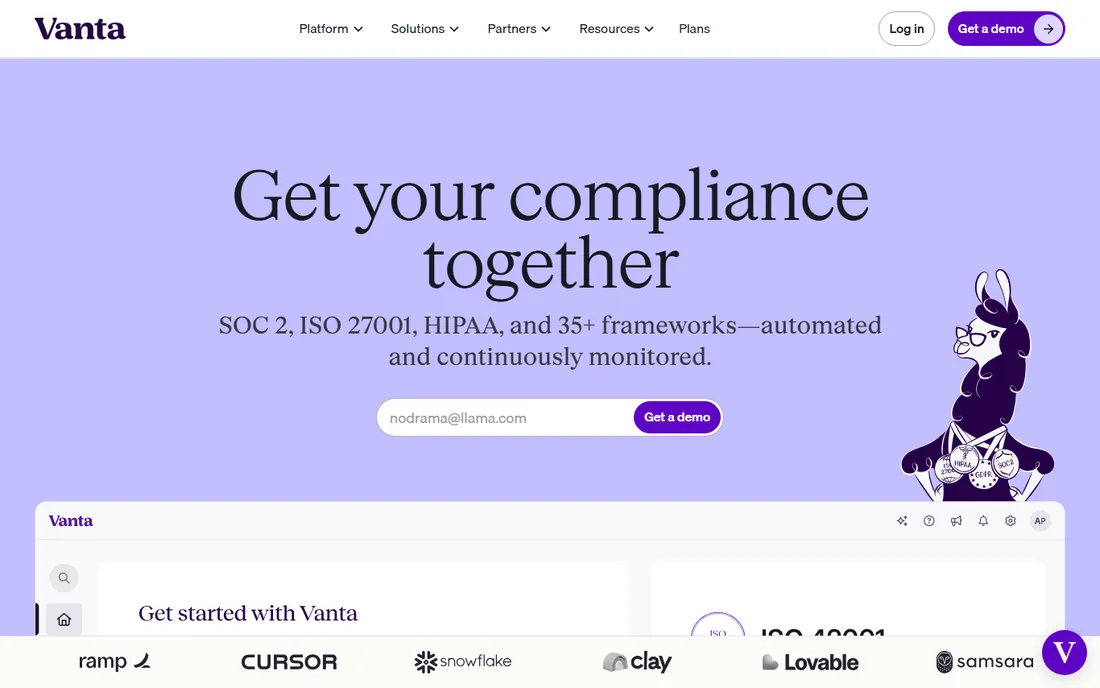
Vanta is the name buyers mention first, and there is a practical reason: auditors know it. Evidence collected in Vanta maps to auditor expectations with less translation work, and the partner network means you can usually find an audit firm that already works with the platform. The integrations are the core value: connect your cloud accounts, identity provider, HR system and issue tracker, and tests run continuously instead of in a frantic month before the audit.
The commercial reality is that Vanta prices everything by quote. Reviewers on G2 consistently flag the sales-led process as the downside: you cannot self-serve a number, and add-on modules like vendor risk or trust centers can shift the final price materially. If you want price transparency today, compare Drata or Secureframe first, then bring Vanta's quote back against them.
What we like- Deep integration catalog covering AWS, GCP, Azure, Google Workspace, Okta and major HR and ticketing systems
- Large auditor partner network, so finding a firm for SOC 2 or ISO 27001 is straightforward
- Strong templates for policies, vendor reviews and access controls
Watch out for- No published pricing, so budgeting starts with a sales call
- Implementation support quality varies by plan tier
#2
Drata
Best for: SMBs that want published pricing with broad framework coverage
Visit drata.com
Starting priceFrom $7,500/year (Essential)
Free planNo
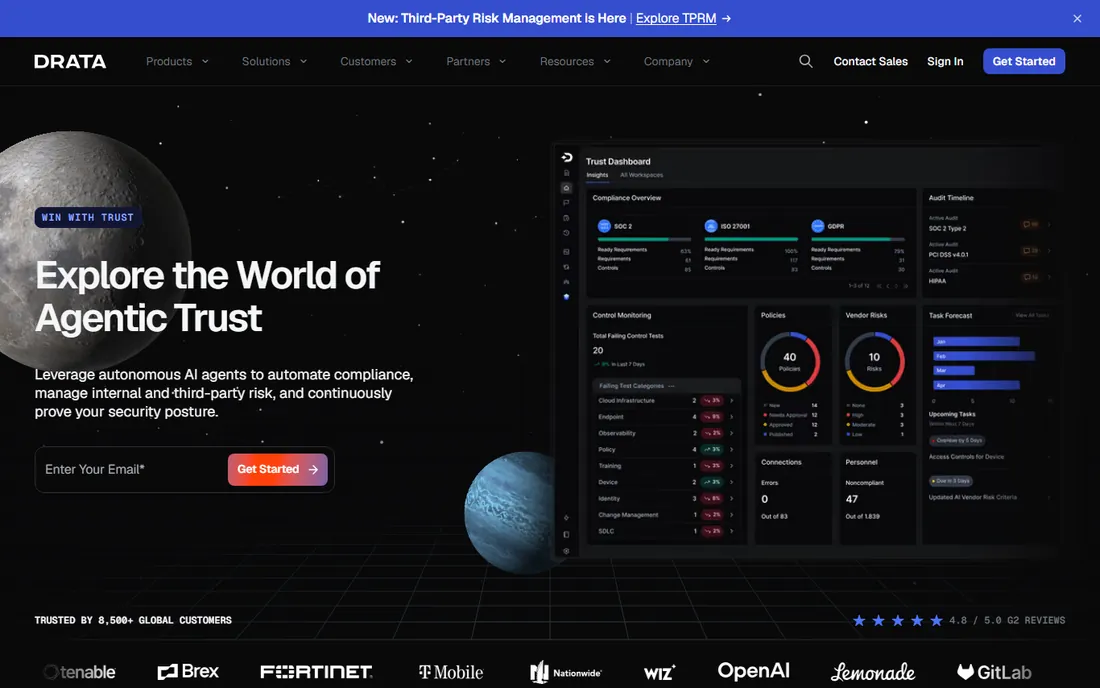
Drata competes with Vanta head-on and wins on one dimension that matters to buyers: you can see a price before talking to anyone. The Essential plan at $7,500 per year is positioned for companies pursuing their first framework, usually SOC 2, with higher tiers adding ISO 27001, HIPAA and the rest. Evidence automation works the same way as the rest of the category: integrations pull proof from your stack, failing controls get flagged, and the auditor portal gives your firm direct access.
The catch is the contract shape. Drata is an annual-commitment product, so the $7,500 figure is real but locked in. Buyers with simple needs sometimes report that the platform has more framework machinery than they use. Compare the tier that covers your actual frameworks, not the headline one.
What we like- Starter price published at $7,500 per year, rare in this category
- Covers SOC 2, ISO 27001, HIPAA, PCI DSS, GDPR and more in one platform
- Continuous control monitoring with automated evidence collection
Watch out for- Annual contracts only, so there is no way to trial the spend quarter by quarter
- Higher tiers get noticeably more expensive for multi-framework programs
Starting priceFrom $7,500/year (Fundamentals)
Free planNo
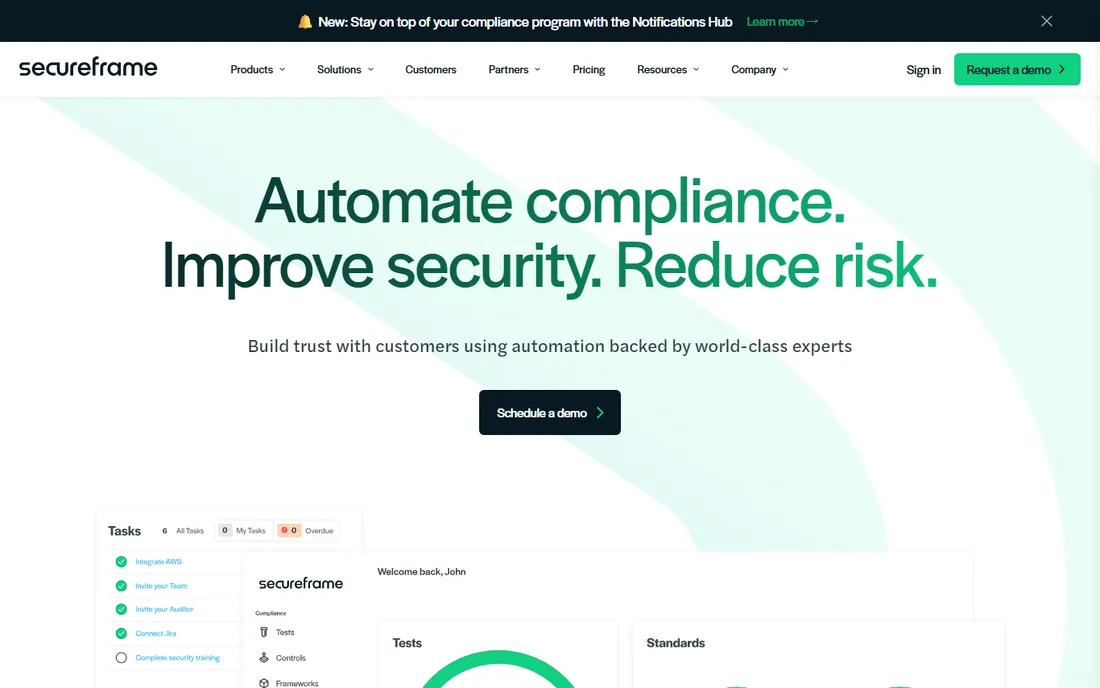
Secureframe's entry tier is the best value in this list for the most common SaaS situation: you need SOC 2 for US enterprise deals and ISO 27001 for international ones, at the same time. Bundling both at $7,500 per year under one plan is something neither Drata's nor Vanta's entry configurations match cleanly. The platform automates evidence collection from your integrations, generates the policies auditors ask for, and runs readiness assessments before the real audit.
Above Fundamentals, pricing moves to quotes, and that is where buyers should slow down. Multi-framework programs with HIPAA or PCI DSS get priced per scope, so the entry price tells you little about a three-framework deal. Get the full framework bundle quoted in writing before committing.
What we like- Fundamentals plan at $7,500 per year includes SOC 2 and ISO 27001 together, a strong pairing for SaaS sellers
- Automated evidence collection plus policy templates
- Dedicated compliance managers on higher tiers
Watch out for- Custom-quoted above the entry tier, so multi-framework costs are opaque
- Onboarding depth varies with plan level
#4
Sprinto
Best for: Mid-market SaaS teams automating audit workflows end to end
Visit sprinto.com
Starting priceFrom ~$8,000/year
Free planNo
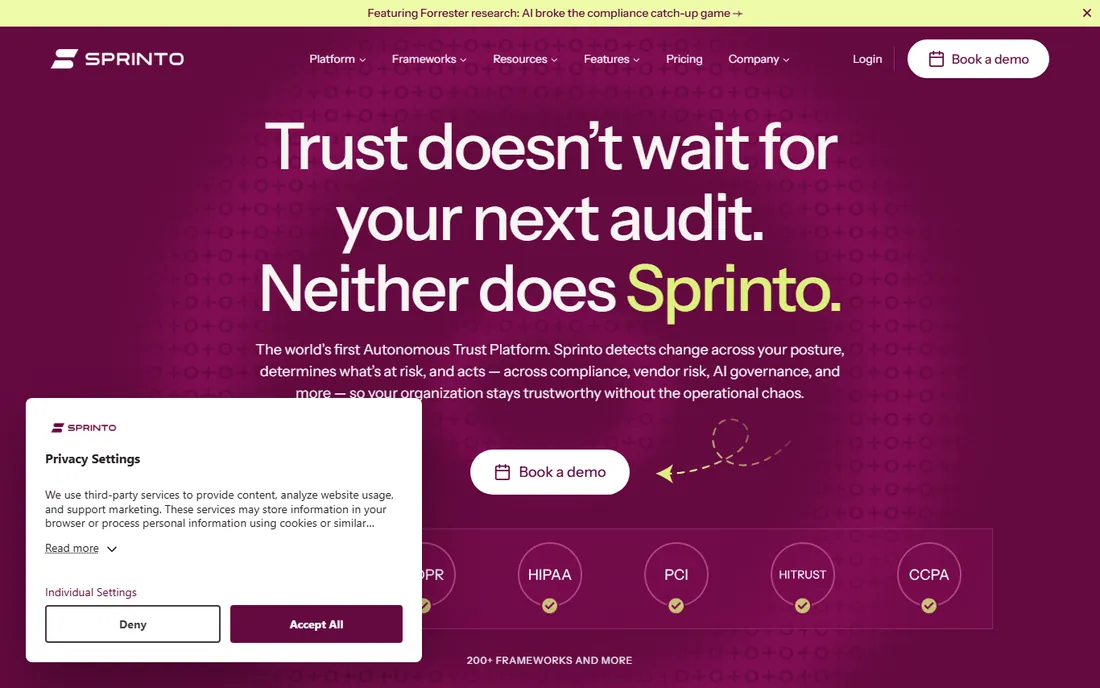
Sprinto sits in the same compliance-automation lane as Vanta and Drata at a slightly lower entry point, around $8,000 per year. The differentiator is workflow: the platform guides the audit from readiness through evidence collection to the auditor's sign-off, with collaboration features that keep the back-and-forth inside the tool instead of in email. Framework breadth is real, with HIPAA, GDPR and CCPA alongside the usual SOC 2 and ISO 27001.
The trade-off is market presence. In the US, auditors are simply more familiar with Vanta and Drata evidence packages, and a few reviewers say Sprinto's newer brand shows in support depth. For teams that do not need the brand premium, the entry price is worth a demo. Ask for a reference customer in your framework before signing.
What we like- Coverage across 20-plus frameworks including SOC 2, ISO 27001, HIPAA, GDPR and CCPA
- Guided audit workflow with auditor collaboration built in
- Positioned below Vanta and Drata on entry cost
Watch out for- Brand recognition lags Vanta and Drata, which some auditors notice
- Support responsiveness is mixed in public reviews
#5
Scrut
Best for: Teams that want AI-assisted remediation, not just evidence collection
Visit scrut.io
Starting priceSee website (custom quote)
Free planNo
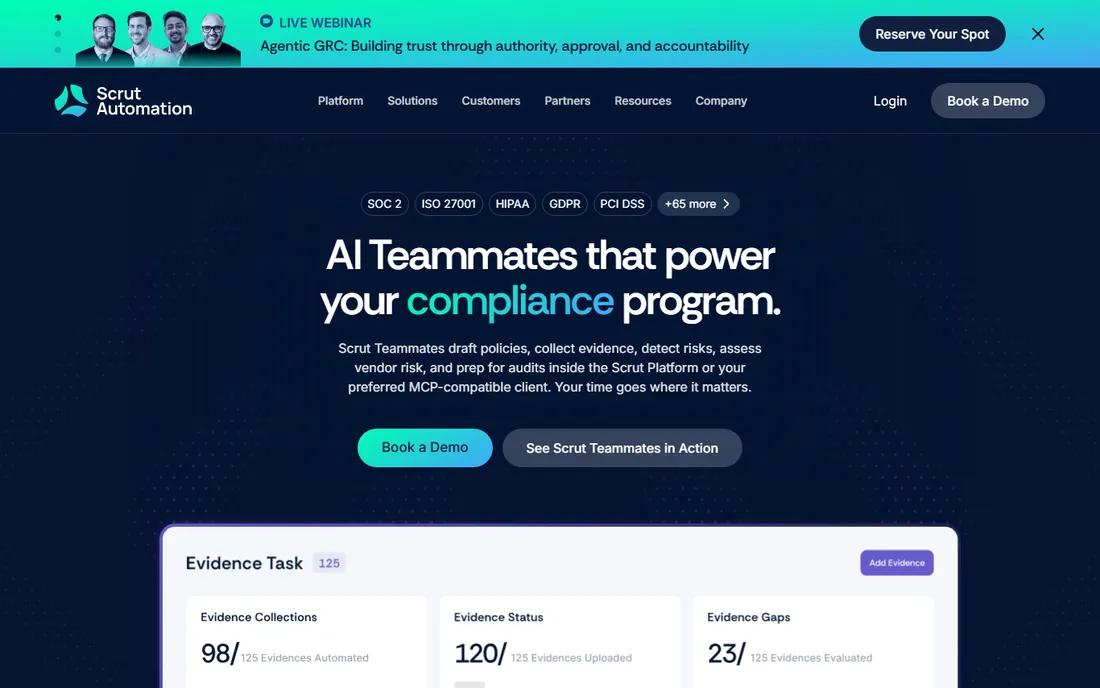
Scrut Automation takes the compliance-automation formula and adds an AI layer that tells you how to fix problems, not just that problems exist. Evidence collection, control monitoring and audit prep work the way they do elsewhere, but the platform's AI teammates guide remediation steps and risk assessments, which is where teams without a dedicated compliance hire usually stall. The G2 2025 award suggests customer satisfaction is holding up as it grows.
The pricing story is the weak point: nothing is published, and third-party sources list no starting figure. That makes it hard to shortlist on budget. If the AI-assisted approach appeals to you, run the demo and push for a fixed quote with your framework count locked in.
What we like- AI-driven guidance for remediation, risk assessments and compliance tasks on top of standard automation
- Named a Top 50 GRC product in G2's 2025 Best Software Awards
- Pre-built frameworks, policies and templates for fast implementation
Watch out for- No published pricing anywhere, so every deal starts with sales
- Smaller customer footprint in the US than Vanta or Drata
#6
Hyperproof
Best for: Companies managing compliance as an ongoing operation, not a one-time audit
Visit hyperproof.io
Starting priceFrom $12,000/year
Free planNo
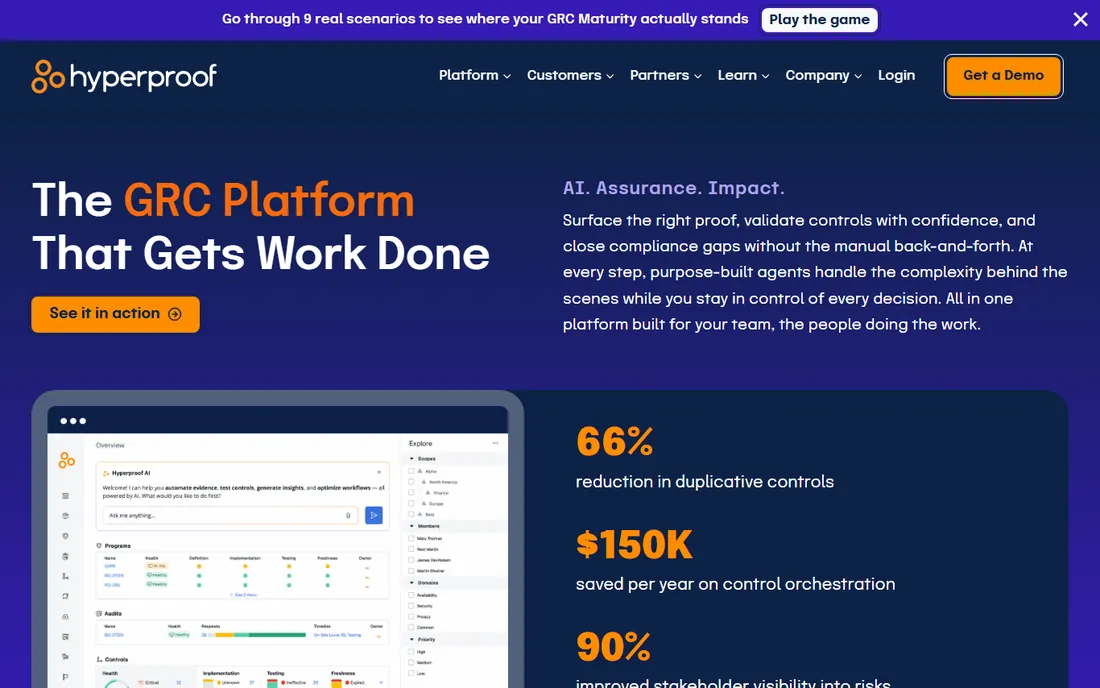
Hyperproof is where this list shifts from audit prep to program management. The platform maps a single control to every framework that requires it, so one piece of evidence satisfies SOC 2, ISO 27001 and PCI DSS at once. Risk registers, audit workspaces and task management make it a daily operations tool for compliance teams rather than a pre-audit scramble. That is the design goal: compliance as a standing program, not a yearly project.
The price reflects it. At $12,000 per year to start, it costs more than the automation-first tools, and companies chasing a single certification will not use half the platform. Buy it if you have, or plan to hire, someone who owns compliance full-time. Otherwise the cheaper automation tools do the audit job.
What we like- Built for continuous compliance programs with controls mapped across frameworks
- Strong risk management and audit management modules beyond certification prep
- Integrations with Jira, ServiceNow, Okta and major cloud platforms
Watch out for- Entry price of $12,000 per year is above the automation-first tools
- Overkill for a company that just needs one SOC 2 report
#7
LogicGate
Best for: Mid-market and enterprise teams that want configurable risk workflows
Visit logicgate.com
Starting priceSee website (custom quote)
Free planNo
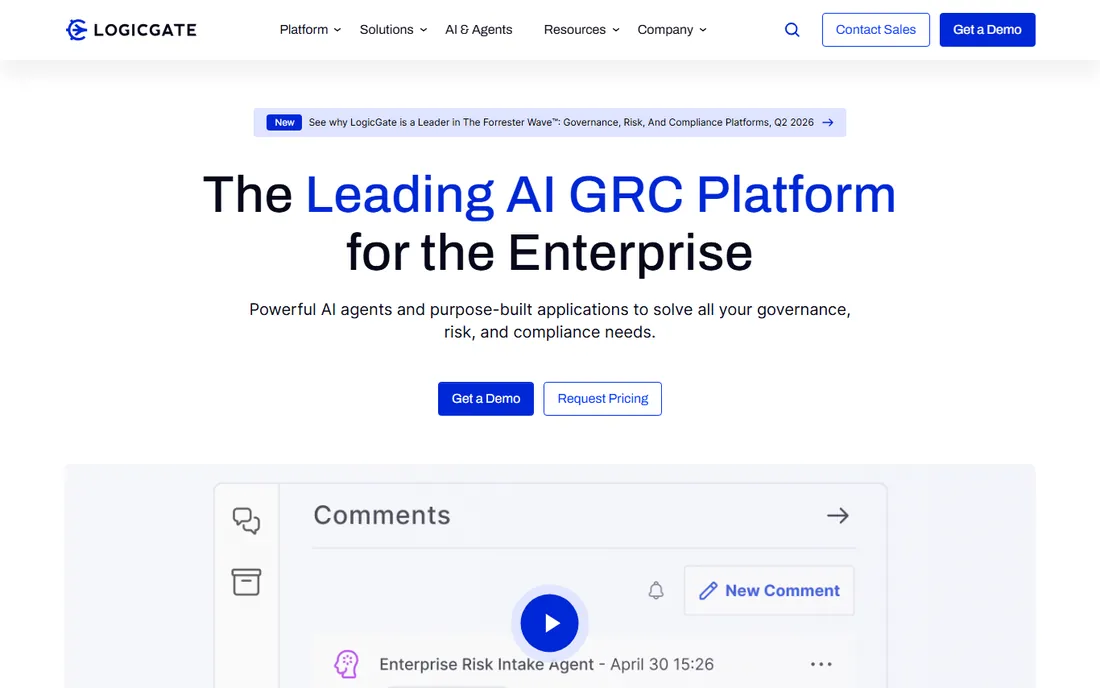
LogicGate's Risk Cloud is the configurable option in this set. Instead of a fixed compliance workflow, you get a no-code builder and a library of prebuilt applications for third-party risk management, policy management, controls testing and incident response. That flexibility is the selling point for teams whose compliance needs do not fit a standard template, and whose auditors ask for evidence shaped a particular way.
Flexibility has a cost: implementation is a project, not a sign-up, and pricing is fully custom with enterprise budgets assumed. LogicGate competes with Archer and ServiceNow GRC, not with Drata. If you cannot name the workflows you need to build, you do not need this much tool yet.
What we like- No-code Risk Cloud platform lets teams build custom risk and compliance workflows without developers
- Strong application library for third-party risk, policy management and incident response
- Professional services team for complex implementations
Watch out for- Enterprise-grade pricing with no public numbers, and implementation is a real project
- Not sized or priced for companies under a few hundred employees
Starting priceSee website (custom quote)
Free planNo
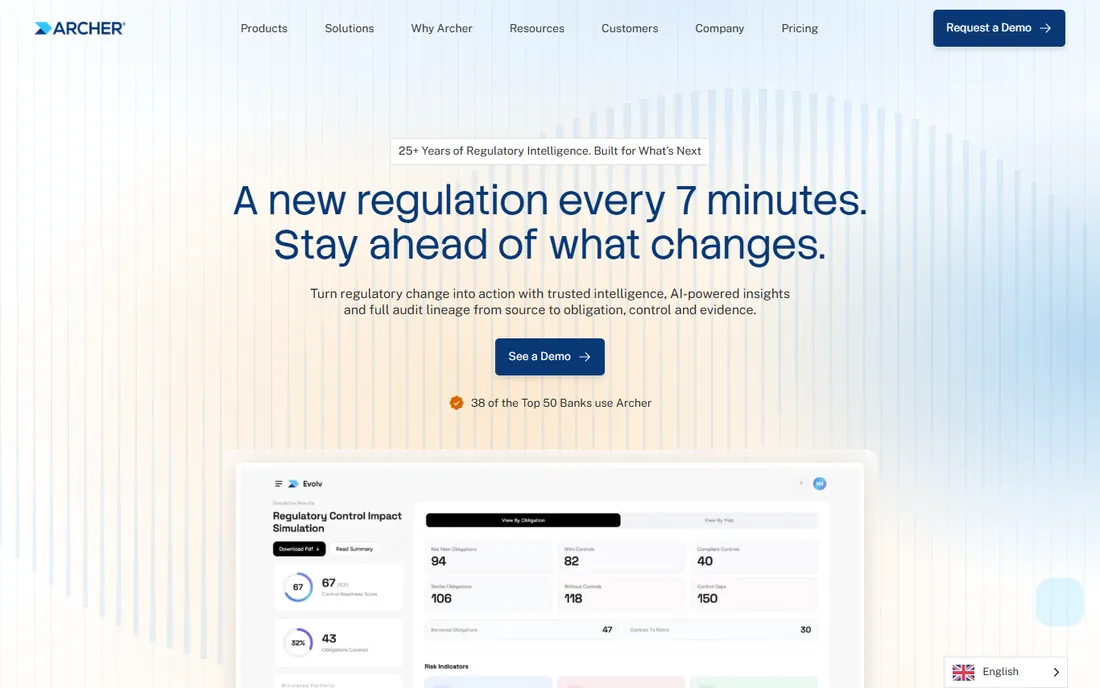
Archer is the incumbent of enterprise GRC, with a 25-year history and a customer base the company says includes half the Fortune 500. The platform covers the full GRC scope: regulatory change management, third-party risk, IT and security risk, audit management and policy management, all on data models built for the domain rather than adapted from general workflow tools. For banks and insurers facing overlapping regulators, that depth is the point.
None of this applies to a 50-person SaaS company. Archer is priced and implemented for enterprises: expect a six-figure commitment and a real implementation program. It belongs on this list because enterprise buyers search this category too, but SMBs should treat it as the price ceiling, not an option.
What we like- The deepest track record in the category, with more than 1,300 organizations running on the platform per the company's own reporting
- Purpose-built GRC data models covering regulatory change, third-party risk and IT risk
- Strong fit for banking and other heavily regulated sectors
Watch out for- Enterprise pricing and implementation timelines put it far outside SMB budgets
- The platform's depth means dedicated administrators are usually needed
#9
ZenGRC
Best for: Teams that want GRC functionality with a simpler interface and lighter services load
Visit zengrc.com
Starting priceSee website (custom quote)
Free planNo
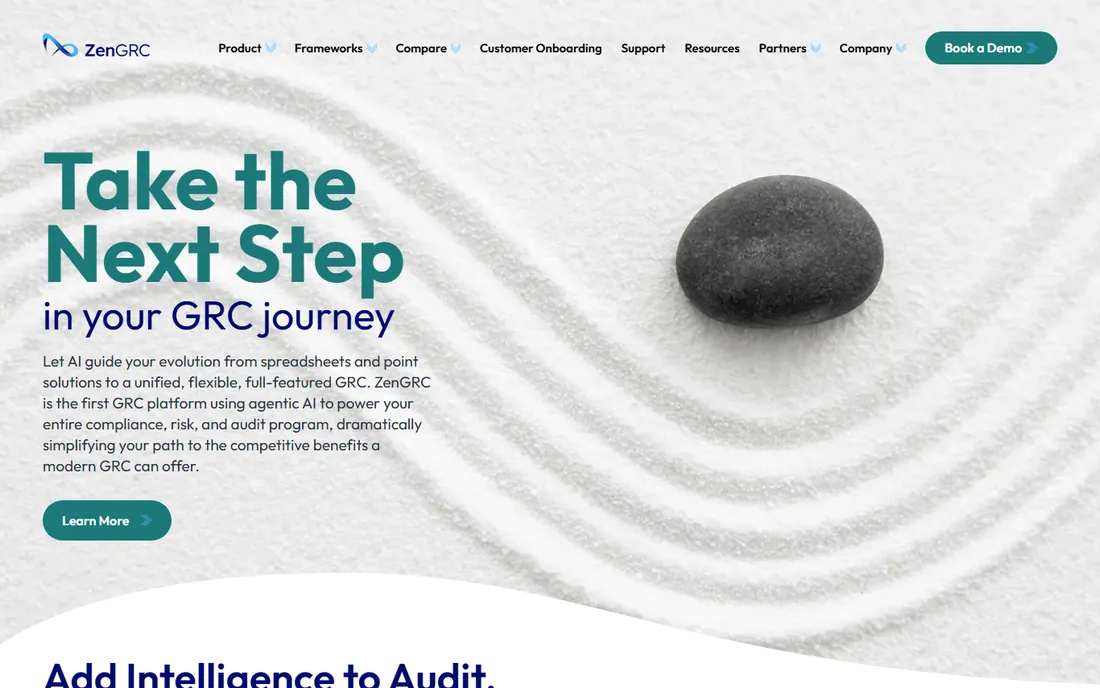
ZenGRC positions itself as the GRC platform you can actually run without a consulting engagement. The interface is the differentiator reviewers mention most: where Archer and LogicGate feel like infrastructure, ZenGRC reads like a modern SaaS product. It stores risk and compliance data in one place, automates routine tasks, and supports custom frameworks for teams with requirements outside the standard set.
The gaps are the usual ones for a mid-tier GRC tool. Pricing is not published, the integration ecosystem is smaller than the enterprise players, and banks with complex regulatory mapping will likely outgrow it. For a mid-market company building its first real GRC program, the usability is worth pricing against Hyperproof and LogicGate.
What we like- Cleaner, more modern interface than legacy GRC tools, which shortens the learning curve
- Single system of record for risk and compliance data
- AI automation features for tasks and insights
Watch out for- No published pricing
- Narrower third-party ecosystem than Archer or LogicGate
- Enterprise credibility is thinner in heavily regulated industries
The most expensive mistake in this category is buying a GRC platform when you need audit automation, or the reverse. If your goal is one certification to unblock enterprise sales, usually SOC 2, you want the automation tier: Vanta, Drata, Secureframe, Sprinto or Scrut. If your goal is managing risk, vendors, policies and multiple audits as a standing program, you want the GRC tier: Hyperproof, LogicGate, Archer or ZenGRC. The price gap between the tiers starts around $4,000 a year and widens fast once services are involved.
Scope your frameworks before you talk to sales. Every vendor quotes on framework count, and adding ISO 27001 or HIPAA later means a renegotiated contract. List the frameworks your buyers actually require in the next 18 months, not the ones that sound impressive. A company that needs SOC 2 only should not pay for a five-framework bundle.
Then price the whole deal, not the license. Ask each vendor for three numbers in writing: the annual license for your framework set, the implementation or onboarding fee, and the cost of the audit itself through their partner network. The audit fee is often the largest line item, and it is separate from every platform on this list. A $7,500 platform with a $40,000 audit is a $47,500 project. Compare projects, not licenses.
Finally, check contract length against your runway. The automation tools generally want annual commitments; the GRC platforms often want multi-year ones. If you are pre-revenue or between funding rounds, a vendor that will not do a one-year term is telling you something about how they treat small customers. Get the renewal cap in writing too, because year-two price increases are where these deals quietly double.
Frequently asked questions
How much does compliance management software cost?
For the automation tier, entry prices run $7,500 to about $12,000 per year: Drata and Secureframe start at $7,500, Sprinto at about $8,000, Hyperproof at $12,000. Vanta, Scrut, LogicGate, Archer and ZenGRC are custom-quoted. Budget the audit separately: a SOC 2 Type II audit alone typically costs $20,000 to $60,000 for a small company.
What is the difference between compliance automation and GRC software?
Compliance automation tools (Vanta, Drata, Secureframe, Sprinto, Scrut) connect to your systems, collect evidence and prepare you for a specific certification. GRC platforms (Hyperproof, LogicGate, Archer, ZenGRC) manage the ongoing program: risk registers, vendor risk, policies and multiple frameworks as a standing operation. Buy automation for your first audit; buy GRC when compliance becomes someone's full-time job.
Do I need SOC 2, ISO 27001 or HIPAA first?
Follow your buyers. US enterprise customers ask for SOC 2. International buyers and many RFPs ask for ISO 27001. Healthcare customers and anyone touching protected health information need HIPAA. Most SaaS companies start with SOC 2 because it unblocks the most revenue, then add ISO 27001 in year two. Do not pursue a framework no customer has asked for.
How long does it take to get SOC 2 certified with one of these tools?
Plan on three to six months for a first SOC 2 Type II, including the observation period, with the platform compressing the evidence-collection work rather than the audit timeline. Type I can be faster, often six to ten weeks. The platform shortens preparation; the auditor still sets the schedule.
Can a small team run compliance without hiring a compliance manager?
For a first SOC 2, yes: the automation tools are designed for exactly this, with templates, guided workflows and auditor partners. Once you run multiple frameworks, manage vendor risk or face customer security questionnaires weekly, the work usually justifies a hire. Hyperproof and the GRC platforms assume that hire exists; the automation tools do not require one.
SOC 2 vs. ISO 27001 vs. HIPAA: which framework first
SOC 2 is the US SaaS default. It is an attestation, not a certification: an auditor verifies that your controls meet the Trust Services Criteria over an observation period, and the resulting report is what enterprise buyers ask to see during procurement. It is not a law and no regulator requires it, but in practice it is the price of selling to mid-market and enterprise customers in the US. If your pipeline is stalling on security reviews, SOC 2 Type II is almost always the first move.
ISO 27001 is the international equivalent with a different shape. It certifies an information security management system against a published standard, and the certificate is recognized globally, which is why European and APAC buyers ask for it. The work overlaps heavily with SOC 2: most controls you build for one satisfy much of the other. Companies that sell internationally usually pursue both, and platforms like Drata and Secureframe are priced around exactly that pairing.
HIPAA is different in kind. It is US law governing protected health information, and it applies the moment you store, process or transmit PHI, whether or not any customer asks for a report. There is no HIPAA certification; vendors can only be HIPAA-compliant, usually demonstrated through a SOC 2 report with HIPAA criteria included or a third-party assessment. If you touch PHI, start here for legal reasons, then add SOC 2 for commercial ones. If you do not touch PHI, ignore HIPAA marketing and spend the money on SOC 2.
How we chose
We started with the categories buyers search: compliance management software, GRC software, SOC 2 automation and compliance software for small business. For each candidate we opened the vendor's own pricing page, checked prices against public reviews on G2 and Capterra and practitioner discussion on Reddit, and compared framework coverage, evidence automation, auditor networks and company-size fit. Where a price could not be verified on the vendor's page we wrote "See website" rather than guessing.
Sources we checked (11)
- https://www.vanta.com
- https://www.drata.com
- https://www.secureframe.com
- https://www.sprinto.com
- https://www.scrut.io
- https://www.hyperproof.io
- https://www.logicgate.com
- https://www.archerirm.com
- https://www.zengrc.com
- https://www.g2.com/categories/compliance-management
- https://www.capterra.com/compliance-software/
Is your product missing or out of date?
We review this list regularly. Vendors can request a listing, send updated pricing or ask about featured placement.

Shihab Mia · Founder, Rankite
Shihab has spent more than a decade helping SaaS and e-commerce brands grow through search. He writes Rankite's software buying guides from pricing pages, documentation and public user reviews. More about Shihab.