How we make this list: we compare pricing pages, product documentation and public user reviews. Rankite is independent; if a vendor ever pays for a featured spot, that listing is clearly labeled Partner.
Key takeaways
- Ramp, Brex, BILL Spend & Expense and Float all offer genuinely free tiers, so small teams can get real spending oversight without a software bill.
- Ramp and Brex are the strongest free options for US companies: unlimited virtual cards, automated expense capture and real budgets at $0 per user.
- Navan wins when travel dominates your spend; Rippling wins when spend policies should follow HR data; Payhawk and Pleo lead for European operations.
- Airbase, now part of Paylocity, is the mid-market pick for deep AP automation, while Mesh Payments suits global enterprises running travel and expense across dozens of countries.
Quick comparison
| Tool | Best for | Starting price | Free plan |
|---|
 Ramp Ramp | Startups and SMBs that want full finance software free | $0 per user/month (Plus $15 per user/month) | Yes |
 Brex Brex | Companies that need global cards and banking in one place | $0 per user/month (Premium $12 per user/month) | Yes |
 BILL Spend & Expense BILL Spend & Expense | SMBs that want free spend control plus access to credit | $0 per user/month | Yes |
 Rippling Rippling | Companies that want spend rules driven by employee data | From $8 per employee/month plus base fee (custom quote) | No |
 Navan Navan | Companies where travel is the biggest uncontrolled spend | See website (custom quote) | No |
 Payhawk Payhawk | European companies and multi-entity finance teams | See website (custom quote) | No |
 Airbase Airbase | Mid-market teams that want AP and spend on one controlled platform | See website (custom quote) | No |
 Float Float | Canadian businesses that want spend control in CAD and USD | $0 (Free Essentials plan) | Yes |
 Pleo Pleo | European SMBs that want simple per-user pricing | $14 per user/month (billed annually) | No |
 Mesh Payments Mesh Payments | Global enterprises running travel and expense across many countries | See website (custom quote) | No |
Is your product missing or out of date?
We review this list regularly. Vendors can request a listing, send updated pricing or ask about featured placement.
The best desktop software for spending oversight
#1
Ramp
Best for: Startups and SMBs that want full finance software free
Visit ramp.com
Starting price$0 per user/month (Plus $15 per user/month)
Free planYes
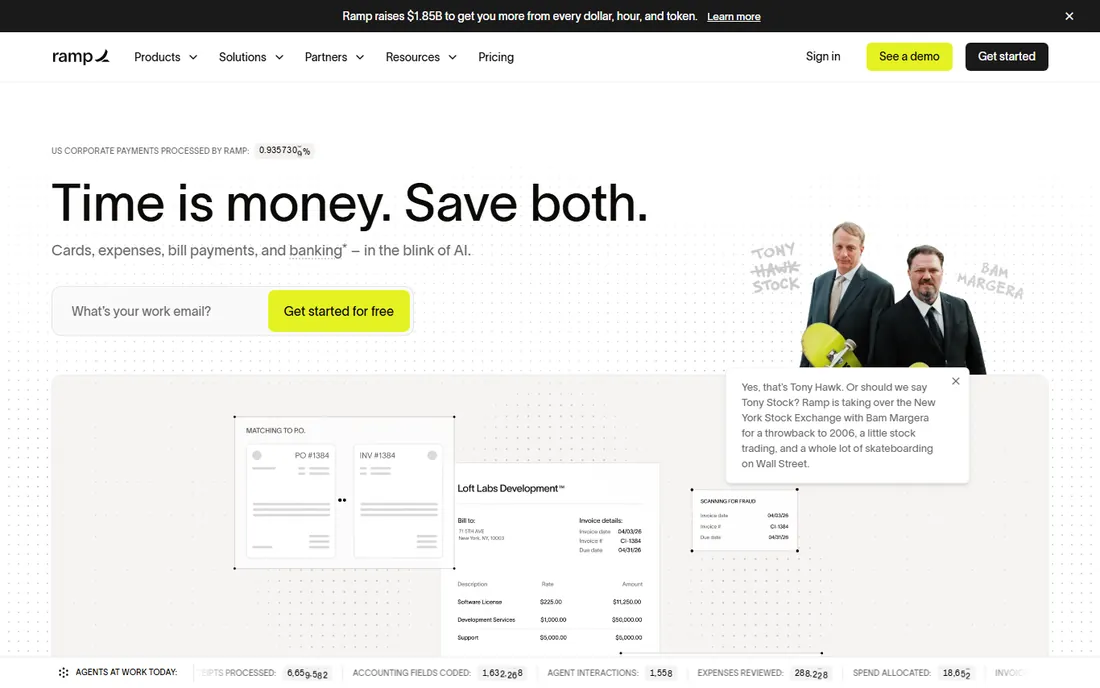
Ramp’s free tier is the most generous in this category. At $0 per user per month you get corporate cards with issuing controls, travel booking with policy enforcement, accounts payable with OCR invoice extraction and approval workflows, accounts receivable, vendor management and banking, with QuickBooks Online and Xero integrations. Startups run entire back offices on the free plan.
The catch is the upgrade path. Ramp Plus at $15 per user per month adds AI-driven expense reviews, NetSuite and Sage Intacct integrations and multi-entity support, but also layers a platform fee based on team size, so model the total before committing. Free-tier support is chat-based, and international banking depth trails the paid tiers.
What we like- Free tier covers cards, travel, AP, AR and banking at $0 per user
- AI agents automate coding, approvals and fraud checks
- Unlimited physical and virtual cards
Watch out for- Plus adds a platform fee on top of per-user pricing
- Free-tier support is chat and AI only
- Banking features are US-centric
#2
Brex
Best for: Companies that need global cards and banking in one place
Visit brex.com
Starting price$0 per user/month (Premium $12 per user/month)
Free planYes
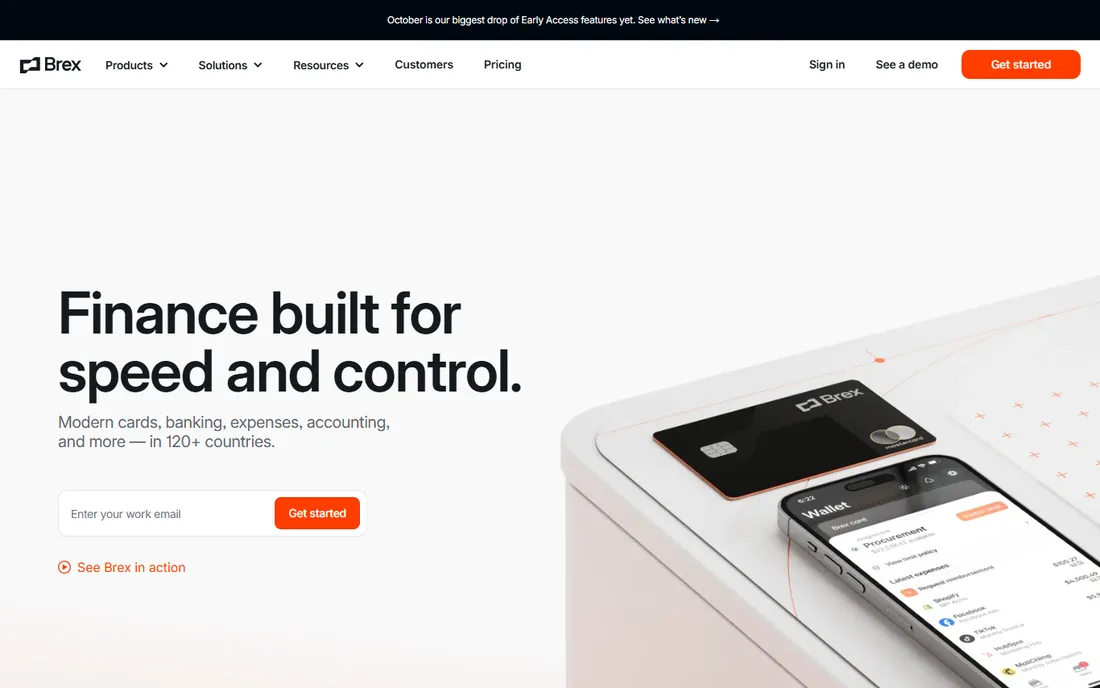
Brex pairs spending oversight with a real financial stack. The free Essentials plan includes global card acceptance, AI-powered spend rules, bill pay, reimbursements, travel booking and accounting integrations at $0 per user. Where Brex separates from Ramp is global reach and treasury: local-currency cards and billing in 50-plus countries, plus a business account earning yield with up to $6M in additional FDIC insurance through program banks.
The Premium tier at $12 per user per month adds the controls that matter as you scale: customizable expense policies with role-based exceptions, dynamic approval chains, AI compliance audit detection and live budgets. Brex suits startups planning to operate internationally from early on.
What we like- Essentials tier is free with global cards and bill pay
- Local-currency cards in 50-plus countries
- Built-in treasury earning yield on cash
Watch out for- Premium features like live budgets and advanced approvals cost $12 per user
- Banking runs through partner banks
- Card rewards favor higher spend volumes
#3
BILL Spend & Expense
Best for: SMBs that want free spend control plus access to credit
Visit bill.com
Starting price$0 per user/month
Free planYes
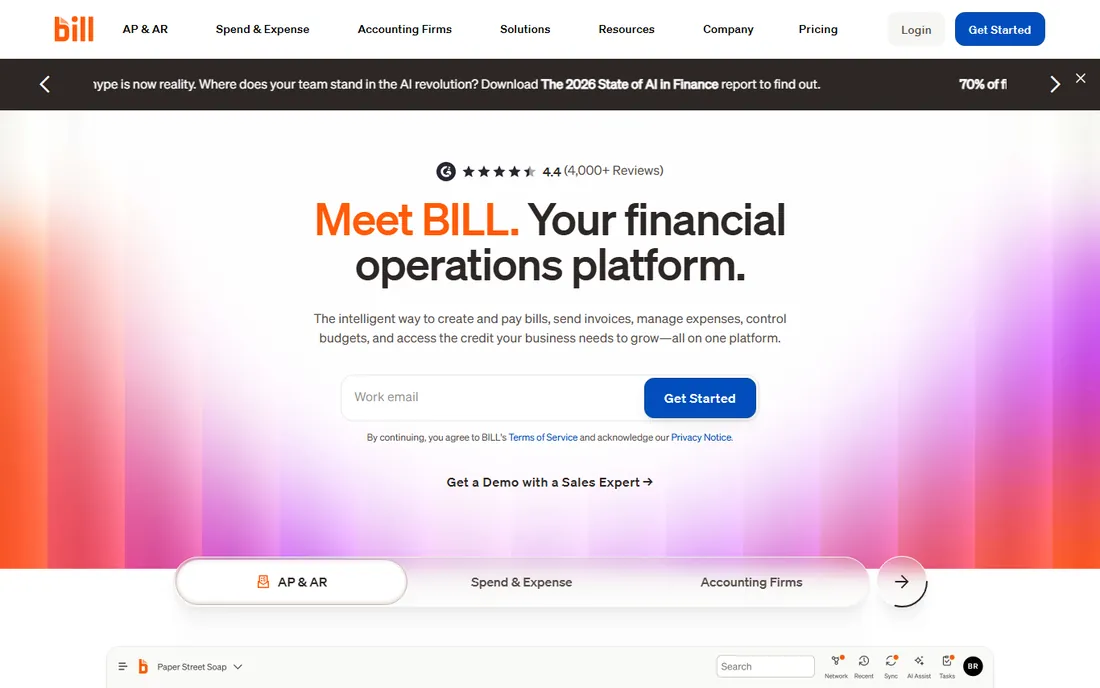
BILL Spend & Expense, the former Divvy, is free in the way that matters: no subscription or per-user fees, so adding cardholders never raises your software bill. You get corporate cards, budgets, expense tracking and access to credit lines from $1,000 to $5M, with AI working behind the spend controls.
The honest framing is that Spend & Expense is one module of the BILL financial operations platform. Accounts payable and accounts receivable are paid subscriptions, so the full procure-to-pay picture costs extra. Credit approval is not guaranteed, and the card product runs through Divvy Pay’s bank partners rather than BILL itself. Use it standalone for free spend control, or as the on-ramp to BILL’s wider platform.
What we like- Completely free with no per-user software fees
- Credit lines from $1,000 to $5M
- Plugs into BILL’s AP and AR platform when you need it
Watch out for- AP and AR are paid subscriptions sold separately
- The card is the BILL Divvy card issued via bank partners
- Credit lines are not guaranteed on approval
#4
Rippling
Best for: Companies that want spend rules driven by employee data
Visit rippling.com
Starting priceFrom $8 per employee/month plus base fee (custom quote)
Free planNo
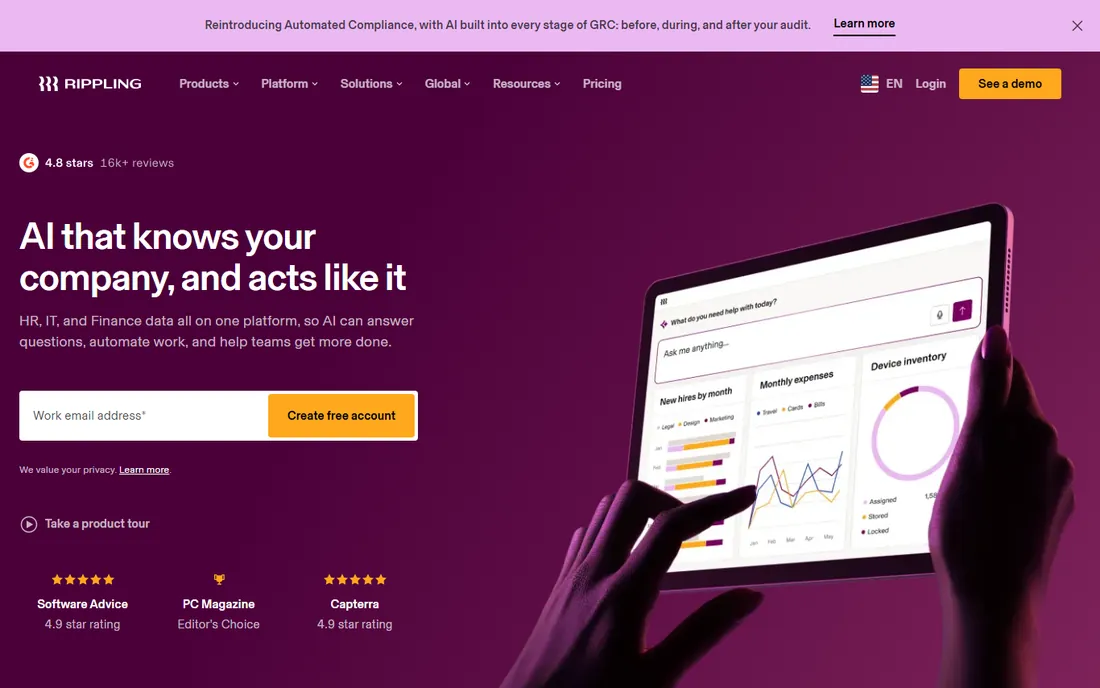
Rippling’s advantage is data most spend tools cannot see. Because HR, IT and finance run on one system, a new hire’s card limits, approval chain and department coding can be set from their employee record on day one, and update automatically when they change roles. Offboard an employee and their cards, devices and app access close together.
The pricing is the least transparent here: plans start at $8 per employee per month with a monthly base fee, and your total depends on the products you select. That modularity is a strength and a trap, since each added product raises the bill.
What we like- Spend policies inherit HR data like role, department and location automatically
- One platform for HR, IT and finance
- Strong reporting across systems
Watch out for- Quote-based pricing with a monthly base fee
- Modular products mean costs stack as you add apps
- Overkill if you only need expense management
#5
Navan
Best for: Companies where travel is the biggest uncontrolled spend
Visit navan.com
Starting priceSee website (custom quote)
Free planNo
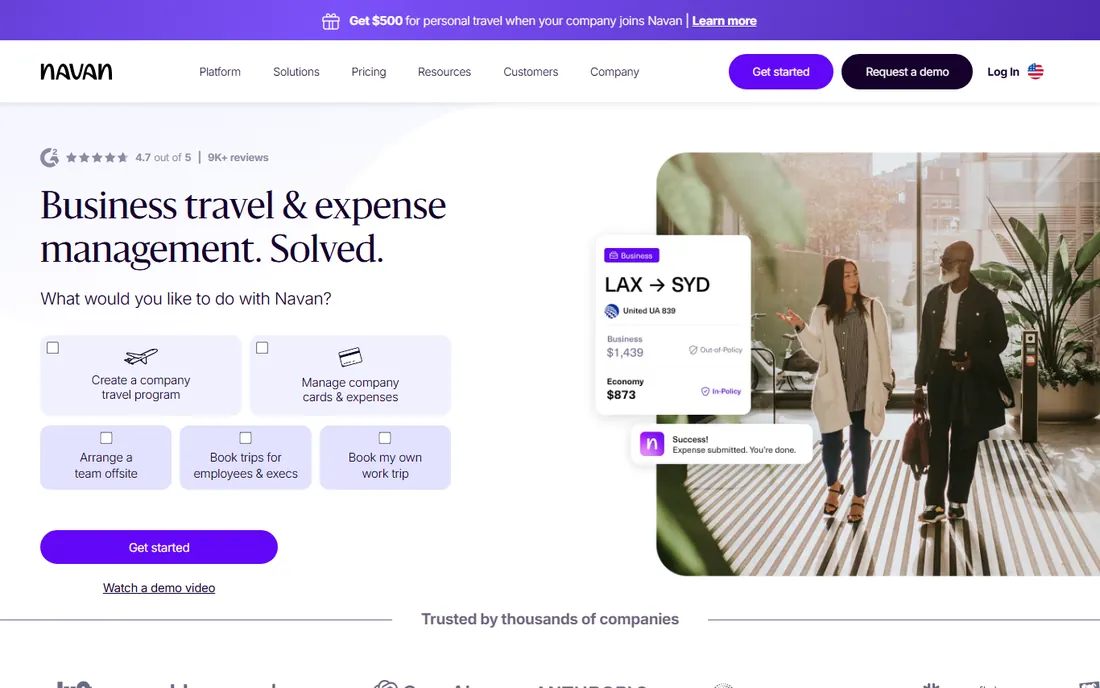
Navan, formerly TripActions, is the travel spend specialist that grew into expense management. Employees book flights, hotels and cars inside policy from one inventory, with an AI travel assistant and 24/7 human agents when plans break. Navan Rewards incentivizes booking under budget. Swipe-to-reconciliation automation handles categorization, reports and reimbursements, and Navan Connect extends the controls to cards you already hold.
The trade-off is scope. Navan’s depth is travel and expense; it does not try to be a full AP platform like BILL or Airbase, and companies with heavy vendor payments will need a companion tool. Pricing is entirely custom. Choose Navan when travel is the spend category leaking money.
What we like- Best-in-class travel booking with AI assistance and 24/7 human support
- Navan Connect brings oversight to your existing Visa, Mastercard or Amex cards
- Expense automation from swipe to reconciliation
Watch out for- Custom pricing with no public tiers
- Travel-first design means less AP and procurement depth
- Rewards structure favors frequent travelers
#6
Payhawk
Best for: European companies and multi-entity finance teams
Visit payhawk.com
Starting priceSee website (custom quote)
Free planNo
Payhawk takes a different approach to cards: instead of issuing its own, it connects to the corporate card programs you already have and layers spend management on top. That matters for established companies that cannot rip out existing banking relationships. The platform covers cards, expenses, invoice management, travel expenses and multi-entity management, with AI that the company says reconciles 98% of expenses without back-and-forth, plus NetSuite, Dynamics 365 and Sage Intacct integrations.
Payhawk is headquartered in Europe, holds EU and UK EMI licenses as a Visa principal member, and is built for multi-entity operations across countries. Pick Payhawk when your spend spans European entities and you want to keep your existing cards.
What we like- Links to your existing Amex, Visa or Mastercard programs instead of forcing new cards
- Strong multi-entity and ERP integration depth
- AI agents reconcile spend in real time
Watch out for- Custom pricing with no public tiers
- US presence is newer than its European base
- Smaller ecosystem than US-native rivals
#7
Airbase
Best for: Mid-market teams that want AP and spend on one controlled platform
Visit airbase.com
Starting priceSee website (custom quote)
Free planNo
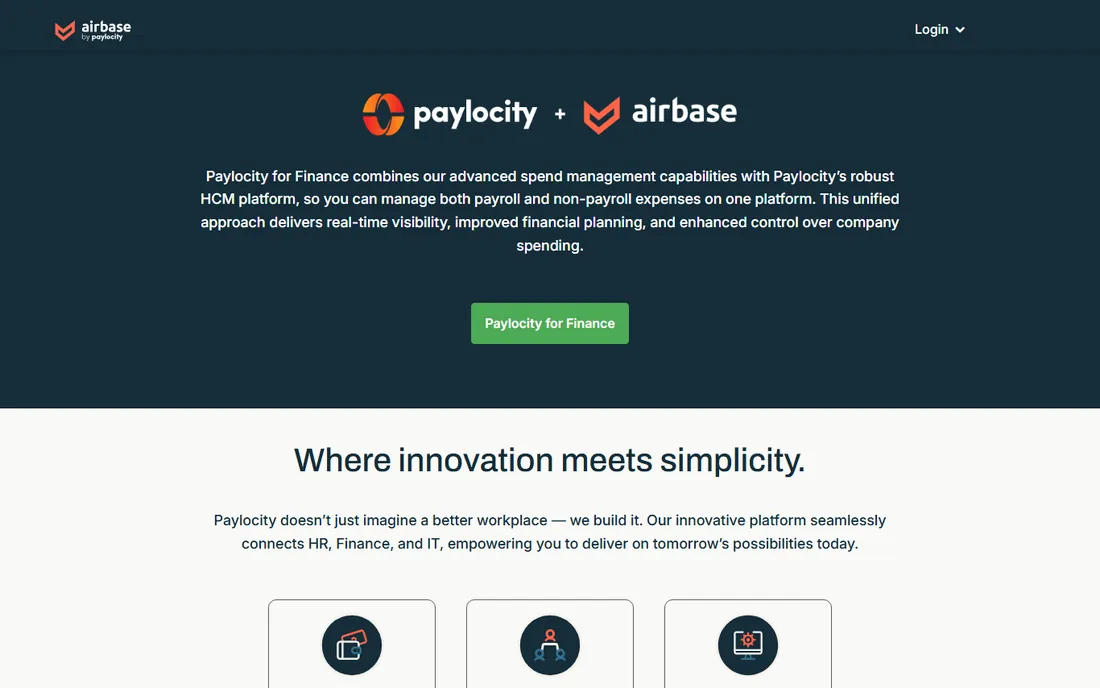
Airbase built its name on approval-driven spend: every payment, whether card, ACH, check or virtual card, flows through configurable approval policies with real-time visibility into committed spend against budgets. Paylocity acquired Airbase in 2024, and the product now sits inside Paylocity for Finance, combining spend management with Paylocity’s HR and payroll platform.
The acquisition is both the opportunity and the risk. Integration with Paylocity’s HCM suite is genuinely useful for mid-market companies that want one employee record driving both payroll and spend. But acquisitions reshuffle roadmaps, so confirm the Airbase experience you evaluate is the one you will get. Pricing is quote-based. Shortlist Airbase for AP-heavy mid-market teams, especially those already on or considering Paylocity.
What we like- Deep AP automation with guided procurement and real-time reporting
- Now combined with Paylocity’s HCM platform for payroll plus non-payroll spend
- Strong approval policy engine
Watch out for- Custom pricing
- The Paylocity acquisition means product roadmap uncertainty
- Heavier implementation than card-first tools
Starting price$0 (Free Essentials plan)
Free planYes
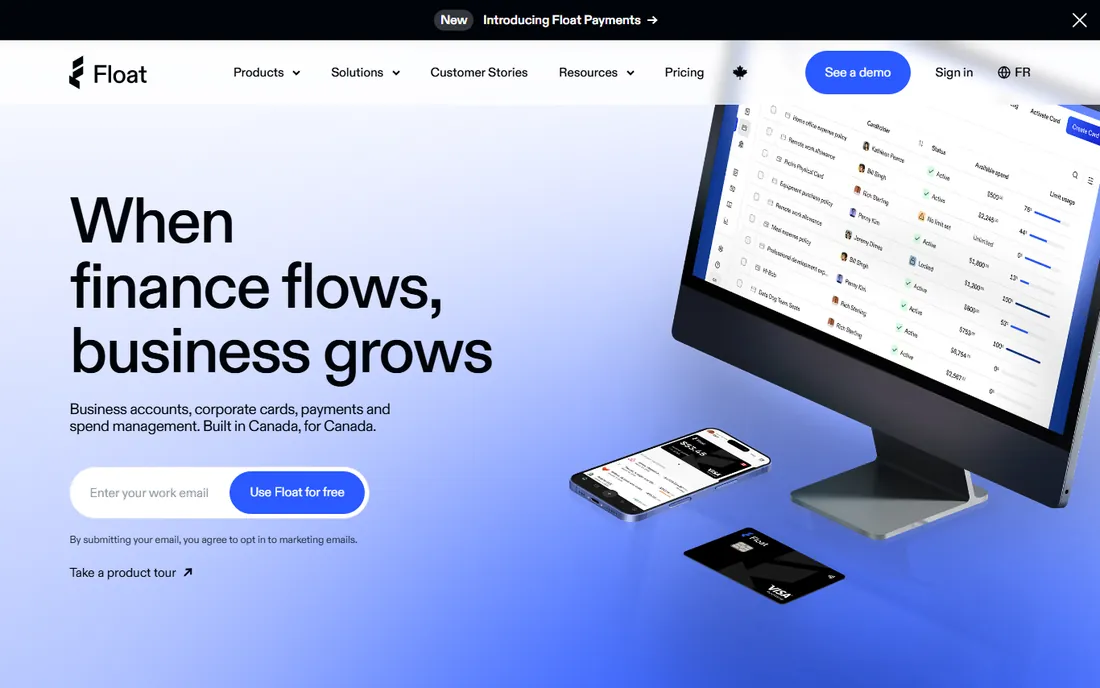
Float is the Canadian answer to Ramp and Brex. The free Essentials plan gives spend control and payments at $0, and the platform issues unlimited CAD and USD corporate cards with built-in controls, free domestic EFT, ACH and SEPA payments, and FX conversion the company says runs 90% below bank rates. Canadian-trained AI handles receipt matching and transaction coding, with direct exports to QuickBooks, Xero and NetSuite.
The limitation is geographic by design. Float is built in Canada for Canada: CDIC coverage, Canadian compliance expertise and local support. US businesses should look at the free tiers above instead.
What we like- Free Essentials plan covers spend control and payments at $0
- Built for Canadian compliance with CDIC coverage and bilingual support
- Dual-currency cards with low FX fees
Watch out for- Canada-focused, not a fit for US-only operations
- Advanced features sit on paid tiers
- Smaller scale than US category leaders
#9
Pleo
Best for: European SMBs that want simple per-user pricing
Visit pleo.io
Starting price$14 per user/month (billed annually)
Free planNo

Pleo is the straightforward European SMB option. Pricing is published and simple: Build at $14 per user per month billed annually adds reimbursements, mileage, approval workflows and AI spend guidelines, while Optimise at $18 adds cashback, budgets, HRIS integrations and AI expense review. The product covers cards, bill pay and bookkeeping sync, with 40,000-plus companies on the platform and a 4.8 out of 5 G2 rating.
The constraints are a three-user minimum and a European center of gravity. There is no free tier, so the smallest teams will find Ramp or BILL cheaper. Choose Pleo for a European small or mid-size business that wants predictable per-user pricing without a sales negotiation.
What we like- Transparent published pricing from $14 per user
- 40,000-plus companies across Europe
- AI expense reviews catch out-of-policy spend automatically
Watch out for- Three-user minimum on paid plans
- Europe-centric with less US depth
- No free tier
#10
Mesh Payments
Best for: Global enterprises running travel and expense across many countries
Visit meshpayments.com
Starting priceSee website (custom quote)
Free planNo
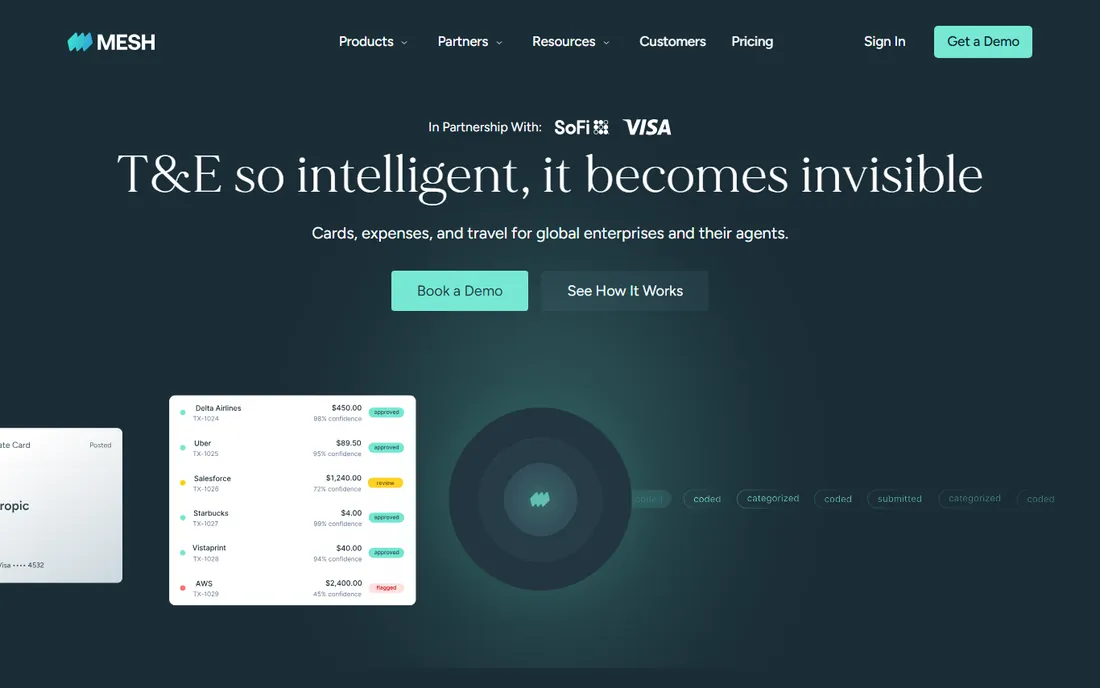
Mesh Payments promises invisibility: an orchestration layer over your existing ERP, HRIS and card programs, checking policy and coding transactions as they happen without a migration project. Employees book travel however they want, through a TMC, airline site or AI agent, and the layer picks up the transaction, benchmarks it and clears it. Local-currency Visa cards in 40-plus countries and a WhatsApp-native AI assistant round out the global story.
This is enterprise software with enterprise buying: custom quotes and implementation scoping. A fifty-person domestic company will not get value from the orchestration story. But for a multinational drowning in fragmented regional T&E processes, Mesh’s no-migration approach is a genuine differentiator. Evaluate it when global coverage matters more than per-seat price.
What we like- Orchestration layer works over your existing stack with no migration
- Local-currency Visa cards in 40-plus countries
- AI assistant operates in WhatsApp, Slack and email
Watch out for- Enterprise focus with custom pricing
- Overkill for small domestic teams
- Newer brand with a smaller reference base than incumbents
How we chose
We started from the buyer’s question: which desktop software gives a small or mid-size business real oversight of spending. We verified every product’s current homepage in October 2026 and pulled pricing only from each vendor’s own pricing page, which is why several entries read “See website”. We favored tools with free tiers where they exist, checked that card, expense and approval features work on desktop, and weighted multi-entity support, ERP integrations and pricing-model honesty. We did not run paid pilots. We read the pricing pages, feature documentation and current reviews, then matched each tool to the buyer it fits.
What to check before you buy
Spending oversight software looks similar in demos. These checks separate the tools that control spend from the ones that just report it.
Controls must come before the purchase
The defining feature here is pre-spend control: card limits, approval chains and policy rules that stop out-of-policy spending before it happens. Ask every vendor to demo a policy-violating purchase and show where it gets blocked. Tools that only reconcile after the fact are trackers, not oversight.
Count the real per-user cost
Free tiers are genuinely free at Ramp, Brex, BILL and Float, but paid plans hide extras. Ramp Plus adds a platform fee on top of per-user pricing. Rippling charges a base fee plus per-employee pricing that stacks with each module. Model twelve months with your actual headcount, including approvers who need seats, before comparing headline numbers.
Verify the accounting integration depth
Every vendor lists QuickBooks, Xero and NetSuite. The difference is whether transactions sync automatically with correct GL coding, or export as CSVs your bookkeeper fixes at month end. Ask for a reference customer on your exact accounting software. Shallow integrations quietly recreate the manual work you bought the software to kill.
Match the tool to your spend shape
Travel-heavy companies should start with Navan or Mesh. Card-heavy startups fit Ramp or Brex. Complex vendor payments need BILL or Airbase. European multi-entity operations suit Payhawk or Pleo. Canadian companies should evaluate Float first.
Why so many free tiers exist
Spend management vendors make money on interchange: every card swipe earns them a slice of the merchant fee. That is why Ramp, Brex, BILL and Float can offer full-featured free plans; the software is the acquisition channel for card volume. Free tiers are not trials and do not expire, but the vendor’s incentive is your team spending more on their cards. Use the free controls aggressively: set tight limits, require approvals and review the analytics. Paid tiers reserve the advanced policy engines and ERP depth for paying customers, so growing companies should budget for the upgrade when headcount or entity count forces it.
Frequently asked questions
What is spending oversight software?
Spending oversight software gives finance teams control over company purchases before and after they happen: corporate cards with limits, approval workflows, expense reporting, bill pay and real-time budget visibility. It replaces the company credit card free-for-all with policies enforced automatically.
Is free spend management software actually free?
Yes, with a caveat. Ramp, Brex, BILL Spend & Expense and Float all offer free plans with no per-user software fees, funded by card interchange revenue. They are not time-limited trials. The caveat is that advanced features sit on paid tiers, and the vendor profits when your team spends more on its cards.
Ramp vs Brex: which is better?
Both offer strong free tiers. Ramp’s free plan covers more finance functions, including AP, AR and banking, making it the better all-in-one choice. Brex leads on global reach with local-currency cards in 50-plus countries and built-in treasury. Either beats a traditional corporate card program.
Do I need spend management software if I have QuickBooks?
QuickBooks records spending; it does not control it. Spend management tools add pre-purchase approvals, card limits, receipt capture and policy enforcement that QuickBooks lacks. The integration matters more than the overlap: the best setups push coded, approved transactions into QuickBooks automatically, which is exactly what the free tiers of Ramp, Brex and BILL do.
How long does implementation take?
Card-first tools like Ramp, Brex and Pleo can be live in days: issue cards, set limits, connect the accounting software. Platform tools like BILL, Airbase and Rippling take weeks because approval chains, vendor data and HR syncs need configuration. Start with a pilot team before rolling out company-wide.
Can these tools replace our AP software?
Some can. BILL and Airbase are genuine AP platforms with bill capture, approval routing and payment execution. Ramp includes AP on its free tier. Pure expense tools like Pleo handle expenses well but leave complex vendor payments to dedicated AP software. Match the tool to whether your pain is employee spend or vendor bills.
Sources we checked (10)
- https://www.ramp.com/pricing
- https://www.brex.com/pricing
- https://www.bill.com/pricing
- https://www.rippling.com/pricing
- https://navan.com/
- https://payhawk.com/
- https://airbase.com/
- https://floatfinancial.com/
- https://www.pleo.io/pricing
- https://meshpayments.com/
Is your product missing or out of date?
We review this list regularly. Vendors can request a listing, send updated pricing or ask about featured placement.

Shihab Mia · Founder, Rankite
Shihab has spent more than a decade helping SaaS and e-commerce brands grow through search. He writes Rankite's software buying guides from pricing pages, documentation and public user reviews. More about Shihab.