How we make this list: we compare pricing pages, product documentation and public user reviews. Rankite is independent; if a vendor ever pays for a featured spot, that listing is clearly labeled Partner.
Key takeaways
- If speed is the priority, SaaS platforms (Druva, Backblaze) deploy in days because there is no hardware to rack and no infrastructure to build; agent-based suites take longer but protect more workload types.
- Veeam remains the market leader for breadth: virtual, physical, cloud, Kubernetes, and SaaS workloads under one platform, with the strongest recovery ecosystem.
- Ransomware has changed the buying criteria: immutable backups, clean-room recovery, and preemptive recovery points (Rubrik, Cohesity, Datto) matter more than backup speed alone.
- Every vendor here sells through quotes, not shopping carts, so plan for demos, proofs of concept, and procurement cycles; the "quick" in rollout refers to deployment, not purchasing.
Quick comparison
| Tool | Best for | Starting price | Free plan |
|---|
 Veeam Veeam | enterprises needing the broadest workload coverage with proven recovery | See website | Free trial |
 Acronis Acronis | teams that want backup, cybersecurity, and IT management in one agent | See website | Free trial |
 Druva Druva | organizations that want backup as a service with zero infrastructure | See website | Free trial |
 Backblaze Backblaze | simple, predictable cloud storage as a backup target | See website | Free trial |
 Datto Datto | businesses that buy IT through an MSP and want bulletproof BCDR | See website | No |
 Cohesity Cohesity | large enterprises consolidating backup, security, and data insights | See website | No |
 Rubrik Rubrik | cyber recovery with preemptive clean restore points | See website | No |
Is your product missing or out of date?
We review this list regularly. Vendors can request a listing, send updated pricing or ask about featured placement.
#1
Veeam
Best for: enterprises needing the broadest workload coverage with proven recovery
Visit veeam.com
Starting priceSee website
Free planFree trial
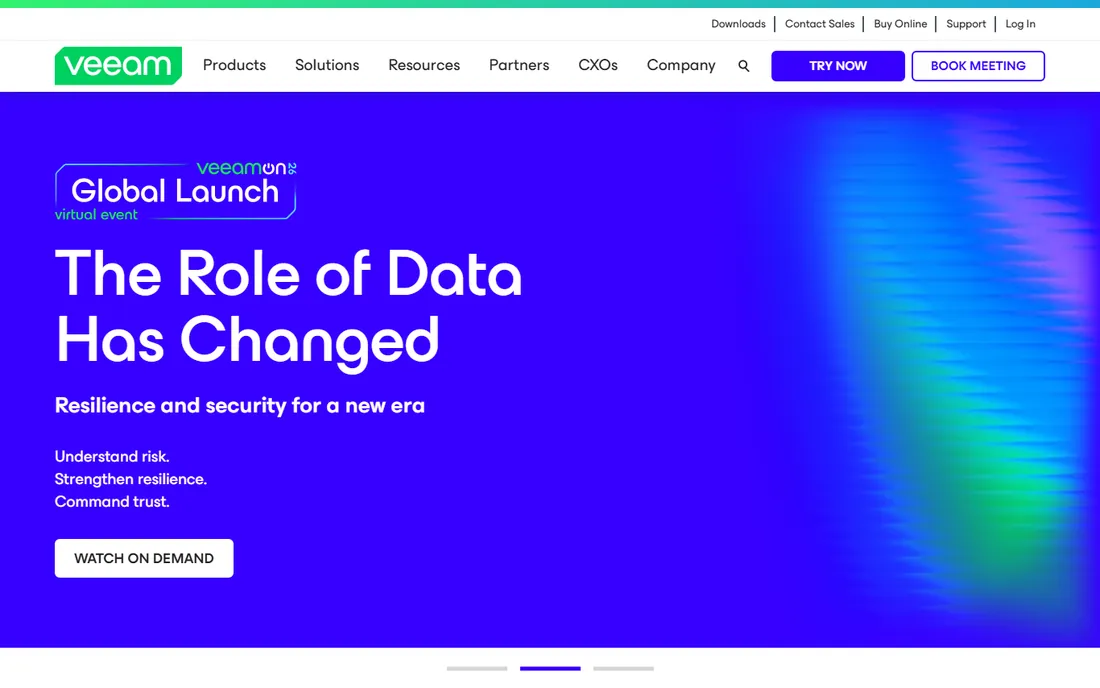
Veeam is the default enterprise backup platform for a reason: it protects practically everything (VMs, physical servers, NAS, cloud instances, Kubernetes, Microsoft 365, Salesforce, and now identity providers) and recovers it fast, with instant VM recovery and granular item-level restores. The Data Platform's immutable-by-design backups and automated malware scanning mean you restore clean data, not reinfected systems. Recognition as a leader in the Gartner Magic Quadrant and #1 in IDC market share reflects genuine installed-base dominance, which matters when you need community knowledge, third-party integrations, and hiring-friendly skills.
The honest cost is complexity. Veeam's licensing spans editions, workload packs, and subscription versus perpetual options that confuse even experienced buyers; get the quote modeled against your actual workload inventory, not a generic estimate. It also rewards expertise: the platform is powerful but not simple, and understaffed IT teams can struggle with the full feature set. For organizations that want one backup vendor covering the entire hybrid estate, though, nothing else matches the breadth.
What we like- Protects cloud, on-prem, Kubernetes, SaaS, and identity workloads from one platform
- Up to 5x faster recovery with immutable-by-design backups
- #1 global market share in data protection
Watch out for- Licensing is complex across editions and workload types
- Full deployments need skilled administrators
#2
Acronis
Best for: teams that want backup, cybersecurity, and IT management in one agent
Visit acronis.com
Starting priceSee website
Free planFree trial
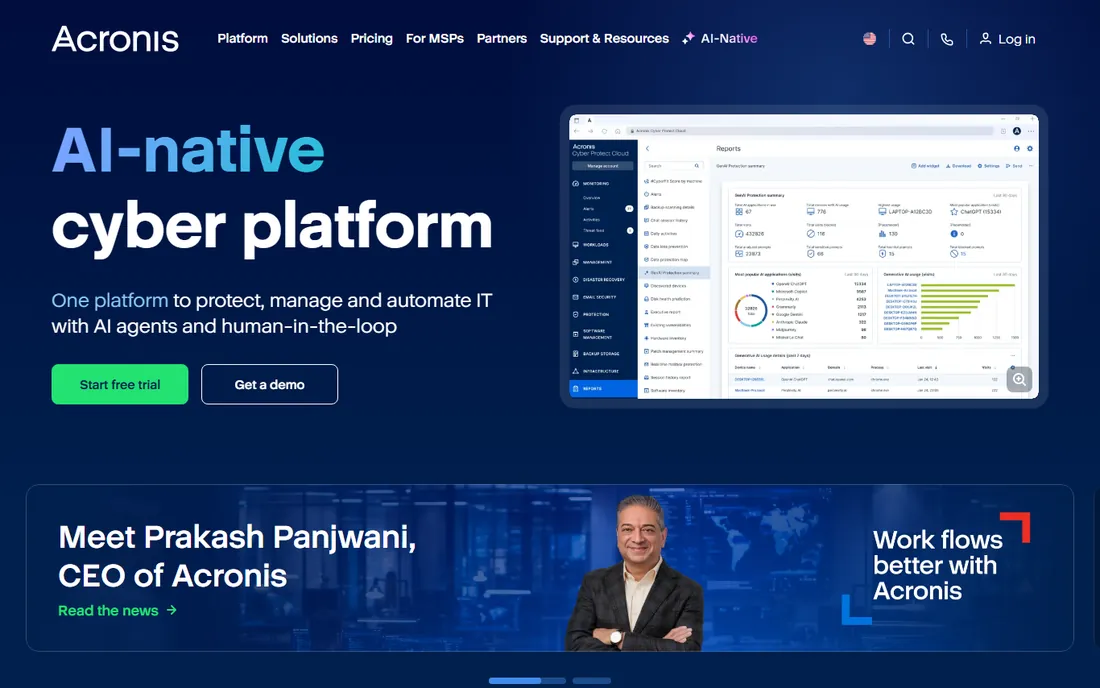
Acronis built its name on the idea that backup and security belong together, and the current platform extends that to full IT management: one agent handles backup, AI-based threat detection, patch management, and remote monitoring. For a lean IT team, that consolidation is the fastest path to coverage: deploy the agent, define policies, and endpoints, servers, and Microsoft 365 are protected without stitching four vendors together. The 50-plus global data centers give you residency options, and a free trial lets you test restores before any procurement paperwork.
The trade is focus versus breadth. If you only need backup, you are buying into a cyber platform with security and management modules attached, and the packaging reflects that. Acronis also grew up serving MSPs, so direct enterprise buyers sometimes find the sales motion and support structure MSP-flavored. For small and mid-size IT teams that want one console and one agent yesterday, it is the quickest route to comprehensive protection.
What we like- Single agent covers backup, anti-malware, patching, and remote management
- 750,000+ companies protected across 150+ countries
- Free trial to validate quickly
Watch out for- The platform's breadth can mean paying for modules you never use
- Strongest in the MSP channel, less so for direct enterprise
#3
Druva
Best for: organizations that want backup as a service with zero infrastructure
Visit druva.com
Starting priceSee website
Free planFree trial
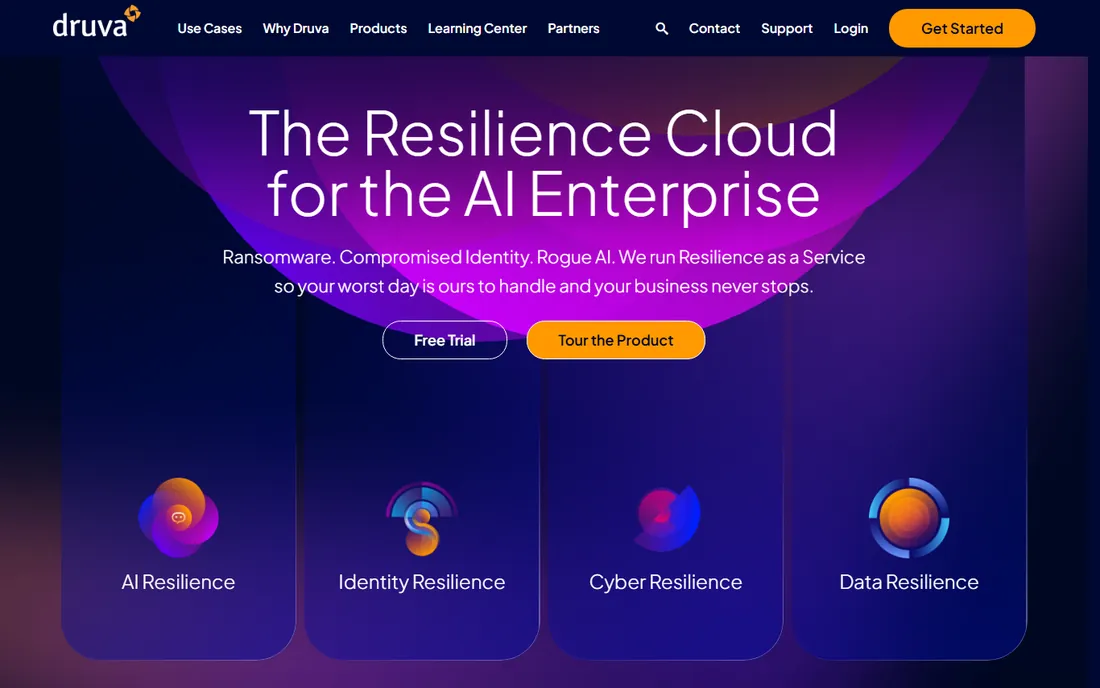
Druva is the purest answer to "quick rollout": because it is fully SaaS, there is nothing to install, no backup servers to size, and no storage to provision. You deploy lightweight agents or connect cloud accounts, define policies, and backups flow to the Druva cloud with global deduplication cutting storage costs. Coverage spans endpoints, VMware and Windows servers, NAS, SQL, Microsoft 365, Salesforce, and AWS workloads from one console. The company claims deployments complete in minutes and total cost runs up to 40% below legacy backup, and customer stories of 10-minutes-a-day management back up the simplicity pitch.
The honest consideration is architectural trust. Your backup data resides in Druva's cloud, which is exactly the point of SaaS but requires comfort with the shared-responsibility model and data-residency terms. Initial seeding of terabytes takes bandwidth and planning regardless of vendor. For organizations happy to trade infrastructure control for speed and simplicity, Druva is the fastest credible path to enterprise-grade backup.
What we like- 100% SaaS means deployment in minutes with no hardware or maintenance
- Unified protection for endpoints, data center, cloud, and SaaS
- Claims up to 40% cost savings versus legacy backup
Watch out for- Cloud-only model means your backups live on someone else's infrastructure
- Large initial uploads need serious bandwidth planning
Starting priceSee website
Free planFree trial
Backblaze plays a different role from the suites on this list: it is high-performance cloud storage (B2) that backup applications write to, plus dead-simple unlimited computer backup for endpoints. The appeal for fast rollouts is radical simplicity and predictable economics: S3-compatible APIs mean Veeam, MSP360, Commvault, and dozens of other tools already integrate with it, and free egress removes the surprise bills that make CFOs hate cloud storage. For an IT team that already has backup software and just needs affordable, reliable off-site storage quickly, a B2 bucket can be live the same afternoon.
The honest framing is that Backblaze does not replace backup software. You still need something to schedule jobs, manage retention, and orchestrate restores; Backblaze is the target, not the engine. Its compliance portfolio is thinner than the enterprise suites, which matters in regulated industries. But as the storage layer of a fast, affordable backup architecture, it is the easiest yes in this category.
What we like- S3-compatible object storage at a fraction of hyperscaler cost with free egress
- Dead-simple to connect as a backup target
- Unlimited computer backup plans available
Watch out for- It is storage, not a backup application, so you bring your own backup software
- Fewer enterprise compliance certifications than the suites
#5
Datto
Best for: businesses that buy IT through an MSP and want bulletproof BCDR
Visit datto.com
Starting priceSee website
Free planNo
Datto's backup story is told through MSPs: you do not buy Datto direct, your managed service provider does, and delivers backup as a service. The technology earns it: BCDR appliances and direct-to-cloud backup with screenshot-verified recoveries, an immutable cloud that ransomware cannot encrypt, and instant virtualization that spins up failed servers in the Datto Cloud in minutes. BackupIQ adds AI-driven monitoring and automated recovery verification, and the newer Endpoint Backup covers laptops and servers at a per-device price that undercuts most competitors.
The channel model is the thing to understand. If you already work with an MSP, Datto arrives as part of that relationship with professional management included, which is genuinely the fastest rollout of all: someone else does it. If you run IT in-house and want to buy direct, Datto is not for you. Evaluated on its own terms (backup delivered as a managed service), its recovery capabilities and ransomware track record are excellent.
What we like- Purpose-built BCDR with immutable Datto Cloud and instant virtualization
- BackupIQ automates monitoring and recovery testing
- Endpoint backup at aggressive per-device pricing
Watch out for- Sold exclusively through MSP partners, not direct
- The broader Kaseya ecosystem can feel like a bundle
#6
Cohesity
Best for: large enterprises consolidating backup, security, and data insights
Visit cohesity.com
Starting priceSee website
Free planNo
Cohesity aims to be the data platform, not just the backup tool: protection, security, and AI-ready data services on one architecture spanning 1,000-plus workload types. The pitch for quick rollouts is consolidation: replace point backup products, separate security scanning, and ad-hoc data services with one deployment, then use the same data for threat hunting, compliance search, and AI workloads. Recognition as a Gartner Magic Quadrant leader and IDC cyber-recovery leader signals enterprise credibility, and features like immutable snapshots and clean-room recovery address the ransomware scenario boards actually worry about.
The honest assessment is that this is big-company software. There is no trial you can start yourself and no published pricing; engagement means demos, architecture workshops, and procurement. Organizations without dedicated backup administrators will struggle to exploit the platform's depth. For enterprises standardizing data protection globally and willing to invest in the platform, Cohesity's breadth is the argument; for everyone else, the SaaS options deploy faster.
What we like- Single platform protects 1,000+ workloads across cloud, on-prem, and SaaS
- Strong cyber-recovery and threat-detection features
- Named a leader by Gartner and IDC
Watch out for- Enterprise sales motion with no self-serve path
- Platform breadth demands dedicated administrators
#7
Rubrik
Best for: cyber recovery with preemptive clean restore points
Visit rubrik.com
Starting priceSee website
Free planNo
Rubrik reframes backup as cyber resilience: the question is not whether you can restore files, but whether you can recover the business after ransomware. Its distinctive move is preemptive: continuously analyzing backups to identify clean recovery points before an attack, so restoration starts from known-good data instead of a forensic guessing game. Immutable backups cannot be encrypted or deleted by attackers, autonomous restoration rebuilds applications without manual runbooks, and identity-provider recovery addresses the attack vector most backup tools ignore. The "minimum viable business restored in minutes" claim targets exactly the board-level conversation.
The trade is price and fit. Rubrik is premium enterprise software sold through a consultative motion; there is no trial tier and no published price. If your requirement is straightforward file-and-VM backup, you are paying for cyber-recovery capabilities you will never invoke. But for organizations where ransomware recovery is the actual requirement (and in 2026, that is most enterprises), Rubrik's preemptive approach is the most differentiated in the category.
What we like- Pre-calculates clean recovery points before attacks land
- Immutable backups with autonomous restoration
- Identity-provider recovery for the fastest-growing attack vector
Watch out for- Premium pricing aimed at the enterprise
- Overkill for basic backup-and-restore needs
How we chose
We prioritized tools that make enterprise backup operational quickly: SaaS platforms with no infrastructure, suites with broad workload coverage from a single deployment, and storage targets that simplify architecture. For each vendor we opened the homepage, verified the current product lineup, and checked deployment models, workload coverage, and ransomware-recovery features. We weighed analyst recognition (Gartner, IDC, Forrester) and customer-review sentiment on G2 and peer forums, with extra weight on recovery reliability since failed restores are the metric that matters most. We excluded discontinued products and listed renamed ones under current names. No vendor paid for placement, and we did not claim hands-on testing.
How to roll out backup in weeks, not months
Start with scope discipline. The fastest rollouts protect the critical 20% first: domain controllers, file servers, core databases, and SaaS data (Microsoft 365, Google Workspace), then expand. SaaS platforms like Druva let you cover endpoints and SaaS in days; agent-based suites like Veeam and Acronis need a week or two for server coverage. Do not try to boil the ocean in phase one.
Second, test restores before you need them. Every vendor here promises fast recovery; verify it with your data, your network, and your team. Run a full VM restore, a granular mailbox-item restore, and (most importantly) a ransomware-scenario restore from immutable storage during the proof of concept. Document the runbook while the vendor's engineers are still on the call.
Third, settle the 3-2-1 question on day one: three copies of data, on two different media, one off-site. Cloud targets (Backblaze B2, Druva cloud, Datto Cloud) make the off-site copy trivial, but confirm immutability settings and retention locks before the first backup runs. A backup you cannot restore from, or that ransomware can encrypt, is just expensive disk space.
The 3-2-1 rule still applies
The 3-2-1 backup rule (three copies, two media types, one off-site) remains the foundation every tool here is designed to implement, and ransomware gave it a modern addendum: one copy must be immutable. Veeam, Rubrik, Cohesity, Datto, and Druva all offer immutability or air-gapped copies; verify the specific mechanism (object-lock, immutable cloud, offline media) rather than accepting the word "immutable" at face value.
Test the off-site copy independently. A surprising number of "we have off-site backup" claims turn out to be a replication job nobody ever restored from. Quarterly, pick a random backup set and restore it to an isolated environment. Measure two numbers: recovery time (how long until the system runs) and recovery point (how much data you lost). Those two numbers, not feature checklists, are what your cyber-insurance carrier and your board will ask about after an incident.
Frequently asked questions
How fast can we realistically deploy enterprise backup?
SaaS platforms (Druva) can protect endpoints and SaaS apps within days. Agent-based suites (Veeam, Acronis) typically need one to three weeks for server environments, depending on workload count. The long pole is rarely the software: it is firewall rules, credentials, bandwidth for initial seeding, and change windows.
Do we still need on-premises backup hardware?
Not necessarily. Cloud and SaaS platforms have made hardware-optional architectures mainstream, and immutable cloud storage satisfies the off-site requirement. Organizations with large data volumes, strict latency needs, or regulatory constraints still use local appliances or repositories for fast restores, with cloud as the second copy.
What is immutable backup and why does it matter?
Immutable backups cannot be modified or deleted for a defined retention period, not even by an attacker with admin credentials. Since ransomware now targets backups first, immutability is the difference between paying the ransom and restoring clean. Verify the implementation: true immutability is enforced by the storage layer, not just a software setting.
How do we back up Microsoft 365 and SaaS data?
Microsoft and Google protect their infrastructure, not your data: deleted or corrupted items are your problem after the retention window. All the suites here (Veeam, Acronis, Druva, Datto, Cohesity) offer SaaS backup for Microsoft 365 and others; enable it early because SaaS data is the most commonly overlooked gap in enterprise backup.
Should we consolidate on one backup vendor?
Usually yes, up to a point. One platform means one console, one support contract, and one skill set to hire for. Keep a second copy with a different vendor or immutable storage for ransomware resilience, but avoid the sprawl of five backup products doing overlapping jobs. Standardize, then verify restores quarterly.
Sources we checked (7)
- https://www.veeam.com/
- https://acronis.com/
- https://www.druva.com/
- https://backblaze.com/
- https://www.datto.com/
- https://www.cohesity.com/
- https://www.rubrik.com/
Is your product missing or out of date?
We review this list regularly. Vendors can request a listing, send updated pricing or ask about featured placement.

Shihab Mia · Founder, Rankite
Shihab has spent more than a decade helping SaaS and e-commerce brands grow through search. He writes Rankite's software buying guides from pricing pages, documentation and public user reviews. More about Shihab.