How we make this list: we compare pricing pages, product documentation and public user reviews. Rankite is independent; if a vendor ever pays for a featured spot, that listing is clearly labeled Partner.
Key takeaways
- Microsoft Intune (Plan 1 $8/user/month, included in M365 Business Premium and E3/E5) is the default for Microsoft 365 shops, especially after the July 2026 bundling update.
- NinjaOne ($1.50-$3.75/endpoint/month published range) is the MSP and mid-market favorite for fast patching and a clean console, with volume pricing that rewards scale.
- Jamf for Mac ($12.50/device/month bundle) remains the Apple-fleet standard, though Mosyle's free tier (up to 30 devices) undercuts it hard on price.
- ManageEngine Endpoint Central (from $1.09/endpoint/month) publishes the deepest feature list and tiered pricing, but configuration takes real effort.
- JumpCloud ($9/user/month for device management) suits directory-first teams replacing Active Directory, while Hexnode and Miradore cover budget mixed-OS fleets.
Quick comparison
| Tool | Best for | Starting price | Free plan |
|---|
 Microsoft Intune Microsoft Intune | Organizations already on Microsoft 365 | $8/user/month (Plan 1 standalone; included in M365 Business Premium, E3, E5) | Free trial |
 NinjaOne NinjaOne | MSPs and mid-market IT teams that want speed | $1.50-$3.75/endpoint/month (published range) | Free trial (14 days) |
 Jamf Pro Jamf Pro | Large Apple-only fleets | $12.50/device/month (Jamf for Mac bundle, 25-device minimum, annual) | Free trial |
 Mosyle Mosyle | Apple SMBs, schools and small fleets | Free (up to 30 devices); Business Premium $1/device/month | Yes |
 Iru (Kandji) Iru (Kandji) | Teams that want Apple management on autopilot | See website (custom; MDM from ~$3.20/device/month reported) | Free trial |
 ManageEngine Endpoint Central ManageEngine Endpoint Central | IT teams that need maximum features per dollar | $1.09/endpoint/month (Professional, 500 endpoints) | Yes (Free edition, 25 endpoints) |
 JumpCloud JumpCloud | Cloud-first teams replacing Active Directory | $9/user/month (Device Management a la carte, annual) | Free trial |
 Addigy Addigy | MSPs running multi-tenant Apple environments | $6.25/device/month (MDM tier) | Free trial |
 Hexnode UEM Hexnode UEM | Mixed-OS fleets on a tight budget | $2.40/device/month (Pro, monthly; $2.20 annual) | Free trial |
 Miradore Miradore | Small teams that want to start free | Free (up to 50 devices); Premium $3.30/device/month | Yes |
Is your product missing or out of date?
We review this list regularly. Vendors can request a listing, send updated pricing or ask about featured placement.
The best endpoint management software
What changed this year is the job description. In 2026, endpoint security shifted from "EDR with alerts" to autonomous response: AI agents isolate, remediate and harden endpoints with almost no human touch for routine incidents. The category is converging too. Analysts now track UEM, EDR and autonomous endpoint management as one platform story, with predictive remediation, zero-downtime patching with rollback, and AI copilots for IT operations as the features to watch.
Microsoft moved the pricing furniture in July 2026, folding select advanced Intune capabilities (Remote Help, Advanced Analytics, Plan 2) into Microsoft 365 E3 and even more into E5 at no extra charge, while raising those suites' list prices. Meanwhile Kandji rebranded to Iru in 2026 as it expanded beyond pure Apple MDM into identity and security workflows. The throughline: buyers get more automation bundled in, and the vendors are consolidating features into fewer, bigger platforms.
For buyers, the honest split is per-user versus per-device pricing, and whether the tool manages all your OSes or does one stack brilliantly. This guide prices both.
Starting price$8/user/month (Plan 1 standalone; included in M365 Business Premium, E3, E5)
Free planFree trial
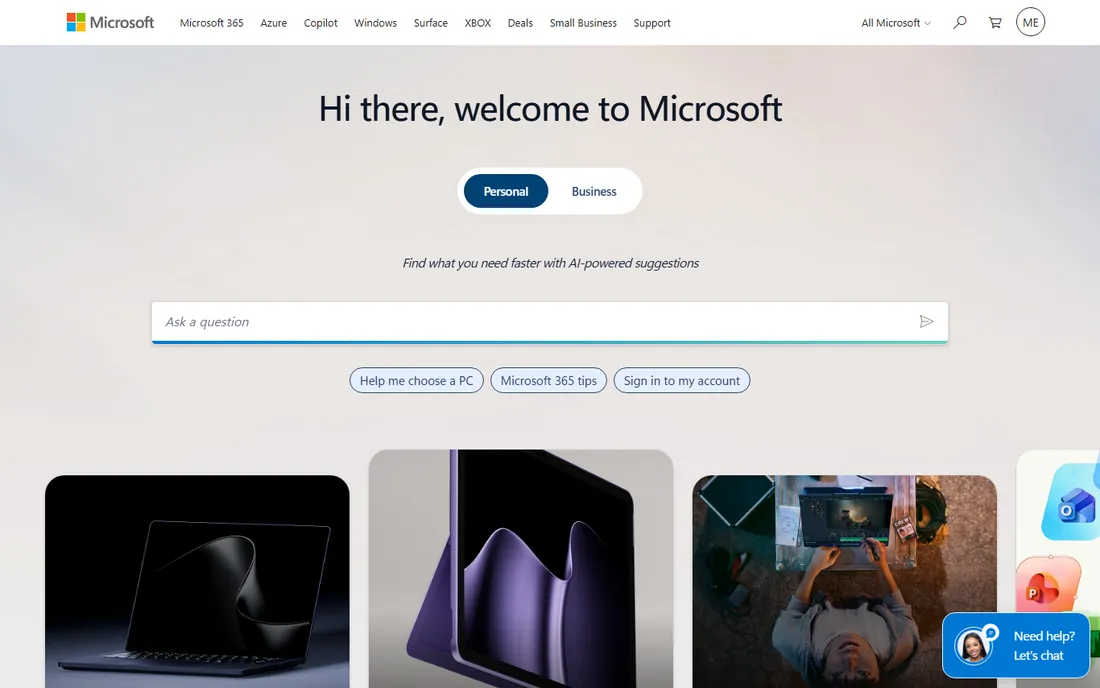
If you pay for Microsoft 365, you probably already own endpoint management and just have not switched it on. Intune Plan 1 at $8 a user a month covers MDM and MAM across Windows, macOS, iOS, Android and Linux, and it is included in Business Premium ($22), E3 and E5. The July 2026 update folded Remote Help, Advanced Analytics and Plan 2 capabilities into E3, and Endpoint Privilege Management, Cloud PKI and more into E5, making the suites meaningfully richer.
Standalone pricing stays simple: Plan 2 adds $4 for specialty devices, the full Suite adds $10 for Remote Help, EPM, Advanced Analytics and Cloud PKI. The device-only license runs about $3.50 a device a month for kiosks and signage. The honest catches: per-user licensing with a 15-device cap per user, and Mac management that lags the Windows experience. For Microsoft shops, Intune is the answer by default; for Apple-first fleets, it is a compromise.
What we like- Already included in most M365 licenses
- Zero-touch Autopilot enrollment
- Deep Entra ID and conditional access integration
Watch out for- Add-ons (Suite $10) stack up for non-E5 tenants
- Each user limited to 15 enrolled devices
- Windows-first depth
Starting price$1.50-$3.75/endpoint/month (published range)
Free planFree trial (14 days)
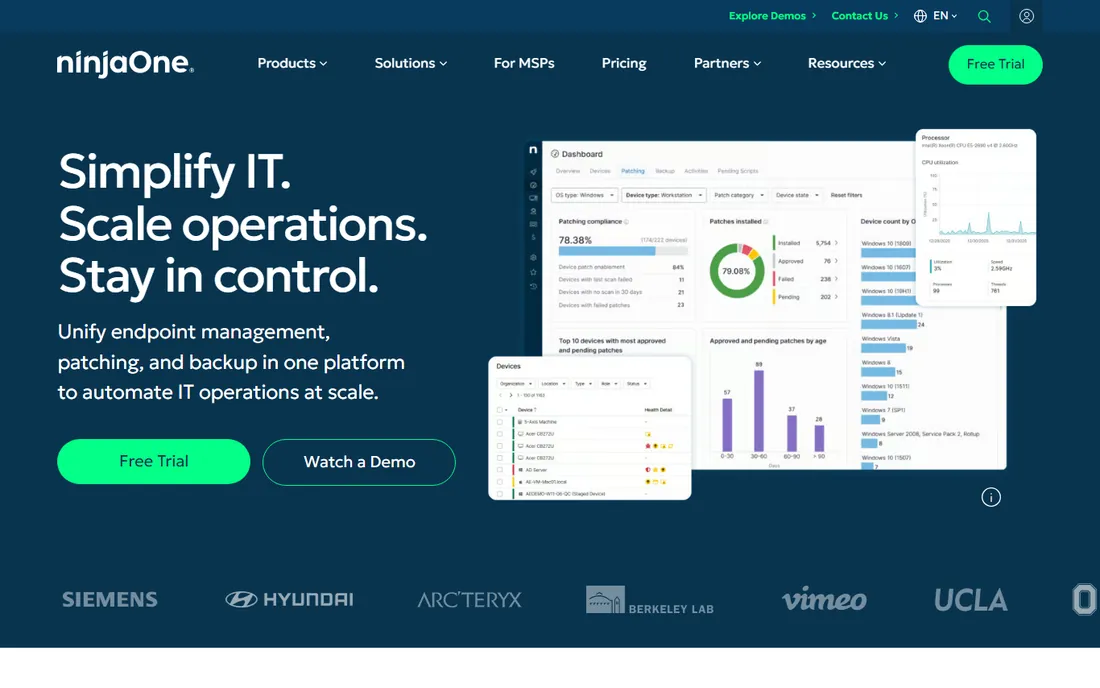
NinjaOne's pitch is operational speed: a cloud-native console that patches, monitors and automates across Windows, Mac and Linux without the configuration weight of legacy tools. It earned a Leader spot in the 2026 Gartner Magic Quadrant for Endpoint Management Tools, and reviewers consistently praise the automation library and patching speed. Free unlimited onboarding and support come bundled.
Pricing is unusually transparent for this category. NinjaOne publishes $1.50 per endpoint a month at 10,000 endpoints rising to $3.75 at 50 or fewer, with mid-range reports around $2.00 to $2.50 near 500 endpoints. The catches: backup, MDM and vulnerability scanning are separately priced modules, and there is a soft 50-device minimum near $180 to $250 a month. NinjaOne fits MSPs and IT departments running hundreds to thousands of endpoints; very small shops pay the top of the range.
What we like- Clean, fast console
- Excellent cross-OS patching
- Free unlimited onboarding and support
Watch out for- Only a pricing range is published, final cost needs a quote
- Backup and MDM are paid add-ons
- ~50-device minimum
Starting price$12.50/device/month (Jamf for Mac bundle, 25-device minimum, annual)
Free planFree trial
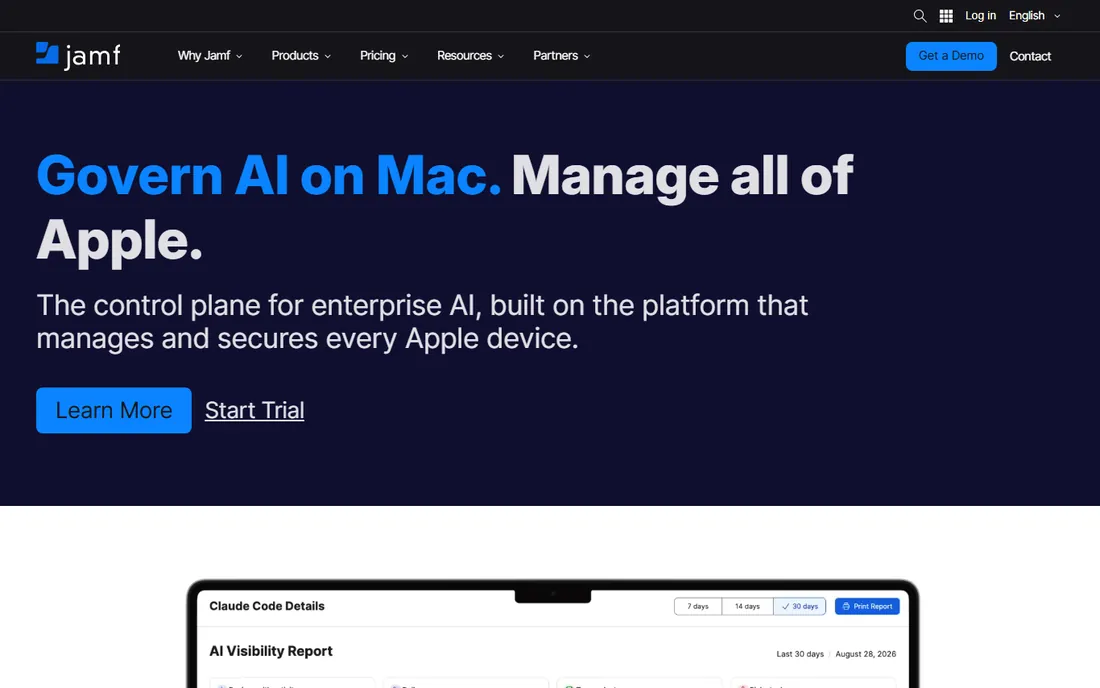
Jamf is the Apple device management standard, and in 2026 it sells through bundles rather than standalone Pro. Jamf for Mac at $12.50 a device a month packages Jamf Pro, Jamf Protect (endpoint security) and Jamf Connect (identity), while Jamf for Mobile runs $5.75. Same-day support for new Apple OS releases, deep policy control and compliance workflows are why regulated industries and large creative shops stay.
The real cost runs above the subscription. Reported total cost of ownership runs 40 to 60 percent above list once onboarding ($6,000 to $7,500 for multi-day programs), training and premium support land. Jamf Now at $4 a device a month with the first three free covers very small teams. Choose Jamf when your fleet is Apple, large and compliance-heavy; choose Mosyle or Iru when it is Apple but budget-conscious.
What we like- Deepest Apple management on the market
- Same-day OS support
- Trusted at enterprise scale
Watch out for- Premium pricing with 40-60% TCO uplift from services reported
- Onboarding fees in the thousands
- Apple only
Starting priceFree (up to 30 devices); Business Premium $1/device/month
Free planYes
Mosyle's pricing is the category's price disruptor. A free tier covers up to 30 Apple devices, Business Premium runs $1 a device a month, and Fuse starts at $1.50, bundling management with security features. For a 50-device school or startup, Mosyle costs a fraction of Jamf while covering enrollment, profiles, app deployment and compliance for Mac, iPhone and iPad.
The limitation is scope: Apple only, with no Windows or Android management, and enterprise depth that trails Jamf for the largest, most regulated fleets. Mosyle suits SMBs, schools and Apple-first startups that want modern MDM without enterprise pricing. It is the best value in Apple device management, full stop.
What we like- Free tier for small fleets
- Radically cheap paid plans
- Clean, modern console
Watch out for- Apple only
- No Windows or Android management
- Enterprise features thinner than Jamf
#5
Iru (Kandji)
Best for: Teams that want Apple management on autopilot
Visit kandji.io
Starting priceSee website (custom; MDM from ~$3.20/device/month reported)
Free planFree trial
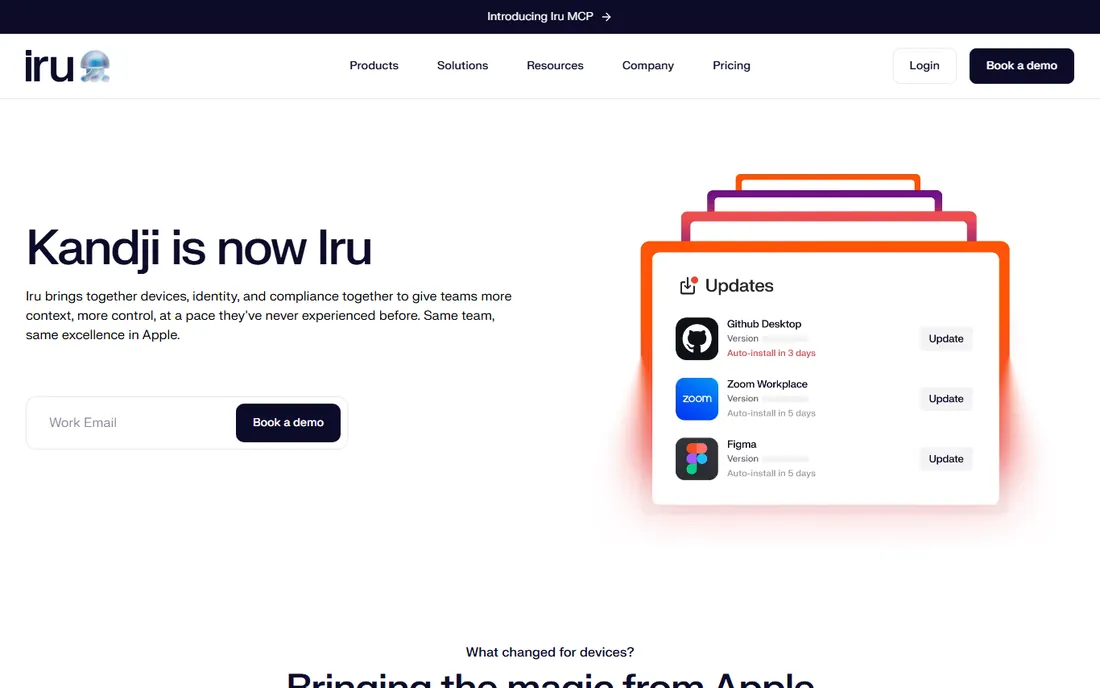
Kandji became Iru in 2026, expanding from Apple MDM into identity, compliance automation and security workflows after acquiring Windows and Android capabilities. The product's core appeal is unchanged: automation-first device management with pre-built templates that let small IT teams run large Apple fleets, plus a proprietary macOS agent that enforces policies even offline.
Pricing is the friction. Iru does not publish rates; reviewer data puts macOS MDM around $3.20 to $8 a device a month with EDR near $2.40, iOS priced separately, and AWS Marketplace baselines near $25,000 a year per module. API access needs 500+ devices. Iru fits Apple-first organizations willing to negotiate an annual enterprise deal; teams that want published pricing should look at Mosyle or Hexnode.
What we like- Heavy automation with pre-built templates
- Built-in EDR and vulnerability management
- Lean teams manage large fleets
Watch out for- Custom pricing, no public rate card
- 25-device minimum on annual billing
- Windows/Android support is new
#6
ManageEngine Endpoint Central
Best for: IT teams that need maximum features per dollar
Visit manageengine.com
Starting price$1.09/endpoint/month (Professional, 500 endpoints)
Free planYes (Free edition, 25 endpoints)
Endpoint Central packs patching, software deployment, OS imaging, remote control and MDM for Windows, macOS, Linux, iOS and Android into one product, and it is the only vendor here with a full public price list: Professional at $1.09 an endpoint a month, Enterprise $1.37, UEM $1.59, Security $2.30, plus a free edition for 25 endpoints. For budget planning, that transparency is a genuine advantage.
The entry figure is not the real figure. The genuinely useful pieces, EDR, ransomware protection, digital experience monitoring and OS deployment, are separately priced add-ons, and reviewers describe the interface as dense next to NinjaOne. Endpoint Central fits teams with the time to configure it and the need for breadth; teams that want simplicity should pay the premium for NinjaOne.
What we like- Deepest published feature set
- Full tiered price list
- On-prem or cloud
- Free 25-endpoint edition
Watch out for- Dense, dated interface
- EDR, ransomware and DEX are paid add-ons
- Configuration burden is real
Starting price$9/user/month (Device Management a la carte, annual)
Free planFree trial
JumpCloud consolidates identity and device management: directory, SSO, MFA, RADIUS, LDAP and multi-OS device management from one console. A la carte pricing starts at $9 a user a month for device management and $11 for core directory on annual billing, with Platform bundles above. It is the natural Active Directory replacement for cloud-first companies with no on-prem infrastructure.
Two caveats. The free tier for up to 10 users is legacy-only; new accounts cannot get it, which removed the easiest on-ramp. And while device management is solid, pure-play MDM tools go deeper on OS-specific features. JumpCloud fits teams that want identity and devices from one vendor; teams that need deep MDM alone should compare Intune or NinjaOne.
What we like- Directory, SSO, RADIUS and device management in one
- A la carte pricing from $3/user
- Strong zero-trust story
Watch out for- Legacy free 10-user tier no longer offered to new accounts
- Device management depth trails pure-play MDM
- Add-ons accumulate
#8
Addigy
Best for: MSPs running multi-tenant Apple environments
Visit addigy.com
Starting price$6.25/device/month (MDM tier)
Free planFree trial
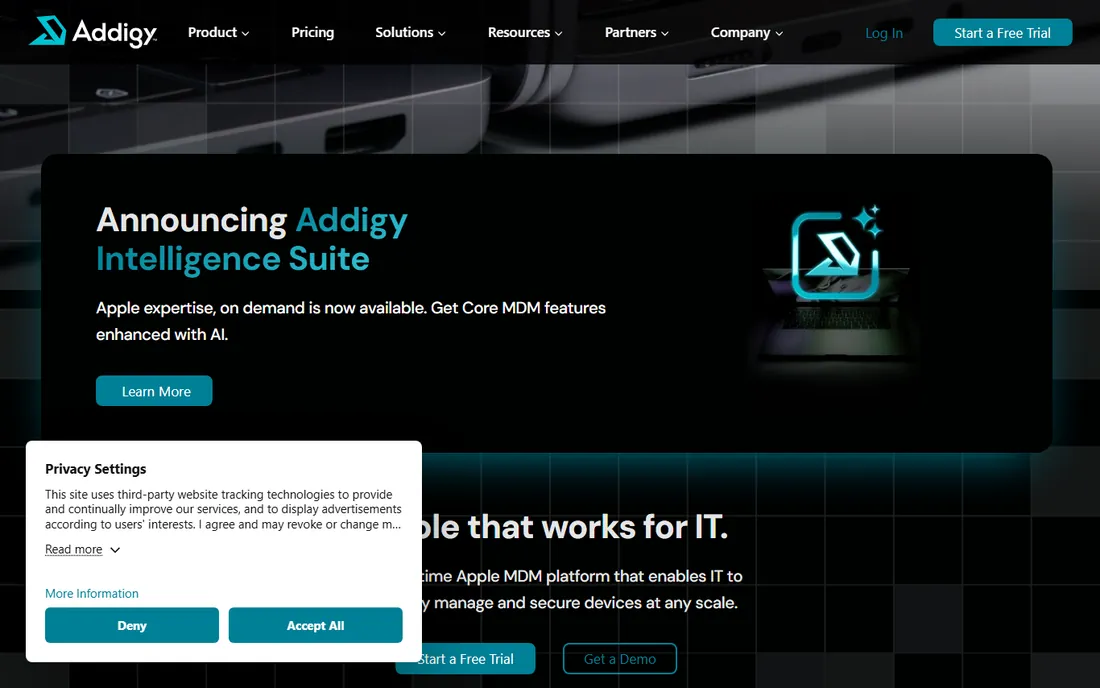
Addigy is built for MSPs managing many Apple clients: a multi-tenant dashboard, per-client reporting, live remote troubleshooting that users never notice, and identity sync with Google, Microsoft or Okta. Three tiers run from Amplify at $2 a device (remote tools for teams that already have an MDM) to MDM at $6.25 to Security at $14 with built-in antivirus. Pricing is month-to-month with no contracts.
The $200 monthly minimum makes it a poor fit under about 30 devices, and reporting customization frustrates larger enterprise teams. Addigy suits MSPs and IT teams running 100+ Apple devices who value the multi-tenant model and live remote tools; in-house teams with one tenant should compare Mosyle first.
What we like- Multi-tenant dashboard built for MSPs
- LiveTerminal and LiveDesktop remote tools
- Month-to-month, no contracts
Watch out for- $200/month minimum excludes tiny shops
- Apple only
- Reporting customization is limited
Starting price$2.40/device/month (Pro, monthly; $2.20 annual)
Free planFree trial
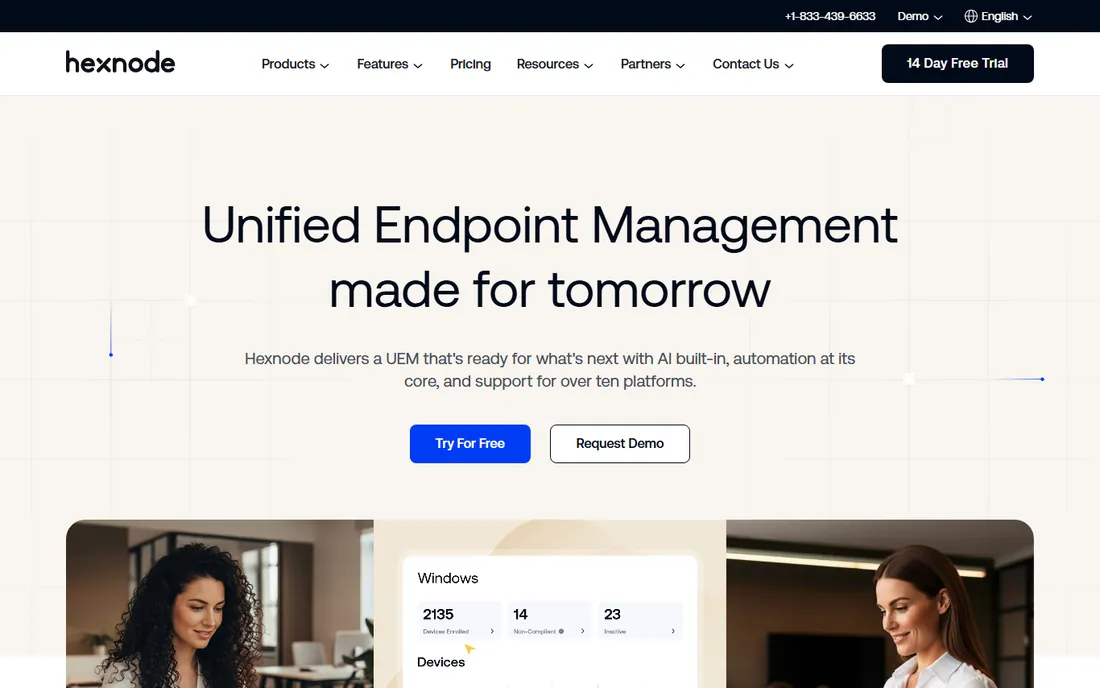
Hexnode covers nearly every OS, Android, iOS, Windows, macOS, Linux, ChromeOS and tvOS, at prices that undercut most competitors: Pro at $2.40 a device a month, Enterprise $3.60, Ultimate $5.20, with annual discounts. Zero-touch enrollment, Knox Mobile Enrollment and Apple Business Manager support make rollout painless, and a free trial needs no credit card.
The tiers gate meaningfully: Windows and Mac app management, remote control, scripting and patch management sit on Enterprise and Ultimate, and paid plans start at a 15-device minimum. Hexnode fits Android-heavy or mixed-OS fleets that need real UEM cheaply; Apple-only shops get more polish per dollar from Mosyle.
What we like- Published tiered pricing
- Covers Android, iOS, Windows, macOS, Linux, ChromeOS
- Cheap entry tier
Watch out for- 15-device minimum on paid plans
- Advanced UEM features need top tiers
- Support quality varies
Starting priceFree (up to 50 devices); Premium $3.30/device/month
Free planYes
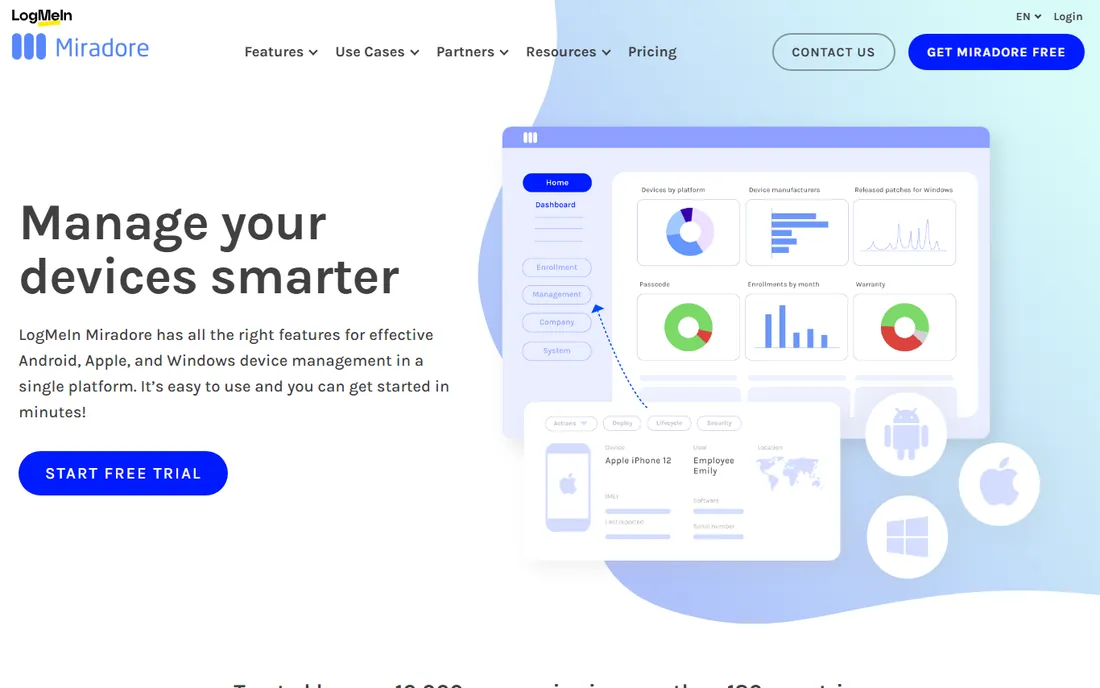
Miradore, now under LogMeIn (GoTo), offers one of the most generous free tiers in endpoint management: up to 50 devices at no cost, covering the basics of securing and managing a fleet. Premium at $3.30 a device a month adds full automation and control, with Premium+ at $4.75 adding integrations and native remote support.
It will not match Intune's ecosystem depth or Jamf's Apple expertise, and the free tier is intentionally limited. But for a small business taking its first step into device management, Miradore's free 50 devices remove every excuse. Upgrade paths exist as the fleet grows, and the GoTo backing suggests staying power.
What we like- Free for up to 50 devices
- Simple setup
- Now part of LogMeIn/GoTo
Watch out for- Premium+ features cost more
- Less deep than enterprise UEM
- MSP multi-tenancy is basic
Microsoft 365 shops start with Intune and check what they already own. Apple-only fleets choose between Jamf for enterprise depth, Mosyle for value, and Iru for automation. MSPs and mid-market IT pick NinjaOne for speed or ManageEngine for feature depth on a budget. Directory-first teams go JumpCloud. Mixed-OS fleets on a budget go Hexnode, and tiny teams start free on Miradore or Mosyle. Match the pricing model to your fleet: per-user wins when people carry many devices, per-device wins when devices outnumber people.
How we assembled this comparison
We priced each product against its own published plans and 2026 pricing reviews, noting where vendors moved to quote-only or bundled pricing. Feature coverage came from current product pages, G2 and TrustRadius listings, and reviewer roundups updated this year. We excluded pure-play EDR tools without management depth and legacy on-prem suites without a cloud story. No hands-on device enrollment testing sits behind these picks, and the article claims none.
Count the licenses, not just the price
Endpoint management pricing is designed to look cheap per unit and get expensive in aggregate. Per-user plans like Intune multiply by headcount, per-device plans multiply by every laptop, phone and kiosk, and add-on modules for MDM, EDR and remote help can double the base. Before signing, inventory your actual devices by OS, decide which modules you truly need, and get the total in writing for year one and year three. The cheapest per-device sticker often loses to the bundle you already own.
Frequently asked questions
Should I manage devices per-user or per-device?
Per-user (Intune, JumpCloud) wins when each person carries several devices, since one license covers the laptop, phone and tablet. Per-device (NinjaOne, Jamf, Mosyle) wins when devices outnumber people, such as kiosks, shared workstations and frontline fleets. Count your actual devices and users before deciding; the wrong model can double the bill.
Is Microsoft Intune enough, or do I need a third-party tool?
For standard Windows and mobile management inside Microsoft 365, Intune is enough for most organizations, and you may already own it. Third-party tools earn their place with deeper Apple management (Jamf, Mosyle), faster patching and automation (NinjaOne), or broader OS coverage (Hexnode). Audit what you own before buying anything new.
What is autonomous endpoint management?
AEM uses AI agents and automation to keep endpoints compliant and secure with minimal human intervention: predictive remediation, zero-downtime patching with rollback, and self-healing configuration. In 2026 it is converging with UEM and EDR into unified platforms. Treat it as an evolution of patching and policy enforcement, not a replacement for security fundamentals.
How many devices can one IT admin manage?
With modern automation, one admin can manage 300 to 500 devices on a well-configured platform like NinjaOne or Intune, and far more with strong zero-touch enrollment and policy automation. The bottleneck is usually onboarding and exception handling, not day-to-day management. Apple automation specialists like Mosyle and Iru push the ratio higher for homogeneous fleets.
Do I need EDR bundled with device management?
They solve different problems: UEM manages configuration and software, EDR detects and responds to threats. Bundled options (Jamf Protect, Iru EDR, ManageEngine Security edition) simplify procurement and console sprawl. If you already run CrowdStrike or SentinelOne, keep them and buy UEM separately; if you do not, a bundle is usually cheaper than two vendors.
Can I migrate MDM providers without wiping devices?
It depends on the OS. Apple added MDM migration paths through Apple Business Manager in recent OS releases that remove the old factory-reset requirement. Windows re-enrollment is generally straightforward; Android varies by management mode. Plan the migration, test on a pilot group, and confirm the process with both vendors before touching production devices.
Sources we checked (19)
- https://www.microsoft.com/en-gb/security/business/microsoft-Intune-pricing
- https://www.ninjaone.com
- https://www.jamf.com
- https://mosyle.com
- https://www.kandji.io
- https://www.manageengine.com
- https://jumpcloud.com
- https://addigy.com
- https://www.hexnode.com
- https://www.miradore.com
- https://digitalitnews.com/2026-endpoint-predictions-for-a-self-defending-enterprise/
- https://medium.com/@shwetakapoor173/autonomous-endpoint-management-best-practices-that-help-businesses-stay-secure-in-2026-4d69585216d7
- https://www.ridgeit.com/faq/how-much-does-microsoft-intune-cost-and-what-licensing-is-required/
- https://www.flamingo.run/blog/ninjaone-pricing-per-device
- https://superops.com/blog/jamf-pro-pricing
- https://syncrosecure.com/blog/unified-endpoint-management-tools/
- https://www.g2.com/products/mosyle/reviews?filters%5Bnps_score%5D%5B%5D=5
- https://www.trustradius.com/compare-products/hexnode-uem-vs-jamf-pro
- https://www.siit.io/tools/alternatives/jumpcloud-alternatives
Is your product missing or out of date?
We review this list regularly. Vendors can request a listing, send updated pricing or ask about featured placement.

Shihab Mia · Founder, Rankite
Shihab has spent more than a decade helping SaaS and e-commerce brands grow through search. He writes Rankite's software buying guides from pricing pages, documentation and public user reviews. More about Shihab.