How we make this list: we compare pricing pages, product documentation and public user reviews. Rankite is independent; if a vendor ever pays for a featured spot, that listing is clearly labeled Partner.
Key takeaways
- Aravo and ProcessUnity suit large teams running formal third-party risk programs across many risk domains, from InfoSec to ESG.
- Resilinc is the strongest pick when your main worry is disruption: port closures, natural disasters, and sub-tier supplier failures.
- Sphera and Coupa make sense if you want risk management inside a broader platform you may already use for EHS or procurement.
- LogicGate Risk Cloud is the most configurable option for teams that want to build their own risk workflows without code.
- None of these tools publish pricing, and none offer a free plan, so budget for an annual enterprise contract and a multi-week implementation.
Quick comparison
| Tool | Best for | Starting price | Free plan |
|---|
 Aravo Aravo | Multi-domain third-party risk at global enterprises | See website | No |
 Resilinc Resilinc | Real-time supply chain disruption monitoring | See website | No |
 Sphera Sphera | Supply chain risk plus EHS and sustainability | See website | No |
 Prevalent Prevalent | Mid-market teams wanting assessments plus services | See website | No |
 ProcessUnity ProcessUnity | Cutting questionnaire workload with shared assessments | See website | No |
 LogicGate Risk Cloud LogicGate Risk Cloud | No-code, configurable GRC workflows | See website | No |
 Archer Archer | Regulated enterprises with mature GRC teams | See website | No |
 OneTrust OneTrust | Privacy-led companies extending into vendor risk | See website | No |
 Coupa Coupa | Procurement teams wanting risk inside spend tools | See website | No |
Is your product missing or out of date?
We review this list regularly. Vendors can request a listing, send updated pricing or ask about featured placement.
The best supplier risk management software
#1
Aravo
Best for: Multi-domain third-party risk at global enterprises
Visit aravo.com
Starting priceSee website
Free planNo
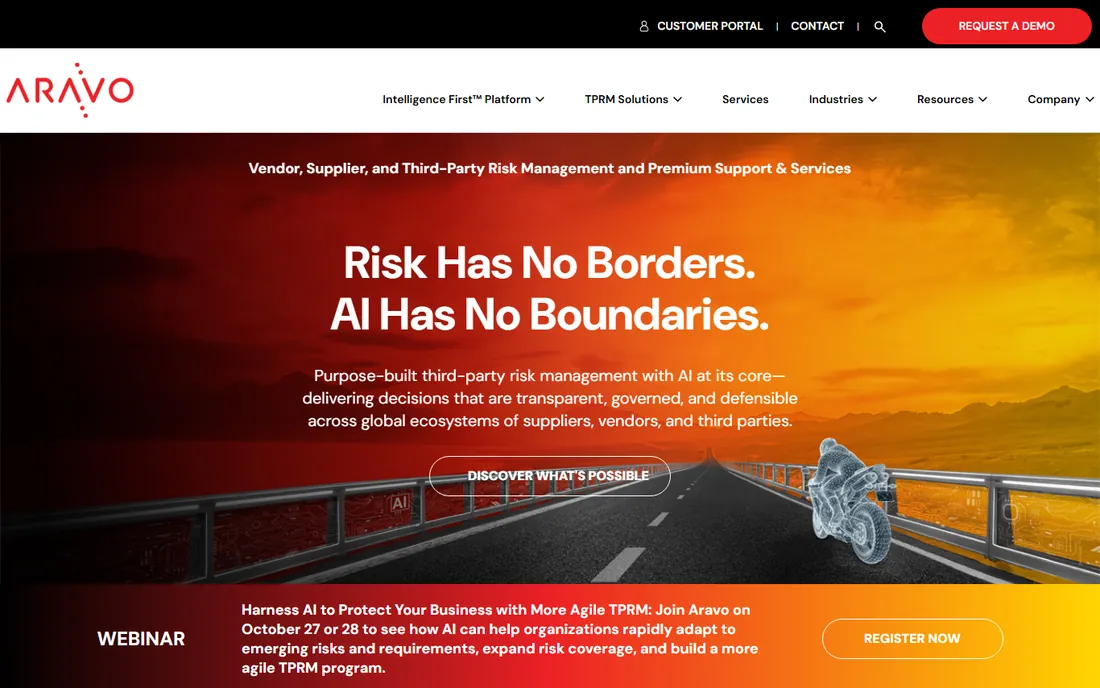
Aravo has spent more than two decades building a central system of record for third-party data. That history shows in the product: it handles the full supplier lifecycle, from onboarding and due diligence through ongoing monitoring and offboarding, across risk domains that point tools often miss. If your program spans anti-bribery, data privacy, ESG, and financial health at the same time, Aravo keeps all of it in one supplier profile instead of four disconnected tools.
The platform leans on automation to keep assessment cycles moving. Questionnaires, evidence collection, and risk scoring run with far less chasing than a manual process. The honest catch is scale: Aravo is built for large, complex programs, and both the price and the implementation reflect that. Smaller companies with a few hundred suppliers will find it heavier than they need.
What we like- Covers ABAC, ESG, GDPR, InfoSec, and financial risk in one record
- Intelligent automation reduces manual assessment work
- Long track record with Global 2000 customers
Watch out for- Enterprise pricing with no public numbers
- Implementation takes real planning for complex programs
Starting priceSee website
Free planNo
Resilinc started as a supply chain visibility company and it still thinks like one. Its core strength is watching the world: natural disasters, port strikes, factory fires, sanctions, and financial distress, then connecting those events to your specific suppliers, sites, and parts. The multi-tier mapping is the part competitors struggle to match. Knowing that your tier-two supplier in a flood zone makes a component in your best-selling product is exactly the insight that prevents a surprise shutdown.
The company has moved toward agentic AI that recommends responses, such as alternative sourcing options, rather than just flagging problems. That is genuinely useful during a crisis. The trade-off is scope: if your risk program is really about vendor questionnaires, privacy reviews, and compliance attestations, a broader TPRM platform fits better. Resilinc is for teams whose nightmare is a stopped line, not a failed audit.
What we like- Monitors a huge volume of global event sources for disruption signals
- Maps supply chains down to the part and site level
- Agentic AI suggests mitigation steps, not just alerts
Watch out for- Weaker on compliance-heavy domains like anti-bribery and privacy than dedicated TPRM platforms
- Built for supply chain teams, less natural for IT vendor risk
#3
Sphera
Best for: Supply chain risk plus EHS and sustainability
Visit sphera.com
Starting priceSee website
Free planNo
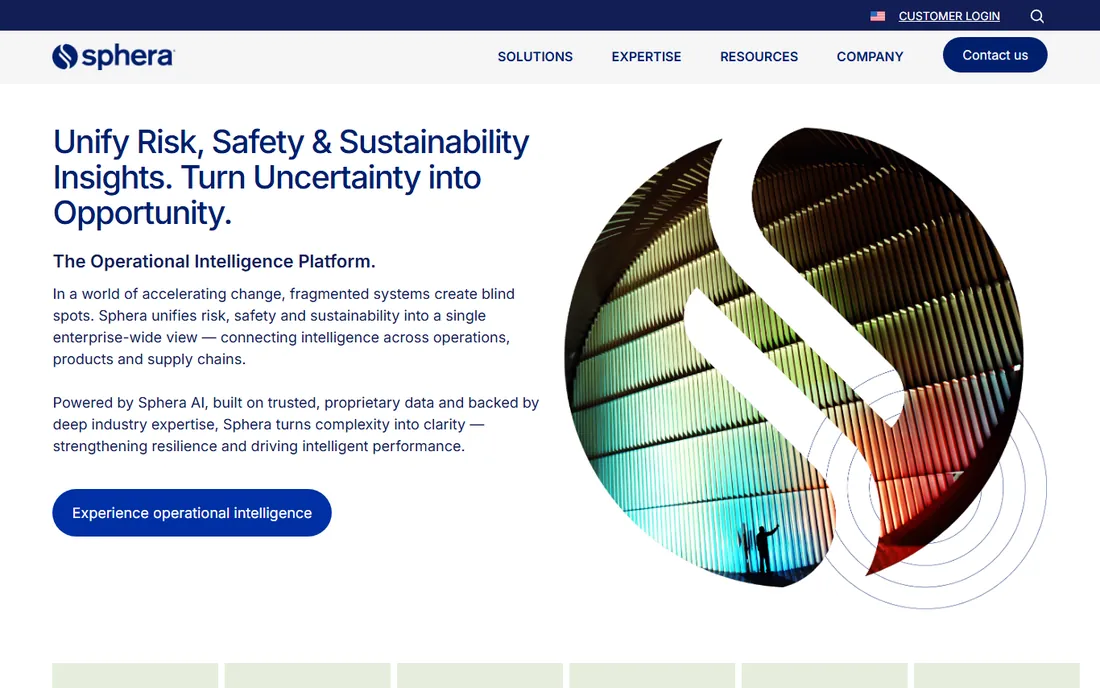
Sphera approaches supplier risk as part of a bigger operational risk picture. Many of its customers already use it for workplace safety or product stewardship, and adding supply chain transparency on the same platform means risk, compliance, and sustainability teams finally look at the same supplier data. The acquisition of riskmethods folded dedicated supply chain risk monitoring into that picture.
This breadth is the selling point and the weakness. If you want one vendor for EHS, sustainability reporting, and supplier risk, Sphera is hard to beat. If you only need supplier risk and nothing else, you pay for platform weight you will never use, and a focused tool like Resilinc or Aravo will feel sharper. Ask for a scoped proposal that prices only the modules you need.
What we like- Combines supply chain risk with environment, health, safety, and sustainability data
- Large customer base across 95 countries
- Acquired riskmethods to deepen supply chain capabilities
Watch out for- A broad suite means some modules feel less deep than specialist tools
- Enterprise implementations can run long
Starting priceSee website
Free planNo
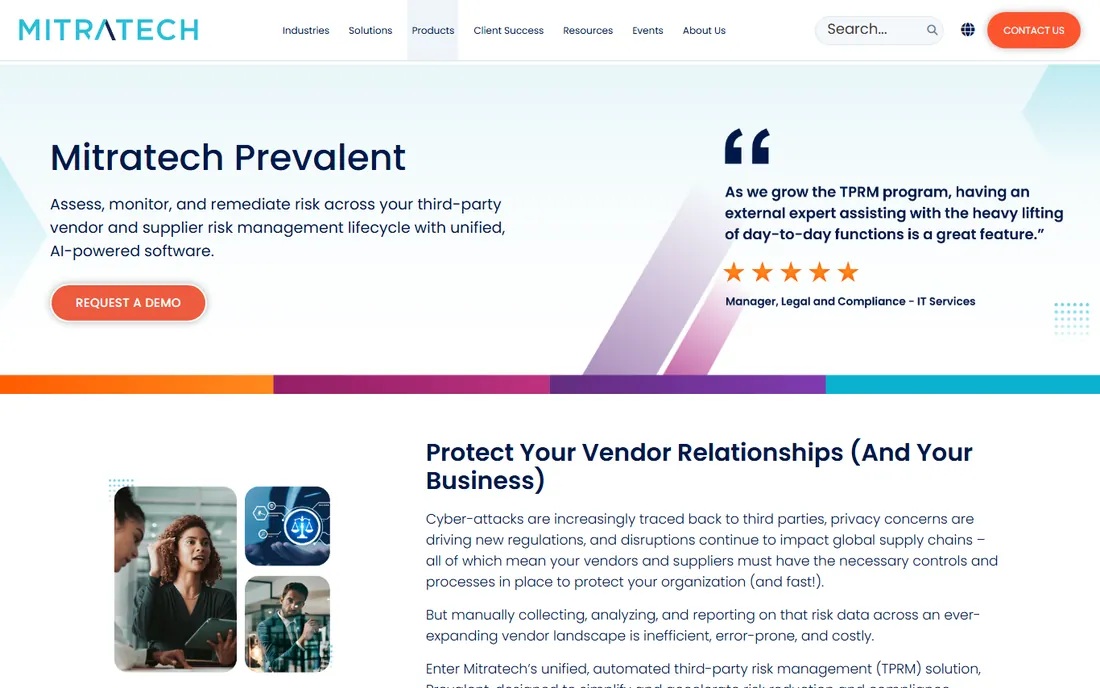
Prevalent understands that many risk teams are two people with a thousand vendors. Its answer is a hybrid model: the platform automates what it can, and Prevalent's own analysts can run vendor assessments as a service when your team is underwater. The shared vendor intelligence network means you often start from an existing assessment instead of a blank questionnaire, which shortens every cycle.
The acquisition by Mitratech puts Prevalent inside a larger GRC portfolio. That could mean tighter integration with complementary tools, or it could mean packaging shifts that existing customers did not ask for. Press for contract terms that lock your pricing and modules. For mid-market companies that want help, not just software, the services angle remains a real differentiator.
What we like- Pairs software with managed assessment services, so small teams can outsource the heavy lifting
- Vendor intelligence network shares completed assessments
- Alfred AI advisor speeds up reviews
Watch out for- Now part of Mitratech, so expect roadmap and packaging changes
- Pricing is opaque and quote-based
Starting priceSee website
Free planNo
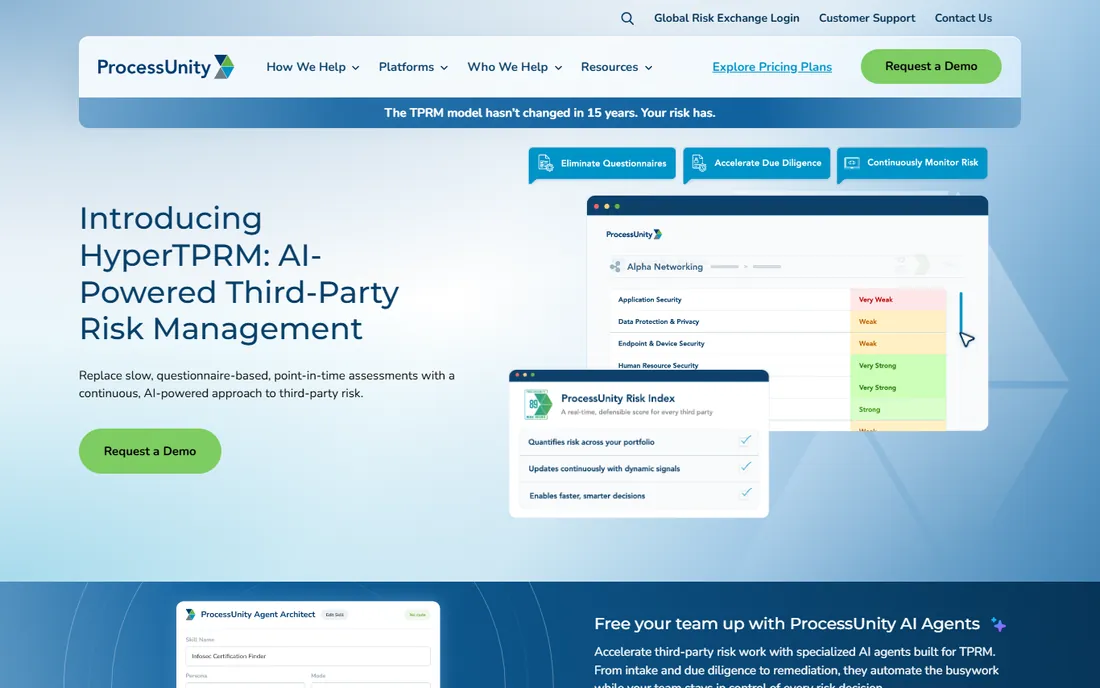
Every risk team knows the pain of sending the same security questionnaire to a vendor that has already answered it for five other customers. ProcessUnity's Global Risk Exchange attacks exactly that waste: a shared library of completed assessments, plus cyber risk data on hundreds of thousands of third parties, lets you skip redundant work. Its AI features go further, drafting evidence evaluations and predicting risk profiles so analysts review instead of transcribe.
The platform suits organizations that run high assessment volumes, especially in financial services and other regulated sectors. Smaller programs may struggle to justify the cost, since value scales with the number of vendors you assess. There is no free trial to kick the tires, so lean on the demo and ask for a proof of concept scoped to your ten hardest vendors.
What we like- Global Risk Exchange holds thousands of completed, standardized vendor assessments
- AI tools autofill evidence and evaluate responses
- Recognized by analysts as a TPRM leader
Watch out for- No public pricing and no self-serve trial
- Best value shows at higher vendor volumes
Starting priceSee website
Free planNo
LogicGate, which moved its public site to logicgate.ai, sells configurability. Instead of adapting your process to the software, you build risk applications with a no-code graph database that links controls, assets, vendors, and risks. For supplier risk, that means you can model exactly the assessment flow, scoring logic, and escalation paths your policy requires, rather than accepting a vendor's template.
This freedom is the main risk too. Teams without a clear process design end up with a powerful tool and no blueprint, and the build work falls on someone internal. Companies that know what they want and have a process owner get live in weeks and iterate from there. If you would rather buy a fixed best-practice workflow than build one, look at Aravo or ProcessUnity instead.
What we like- Drag-and-drop builder lets risk teams design their own applications without developers
- 30+ prebuilt applications cover common GRC processes
- Faster typical implementation than legacy GRC suites
Watch out for- Flexibility demands internal ownership, someone has to design and maintain the workflows
- Quote-based pricing only
Starting priceSee website
Free planNo
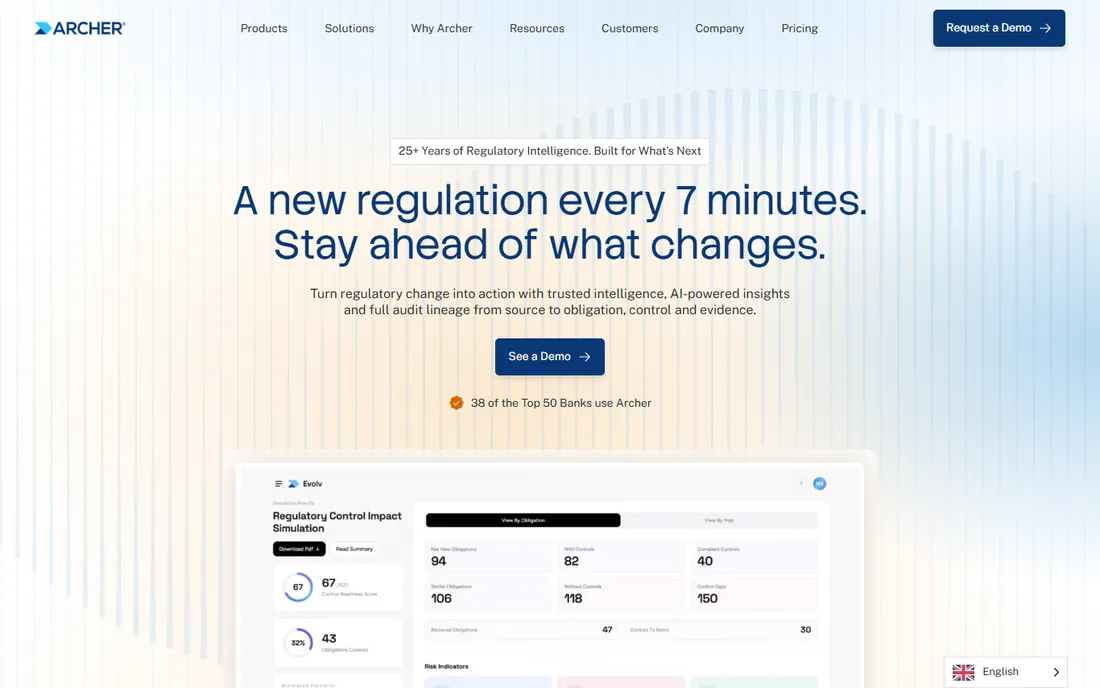
Archer is the incumbent of the GRC world. Large banks, insurers, and healthcare systems have run their risk programs on it for years, and its third-party risk capabilities inherit that depth: granular control mapping, audit trails, issue management, and reporting that satisfies demanding regulators. If your examiners already know Archer reports, that familiarity has real value.
The price of that depth is complexity. Archer projects have a reputation for long implementations and heavy services involvement, and the user experience shows its age compared with cloud-native rivals. It remains a safe choice for the largest regulated enterprises with dedicated GRC staff. Everyone else should weigh whether they need Archer's depth or would move faster on something lighter.
What we like- Deep, proven integrated risk management with strong audit and compliance lineage
- Huge library of use cases and integrations
- Trusted in banking and other heavily regulated sectors
Watch out for- Implementations are famously heavy and consultant-dependent
- Interface feels dated next to newer cloud platforms
Starting priceSee website
Free planNo
Many companies meet OneTrust through privacy compliance, then discover its third-party management module. The logic is sound: vendor risk and data privacy overlap heavily, since every vendor that touches personal data is both a privacy and a security question. Keeping those assessments in one platform avoids duplicate questionnaires and gives privacy and security teams a shared vendor record.
OneTrust's exchange model, formerly called Vendorpedia, lets vendors publish their security posture once for many customers to consume. The caution is commercial: OneTrust prices by module, and a "platform" deal can grow as you add capabilities. Scope the purchase to third-party risk first, prove value, then expand. Teams buying it purely for supplier risk, with no privacy use case, may find a focused TPRM vendor simpler.
What we like- Connects third-party risk to privacy, consent, and data mapping data you may already hold
- Vendorpedia exchange shares vendor security profiles
- Wide integration catalog
Watch out for- Modular pricing stacks up quickly across products
- Broad platform means a steeper learning curve
#9
Coupa
Best for: Procurement teams wanting risk inside spend tools
Visit coupa.com
Starting priceSee website
Free planNo
Coupa's argument is that risk management works best when it lives inside procurement. Instead of a separate risk tool that buyers ignore, Coupa surfaces risk scores at the moment of purchase: a PO to a high-risk supplier can trigger a warning or a hold, and missing supplier information gets flagged when invoices arrive. Risk Assess, its third-party risk module, digitizes assessments across InfoSec, anti-bribery, and privacy domains.
This only sings if Coupa is already your spend platform or is about to become it. Bought alone, the risk module competes with dedicated TPRM tools that go deeper on assessment automation and monitoring. But for procurement-led organizations that want risk embedded in buying workflows rather than bolted on, Coupa's approach matches how the work actually gets done.
What we like- Risk signals appear where buying happens, in POs, invoices, and sourcing events
- Supplier portal makes data collection part of normal transactions
- Community data benchmarks supplier performance
Watch out for- Deepest value comes as part of the full Coupa suite
- Standalone risk depth trails pure-play TPRM platforms
How we chose
We started from analyst coverage of the supplier risk and third-party risk management market, then checked each vendor's current product pages and documentation to confirm the product still exists and still serves this category. We read user reviews on G2, Capterra, and Reddit to find the strengths buyers mention most and the complaints that repeat. We weighted breadth of risk domains, quality of monitoring data, assessment automation, integration options, and fit for different company sizes. Pricing comes only from vendor-published pages; every tool here prices by quote, so we marked them all as See website rather than repeating third-party estimates.
What to check before you sign a contract
Supplier risk tools all promise visibility, but they see different things. Match the product to the risks that actually keep you up at night, then verify the details that decide whether the tool gets used.
Match the tool to your risk domains
List the domains your program must cover: information security, financial health, anti-bribery and corruption, privacy, ESG, and business continuity. Then check each candidate against that list, not against its marketing page. A supply chain monitoring specialist will not run your anti-bribery questionnaires well, and a questionnaire platform will not warn you about a typhoon hitting a supplier's factory.
Ask where the data comes from
Risk scores are only as good as their inputs. Ask vendors which data feeds power their monitoring, how often supplier data refreshes, and what happens when a supplier ignores an assessment request. Tools with shared assessment exchanges or supplier-validated data cut your chasing dramatically compared with tools that start every assessment from zero.
Plan the supplier onboarding effort
The software is the easy part; getting hundreds of suppliers to respond is the hard part. Ask how suppliers submit information, whether there is a free supplier portal, and what the vendor does about non-responsive suppliers. A tool your suppliers hate becomes a tool your team stops using.
What supplier risk software actually costs
Expect annual contracts, not monthly subscriptions. Entry-level deals for mid-market programs typically start in the tens of thousands of dollars per year and scale with the number of suppliers monitored, the risk domains covered, and whether you buy managed services on top. Large global programs with thousands of suppliers and multiple modules run well into six figures.
Almost no vendor publishes prices, which means the quote depends on your supplier count, required modules, and negotiating position. Get at least three quotes, ask each vendor to price the same scope, and push for multi-year price protection. Implementation services are often quoted separately, so ask whether configuration, data migration, and training are included or extra. A pilot with a defined supplier count and a fixed-fee implementation cap keeps the first year predictable.
Frequently asked questions
What is supplier risk management software?
It is software that helps companies evaluate and monitor the risks posed by their suppliers and vendors. It typically covers supplier onboarding, risk assessments across domains like cybersecurity and financial health, continuous monitoring of disruption events, and remediation workflows when issues surface.
How is supplier risk management different from third-party risk management?
The terms overlap heavily. Third-party risk management is the broader category covering all outside parties, including IT vendors and contractors. Supplier risk management usually focuses on the supply chain: the companies that provide materials, components, and finished goods. Many platforms cover both.
How much does supplier risk management software cost?
Most products are priced by annual quote based on supplier count and modules, typically starting in the tens of thousands of dollars per year for mid-market deployments. None of the major platforms publish pricing or offer free plans, so budget for a sales-led buying process.
How long does implementation take?
It varies by scope. Configurable cloud platforms can go live in weeks for a focused use case, while broad enterprise deployments with data migration and integrations often take three to six months. The bigger variable is usually supplier onboarding, not software configuration.
Can small businesses use these tools?
Most of the tools on this list target mid-market and enterprise companies. Small businesses with a handful of critical suppliers can start with lighter approaches, such as standardized questionnaires and financial health checks, before investing in a dedicated platform. Prevalent's managed services and Coupa's procurement-led model are the friendliest on-ramps here.
Do these tools replace supplier audits?
No. Software improves continuous monitoring and standardizes assessments, but on-site audits still matter for critical suppliers and regulated industries. Think of the platform as the system that tells you which suppliers deserve an audit and keeps the findings tracked afterward.
Sources we checked (11)
- https://www.aravo.com
- https://resilinc.ai/
- https://www.sphera.com
- https://www.prevalent.net
- https://www.processunity.com
- https://www.logicgate.ai/
- https://www.archerirm.com
- https://www.onetrust.com
- https://www.coupa.com
- https://www.businesswire.com/news/home/20251021047001/en/Aravo-Named-Category-Leader-in-Chartis-RiskTech-Quadrant-for-Third-Party-Risk-Management-Solutions
- https://www.prnewswire.com/news-releases/logicgate-advances-agentic-grc-capabilities-with-its-summer-2026-release-302866798.html
Is your product missing or out of date?
We review this list regularly. Vendors can request a listing, send updated pricing or ask about featured placement.

Shihab Mia · Founder, Rankite
Shihab has spent more than a decade helping SaaS and e-commerce brands grow through search. He writes Rankite's software buying guides from pricing pages, documentation and public user reviews. More about Shihab.