How we make this list: we compare pricing pages, product documentation and public user reviews. Rankite is independent; if a vendor ever pays for a featured spot, that listing is clearly labeled Partner.
Introduction
Enterprise security buying has changed. A decade ago, most teams bought a firewall, an endpoint agent and an email filter, then called the job done. Now the attack surface includes cloud workloads, remote workers, APIs, SaaS apps and AI agents, so buyers need platforms that pull signals together instead of more point products.
The top enterprise cybersecurity software vendors all sell some version of a platform story, but the products differ in real ways: endpoint-first vendors such as CrowdStrike and SentinelOne built their reputations on lightweight agents, network leaders such as Palo Alto Networks and Fortinet start at the firewall, and Zscaler rebuilt the model around zero trust delivered from the cloud.
This comparison walks through nine of the most widely deployed enterprise security platforms, what each one covers best, where it fits least well, and how to think about consolidating without betting on a single vendor blindly.
Quick comparison
| Tool | Best for | Starting price | Free plan |
|---|
 CrowdStrike CrowdStrike | Organizations that want cloud-native endpoint security | See website | Free trial |
 Palo Alto Networks Palo Alto Networks | Enterprises standardizing network security on one vendor | See website | No |
 SentinelOne SentinelOne | Teams that want autonomous endpoint response with AI assistance | See website | No |
 Microsoft Defender Microsoft Defender | Enterprises already invested in Microsoft 365 and Azure | See website | No |
 Fortinet Fortinet | Network-heavy enterprises that want firewall, SD-WAN and security in one stack | See website | No |
 Zscaler Zscaler | Cloud-first organizations replacing VPNs with zero trust | See website | No |
 Check Point Software Check Point Software | Enterprises that prioritize prevention-first firewall and threat prevention | See website | No |
 Trend Micro Trend Micro | Large enterprises that want one vendor across endpoint, network and cloud | See website | No |
 Sophos Sophos | Mid-market teams and organizations buying security as a managed service | See website | No |
Is your product missing or out of date?
We review this list regularly. Vendors can request a listing, send updated pricing or ask about featured placement.
9 Top Enterprise Cybersecurity Software
Starting priceSee website
Free planFree trial
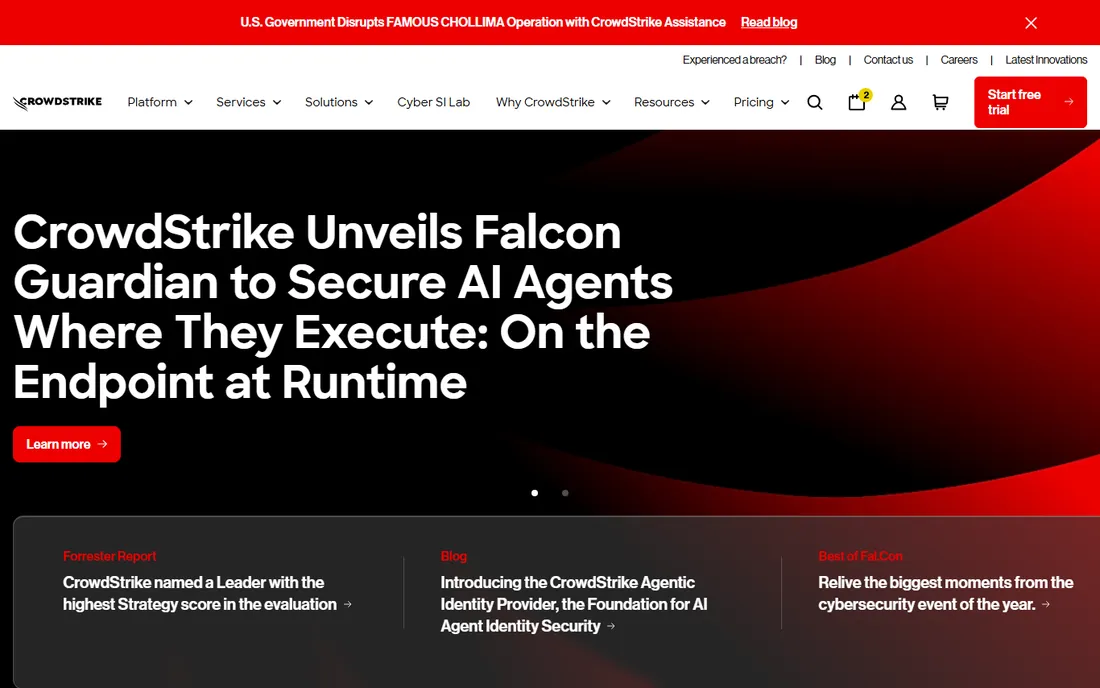
The CrowdStrike Falcon platform is built around one lightweight sensor that streams telemetry to a cloud backend instead of relying on on-device signatures. That architecture is what made the company famous: detections arrive fast, updates do not need signature downloads, and a single agent covers antivirus, endpoint detection and response, device control and mobile protection.
Its vendor pricing is unusually transparent for this market. Falcon Go starts at $7.99 per device per month billed monthly, with Pro and Enterprise tiers above it, and a free Falcon trial with no credit card required sits alongside them. Fully managed protection through Falcon Complete adds 24/7 expert-led detection and response for teams that cannot staff a SOC around the clock.
The trade-off is that Falcon is a platform of add-on modules. Identity protection, next-gen SIEM, IT hygiene and other capabilities are available, but each is a separate module, so the quote can grow quickly as coverage widens. Enterprises evaluating CrowdStrike should price the bundle they actually need, not the entry tier.
What we like- Single lightweight agent, cloud-native Falcon platform, free trial with no credit card required
Watch out for- Enterprise pricing is quoted rather than listed, platform breadth can require multiple add-on modules
Starting priceSee website
Free planNo
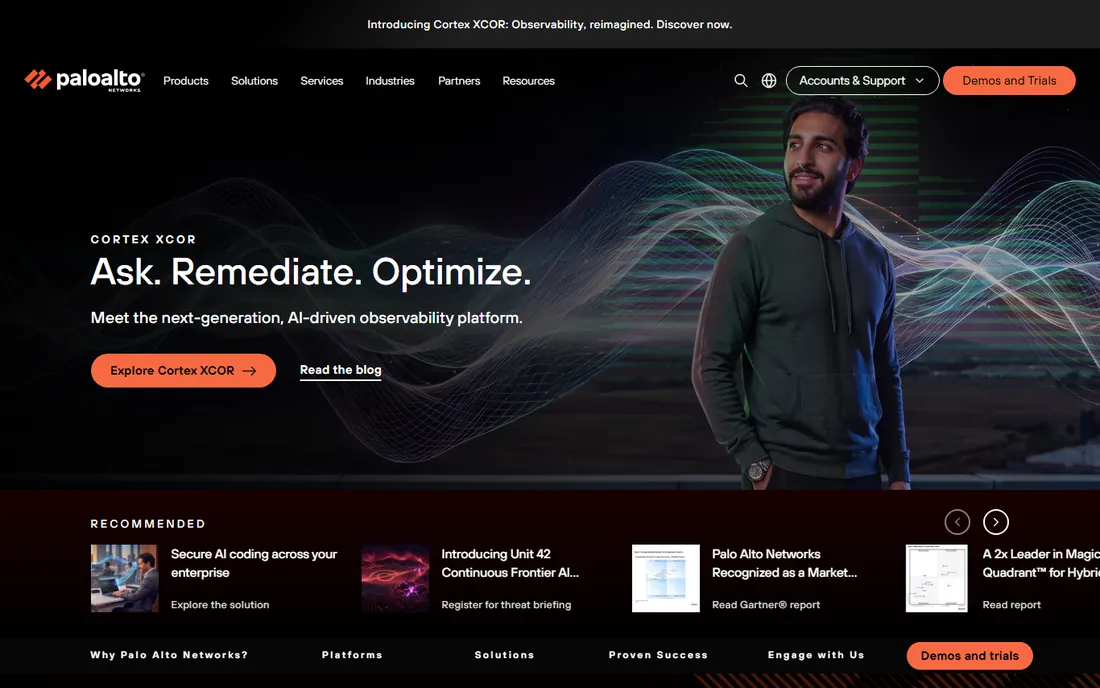
Palo Alto Networks organizes its portfolio into AI-powered platforms: Strata for network security, Cortex for security operations, cloud security, and identity security. The network line includes the next-generation firewalls that built the company's name, while Prisma Access and the Zero Trust Exchange-style offerings cover secure access for remote and branch users.
A notable strength is Unit 42, the company's threat research and incident response team, which handles thousands of engagements a year and publishes intelligence that feeds back into the products. For large enterprises that already run Palo Alto firewalls, extending into Cortex or cloud modules can consolidate consoles and vendors.
The cost side is the caveat. Palo Alto Networks sells through a consultative enterprise motion with quote-based pricing, and real deployments tend to mix hardware, subscriptions and professional services. Buyers should expect a longer evaluation and should negotiate platform-level bundles rather than buying modules one at a time.
What we like- Broad platform across network, cloud, SOC and identity, strong threat research through Unit 42
Watch out for- Enterprise deals are heavily consultative, platform complexity can slow initial rollouts
#3
SentinelOne
Best for: Teams that want autonomous endpoint response with AI assistance
Visit sentinelone.com
Starting priceSee website
Free planNo
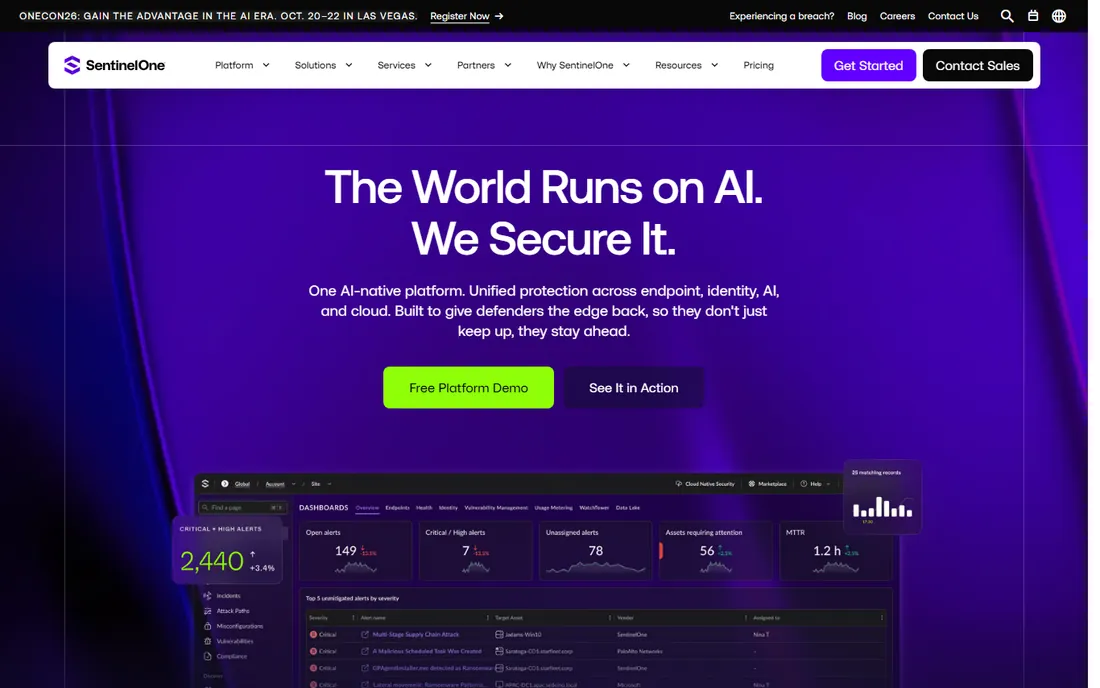
SentinelOne's Singularity platform positions itself as an AI-native alternative to the older endpoint vendors. Its headline differentiator has always been automated response: when ransomware strikes, the agent can kill processes, quarantine the endpoint and roll back encrypted files on its own, which matters for teams with thin overnight coverage.
Purple AI, the company's agentic assistant, now handles triage, correlation and routine response inside the console, and an agentic investigation capability opened to all customers in 2026. The platform also extends beyond endpoints into cloud workloads, containers, identities and network-connected devices.
Where it fits less well is network perimeter security. SentinelOne is not a firewall company, so enterprises that need deep network segmentation or SD-WAN will pair it with another vendor. Evaluate it head to head with CrowdStrike on endpoint efficacy and operational load, then plan the network layer separately.
What we like- AI-native Singularity platform, automated rollback on ransomware, Purple AI for SOC workflows
Watch out for- Quote-based enterprise pricing, narrower network security portfolio than firewall vendors
#4
Microsoft Defender
Best for: Enterprises already invested in Microsoft 365 and Azure
Visit microsoft.com
Starting priceSee website
Free planNo
Microsoft Defender for Endpoint is the enterprise tier of Microsoft's security stack, built on the same engine that ships with Windows and Microsoft 365. For organizations that already run Microsoft 365 E5 or Azure, the economics are hard to beat: much of the protection is already licensed, and the Defender portal unifies endpoint, identity, cloud app and email signals.
The practical advantage is integration. Defender talks natively to Entra ID, Intune, Microsoft Sentinel and the rest of the Microsoft security portfolio without connectors, which simplifies deployment for teams that live in that ecosystem. Attack surface reduction rules and automated investigation handle many common incidents with limited analyst time.
The limitation is scope. Organizations with diverse operating systems, non-Microsoft identity providers or heavy on-premises estates may find the non-Microsoft integrations thinner than a pure-play vendor's. Defender is strongest as the anchor of a Microsoft-centric security program rather than as a standalone purchase.
What we like- Deep integration with the Microsoft stack, included baseline in Windows and Microsoft 365
Watch out for- Best value inside the Microsoft ecosystem, standalone positioning is weaker outside it
#5
Fortinet
Best for: Network-heavy enterprises that want firewall, SD-WAN and security in one stack
Visit fortinet.com
Starting priceSee website
Free planNo
Fortinet built its reputation on FortiGate next-generation firewalls powered by custom FortiASIC chips, which give the appliances strong price-to-performance in throughput-heavy environments. The Fortinet Security Fabric extends that foundation into SD-WAN, SASE, endpoint protection with FortiEDR, email security and more.
The company also acquired Lacework to strengthen its cloud-native application protection story, and FortiGuard Labs feeds daily threat intelligence across the portfolio. For enterprises with many branch offices or a strong on-premises footprint, consolidating firewall, SD-WAN and security management on Fortinet can reduce both hardware cost and operational overhead.
Complexity is the main criticism. The Forti product catalog is enormous, and naming alone can confuse buyers. FortiEDR, FortiXDR, FortiSIEM and FortiSOAR cover different problems, and licensing the Fabric broadly is an enterprise negotiation. Teams should map the exact modules they need before requesting a quote.
What we like- FortiGate firewalls with custom ASIC performance, broad Security Fabric portfolio, competitive appliance economics
Watch out for- Portfolio breadth creates complexity, enterprise pricing is quote-based
#6
Zscaler
Best for: Cloud-first organizations replacing VPNs with zero trust
Visit zscaler.com
Starting priceSee website
Free planNo
Zscaler took a different path from the firewall vendors: instead of extending appliances to the cloud, it built a cloud-native security platform from scratch. The Zero Trust Exchange sits inline on every connection and connects each user only to the applications they are authorized to reach, which removes the traditional VPN model and shrinks the attack surface.
Zscaler Internet Access and Zscaler Private Access handle secure web and private app access, while the same platform now covers data protection, AI security and security operations. With more than 150 data centers and a large share of the Fortune 500 as customers, scale is a genuine differentiator for globally distributed workforces.
The catch is architectural. Zscaler works best for organizations willing to move traffic to the cloud and redesign access around identity rather than the network perimeter. Teams with heavy on-premises requirements or strict data residency needs should validate those scenarios carefully during the pilot.
What we like- Purpose-built zero trust exchange, no appliances to manage, massive global cloud footprint
Watch out for- Requires rethinking network architecture, quote-based enterprise pricing
#7
Check Point Software
Best for: Enterprises that prioritize prevention-first firewall and threat prevention
Visit checkpoint.com
Starting priceSee website
Free planNo
Check Point has been in the firewall business since the 1990s, and its Quantum line remains a staple in large enterprise networks. The Infinity architecture consolidates network, cloud and workspace security under one management plane, and the company's prevention-first philosophy emphasizes blocking attacks before they execute rather than cleaning up afterward.
Check Point Research is one of the industry's better-known threat intelligence teams, and the 2026 additions around AI security show the company tracking the same AI-agent risks its competitors are. Harmony covers endpoint and mobile, CloudGuard covers cloud workloads, and the SASE offerings extend the perimeter to remote users.
The criticism that follows Check Point is usability. Some administrators describe the management experience as powerful but old-fashioned compared with newer cloud-native consoles. Buyers who value mature, battle-tested firewall policy management over modern dashboards will feel most at home here.
What we like- Long-standing firewall expertise, Infinity platform unifies network, cloud and workspace, strong threat research
Watch out for- Interface and management feel dated to some teams, enterprise pricing is quote-based
#8
Trend Micro
Best for: Large enterprises that want one vendor across endpoint, network and cloud
Visit trendmicro.com
Starting priceSee website
Free planNo
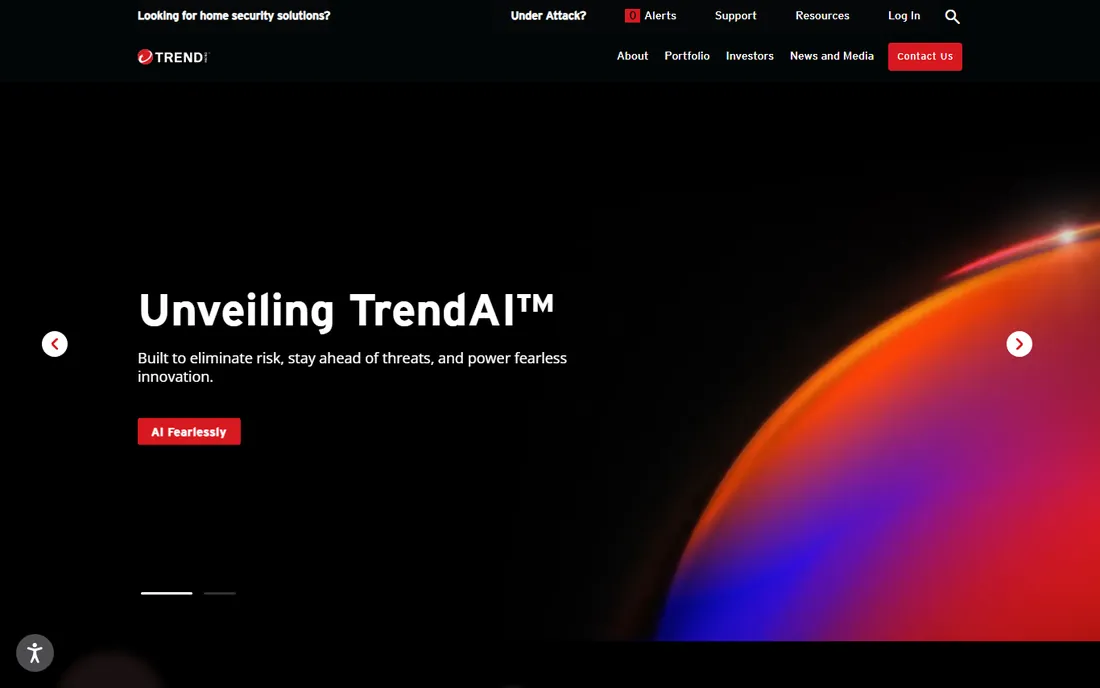
Trend Micro positions itself as a global enterprise platform with coverage across endpoints, networks, cloud environments and data centers. The 2026 reorganization around TrendAI as the enterprise security business signals a pivot toward AI-driven security operations, with a portfolio of focused businesses serving different customer segments.
The company's threat intelligence operation is one of the oldest in the industry, and its cloud security products are well regarded in hybrid data center environments. For enterprises with significant Asian operations, Trend Micro's regional presence and support are practical advantages over US-centric vendors.
In North America and Europe, Trend Micro competes less visibly than CrowdStrike, Palo Alto Networks or Microsoft in enterprise shortlists. That can actually help buyers: less demand-driven pricing and attentive sales teams. Evaluate it wherever broad platform consolidation is the goal rather than best-of-breed point products.
What we like- Broad platform coverage, decades of threat intelligence, strong cloud and data center security
Watch out for- Brand recognition weaker in North America, enterprise pricing is quote-based
#9
Sophos
Best for: Mid-market teams and organizations buying security as a managed service
Visit sophos.com
Starting priceSee website
Free planNo
Sophos defends hundreds of thousands of organizations with Sophos Fusion, which the company describes as a unified cyber defense system where every control point operates as one. Powered by agentic AI plus human expertise from Sophos X-Ops, the platform spans endpoint, firewall, email, cloud and managed detection and response.
The standout is the MDR operation. Organizations that cannot build a security operations center can effectively rent one from Sophos, with 24/7 monitoring, investigation and response included. The partner and MSP channel is another strength: many smaller companies consume Sophos entirely through a managed service provider.
The trade-off is ceiling. Very large enterprises with complex multi-cloud estates or advanced threat-hunting programs may find the platform shallower than Palo Alto Networks or CrowdStrike at the top end. Sophos wins where operational simplicity and managed delivery matter more than feature depth.
What we like- Sophos Fusion unified defense system, strong managed detection and response, partner-friendly channel
Watch out for- Enterprise feature depth trails the largest vendors, aimed more at mid-market than the Fortune 500
Key takeaways
- Endpoint-first buyers will shortlist CrowdStrike and SentinelOne; network-first buyers will start with Palo Alto Networks, Fortinet or Check Point.
- Microsoft Defender is the default choice for Microsoft-centric shops and should be costed as the baseline before adding anything else.
- Zscaler suits cloud-first teams ready to replace VPNs, while Sophos fits mid-market teams that want managed delivery.
- Every vendor here prices enterprise deals by quote, so run structured pilots and negotiate platform bundles.
- Consolidation saves money only if the platform covers your actual risks; audit coverage gaps before signing.
How to choose enterprise cybersecurity software
Start with your architecture, not the vendor's marketing. Map where your users, workloads and data actually live: endpoints, on-premises data centers, public cloud, SaaS apps and remote offices. An organization that is 90 percent Microsoft 365 will get different value from Microsoft Defender than one running a mixed Linux estate.
Second, decide how much you will manage yourself. A staffed SOC can run best-of-breed tools and tune them; a lean team benefits more from managed detection and response, whether that is Falcon Complete, Sophos MDR or another vendor's service. Honest headcount math prevents buying a Ferrari you cannot drive.
Third, test detection and response, not dashboards. Run the same attack simulations against each finalist and measure mean time to detect and respond. Vendor-supplied test results are marketing; your own red-team or breach-and-attack simulation data is evidence.
Finally, price the three-year total. Enterprise security contracts bundle licenses, support, appliances and professional services, and list prices rarely reflect what large buyers pay. Get competing quotes for equivalent coverage, ask about renewal caps, and confirm what happens to your data if you leave.
How we chose
We built this list from vendors with sustained enterprise adoption and broad platform coverage, then checked each vendor's own site for current positioning and pricing transparency. Enterprise suites here are quote-based, so any figure not published on the vendor's own pricing page is listed as See website rather than estimated. We treated renamed or merged product lines under their current names and favored platforms that cover multiple security domains over single-purpose tools.
Frequently asked questions
What is the best enterprise cybersecurity software?
There is no single best product. CrowdStrike and SentinelOne lead for cloud-native endpoint protection, Palo Alto Networks and Fortinet lead for network security, Zscaler leads for zero trust access, and Microsoft Defender is the natural pick for Microsoft-centric enterprises. The right choice depends on your architecture and team size.
How much does enterprise cybersecurity software cost?
Enterprise deals are almost always quoted based on user or device counts, modules and contract length. CrowdStrike publishes entry pricing for its Falcon Go tier at $7.99 per device per month, but most vendors in this comparison require a sales conversation for enterprise quotes.
Should enterprises consolidate on one security vendor?
Consolidation reduces integration work and can lower total cost, but only if the chosen platform genuinely covers your risks. Many enterprises consolidate on two vendors, for example one for endpoint and one for network, rather than forcing everything onto a single stack.
What is the difference between EDR, XDR and MDR?
EDR detects and responds to threats on endpoints. XDR extends that across endpoints, network, email, cloud and identity in one correlated view. MDR is a managed service where the vendor's analysts monitor and respond on your behalf, which suits teams without a full SOC.
Do any of these tools offer a free trial?
CrowdStrike offers a free Falcon trial with no credit card required. Most other enterprise vendors provide demos or proof-of-concept pilots rather than self-serve trials, and several offer test-drive or evaluation programs through their sales teams.
How long does enterprise security deployment take?
Cloud-native tools like CrowdStrike or Zscaler can protect endpoints or users in days to weeks. Firewall replacements, SIEM rollouts and full platform consolidations typically take months, including policy migration, tuning and team training.
Sources we checked (17)
- https://www.crowdstrike.com/
- https://www.paloaltonetworks.com
- https://www.sentinelone.com/
- https://www.fortinet.com
- https://www.checkpoint.com/
- https://www.zscaler.com/
- https://www.trendmicro.com/
- https://sophos.com/
- https://www.microsoft.com/
- https://en.wikipedia.org/wiki/CrowdStrike
- https://en.wikipedia.org/wiki/Check_Point_VPN-1
- https://en.wikipedia.org/wiki/Sophos
- https://www.businesswire.com/news/home/20260323742261/en/CrowdStrike-Delivers-Industrys-First-Adversary-Informed-Cloud-Risk-Prioritization-to-Stop-AI-Powered-Adversaries
- https://leadiq.com/c/sentinelone/5a1d853224000024005fc339
- https://leadiq.com/c/crowdstrike/5a1d8a67240000240063bcd8
- https://www.zoominfo.com/c/check-point-software-technologies-ltd/23857792
- https://www.linkedin.com/company/sophos
Is your product missing or out of date?
We review this list regularly. Vendors can request a listing, send updated pricing or ask about featured placement.

Shihab Mia · Founder, Rankite
Shihab has spent more than a decade helping SaaS and e-commerce brands grow through search. He writes Rankite's software buying guides from pricing pages, documentation and public user reviews. More about Shihab.