How we make this list: we compare pricing pages, product documentation and public user reviews. Rankite is independent; if a vendor ever pays for a featured spot, that listing is clearly labeled Partner.
Key takeaways
- Veriff from $0.80 per check with a $49 monthly minimum is the most accessible self-serve option for startups that need fast onboarding.
- Sumsub from $1.35 per check with a $149 minimum bundles KYC, KYB, AML and transaction monitoring for fintechs that want one contract.
- Persona's free Starter tier covers 500 verifications a month, making it the cheapest way to test configurable identity workflows.
- Jumio, Entrust, Socure and Incode serve regulated enterprises on quote-based contracts, typically $50,000-plus a year.
- The cheapest per-check price rarely wins: conversion rates and false rejections cost more in lost customers than the verification fee.
Quick comparison
| Tool | Best for | Starting price | Free plan |
|---|
 Veriff Veriff | Fast self-serve onboarding | From $0.80/check ($49/mo min) | Free trial (15 days) |
 Sumsub Sumsub | All-in-one KYC, KYB and AML | From $1.35/check ($149/mo min) | Free trial (14 days) |
 Persona Persona | Configurable no-code workflows | Free Starter; then custom | Yes |
 iDenfy iDenfy | Pay only for approved checks | ~$1.39/check | No |
 Jumio Jumio | Banks and high-assurance industries | See website | No |
 Entrust (Onfido) Entrust (Onfido) | Enterprises in the Entrust ecosystem | See website | No |
 Socure Socure | US-focused fraud and identity graph | See website | No |
 Trulioo Trulioo | Global data-driven verification | See website | No |
 ID.me ID.me | Government and verified-group programs | See website | No |
 Incode Incode | Biometric-first high-risk onboarding | See website | No |
Is your product missing or out of date?
We review this list regularly. Vendors can request a listing, send updated pricing or ask about featured placement.
The best identity verification software
The most expensive myth in identity verification is that it is a commodity, so the cheapest per-check price wins. Run the real math. A vendor charging $0.80 per check with a 12% false-rejection rate costs you twelve lost customers per hundred verifications. If each customer is worth $50 in lifetime value, that "cheap" vendor just cost $600 per hundred checks in rejected revenue. The expensive vendor at $2 a check with a 3% rejection rate costs $200 in checks plus $150 in lost customers. Price per check is the smallest variable in the equation.
The second misconception is that a document check equals identity verification. Modern fraud does not submit blurry photos of fake IDs anymore. It submits AI-generated faces, injected video streams and morphed documents that pass basic checks cleanly. The vendors worth their contracts defend against presentation attacks, deepfakes and injection, not just OCR errors. Ask every vendor how they detect a video stream injected into the camera feed, because that is the attack your fraud team will actually face.
The practical split is volume and risk. Under a few thousand checks a month, self-serve pricing from Veriff, Sumsub or Persona's free tier covers you. Past that, or in regulated banking and lending, the enterprise vendors earn their contracts through assurance levels, audit support and fraud intelligence that startups do not need yet.
Starting priceFrom $0.80/check ($49/mo min)
Free planFree trial (15 days)
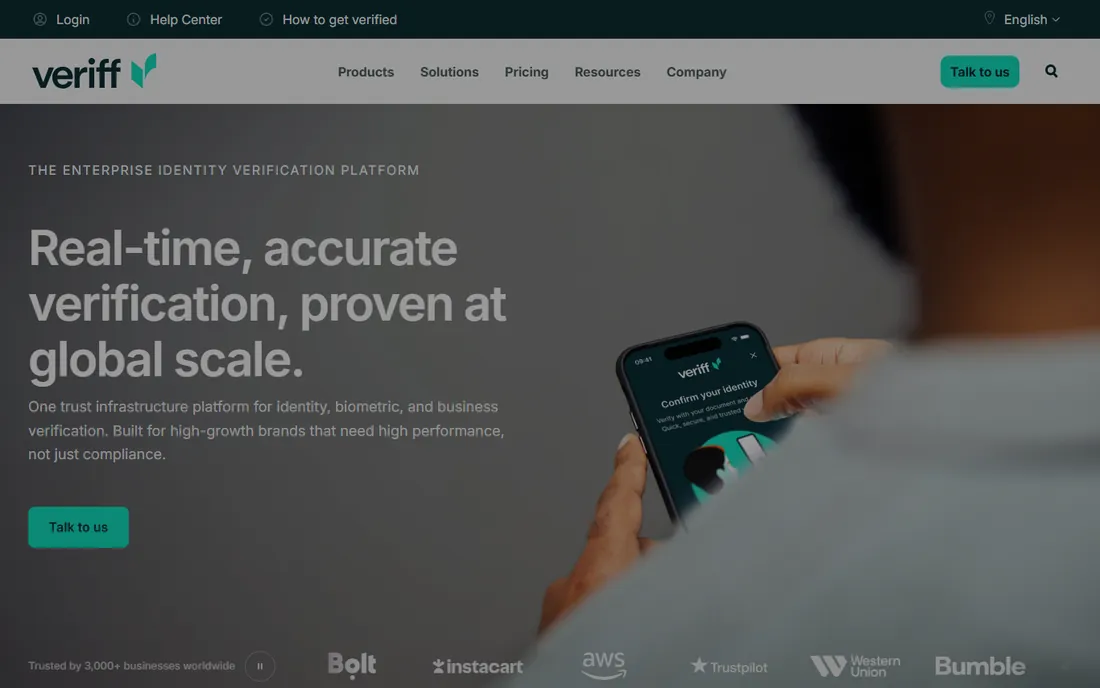
Veriff is the easiest serious IDV vendor to start with. The Essential plan publishes its pricing, $0.80 per verification with a $49 monthly commitment, and the 15-day trial includes 50 live sessions, which is enough to measure your actual conversion rate before spending real money. Decision speeds are fast, document coverage is global, and the AI defenses cover deepfakes and injection attacks.
The honest catch is the add-on structure. Core identity verification is the advertised price; AML screening, fraud intelligence and biometric authentication stack on top, and real enterprise volumes end up negotiated like everyone else's. Veriff fits mobile-first apps and marketplaces where onboarding speed is the metric. Fintechs needing the full compliance stack in one contract should compare Sumsub first.
What we like- Published self-serve pricing from $0.80 per check
- Fast automated decisions with broad document coverage
- 15-day trial with 50 live sessions
Watch out for- AML screening is an add-on, not included
- Enterprise volumes need negotiated contracts anyway
- Per-check costs rise with add-on products
Starting priceFrom $1.35/check ($149/mo min)
Free planFree trial (14 days)
Sumsub sells consolidation. Instead of separate vendors for identity verification, business verification, sanctions screening and transaction monitoring, one platform and one contract cover the compliance stack. For fintech, crypto and iGaming companies that need all of it from day one, that single throat to choke is worth real money. Published pricing starts at $1.35 per verification with a $149 monthly commitment.
The minimums matter at small scale. A startup doing two hundred checks a month pays the $149 floor regardless, which changes the effective per-check math. And the higher Compliance tier runs about $1.85 per check. But for regulated products where the alternative is three vendors and three integrations, Sumsub's breadth justifies the premium.
What we like- KYC, KYB, AML screening and transaction monitoring in one platform
- Published pricing from $1.35 per check
- 14-day trial with 50 free checks
Watch out for- $149 monthly minimum prices out tiny volumes
- Higher tiers reach $1.85 per check
- The all-in-one scope can be more than simple use cases need
Starting priceFree Starter; then custom
Free planYes
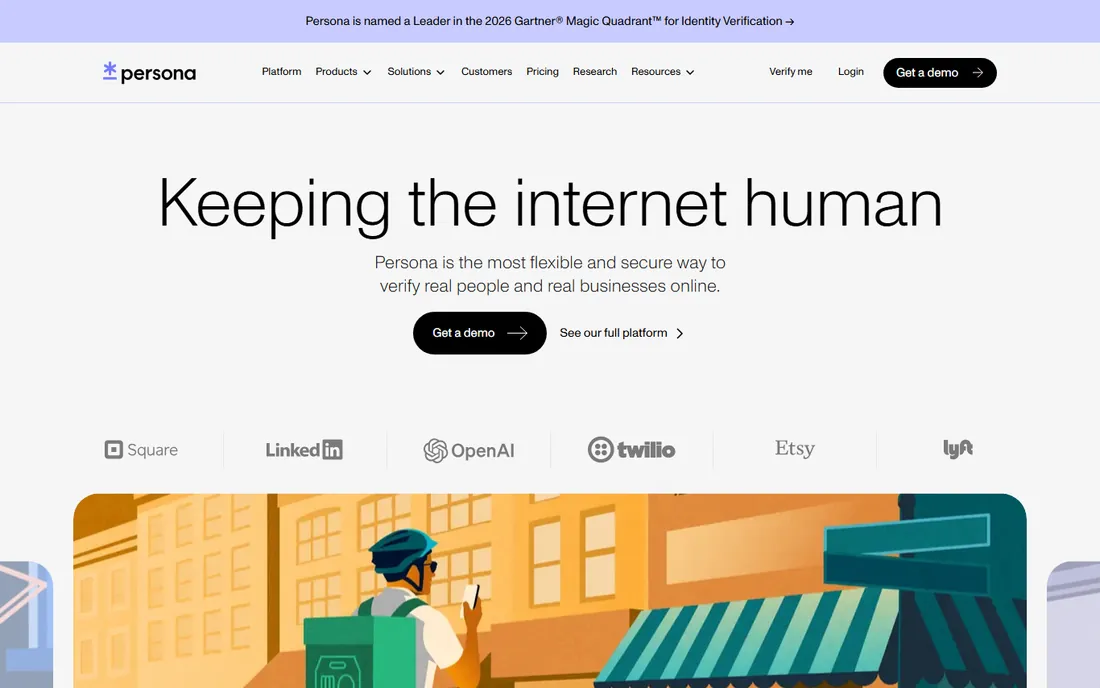
Persona is the product team's IDV vendor. The free Starter tier, 500 verifications a month at no cost, lets you build and test real onboarding flows before any commercial conversation. The low-code builder composes document checks, database verifications, custom UI and risk rules into flows that match your product instead of forcing your product into a generic widget.
Paid pricing goes custom, with third-party comparisons suggesting around $1.50 per KYC check on growth tiers. That puts Persona above the self-serve price leaders once volume grows, which is the tradeoff for configurability. Choose Persona when the verification flow itself is a product differentiator. Choose Veriff or Sumsub when you want verification to be invisible infrastructure.
What we like- Free Starter tier with 500 verifications a month
- Low-code builder for custom onboarding flows
- Case management and dynamic risk rules
Watch out for- Paid pricing is quote-based with ~$1.50 per KYC reported
- Enterprise features need the sales process
- Smaller verification network than Jumio
Starting price~$1.39/check
Free planNo
iDenfy's pricing model fixes the industry's quiet ripoff: paying for verifications that fail. At roughly $1.39 per check with payment only on approvals, the vendor shares the cost of its own false rejections, which aligns incentives in the buyer's favor. Document verification, liveness detection and AML screening come in the package.
The tradeoff is vendor weight. iDenfy lacks Jumio's banking pedigree and Persona's workflow configurability, and large regulated buyers will want deeper diligence. But for global SMBs and fintechs watching unit economics closely, paying only for successes is a genuinely buyer-friendly structure. Confirm the current per-check rate for your volume before budgeting.
What we like- Pay-per-approved-verification model means failed checks cost nothing
- No monthly minimum reported
- Document, liveness and AML in one check
Watch out for- Smaller brand recognition than the leaders
- Enterprise assurance depth trails Jumio
- Pricing details need confirmation for your volume
Starting priceSee website
Free planNo
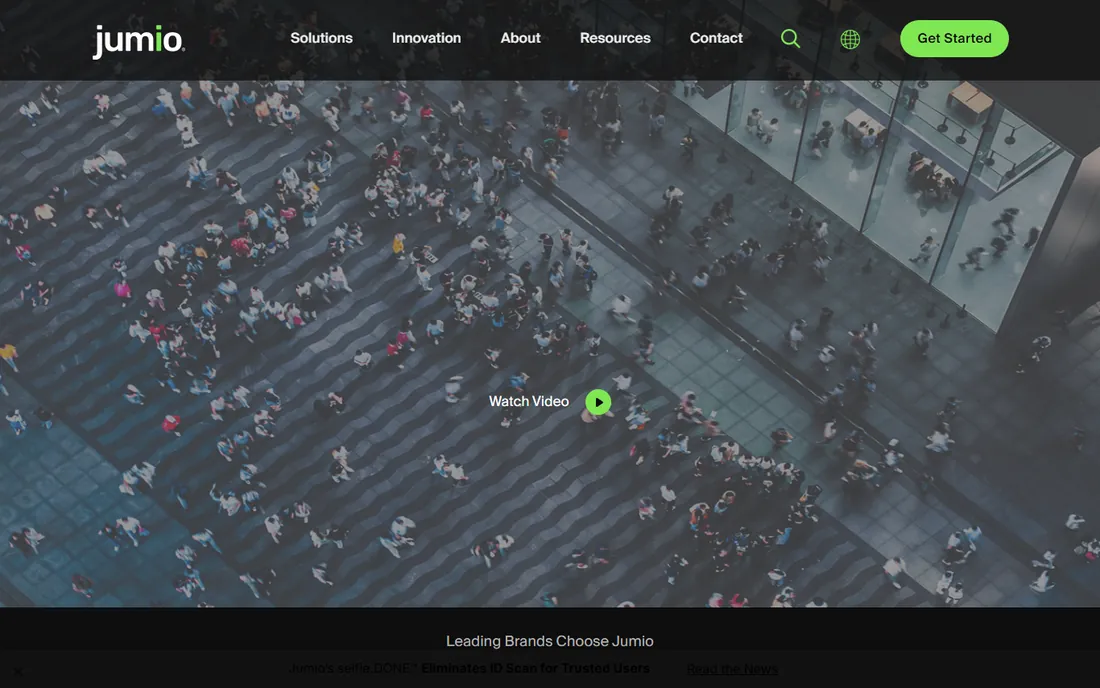
Jumio is the incumbent that banks call first. The document coverage is unmatched at over 5,000 ID types, the biometric defenses handle presentation attacks and face morphing, and the identity graph adds risk signals beyond the single session. For high-assurance regulated industries, Jumio's audit trail and compliance posture are the product as much as the technology.
Everything about the buying is enterprise. Quote-only pricing, annual contracts starting deep in five figures, and a sales process measured in months. Startups and marketplaces will find it heavy and expensive. But when regulators, auditors or banking partners need to see a name they trust, Jumio is that name.
What we like- 5,000+ ID document types, the broadest coverage
- Liveness and face-morph detection for sophisticated fraud
- The default choice for regulated banking
Watch out for- Enterprise quote-only pricing, typically $50,000-plus a year
- Sales-led buying with long cycles
- Overkill for simple age or identity checks
Starting priceSee website
Free planNo
Onfido's acquisition by Entrust created an identity security suite rather than a point product. The IDV platform keeps Onfido's strengths, fast document and biometric verification with the Workflow Studio for building multi-step journeys, now inside a portfolio spanning PKI, passwordless and hardware security. Enterprises standardizing on Entrust get a coherent identity story.
Standalone buyers face standard enterprise friction: quoted pricing, annual contracts and a sales cycle. The 2026 SDK redesign improved integration, but this remains a platform for companies with compliance teams, not a self-serve signup. If your organization already buys Entrust, the integration logic is compelling. Otherwise, evaluate on verification merits against Jumio and Veriff.
What we like- Workflow Studio for orchestrating complex verification journeys
- 2,500+ document types across 195 countries
- Backed by Entrust's identity security portfolio
Watch out for- Enterprise quote-only pricing
- Best value inside the Entrust ecosystem
- Smaller companies face the full enterprise buying process
Starting priceSee website
Free planNo
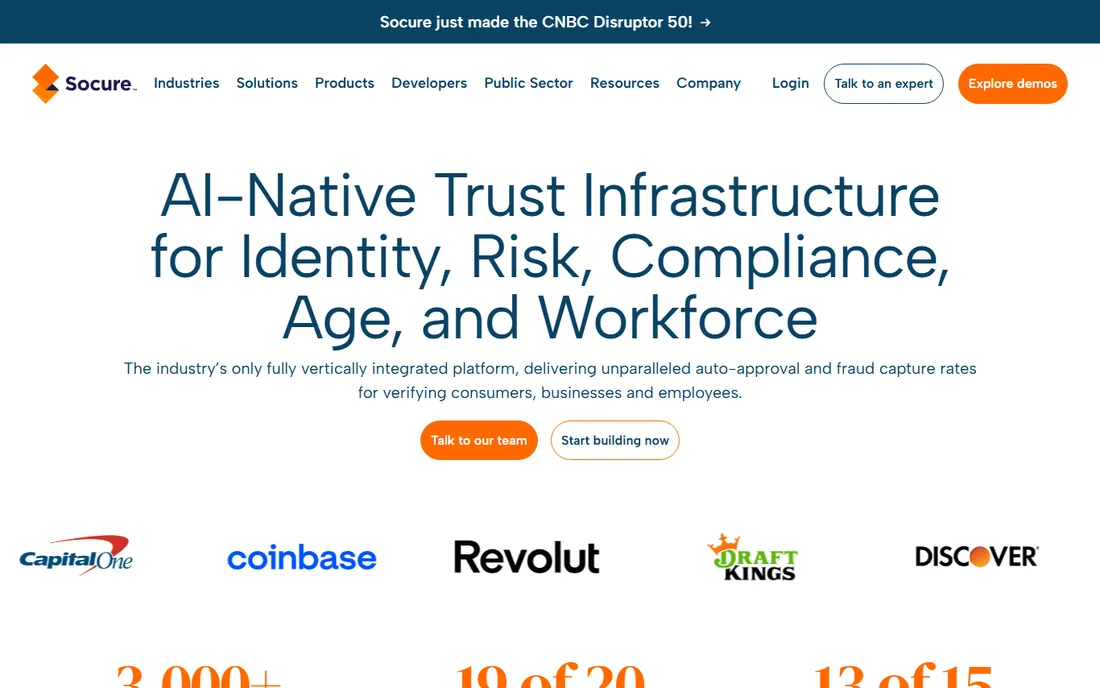
Socure's thesis is that the best verification is the one the user never notices. Its identity graph correlates thousands of data signals to verify identities and predict fraud without demanding a document photo, which protects conversion rates. The Berbix acquisition added proper document verification for cases where data alone is not enough.
The strength is US-shaped. International coverage exists but the data moat is deepest domestically, so global businesses should test their actual markets. Pricing is enterprise and quoted. Socure fits US fintechs and lenders optimizing for approval rates on thin-file and young consumers, where document-first vendors reject good customers.
What we like- Identity graph with deep US data coverage
- Strong at fraud prediction without document friction
- Acquired Berbix for document verification depth
Watch out for- US-centric data advantages fade internationally
- Enterprise quote-only pricing
- Document verification historically secondary to data-driven checks
Starting priceSee website
Free planNo

Trulioo answers the global coverage question with data instead of documents. Where reliable identity data exists, and across 195 countries it usually does, Trulioo verifies people and businesses electronically without the friction of a document photo. That makes it the pick for marketplaces and platforms onboarding users in dozens of countries where document standards vary wildly.
Data quality is uneven by market, which is true of every data vendor and worth testing country by country. Pricing is usage-based and quoted. Trulioo fits platforms whose users span the globe and whose conversion rates cannot survive document friction. Pair it with a document vendor for the markets where data runs thin.
What we like- 450+ data sources across 195 countries for electronic verification
- Person and business verification plus watchlists
- Verifies without documents where data suffices
Watch out for- Usage-based quotes with no published rates
- Data quality varies by country
- Document verification is not the core strength
#9
ID.me
Best for: Government and verified-group programs
Visit id.me
Starting priceSee website
Free planNo
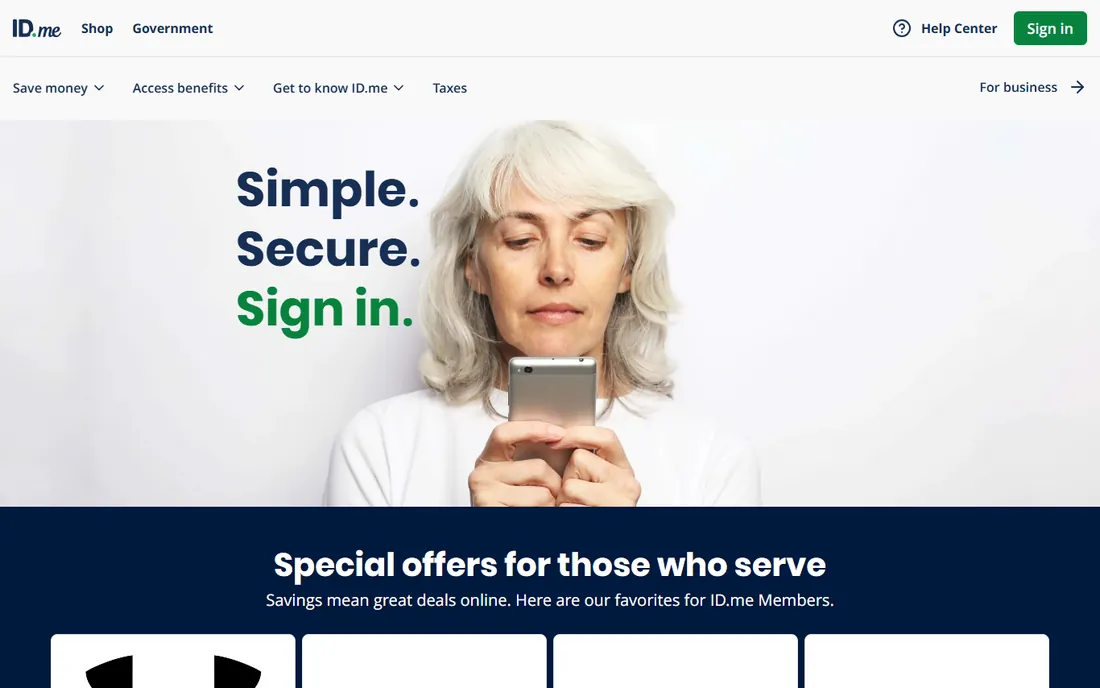
ID.me plays a different game: reusable identity. Consumers verify once and reuse that verification across government agencies, healthcare providers and retailers, which removes repeated document checks entirely. For organizations serving veterans, government employees or verified patient groups, accepting ID.me means accepting a credential users already hold.
The tradeoffs are control and brand. Verification happens in ID.me's flow under ID.me's brand, and the company's data practices have drawn scrutiny. B2B pricing is contracted, not published. ID.me fits when your users already have ID.me wallets or your compliance regime recognizes it. It does not fit when you need invisible white-labeled verification.
What we like- Reusable verified identity across government and commercial partners
- Free for consumers
- Strong in healthcare, military and government verification
Watch out for- B2B contracts only, no self-serve
- Consumer privacy concerns dog the brand
- Verification is ID.me-branded, not white-labeled
Starting priceSee website
Free planNo
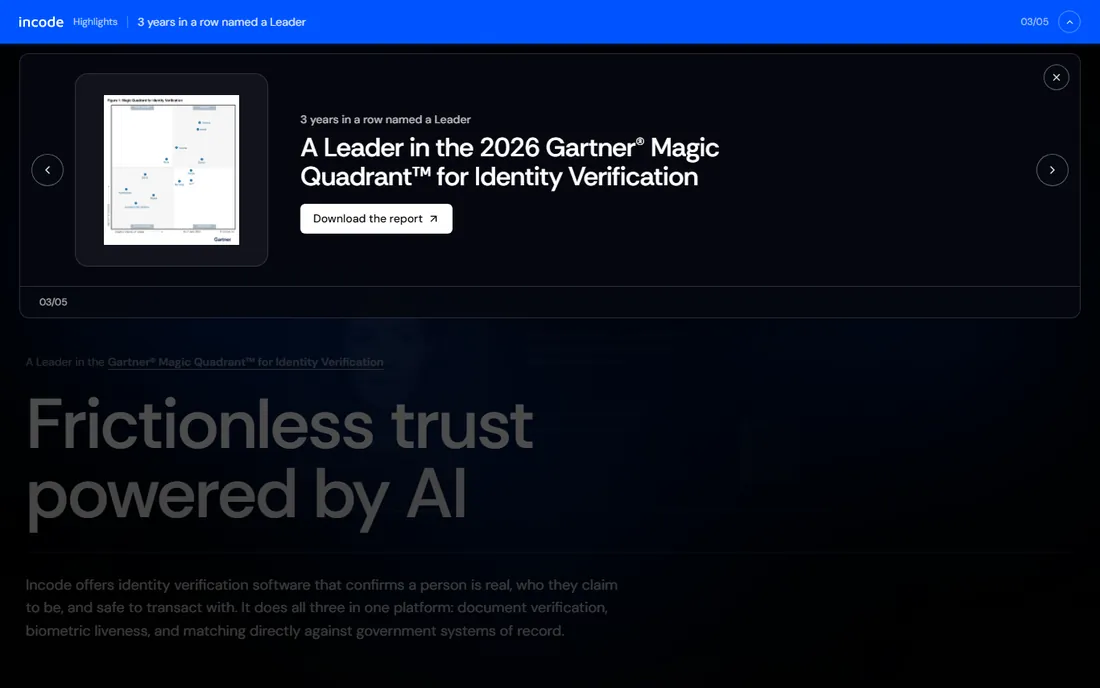
Incode bets everything on biometrics. The platform's liveness detection and deepfake defenses are built in-house rather than licensed, and the onboarding flows center on face matching against documents and government sources. For banks and high-risk consumer platforms where account takeover and synthetic identity are the threats, this focus shows.
Biometric-first means privacy-first questions. Regulators and users increasingly scrutinize face data storage, so the PII model deserves diligence. Pricing is enterprise and quoted. Incode fits organizations where fraud sophistication justifies biometric assurance and the compliance team is comfortable with the data model. Others should weigh the privacy posture carefully.
What we like- In-house deepfake and injection-attack defense
- Facial recognition with liveness at the core
- Strong in banking and high-risk B2C at scale
Watch out for- Enterprise quote-only pricing
- Biometric-first approach raises privacy considerations
- Smaller ecosystem than Jumio or Entrust
The conversion-rate test
During every trial, measure three numbers: the pass rate, the false-rejection rate on known-good users, and the median time to decision. Run at least a few hundred real sessions, because vendor benchmarks use clean data and your users will not. A two-point difference in pass rates dwarfs any per-check price difference at real customer values.
Then attack your own shortlist. Submit a printed photo, a screen replay and a morphed image through the trial integration, and ask the vendor to explain what their system detected. The quality of that answer separates real fraud defenses from marketing. Any vendor that cannot explain its liveness detection in concrete terms is selling you a document scanner with a fancy name.
Finally, read the PII storage model. Centralized vendor databases, user-held keys and zero-retention options have very different breach and compliance implications. Your legal team will ask eventually; ask first.
How we compared these ten
We started from vendor pricing pages and documentation, then cross-checked against September 2026 pricing research and public reviews on G2 and Capterra. Every published price above reflects per-check rates and monthly minimums verified in 2026, including Veriff's $0.80 entry and Sumsub's $149 floor. Where vendors keep pricing quote-only, which is standard for enterprise IDV, we say so instead of repeating estimates.
We did not claim hands-on testing of any platform. We weighted verification-specific capabilities over adjacent fraud features: document coverage, liveness and deepfake defense, conversion impact, global data sources, AML screening and the PII storage model. Pure fraud-scoring tools without verification flows and consumer identity apps did not make the cut.
The real cost of a verification stack
The per-check price is the headline, not the bill. Monthly minimums mean low volumes pay the floor regardless. AML screening typically adds $0.50 to $1.50 per check when it is not included. Enterprise contracts land in the $50,000 to $200,000 annual range, far above advertised entry rates. And integration engineering, ongoing tuning and manual review staffing are real costs no pricing page mentions.
Model the total at your actual volume with your actual add-ons. A startup doing 500 checks a month on Veriff Essential pays the $49 minimum, or about ten cents a check in practice. The same startup on Sumsub pays $149. At 50,000 checks a month, negotiated enterprise rates rewrite the math entirely. Get every quote in writing against your projected volumes, including overage rates, before you sign.
Frequently asked questions
How much does identity verification cost per check?
Published self-serve rates run from $0.80 per check (Veriff) to about $1.85 (Sumsub's higher tier), with monthly minimums of $49 to $299. Enterprise contracts are negotiated and typically start at $50,000 a year. AML screening often adds $0.50 to $1.50 per check.
What is the difference between KYC and identity verification?
Identity verification proves the person is who they claim to be, usually via documents and biometrics. KYC is the broader regulatory process that includes verification plus risk assessment, ongoing monitoring and record-keeping. Most vendors here sell verification; the full KYC stack adds screening and monitoring.
Can these tools detect deepfakes?
The serious ones can. Look for explicit defenses against presentation attacks, injected video streams and face morphing, not just liveness detection. Ask vendors to demonstrate against your own attack samples during the trial. Marketing claims about AI defense are cheap; demonstrated detection is not.
Do we need document verification or is data enough?
It depends on your markets and risk. Where reliable identity data exists, electronic verification converts better. Where data is thin or assurance requirements are high, documents plus biometrics are necessary. Many platforms combine both, using data first and documents as fallback.
How long does integration take?
Self-serve vendors go live in days with hosted flows or SDKs. API integrations with custom workflows take two to six weeks. Enterprise deployments with compliance review, custom models and audit integration run two to six months. Start with a hosted flow to measure conversion, then customize.
What happens to user data after verification?
It depends on the vendor's PII model. Some retain data centrally, some offer zero-retention options, and a few use decentralized models. Retention affects breach exposure and regulatory obligations, so confirm the model, the retention period and the deletion process before signing.
Sources we checked (12)
- https://www.veriff.com/pricing
- https://sumsub.com/pricing
- https://withpersona.com/pricing
- https://www.idenfy.com/pricing
- https://www.jumio.com/pricing
- https://www.entrust.com/pricing
- https://www.socure.com/pricing
- https://www.trulioo.com/pricing
- https://www.id.me/pricing
- https://incode.com/pricing
- https://www.zyphe.com/resources/blog/best-kyc-software-2026
- https://guptadeepak.com/the-top-10-identity-verification-software/
Is your product missing or out of date?
We review this list regularly. Vendors can request a listing, send updated pricing or ask about featured placement.

Shihab Mia · Founder, Rankite
Shihab has spent more than a decade helping SaaS and e-commerce brands grow through search. He writes Rankite's software buying guides from pricing pages, documentation and public user reviews. More about Shihab.