How we make this list: we compare pricing pages, product documentation and public user reviews. Rankite is independent; if a vendor ever pays for a featured spot, that listing is clearly labeled Partner.
Key takeaways
- SkyCiv and ClearCalcs give small practices browser-based analysis and code checks without enterprise licensing or IT setup.
- ETABS is the reference tool for building design, while SAP2000 covers the non-building structures that CSI's building flagship does not.
- RISA-3D remains the fastest route to US code checks for frames, and STAAD.Pro offers the widest code library of the desktop packages.
- Dlubal RFEM suits engineers who need serious finite element depth, and Tekla Structural Designer fits BIM-led building workflows.
Quick comparison
Is your product missing or out of date?
We review this list regularly. Vendors can request a listing, send updated pricing or ask about featured placement.
Choosing structural software is a bigger decision than most firms admit at the start. The pick locks you into file formats, staff training, and annual renewals that are painful to unwind. Most practices only need one or two packages, yet many pay for FEA depth nobody touches while hitting walls on projects the tool was never built to model.
This list sticks to software that both analyzes and designs, meaning it runs code checks against standards like AISC, ACI, or the Eurocodes, not just draws members. Pure drafting and detailing tools are left out. Prices below are marked "See website" because vendors in this space quote by seats, modules, and region, and published numbers go stale fast.
Starting priceSee website
Free planYes
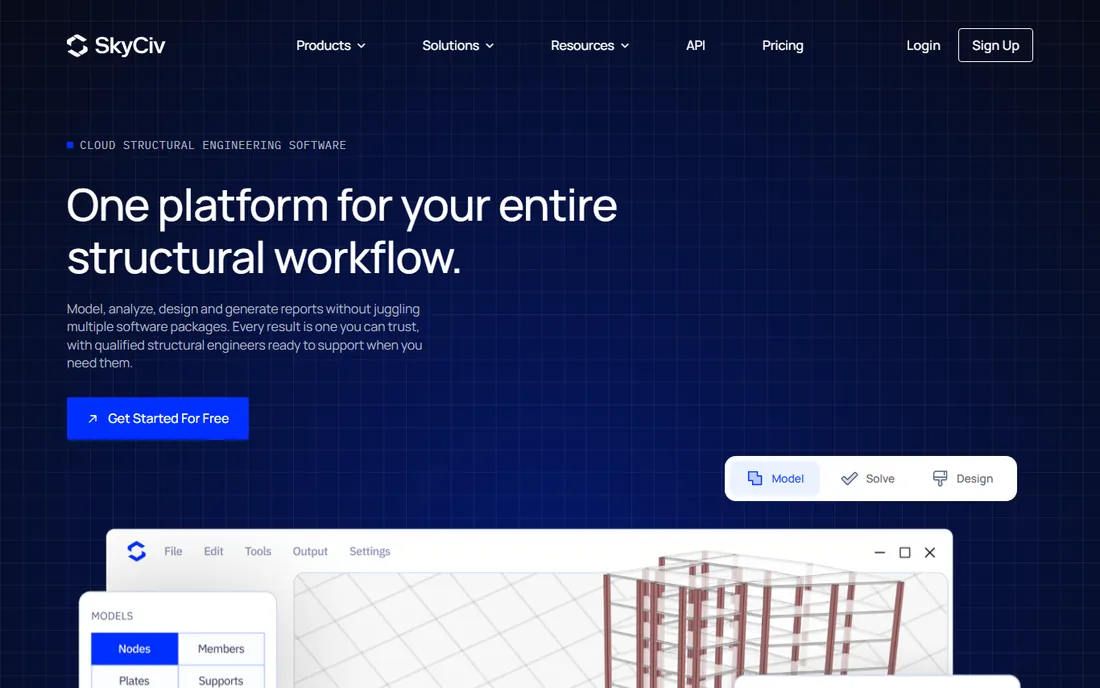
SkyCiv runs entirely in the browser, so there is nothing to install and no license server to babysit. Modeling feels closer to a modern web app than to legacy desktop software, and the learning curve is gentler than most tools on this list. Steel, concrete, timber, connection, and foundation design checks ship against a long list of codes including AISC, AS, EN, CSA, and BS.
The trade is depth. Very large models and advanced nonlinear or staged-construction workflows still belong on desktop solvers like SAP2000 or RFEM. Pricing is subscription-only, so firms that prefer perpetual licenses will not find what they want here.
What we like- Runs fully in the browser with no install
- Broad code coverage across steel, concrete, timber and foundations
- Gentle learning curve for new engineers
Watch out for- Advanced nonlinear and staged-construction workflows lag desktop solvers
- Subscription-only licensing
Starting priceSee website
Free planFree trial
ETABS is the tool most building engineers reach for first, and for good reason. CSI built it around the way buildings are actually designed, from floor-by-floor modeling through concrete and steel code checks to documentation. If your work is mostly low-rise to high-rise buildings, few tools on this list match its workflow.
The catch is the ecosystem. You pay CSI prices and you live inside CSI file formats, which is fine until a project needs a cooling tower or a cable-stayed footbridge. That is exactly the gap SAP2000 exists to fill.
What we like- Purpose-built for building workflows from modeling to documentation
- Deep concrete and steel design integration
- Widely taught, so hiring trained staff is easy
Watch out for- CSI ecosystem lock-in on file formats
- Less suited to non-building structures
Starting priceSee website
Free planFree trial
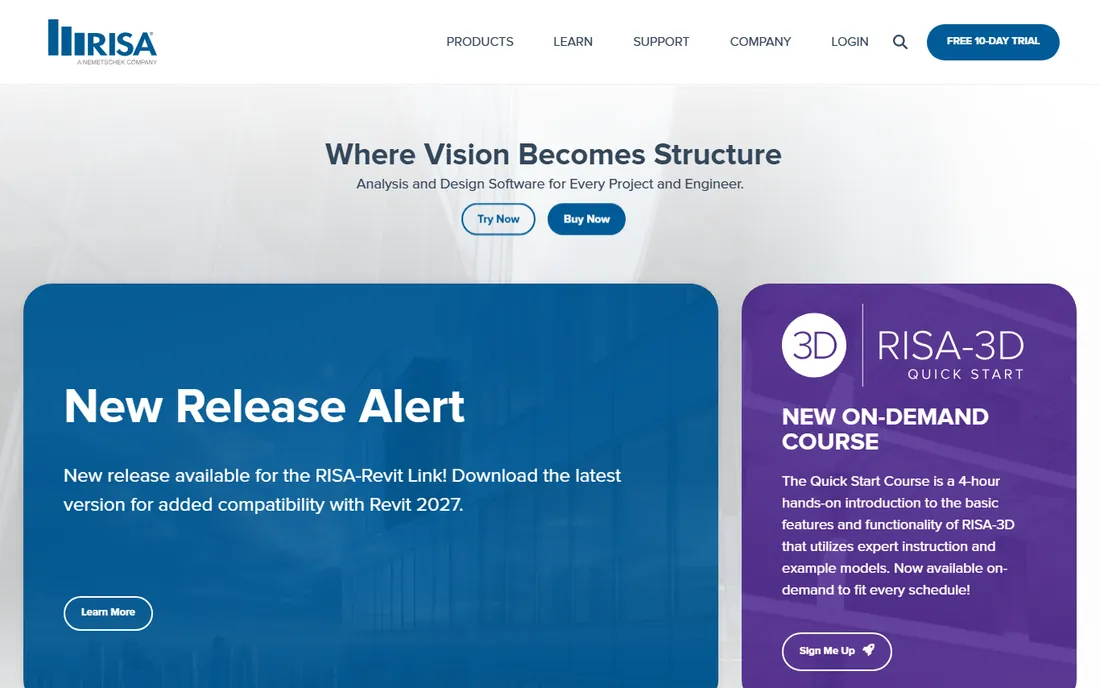
RISA-3D has a loyal US following because it is fast. The spreadsheet-style input lets experienced engineers model and check a steel frame in a fraction of the time a full FEA package takes. Wood, steel, concrete, and aluminum checks against US codes cover the bulk of American practice.
What you give up is generality. Complex geometry, plate and shell behavior, and advanced dynamics are thinner here than in SAP2000 or RFEM. It is also Windows-only, which matters to Mac-based offices.
What we like- Spreadsheet-style input makes common frames very fast to model
- Strong US code coverage for steel, concrete, wood and aluminum
- Approachable for small US practices
Watch out for- Thinner on complex geometry and advanced dynamics
- Windows-only
Starting priceSee website
Free planFree trial
STAAD.Pro has been around long enough that most engineers have touched it at some point. Bentley's code library is enormous, covering steel, concrete, timber, and aluminum across dozens of national codes. The physical modeling workflow, where a physical model converts to an analytical one, saves real time on building frames.
The interface shows its age next to SkyCiv or ClearCalcs, and new users sometimes bounce off the learning curve. Pricing sits in enterprise territory, so it makes most sense for firms that already live in the Bentley ecosystem.
What we like- Enormous library of international design codes
- Physical-to-analytical modeling workflow
- Strong interoperability inside Bentley workflows
Watch out for- Interface feels dated next to newer tools
- Enterprise-level pricing
Starting priceSee website
Free planFree trial
When the structure is not a building, SAP2000 is usually the answer. CSI's general-purpose solver handles bridges, tanks, dams, cable structures, and offshore frames with the same seriousness ETABS gives to buildings. The analysis options run deep, from staged construction to buckling and time-history.
For everyday building design it feels like the wrong tool, with more setup than ETABS for the same result. Solo practitioners sometimes find the price hard to justify unless special structures are a steady part of their workload.
What we like- True general-purpose solver for non-building structures
- Deep analysis options including staged construction and time history
- Same CSI reliability as ETABS
Watch out for- Building design workflows are clunkier than ETABS
- Pricey for solo practitioners
Starting priceSee website
Free planFree trial
RFEM is the engineer's FEA package. Plates, shells, membranes, stability analysis, and dynamics are core features rather than add-ons. European code coverage is excellent, and the program is popular with firms doing architecturally ambitious structures where shell behavior actually matters.
Expect a steeper climb than SkyCiv or RISA-3D. The modular pricing means the number on the quote grows as you add the steel, concrete, and dynamics modules most practices need.
What we like- Plates, shells, stability and dynamics are first-class features
- Excellent European code coverage
- Strong for architecturally ambitious structures
Watch out for- Steeper learning curve than frame-focused tools
- Modular pricing adds up

#7
Tekla Structural Designer
Best for: BIM-led building design
Visit tekla.com
Starting priceSee website
Free planFree trial
Tekla Structural Designer aims at the full building workflow, from analysis through design and into detailing. The link to Tekla Structures is the selling point: analysis results flow toward fabrication-level models without re-entry. Concrete and steel building design are both strong.
It is firmly a Trimble-world product, so firms outside that orbit get less of the benefit. Licensing costs reflect its enterprise positioning, and it is overkill for engineers who only need member checks.
What we like- Analysis flows toward detailing via Tekla Structures
- Strong concrete and steel building design
- Good for design-to-fabrication workflows
Watch out for- Firmly a Trimble-world product
- Overkill if you only need member checks
Starting priceSee website
Free planFree trial
SCIA Engineer is the quiet all-rounder of the European market. Steel, concrete, timber, and aluminum design sit inside one model, and the BIM links to Revit, Tekla Structures, and IFC are genuinely useful on mixed-software projects. Engineering offices that juggle Eurocodes across countries like it.
In the US it is a smaller presence, and American code coverage is not its strength. Support and training resources in English are fine, but the community is thinner than STAAD.Pro's or RISA's.
What we like- Steel, concrete, timber and aluminum in one model
- Genuinely useful BIM links to Revit, Tekla and IFC
- Solid multi-Eurocode workflows
Watch out for- Smaller US presence and US code coverage
- Thinner user community than STAAD.Pro or RISA

#9
Autodesk Robot Structural Analysis
Best for: Revit-integrated analysis
Visit autodesk.com
Starting priceSee website
Free planFree trial
Robot makes sense for one specific buyer: the firm already paying for the Autodesk AEC Collection. The Revit link lets analytical models travel back and forth with the BIM model, which removes a whole class of coordination errors. For steel and concrete building analysis it is capable.
Outside the Autodesk stack, there is little reason to choose it over the specialists above. Long-time users also note that development pace has been uneven, so check the latest release notes before committing.
What we like- Direct Revit link removes a class of coordination errors
- Capable steel and concrete building analysis
- Included in the AEC Collection many firms already pay for
Watch out for- Little reason to choose it outside the Autodesk stack
- Uneven development pace
Starting priceSee website
Free planYes
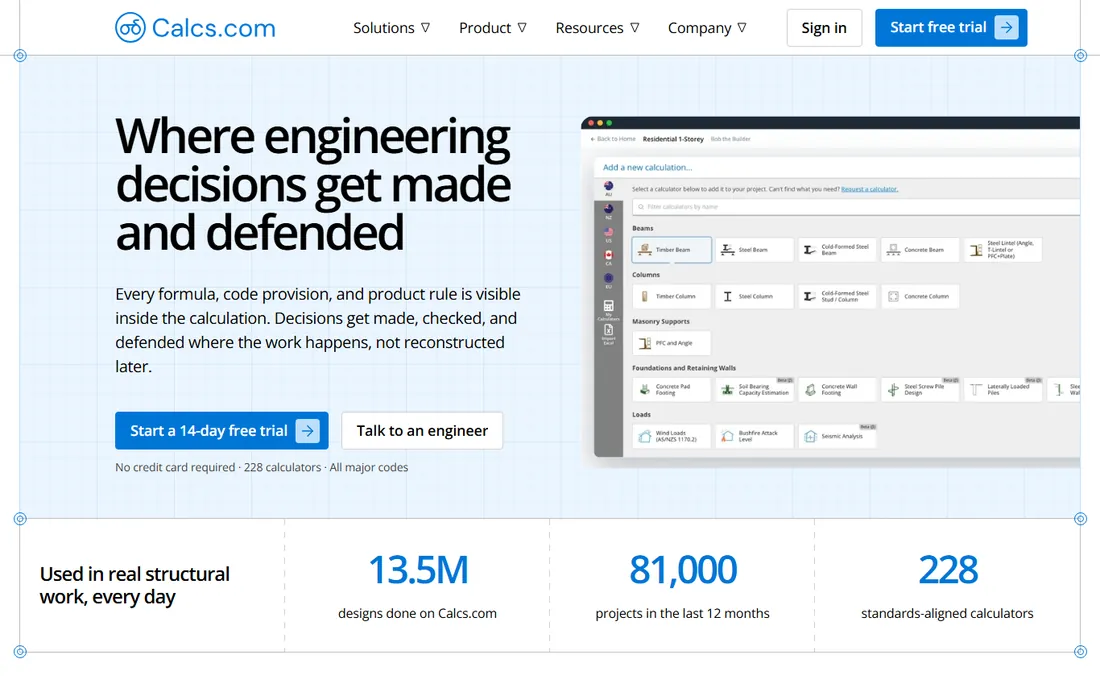
ClearCalcs takes the opposite approach from everything above it. Instead of modeling whole structures, it gives you clean, fast calculators for beams, columns, footings, retaining walls, and connections. The output sheets look professional enough to hand to a plan checker or client. For residential and light commercial work, this covers a surprising share of daily calculations.
It is not a system-level tool. If you need to analyze a full 3D frame with lateral loads, you will still need one of the packages above. Think of it as the fastest way to answer "does this beam work" rather than a replacement for a 3D model.
What we like- Very fast beam, column, footing and connection checks
- Clean calculation sheets suitable for plan checkers
- Low entry cost with a free tier
Watch out for- Member-by-member, not system-level analysis
- No full 3D frame modeling
How we chose
We reviewed vendor pricing pages and documentation, read public reviews on G2, Capterra, and SourceForge, and went through practitioner discussions on Reddit and engineering forums. We compared code coverage by jurisdiction, analysis depth, modeling workflow, and how each vendor prices seats, modules, and renewals. No hands-on testing was performed; the assessment reflects documented capabilities and reported user experience.
How to choose without overbuying
Start from your structure types
List what you actually design in a year. Mostly buildings points to ETABS, RISA-3D, or Tekla Structural Designer. Bridges, tanks, and industrial structures point to SAP2000 or STAAD.Pro. Shells and architecturally complex forms point to RFEM. If most of your work is member sizing for houses and small commercial buildings, ClearCalcs may cover 80 percent of it.
Count the full license cost
The sticker price is rarely the whole story. Ask about per-seat versus floating licenses, which design modules are included, and what the annual renewal costs after year one. Cloud tools like SkyCiv and ClearCalcs keep this simple; modular desktop packages like RFEM and STAAD.Pro need a line-by-line quote.
Check code coverage for your jurisdiction
A tool that is excellent under the Eurocodes may be thin under ASCE 7 or the NDS. Confirm that the specific code editions your authority having jurisdiction enforces are supported, not just the code family name.
Trial it on a real past project
Demos with sample models flatter every vendor. Rebuild one of your own completed projects during the trial period and compare the design output against your stamped calculations. That single exercise reveals more than any feature matrix.
Where engineering firms usually land
Solo engineers and small practices tend to settle on SkyCiv for full 3D work plus ClearCalcs for quick checks, because the combined cost stays low and there is no IT burden. US building practices standardize on RISA-3D for speed or ETABS for depth. Larger multi-disciplinary firms keep STAAD.Pro, SAP2000, or RFEM for the breadth of codes and structure types. Offices already committed to BIM usually add Tekla Structural Designer, Robot, or SCIA Engineer for the model handoff rather than the solver alone.
Frequently asked questions
Do I need analysis and design in one package?
Not always. Many engineers analyze in one tool and check members in another, especially for steel connections. A combined package saves time when the design is iterative, because member sizes update the analysis automatically. If your workflow is mostly verification of already-sized members, a calculator like ClearCalcs plus a simple analysis tool can be enough.
Is cloud-based structural software reliable enough for real projects?
For routine frames and buildings, yes. SkyCiv and ClearCalcs both produce code-checked output that engineers stamp every day. The remaining concerns are practical: you need internet access on site, and very large or highly nonlinear models still run better on desktop solvers. Keep local backups of every model you stamp.
Which tool is best for learning structural design?
RISA-3D and SkyCiv have the gentlest learning curves for students and new graduates. ETABS is worth learning early because so many employers use it. University programs often provide educational licenses for STAAD.Pro, SAP2000, and Robot, so check what your school offers before paying for anything.
Can one license cover both US and European codes?
STAAD.Pro and RFEM come closest, with broad international code libraries. CSI products cover major codes well but verify the specific editions. ClearCalcs and RISA-3D are US- and Australia-focused, so European engineers should look at SCIA Engineer or RFEM first.
How long does it take to switch tools?
Plan on two to four weeks of reduced productivity per engineer for a frame-based tool, longer for FEA-heavy packages like RFEM. The bigger cost is template and library migration: load combinations, typical details, and report formats all need rebuilding. Run the old and new tools in parallel on live projects for at least a month.
Sources we checked (10)
- https://skyciv.com
- https://www.csiamerica.com
- https://risa.com
- https://www.bentley.com
- https://www.dlubal.com
- https://www.tekla.com
- https://www.scia.net
- https://www.autodesk.com
- https://clearcalcs.com
- https://github.com/pauljomy/awesome-civil-engineering
Is your product missing or out of date?
We review this list regularly. Vendors can request a listing, send updated pricing or ask about featured placement.

Shihab Mia · Founder, Rankite
Shihab has spent more than a decade helping SaaS and e-commerce brands grow through search. He writes Rankite's software buying guides from pricing pages, documentation and public user reviews. More about Shihab.
 SkyCiv
 ETABS
ETABS RISA-3D
 STAAD.Pro
 SAP2000
 Dlubal RFEM
 SCIA Engineer
 ClearCalcs