How we make this list: we compare pricing pages, product documentation and public user reviews. Rankite is independent; if a vendor ever pays for a featured spot, that listing is clearly labeled Partner.
Key takeaways
- SAP2000 and ETABS (both from CSI) are the industry standards for general structural analysis and building design.
- STAAD.Pro and RAM Structural System (both Bentley) serve firms standardized on Bentley workflows.
- RISA is the practical American choice for steel, concrete, and wood building design.
- Robot Structural Analysis suits firms in the Autodesk ecosystem; Tekla Structural Designer excels at model-based design.
- SkyCiv and RFEM offer modern cloud and powerful FEA approaches at accessible price points.
Quick comparison
Is your product missing or out of date?
We review this list regularly. Vendors can request a listing, send updated pricing or ask about featured placement.
The best structural engineering software
Starting priceSee website
Free planNo
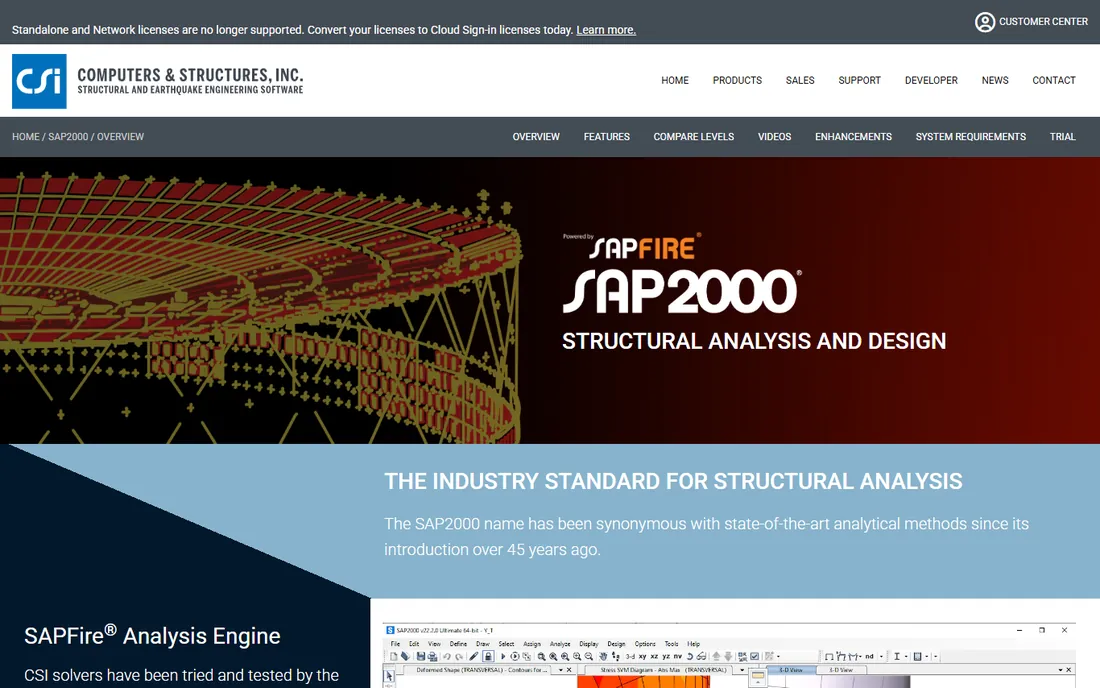
SAP2000 from Computers and Structures (CSI) is the generalist's power tool: bridges, dams, towers, stadiums, industrial structures, and buildings all model and analyze in one program. The analysis capabilities (static, dynamic, nonlinear, staged construction) run deep, and the program has decades of validation behind it. Structural engineers worldwide learn it in school and use it in practice.
The versatility brings complexity; new users face a dense interface and many options. But for firms handling varied structure types, SAP2000's breadth means one tool instead of several. It remains the default answer to "which structural analysis software should we buy."
What we like- Extremely versatile
- Handles any structure type
- Deep analysis options
Watch out for- Learning curve
- Interface is dense
Starting priceSee website
Free planNo

ETABS, also from CSI, focuses SAP2000-style power on buildings. The modeling is object-based (columns, beams, walls, floors as intelligent objects rather than raw finite elements), which makes building models faster to build and easier to modify. Integrated design for steel and concrete per major codes means analysis flows directly into code checks and detailing.
Non-building structures belong in SAP2000 instead. But for building design firms, ETABS's specialized workflow is more productive than a generalist tool. High-rise designers in particular rely on its efficiency. If your firm designs buildings, ETABS is the natural CSI choice.
What we like- Purpose-built for buildings
- Integrated design codes
- Efficient workflows
Watch out for- Building-focused
- Less for non-building structures
Starting priceSee website
Free planNo
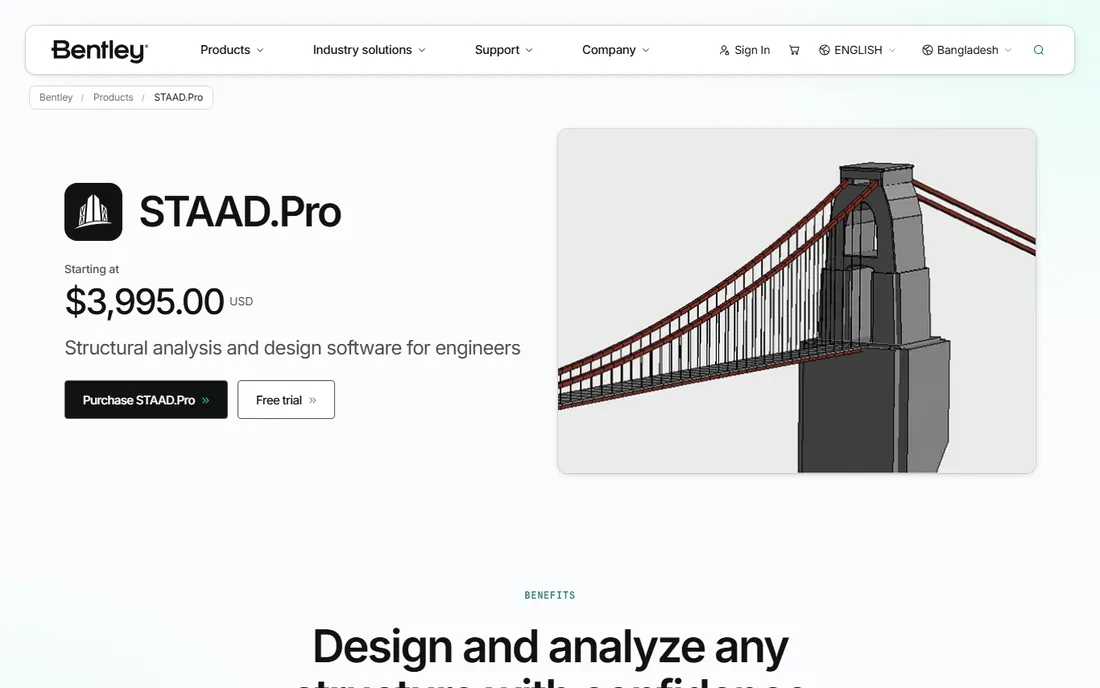
STAAD.Pro, now part of Bentley, analyzes structures in steel, concrete, timber, aluminum, and cold-formed steel against an enormous library of international design codes. Firms working across countries value the code coverage. Integration with other Bentley products (and the broader infrastructure portfolio) suits firms standardized on Bentley.
The interface reflects its long history and can feel piecemeal next to newer tools. But the analytical breadth and global code support keep STAAD.Pro entrenched, especially in markets where Bentley dominates infrastructure work. For multi-material, multi-code practice, it remains a workhorse.
What we like- Broad material and code support
- Bentley integration
- Widely used globally
Watch out for- Interface aging
- Can feel piecemeal
Starting priceSee website
Free planNo
RISA (including RISA-3D, RISAFloor, and RISAFoundation) is built around American design practice: AISC steel, ACI concrete, NDS wood, with workflows that match how US engineers actually design buildings. The integration between the 3D model, floor systems, and foundations keeps building projects coherent. Pricing is competitive for the capability.
International code coverage is thinner than STAAD.Pro's. Highly unusual structures may need SAP2000's generality. But for US building design firms, RISA's practical, code-aware workflow is often more productive than the bigger international tools. It is the pragmatic American choice.
What we like- Intuitive for US practice
- Integrated 2D and 3D
- Good value
Watch out for- US-centric codes
- Less for exotic structures
Starting priceSee website
Free planNo
Robot Structural Analysis Professional brings serious finite element analysis to firms working in Autodesk's BIM ecosystem. The Revit integration enables bidirectional model exchange: design in Revit, analyze in Robot, update both. For firms that live in Revit, this workflow advantage is significant. Availability through the AEC Collection bundles it with other Autodesk tools.
Some users note slower development compared with CSI's pace. Outside Autodesk workflows, its advantages narrow. But for Revit-based structural practices, Robot's BIM integration makes it the logical analysis choice. The model-to-analysis round trip is the selling point.
What we like- BIM integration with Revit
- Strong analysis
- Part of AEC Collection
Watch out for- Development pace concerns
- Best inside Autodesk workflows

#6
Tekla Structural Designer
Best for: Model-based building design
Visit tekla.com
Starting priceSee website
Free planNo
Tekla Structural Designer (from Trimble) keeps one model from initial analysis through detailed design: analyze, design members, and produce drawings and schedules from the same data. The concrete and steel building workflows are well developed, and integration with Tekla Structures extends into fabrication-level detailing. Firms that value the single-model philosophy find it efficient.
It focuses on buildings rather than general structures. Pricing follows enterprise patterns. But for building design practices that want analysis and design truly integrated (not just linked), Tekla Structural Designer's model-based approach reduces the errors that creep in between separate tools.
What we like- Single model from analysis to detailing
- Great for concrete and steel buildings
Watch out for- Building-focused
- Trimble ecosystem pricing
Starting priceSee website
Free planNo
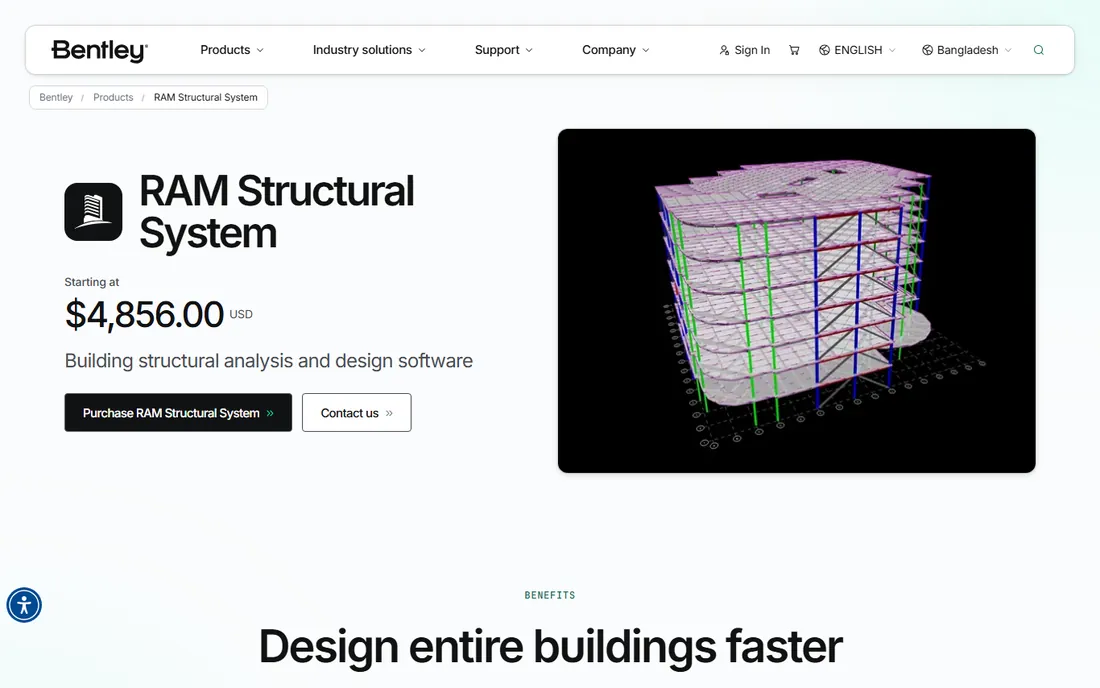
RAM Structural System (Bentley) covers the complete building design workflow: modeling, analysis, steel and concrete design, and foundation design (RAM Foundation) in an integrated suite. US building firms appreciate the code-aware design and the way the modules share one model. Bentley ecosystem firms get natural integration with their other tools.
Like its peers, it focuses on buildings. The learning investment is real. But for firms wanting a single-vendor building solution from analysis through foundations, RAM's integrated suite is comprehensive. It competes directly with ETABS and RISA for the US building market.
What we like- Full building workflow
- Foundations included
- Bentley ecosystem
Watch out for- Building-focused
- Learning investment
Starting priceSee website
Free planYes
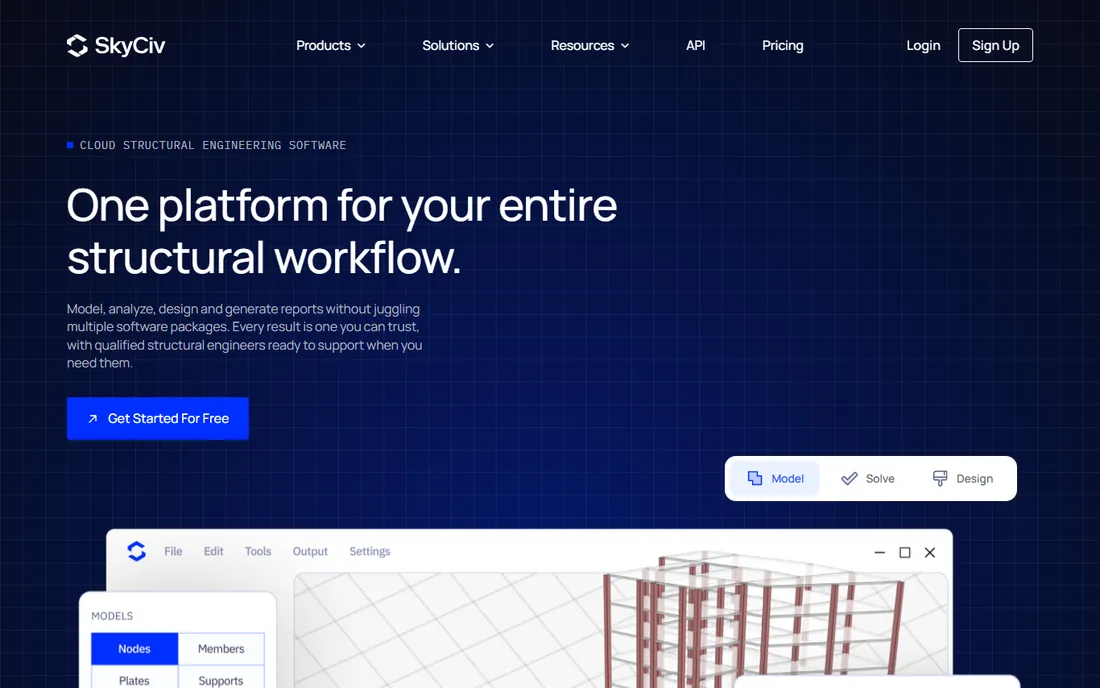
SkyCiv brings structural analysis to the browser: beam calculators, frame analysis, and design modules that run without installation. The free tier suits students and quick checks; paid plans add serious capability at prices far below the desktop giants. Accessibility is the point: analysis from any computer, collaboration through the cloud.
The depth does not match SAP2000 or Robot for complex projects. An internet connection is required. But for small firms, solo engineers, and quick analyses, SkyCiv's combination of capability and accessibility is remarkable. It is also the best way for students to learn structural software without license costs.
What we like- Runs in the browser
- Accessible pricing
- Free tier for learning
Watch out for- Less depth than desktop giants
- Needs internet
Starting priceSee website
Free planNo
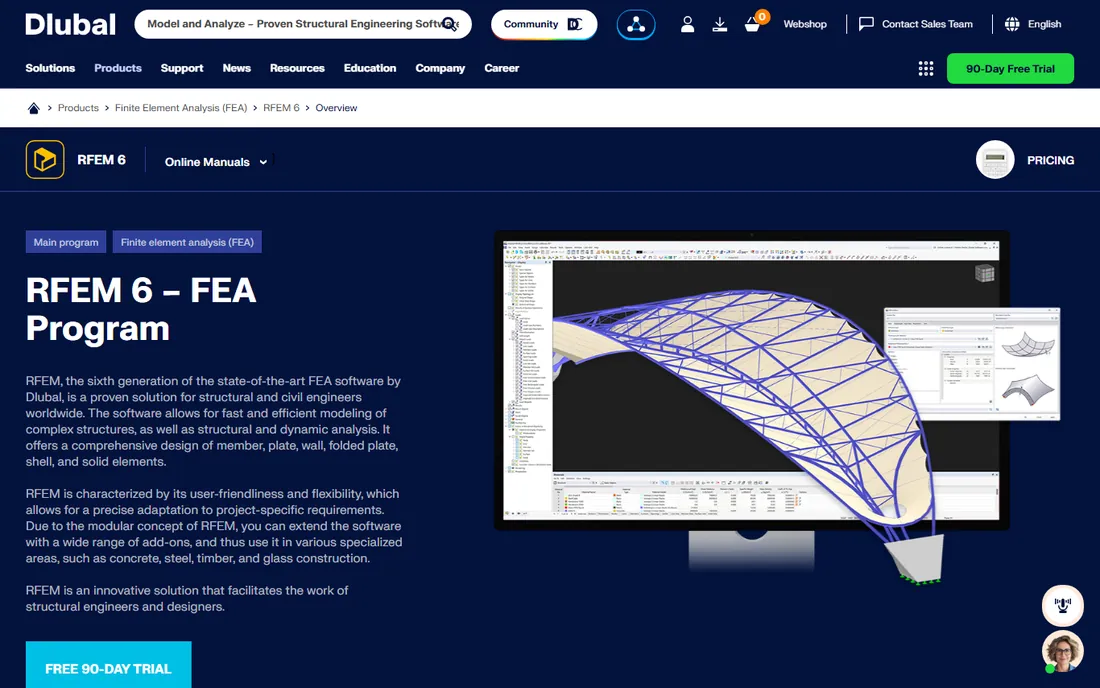
RFEM from Dlubal is a serious finite element platform with an enormous library of add-ons covering steel, concrete, timber, glass, membranes, and dynamic analysis. European engineers value its precision and the depth of the Eurocode implementation. The parametric modeling capabilities suit complex geometries.
The complexity matches the power; this is not casual software. Code coverage emphasizes European standards. But for engineers needing genuine FEA depth (rather than building-design workflows), RFEM's analytical rigor stands with the best. It is the analyst's tool among building designers' tools.
What we like- Powerful finite element analysis
- Huge add-on library
- Precise modeling
Watch out for- Complexity
- European-centric codes
Matching software to practice
Structural software choices follow practice type more than feature lists. Building design firms choose between ETABS, RISA, RAM, and Tekla Structural Designer based on region, codes, and ecosystem. General and infrastructure practices need SAP2000, STAAD.Pro, or Robot. Analysts doing complex FEA look at RFEM. Small practices and students start with SkyCiv. The wrong question is "which is best"; the right question is "which fits the structures we design, the codes we follow, and the ecosystem we work in." Most established firms standardize on one primary tool and keep a second for special cases.
What to check before you buy
Code coverage for your jurisdiction
Design codes are not interchangeable. Verify that the software implements the specific codes and editions your projects require (AISC 360, ACI 318, Eurocodes, or others). "Supports steel design" is meaningless without the right code edition. This check eliminates candidates faster than any feature comparison.
BIM and detailing workflow
Analysis is only part of the job. Check how models flow to detailing and documentation: Revit integration, drawing production, and connection design. A great analysis tool with a painful documentation workflow costs more in drafting time than it saves in analysis.
Licensing and team size
Structural software licensing is traditionally expensive and often network-based. Understand concurrent versus named licenses, annual versus perpetual terms, and what modules cost extra. For small firms, the total licensing cost can be the deciding factor; model it honestly.
Validation and trust
Engineers stamp drawings based on software output, which makes validation critical. Established tools have decades of benchmark verification. Newer or cheaper tools should be validated against known solutions before use on real projects. Never trust analysis software you have not verified.
How we chose
We selected structural analysis and design software with professional user bases in 2026, covering buildings, general structures, and advanced FEA. We evaluated analytical capability, code coverage, workflow integration, and fit for different practice types. We excluded pure CAD tools, general FEA without structural focus, and discontinued products. No vendor paid for placement, and we did not run analysis benchmarks.
Frequently asked questions
What is the most widely used structural engineering software?
SAP2000 and ETABS (CSI), STAAD.Pro (Bentley), and Robot (Autodesk) are the most widely used globally, with RISA strong in the US. The "standard" varies by region, structure type, and industry: building designers, bridge engineers, and industrial firms often use different tools.
Which software is best for learning structural engineering?
SkyCiv's free tier is the most accessible starting point. Many universities teach SAP2000, ETABS, or STAAD.Pro with student licenses, so check what your program provides. Learning the concepts (statics, load paths, code provisions) matters more than the specific software; tools change, fundamentals do not.
Do I need BIM integration?
If your firm works in Revit or other BIM tools, yes: the model exchange between BIM and analysis saves enormous remodeling time and reduces errors. Robot, Tekla Structural Designer, and the CSI tools all offer BIM links of varying depth. Evaluate the round-trip quality, not just the marketing claim.
Cloud vs desktop structural software?
Desktop tools (SAP2000, ETABS, Robot) remain the standard for serious work: performance, reliability, and depth. Cloud tools (SkyCiv) excel at accessibility, collaboration, and quick analyses. Most firms will use desktop for primary work and cloud for checks and collaboration for the foreseeable future.
How much does structural engineering software cost?
Professional licenses typically run into thousands of dollars yearly per seat, with modules and add-ons extra. This surprises newcomers but reflects the specialized market and validation costs. Student versions are often free or cheap; small firms should compare SkyCiv and entry tiers before committing to flagship licenses.
Sources we checked (9)
- https://www.csiamerica.com/products/sap2000
- https://www.csiamerica.com/products/etabs
- https://www.bentley.com/products/staad-pro/
- https://risa.com
- https://www.autodesk.com/products/robot-structural-analysis/overview
- https://www.tekla.com/products/tekla-structural-designer
- https://www.bentley.com/products/ram-structural-system/
- https://skyciv.com
- https://www.dlubal.com/en/products/rfem-fea-software/rfem/what-is-rfem
Is your product missing or out of date?
We review this list regularly. Vendors can request a listing, send updated pricing or ask about featured placement.

Shihab Mia · Founder, Rankite
Shihab has spent more than a decade helping SaaS and e-commerce brands grow through search. He writes Rankite's software buying guides from pricing pages, documentation and public user reviews. More about Shihab.
 SAP2000
 ETABS
ETABS STAAD.Pro
 RISA
RISA Robot Structural Analysis
 RAM Structural System
 SkyCiv
 RFEM
RFEM