How we make this list: we compare pricing pages, product documentation and public user reviews. Rankite is independent; if a vendor ever pays for a featured spot, that listing is clearly labeled Partner.
Key takeaways
- How much does a single bad shading estimate cost you? In residential solar, one overpromised production figure can become a change order, a financing rejection, or a lost referral, which is why design software is a revenue tool, not an expense.
- Aurora Solar and OpenSolar dominate residential: Aurora is the paid category leader with 7,000+ organizations, while OpenSolar offers a genuinely free end-to-end platform used by 28,000+ installers.
- HelioScope and PVsyst serve the engineering side: HelioScope for fast commercial designs, PVsyst for bankable yield simulations lenders accept.
- Energy Toolbase is the specialist for solar-plus-storage economics and dispatch, while Scanifly adds drone-verified 3D accuracy for contractors obsessed with install-day fit.
- SolarGraf and Pylon round out the sales-focused picks, with per-project pricing from Pylon suiting installers with uneven job volume.
Quick comparison
| Tool | Best for | Starting price | Free plan |
|---|
 Aurora Solar Aurora Solar | Residential installers that sell, design, and permit in one platform | $159 per user/month ($135 billed annually) | No |
 OpenSolar OpenSolar | Installers wanting a free, full-featured design and sales platform | Free | Yes |
 HelioScope HelioScope | Commercial solar engineers doing fast, bankable rooftop and ground-mount designs | $159 per license/month ($1,620/year) | No |
 PVsyst PVsyst | Engineers needing bankable P50/P90 yield simulations lenders trust | CHF 700/year per license | No |
 Energy Toolbase Energy Toolbase | Developers modeling solar-plus-storage economics and dispatch | See website | No |
 SolarGraf SolarGraf | Sales teams wanting fast residential designs with financing built in | See website | Free trial |
 Scanifly Scanifly | Contractors verifying designs with drone-based 3D models | See website | No |
 Pylon Pylon | Growing installers wanting pay-per-project pricing instead of seats | See website (per-project pricing) | Free trial |
Is your product missing or out of date?
We review this list regularly. Vendors can request a listing, send updated pricing or ask about featured placement.
The best solar design software
#1
Aurora Solar
Best for: Residential installers that sell, design, and permit in one platform
Visit aurorasolar.com
Starting price$159 per user/month ($135 billed annually)
Free planNo
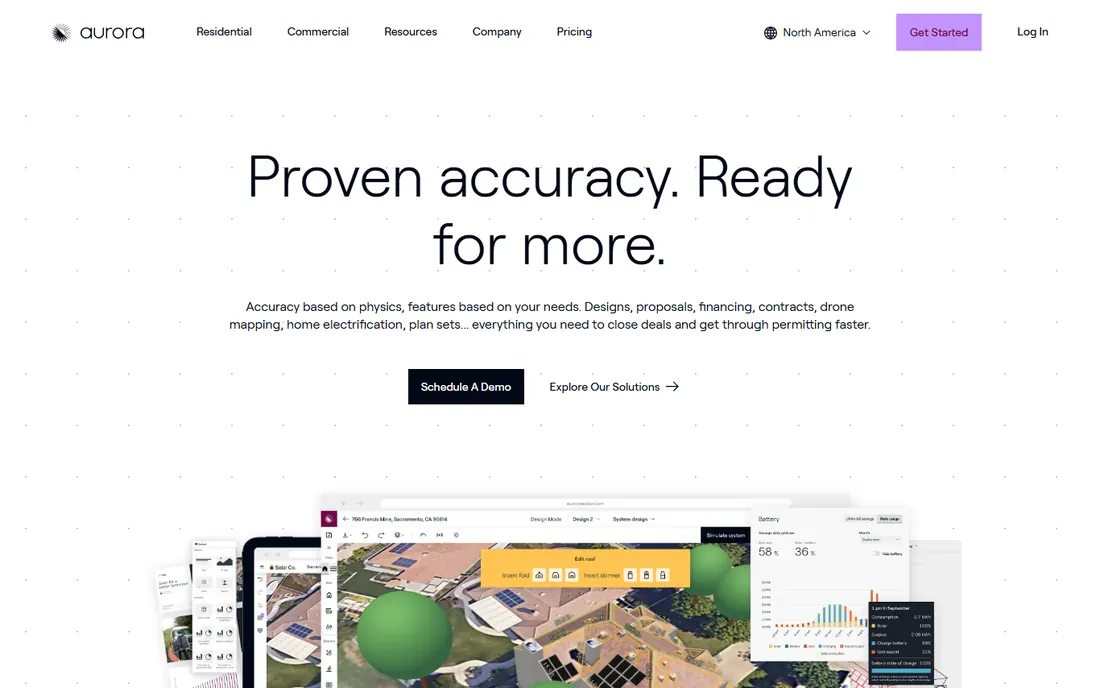
Aurora Solar is the tool most US residential contractors compare everything else against. The platform models the roof, places panels, runs shading analysis, and generates a code-compliant layout in one session, then turns the design into a mobile-friendly proposal with financing options, contracts through DocuSign, and permit plan sets generated in under a minute. AI automation now handles roof modeling, shading, stringing, and fire pathways, so a rep can walk into a sales conversation with a contract-ready design.
The honest catch is the commercial model. Pricing starts at $159 per user per month ($135 billed annually) for Basic, $259 ($220 annually) for Premium, and Enterprise is custom, with no free tier and access starting through sales. It is built for companies running solar volume regularly; occasional users will feel the cost. But for residential teams that live on design accuracy and close rates, Aurora remains the benchmark.
What we like- Industry-leading design accuracy with NREL-validated shading
- 7,000+ organizations and 20M+ projects
- Full workflow from design to proposals, contracts, and permits
Watch out for- No free tier and no self-serve trial
- Premium pricing
- Commercial electrical documentation still needs supplementary tools
#2
OpenSolar
Best for: Installers wanting a free, full-featured design and sales platform
Visit opensolar.com
Starting priceFree
Free planYes
OpenSolar's pitch is simple: the whole platform, design, proposals, project management, financing, e-signatures, and permitting, is free. Instead of charging a license fee, OpenSolar earns from its hardware and finance partners. That model has scaled to more than 28,000 users in 185+ countries, and the design engine has been independently verified by the US National Renewable Energy Laboratory and PV Evolution Labs. For installers watching every dollar of overhead, it removes the biggest objection to professional design software.
The honest catch is that free has a business model behind it: you will encounter partner hardware and finance offerings inside the workflow, and large organizations may find admin and reporting controls lighter than Aurora's. But the core design and sales tools are genuinely capable, not a cut-down teaser. If you are starting out or running lean, OpenSolar is the obvious first tool to try.
What we like- Entirely free end-to-end platform with no licensing fee
- 28,000+ users across 185+ countries
- Design accuracy independently verified by NREL and PVEL
Watch out for- Revenue comes from hardware and finance partners, which shapes integrations
- Enterprise admin controls are lighter than paid rivals
#3
HelioScope
Best for: Commercial solar engineers doing fast, bankable rooftop and ground-mount designs
Visit helioscope.com
Starting price$159 per license/month ($1,620/year)
Free planNo
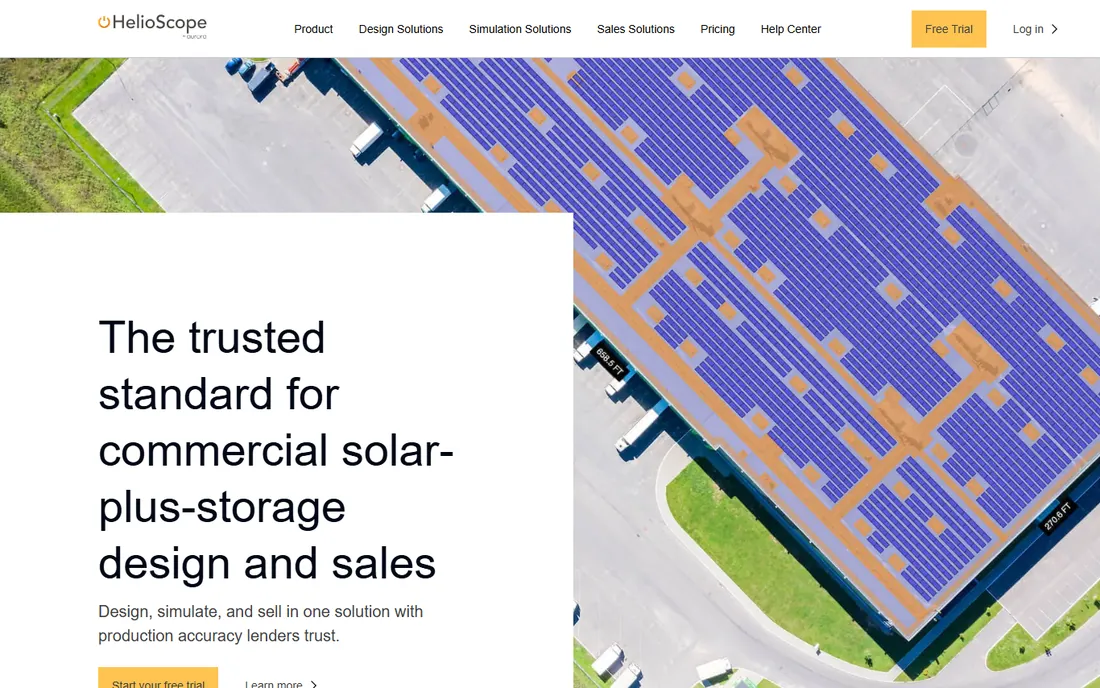
HelioScope, now part of Aurora Solar's family, is built for commercial solar professionals who need engineering-grade designs fast. Rooftop, carport, and ground-mount layouts with storage can be modeled in about 20 minutes, with automatic layouts, sub-minute simulations, and a 50,000-component library. The production estimates are validated by DNV, NREL, and CEC, and recognized by lenders, which is exactly what commercial projects need when financing enters the picture.
The honest catch is scope. This is a commercial design tool, not a residential sales platform: proposals and financing integrations are not the point here. Tier limits matter too: Basic covers up to 10 projects a month and 1.25 MW designs, Pro extends to 5 MW with LiDAR and AI obstruction detection, and larger projects need Enterprise. For C&I engineers, though, nothing else in this price range gets from address to bankable design this quickly.
What we like- Simulations complete in 30 to 60 seconds
- Accuracy validated by DNV and NREL within 1% of PVsyst
- Single platform from layout to financials for commercial projects
Watch out for- Commercial-focused, so residential sales features are thin
- Designs capped by tier (1.25 MW Basic, 5 MW Pro)
- No free plan
#4
PVsyst
Best for: Engineers needing bankable P50/P90 yield simulations lenders trust
Visit pvsyst.com
Starting priceCHF 700/year per license
Free planNo
PVsyst is the engineer's reference tool: when a bank asks for a P50 or P90 yield report, this is usually the software that produced it. The Windows-based program simulates grid-connected and standalone PV systems with detailed physics for shading, soiling, thermal behavior, and bifacial gain, and version 8 added sub-hourly simulation and CSV-based soiling inputs. Pricing is refreshingly public: CHF 700 per year for a Professional license, with education and student tiers at CHF 420 and CHF 25.
The honest catch is that PVsyst is a simulation lab, not a business platform. There is no proposal builder, no CRM, and the interface assumes engineering training. Most installers pair it with a sales tool like Aurora or OpenSolar: design and sell in the web platform, verify the numbers that matter in PVsyst. If your work touches project finance, the license pays for itself with the first bankable report.
What we like- Industry-standard simulation engine used for bankable reports worldwide
- Transparent public pricing from CHF 700/year
- Deep physics for shading, soiling, and bifacial systems
Watch out for- Desktop Windows software, not a modern web app
- Steep learning curve
- No sales, proposal, or CRM features
Starting priceSee website
Free planNo
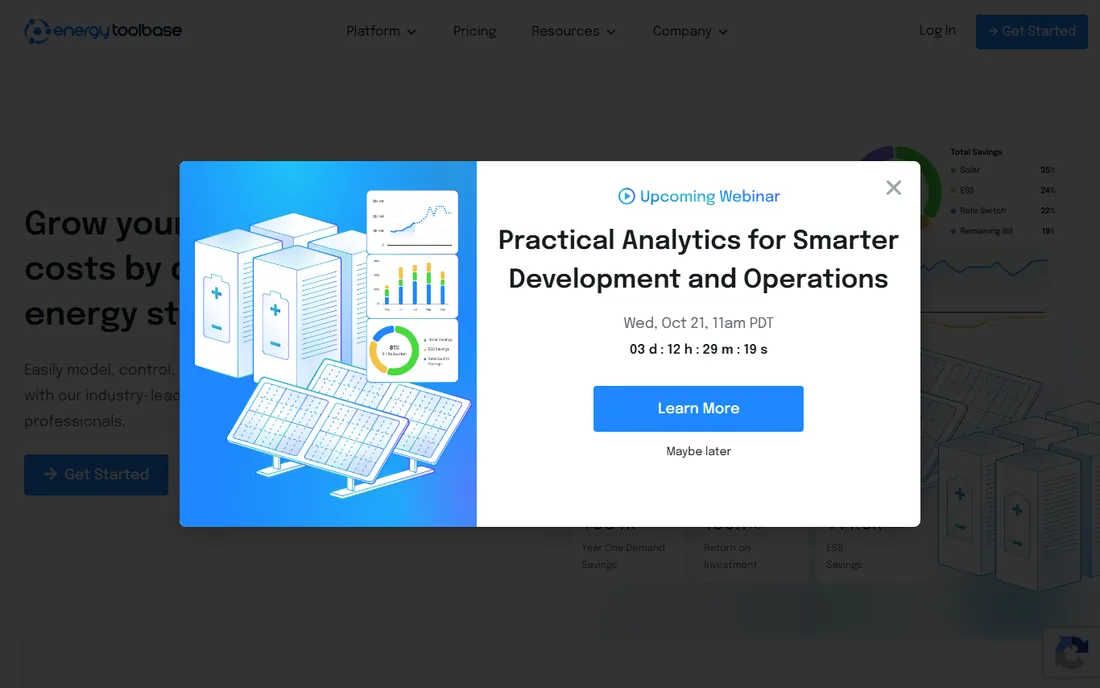
Energy Toolbase occupies the spot where solar design meets energy storage economics. Its platform models solar and storage projects, then extends into controlling batteries with AI-driven dispatch and monitoring fleet performance. The company is widely regarded as the market leader for utility rate and avoided-cost analysis, which is the exact math that decides whether a storage project pencils out. Products span modeling, control, and monitoring for developers, EPCs, asset owners, and financiers.
The honest catch is that this is not a layout-and-proposal tool. If your job is placing panels on roofs and closing homeowners, Aurora, OpenSolar, or SolarGraf fit better. Energy Toolbase earns its place when projects include batteries, demand-charge reduction, or grid services, where its tariff modeling and dispatch optimization are unmatched. Pricing is not published, so expect a sales conversation scoped to your project pipeline.
What we like- Market leader for utility rate and avoided-cost analysis
- End-to-end platform covering modeling, control, and monitoring
- Backed by a global publicly traded parent
Watch out for- Pricing not published
- Storage-focused depth is overkill for simple residential design
- Sales-led buying process
#6
SolarGraf
Best for: Sales teams wanting fast residential designs with financing built in
Visit solargraf.com
Starting priceSee website
Free planFree trial

SolarGraf targets the residential sales workflow: auto roofline detection, HD overhead imagery, shade analysis, battery and electrical design tools, and proposals with financing options and DocuSign e-signatures built in. It also offers permit-ready plan sets for grid-tied and off-grid residential systems, including engineering stamps from its own team of over 200 experts. For sales-led organizations that want design, financing, and signatures in one flow, it covers the essentials.
The honest catch is transparency and depth. The vendor does not publish pricing on its site (third-party directories report around $229 per user per month, with higher team tiers), so you will need to talk to sales. Some reviewers find it less technically deep than Aurora for complex designs. A free trial is available without a credit card, which makes it easy to test against your current tool before committing.
What we like- Auto roofline detection and NREL-verified shading
- Built-in financing options and e-signatures
- Permit-ready plan sets with engineering stamps
Watch out for- Pricing not published on the vendor site
- Reviews are mixed on depth for complex projects
- Canadian company, so US imagery depth varies
#7
Scanifly
Best for: Contractors verifying designs with drone-based 3D models
Visit scanifly.com
Starting priceSee website
Free planNo
Scanifly takes a different route to accuracy: instead of relying on satellite imagery and LiDAR alone, it builds 3D models from drone flights, accurate to within 1 to 3 inches of hand measurements, and generates shading analysis approved by major regulators and lenders. The platform combines AI-assisted remote prelim designs for sales with drone-verified designs for operations, plus field tools like digital checklists, site capture, and plan-set generation with engineering stamps in under 48 hours. Contractors report cutting site survey time by up to 90%.
The honest catch is operational: you need a drone program, or you pay Scanifly to outsource the survey. Companies without field operations will get more from a pure design tool. Pricing is not published. But for quality-obsessed contractors tired of install-day change orders caused by bad remote data, the drone-verified workflow is a genuine differentiator.
What we like- Drone-based 3D models accurate to within 1 to 3 inches of hand measurements
- Design plus field operations on one platform
- Plan sets and engineering stamps in under 48 hours
Watch out for- Full value requires drone flights or outsourced surveys
- Pricing not published
- Remote-only prelim designs compete with cheaper tools
#8
Pylon
Best for: Growing installers wanting pay-per-project pricing instead of seats
Visit getpylon.com
Starting priceSee website (per-project pricing)
Free planFree trial
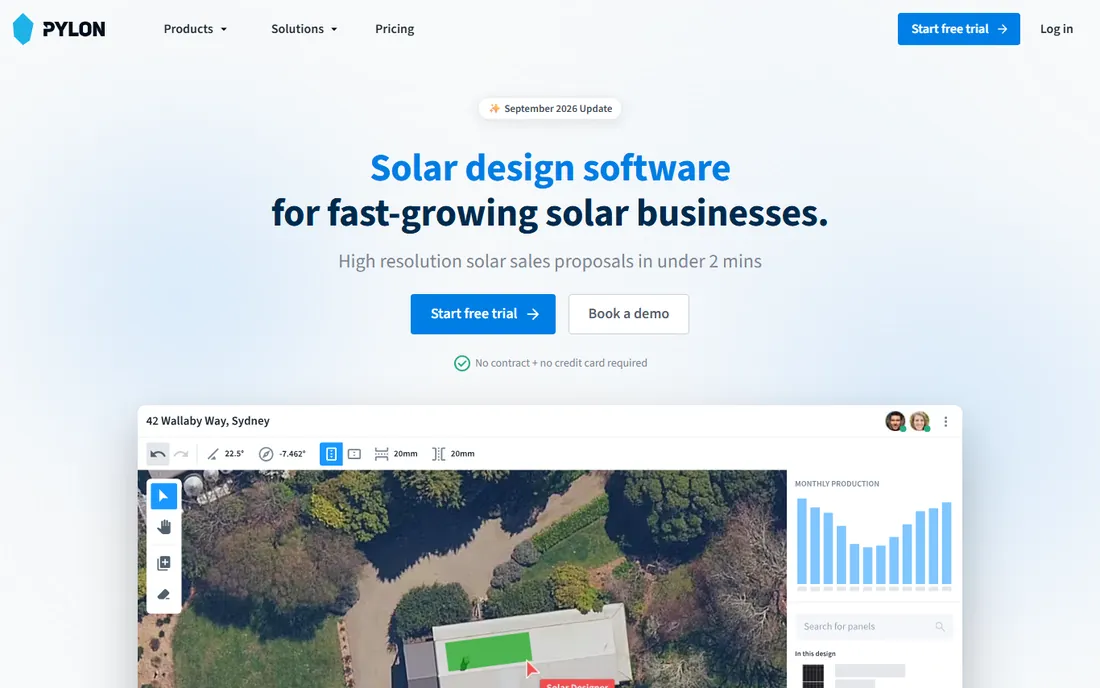
Pylon is the flexible pick: instead of per-seat subscriptions, you pay per project, with Standard from 4 per project and Pro at 10 per project on the vendor's published pricing, plus custom Enterprise plans. That makes it attractive for installers whose job volume fluctuates or who are tired of paying for seats that sit idle. The platform covers design on high-resolution aerial imagery, 3D shading simulations, battery modeling, financial projections, automatic single-line diagrams, proposals with e-signatures, and a built-in sales CRM with SMS and email follow-up.
The honest catch is geography: Pylon is Australian-built and strongest in Australia and the UK, so high-resolution imagery coverage varies elsewhere. Advanced features like custom load profiles, battery storage design, and commercial-sized projects require the Pro tier. Still, the pay-per-project model is unique on this list, and for small operators the math often beats any per-seat plan.
What we like- Pay-as-you-go per-project pricing with no seat lock-in
- 20,000+ component library and automatic single-line diagrams
- High-resolution imagery up to 5 cm resolution
Watch out for- Strongest in Australia and the UK, with imagery depth varying by country
- Battery and commercial features sit on higher tiers
- CRM is lighter than dedicated platforms
Remote design vs drone-verified design: which do you need?
Most solar design software works from satellite imagery and LiDAR: fast, cheap, and accurate enough for sales conversations and most residential permits. Drone-verified design, Scanifly's specialty, adds a site flight that produces 3D models measured to within inches and shade data captured in real time. The difference shows up at installation. If your change orders and redesigns come from roof features the imagery missed, a drone program pays for itself. If your designs install cleanly already, remote design plus good QA is the cheaper answer. Some contractors split the difference: remote designs for proposals, drone verification only on complex or high-value projects.
How to choose solar design software without overpaying for accuracy
Start with your project type. Residential installers selling to homeowners need proposals, financing, and speed: Aurora Solar, OpenSolar, SolarGraf, or Pylon. Commercial engineers need bankable simulations and electrical detail: HelioScope, PVsyst, and Energy Toolbase for storage. Drone-verified accuracy is its own category, served by Scanifly.
Next, match the pricing model to your volume. Per-seat subscriptions (Aurora, HelioScope) suit steady teams. Free (OpenSolar) suits lean operations. Per-project pricing (Pylon) suits fluctuating pipelines. Published low-cost licenses (PVsyst at CHF 700/year) suit engineers who need simulation without a platform.
Then test the accuracy claims that matter to you. Run the same roof through two tools and compare production estimates. Check which imagery covers your service area, because every vendor's accuracy depends on data quality in your specific markets. Finally, confirm the handoffs: proposals, contracts, financing, plan sets, and stamps. The design is only half the job; the software that carries the project through permitting and close is worth more than the one with the prettiest 3D view.
How we chose
We selected eight established solar design platforms covering residential sales, commercial engineering, storage economics, and drone-based surveying. In October 2026 we verified each vendor's homepage and confirmed current positioning, including that HelioScope operates within Aurora Solar's product family and that Pylon remains independently active with per-project pricing. We used vendor-published pricing where available and marked quote-based or unpublished pricing honestly. We did not run hands-on trials; assessments reflect vendor-published capabilities and widely reported user feedback.
Frequently asked questions
How much does solar design software cost?
It ranges from free to several hundred dollars per user per month. OpenSolar is completely free. Aurora Solar starts at $159 per user per month ($135 billed annually), HelioScope at $159 per license per month, and PVsyst at CHF 700 per year per license. Pylon charges per project rather than per seat. Energy Toolbase, SolarGraf, and Scanifly price by quote, so talk to sales with your volume in hand.
Is there really a free option that professionals use?
Yes. OpenSolar is genuinely free, with 28,000+ users and design accuracy verified by NREL and PVEL. It covers design, proposals, financing, project management, and e-signatures. The business model runs on partner revenue rather than license fees, so expect partner hardware and finance offerings inside the workflow. For most residential installers, it is a credible alternative to paid platforms.
Should I use PVsyst or a web-based tool like Aurora?
They do different jobs. Web tools like Aurora, OpenSolar, and HelioScope handle layout, proposals, and sales speed. PVsyst handles engineering-grade yield simulation for bankable P50/P90 reports. Most serious operations use both: design and sell in the web platform, run the numbers that financing depends on through PVsyst.
Which tools handle battery storage design?
Aurora Solar, HelioScope, Energy Toolbase, and Pylon all model batteries. Energy Toolbase goes deepest, with dispatch optimization and monitoring for storage economics. HelioScope models commercial solar-plus-storage in one workflow. For residential sales, Aurora and Pylon cover battery sizing and financial projections well enough for most proposals.
Do I need a drone to design solar accurately?
No, but it helps on difficult roofs. Satellite and LiDAR-based design is accurate enough for most residential sales and permits. Scanifly's drone-based 3D models, accurate to within 1 to 3 inches, earn their keep on complex roofs, commercial projects, and operations where install-day fit problems are expensive. You can also outsource drone surveys per project instead of buying a drone.
Can these tools generate permit-ready plan sets?
Most can. Aurora Solar generates instant plan sets in under a minute or delivers AHJ-ready sets with stamps in 24 to 48 hours. SolarGraf and Scanifly offer plan sets with engineering stamps. Pylon generates single-line diagrams automatically. Confirm stamp availability in your jurisdiction before promising it to customers, since engineering stamps are state-specific.
Sources we checked (8)
- https://aurorasolar.com/
- https://opensolar.com/
- https://helioscope.com/
- https://pvsyst.com/
- https://energytoolbase.com/
- https://www.solargraf.com/
- https://scanifly.com/
- https://getpylon.com/
Is your product missing or out of date?
We review this list regularly. Vendors can request a listing, send updated pricing or ask about featured placement.

Shihab Mia · Founder, Rankite
Shihab has spent more than a decade helping SaaS and e-commerce brands grow through search. He writes Rankite's software buying guides from pricing pages, documentation and public user reviews. More about Shihab.