How we make this list: we compare pricing pages, product documentation and public user reviews. Rankite is independent; if a vendor ever pays for a featured spot, that listing is clearly labeled Partner.
Key takeaways
- Market analysis splits into digital intelligence (Similarweb, Semrush), published research (Statista, IBISWorld, Euromonitor) and private-market data (CB Insights, PitchBook); define your question before choosing.
- Statista is the best value for general market statistics; IBISWorld and Euromonitor win for deep industry reports with forecasts.
- Investors and corporate development teams should compare CB Insights and PitchBook on private-market coverage, not on marketing claims.
- Free and cheap starting points exist (Statista's free stats, Similarweb's free tier); enterprise research contracts run into five figures annually.
Quick comparison
| Tool | Best for | Starting price | Free plan |
|---|
 Similarweb Similarweb | Digital market sizing and competitor benchmarking | See website | Yes |
 Semrush Semrush | Search-driven market and competitor analysis | See website | Free trial |
 Statista Statista | Fast, citable statistics on almost any topic | See website | Yes |
 IBISWorld IBISWorld | Deep US industry reports with five-year forecasts | See website | No |
 Euromonitor Euromonitor | Global consumer market intelligence | See website | No |
 CB Insights CB Insights | Technology markets, startups and venture trends | See website | Free trial |
 PitchBook PitchBook | Private market deals, companies and investors | See website | No |
 MarketResearch.com MarketResearch.com | Buying individual published research reports | See website | No |
Is your product missing or out of date?
We review this list regularly. Vendors can request a listing, send updated pricing or ask about featured placement.
The best software for market analysis
Market analysis answers how big the opportunity is, who competes for it and where it is heading. The software splits three ways: digital intelligence (what the web reveals), published research (what analysts wrote) and private-market data (what deals show). Eight platforms covering all three, each with the question it answers best.
Starting priceSee website
Free planYes
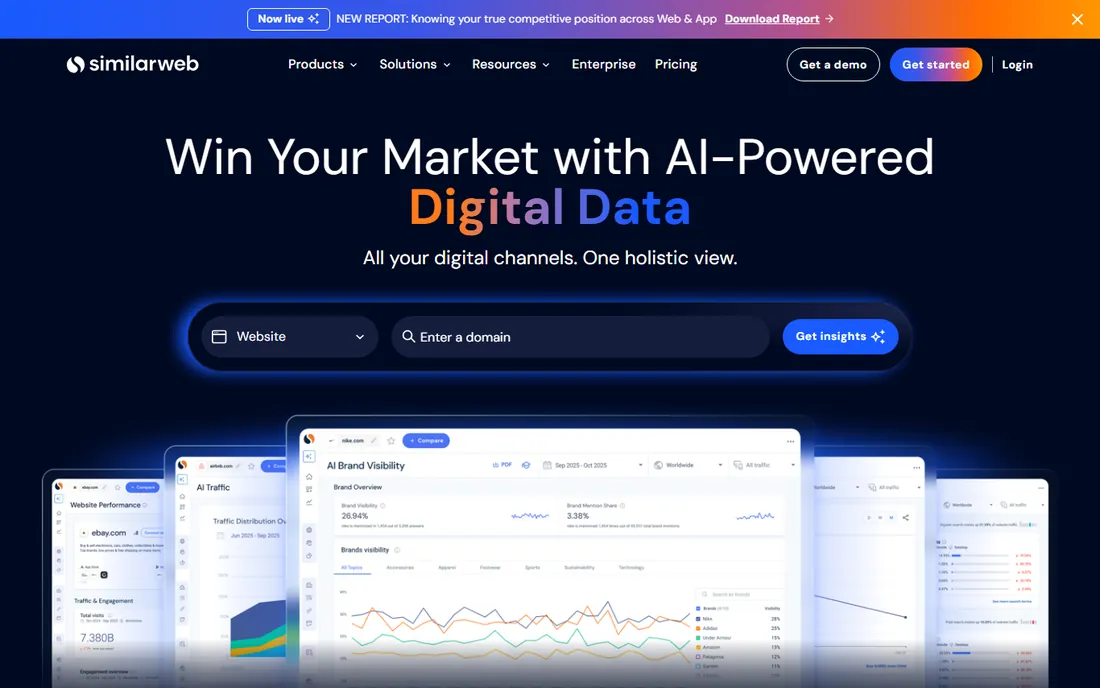
Similarweb answers the digital version of "how big is this market": traffic estimates for any website, category benchmarks, traffic sources, audience geography and increasingly AI-search visibility data. For competitive intelligence on digital businesses, it is the standard starting point, and the free tier gives useful directional data.
The honest caveat is estimation. Similarweb models traffic from panels and partnerships; accuracy varies by site size and market, and small sites get noisy estimates. Treat it as directional intelligence for market sizing, not audited truth. For digital market analysis, though, nothing else covers as much ground.
What we like- Estimates any site's traffic, engagement and sources
- Industry and keyword analysis for digital markets
- Increasingly strong AI search intelligence modules
Watch out for- Estimates, not measurements, with variable accuracy
- Premium pricing for full access
Starting priceSee website
Free planFree trial
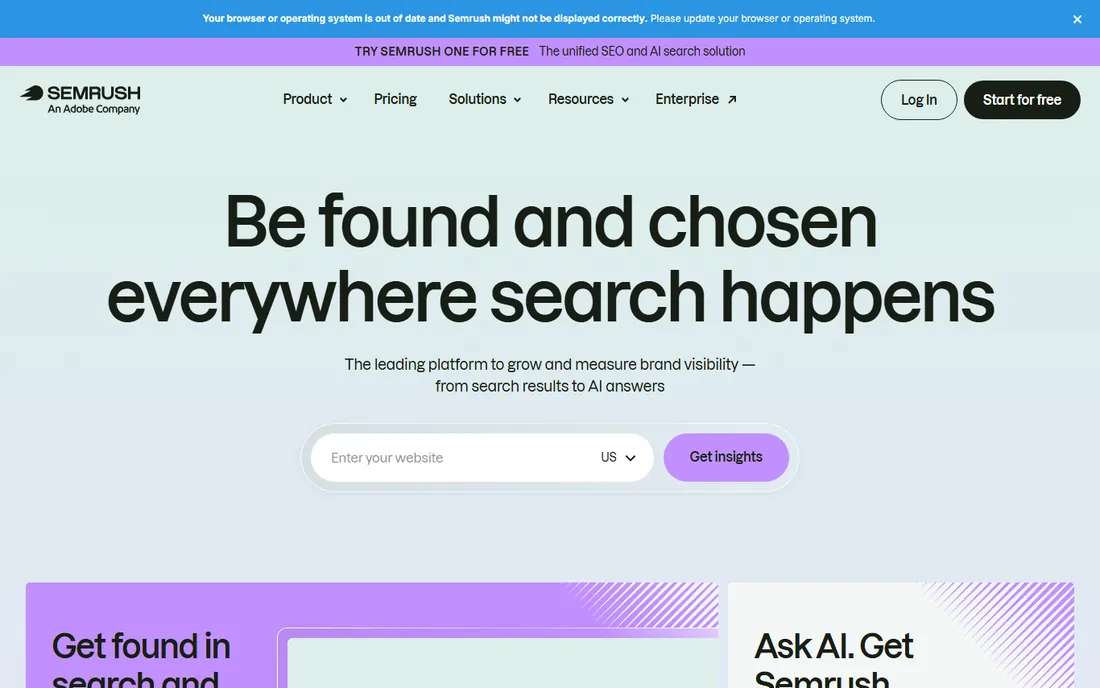
Semrush's market analysis angle is search: how big is the demand (keyword volumes), who captures it (competitor traffic and rankings), and where the gaps are. Its Market Explorer and competitive intelligence tools turn SEO data into market sizing, which suits digital-first categories well.
The boundary is the lens. Search data illuminates online demand beautifully and offline markets poorly; a local services market will not appear correctly. And buying the full suite for research alone is expensive. For digital market analysis inside a broader SEO program, Semrush's marginal value is excellent.
What we like- Keyword, traffic and competitive data in one suite
- Market Explorer for audience and market sizing
- Strong international databases
Watch out for- Search-centric view misses offline markets
- Suite pricing for research-only needs
Starting priceSee website
Free planYes
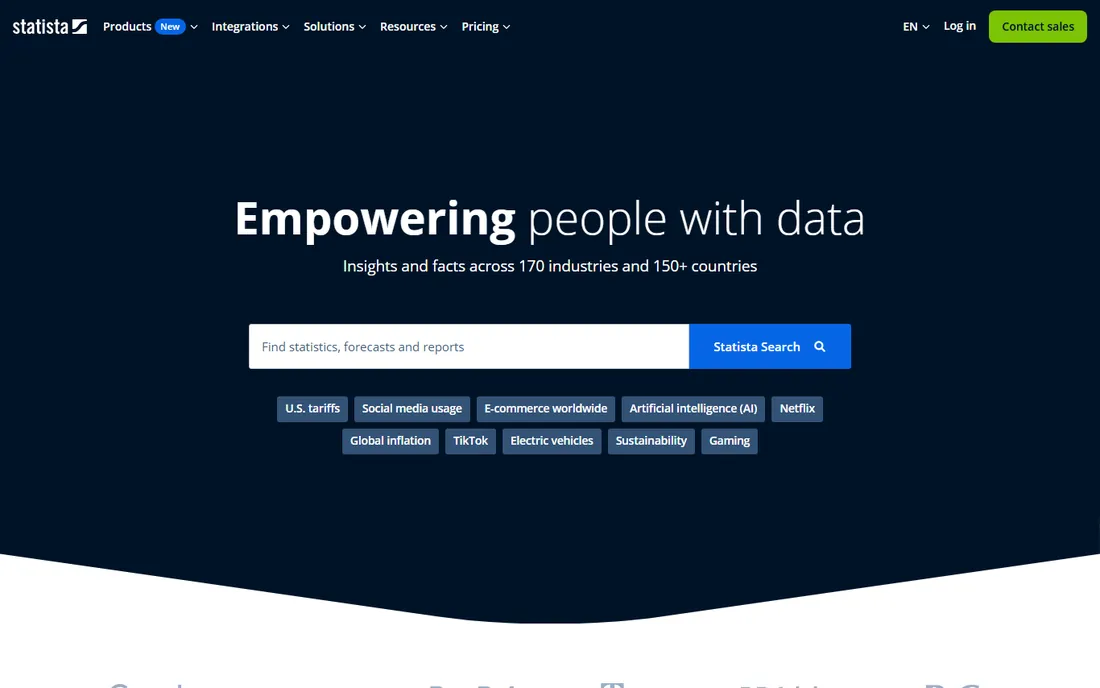
Statista is the statistics portal: market sizes, consumer survey results, industry data and forecasts across nearly every topic, sourced from thousands of publications and presented in presentation-ready charts. For pitch decks, business plans and quick market sizing, it is the fastest path from question to citable number.
The honest limits are depth and freshness. Individual statistics vary in age and methodology, and Statista aggregates rather than produces primary research. Verify critical numbers against their sources. But as the best-value general market data subscription, it belongs in every analyst's toolkit.
What we like- Over 60,000 topics with statistics from 22,500 sources
- Clean charts ready for presentations
- Affordable compared to analyst firms
Watch out for- Statistics vary in recency and methodology
- Not a substitute for primary research
Starting priceSee website
Free planNo
IBISWorld writes the industry reports consultants cite: market size, segmentation, competitor dynamics, key success factors and five-year forecasts for thousands of US industries, each with consistent structure and human-verified data. For market entry decisions, benchmarking and strategic planning, the depth per report is the product's value.
The price reflects it: IBISWorld is an institutional subscription, not a casual purchase. International coverage exists but the US is the stronghold. Organizations that regularly evaluate industries find the per-report cost reasonable; occasional users should consider single-report purchases or Statista first.
What we like- Thousands of industry reports with structured data and forecasts
- Human-verified, consistent methodology
- Excellent for US market evaluation
Watch out for- Premium pricing aimed at institutions
- US depth exceeds international coverage
Starting priceSee website
Free planNo
Euromonitor's Passport database is the reference for global consumer markets: category sizes, brand shares, channel splits and forecasts across countries, built by local analysts over decades. Consumer goods companies, retailers and investors use it as the shared language for market sizing.
The honest boundaries are price and focus. This is enterprise research pricing, and the consumer-market orientation serves B2B industrial analysis less well. But for "how big is the global skincare market in Southeast Asia," Euromonitor's answer is the industry standard.
What we like- Unmatched global consumer market coverage via Passport
- Category and country-level data with forecasts
- Long-established analyst methodology
Watch out for- Enterprise pricing
- Consumer focus limits B2B industrial use
Starting priceSee website
Free planFree trial
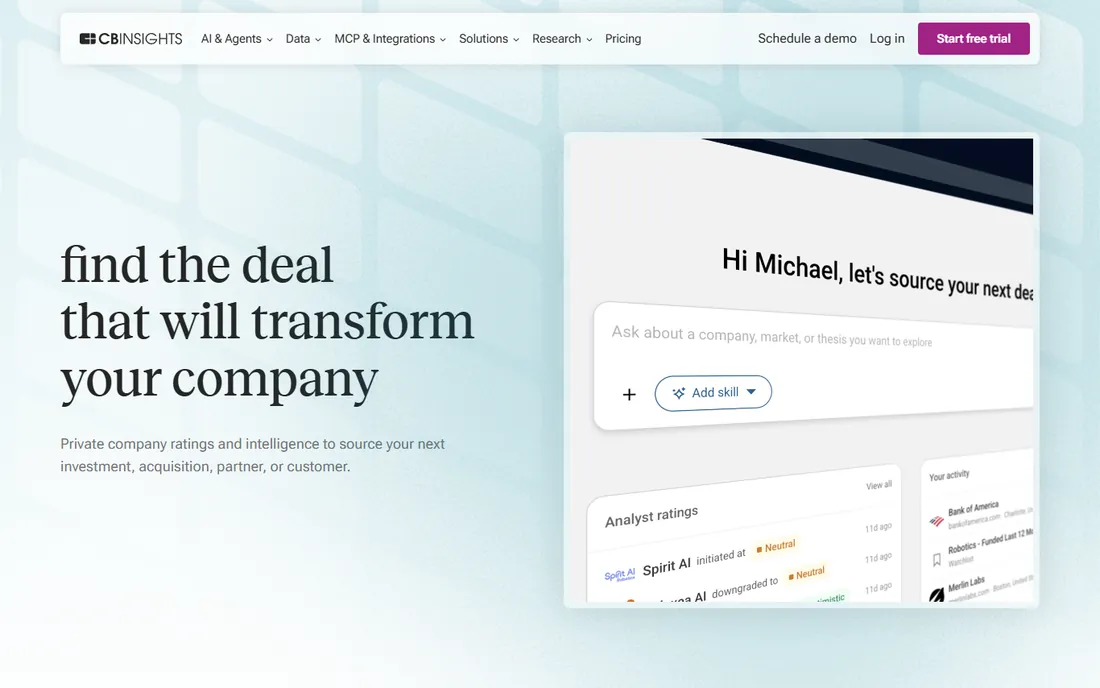
CB Insights analyzes venture capital, startups, patents and tech news to map where technology markets are heading. Its research on emerging tech, market maps and funding trends makes it the standard for corporate innovation teams, VCs and strategists tracking disruption.
The focus is the limitation: outside technology and innovation markets, the value drops. And the pricing targets institutions. For the specific question "what is happening in this tech market and who is funding it," CB Insights' data-plus-analysis combination is the category leader.
What we like- Venture, startup, patent and partnership data with tech-market analysis
- Strong emerging-tech research
- Widely cited in tech strategy
Watch out for- Premium pricing
- Tech-centric coverage less useful outside innovation markets
Starting priceSee website
Free planNo
PitchBook is the private capital markets database: company profiles, deal histories, investor activity, fund performance and valuations across private markets globally. Investment bankers, PE firms, VCs and corporate development teams run sourcing, comps and due diligence on it.
The honest framing is audience. This is professional-grade financial data at professional prices; general market researchers get better value from Statista or IBISWorld. But for private-market analysis (who raised, who bought whom, at what valuation), PitchBook's coverage is the deepest available.
What we like- The most comprehensive private-market data: companies, deals, investors, funds
- Excel plugin and API for analyst workflows
- Trusted by 1M-plus professionals
Watch out for- Expensive institutional pricing
- Private-market focus, not general market research
Starting priceSee website
Free planNo
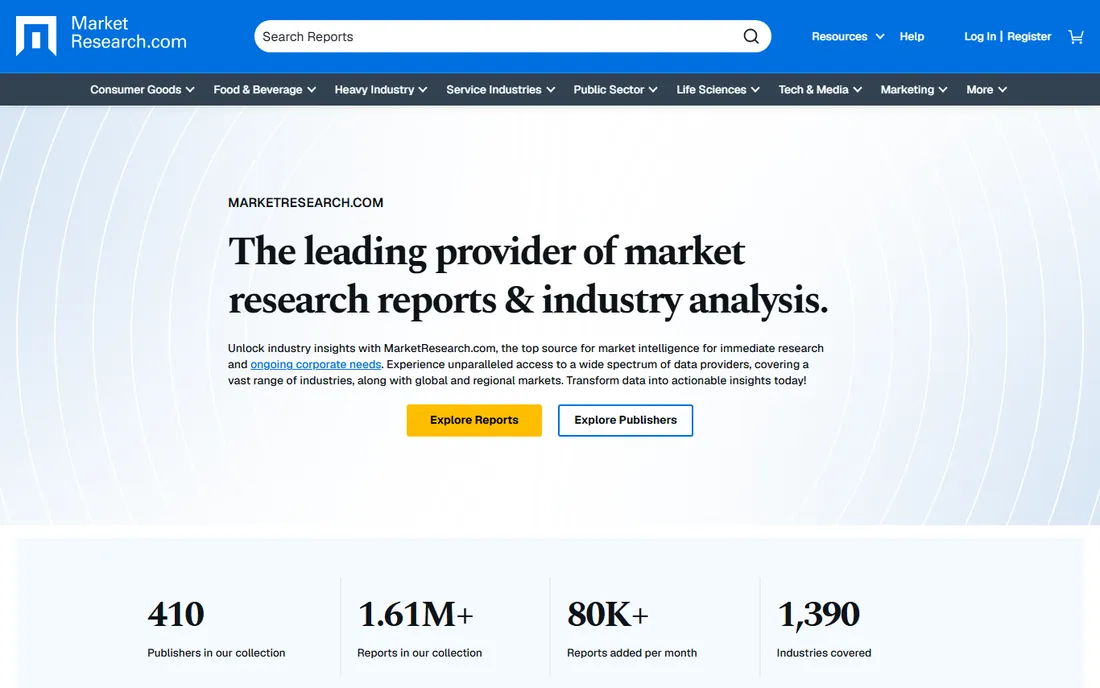
MarketResearch.com is the marketplace model: instead of subscribing, buy individual reports from hundreds of research publishers on the specific market you need. For one-off questions (a single market entry decision, one due-diligence project), a single report often beats a subscription.
The honest caveat is variance. Publisher quality differs, report ages differ, and single reports carry premium per-unit pricing. Read tables of contents and publication dates carefully before buying. But when you need one authoritative report without an annual contract, the marketplace is the efficient route.
What we like- Marketplace of reports from hundreds of publishers
- Buy single reports instead of subscriptions
- Broad topic coverage
Watch out for- Report quality varies by publisher
- Individual reports are expensive
How we chose
We covered the three branches of market analysis software (digital intelligence, published research, private-market data), selecting established platforms with real analyst adoption in each. We weighed data methodology transparency, coverage depth, price accessibility and how honestly each tool fits its stated use case. Pricing comes from each vendor's own pricing page; unverifiable plans are marked "See website." No hands-on testing was performed.
What to look for before you buy
Start with the question type. Market sizing needs statistics (Statista) or digital estimates (Similarweb); competitive dynamics need intelligence platforms (CB Insights, Similarweb); investment decisions need deal data (PitchBook); strategic planning needs industry reports (IBISWorld, Euromonitor). The wrong branch wastes the budget.
Check methodology and recency for any number you will cite. Ask when the data was collected, how it was sourced and what it excludes. A 2022 statistic presented as current is worse than no statistic.
Trial against a market you know. Run each tool on a category where you already know the answer; the platform whose numbers match reality earns trust for categories where you do not.
Finally, compare subscription versus single-report economics. Frequent researchers need subscriptions; occasional questions are cheaper as individual reports. Most organizations overbuy here.
Getting value from market research subscriptions
Market analysis platforms are expensive, and the subscription is only worth it if the organization actually uses the research. The tools in this guide range from affordable to enterprise-priced; either way, a few practices separate the teams that extract value from the ones that pay for a login nobody opens.
Assign research owners, not just logins. A subscription with 50 seats and no owner gets sporadic use; one person responsible for monitoring key industries, summarizing findings monthly and answering internal questions multiplies the return. The owner does not need to be senior, but the role needs to be explicit and measured.
Build the habit of checking before deciding. Market sizing for a new product, competitor moves before a launch, industry growth rates for board decks: these questions recur, and the platform answers them in minutes when people remember to ask. The failure mode is teams commissioning custom research or guessing while the subscription sits unused. A short internal "ask the platform first" norm fixes it.
Combine syndicated research with your own data. Industry reports give the market context; your CRM, analytics and customer conversations give the ground truth. The best market analysis happens where the two meet: "the industry grows 8 percent, but our win rates suggest the mid-market segment grows faster." Teams that only read reports get generic strategy; teams that triangulate get insight.
Watch the report dates. Syndicated research updates on cycles (annual, biennial); a 2024 report read in late 2026 may describe a different market. Check methodology dates before citing numbers, especially in fast-moving tech sectors. The platforms are usually transparent about vintage; the reader has to look.
Negotiate the renewal with usage data. Vendors price on seats and report bundles; if only 8 of 50 seats are active, right-size at renewal. Conversely, heavy users have a stronger position for better terms. Pull the usage report 90 days before renewal and negotiate from evidence. Auto-renewing an oversized research contract is one of the most common wasted spends in corporate budgets.
Frequently asked questions
What is the best market research tool for startups?
Statista for affordable statistics, Similarweb's free tier for digital competitive data, and CB Insights when tracking tech markets and funding. Start cheap; upgrade when the questions get expensive.
How much does market research software cost?
From free tiers to a few hundred dollars monthly for digital intelligence, to institutional subscriptions (IBISWorld, Euromonitor, PitchBook, CB Insights) that run into five figures annually. Single reports typically cost hundreds to thousands each.
Can I do market analysis for free?
Directionally, yes: Statista's free statistics, Similarweb's free tier, government data (census, Eurostat) and company filings cover the basics. Paid tools add depth, forecasts and convenience, not the entire picture.
What is the difference between market research and competitive intelligence?
Market research sizes the opportunity (how big, growing how fast); competitive intelligence tracks the players (who, doing what, winning how). The tools overlap but the questions differ; most strategies need both.
How accurate is Similarweb's traffic data?
Directionally useful, especially for larger sites and category comparisons; noisy for small sites. Treat estimates as ranges for sizing, and validate critical numbers against first-party data where possible.
Should I buy reports or a subscription?
Subscriptions suit frequent researchers; single reports suit occasional deep questions. Calculate your annual report needs honestly; three-plus reports a year usually justifies evaluating a subscription.
Sources we checked (8)
- https://www.similarweb.com
- https://www.semrush.com
- https://www.statista.com
- https://www.ibisworld.com
- https://www.euromonitor.com
- https://www.cbinsights.com
- https://www.pitchbook.com
- https://www.marketresearch.com
Is your product missing or out of date?
We review this list regularly. Vendors can request a listing, send updated pricing or ask about featured placement.

Shihab Mia · Founder, Rankite
Shihab has spent more than a decade helping SaaS and e-commerce brands grow through search. He writes Rankite's software buying guides from pricing pages, documentation and public user reviews. More about Shihab.