How we make this list: we compare pricing pages, product documentation and public user reviews. Rankite is independent; if a vendor ever pays for a featured spot, that listing is clearly labeled Partner.
Key takeaways
- Ghidra is the default free choice: full decompiler, multi-architecture support, and collaborative workflows at no cost.
- IDA Pro remains the commercial standard for professional malware analysis and vulnerability research, with pricing to match.
- Binary Ninja and JEB are the paid tools worth evaluating if you want a modern interface or Android decompilation.
- Radare2, Rizin, Cutter, Frida and x64dbg cover nearly every workflow for free, if you accept steeper learning curves.
Quick comparison
| Tool | Best for | Starting price | Free plan |
|---|
 Ghidra Ghidra | free, full-featured static analysis and decompilation | See website (free, open source) | Yes |
 IDA Pro IDA Pro | professional malware analysis and vulnerability research | See website (paid) | Yes (IDA Free) |
 Binary Ninja Binary Ninja | modern scriptable workflows with a clean interface | $299 one-time (Non-Commercial) | Yes (free cloud version) |
 Radare2 Radare2 | scriptable command-line binary analysis | See website (free, open source) | Yes |
 Frida Frida | dynamic instrumentation of running programs | See website (free, open source) | Yes |
 x64dbg x64dbg | debugging Windows executables | See website (free, open source) | Yes |
 Hopper Hopper | reversing macOS and iOS binaries | See website | Free trial |
 Cutter Cutter | a free graphical interface over a powerful engine | See website (free, open source) | Yes |
 JEB JEB | Android app decompilation and multi-architecture analysis | From $140 per user/month (JEB Android) | Yes (Community Edition) |
 Rizin Rizin | a clean, community-driven reversing framework | See website (free, open source) | Yes |
Is your product missing or out of date?
We review this list regularly. Vendors can request a listing, send updated pricing or ask about featured placement.
Starting priceSee website (free, open source)
Free planYes
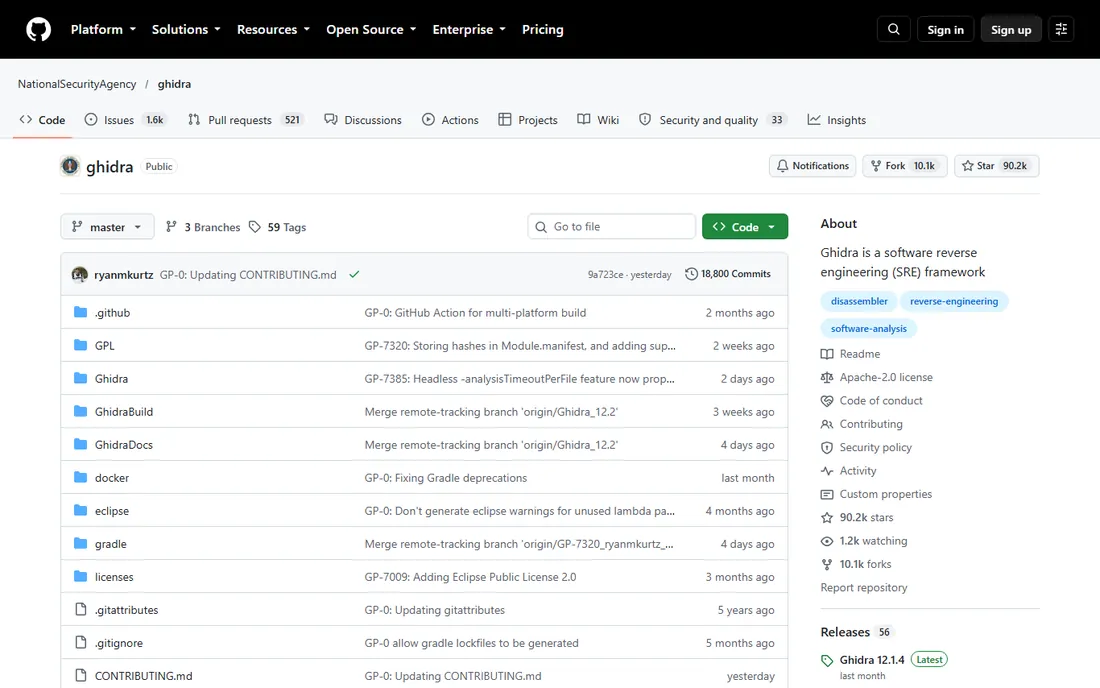
Ghidra is the NSA's reverse engineering framework, released free and open source, and it reset expectations for the whole category. You get a real decompiler, a scriptable API in Java and Python, and support for everything from x86 to exotic embedded architectures. For malware analysis, CTF competitions and firmware work, it handles the core job at zero cost.
The trade-offs are comfort, not capability. The interface is functional rather than beautiful, you need to install a JDK to run it, and very large binaries can take a while to analyze. But as the baseline every other tool is measured against, Ghidra is the first install for anyone serious about reversing.
What we like- Complete decompiler included free
- Supports dozens of architectures
- Collaborative multi-user projects
Watch out for- Java-based UI feels heavy
- Setup needs a JDK
- Analysis can be slow on huge binaries
#2
IDA Pro
Best for: professional malware analysis and vulnerability research
Visit hex-rays.com
Starting priceSee website (paid)
Free planYes (IDA Free)
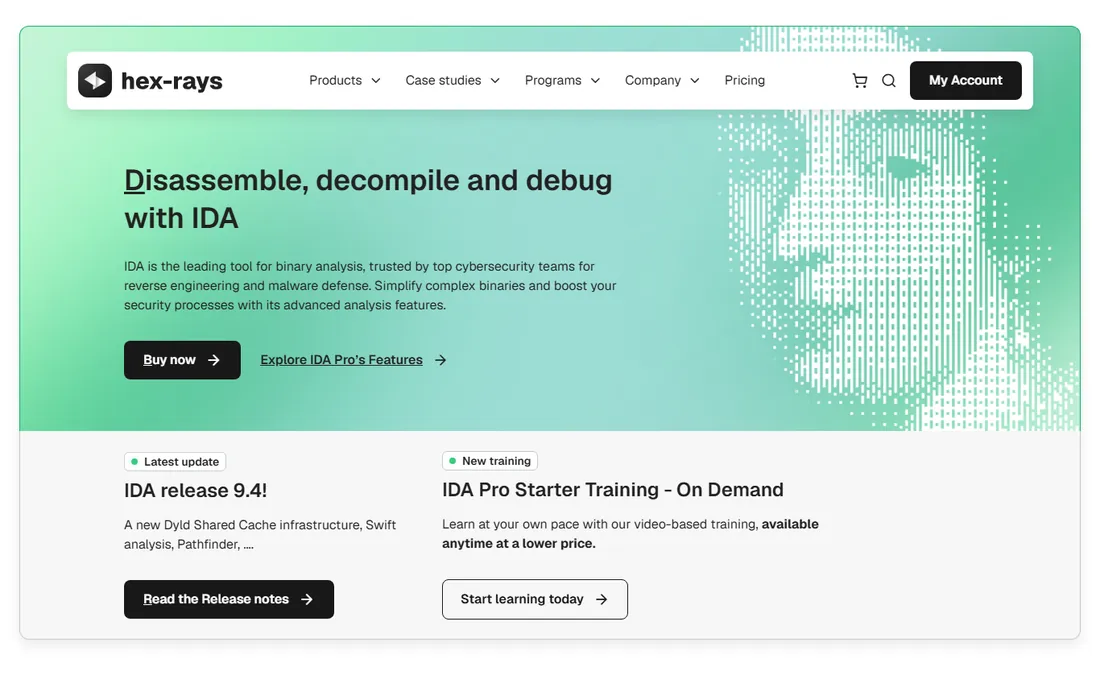
IDA Pro has been the professional's disassembler for decades, and in commercial malware labs it still is. The interactive workflow, the FLIRT signature libraries, and the enormous plugin ecosystem mean that obscure problems usually have a known solution. IDA Home offers a cheaper annual subscription for non-commercial use, and IDA Free covers basic x86 and x64 work.
The price is the conversation. Full commercial licenses run into the thousands per year, and the Hex-Rays decompiler is a separate per-architecture purchase. If your employer pays, it is the safest choice. If you pay yourself, start with IDA Free and Ghidra before deciding the premium is worth it.
What we like- The industry standard with the deepest plugin ecosystem
- Superb interactive disassembly
- Hex-Rays decompiler is excellent
Watch out for- Expensive commercial licenses
- Decompiler sold separately per architecture
- IDA Free is limited to x86/x64
#3
Binary Ninja
Best for: modern scriptable workflows with a clean interface
Visit binary.ninja
Starting price$299 one-time (Non-Commercial)
Free planYes (free cloud version)
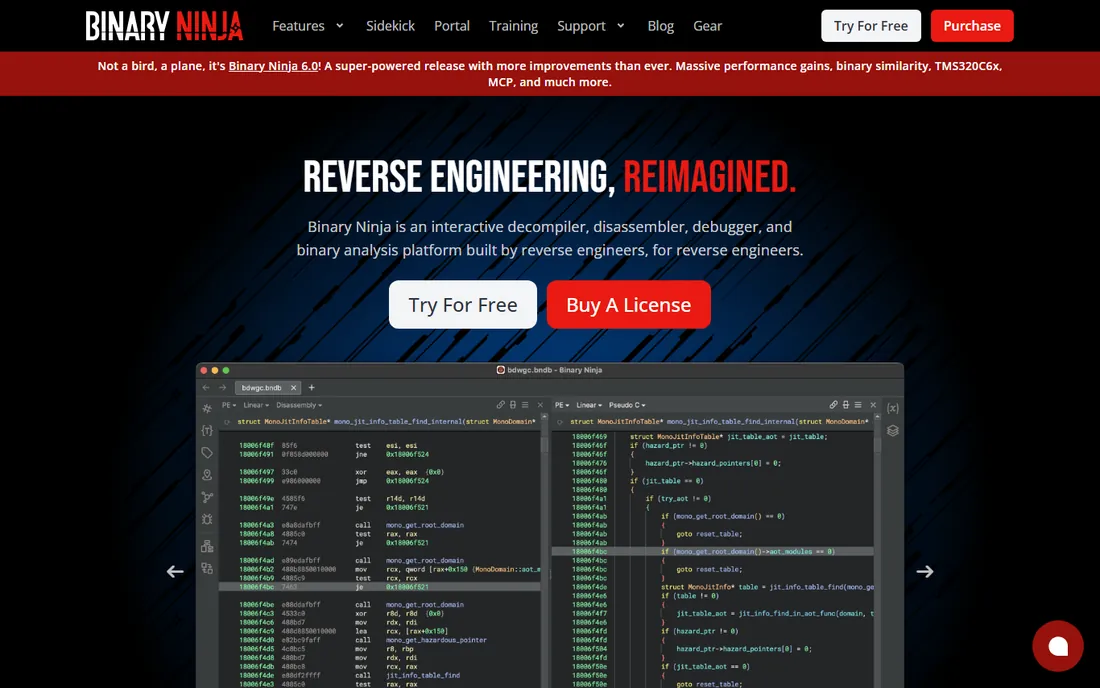
Binary Ninja feels like a reversing tool designed this decade. The interface is clean, the analysis lifts code through well-documented intermediate languages, and the Python API is a pleasure for automation. The $299 Non-Commercial license is a one-time purchase that never expires, with a year of updates included, and there is a free cloud version for light work.
It does not match IDA's plugin catalog or Ghidra's architecture breadth, and the $1,199 Commercial tier is a real step up in price. But for researchers who live in scripts and want a modern, fast tool without a subscription, it is the most likeable paid option here.
What we like- Excellent Python API and intermediate languages
- Decompiler included at every tier
- License never expires
Watch out for- Smaller plugin ecosystem than IDA
- Commercial tier costs more
- Fewer supported architectures than Ghidra
Starting priceSee website (free, open source)
Free planYes
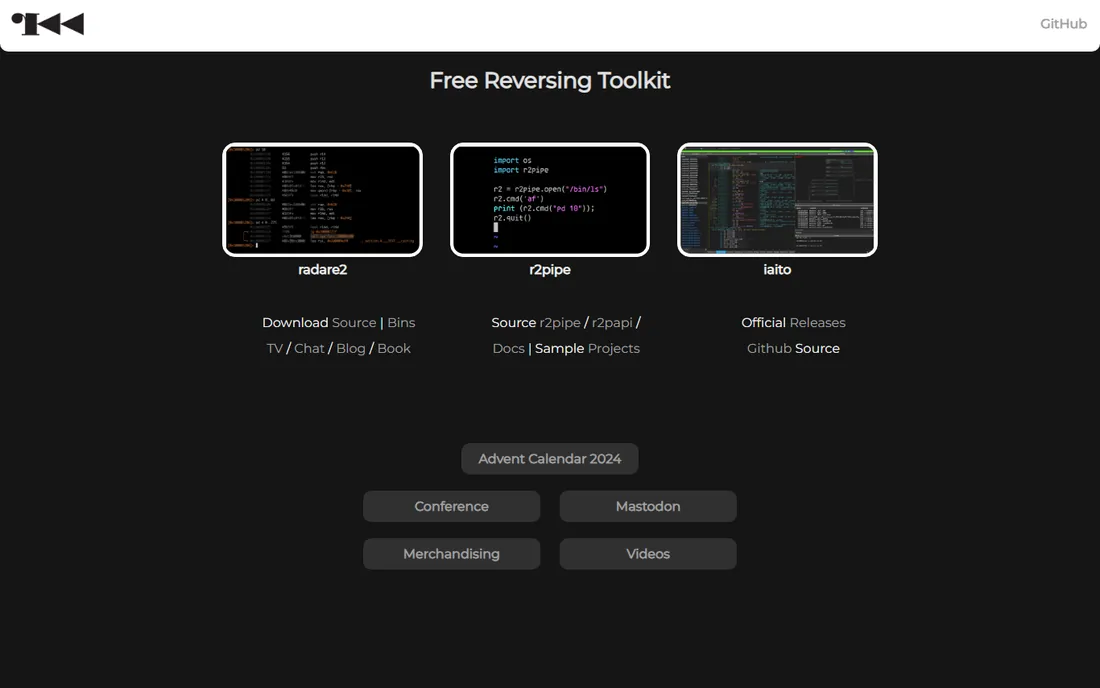
Radare2 is a complete reversing framework built on the Unix philosophy: small tools, composable, scriptable, terminal-first. It disassembles, debugs, patches, emulates and forensically carves, and r2pipe lets you drive it from Python and other languages. For automation pipelines and remote analysis, nothing else is as flexible.
The cost is paid in learning time. The command syntax is famously terse, and beginners bounce off it hard. If you like terminals, CTFs and automation, it repays the effort many times over. If you want a GUI, look at Cutter or Rizin instead.
What we like- Completely free and endlessly scriptable
- Runs anywhere including headless servers
- Huge range of architectures and formats
Watch out for- Steep learning curve with cryptic commands
- Documentation requires patience
- GUI is not the focus
#5
Frida
Best for: dynamic instrumentation of running programs
Visit frida.re
Starting priceSee website (free, open source)
Free planYes
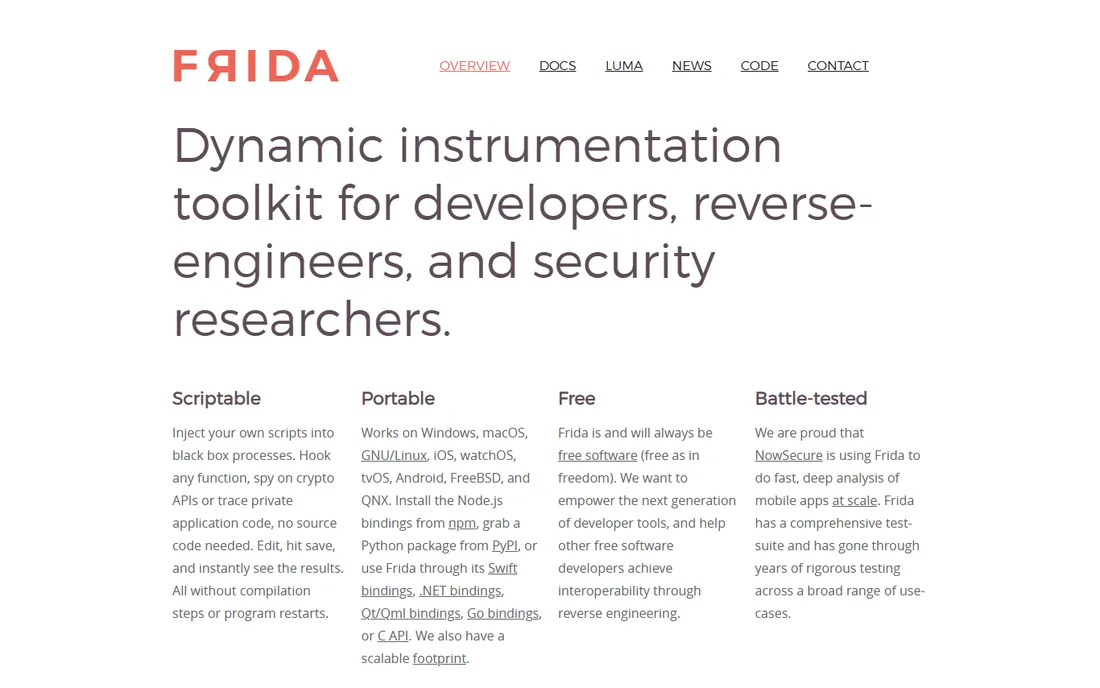
Frida answers a different question from the disassemblers: what does this program do right now? You inject JavaScript into a running process, hook functions, inspect crypto calls, and bypass client-side checks, all without restarting. It is the backbone of mobile security testing and a staple in malware behavior analysis.
It complements rather than replaces static tools. You still need Ghidra or IDA to understand the binary's structure; Frida tells you what happens at runtime. It is free and open source, maintained with commercial backing, and the community script collection covers most common tasks.
What we like- Hook any function with JavaScript, no source needed
- Works on mobile, desktop and embedded
- Huge community scripts
Watch out for- Dynamic only, not a disassembler
- Mobile use needs a rooted or jailbroken device
- Scripts need maintenance across app updates
Starting priceSee website (free, open source)
Free planYes
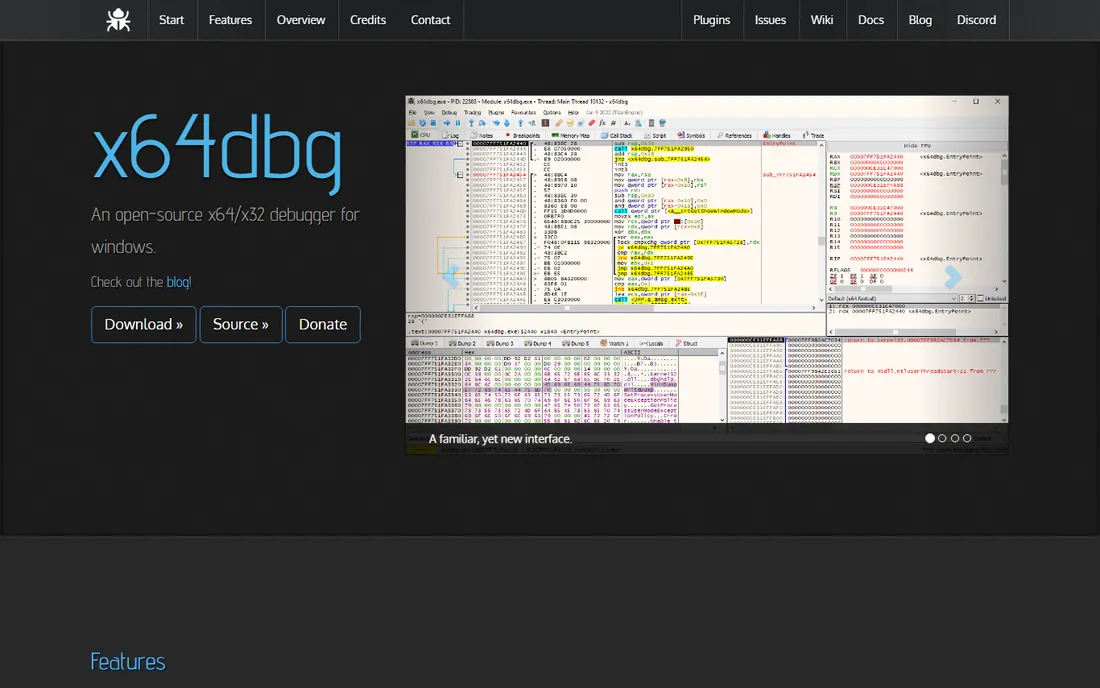
x64dbg is the free Windows debugger that malware analysts actually use. The interface will feel familiar to IDA users, with graph views, memory maps and breakpoint management, and plugins extend it into unpacking and anti-analysis work. For stepping through a suspicious executable on Windows, it is the default free choice.
Know its boundaries. There is no decompiler, so you read assembly, and heavily protected binaries may need extra plugins or a different tool. It is Windows-only, which is fine since Windows malware is the main target. Pair it with Ghidra for static analysis and you have a complete free lab.
What we like- Free and open source with an IDA-like interface
- Strong plugin ecosystem
- Built-in assembler and patching
Watch out for- Windows only
- No built-in decompiler
- Can be unstable on packed or protected binaries
Starting priceSee website
Free planFree trial
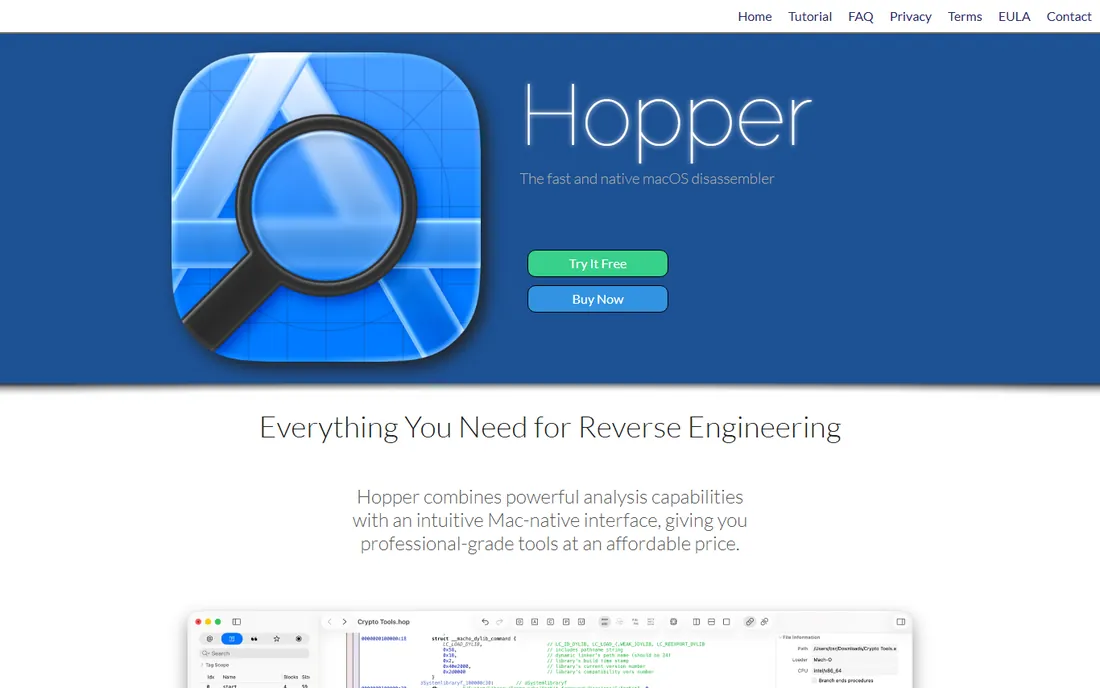
Hopper is the disassembler for people who live on Macs. It disassembles macOS, iOS, Linux and Windows binaries, turns assembly into readable pseudo-code, and includes a debugger, all in an interface that feels like native Mac software rather than a port. For iOS app analysis and Mac malware, it is the most comfortable tool on this list.
It is a commercial product with a trial, priced far below IDA Pro. The focus on Apple platforms is both its strength and its limit; Windows-centric analysts will find less here. If your targets are Mach-O binaries, Hopper earns its place.
What we like- Native Mac feel and workflow
- Built-in decompiler with pseudo-code
- Debugger included
Watch out for- Paid license
- Focused on Apple platforms
- Smaller community than IDA or Ghidra
#8
Cutter
Best for: a free graphical interface over a powerful engine
Visit cutter.re
Starting priceSee website (free, open source)
Free planYes
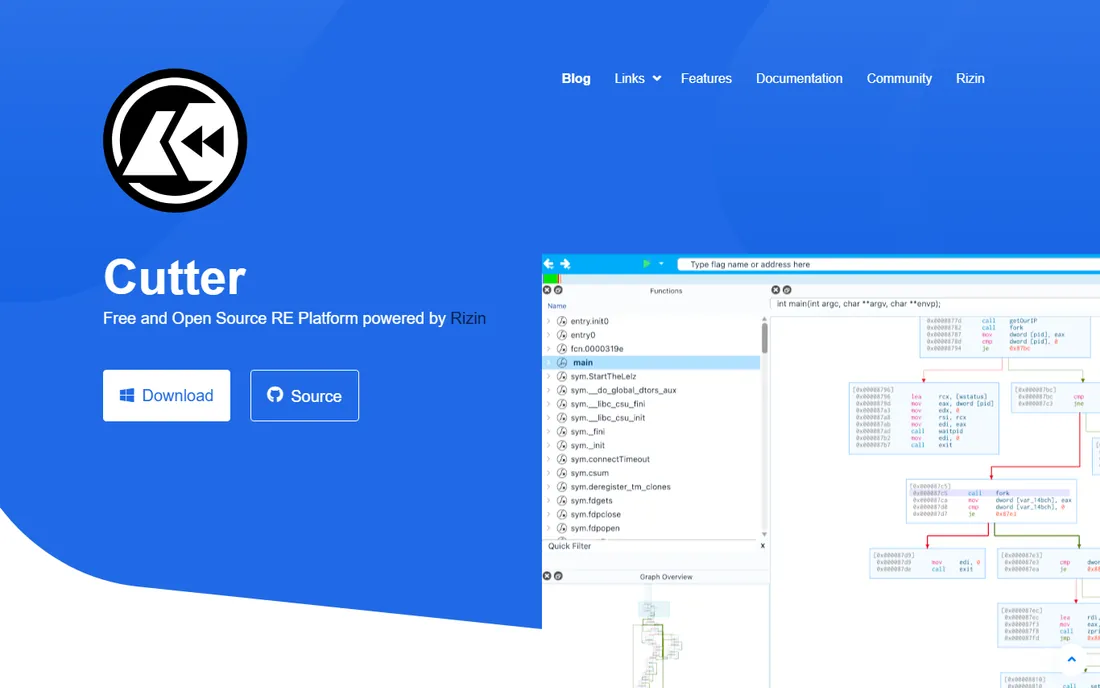
Cutter gives you the radare2-family power without living in a terminal. Built on Rizin, it offers graph views, an integrated console, a decompiler and a layout that feels familiar to anyone coming from IDA. It is free, open source and cross-platform, and it is the friendliest on-ramp to open-source reversing.
It is less mature than the giants, so expect occasional rough edges and a smaller plugin catalog. For students, CTF players and analysts who want a GUI without paying, though, it is an easy recommendation and improving steadily.
What we like- Free and open source
- Friendly GUI with graphs and widgets
- Powered by the Rizin engine
Watch out for- Younger project than IDA or Ghidra
- Some advanced features lag the CLI
- Plugin ecosystem still growing
Starting priceFrom $140 per user/month (JEB Android)
Free planYes (Community Edition)
JEB's reputation rests on Android. Its Dalvik decompiler turns APK bytecode into readable Java better than the free alternatives, which is why mobile security teams pay for it. JEB Pro extends that to native code across x86, ARM, MIPS and RISC-V, with an interactive interface for renaming and refactoring.
The pricing is firmly professional: JEB Android from $140 a month or $1,200 a year per user, JEB Pro from $2,000 a year. The free Community Edition covers x86 decompilation for students and hobbyists. If Android is your beat and someone else pays, JEB is the tool.
What we like- Best-in-class Dalvik to Java decompilation
- Wide architecture coverage
- Interactive refactoring of decompiled code
Watch out for- Expensive subscriptions
- Community Edition limited to x86
- Java-based UI
#10
Rizin
Best for: a clean, community-driven reversing framework
Visit rizin.re
Starting priceSee website (free, open source)
Free planYes
Rizin is the community fork of radare2, rebuilt with an emphasis on usability, cleaner code and stable APIs. It does everything the r2 family does, disassembly, debugging, patching, forensics, while Cutter serves as its official graphical face. Development is active and the direction is deliberately user-friendlier.
The fork split the community, so Rizin has fewer third-party scripts and tutorials than radare2 itself. For new projects and anyone who found radare2's internals frustrating, Rizin is the better bet going forward, and it costs nothing to try.
What we like- Free and open source with cleaner codebase than its fork parent
- CLI plus Cutter GUI
- Active development
Watch out for- Smaller community than radare2
- Documentation still catching up
- Fewer third-party integrations
How to choose among the Ghidra alternatives
Start free, then pay for a specific pain. Ghidra covers static analysis and decompilation for nothing, so a paid tool has to earn its price: IDA Pro earns it with ecosystem and polish in commercial labs, Binary Ninja with a modern API and interface, JEB with Android decompilation, Hopper with Mac-native comfort.
Match the tool to the target. Windows malware means x64dbg plus a disassembler. Mobile apps mean Frida plus JEB or Ghidra. Firmware and CTFs mean Ghidra, Radare2 or Rizin. And remember the static-dynamic split: disassemblers show you the code, debuggers and Frida show you the behavior. Most analysts use at least one of each.
Budget matters too. A solo researcher can build a complete lab for free with Ghidra, Cutter, Frida and x64dbg. The best reverse engineering software for a team is rarely the same as for a solo researcher, so weigh collaboration features and licensing as well as raw capability. Commercial licenses make sense when time is money: a team reversing malware daily will recover IDA Pro's cost in saved hours, while a student will not.
How we chose
We compared tools that security researchers, malware analysts and CTF players actually use in 2026, checking vendor sites, official documentation, and community discussion on Reddit and GitHub. We covered static analysis, decompilation, debugging and dynamic instrumentation, because real reversing workflows mix all four.
We did not do hands-on testing for this roundup. We weighted practical factors instead: license cost and terms, architecture coverage, decompiler quality, scripting APIs, platform support, and how each tool fits teams versus solo researchers. Pricing for commercial tools changes, so confirm current figures with the vendor.
Static analysis vs dynamic instrumentation: a quick primer
Static analysis reads the binary without running it. Disassemblers and decompilers, Ghidra, IDA Pro, Binary Ninja, Radare2, show you the program's structure: functions, strings, control flow. It is safe, thorough, and the starting point for every investigation.
Dynamic analysis watches the program run. Debuggers like x64dbg let you step through instructions and inspect memory; instrumentation frameworks like Frida let you hook functions and change behavior live. It reveals packed code, decrypted strings and actual behavior that static analysis can miss.
Use both. Static analysis maps the territory; dynamic analysis confirms what actually happens. Malware analysts typically start static for triage, then go dynamic for the interesting parts, then return to static with new understanding.
Frequently asked questions
What is the best reverse engineering software for beginners?
Ghidra, because it is free, complete and well documented, with a huge tutorial community. Cutter is the friendliest free GUI alternative. Beginners should learn static analysis first, then add x64dbg or Frida for dynamic work once the basics click.
Is Ghidra really a match for IDA Pro?
For most static analysis and decompilation tasks, yes. Ghidra's decompiler is strong, it supports more architectures, and it costs nothing. IDA Pro keeps an edge in its plugin ecosystem, interactive polish and commercial support, which is why professional labs still pay for it.
What are the best Ghidra alternatives?
Binary Ninja for a modern paid workflow, IDA Pro for the commercial standard, Cutter and Rizin for free GUI and CLI open-source options, and JEB for Android decompilation. Each earns its place on a specific strength rather than beating Ghidra outright.
Do I need to know assembly to use these tools?
It helps a great deal. Decompilers reduce the need to read raw assembly, but understanding registers, calling conventions and control flow makes every tool more useful. Start with a decompiler-heavy tool like Ghidra while learning assembly alongside.
Are these tools legal to use?
Reverse engineering tools are legal; what matters is what you analyze and why. Analyzing your own software, malware samples, or code you have permission to examine is standard security work. Bypassing protections or violating licenses and terms of service is a separate legal question, so know your jurisdiction and your authorization.
Sources we checked (15)
- https://ghidra-sre.org
- https://hex-rays.com
- https://binary.ninja
- https://www.radare.org/
- https://frida.re
- https://x64dbg.com
- https://www.hopperapp.com
- https://cutter.re
- https://www.pnfsoftware.com
- https://rizin.re
- https://pnfsoftware.com/jeb/buy
- https://en.wikipedia.org/wiki/Ghidra
- https://en.wikipedia.org/wiki/Radare2
- https://en.wikipedia.org/wiki/X64dbg
- https://github.com/rizinorg/cutter
Is your product missing or out of date?
We review this list regularly. Vendors can request a listing, send updated pricing or ask about featured placement.

Shihab Mia · Founder, Rankite
Shihab has spent more than a decade helping SaaS and e-commerce brands grow through search. He writes Rankite's software buying guides from pricing pages, documentation and public user reviews. More about Shihab.