How we make this list: we compare pricing pages, product documentation and public user reviews. Rankite is independent; if a vendor ever pays for a featured spot, that listing is clearly labeled Partner.
Key takeaways
- Most MSPs end up choosing between per-technician pricing (Atera and Syncro at $129 per tech per month) and per-endpoint pricing (NinjaOne from $3.75 per endpoint down to $1.50 at scale). The right model depends on your tech-to-device ratio.
- NinjaOne and Atera publish real numbers; Datto RMM, ConnectWise RMM and N-able N-central are quote-only, so budget a sales cycle and get terms in writing.
- Tactical RMM is genuinely free and self-hosted, but you own the server, the security and the maintenance.
- Pulseway is the cheapest commercial entry point (about $27 per month for 20 devices) with the best mobile app in the category.
Quick comparison
| Tool | Best for | Starting price | Free plan |
|---|
 NinjaOne NinjaOne | MSPs and internal IT teams running 200 to 5,000 endpoints | $3.75 per endpoint/month (50 or fewer endpoints), down to $1.50 at 10,000 | Free trial (14 days) |
 Atera Atera | MSPs with lean technician teams managing many endpoints | $129 per technician/month billed annually (Pro MSP plan) | Free trial (30 days, no credit card) |
 Datto RMM Datto RMM | Mid-size MSPs already in the Datto or Kaseya stack | See website (quote-based, no public price list) | Free trial (demo available) |
 ConnectWise RMM ConnectWise RMM | Established MSPs already running ConnectWise PSA | See website (custom quote, modular licensing) | Free trial (available) |
 N-able N-central N-able N-central | Mid-to-large MSPs with complex networks | See website (quote-only) | Free trial (available) |
 Syncro Syncro | Small to mid MSPs that want one platform and one bill | $129 per user/month billed annually (Core plan) | Free trial (14 days, no credit card) |
 SuperOps SuperOps | Newer MSPs and internal IT teams that value modern UI and AI | $129 per technician/month billed annually (Pro unified PSA+RMM) | Free trial (14 days, no credit card) |
 Pulseway Pulseway | Sysadmins and smaller MSPs that want mobile-first management | About $27/month for 20 devices (per-installation pricing) | Free trial (available) |
 ManageEngine RMM Central ManageEngine RMM Central | MSPs that want on-prem or hybrid RMM with perpetual licensing | $1,195/year for 50 devices with 1 user (Enterprise Edition) | Free trial (30-day full-feature) |
 Tactical RMM Tactical RMM | Technical teams that want free, self-hosted RMM | $0 (self-hosted; you pay only for server hosting) | Yes (free license; paid sponsorship tiers add extras) |
Is your product missing or out of date?
We review this list regularly. Vendors can request a listing, send updated pricing or ask about featured placement.
The best remote monitoring and management software
It is 2 a.m. and a client's server is throwing disk errors. With the right RMM, you get the alert on your phone, open a remote session, kick off a fix, and go back to sleep. With the wrong one, you find out Monday morning when the client calls. Remote monitoring and management software is the console an MSP or internal IT team lives in: it watches every endpoint, pushes patches, runs scripts, and gives you remote access when something breaks. These ten cover the real market, from per-tech all-in-ones to a free self-hosted option.
#1
NinjaOne
Best for: MSPs and internal IT teams running 200 to 5,000 endpoints
Visit ninjaone.com
Starting price$3.75 per endpoint/month (50 or fewer endpoints), down to $1.50 at 10,000
Free planFree trial (14 days)
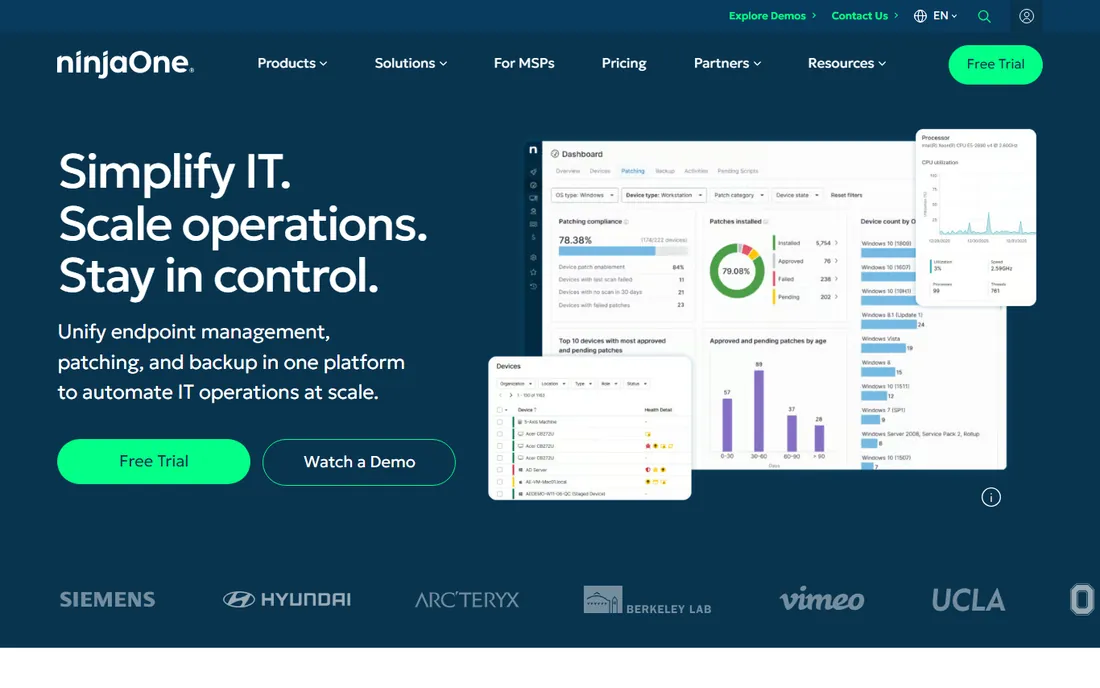
NinjaOne wins on polish. The console is fast, the patching covers OS and third-party software across all three major operating systems, and remote access, backup and mobile device management live in the same place. For an MSP or IT team in the few-hundred to few-thousand endpoint range, it is the tool technicians complain about least.
The honest catch is pricing precision. NinjaOne publishes a range ($3.75 down to $1.50 per endpoint per month) but your exact rate comes from a quote, and add-ons like backup and endpoint security add per-device cost on top. Contracts are generally annual with roughly a 50-endpoint minimum. If you want one number before a sales call, Atera or SuperOps publish theirs.
What we like- Clean fast UI with strong Windows, macOS and Linux patching
- Built-in remote access, backup and MDM in one console
- Free unlimited support and onboarding bundled in
Watch out for- Only a pricing range is published, so the exact rate needs a sales quote
- Native ticketing is basic next to dedicated PSA tools
#2
Atera
Best for: MSPs with lean technician teams managing many endpoints
Visit atera.com
Starting price$129 per technician/month billed annually (Pro MSP plan)
Free planFree trial (30 days, no credit card)
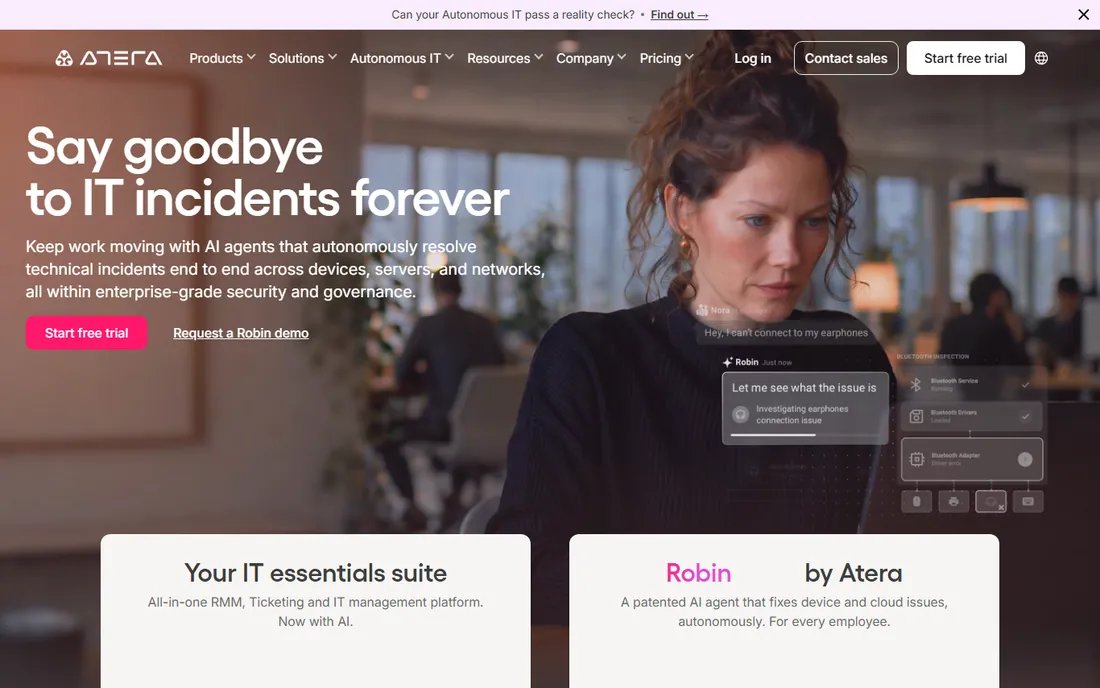
Atera's pitch is arithmetic. Per-technician pricing with unlimited endpoints means a 3-tech shop managing 2,000 devices pays the same as one managing 300. RMM, ticketing, patching, automation and billing share one console, and the AI Copilot (plus the Robin agent for tier-1 tickets) is included rather than upsold. No contracts required.
Flip the ratio and the math turns against you: many technicians and few endpoints is cheaper on a per-device tool like NinjaOne. The MSP plans run $129, $179 and $209 per tech per month billed annually, and the marketplace add-ons add up. For the classic small MSP shape (few techs, lots of devices), though, this is the most predictable bill in the category.
What we like- Per-technician pricing with unlimited endpoints on every plan
- RMM, ticketing, patching, automation and billing in one console
- AI Copilot included in every plan
Watch out for- Add-ons like network discovery and some integrations cost extra
- PSA depth lags dedicated platforms for complex billing
#3
Datto RMM
Best for: Mid-size MSPs already in the Datto or Kaseya stack
Visit datto.com
Starting priceSee website (quote-based, no public price list)
Free planFree trial (demo available)
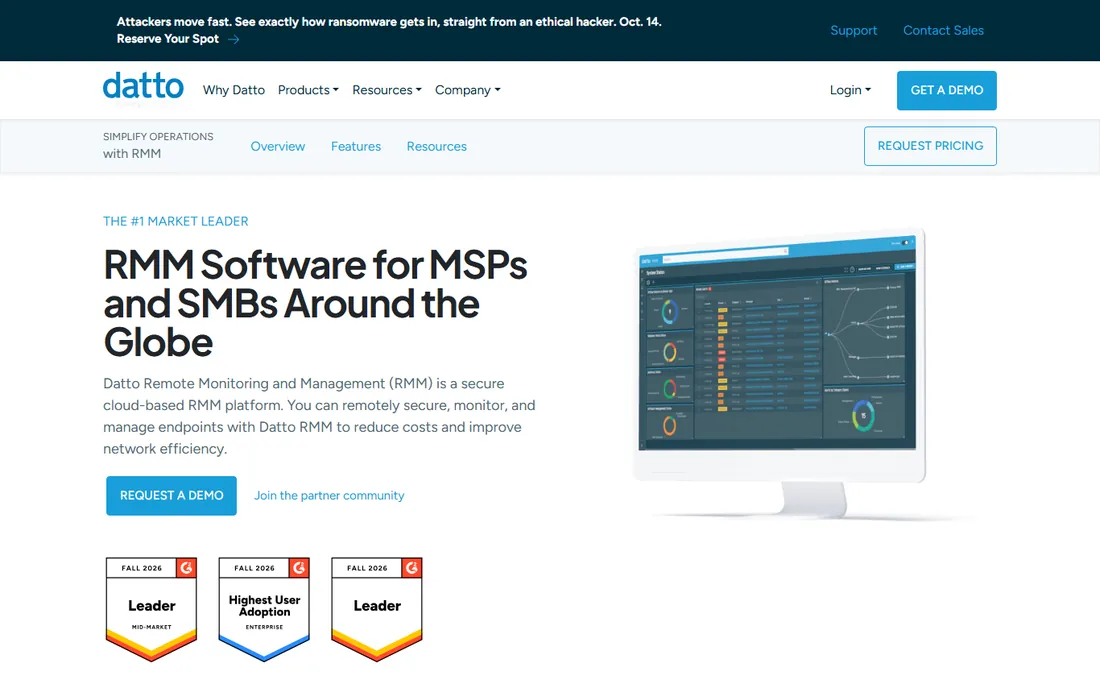
Datto RMM (owned by Kaseya since 2022) is the security-forward choice. The ransomware detection and isolation is the feature competitors talk about, and the third-party patching catalog is genuinely deep at 200-plus applications with policy-based approvals. If you already run Autotask PSA, the integration is the reason to stay in the family.
Everything else is a negotiation. There is no price list; community reports suggest roughly $2.50 to $4.50 per endpoint per month, but treat that as a bargaining anchor, not a rate card. The Kaseya ecosystem has a reputation for aggressive contract terms, so read renewal and cancellation clauses before you sign anything.
What we like- Native ransomware detection and isolation, a real differentiator
- Policy-based third-party patching across 200-plus applications
- Tight integration with Autotask PSA, IT Glue and Datto BCDR
Watch out for- No public pricing and typically annual commitments
- Native macOS patching is limited
Starting priceSee website (custom quote, modular licensing)
Free planFree trial (available)
Nobody buys ConnectWise RMM standalone; they buy into the ecosystem. On the Asio platform you get intelligent automation, bundled ScreenConnect remote access, and a PSA, documentation and security stack that all talk to each other. For a large MSP that wants one vendor, the depth is unmatched.
The price of depth is opacity and complexity. PSA, RMM, Automate and security are licensed separately, and community reports put PSA plus RMM around $150 to $200 or more per technician per month before add-ons (unverified, so get it scoped in writing). Setup can take weeks to months on larger estates. Confirm whether ConnectWise Automate is included or a separate license before you compare quotes.
What we like- Deep automation via the Asio platform with done-for-you options
- ScreenConnect remote access bundled at no extra charge
- Broad ecosystem of PSA, security and billing integrations
Watch out for- No published pricing and modules licensed separately, so costs creep
- Complex platform with multi-year terms common
#5
N-able N-central
Best for: Mid-to-large MSPs with complex networks
Visit n-able.com
Starting priceSee website (quote-only)
Free planFree trial (available)
N-central is the technician's RMM. The automation manager with drag-and-drop scripting is the most capable in the category, and the network monitoring (NetPath, SNMP) goes deeper than cloud-only rivals. You can run it on-premises or hosted, which matters for MSPs with compliance-bound clients.
It is not built for small shops: effective minimums sit around 100 devices, and smaller MSPs get steered to N-sight. Pricing is quote-only, so get N-central and N-sight quoted in writing and bring a NinjaOne quote to the negotiation. Renewal rates have reportedly softened, which means there is room to push back on multi-year terms.
What we like- Best-in-class automation policies with drag-and-drop scripting
- On-premises or hosted deployment with strong multi-tenancy
- Cove backup and SentinelOne EDR bundle into one quote
Watch out for- Quote-only pricing with effective minimums around 100-plus devices
- Console can feel cluttered at scale
Starting price$129 per user/month billed annually (Core plan)
Free planFree trial (14 days, no credit card)
Syncro is the simplicity play: RMM, PSA, ticketing, scripting and invoicing in one record, at $129 per user per month billed annually with unlimited endpoints and no contracts. Microsoft 365 multi-tenant management is built in, and the community script library means someone has already automated your problem. The Team plan ($179) adds M365 security and Power BI reporting.
Growing shops sometimes hit the customization ceiling and graduate to HaloPSA or ConnectWise PSA. But for the 15-to-40-client MSP that wants to stop stitching tools together, the single bill and no-contract terms make this an easy trial against your current stack.
What we like- RMM, PSA, scripting and billing in one plan at a single per-user price
- Unlimited endpoints per user with no contracts or minimums
- Large community script library and open API
Watch out for- Less configurable than dedicated PSA tools for heavily custom workflows
- M365 security features need the Team plan
#7
SuperOps
Best for: Newer MSPs and internal IT teams that value modern UI and AI
Visit superops.com
Starting price$129 per technician/month billed annually (Pro unified PSA+RMM)
Free planFree trial (14 days, no credit card)
SuperOps is what an RMM looks like when it is designed in the 2020s instead of the 2000s. The interface is modern, AI ticket triage is built in rather than bolted on, and the pricing transparency is refreshing: MSP plans at $79, $99, $129 and $159 per tech per month billed annually, and internal IT at $1.50 per endpoint per month sliding to $1.20 above 1,000.
Maturity is the trade-off. Reviewers praise the UI and AI but flag gaps in complex workflows, and the third-party patching catalog is thinner, so test it against your application list during the trial. AI add-ons carry usage-based pricing on top. For a newer MSP that values speed over legacy depth, it is the most pleasant console to live in.
What we like- Modern UI with AI-assisted ticket triage built in
- Fully published rate cards, rare transparency here
- Unified PSA and RMM avoids integration work
Watch out for- Younger platform with a smaller community and fewer integrations
- Third-party patching catalog is thinner than NinjaOne's
#8
Pulseway
Best for: Sysadmins and smaller MSPs that want mobile-first management
Visit pulseway.com
Starting priceAbout $27/month for 20 devices (per-installation pricing)
Free planFree trial (available)
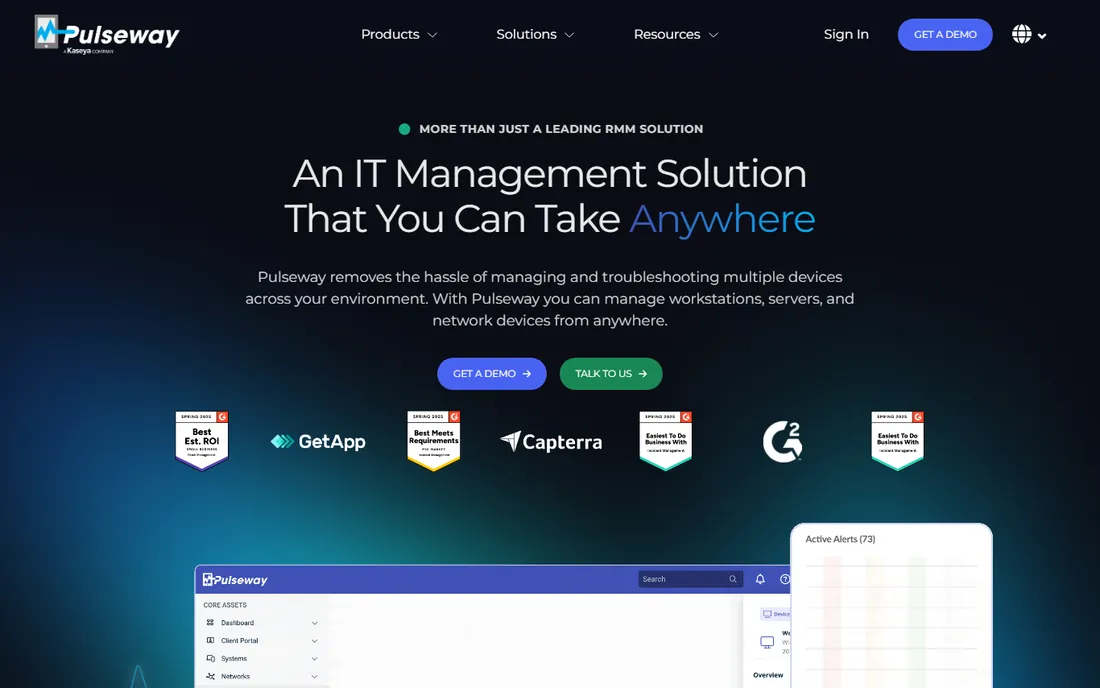
Pulseway's mobile app is the reason it exists. You get the alert, see the issue and fix it from your phone in seconds, and auto-remediation workflows handle common problems before users notice. At about $27 per month for 20 devices with per-installation pricing that drops at scale, it is one of the cheapest ways into real RMM.
What you give up is depth: alerting, reporting and integrations are thinner than the enterprise tools, and there is no native PSA. For a solo sysadmin or a small MSP that lives on their phone, that trade is easy to make. Onboarding help is available for a one-time fee.
What we like- Best-in-class mobile app for monitoring and remediation from a phone
- Cheap per-installation pricing at scale with no hidden fees
- Self-hosting option plus cloud
Watch out for- Advanced alerting and reporting are thinner than enterprise RMMs
- Smaller integration ecosystem and no native PSA
#9
ManageEngine RMM Central
Best for: MSPs that want on-prem or hybrid RMM with perpetual licensing
Visit manageengine.com
Starting price$1,195/year for 50 devices with 1 user (Enterprise Edition)
Free planFree trial (30-day full-feature)
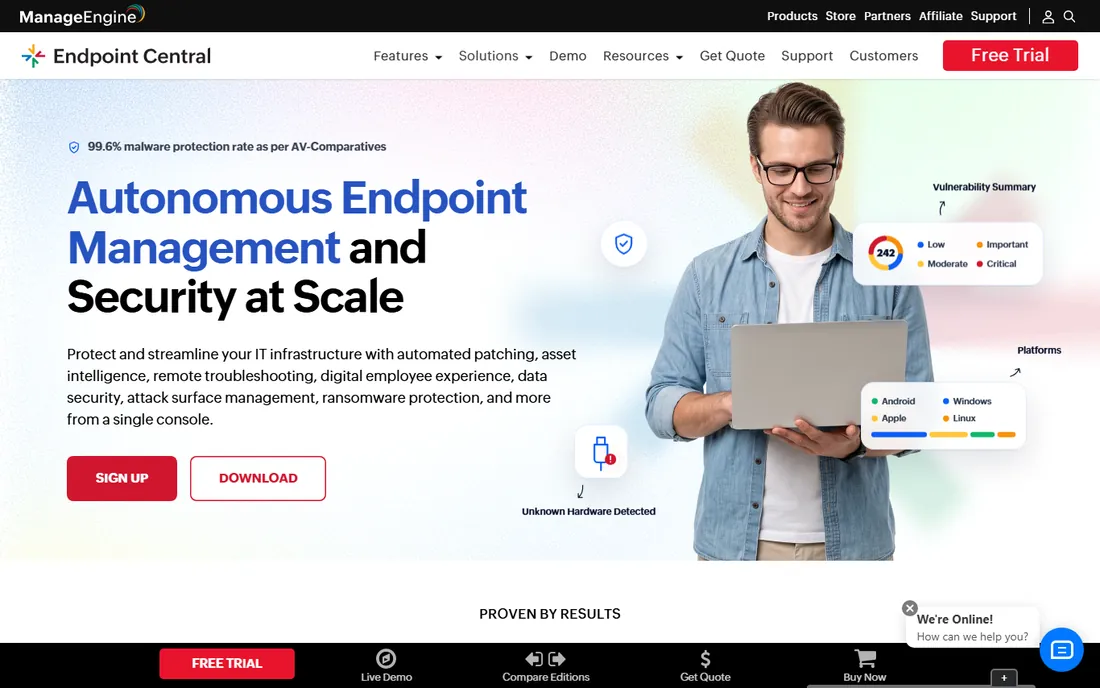
RMM Central is the old hand. ManageEngine's endpoint management depth (patching, remote desktop, asset management, MDM, USB and power management) is battle-tested, and you can run it on-premises or in the cloud with perpetual licenses available. Published tiers run $1,195 per year for 50 devices scaling to $64,795 per year for 10,000.
The licensing is the maze. Servers cost more than workstations, extra users start at $345 per year, and each ManageEngine product renews on its own schedule. If you already standardize on ManageEngine tooling, the fit is natural. If not, budget time to model the true annual cost.
What we like- Deep endpoint management heritage with patching, MDM and software deployment
- On-premises and cloud deployment with perpetual licenses
- Strong network, server and VMware monitoring
Watch out for- Servers licensed separately at higher rates
- ManageEngine products renew separately with separate price lists
#10
Tactical RMM
Best for: Technical teams that want free, self-hosted RMM
Visit github.com
Starting price$0 (self-hosted; you pay only for server hosting)
Free planYes (free license; paid sponsorship tiers add extras)
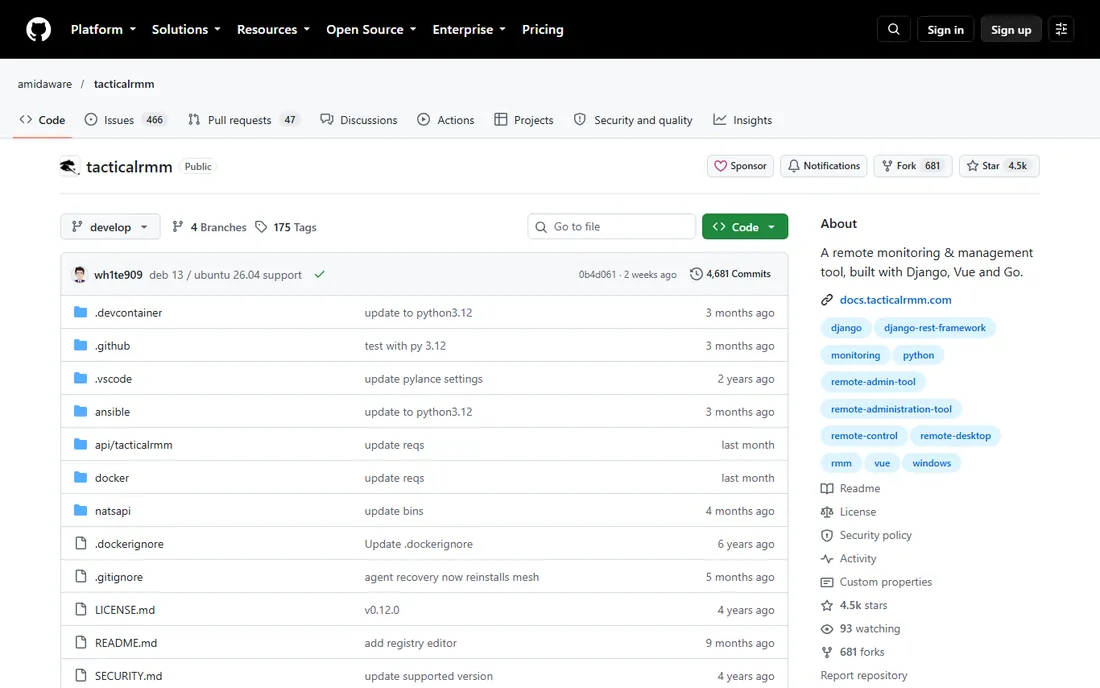
Tactical RMM is the open-source answer to a $3-per-endpoint world. You get monitoring, policy-based patch automation, scripting, alerting and remote access via MeshCentral for the cost of a VPS (typically $20 to $60 per month), with community reports of 5,000-plus agents in production. The code is source-available, so you can audit exactly what runs on client machines.
The cost is operational, not financial. You host and secure the server, there is no vendor SLA, and you still need a separate PSA for ticketing and invoicing. Paid sponsorship tiers add code-signed Windows agents, SSO and Mac/Linux agents. For a technically strong team, it is the cheapest capable RMM on this list by a wide margin.
What we like- Zero licensing cost with full RMM depth including scripting and MeshCentral remote access
- Source-available code with complete data control
- Active open-source MSP community
Watch out for- No native PSA, ticketing or billing
- You own the server, its security and its backups
Pricing models, decoded
RMM pricing comes in three shapes, and picking the wrong one is the most expensive mistake in this category. Per-technician pricing (Atera, Syncro, SuperOps) charges per tech with unlimited endpoints: brilliant when a few techs manage thousands of devices, punishing when many techs manage few. Per-endpoint pricing (NinjaOne, Pulseway, ManageEngine) charges per device: fair for large tech teams with modest fleets, and it scales linearly with growth.
Then there is quote-only (Datto, ConnectWise, N-able), where the price is whatever the negotiation produces. Here the real cost drivers hide in the contract: annual versus monthly terms, renewal uplift clauses, minimum endpoint counts, and separately licensed modules. Always get the renewal terms in writing before the first term, not after.
The mistake first-time RMM buyers make
First-time buyers compare feature checklists. Experienced buyers compare exit costs. RMM tools become deeply embedded: agents on every endpoint, automation policies tuned over months, PSA data intertwined. Switching is a project, and vendors know it.
Before you sign, answer three questions. What does month-to-month cost versus annual, and is it even offered? What happens to your data and agents at cancellation? And which features in the demo are paid add-ons? The vendors with published pricing and no-contract options (Atera, Syncro, SuperOps, Pulseway) make these answers easy. The quote-only vendors make them a negotiation. Either is fine, as long as you negotiate before you are locked in.
How we chose
We started with the tools MSPs and IT teams actually evaluate: the per-tech all-in-ones, the per-endpoint specialists, the enterprise quote-only platforms, and the free self-hosted option. For each candidate we checked the vendor's own pricing page, compared feature lists and deployment options, and read public reviews on G2, Capterra and practitioner discussion on Reddit. Where a price could not be verified on the vendor's page we wrote "See website" rather than guessing, and community-reported figures are flagged as estimates, not rate cards.
Frequently asked questions
Per-tech or per-endpoint pricing: which is cheaper?
It depends on your ratio. Divide your endpoint count by your technician count. Above roughly 250 endpoints per tech, per-tech pricing (Atera, Syncro at $129 per tech per month) usually wins. Below that, per-endpoint tools (NinjaOne from $3.75, Pulseway from about $1.35 per device at the entry tier) are cheaper. Model both with your actual numbers.
Do I need a separate PSA with an RMM?
Not always. Atera, Syncro and SuperOps bundle PSA-style ticketing and billing, which covers small to mid MSPs. NinjaOne, Datto, N-able and Pulseway pair with a dedicated PSA (Autotask, HaloPSA, ConnectWise PSA) for ticketing depth. Tactical RMM has no PSA at all, so you will bolt one on.
Can I switch RMM vendors easily?
It is a project, not a flip of a switch. You will redeploy agents to every endpoint, rebuild automation policies, and migrate ticket history. No-contract vendors (Atera, Syncro, Pulseway) lower the risk of trying before committing. Plan the migration, run both consoles in parallel on a pilot group, and never switch during your busiest season.
What is the cheapest way to get started with RMM?
Tactical RMM at $0 license cost plus a small VPS, if you have the technical chops to self-host. Among commercial tools, Pulseway's entry tier (about $27 per month for 20 devices) is the cheapest on-ramp, and Atera's per-tech model is cheapest for a one-tech shop with a large fleet.
Does RMM include remote access?
Most do. NinjaOne, Atera, Datto, N-able, Syncro, SuperOps, Pulseway and ManageEngine all bundle remote access. ConnectWise bundles ScreenConnect at no extra charge. Tactical RMM uses MeshCentral, which is bundled. Confirm session limits and whether unattended access costs extra on your plan.
Sources we checked (12)
- https://www.ninjaone.com/pricing
- https://www.atera.com/pricing
- https://www.datto.com/products/rmm
- https://www.connectwise.com/platform/unified-management
- https://www.n-able.com/products/n-central-rmm
- https://www.syncromsp.com/pricing
- https://www.superops.com/pricing
- https://www.pulseway.com/pricing
- https://www.manageengine.com/products/desktop-central/
- https://github.com/amidaware/tacticalrmm
- https://www.g2.com/categories/remote-monitoring-and-management
- https://www.capterra.com/remote-monitoring-and-management-software/
Is your product missing or out of date?
We review this list regularly. Vendors can request a listing, send updated pricing or ask about featured placement.

Shihab Mia · Founder, Rankite
Shihab has spent more than a decade helping SaaS and e-commerce brands grow through search. He writes Rankite's software buying guides from pricing pages, documentation and public user reviews. More about Shihab.