How we make this list: we compare pricing pages, product documentation and public user reviews. Rankite is independent; if a vendor ever pays for a featured spot, that listing is clearly labeled Partner.
Key takeaways
- Apify and Bright Data are the full-stack platforms, covering actors, proxies, datasets and scheduling in one place.
- Zyte and Oxylabs are the infrastructure picks, with pay-on-success scraping APIs and enterprise-grade proxy networks.
- Diffbot is the knowledge play, with a free tier and extraction plus a knowledge graph, though paid plans start at $299 a month.
- Scrapy remains the open-source standard and costs nothing, if you can supply the engineering time.
- ScrapingBee, ScraperAPI and Crawlbase are the API-first specialists for teams that want to send a URL and get structured data back.
Quick comparison
| Tool | Best for | Starting price | Free plan |
|---|
 Apify Apify | Teams that want crawlers, proxies and scheduling on one platform | See website | No |
 ScrapingBee ScrapingBee | Developers who want a simple API for hard pages | See website | No |
 Bright Data Bright Data | Enterprises running large-scale data collection | See website | No |
 Zyte Zyte | Teams that want to pay only for successful extractions | See website | No |
 Oxylabs Oxylabs | Proxy infrastructure with a scraping API on top | From $30/month | Yes |
 Diffbot Diffbot | Structured extraction and a queryable knowledge graph | From $299/month | Yes |
 ScraperAPI ScraperAPI | Developers adding reliable scraping to an existing stack | See website | No |
 Crawlbase Crawlbase | Managed crawling without running infrastructure | See website | No |
 Scrapy Scrapy | Python teams building custom crawlers they fully control | Free | Yes |
 Octoparse Octoparse | Non-developers who need visual point-and-click scraping | See website | No |
Is your product missing or out of date?
We review this list regularly. Vendors can request a listing, send updated pricing or ask about featured placement.
#1
Apify
Best for: Teams that want crawlers, proxies and scheduling on one platform
Visit apify.com
Starting priceSee website
Free planNo
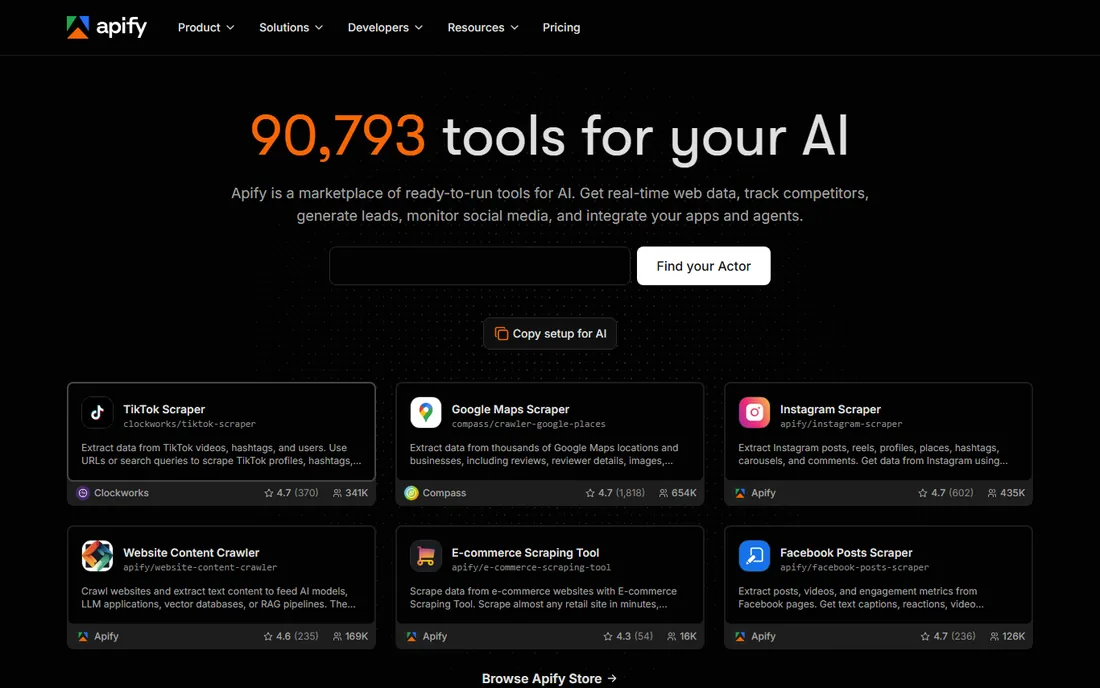
Apify is the closest thing to a full-stack crawling platform. Actors are reusable serverless crawlers you can run on demand or on a schedule, the marketplace offers thousands of pre-built ones, and the platform handles proxies, storage, datasets and integrations natively. It is the tool teams pick when they want to stop maintaining crawling infrastructure and start consuming data.
The trade-off is complexity for simple jobs. If you need one URL scraped on a schedule, a lighter API may be cheaper and faster. We could not verify plan rates from Apify's public pages during this check, so confirm current pricing on the vendor site before budgeting.
What we like- Marketplace of ready-made actors
- Built-in proxies, storage and scheduling
- Generous developer ecosystem
Watch out for- Pricing page did not render publicly in our check, so costs need the vendor site or a call to confirm
Starting priceSee website
Free planNo
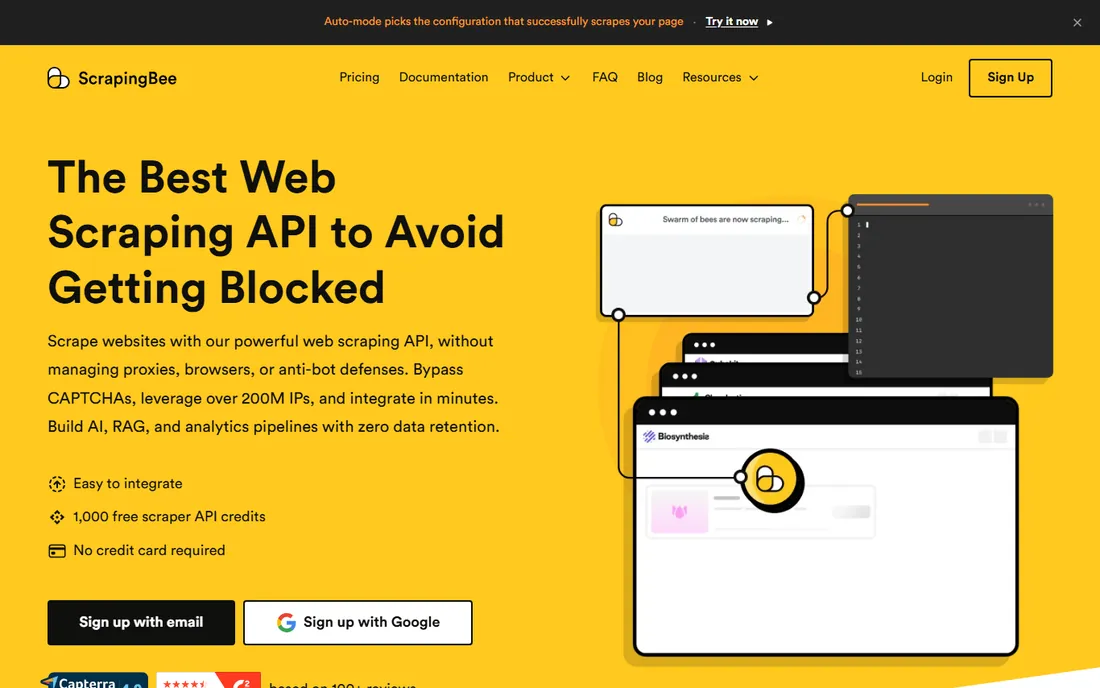
ScrapingBee sells simplicity: one API endpoint that renders JavaScript, rotates proxies and returns the HTML or extracted data. There is no crawler framework to learn and no browser fleet to maintain. For teams whose scraping needs are really "get this page reliably," that focus is the appeal.
The product is narrower by design. It does not offer a crawler marketplace, scheduling dashboards or managed datasets, so larger programs end up bolting those on. We could not verify plan rates from ScrapingBee's public pages during this check, so get the numbers from the vendor site before committing.
What we like- Handles headless browsers and proxies behind one endpoint
- Straightforward credit model
- Good documentation
Watch out for- Pricing page did not render publicly in our check
- Less of a platform than Apify or Bright Data
Starting priceSee website
Free planNo
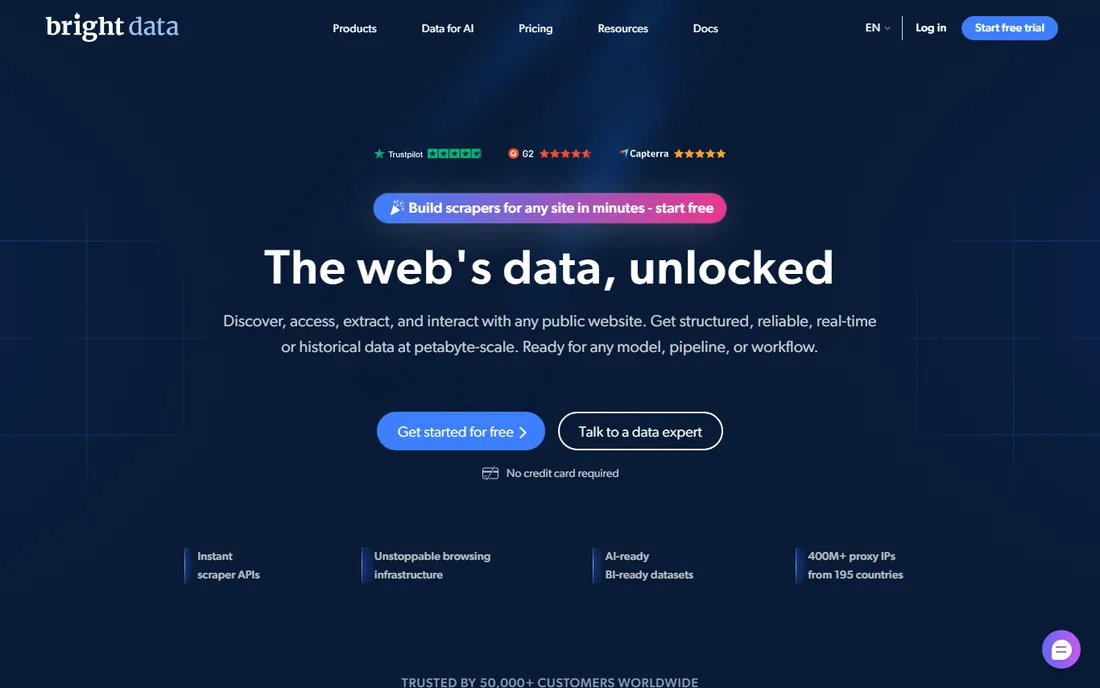
Bright Data is the infrastructure heavyweight: a massive proxy network, scraping APIs, ready-made datasets and a managed data collection service. For enterprises that need millions of pages a month with legal and compliance review, it is the default shortlist entry. The compliance tooling and documentation are more mature than most competitors.
The pricing and buying experience reflect that enterprise focus. We could not verify plan rates from Bright Data's public pages during this check, and the sales-led motion means evaluation takes longer than with self-serve APIs. If you need serious scale with compliance cover, it is worth the process. For small projects, start with a simpler API.
What we like- One of the largest proxy networks in the industry
- Scraping APIs, datasets and managed collection under one roof
- Strong compliance posture
Watch out for- Pricing page did not render publicly in our check
- Enterprise sales motion, not self-serve friendly
#4
Zyte
Best for: Teams that want to pay only for successful extractions
Visit zyte.com
Starting priceSee website
Free planNo
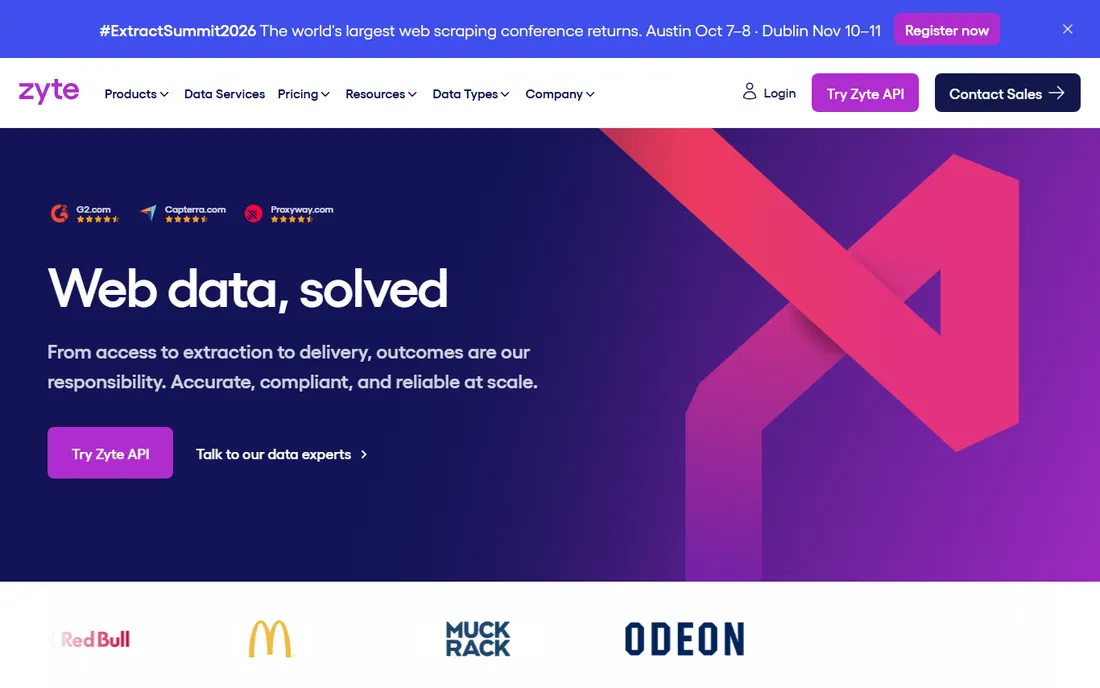
Zyte, formerly Scrapinghub, has one of the most buyer-friendly pricing ideas in the category: you are billed on successful results, not on requests, retries or blocked attempts. The Zyte API picks the leanest access strategy that works for each site and escalates only when needed, which aligns the vendor's incentives with yours.
Zyte also maintains Scrapy, the open-source framework, and runs Scrapy Cloud for hosting your own spiders, so it serves both the build-it-yourself and hand-it-over ends of the market. We could not verify current plan rates from the public pricing page during this check. The breadth of the lineup means you should decide upfront whether you want the API, the cloud hosting or the managed data service.
What we like- One API that picks the cheapest access strategy per site
- Billed on success
- Scrapy Cloud for hosting your own spiders
Watch out for- Pricing page did not render publicly in our check
- The product lineup spans APIs, managed data and cloud, which can confuse buyers
#5
Oxylabs
Best for: Proxy infrastructure with a scraping API on top
Visit oxylabs.io
Starting priceFrom $30/month
Free planYes
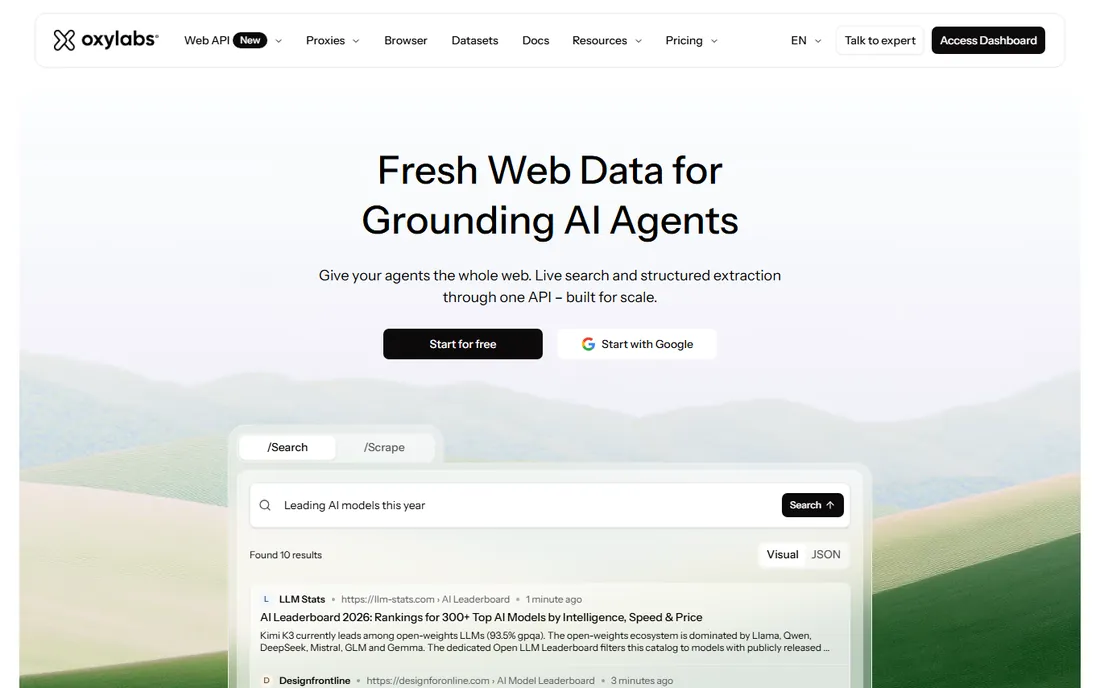
Oxylabs built its name on proxy infrastructure and has layered a Web API on top that brings search and data retrieval under one interface, with agent-ready output. The proxy network, 177 million-plus IPs, is the backbone, and the newer browser and dataset products round out a genuinely full stack for data operations.
Pricing is published and unusually transparent for the category: Starter at $30 a month, Basic at $100, Flexible at $500, with per-request rates for scraping and proxies, and $5 in free welcome credits to start. Oxylabs is the pick when the core problem is reliable access at scale and you want the pricing in writing before the first call.
What we like- 177M-plus IP proxy network
- Published pricing from $30 a month
- $5 free welcome credits to test
Watch out for- The full product catalog is wide, so picking the right service takes work
- Usage-based costs scale fast
#6
Diffbot
Best for: Structured extraction and a queryable knowledge graph
Visit diffbot.com
Starting priceFrom $299/month
Free planYes
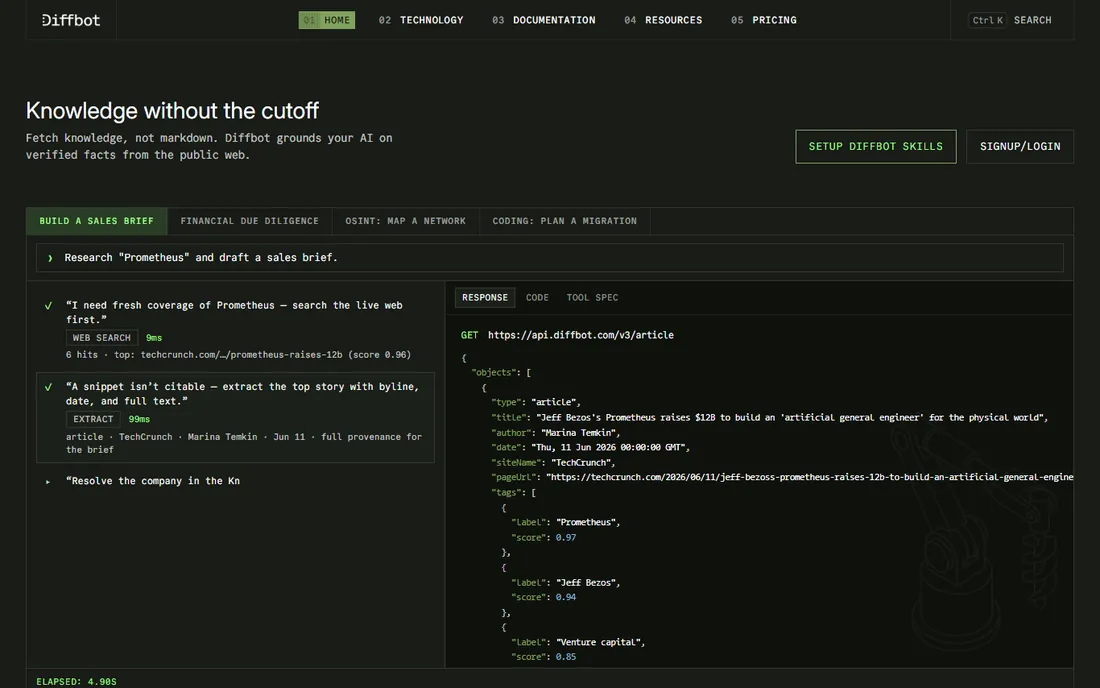
Diffbot is the odd one out in the best way. It does not just fetch pages: it extracts structured, opinionated data from them, resolves entities, and maintains a knowledge graph of the public web you can query directly. For AI applications that need grounded facts rather than raw HTML, that is a different and valuable proposition.
The pricing page is refreshingly clear: a Free plan with 10,000 monthly credits, Startup at $299 a month with 250,000 credits, Plus at $899, and custom Enterprise. Credits map to actions like page extractions and entity queries, so model your workload with the on-page calculator. Diffbot is expensive for casual use but strong value for knowledge-driven products.
What we like- Real free plan with 10,000 credits a month and no card required
- Extraction plus knowledge graph plus web search
- Patented extraction technology
Watch out for- Paid plans start high at $299 a month
- Credit model takes effort to map to your workload
#7
ScraperAPI
Best for: Developers adding reliable scraping to an existing stack
Visit scraperapi.com
Starting priceSee website
Free planNo
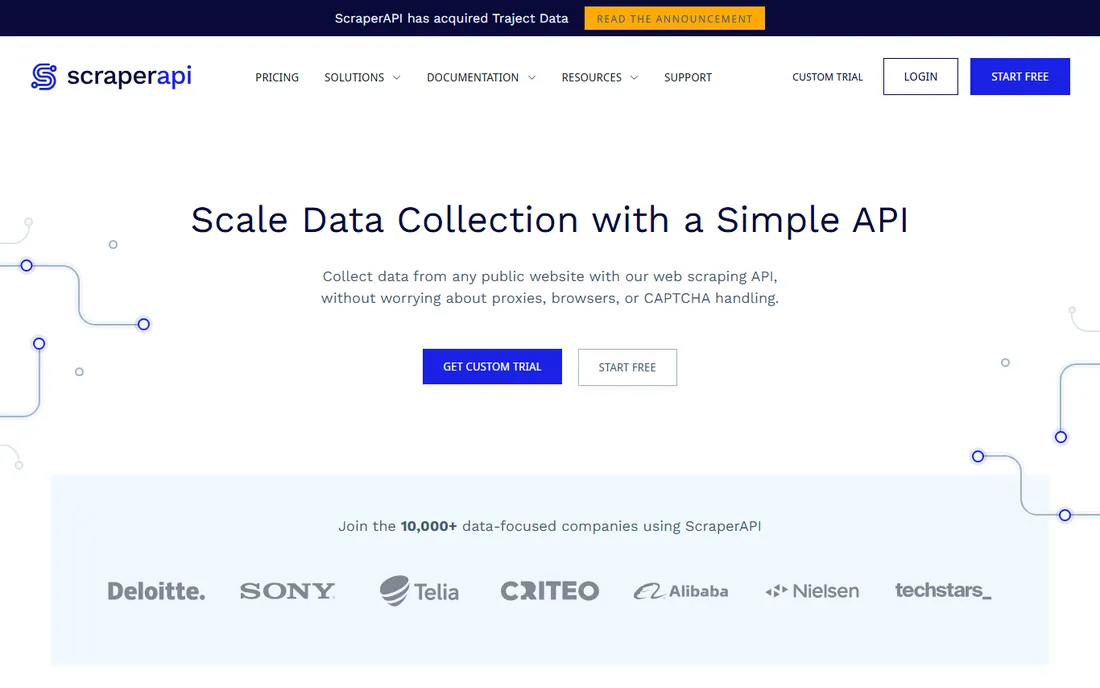
ScraperAPI is the developer's shortcut: send a URL to the API, get the page back, with proxies, headers, CAPTCHAs and retries handled behind the scenes. Integration is typically a few lines of code, and it slots into an existing data pipeline without changing how your team works.
It is deliberately not a platform. There is no actor marketplace, no visual builder, no managed datasets. For a team that already has orchestration and storage and just needs reliable page access, that is exactly right. We could not verify plan rates from ScraperAPI's public pages during this check, so confirm pricing on the vendor site.
What we like- Drop-in API with proxy rotation and CAPTCHA handling
- Simple integration
- Purpose-built for developers
Watch out for- Pricing page did not render publicly in our check
- Focused API, not a crawling platform
Starting priceSee website
Free planNo
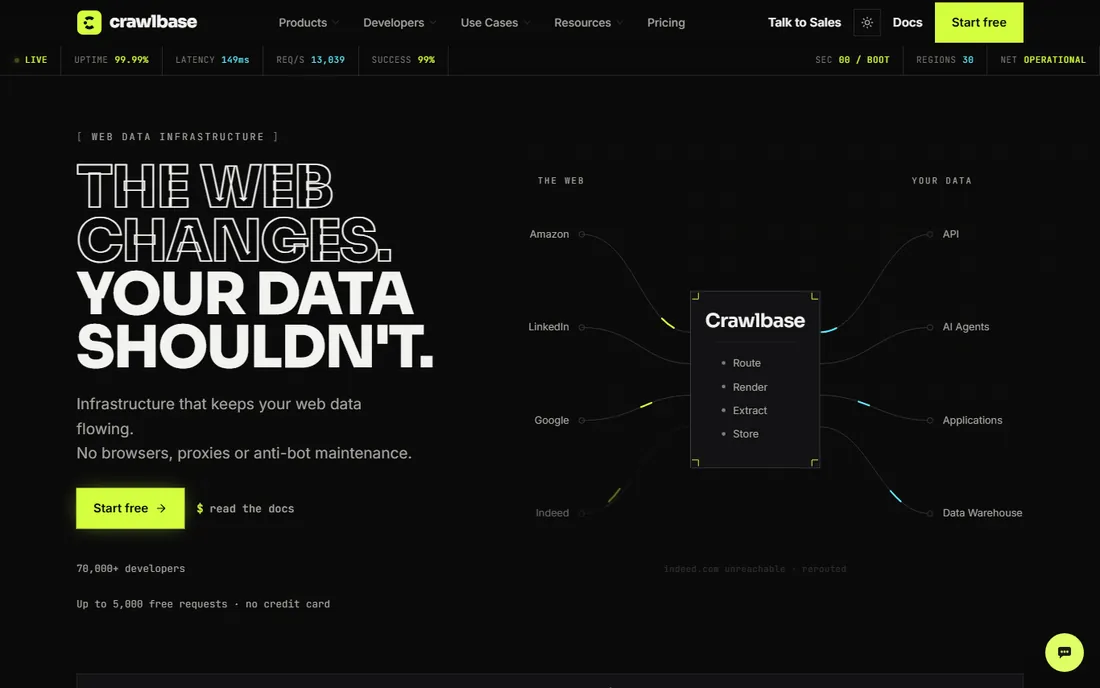
Crawlbase positions itself as managed crawling infrastructure: you define what to crawl, it handles the browsers, proxies, storage and scheduling. The pitch is aimed at product teams that need web data as an input and have no interest in running a scraping operation.
The ecosystem is smaller than Apify's or Bright Data's, which means fewer pre-built integrations and community resources. We could not verify plan rates from Crawlbase's public pages during this check. It fits teams with a defined, ongoing crawl workload that want a managed service rather than a DIY stack.
What we like- Managed crawling and scraping APIs
- Storage and scheduling handled
- Aimed at teams that want data, not servers
Watch out for- Pricing page did not render publicly in our check
- Smaller ecosystem than the category leaders
#9
Scrapy
Best for: Python teams building custom crawlers they fully control
Visit scrapy.org
Starting priceFree
Free planYes
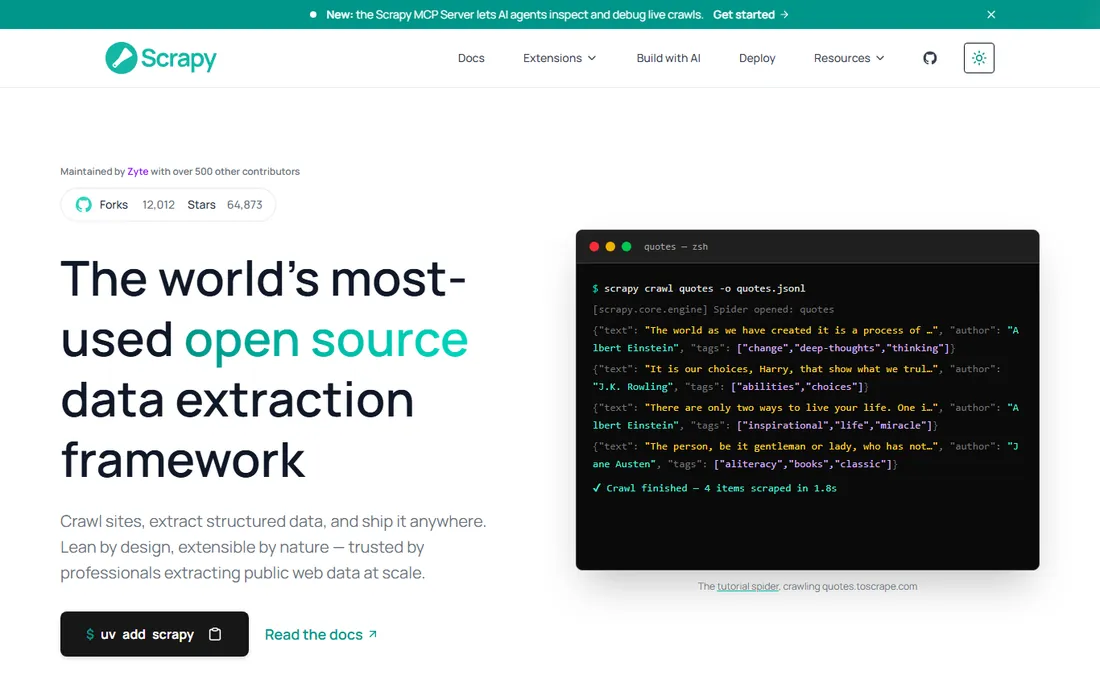
Scrapy is the framework the industry was built on, maintained by Zyte with over 500 contributors. Spiders are Python classes that follow links, extract data with CSS or XPath selectors and yield structured items. The asynchronous engine, middleware system and extension ecosystem, Splash for rendering, spidermon for monitoring, make it genuinely production-grade at millions of pages.
The cost is engineering time. Scrapy gives you the crawler, not the infrastructure: proxies, CAPTCHAs, scheduling, alerting and storage are your problem, though Scrapy Cloud can host the spiders. For teams with Python skills and specific requirements no API can meet, it remains the best answer. Everyone else should price the engineering time honestly against a managed API.
What we like- The most-used open-source extraction framework
- 15-plus years in production
- 64.8k GitHub stars and a huge extension ecosystem
Watch out for- You supply the proxies, browsers, scheduling and monitoring
- JavaScript-heavy sites need extra tooling
#10
Octoparse
Best for: Non-developers who need visual point-and-click scraping
Visit octoparse.com
Starting priceSee website
Free planNo
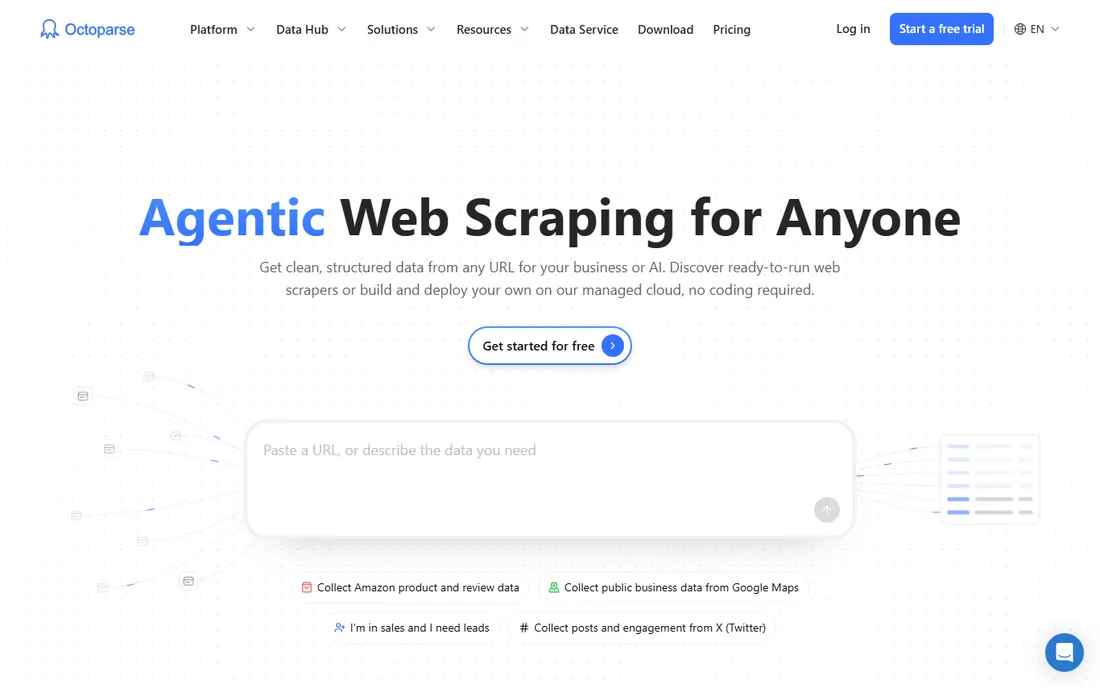
Octoparse is the no-code entry in this list: point, click and extract, with a visual workflow designer, pre-built templates and cloud-based scheduled runs. For analysts, marketers and researchers who need data without writing code, it is the most approachable option here.
The limits are the usual ones for visual scrapers. Complex multi-step flows, aggressive anti-bot protection and very large crawls will strain it, and that is where the API-first tools take over. We could not verify plan rates from Octoparse's public pages during this check, so confirm pricing on the vendor site.
What we like- Visual workflow builder with no coding
- Templates for popular sites
- Cloud extraction with scheduling
Watch out for- Pricing page did not render publicly in our check
- Visual builders hit limits on complex or heavily protected sites
The compliance half of crawling nobody budgets for
Here is the part that sinks crawling projects: access is a legal and ethical question before it is a technical one. Respect robots.txt, check the site's terms of service, and understand the regulations that apply to the data you collect. The EU AI Act and California's transparency rules are reshaping what lawful web data collection looks like, and several vendors on this list now publish compliance documentation and provenance tooling for exactly this reason.
On the technical side, the pattern is the same everywhere: rate limits are identity checks, not speed limits, and JavaScript renders a large share of sites invisible to plain HTTP requests. That is why the API vendors exist. They absorb the cat-and-mouse work of access handling so your team does not have to. When you evaluate, ask how the vendor handles blocks, what their retry policy costs you, and whether you pay for failed requests. Zyte's pay-on-success model and Oxylabs' published rates are the transparent end of this spectrum.
What to check before you buy
Start with the shape of the job. Crawling an entire site on a schedule is a different product than extracting one page on demand, which is different again from buying a ready-made dataset. Apify, Crawlbase and Scrapy suit ongoing crawl programs. ScrapingBee, ScraperAPI and Zyte's API suit on-demand extraction. Bright Data, Oxylabs and Diffbot cover datasets and knowledge as products.
Then check the pricing unit. Credits, successful requests, gigabytes of proxy traffic and monthly subscriptions all price the same workload differently. Diffbot's credit calculator, Oxylabs' published per-request rates and Zyte's pay-on-success model let you model costs upfront. Where the vendor would not show rates publicly, which was most of this list, get a quote before you architect around the tool.
Look at the access handling honestly. Ask which sites the vendor can reliably handle, how JavaScript rendering is priced, and what happens when a target blocks you. The vendors that answer crisply, with docs and status pages, are the ones whose infrastructure you can depend on.
Finally, confirm the output format and delivery. Structured JSON, CSV exports, API callbacks, warehouse delivery and scheduling cadence are where crawling projects actually succeed or fail. A crawler that works but delivers data you cannot use is just an expensive hobby.
How we chose
We shortlisted the web crawling tools that appear most often in data-engineering buyer guides and review roundups, favoring products with a live presence and a real 2026 product. For each one we attempted the vendor's homepage and pricing page, read the product documentation for crawling and extraction coverage, and scanned user reviews for recurring complaints about reliability, pricing transparency and support. We did not run hands-on crawls. Several vendor sites were unreachable from our research environment, so those tools carry "See website" pricing and are flagged in our report.
Frequently asked questions
What is the difference between web crawling and web scraping?
Crawling is systematically discovering and visiting many pages, usually across a site. Scraping is extracting structured data from pages you visit. Most tools here do both, but their strengths differ: Scrapy and Apify are crawler-first, while ScrapingBee and ScraperAPI are extraction-first APIs.
How much do web crawling tools cost?
It varies widely. Scrapy is free and open source. Oxylabs starts at $30 a month with $5 in free credits. Diffbot starts at $299 a month with a real free tier. Most other vendors here did not publish rates in our check, so budget from a vendor quote rather than a list price.
Which tool is best for large-scale crawling?
Apify, Bright Data and Zyte are the usual answers for scale, with platform features for scheduling, proxies and monitoring. Oxylabs covers the proxy infrastructure underneath. Scrapy scales fine too, if you bring the infrastructure and the engineers.
Do I need proxies for web crawling?
Usually, yes, for anything beyond a handful of pages. Targets rate-limit and block aggressive crawlers, so proxy rotation, header management and CAPTCHA handling are core to the job. That is the main reason managed APIs exist: they bundle the access handling you would otherwise build yourself.
Is web crawling legal?
It depends on what you crawl, how, and where. Public data is broadly crawlable in many jurisdictions, but terms of service, robots.txt, rate limits and data protection regulations all constrain the practice. Several vendors on this list publish compliance guidance; read it, and get legal advice for anything at scale.
Can these tools handle JavaScript-heavy sites?
Yes, with caveats. ScrapingBee, Zyte, Bright Data and Oxylabs all offer browser rendering, and Scrapy pairs with tools like Splash. Rendering costs more than plain HTTP fetching, so check how the vendor prices it before you point a crawler at a JavaScript-heavy target.
Sources we checked (4)
- https://zyte.com/
- https://oxylabs.io/pricing
- https://www.diffbot.com/pricing
- https://scrapy.org/
Is your product missing or out of date?
We review this list regularly. Vendors can request a listing, send updated pricing or ask about featured placement.

Shihab Mia · Founder, Rankite
Shihab has spent more than a decade helping SaaS and e-commerce brands grow through search. He writes Rankite's software buying guides from pricing pages, documentation and public user reviews. More about Shihab.