How we make this list: we compare pricing pages, product documentation and public user reviews. Rankite is independent; if a vendor ever pays for a featured spot, that listing is clearly labeled Partner.
Key takeaways
- NVivo, MAXQDA and ATLAS.ti remain the big names, but all sit under just two companies now after Lumivero's acquisitions, and prices have risen.
- Quirkos ($6/month or $69 lifetime) is the best value for straightforward thematic coding with an interface anyone can learn.
- Dedoose (~$13/month) and Delve (~$18/month) suit teams that want cloud-based collaboration without desktop software.
- Taguette and QDA Miner Lite are genuinely free options for students and small projects.
- Student licenses cut prices dramatically; always check academic pricing before paying standard rates.
Quick comparison
| Tool | Best for | Starting price | Free plan |
|---|
 NVivo NVivo | The research standard | $130 per year (student license) | Free trial |
 MAXQDA MAXQDA | Powerful and user-friendly | $45 per user/month | Free trial |
 ATLAS.ti ATLAS.ti | AI-assisted coding | $142 per year (student license) | Free trial |
 Quirkos Quirkos | Simple visual coding | $6 per month | Free trial |
 Dedoose Dedoose | Cloud collaboration | $13 per month | Free trial |
 Delve Delve | Modern cloud coding | $18 per month | Free trial |
 Taguette Taguette | Free open-source coding | Free | Yes |
 QDA Miner Lite QDA Miner Lite | Free basic coding | Free | Yes |
Is your product missing or out of date?
We review this list regularly. Vendors can request a listing, send updated pricing or ask about featured placement.
The market consolidated, so choose carefully
Lumivero now owns both NVivo and ATLAS.ti, leaving MAXQDA as the main independent alternative, and prices across the big names have climbed. That makes the smaller and free tools more attractive than ever. The right choice depends on your methodology, team size and whether you need advanced queries or just clean thematic coding.
Before you buy, take the free trial seriously: import a slice of your real data, code a dozen excerpts, and run one query. That 30-minute test tells you more than any feature matrix. Also check what your institution already provides; many universities hold campus licenses for NVivo or MAXQDA, which can make the decision for you.
Starting price$130 per year (student license)
Free planFree trial
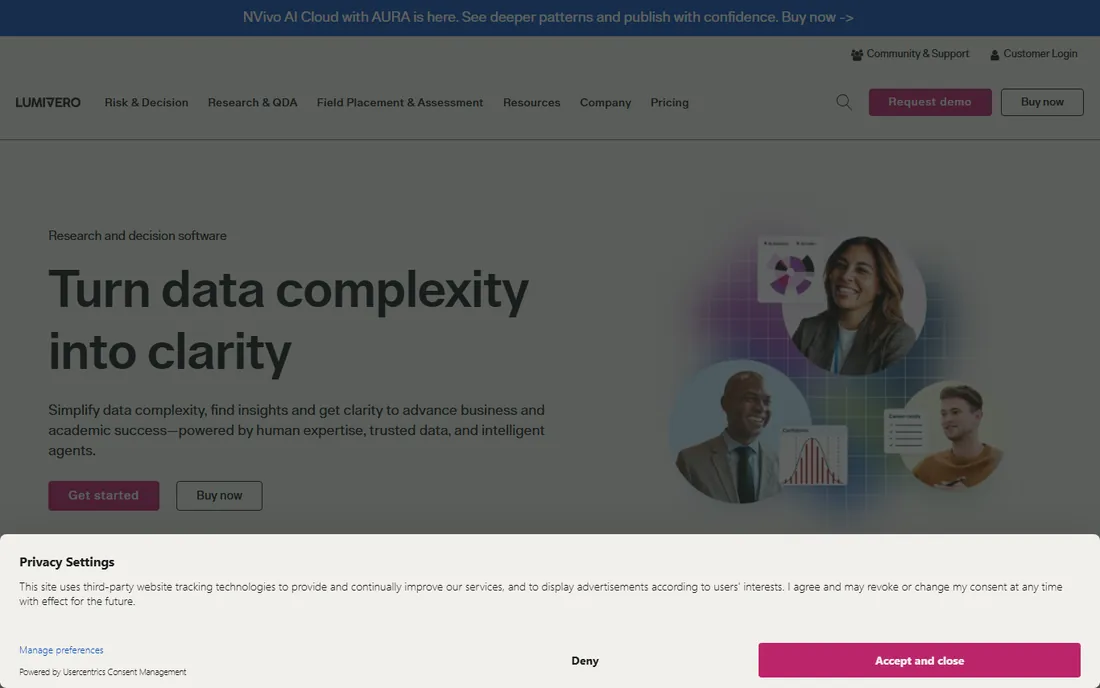
NVivo is the most cited qualitative analysis software in academia for a reason: it codes and queries virtually any data type, from interview transcripts to social media to video, with matrix coding, framework analysis and visualization tools that support rigorous methodologies. Version 15 added a Lumivero AI Assistant for faster exploration.
Standard licenses cost far more than the $130 student rate, the interface overwhelms newcomers, and large projects demand a strong computer. It is the safe choice for dissertations and funded research where the supervisor expects NVivo, and overkill for simple thematic coding.
Setup is a standard desktop install on Windows or Mac, and most researchers are coding within a day if they follow the built-in tutorials. Team coding runs through NVivo Collaboration Cloud, a paid add-on, or by merging project files, which gets messy past two or three coders. It imports from Word, PDF, audio, video and survey platforms, and exports coded data to SPSS or Excel. Lumivero's support portal and video library are genuinely good, though live support hours vary by region, so check before a deadline week.
What we like- Deepest feature set
- Handles text, audio, video and images
- AI Assistant in version 15
Watch out for- Expensive at standard rates
- Steep learning curve
- Resource-heavy
Starting price$45 per user/month
Free planFree trial
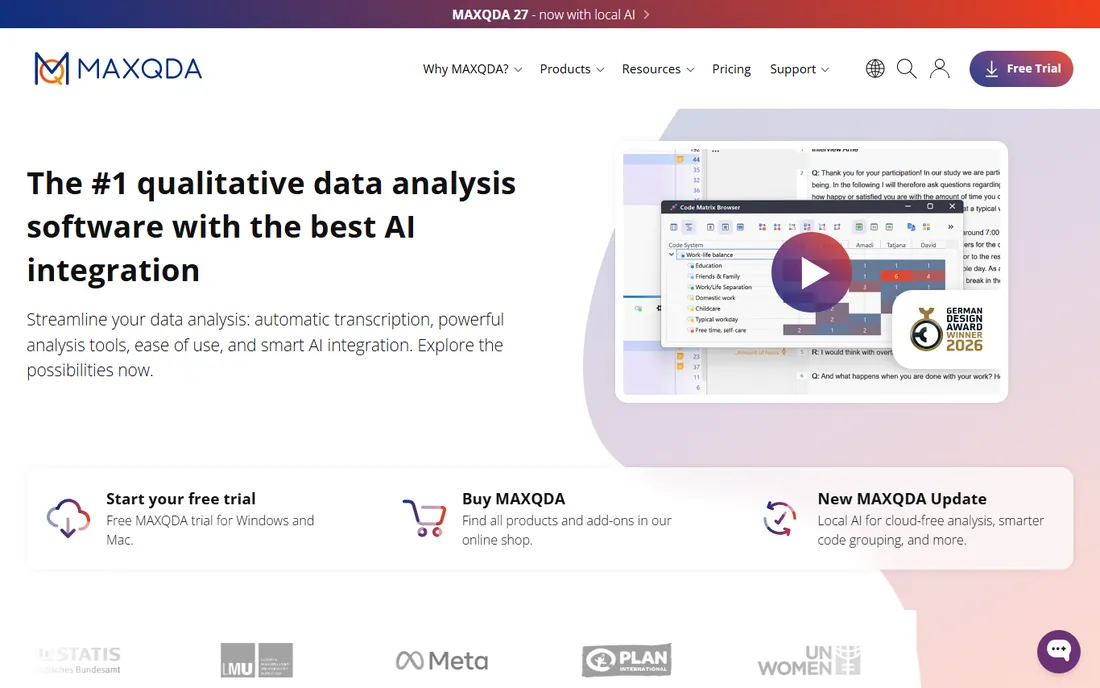
MAXQDA balances power and usability better than its rivals: full coding, transcription, visualization and stats integration in an interface that new researchers actually learn. It is the only leading QDA tool identical on Windows and Mac, and its mixed-methods features bridge qualitative and quantitative work.
Student licenses run about $114 a year, but standard pricing at $45 a user a month adds up for teams. For researchers who want NVivo-class depth without NVivo-class complexity, MAXQDA is the sweet spot.
Installation is a single download on Windows or Mac, and the interface is identical on both, which removes a common team headache. The free MAXQDA Reader lets supervisors or clients review a project without a license, and TeamCloud handles multi-coder projects for a separate fee. Data moves cleanly to and from SPSS, Excel and R, which mixed-methods researchers rely on. Support is a strong point: free webinars, detailed manuals, and email support that users consistently rate well.
What we like- Powerful yet approachable
- Identical on Windows and Mac
- Strong mixed-methods tools
Watch out for- Prices have risen
- Subscription model for most licenses
Starting price$142 per year (student license)
Free planFree trial
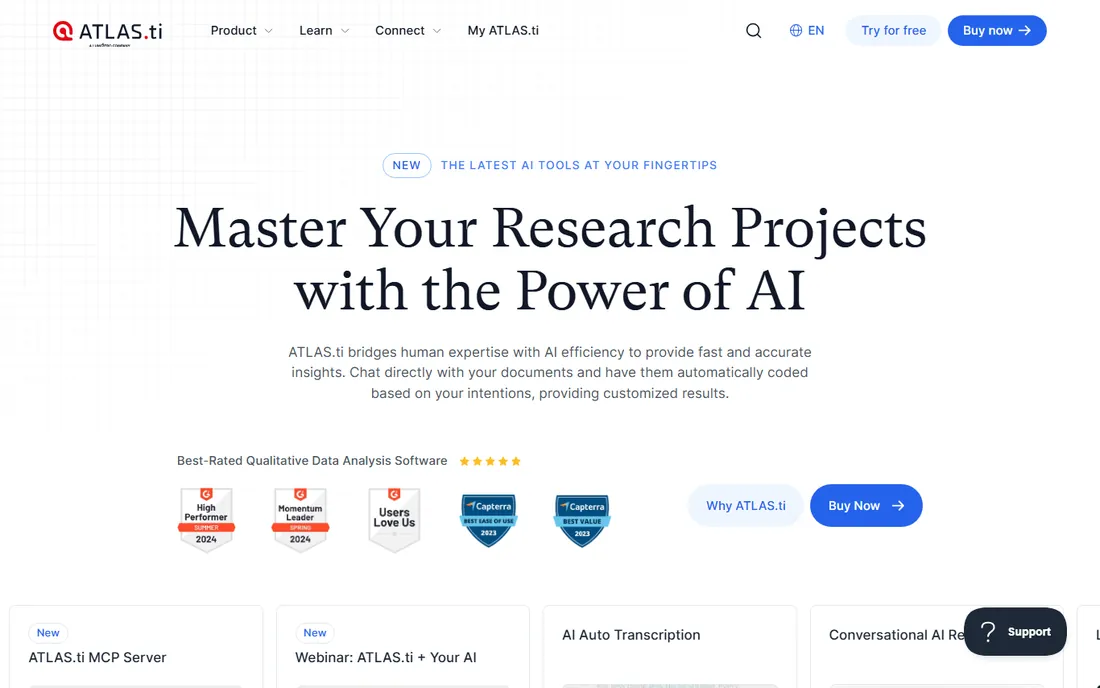
ATLAS.ti has pushed hardest on AI-assisted coding, using machine learning to suggest codes and surface themes faster than manual coding alone. Network views visualize relationships between codes elegantly, and the choice of cloud or desktop suits different workflows.
The Lumivero acquisition brought price increases, with student licenses around $142 a year and standard rates much higher. Researchers invested in its workflow have little reason to leave, but new buyers should compare total cost against MAXQDA and Quirkos.
You can work in the desktop app or the web version, and projects move between the two, which suits researchers who switch machines. AI coding is credit-based on some plans, so check what your license includes before assuming it is unlimited. Integrations cover survey tools, reference managers and SPSS. Support reports have been mixed since the Lumivero acquisition, with some users noting slower ticket responses; the tutorial library and community forum remain useful.
What we like- Strong AI coding assistance
- Good network visualizations
- Cloud and desktop options
Watch out for- Now owned by Lumivero
- Prices up significantly
- Standard licenses are pricey
Starting price$6 per month
Free planFree trial
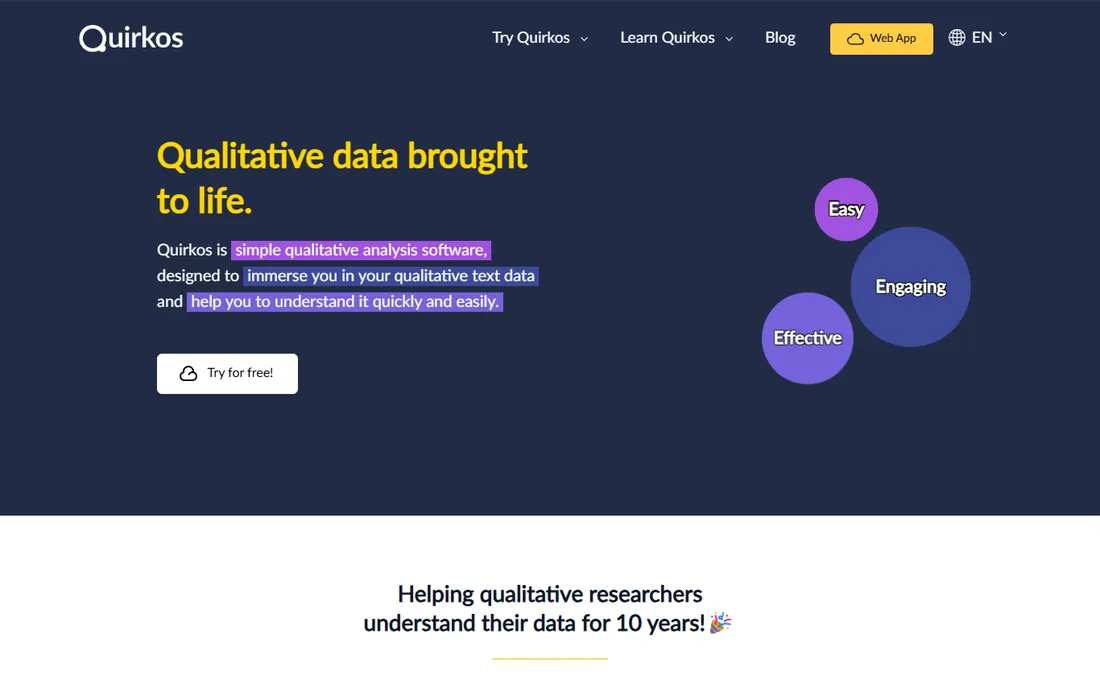
Quirkos is the deliberately simple alternative: a visual, colorful interface where coding feels intuitive rather than technical. At $6 a month, or $69 for a lifetime offline license, it costs a fraction of the big names while handling thematic analysis perfectly well.
It will not do the advanced matrix queries or mixed-methods statistics of NVivo. For students, small teams and anyone doing straightforward thematic coding, that simplicity is the point, not a limitation.
Setup takes minutes: download, install, start coding, with an interface that needs almost no training. It is offline-first, which ethics boards like, and one license covers a single researcher; teams share projects through Quirkos Cloud, priced separately. There are no AI features and no statistics integrations, so do not expect it to replace NVivo on a mixed-methods project. Support is small and personal, with the founder answering many tickets himself, and the video tutorials cover the whole workflow.
What we like- Extremely easy to learn
- Visual bubble interface
- $69 lifetime license available
Watch out for- Less depth for complex queries
- Smaller feature set than the big three
Starting price$13 per month
Free planFree trial
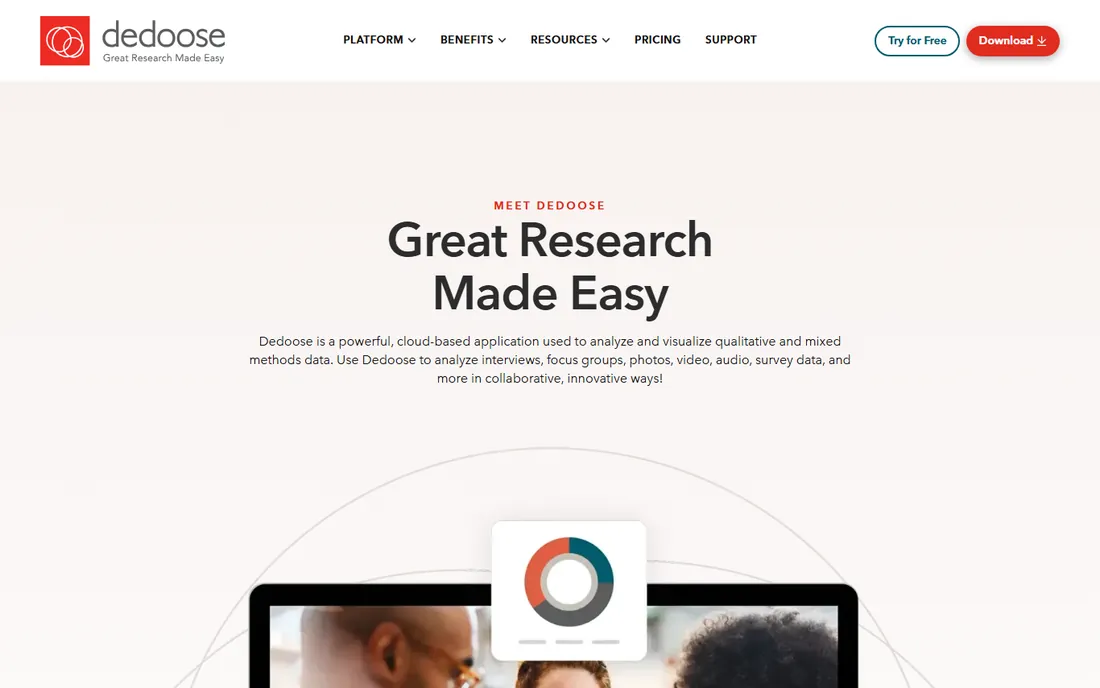
Dedoose pioneered affordable cloud-based qualitative analysis: around $13 a month gets you collaborative coding, excerpt management and basic quantitative integration, with nothing to install. Distributed research teams can code the same project simultaneously from anywhere.
Being web-based, it needs a connection and can feel slower than desktop tools on very large datasets. For collaborative projects on a budget, especially in education and nonprofits, the value is excellent.
There is nothing to install; you log in, create a project, and invite collaborators by email with role-based access. Pricing looks small per month, but a year-long multi-coder project adds up, so compare it against a student or team license for a desktop tool. All data lives on Dedoose servers, which some ethics boards question, so check your institution's data policy before importing sensitive interviews. Support is email-based with a solid knowledge base, and the team answers methodology questions, not just technical ones.
What we like- True cloud collaboration
- Affordable monthly pricing
- Good for mixed methods
Watch out for- Internet-dependent
- Less powerful than desktop tools for huge projects
Starting price$18 per month
Free planFree trial
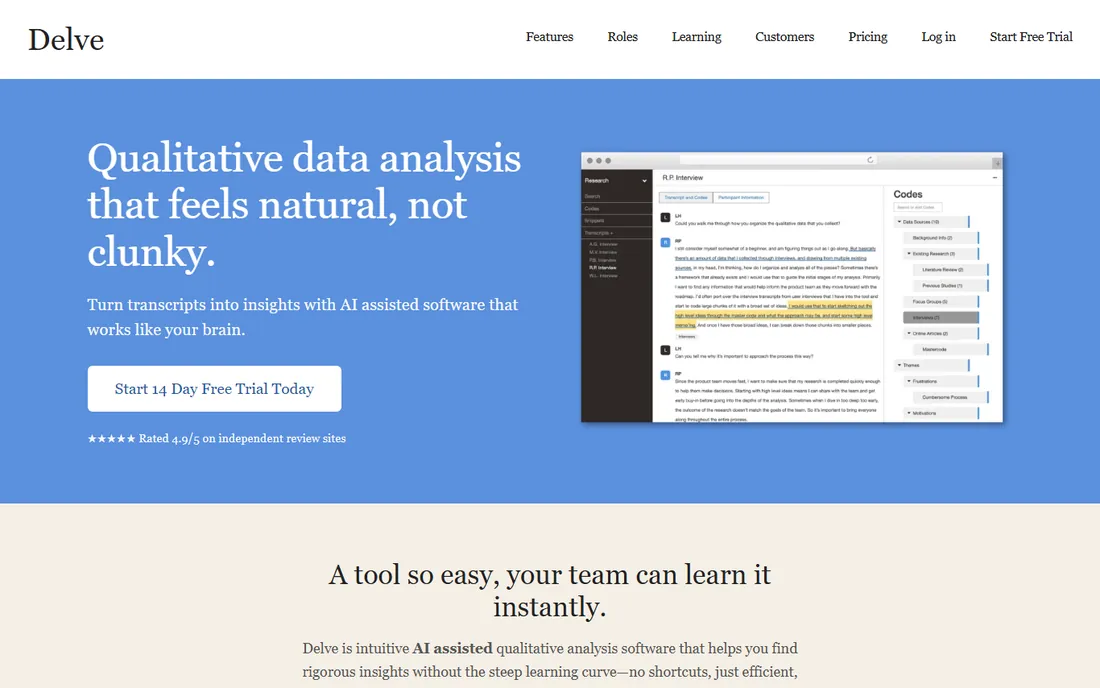
Delve offers a modern, streamlined take on cloud qualitative coding at around $18 a month: clean design, quick onboarding, and collaboration features that feel current rather than academic. Teams that bounced off NVivo's complexity often land here.
The feature set is narrower than the established players, and the long-term track record is shorter. For straightforward collaborative coding with minimal training time, it is a refreshing option.
Signup is instant and the onboarding walkthrough gets you coding sample data within minutes. Team plans add shared codebooks and inter-coder agreement checks, which is the main reason teams upgrade. Limits are real: no desktop app, no advanced queries, and far fewer integrations than the big three. Pricing stays simple with monthly and annual tiers and no seat surprises. Support comes from a small team over email and in-app chat; responses are friendly but the documentation is thinner than NVivo's.
What we like- Clean modern interface
- Fast to learn
- Good collaboration
Watch out for- Newer with a smaller track record
- Fewer advanced analysis features
Starting priceFree
Free planYes
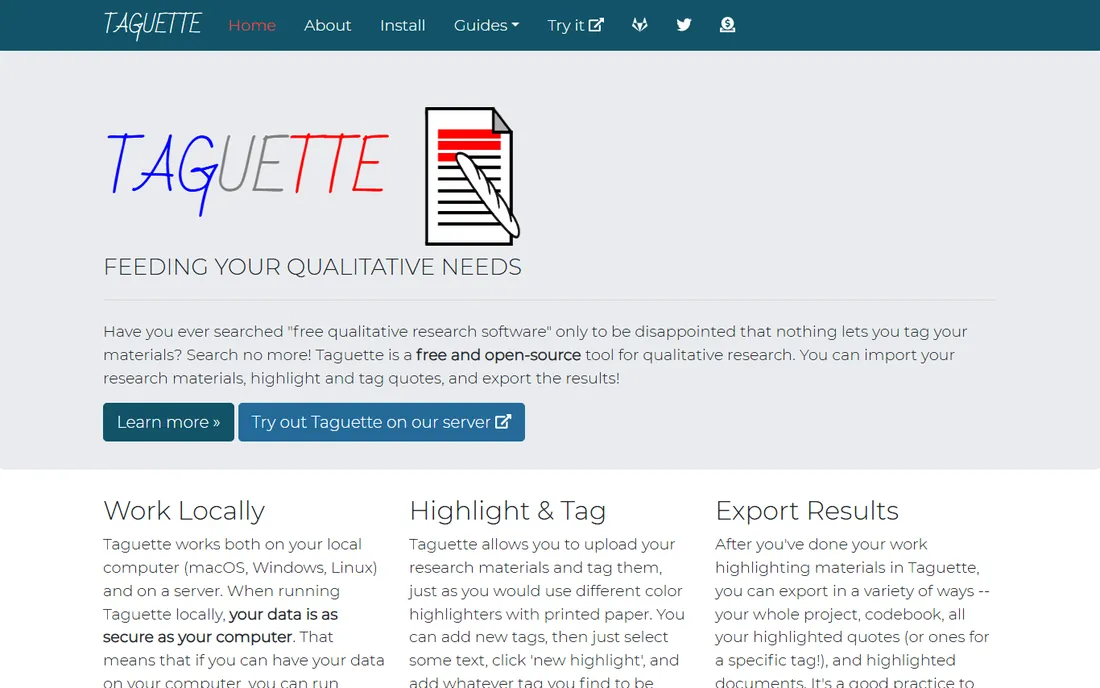
Taguette is the free, open-source qualitative coding tool: import documents, highlight and code excerpts, export your work. It covers the core coding workflow at zero cost, and you can self-host it for full data control.
Expect basic features only: no AI assistance, no advanced queries, no multimedia coding depth. For students, pilot studies and anyone who needs free coding without compromise on data ownership, it does the essential job.
You can use the hosted version for free or self-host on your own server for total data control. Self-hosting needs basic server comfort; the hosted route needs none. User management is minimal and there is no conflict resolution for simultaneous coders, so it suits solo researchers best. Support is community-driven through GitHub and the documentation, which means solving odd problems yourself. Development moves slowly, so treat Taguette as a stable simple tool rather than a growing platform.
What we like- Completely free and open source
- Simple coding workflow
- Self-hostable
Watch out for- Basic features
- Small development community
Starting priceFree
Free planYes
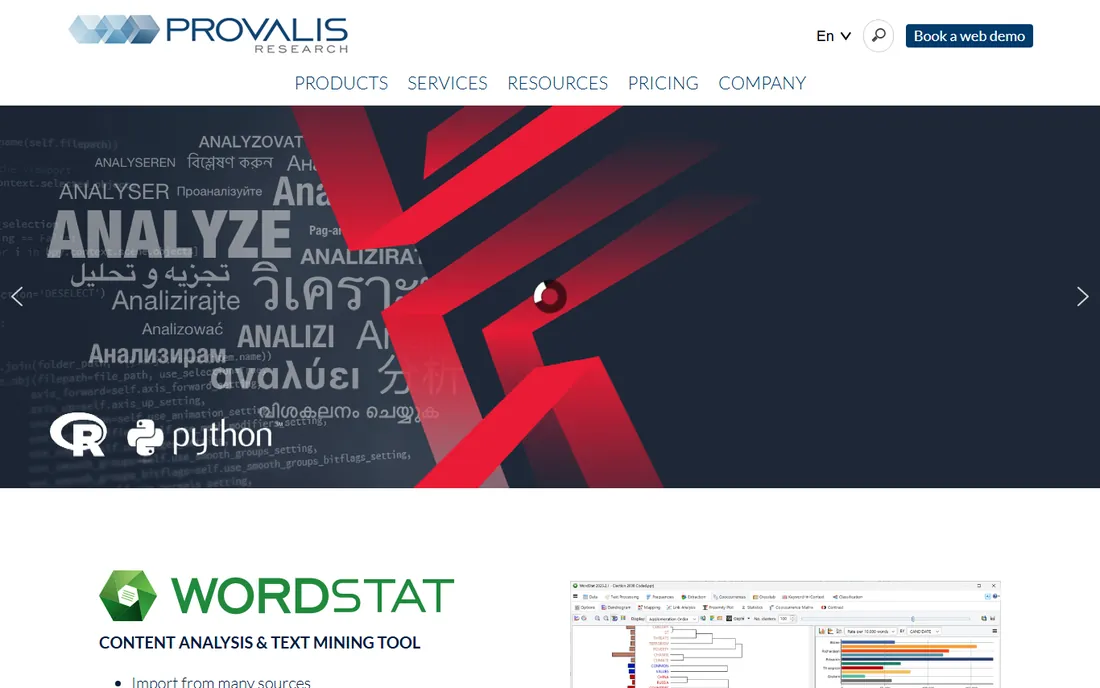
QDA Miner Lite is the free edition of Provalis Research's commercial QDA Miner: real qualitative coding, document management and basic analysis at no cost. It serves as both a usable free tool and a trial of the full platform's approach.
The Lite limits push serious projects toward the paid version, and it is Windows-centric. For researchers who may later need the full QDA Miner with WordStat text mining, starting free here is sensible.
The Windows installer is quick and the interface feels familiar to anyone who has used a desktop analysis tool. Caps apply: fewer documents, cases and variables than the paid version, which is the nudge toward upgrading. The upgrade path is the real selling point: projects open directly in full QDA Miner, and the WordStat and SimStat add-ons turn it into a serious text-mining suite. Support comes through Provalis documentation and email, with Lite users leaning mostly on the docs.
What we like- Free version of a respected commercial tool
- Solid coding basics
- Upgrade path to full QDA Miner
Watch out for- Lite version is feature-limited
- Windows-focused
Grounded theory with complex queries points to NVivo or MAXQDA. Straightforward thematic analysis is served perfectly by Quirkos or Delve. Collaborative team projects favor Dedoose or Delve. Tight budgets point to Taguette or QDA Miner Lite. The methodology determines the tool, not the other way around.
Also weigh who else touches the project. If a supervisor or funder expects NVivo, fighting that expectation costs more than the license. For sensitive data, prefer offline tools like NVivo, MAXQDA or Quirkos over cloud options, and confirm your ethics board's rules first. When torn between two finalists, code the same ten excerpts in both trials; the one that feels less like work is the one you will actually finish the project in.
How we chose
We compared the qualitative coding tools most used in academic and applied research in 2026, verifying pricing against vendor pages and current cost comparisons. We weighted coding depth, usability, collaboration and value. We did not code test datasets in each tool.
Frequently asked questions
What is qualitative coding software?
Software that helps researchers analyze non-numerical data, interview transcripts, open survey responses, field notes, by tagging segments with codes, finding patterns, and building themes, instead of doing it all manually in documents. The payoff is traceability: every theme links back to the exact quotes that support it, which makes your analysis defensible in peer review and easier to revise when your thinking changes.
Do I need special software for thematic analysis?
Not strictly; many researchers code in Word or spreadsheets. Dedicated software pays off with larger datasets, team collaboration, audit trails and complex queries. For a handful of interviews, manual methods work fine. The tipping point is usually around 10 to 15 interviews, or the moment a second coder joins; past that, manual color-coding becomes the slow and error-prone option.
Which is better, NVivo or MAXQDA?
NVivo offers the deepest feature set and is the most expected in academia. MAXQDA is more approachable with comparable power for most projects and better Mac support. Compare student pricing and try both trials before deciding. Methodology fit matters too: NVivo's query tools suit complex designs, while MAXQDA's mixed-methods features suit projects that blend survey statistics with interview data.
Are there free options for students?
Yes: Taguette and QDA Miner Lite are free outright, Quirkos costs $6 a month with a $69 lifetime option, and all major vendors offer heavily discounted student licenses. Verify your student status through your university email or campus IT; the discounts typically run 70 to 90 percent off standard pricing and sometimes include the AI add-ons.
Can these tools transcribe interviews?
NVivo and MAXQDA include transcription features, sometimes with extra credit costs. Many researchers transcribe separately with dedicated services and import the transcripts for coding. Check transcription pricing per hour of audio before committing; for long interview sets, a separate service is often cheaper and more accurate than the built-in option.
Sources we checked (8)
- https://www.lumivero.com/
- https://www.maxqda.com/
- https://www.atlasti.com/
- https://www.quirkos.com/
- https://www.dedoose.com/
- https://www.delvetool.com/
- https://www.taguette.org/
- https://www.provalisresearch.com/
Is your product missing or out of date?
We review this list regularly. Vendors can request a listing, send updated pricing or ask about featured placement.

Shihab Mia · Founder, Rankite
Shihab has spent more than a decade helping SaaS and e-commerce brands grow through search. He writes Rankite's software buying guides from pricing pages, documentation and public user reviews. More about Shihab.