How we make this list: we compare pricing pages, product documentation and public user reviews. Rankite is independent; if a vendor ever pays for a featured spot, that listing is clearly labeled Partner.
What to look for in push notification software
Before the list, it helps to know what separates the options. The first question is API versus dashboard. If your product team runs campaigns, you want a visual composer, audience segments and scheduling. If engineers own messaging, you want clean SDKs, webhooks and predictable APIs. Many tools try to serve both, but each one leans somewhere.
Second, check how delivery works under the hood. On mobile, every serious platform sends through APNs and FCM anyway, so the differentiators are token management, delivery receipts and retry logic. A good platform handles expired tokens and bounces quietly instead of making you write that cleanup code.
Third, think about scale and pricing model. Most vendors charge by monthly active users, subscribers or message volume, and the free tiers vary wildly. A side project with 5,000 users might pay nothing on one platform and real money on another. Map your growth curve to the pricing tiers before you commit, because migrating push providers later is painful.
Fourth, look at what else comes in the box. Some tools are push-only, which keeps things simple. Others add email, SMS, in-app messages and analytics. Bundles save integration time but cost more and take longer to learn. Pick the smallest surface that covers your roadmap for the next year.
Finally, read the docs before you sign anything. Developer experience is the whole point of this category, and you can judge it fast: how long does the quickstart take, are the SDKs current, and do the API references answer real questions. If the docs feel thin, support will feel thinner.
The 8 best push notification software for developers

#1
OneSignal
Best for: developers and startups that want multichannel messaging without enterprise contracts
Visit onesignal.com
Starting priceFree $0 per month (up to 1,000 MAU); Growth from $19 per month
Free planYes
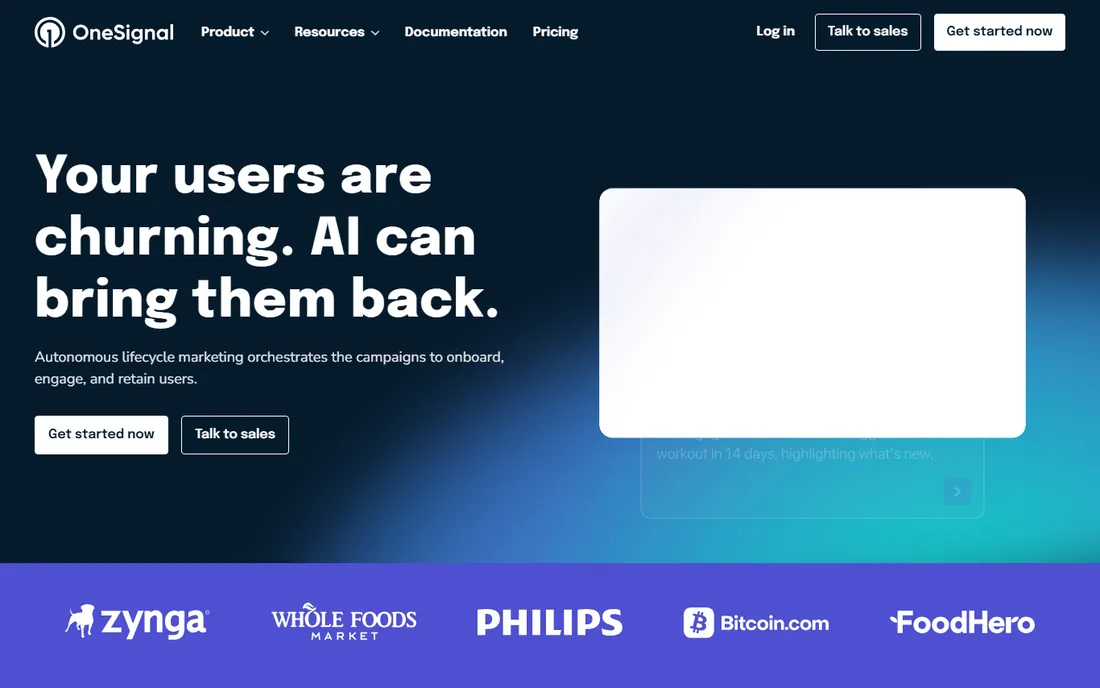
OneSignal is the default pick for a reason. It gives developers a genuinely useful free tier, SDKs for iOS, Android, web, Flutter, React Native and Unity, and a dashboard your product team can use without asking engineering for help. You can send push, email, in-app messages and SMS from the same audience, which means one integration covers most messaging needs for a young product.
The free plan covers up to 1,000 monthly active users, which is enough to launch and find product-market fit before spending anything. Paid plans start at $19 per month for Growth and scale with MAU, so costs stay proportional to traction. The API is well documented and the segmentation engine is stronger than most free-tier tools offer. Where OneSignal loses ground is at the top end: the most advanced analytics, data export and personalization features sit on the higher plans, and very large senders sometimes outgrow it. For indie developers, startups and small teams, it remains the best balance of power and price in this list.
What we like- Generous free tier
- SDKs for every major platform
- Email, in-app and SMS in one place
- Strong documentation
Watch out for- Pricing scales with MAU
- Advanced features are gated to higher tiers

#2
Firebase Cloud Messaging
Best for: Android and cross-platform apps already built on Google services
Visit firebase.google.com
Starting priceFree
Free planYes
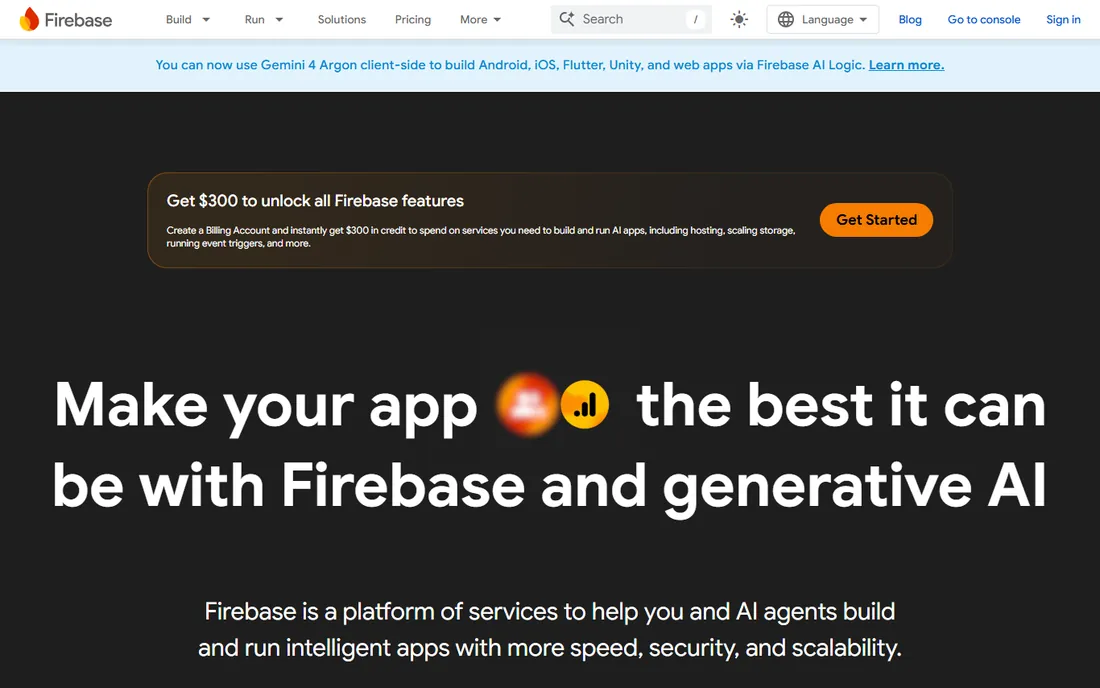
Firebase Cloud Messaging is the plumbing underneath much of the mobile world, and Google does not charge for it. If your app already uses Firebase for auth, databases or crash reporting, FCM is the path of least resistance: one console, one set of credentials, and messaging that scales from your first user to millions without a pricing conversation.
The trade is that FCM is infrastructure, not a product. You get message delivery and topic subscriptions, but campaign scheduling, rich segmentation and engagement analytics live elsewhere. The Firebase console covers simple sends, and anything fancier means building it yourself or pairing FCM with another tool. iOS support works fine but needs more setup than Android, since you are bridging APNs through Google's service. For developers who want free, reliable delivery and are comfortable building their own campaign layer, nothing beats the price.
What we like- Completely free with no message caps
- Deep Android integration
- Connects to the wider Firebase suite
Watch out for- Minimal campaign tooling
- Basic analytics compared with dedicated platforms
- IOS setup takes more work

#3
Pusher Beams
Best for: developers who want a clean push API without marketing-suite baggage
Visit pusher.com
Starting priceSee website
Free planYes
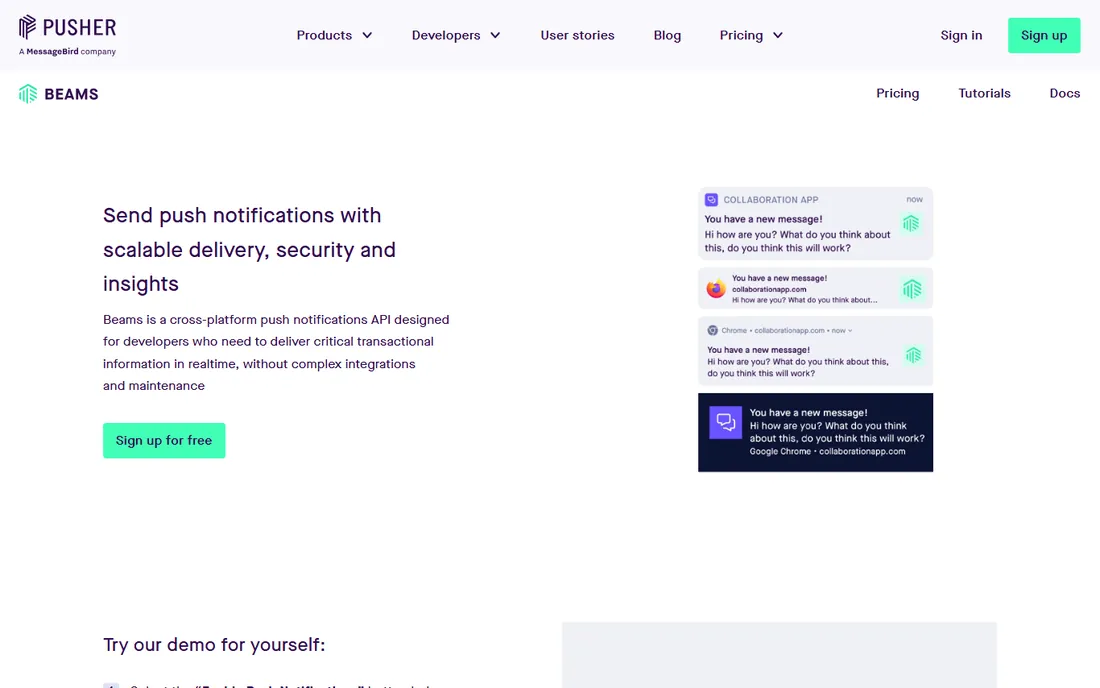
Pusher Beams takes the opposite approach from the marketing-heavy platforms. It is a push notifications API, full stop. You publish to interests or users, the service handles device interests and delivery, and your code stays in charge of everything else. The free sandbox covers up to 1,000 subscribers, which is plenty for development, staging and small launches.
This narrow focus is the selling point. If you already have your own segmentation logic, your own analytics and your own scheduling, Beams gives you reliable delivery without dragging in a dashboard your team will never open. It pairs naturally with Pusher Channels for realtime features, so apps with live data plus push get both from one vendor. The downside is exactly what you would expect: there is no campaign composer, no journey builder and no marketer-friendly analytics. Teams that want product and marketing to share one tool should look at OneSignal or Braze instead.
What we like- Simple developer-first API
- Generous free sandbox
- Sits inside the Pusher realtime family
Watch out for- No built-in campaign or audience tooling
- Smaller feature set than full engagement platforms

#4
Ably
Best for: realtime apps that need push alongside live data streams
Visit ably.com
Starting priceSee website
Free planYes
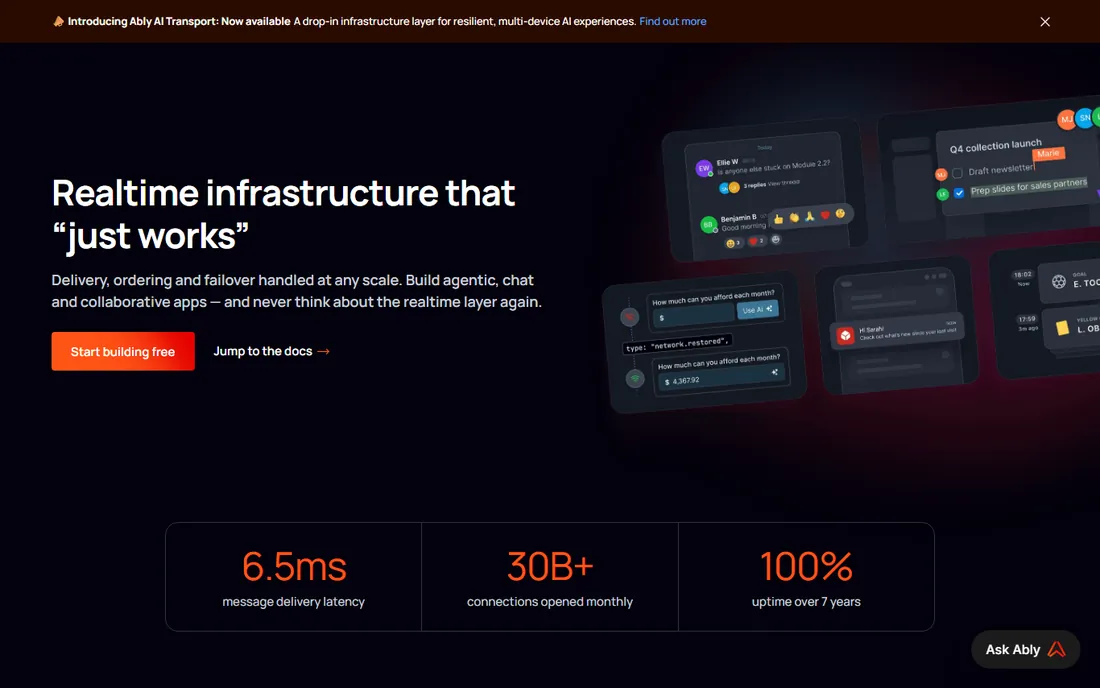
Ably is a realtime messaging platform first, and push notifications ride on top of the same infrastructure. If your app already streams live scores, chat messages, location updates or trading data through Ably, adding push means one SDK, one connection model and one bill instead of a second vendor. The free tier includes 6 million messages per month and 200 concurrent connections, which covers a surprising amount of real usage.
Delivery goes through native push when the app is in the background and realtime channels when it is in the foreground, which is a genuinely good architecture for live apps. Ably also publishes serious reliability numbers and fallback behavior, the kind of thing that matters when messages are time-sensitive. The honest limitation is that push is not the star of the show here. You will not find campaign templates, marketer dashboards or lifecycle journeys. Ably fits engineering-led teams building realtime products; marketing-led teams should shortlist the engagement platforms below.
What we like- Realtime pub/sub plus push in one platform
- Generous free tier
- Strong reliability story
Watch out for- Push is one feature among many
- Campaign tooling is not the focus
#5
Pushwoosh
Best for: teams that want omnichannel messaging with web push and in-app
Visit pushwoosh.com
Starting priceSee website
Free planNo
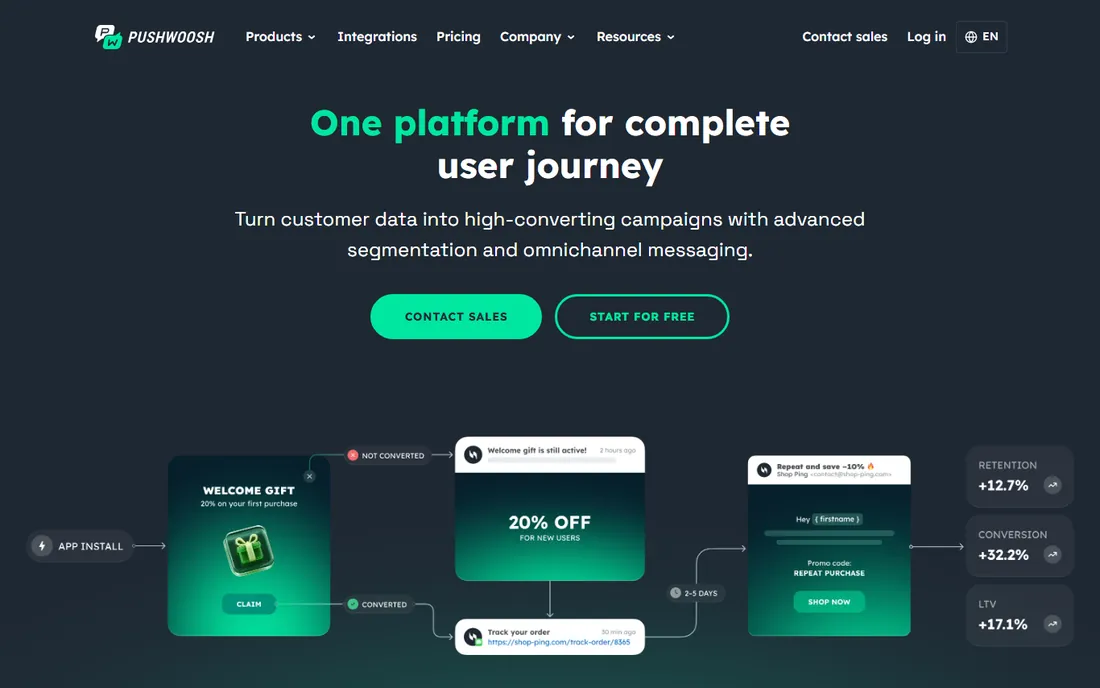
Pushwoosh has been in this space for over a decade, and it shows in the channel list: mobile push, web push, email, SMS, in-app messages and even WhatsApp in some plans. The visual journey builder lets non-developers string together multi-step campaigns with delays, conditions and A/B splits, which is more marketing power than the API-first tools offer.
Segmentation is flexible, with device properties, events and behavioral filters, and the platform handles the usual token housekeeping. The rough edges are real, though. The interface has not aged gracefully next to newer competitors, and pricing gets murky once you move past the starter tiers, which makes budgeting harder than it should be. Pushwoosh suits mid-size teams that need several channels in one contract and do not mind a learning curve on the UI. Pure developers may find the API-first options cleaner to work with.
What we like- Wide channel coverage
- Visual journey builder
- Solid segmentation
Watch out for- Interface feels dated
- Pricing is opaque at larger volumes

#6
Airship
Best for: enterprises running complex, high-volume messaging programs
Visit airship.com
Starting priceSee website
Free planNo
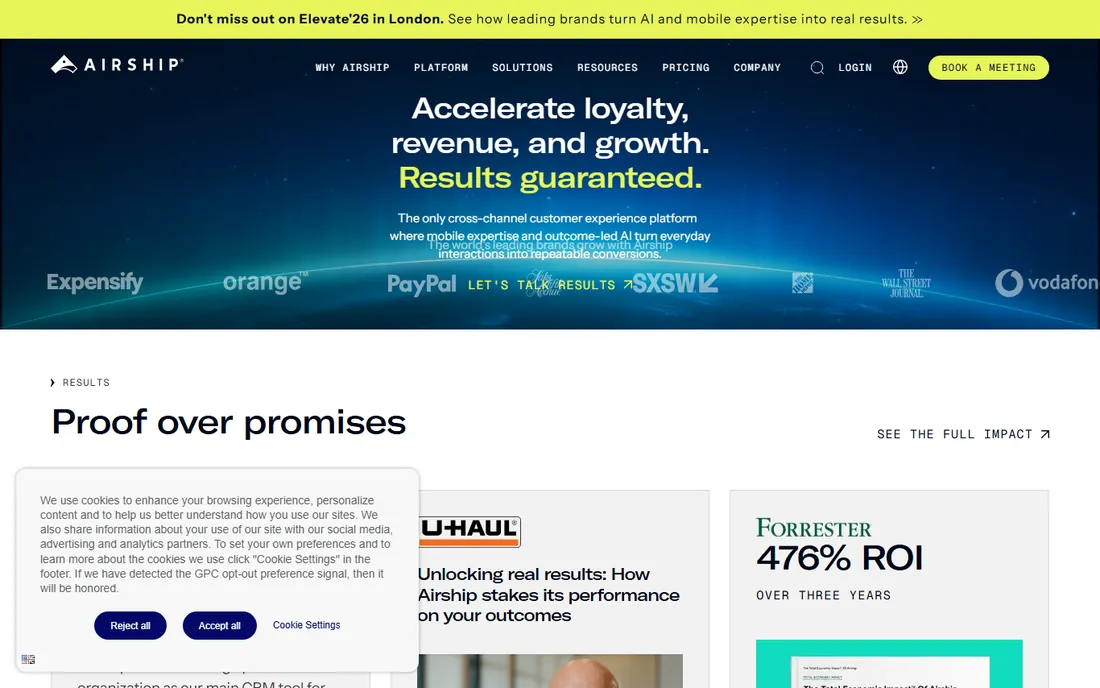
Airship, formerly Urban Airship, is the veteran enterprise pick. It handles push, in-app, SMS, email and mobile wallet at serious scale, with journey orchestration that covers branching logic, predictive send-time optimization and cross-channel coordination. Big brands with millions of users and dedicated lifecycle teams are the core audience, and the platform is built for their compliance, security and approval workflows.
That enterprise focus cuts both ways. Pricing is quote-based and sits well above the self-serve tools on this list, and onboarding runs through a sales process rather than a signup form. Small teams will drown in features they will never touch. But if you are choosing infrastructure for a large consumer app with strict governance needs, Airship's depth and support are hard to match. Everyone else should start cheaper and upgrade only when the complexity is real.
What we like- Deep journey orchestration
- Strong enterprise support
- Long track record as Urban Airship
Watch out for- Enterprise pricing and sales process
- Overkill for small apps

#7
Braze
Best for: product and growth teams running full lifecycle campaigns
Visit braze.com
Starting priceSee website
Free planNo
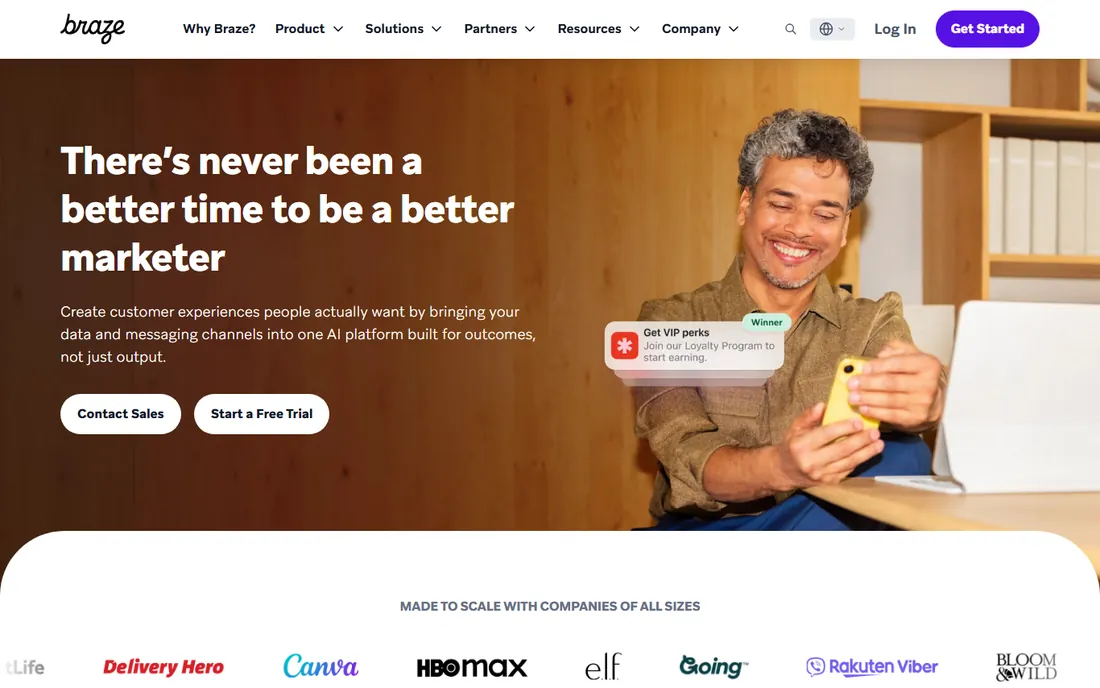
Braze is where push becomes one instrument in a full customer engagement orchestra. Its Canvas journey builder, Liquid personalization and experimentation framework are the best in this category, and the data ingestion is built for streaming event data from your app in real time. Growth teams at large consumer brands use it to run onboarding flows, win-back campaigns and personalized promotions across push, email, in-app and SMS from one canvas.
The catch is commitment. Braze pricing is enterprise-grade and quote-based, and a proper implementation takes weeks of engineering time for SDK integration, event taxonomy and data plumbing. This is not a tool you adopt casually. For funded startups and scale-ups with a dedicated growth function, the payoff is real: messaging that reacts to user behavior within seconds. For everyone else, the cost and complexity will outweigh the benefits.
What we like- Best-in-class segmentation and personalization
- Strong experimentation tools
- Unifies push with email and in-app
Watch out for- Significant cost
- Implementation takes real effort

#8
CleverTap
Best for: mobile-first teams focused on retention and engagement analytics
Visit clevertap.com
Starting priceSee website
Free planNo
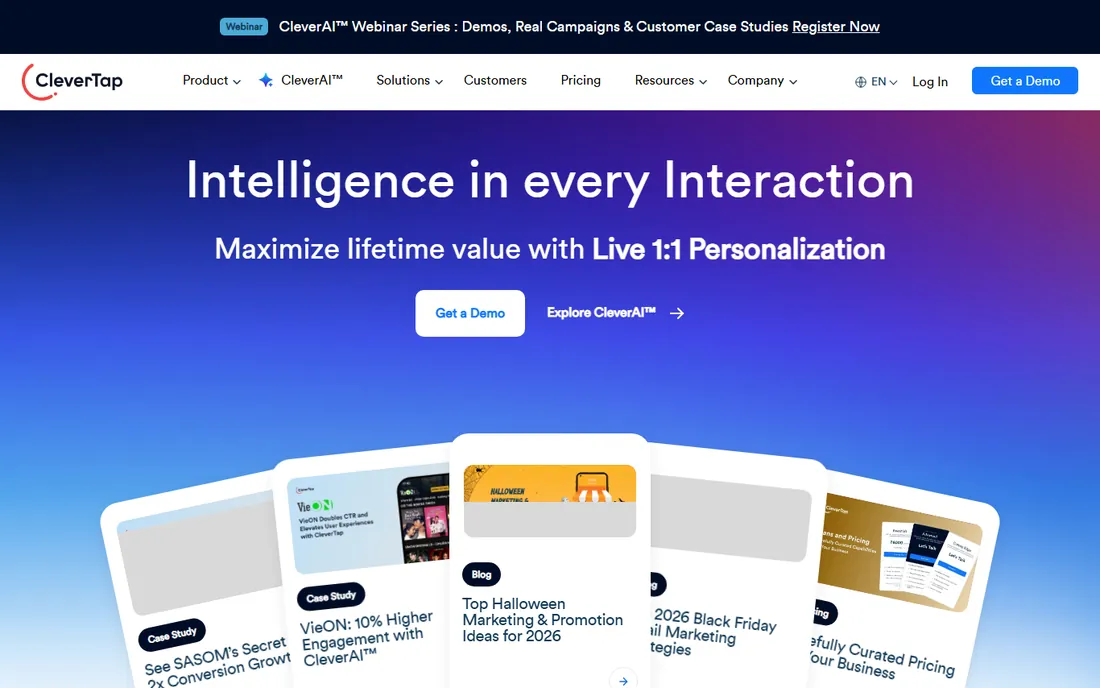
CleverTap positions itself as an all-in-one engagement and retention platform, and its analytics are the standout. Cohort analysis, funnels, uninstall tracking and RFM segmentation come built in, so growth teams can find the leaky bucket and then message the users falling through it without switching tools. Push, in-app, email and SMS campaigns run from the same audience definitions.
The platform is especially popular with consumer mobile apps in e-commerce, fintech and media, where retention math decides the business. Automation covers the standard lifecycle plays: onboarding drips, cart abandonment, re-engagement and win-back. On the downside, pricing is quote-based and the platform's breadth means setup takes real configuration work. Teams that mainly need simple push delivery will find it heavy. Teams that live in retention metrics will feel at home.
What we like- Strong analytics and cohort tools
- Good automation
- Popular with consumer apps
Watch out for- Pricing is quote-based
- Configuration can get complex
Quick comparison
| Tool | Best for | Starting price | Free plan |
|---|
| OneSignal | developers and startups that want multichannel messaging without enterprise contracts | Free $0 per month (up to 1,000 MAU); Growth from $19 per month | Yes |
| Firebase Cloud Messaging | Android and cross-platform apps already built on Google services | Free | Yes |
| Pusher Beams | developers who want a clean push API without marketing-suite baggage | See website | Yes |
| Ably | realtime apps that need push alongside live data streams | See website | Yes |
| Pushwoosh | teams that want omnichannel messaging with web push and in-app | See website | No |
| Airship | enterprises running complex, high-volume messaging programs | See website | No |
| Braze | product and growth teams running full lifecycle campaigns | See website | No |
| CleverTap | mobile-first teams focused on retention and engagement analytics | See website | No |
Is your product missing or out of date?
We review this list regularly. Vendors can request a listing, send updated pricing or ask about featured placement.
How much does push notification software cost?
The honest answer is that most developers pay nothing at first. OneSignal, Pusher Beams, Ably and Firebase Cloud Messaging all offer free tiers that cover early traction, and the free plans here are genuinely usable rather than demos with a timer. The jump to paid usually happens when MAU, subscriber counts or message volume cross a threshold, or when you need features like advanced analytics, data export or SSO.
Pricing models split three ways. API-first tools tend to charge by messages or connections, which maps cleanly to engineering budgets. Marketing platforms charge by monthly active users or profiles, which maps to growth but can surprise you as your user base grows. Enterprise platforms quote custom contracts, which buys support and SLAs at a real premium. Before committing, model your cost at 10x your current scale, because push pricing that looks cheap at 50,000 users can sting at 500,000.
How we chose
We started from the tools developers actually discuss when push comes up: G2 and Capterra reviews, Hacker News threads, Stack Overflow questions and the documentation quality of each vendor. We opened every vendor homepage to confirm the product still exists under its current name and checked pricing pages for the numbers we could verify firsthand. Anything we could not confirm on the vendor's own site is marked "See website" rather than guessed.
We favored tools with current SDKs, clear API references and transparent free tiers, since this guide is written for developers. We included both API-first services and full engagement platforms because different teams own messaging differently, and we weighted honest trade-offs over feature count. No vendor paid for placement, and none of these write-ups come from hands-on testing; they come from public documentation, pricing pages and what users report in reviews.
Frequently asked questions
Can I send push notifications for free?
Yes. Firebase Cloud Messaging is free with no message caps, and OneSignal, Pusher Beams and Ably all have free tiers that cover early-stage apps. You start paying when you outgrow the free limits or need advanced features.
Do I need a separate service, or can I use APNs and FCM directly?
You can talk to APNs and FCM directly, and many teams start there. A push service earns its keep with token management, delivery analytics, segmentation, scheduling and cross-platform abstraction. If you are building those yourself, you have already built half a push service.
What is the difference between Pusher Beams and OneSignal?
Pusher Beams is a developer API for sending push, with no campaign tooling. OneSignal is a fuller platform with a dashboard, segments, journeys and multiple channels. Pick Beams when engineers own messaging; pick OneSignal when product or marketing needs a UI.
How hard is it to switch push providers later?
Harder than it looks. Device tokens, user mappings and opt-in states live in the old system, and migration means re-registering devices and re-mapping audiences. Choose with your 18-month scale in mind, not just today's numbers.
Do these tools work for web push too?
Most of them do. OneSignal, Pushwoosh, Airship, Braze and CleverTap all support web push alongside mobile. Firebase Cloud Messaging supports web through the Firebase JS SDK, and Pusher Beams covers web as well.
Sources we checked (8)
- https://onesignal.com/
- https://firebase.google.com/
- https://pusher.com/beams
- https://ably.com/
- https://pushwoosh.com/
- https://airship.com/
- https://braze.com/
- https://clevertap.com/
Is your product missing or out of date?
We review this list regularly. Vendors can request a listing, send updated pricing or ask about featured placement.

Shihab Mia · Founder, Rankite
Shihab has spent more than a decade helping SaaS and e-commerce brands grow through search. He writes Rankite's software buying guides from pricing pages, documentation and public user reviews. More about Shihab.