How we make this list: we compare pricing pages, product documentation and public user reviews. Rankite is independent; if a vendor ever pays for a featured spot, that listing is clearly labeled Partner.
Key takeaways
- Predictive analytics tools turn historical data into forecasts: churn, demand, lead scores, risk. Most are either AutoML platforms, data science workbenches, or BI tools with forecasting bolted on.
- Teams without data scientists start with AutoML: DataRobot and H2O.ai build and deploy models with minimal coding.
- Dataiku suits organizations where data scientists, analysts and business users collaborate on the same platform.
- Alteryx and KNIME own the data preparation layer that every predictive project needs before modeling starts.
- SAS, IBM and SAP serve enterprises with governance requirements and existing stack commitments. Pricing is almost entirely quote-based.
Quick comparison
| Tool | Best for | Starting price | Free plan |
|---|
 DataRobot DataRobot | business teams that need models without data scientists | See website | No |
 H2O.ai H2O.ai | technical teams that want powerful open-source-rooted AutoML | See website | No |
 Dataiku Dataiku | organizations where data science is a team sport | See website | No |
 Alteryx Alteryx | analysts who need data prep plus predictive workflows without code | See website | No |
 KNIME KNIME | teams that want serious analytics for free | Free | Yes |
 SAS Viya SAS Viya | regulated industries needing governed, auditable modeling | See website | No |
 IBM SPSS Statistics IBM SPSS Statistics | researchers and analysts doing traditional statistical modeling | See website | No |
 SAP Analytics Cloud SAP Analytics Cloud | SAP shops that want predictive planning in their BI | See website | No |
Is your product missing or out of date?
We review this list regularly. Vendors can request a listing, send updated pricing or ask about featured placement.
#1
DataRobot
Best for: business teams that need models without data scientists
Visit datarobot.com
Starting priceSee website
Free planNo
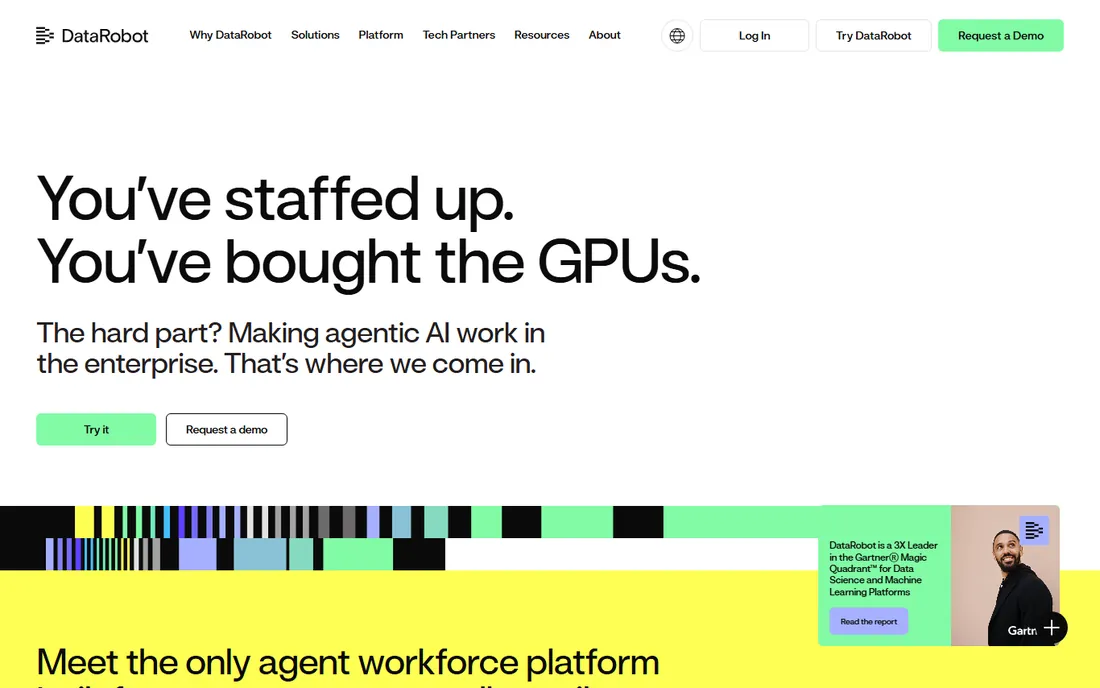
A marketing manager wants to know which trial accounts will convert, and the company has no data science team. DataRobot is built for that buyer. Upload the data, define the target, and the platform builds, compares and deploys models automatically, with monitoring once they are live. The MLOps layer handles the production part most teams forget: drift detection, retraining and governance.
Pricing is quote-based and scales with usage, which means the bill grows with success. There is no free tier. For organizations that need predictions in production without hiring a modeling team, DataRobot is the enterprise AutoML standard.
What we like- Automated model selection and deployment
- Strong MLOps
- Built for business users
Watch out for- Quote-only pricing
- Costs scale with usage
#2
H2O.ai
Best for: technical teams that want powerful open-source-rooted AutoML
Visit h2o.ai
Starting priceSee website
Free planNo
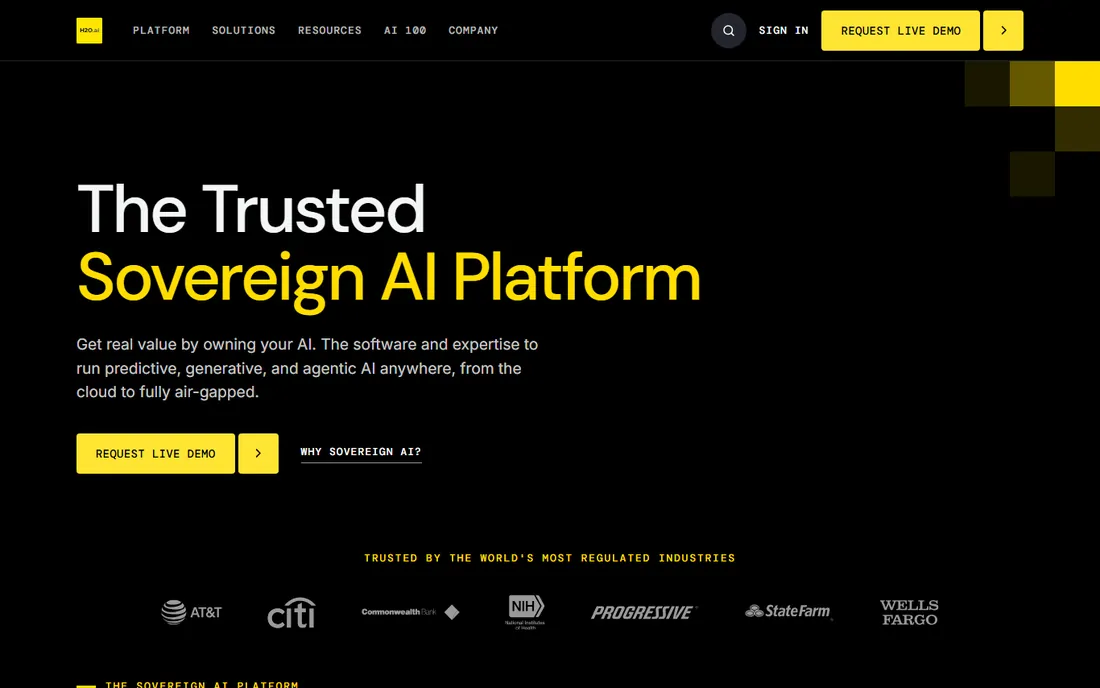
H2O.ai grew out of the open-source H2O machine learning platform, which gives it credibility with technical teams that distrust black boxes. Driverless AI automates feature engineering, model selection and tuning, and the platform scales to large datasets that choke simpler tools.
It expects more technical skill than DataRobot. Pricing is quote-based with no free tier for the enterprise platform (the open-source H2O-3 remains available). For data-savvy teams that want AutoML power with transparency, H2O.ai is the pick.
What we like- Strong open-source lineage
- Scalable AutoML
- Good for large datasets
Watch out for- Pricing behind sales
- Needs technical users to get full value
#3
Dataiku
Best for: organizations where data science is a team sport
Visit dataiku.com
Starting priceSee website
Free planNo
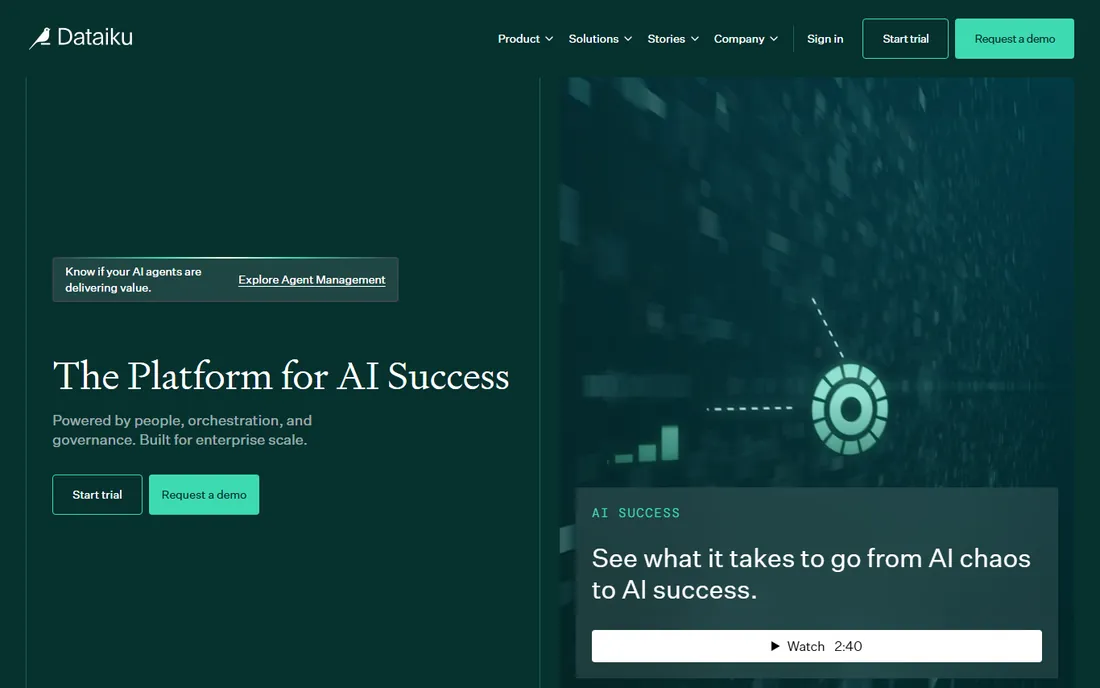
Dataiku's bet is that predictive analytics works best when data scientists, analysts and business stakeholders share one platform. Visual recipes let non-coders build pipelines; code notebooks let data scientists go deep; the same project tracks both. Model deployment and monitoring keep predictions running in production.
The collaboration strength needs governance, or projects sprawl. Pricing is quote-based with no free tier. For companies building a real data science practice rather than buying one model, Dataiku is the collaborative choice.
What we like- Visual and code workflows in one
- Strong collaboration
- Model lifecycle management
Watch out for- Quote-only pricing
- Breadth needs governance to stay tidy
#4
Alteryx
Best for: analysts who need data prep plus predictive workflows without code
Visit alteryx.com
Starting priceSee website
Free planNo
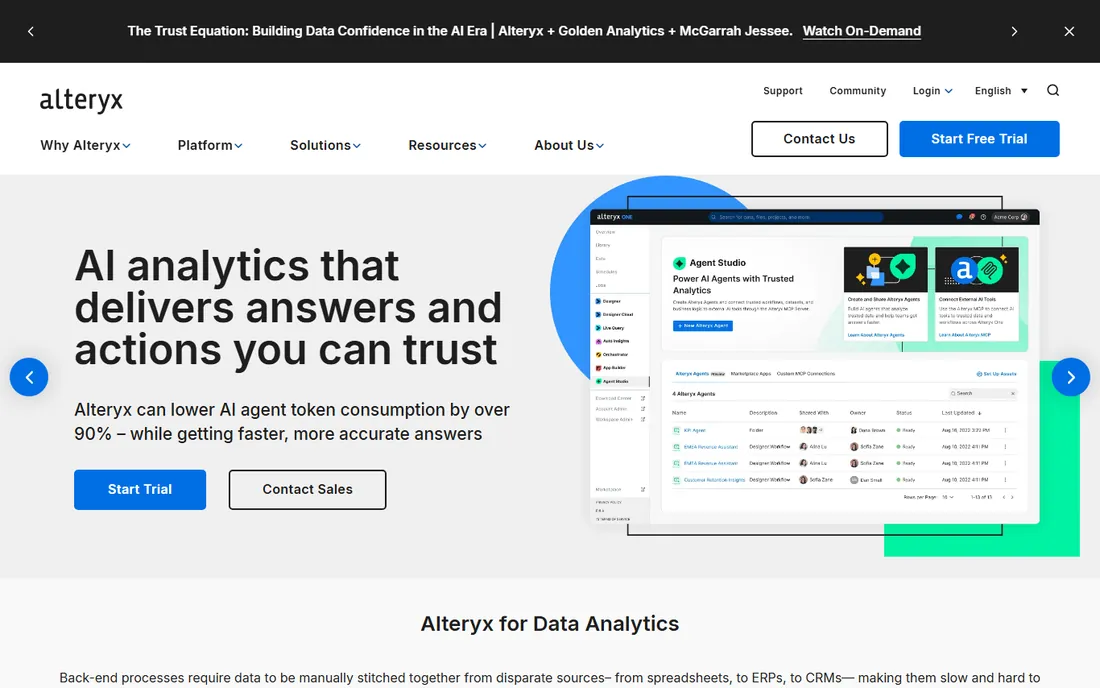
Most predictive projects die in data preparation, and Alteryx owns that layer. Its visual workflows blend, clean and transform data from dozens of sources, then run predictive models with drag-and-drop tools. Analysts who live in spreadsheets can build real pipelines without writing code.
Pricing is enterprise-grade and quote-based. The platform's breadth means training is not optional. Buy Alteryx when data preparation is the bottleneck and your analysts need to own the whole pipeline from raw data to prediction.
What we like- Best-in-class data blending
- No-code predictive tools
- Strong analyst community
Watch out for- Enterprise pricing
- The platform is broad enough to need training
#5
KNIME
Best for: teams that want serious analytics for free
Visit knime.com
Starting priceFree
Free planYes
KNIME Analytics Platform is free and open source, which makes it the zero-budget answer to predictive analytics. Visual workflows cover data prep, modeling, and deployment basics, and the extension ecosystem adds text mining, deep learning and big data connectors. For learning, prototyping and even production use at small scale, it is remarkably capable.
The free platform does not include the enterprise server features: scheduling, collaboration and deployment management cost extra. Support is community-based unless you pay. For teams with more skill than budget, KNIME is the honest starting point.
What we like- Open-source analytics platform at no cost
- Visual workflows
- Huge extension ecosystem
Watch out for- Enterprise server features cost extra
- Less hand-holding than commercial tools
#6
SAS Viya
Best for: regulated industries needing governed, auditable modeling
Visit sas.com
Starting priceSee website
Free planNo
SAS Viya is the enterprise modeling powerhouse. Advanced statistical methods, risk modeling, and forecasting run on a cloud-native platform with the governance, audit trails and model risk management that regulators demand. Banks, insurers and pharmaceutical companies standardize on it for exactly those reasons.
It is also the most expensive and complex option here, with pricing behind sales and a learning curve to match. There is no free tier. Buy SAS when the models must be defensible to a regulator, not just accurate.
What we like- Deepest statistical modeling
- Strong governance and auditability
- Trusted in finance and pharma
Watch out for- Quote-only pricing
- Complex and expensive
- Steep learning curve
#7
IBM SPSS Statistics
Best for: researchers and analysts doing traditional statistical modeling
Visit ibm.com
Starting priceSee website
Free planNo
SPSS has been the statistical workhorse for decades, and it still does regression analysis, time-series forecasting and survey analytics reliably. Researchers in healthcare, academia and government know it, trust it, and have decades of institutional knowledge built on it.
It is not where the innovation is. Modern AutoML platforms build models faster and deploy them better. Pricing is not published. Keep SPSS where the team and the workflows already exist; buy modern tools for new predictive programs.
What we like- Familiar to generations of researchers
- Strong regression and time-series tools
- Trusted in academia and healthcare
Watch out for- Pricing not published
- Feels dated next to modern AutoML
#8
SAP Analytics Cloud
Best for: SAP shops that want predictive planning in their BI
Visit sap.com
Starting priceSee website
Free planNo
SAP Analytics Cloud brings predictive capabilities to the planning and BI workflows SAP customers already run. Smart predict features generate forecasts from business data, and the native integration with SAP sources means no data plumbing. For demand planning and financial forecasting inside an SAP environment, the fit is natural.
Outside SAP, the value proposition weakens considerably. Pricing is quote-based. This is a tool for SAP-committed enterprises, not a general-purpose predictive platform.
What we like- Predictive forecasting inside planning workflows
- Native SAP data integration
- Smart insights
Watch out for- Best value inside the SAP ecosystem
- Quote-based pricing
What to check before you buy
First, verify your data foundation. Predictive models need 6 to 12 months of clean, centralized historical data with enough examples of the outcome you want to predict. Without that, no tool will help. Audit your data before you shop.
Second, match the tool to your team's skills. AutoML platforms serve business users; workbenches like Dataiku and KNIME serve mixed teams; SAS and H2O.ai serve technical users. Buying a data scientist's tool for a marketing team wastes the license.
Third, plan for production, not just modeling. Building a model is a fraction of the work. Monitoring, retraining, and governance decide whether predictions keep working. Ask every vendor how models stay accurate over time and who gets alerted when they drift.
Fourth, run a proof of concept on your own data. Vendor demos use clean datasets. Your data is messier. A two-week trial with real data exposes integration gaps, data quality problems and hidden costs before you commit.
Start with one prediction
The teams that succeed with predictive analytics start embarrassingly small: one prediction, one decision, one workflow. Which trial accounts should sales call first? Which customers are likely to churn this quarter? Which SKUs will stock out next month? One question, answered well, proves the value and teaches the organization how to work with predictions.
The teams that fail start with a platform and a mandate to "do AI." Six months later there are dashboards nobody opens and models nobody trusts. Predictions only matter when they change a decision. Tie every model to a specific action, measure whether the action worked, and expand from there. The tool choice matters far less than this discipline.
How we chose
We selected predictive analytics tools that exist today and cover real jobs: AutoML, collaborative data science, data preparation, and governed enterprise modeling. Pricing facts come from vendor pages and documentation checked in October 2026; most vendors do not publish prices, so those are listed as See website. KNIME's free open-source platform is the verified exception. Confirm live pricing with each vendor.
The hidden costs
The subscription is often the smallest line item. Connector fees, professional services for implementation, training for the team, and user seats multiply the first-year cost well beyond the license. One practitioner rule of thumb: budget two to three times the subscription for year one.
Data preparation is the other hidden cost, measured in staff time rather than dollars. Cleaning and centralizing data for modeling takes longer than every vendor estimate. Staff the data work before you buy the modeling tool, because the best platform in the world cannot model data you have not prepared.
Frequently asked questions
What are predictive analytics tools?
Software that uses historical data, statistics and machine learning to forecast future outcomes: customer churn, demand, lead conversion, equipment failure, risk scores. They range from no-code AutoML platforms to open-source workbenches to governed enterprise suites.
Do I need a data scientist to use predictive analytics tools?
Not necessarily. AutoML platforms like DataRobot and H2O.ai build models for business users. But someone on the team needs to understand the data, validate the models, and monitor them in production. The tools lower the bar; they do not remove it.
How much do predictive analytics tools cost?
Most enterprise tools use quote-based pricing. KNIME is free and open source. Budget two to three times the license for implementation, training and data preparation in year one. Get a written quote scoped to your users and data volume.
What is the difference between AutoML and a data science platform?
AutoML automates model building: upload data, get predictions. Data science platforms like Dataiku and KNIME give practitioners full control over the pipeline: data prep, feature engineering, custom modeling and deployment. AutoML is faster; platforms are more flexible.
How much data do we need for predictive analytics?
A common minimum is 6 to 12 months of clean historical data with enough examples of the outcome you want to predict. More history and more examples produce better models. Start with one well-defined use case rather than boiling the ocean.
Can BI tools do predictive analytics?
Some can, partially. Tableau, Power BI and SAP Analytics Cloud offer forecasting and automated insights. But they are BI tools with predictive features, not predictive platforms. For serious modeling with deployment and monitoring, use a dedicated tool.
Sources we checked (6)
- https://improvado.io/blog/best-predictive-analytics-tools
- https://booboone.com/9-best-predictive-analytics-tools-for-2026-my-top-picks/
- https://crm.org/news/best-predictive-analytics-tools
- https://www.guideflow.com/blog/best-predictive-analytics-software-tools
- https://codewave.com/insights/predictive-analytics-tools/
- https://8allocate.com/blog/best-ai-tools-for-data-analysis-7-types-compared/
Is your product missing or out of date?
We review this list regularly. Vendors can request a listing, send updated pricing or ask about featured placement.

Shihab Mia · Founder, Rankite
Shihab has spent more than a decade helping SaaS and e-commerce brands grow through search. He writes Rankite's software buying guides from pricing pages, documentation and public user reviews. More about Shihab.