How we make this list: we compare pricing pages, product documentation and public user reviews. Rankite is independent; if a vendor ever pays for a featured spot, that listing is clearly labeled Partner.
Key takeaways
- OpenTable ($149/month Basic) is the only one with widely published pricing; expect $1 to $1.50 per-cover fees on top.
- Tock, SevenRooms, Resy and ResDiary are quote-based; Tock's vendor-supplied tiers run $79 to $769 per month.
- Quandoo is shutting down globally (new bookings ended September 30, 2026); its restaurants need a new system now.
- The real cost question is per-cover fees versus flat rate: network-driven restaurants pay OpenTable's fees gladly, direct-booking restaurants should not.
- Contract terms deserve as much scrutiny as fees: OpenTable's one-year auto-renewing contract locks you in, so ask every vendor for the cancellation window and any early-termination fee before signing.
The shortlist
| Tool |
Best for |
Starting price |
Free plan |
| OpenTable |
Restaurants that want the biggest diner network |
$149/month (Basic) |
No |
| Tock |
Wineries, tasting rooms and experience-led venues |
See website |
No |
| SevenRooms |
Guest experience and CRM for hospitality groups |
See website |
No |
| Resy |
Trendy restaurants in major cities |
See website |
No |
| ResDiary |
High-volume restaurants needing yield control |
See website |
No |
| Eat App |
Flat-rate reservations with data ownership |
See website |
Yes |
| TableCheck |
Restaurants in Japan and Asia-Pacific |
See website |
No |
| SpotOn |
US restaurants on the SpotOn POS ecosystem |
See website |
No |
The best reservation software
Starting price$149/month (Basic)
Free planNo
OpenTable has taken restaurant reservations since 1998 and remains the default discovery platform for diners. Its published plans run Basic at $149 per month, Core at $299 and Pro at $499, plus per-cover fees of $1 to $1.50 for diners who find you through the network, and a 2% service fee on prepaid experiences added in early 2026. Phone and walk-in reservations carry no fees on any plan.
The math is the whole story: a busy restaurant can pay $20,000 to $30,000 a year once cover fees compound. If the OpenTable network fills your tables, that is money well spent. If your bookings come from Google, Instagram and your own site, you are paying network prices for your own traffic. Note the one-year auto-renewing contract with a 30-day cancellation window.
What we like- Largest diner network
- Published pricing
- Strong table management on Core and up
Watch out for- Per-cover fees scale with success
- One-year auto-renewing contract
- Guest data stays with OpenTable
Starting priceSee website
Free planNo
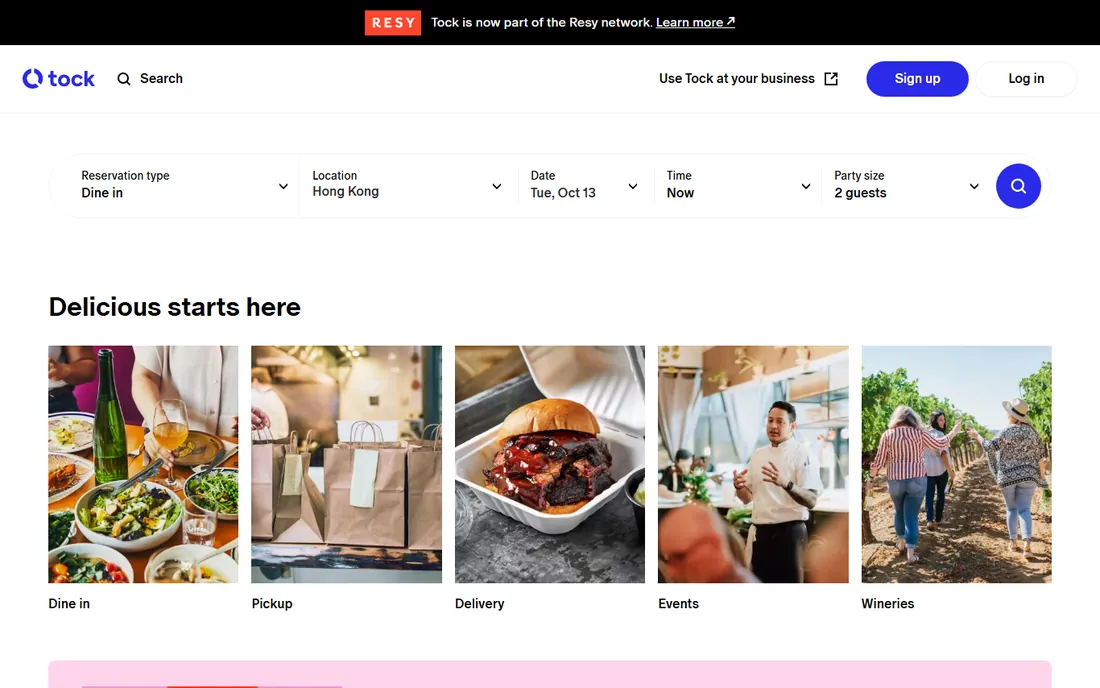
Tock carved out the experience-led corner of reservations: wineries, tasting rooms, chef's counters and prepaid events, where the booking is really a ticket sale. Vendor-supplied pricing data puts tiers at Base $79, Essential $199, Premium $339 and Premium Unlimited $769 per month, though Tock's own site does not publish these plainly, so confirm on a demo. The platform handles ticketing, prepaid experiences and table management in one.
For venues where every seat is sold in advance, Tock's experience-first design beats restaurant-first tools. For standard dinner service, the premium over simpler tools is harder to justify. Note that Tock does not offer a free trial per third-party data, so negotiate a pilot.
What we like- Built for experiences and prepaid bookings
- Strong winery and tasting room features
- Flat-rate tiers
Watch out for- Vendor pricing not published on its own page
- Expensive at higher tiers
- Smaller diner network than OpenTable

#3
SevenRooms
Best for: hospitality groups obsessed with guest data and experience
Visit sevenrooms.com
Starting priceSee website
Free planNo
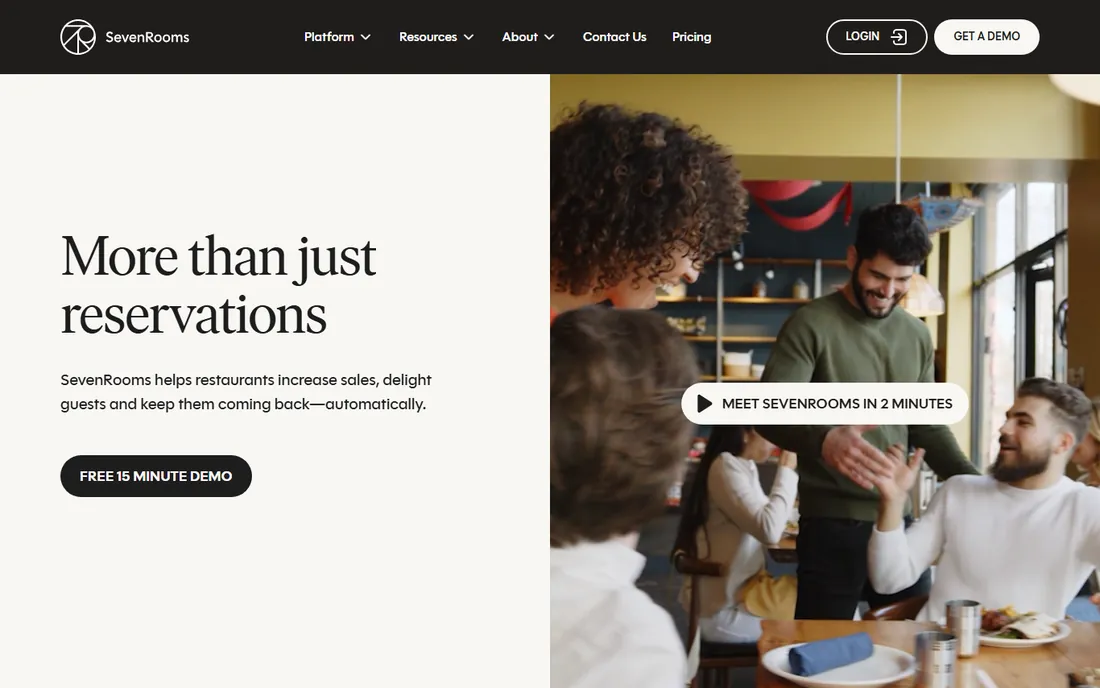
SevenRooms positions against OpenTable on one axis: you own the guest relationship. Its platform combines reservations, table management, waitlists and marketing automation with a guest CRM that tracks preferences, visit history and spend across every venue in your group. Pricing is quote-based and aimed at groups and ambitious independents.
The pitch resonates with operators tired of paying per-cover fees to access their own guests' data. For multi-venue groups building direct-booking programs, SevenRooms is the strategic choice. For a single restaurant that just needs a book, simpler and cheaper tools suffice.
What we like- Best-in-class guest CRM and personalization
- Direct booking emphasis
- Strong for multi-venue groups
Watch out for- Quote-only pricing
- Enterprise sales process
- Overkill for single independents
Starting priceSee website
Free planNo
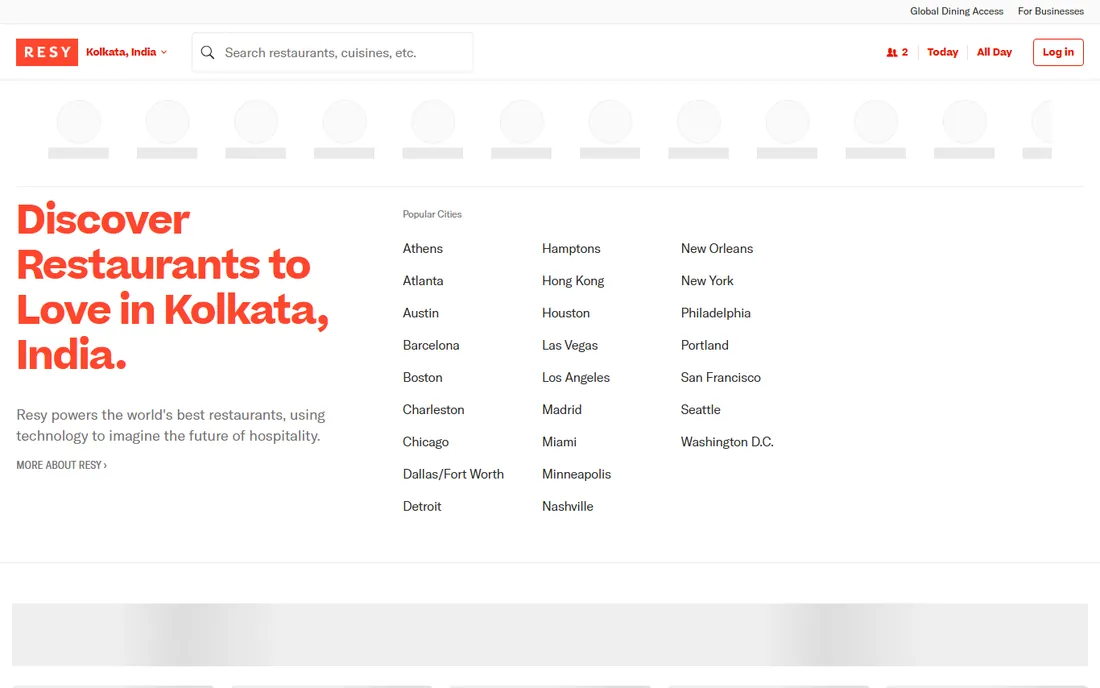
Resy, owned by American Express, is the reservation platform of choice for trendy restaurants in New York, Los Angeles, London and other major dining cities. Diners set Notify alerts for hard-to-get tables, which fills cancellations automatically, and the operator side offers table management, guest profiles and ticketing. Pricing is not published; Resy sells through its sales team.
The Amex connection brings cardholder perks and spend power to your dining room. For restaurants where demand exceeds supply, Resy's waitlist dynamics are unmatched. For neighborhood restaurants in smaller markets, OpenTable's broader network or a flat-rate tool makes more sense.
What we like- Strongest brand with food-savvy diners
- Notify waitlist fills cancellations
- Clean operator tools
Watch out for- No published pricing
- American Express ownership shapes the ecosystem
- Smaller network than OpenTable

#5
ResDiary
Best for: high-volume restaurants that need yield management
Visit resdiary.com
Starting priceSee website
Free planNo
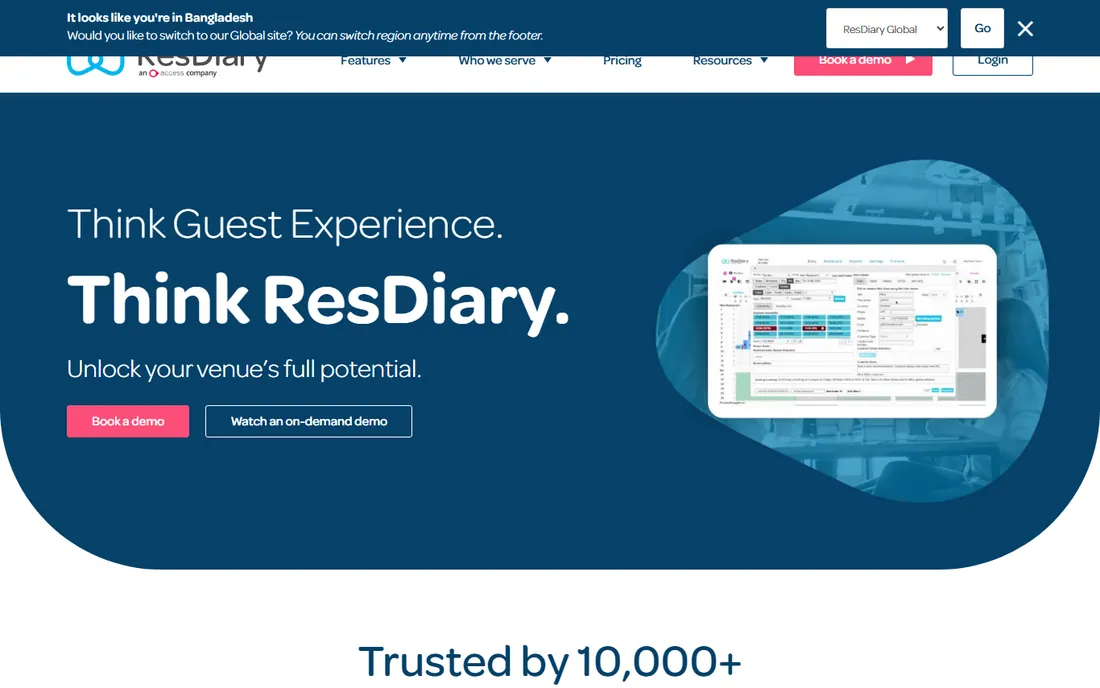
ResDiary is the workhorse of high-volume restaurant reservations, particularly strong in the UK, Europe and Asia-Pacific. Its table management and yield controls, rules for party sizes, durations, turn times and channel allocation, are built for operators running hundreds of covers a night. Pricing is quote-based.
For large restaurants and groups where table yield is the profit lever, ResDiary's operational depth matters more than diner network size. The interface shows its age next to SevenRooms and Resy, but the functionality underneath is battle-tested. Get a demo focused on your busiest service, not a generic walkthrough.
What we like- Powerful table and yield management
- Strong in UK, Europe and Asia-Pacific
- Proven at high volume
Watch out for- Quote-only pricing
- Interface less modern than rivals
- US presence smaller

#6
Eat App
Best for: restaurants that want flat-rate pricing and their own guest data
Visit eatapp.co
Starting priceSee website
Free planYes
Eat App's pitch is arithmetic: flat monthly plans with no per-cover fees and full ownership of guest data, versus OpenTable's $1 to $1.50 per network cover. Table management, guest CRM, marketing automation and analytics come in the package, with a free plan for smaller operations. The trade-off is the absence of a diner discovery network; your marketing fills the tables.
For independent restaurants whose bookings already come from their own channels, the savings versus OpenTable are dramatic, third-party math puts the gap near $18,800 a year for a 100-cover restaurant. For restaurants that depend on network discovery, OpenTable's fees buy real demand. Choose based on where your diners actually come from.
What we like- Flat monthly pricing with zero per-cover fees
- Full guest data ownership
- Free plan available
Watch out for- No diner discovery network
- Smaller brand
- Paid tiers for advanced features
Starting priceSee website
Free planNo
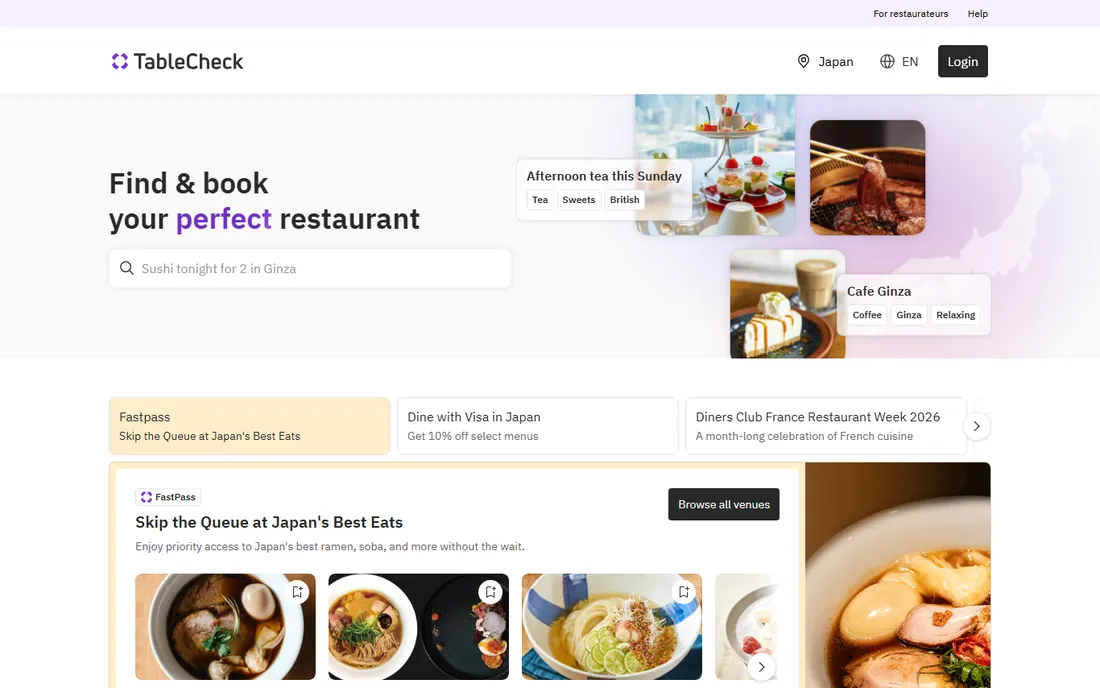
TableCheck is the reservation standard across Japan and much of Asia-Pacific, with deep integrations into local POS, payment and hotel systems, plus multilingual interfaces that handle inbound tourism gracefully. Pricing is not published; the vendor sells regionally. The website geo-redirects visitors to their regional edition.
For restaurants in Japan, TableCheck's local dominance makes it the default choice. For operators elsewhere in Asia-Pacific serving Japanese tourists, its language support is a real advantage. Western restaurants should look at the other tools here unless they have specific Asia-Pacific needs.
What we like- Dominant in Japan with deep local integrations
- Multilingual support
- Strong hotel and ryokan features
Watch out for- Pricing not published
- Weaker outside Asia-Pacific
- Site geo-redirects by region
Starting priceSee website
Free planNo
SpotOn Reserve gives restaurants on the SpotOn point-of-sale platform native reservations, waitlists and table management without a third-party integration. Guest data flows straight into the POS and marketing tools, and reporting covers the whole operation in one dashboard. Pricing is quote-based through SpotOn's sales team.
The value is entirely about the ecosystem: one vendor, one contract, one dataset from reservation to payment. Standalone, it does not out-feature the specialists. For independent US restaurants already on SpotOn, adding Reserve is the path of least resistance. For everyone else, evaluate it only if you are also considering a POS switch.
What we like- Native integration with SpotOn POS and payments
- Unified reporting
- One vendor for front and back of house
Watch out for- Pricing not published
- Best value locked in the SpotOn ecosystem
- Smaller standalone feature set
Per-cover fees vs. flat rate: the only math that matters
Reservation pricing has two philosophies. OpenTable charges a subscription plus $1 to $1.50 per diner who discovers you through its network. Flat-rate tools (Eat App, and Tock's higher tiers) charge a fixed monthly fee regardless of volume.
The breakeven is simple: if the network sends you diners you would not otherwise get, per-cover fees are a marketing cost with measurable return. If your tables fill from your own marketing, per-cover fees are a tax on success. Audit where your reservations actually originate before choosing a pricing model, not after signing a one-year auto-renewing contract.
Setup time matters too. Most reservation tools go live in a few days once your floor plan and shift templates are in; the slow part is staff training and migrating future bookings. Run both systems in parallel for a week before cutting over, and confirm guest data exports cleanly (CSV at minimum) so a future move does not mean rebuilding your guest list from zero.
Quandoo is shutting down: migrate now
Quandoo announced in March 2026 that it will cease operations globally: new bookings ended September 30, 2026, and all infrastructure goes offline December 31, 2026. Restaurants on Quandoo should export reservation history and guest lists before the end of November 2026 and choose a replacement now. Natural landing spots: Eat App for flat-rate value, ResDiary for European operations, OpenTable or Resy for network discovery.
Frequently asked questions
What is the best reservation software for restaurants?
OpenTable ($149/month) is best for diner discovery, Resy for trendy city restaurants, SevenRooms for guest CRM and direct bookings, Eat App for flat-rate pricing with data ownership, and Tock for wineries and prepaid experiences.
How much does OpenTable cost?
OpenTable's Basic plan is $149 per month, Core $299 and Pro $499, plus $1 to $1.50 per cover for diners who book through the OpenTable network, and a 2% service fee on prepaid experiences. Phone and walk-in reservations are free on all plans. The standard contract is one year with auto-renewal.
Is there a free restaurant reservation system?
Eat App offers a free plan for smaller operations. Most serious tools (OpenTable, Tock, SevenRooms, Resy, ResDiary) have no free plans. Free plans suit low-volume restaurants; busy venues need paid tiers for table management and guest CRM. Check the free plan's covers-per-month limit before committing, since outgrowing it mid-season forces a rushed upgrade.
What is the difference between OpenTable and Resy?
OpenTable has the largest diner network and published pricing from $149/month plus per-cover fees. Resy, owned by American Express, has stronger cachet with food-savvy diners in major cities and powerful waitlist features, with unpublished pricing. Choose OpenTable for reach, Resy for buzz.
What should replace Quandoo?
Quandoo shuts down fully on December 31, 2026. Alternatives: Eat App (flat-rate, data ownership), ResDiary (European operations), OpenTable or Resy (network discovery), SevenRooms (guest CRM). Export your guest and reservation data before the end of November 2026.
Do I own my guest data?
It depends on the platform. SevenRooms and Eat App emphasize full guest data ownership. OpenTable's model keeps network guest data within its ecosystem, which is a common complaint. If direct marketing to your diners matters, prioritize data ownership in vendor questions, and ask exactly how exports work; vague answers are a red flag.
Sources we checked (6)
- https://tablelink.app/blog/opentable-fees-explained
- https://restaurant.eatapp.co/blog/opentable-pricing
- https://www.perfectvenue.com/post/opentable-review
- https://www.g2.com/products/tock/pricing
- https://mothership.sg/2026/03/quandoo-platform-cease-operations-closure/
- https://restaurant.eatapp.co/blog/quandoo-alternative
Is your product missing or out of date?
We review this list regularly. Vendors can request a listing, send updated pricing or ask about featured placement.

Shihab Mia · Founder, Rankite
Shihab has spent more than a decade helping SaaS and e-commerce brands grow through search. He writes Rankite's software buying guides from pricing pages, documentation and public user reviews. More about Shihab.