How we make this list: we compare pricing pages, product documentation and public user reviews. Rankite is independent; if a vendor ever pays for a featured spot, that listing is clearly labeled Partner.
Key takeaways
- Square POS (free) is the lowest-commitment way to start, with no contract and no chargeback fees, but its flat rates get expensive at volume.
- Toast ($69/month) is the restaurant default with deep hospitality features, though modules and a typical two-year contract push the real cost much higher.
- Shopify POS Pro ($89/month per location) makes sense only if your store already runs on Shopify; the shared inventory is its whole argument.
- SpotOn ($55/station) and Clover (restaurant plans from $89.95/month) compete on bundling hardware and processing, so compare the contract terms, not the headline price.
- Zettle ($0 monthly) and SumUp ($0 monthly) are the cheapest serious options for micro-merchants and pop-ups who just need to take cards.
Quick comparison
| Tool | Best for | Starting price | Free plan |
|---|
 Square POS Square POS | Small businesses that want zero commitment | Free; Plus $49/month per location (billed monthly) | Yes |
 Toast Toast | Restaurants that want the full hospitality stack | $69/month (Point of Sale plan, restaurant) | $0 Starter Kit option (higher processing rate) |
 Shopify POS Shopify POS | Retailers already selling on Shopify | Free (POS Lite with any Shopify plan); POS Pro $89/month per location | Free trial |
 Lightspeed Restaurant Lightspeed Restaurant | Restaurants that live in their data | Starter $69/month | Free trial |
 Clover Clover | Businesses wanting bundled hardware, software and processing | Free (Retail Basic); restaurant Starter from $89.95/month | Yes (basic retail tier) |
 SpotOn SpotOn | Restaurants comparing bundled hardware deals | All-In $0/station; POS Essentials $55/station per month | Yes (Quick Start) |
 Epos Now Epos Now | Businesses that want hardware bundled with the subscription | $39/month (software only) | Free trial (30 days) |
 PayPal Zettle PayPal Zettle | Micro-merchants who want no monthly bill at all | Free (software); first card reader $29 one-time | Yes |
 TouchBistro TouchBistro | iPad-native restaurant service | From $69/month | Free trial |
 SumUp SumUp | Solo vendors who want the cheapest way to take cards | Free (software); card reader $54 one-time | Yes |
Is your product missing or out of date?
We review this list regularly. Vendors can request a listing, send updated pricing or ask about featured placement.
The best point of sale software
What changed this year is that your phone became a register. In 2026, accepting contactless payments directly on a smartphone with no card reader moved from novelty to standard practice, and industry reporting now calls it the biggest shift in mobile payment processing. Over 65 percent of in-person card transactions in the United States are now contactless, and Visa reports tap-to-pay at 79 percent of face-to-face transactions globally. If your line is still swipe-only, customers read that as outdated.
At the same time the software went to the cloud and the intelligence went up. More than half of modern POS platforms now ship built-in AI features like demand forecasting, fraud flags and upsell prompts as default capabilities rather than premium add-ons. Handheld terminals moved tableside in restaurants, loyalty touchpoints got baked into the payment step, and the on-prem terminal that used to be the safe choice became the one falling behind.
The practical consequence for buyers: the software fee is rarely the decision anymore. Processing rates, contract length and which modules you actually need decide what you pay over three years. This guide prices all three.
Starting priceFree; Plus $49/month per location (billed monthly)
Free planYes
Square is the reason starting a card-taking business costs almost nothing in 2026. The free plan includes the full POS app, inventory, invoices and an online store, and you pay only processing: 2.6% plus 15 cents in person and 3.3% plus 30 cents online. Everything is month-to-month with no early termination fee, and Square absorbs all chargeback costs, a differentiator no other major POS matches.
Square overhauled its plans in October 2025, folding the old industry tiers into three unified plans: Free, Plus at $49 a month per location, and Premium at $149. Plus drops the in-person rate to 2.5% plus 15 cents and adds loyalty, marketing and advanced staff tools. The honest math: on the free plan, roughly $12,000 a month in online card sales is where Plus pays for itself. Square fits low-to-medium volume businesses with mostly in-person sales; high-volume operators should negotiate rates elsewhere.
What we like- No contracts, no early termination fees, no chargeback fees
- Free plan is genuinely capable
- Setup in minutes
Watch out for- Flat rates get expensive at high volume
- Online rate on free plan jumped to 3.3%
- Industry-specific depth is limited
Starting price$69/month (Point of Sale plan, restaurant)
Free plan$0 Starter Kit option (higher processing rate)
Toast is the restaurant POS by which others are judged. The core platform covers menu management, table and course management, handheld ordering, a kitchen display system and online ordering in one stack, and the $69 Point of Sale plan pairs it with 2.49% plus 15 cents card-present processing. For retail and grocery, Toast offers separate bundles starting at $90 a month per location.
The real cost needs itemizing. Online ordering runs about $75 a month, loyalty $50, gift cards $50, email marketing $75 and the KDS $25, so a $69 plan quietly becomes $200 to $400 a month with the modules most independents actually use. The $0 Starter Kit moves the cost into a 3.09% to 3.69% processing rate, which costs more than the subscription above modest volume. Go in assuming a two-year commitment and price the full stack before signing.
What we like- Deep restaurant features, handhelds, KDS and online ordering
- 24/7 support
- Strong offline mode
Watch out for- Contracts typically run one to three years with four-figure termination fees
- Add-on modules stack up fast
- Proprietary hardware
Starting priceFree (POS Lite with any Shopify plan); POS Pro $89/month per location
Free planFree trial
If your store runs on Shopify, this is a one-vendor decision. Shopify POS shares the same product catalog, inventory, customers and reporting as the online store, so buy-online-pickup-in-store and in-store returns of online orders work without reconciliation. POS Lite is free with every Shopify plan; POS Pro at $89 a month per location adds unlimited staff accounts, smart inventory, omnichannel selling and detailed retail reporting.
Two costs sit beneath the headline. Processing through Shopify Payments runs about 2.6% plus 10 cents on Basic, and hardware runs from a $49 reader to around $1,100 per counter. POS Pro only makes sense for staffed, permanent locations; pop-ups and occasional selling do fine on Lite. The argument for Shopify POS over a standalone system is that there is no integration to maintain, but if you are not on Shopify, look elsewhere.
What we like- One shared catalog, inventory and customer database with the online store
- Unlimited registers on Pro
- Strong BOPIS and cross-location returns
Watch out for- Pro add-on needed for real retail features
- Weak offline mode
- Android app reviews lag
- Many features need paid apps
Starting priceStarter $69/month
Free planFree trial
Lightspeed's restaurant product starts at $69 a month for Starter and scales to Essential at $189 and Premium at $399, with custom processing rates available at Premium. All plans include the core POS, menu and floor management, online ordering, contactless payments, loyalty and the Pulse remote-monitoring app, which makes the entry tier unusually complete. In-person processing sits around 2.6% plus 10 cents on Starter.
The tradeoffs are contractual and hardware-related. Expect a one-year commitment, iPad-only deployment (you buy the iPads), and the kitchen display at $30 a screen extra. Restaurant plans include one register on Basic and up to three on Pro, with extra registers by quote. Lightspeed fits operators who want deep analytics and multi-revenue support; cost-sensitive independents should weigh the contract against Toast's flexibility.
What we like- Strong reporting, floor plans and inventory on all plans
- Online ordering and loyalty included from the start
- Offline mode
Watch out for- One-year contract typically required
- IPad only, no Android
- KDS costs extra
- Additional registers quoted separately
#5
Clover
Best for: Businesses wanting bundled hardware, software and processing
Visit clover.com
Starting priceFree (Retail Basic); restaurant Starter from $89.95/month
Free planYes (basic retail tier)
Clover, owned by Fiserv, is the all-in-one option: white-and-silver Android hardware, cloud software, and processing in a single stack. Retail Basic starts at $0 to about $16 a month; restaurant tiers run from $89.95 a month for starters to around $129.85 for advanced full-service, with in-person rates of 2.3% to 2.6% plus 10 cents. The 300-app marketplace covers loyalty, accounting and online ordering add-ons.
The catch is the channel. Your rate and contract depend on who sold you the hardware: Clover.com direct, a bank, or an independent reseller. Reseller agreements commonly run 36 months with $295 to $595 termination fees, and the hardware only processes through Fiserv, so leaving means replacing equipment. Buy direct to keep terms sane, and always get the full written breakdown before signing.
What we like- Purpose-built hardware lineup
- 300+ app marketplace
- Free online ordering
- 24/7 phone support
Watch out for- Multi-year reseller contracts are common
- Hardware locked to Fiserv processing
- Pricing varies by seller
#6
SpotOn
Best for: Restaurants comparing bundled hardware deals
Visit spoton.com
Starting priceAll-In $0/station; POS Essentials $55/station per month
Free planYes (Quick Start)
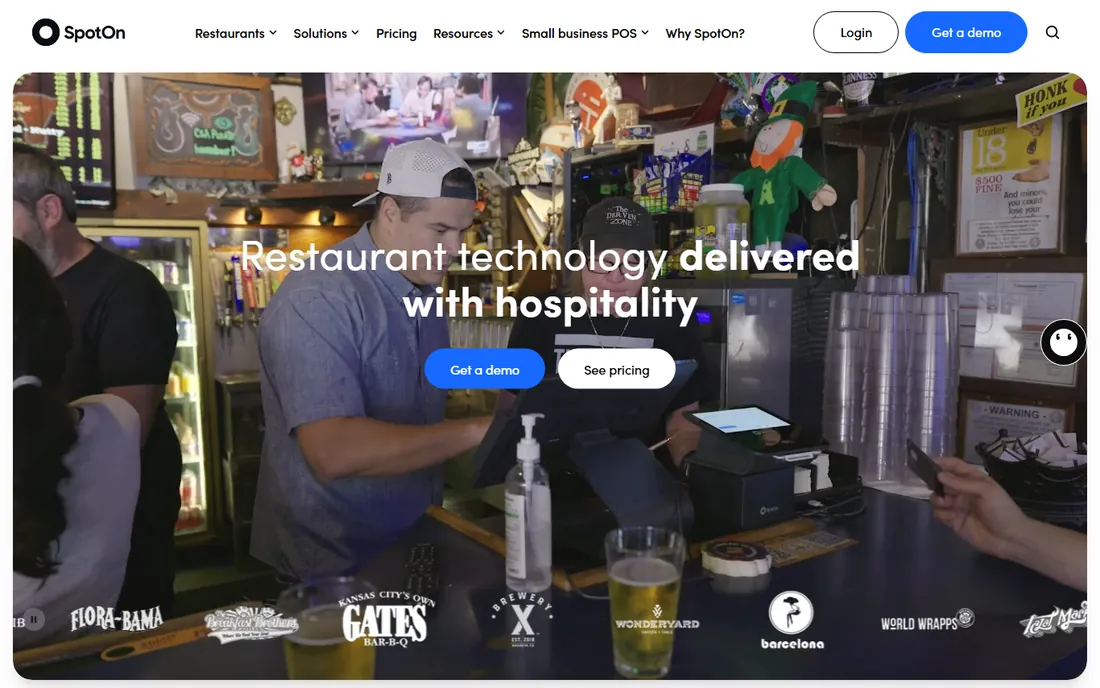
SpotOn is unusually transparent about the tradeoff. The All-In plan is $0 per station with hardware included, processing at 2.79% plus 20 cents card-present, with a two-year minimum term. POS Essentials is $55 per station per month at 2.45% plus 15 cents, month-to-month, with hardware purchased outright. The Quick Start free tier gets you selling at 2.89% plus 25 cents.
Run the volume math before the $0 sticker decides. At $60,000 a month in card sales, the All-In rate premium costs hundreds more per month than Essentials plus subscription. SpotOn suits restaurants that want bundled pricing with everything from one vendor, including reservations and the Core Bundle add-on with AI profit analysis. Just confirm the conversion fee terms in writing, since leaving the processing later is expensive.
What we like- Published two-plan pricing
- Commission-free online ordering
- Strong tableside handhelds
- 24/7 support
Watch out for- All-In requires a two-year minimum term
- Higher processing rates on $0 plan
- Switching processors later costs $995
#7
Epos Now
Best for: Businesses that want hardware bundled with the subscription
Visit eposnow.com
Starting price$39/month (software only)
Free planFree trial (30 days)
Epos Now, UK-born and big in hospitality, prices around the hardware bundle: software-only starts at $39 a month, while the Complete System is $349 upfront plus $79 a month with hardware included. Payment processing through Epos Now Payments runs 2.6% plus 10 cents in person, with limited third-party processor options. The platform covers retail, restaurants and hospitality with table management, stock control and real-time cloud reporting.
The headline number is rarely the real number. Promotional bundles commonly require a paid support package that pushes the effective monthly cost well above the advertised software fee, and contracts of three to five years are normal. Demand a written quote that itemizes software, support, hardware and processing separately, then compare the total against Square or SumUp before committing.
What we like- Hardware bundles with low upfront cost
- Works on iPad, Android, PC or own terminals
- 100+ integrations
- Offline with 4G backup
Watch out for- Contracts often run three to five years
- 24/7 support needs a paid upgrade
- Pricing is promotional and varies
#8
PayPal Zettle
Best for: Micro-merchants who want no monthly bill at all
Visit zettle.com
Starting priceFree (software); first card reader $29 one-time
Free planYes
Zettle, now PayPal Point of Sale, is the simplest possible POS economics: $0 monthly software fee, first card reader for $29, and 2.29% plus 9 cents per in-person transaction. Tap to Pay on iPhone or Android means you can skip the hardware entirely. Termination is free and instant, which makes it the lowest-risk way to test whether card acceptance is worth it for a new venture.
The rate is the limitation. At 2.29% plus 9 cents with no volume discount, anything beyond a micro-business pays more here than on a paid plan elsewhere, and there are no add-ons, no offline mode and thin integrations to grow into. Zettle fits market stalls, pop-ups, freelancers and tiny single-counter shops. When annual volume crosses six figures, price interchange-plus alternatives.
What we like- No monthly fees and no contract
- Tap to Pay on phone with no reader
- Next-day settlement
- Easy to abandon
Watch out for- 2.29% plus 9 cents in-person rate is high for volume
- No offline mode
- Few integrations
- No real add-ons
Starting priceFrom $69/month
Free planFree trial
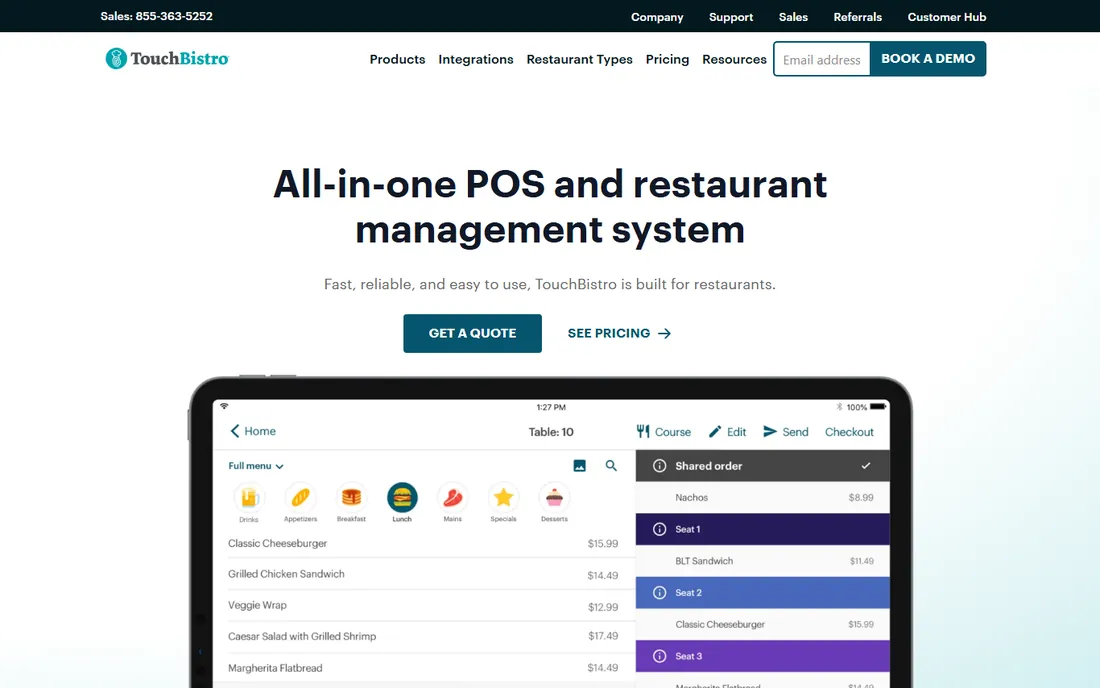
TouchBistro's pitch is straightforward restaurant software with honest pricing. The Point of Sale package starts at $69 a month, and Essentials starts at $119 with zero-upfront-cost hardware. Every package includes unlimited users, advanced reporting, free updates and round-the-clock support, which keeps staffing costs flat as you grow. Online ordering, menu management and table layouts are core rather than add-ons.
It is iPad only, so Android shops are out, and hardware remains a separate purchase outside the Essentials tier. Against Toast, TouchBistro competes on transparent pricing and simpler commitments; against Square, on restaurant-specific depth. It suits single- and multi-location restaurants that want the iPad experience without Toast's contract weight.
What we like- Clear published pricing
- Unlimited users on all packages
- Free updates
- 24/7 support
Watch out for- IPad only
- Hardware costs are separate
- Essentials tier with hardware financing from $119/month
#10
SumUp
Best for: Solo vendors who want the cheapest way to take cards
Visit sumup.com
Starting priceFree (software); card reader $54 one-time
Free planYes
SumUp's pay-as-you-go model is the simplest in the category: buy the $54 Plus reader once, download the free app, and pay 2.6% plus 10 cents per in-person transaction with no monthly fee, no PCI fee and no hidden costs. Solo at $99 works without a phone, and a full Terminal runs $249 when the business outgrows the pocket setup. You start or stop anytime with no termination fee.
The simplicity has edges. There is no offline mode, account verification complaints appear in reviews, and SumUp explicitly prohibits cash discounting, so you cannot pass the fee to customers. Above roughly $5,000 a month in volume, a subscription-based processor usually costs less. For market vendors, mobile professionals and tiny retail, SumUp is the cheapest serious starting point in the US.
What we like- No monthly fee or minimums
- No contracts
- 2.6% plus 10 cents in-person
- Reader handles chip, tap and swipe
Watch out for- No offline mode
- Customer support is hard to reach
- US feature set lags Europe
- Prohibits cash discounts
Matching the POS to the way you sell
Restaurants should start with Toast, Lightspeed or SpotOn and compare the contract, not just the software fee. Retailers choose between Square for simplicity, Shopify POS for Shopify stores, and Lightspeed Retail for inventory depth. Mobile and micro sellers pick SumUp or Zettle and pay only per transaction. And anyone being pitched a bundle should ask one question: what does this cost at my actual volume over the full contract term, including every module and processing rate? That number is the price. Everything else is advertising.
How we built this POS shortlist
We priced each product against its own published plans and independent 2026 reviews, cross-checking rates on vendor pricing pages and review-site breakdowns dated this year. Contract terms came from reviewer reports and the vendors' own published terms, since the multi-year lock-in is often the biggest cost in the room. We excluded generic card readers without real POS software and processors that hide pricing behind quotes. No hands-on register testing sits behind these picks, and the article claims none.
The contract is the price
Across every vendor here, the software subscription is the smallest line item. Processing rates at your volume, module add-ons and contract length decide the three-year cost. Toast's $69 becomes $300 with modules; SpotOn's $0 becomes expensive at volume; Clover's rate depends on the reseller who sold it. Three rules before signing: get the full breakdown in writing, ask how leaving works and what it costs, and buy hardware outright rather than leasing it. A cheap monthly fee on a three-year contract with a termination fee is not a cheap POS.
Frequently asked questions
Should I get a free POS plan or pay monthly?
Do the math on your volume. A $0 software plan with a 2.79% to 3.69% processing rate costs more than a $49 to $69 subscription with lower rates once monthly card sales pass roughly $10,000 to $20,000. Micro-merchants and seasonal sellers stay free; anyone doing steady five-figure monthly volume saves with a paid tier.
Do POS contracts lock me in?
Many do. Toast commonly runs one to three years, Lightspeed often a year, Clover reseller deals 36 months, and SpotOn's $0 plan two years, with termination fees from $295 into the four figures. Square, Zettle and SumUp are month-to-month with no termination fee. Read the exit clause before the pricing page.
Can I bring my own hardware or processor?
Usually not with the big bundles. Clover, Toast and SpotOn hardware is proprietary and locked to their processing. Square and Shopify offer more hardware flexibility within their ecosystems. If you want processor choice, pick a POS that supports third-party gateways, like Epos Now with Worldpay, and accept thinner integration.
What does a POS system really cost per month all-in?
For a small restaurant on Toast with online ordering and loyalty, $250 to $400 a month including processing is realistic. A retail counter on Square Plus runs the $49 subscription plus 2.5% plus 15 cents per sale. A market vendor on SumUp or Zettle pays no monthly fee at all. Add hardware, typically $200 to $2,000 one-time, to every estimate.
Does tap-to-pay on phone replace a card reader?
For low-volume sellers, yes. Tap to Pay on iPhone and Android accepts contactless cards and wallets with no reader hardware through Square, Zettle and others. Limitations apply: contactless only, no chip insert or swipe, and reliability at high volume still favors dedicated terminals. Keep a reader as backup for anything beyond occasional sales.
Which POS is best for multiple locations?
Lightspeed (Retail and Restaurant) and Shopify POS Pro handle multi-location inventory and reporting natively, with per-location or per-register fees to budget. Square's per-location pricing scales cleanly too. Confirm cross-location returns, stock transfers and consolidated reporting are included in your tier, not reserved for the top plan.
Sources we checked (18)
- https://squareup.com/pricing
- https://pos.toasttab.com
- https://www.shopify.com/pos
- https://www.lightspeedhq.com
- https://www.clover.com
- https://www.eposnow.com
- https://www.zettle.com
- https://www.touchbistro.com
- https://www.sumup.com
- https://techlinkservices.com/10-pos-trends-2026/
- https://www.sleftpayments.com/learning-hub/mobile-payment-processing-small-business-2026
- https://koronapos.com/blog/square-pos-fees/
- https://koronapos.com/blog/toast-pos-cost-calculator/
- https://www.gingerserve.com/guides/spoton-pricing
- https://www.posusa.com/clover-pos-review/
- https://www.posusa.com/zettle-by-paypal/
- https://www.posusa.com/sumup-plus-card-reader/
- https://www.posusa.com/epos-now-review/
Is your product missing or out of date?
We review this list regularly. Vendors can request a listing, send updated pricing or ask about featured placement.

Shihab Mia · Founder, Rankite
Shihab has spent more than a decade helping SaaS and e-commerce brands grow through search. He writes Rankite's software buying guides from pricing pages, documentation and public user reviews. More about Shihab.