How we make this list: we compare pricing pages, product documentation and public user reviews. Ratings come from G2, Capterra or Trustpilot, with the date we checked them.
Key takeaways
- Monarch Money gives the most complete household view, with budgeting, net worth, and investments in one place for $99.99 per year.
- YNAB suits people who want a strict budgeting method and are willing to learn it, at $14.99 per month or $109 per year.
- Quicken Classic remains the strongest choice for long histories, detailed investment records, and desktop files, starting at $6.99 per month billed annually for Deluxe.
- Rocket Money offers a genuinely useful free tier, so a reader can start without paying, and PocketGuard gives a simple safe-to-spend number.
- Copilot Money is the pick for Apple users who value design, while Tiller and PocketSmith serve readers who want spreadsheets or long-range forecasts.
Choosing personal finance software comes down to one question: do you want a plan, a picture, or both? A plan tells you what each dollar should do before the month ends. A picture shows what you own, what you owe, and where the money went. Some tools do both well. Others do one job with unusual depth and leave the rest alone. The wrong choice usually fails for a simple reason. It asks for more attention than the person using it is willing to give, week after week.
This guide covers nine tools that exist today and fit the category. Prices come from vendor pricing pages and recent pricing coverage checked in October 2026. Where a price varies by promotion, the standard rate is shown and the promotion is noted. This is not financial advice. These tools organize and display financial information. They do not replace advice from a qualified professional about investing, taxes, or debt.
Quick comparison
| Tool | Best for | Starting price | Free plan |
|---|
 Monarch Money | Complete household money view | $14.99 per month or $99.99 per year | Free trial (7 days) |
 YNAB | Strict zero-based budgeting | $14.99 per month or $109 per year | Free trial (34 days) |
 Quicken Classic | Long histories and investment records | $6.99 per month billed annually (Deluxe) | No |
 Copilot Money | Apple users who value design | $13 per month or $95 per year | Free trial (1 month) |
 PocketGuard | Simple safe-to-spend number | $12.99 per month or $74.99 per year | Yes (limited) |
 Rocket Money | Finding and cancelling subscriptions | Free; Premium from about $7 per month | Yes |
 Goodbudget | Envelope budgeting without bank links | Free; Plus $10 per month or $80 per year | Yes |
 PocketSmith | Long-range cash flow forecasts | $14.95 per month or $119.88 per year (Foundation) | Yes |
 Tiller | Spreadsheet-based tracking | $79 per year | Free trial (30 days) |
Is your product missing or out of date?
We review this list regularly. Vendors can request a listing, send updated pricing or ask about featured placement.
The best personal finance software
Starting price$14.99 per month or $99.99 per year
Free planFree trial (7 days)
Monarch Money is the closest thing to a single home for household finances. Bank accounts, credit cards, loans, property, and investments connect into one dashboard, and the budget sits next to net worth rather than in a separate app. Couples can share the plan without paying for a second subscription, and each person can choose what to share.
The catch is the trial. Seven days is enough to connect accounts and look around, but not enough to judge a full month of spending. Readers who need a longer test period should use the trial during a busy spending week, set up the budget categories on day one, and check the recurring expense list before the trial ends. Monarch also has a higher-priced Plus tier that most households will not need.
What we like- Budgeting, net worth, and investments in one dashboard
- Strong sharing for couples
- Clear recurring expense detection
Watch out for- No permanent free tier
- The 7-day trial is short for a tool this broad
#2YNAB
Best for: Strict zero-based budgeting4.5/5 on
G2 (30 reviews, checked Oct 2026)
Visit ynab.com
Starting price$14.99 per month or $109 per year
Free planFree trial (34 days)
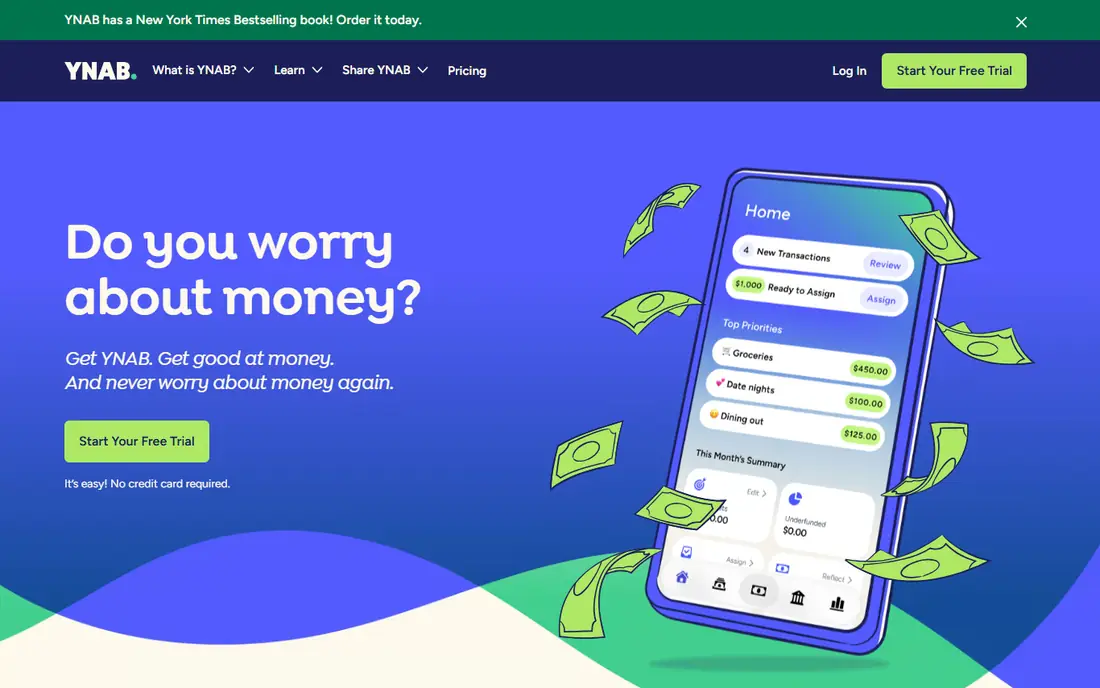
YNAB, short for You Need A Budget, is less an app and more a method with an app attached. Every dollar gets a job before it is spent, and money moves between categories when plans change instead of quietly disappearing. That discipline is why many users report that YNAB changed their spending habits in a way that a simple tracker did not. The debt payoff tools, goal tracking, and loan planner give the method practical weight beyond the budgeting screen.
The trade-off is effort. The first month feels like homework, and readers who only want to glance at spending once a week will find YNAB demanding. Bank sync covers many US, Canadian, UK, and EU institutions, but availability varies, so check the supported list before subscribing. College students can get a free year, which makes the trial period effectively much longer for that group. For everyone else, the 34-day trial is generous and worth using in full.
What we like- A clear method that assigns every dollar a job
- Strong debt payoff tools
- Sharing for up to six people
Watch out for- Real learning curve in the first two weeks
- No permanent free tier
- Overkill for passive trackers
#3Quicken Classic
Best for: Long histories and investment records4.3/5 on
G2 (76 reviews, checked Oct 2026)
Visit quicken.com
Starting price$6.99 per month billed annually (Deluxe)
Free planNo

For readers with years of financial history, Quicken Classic still has no equal. The desktop file holds transactions, investment cost basis, and category history going back as far as the user has kept records, and the Premier tier adds deeper portfolio and tax reporting. Business and Personal, at $10.99 per month billed annually, adds rental and small business tracking for landlords and sole proprietors. If a reader reconciles accounts, follows a portfolio closely, or needs clean records for taxes, that depth justifies the price.
Quicken is a subscription now, and that change still bothers long-time users who once bought it outright. When a Deluxe or higher subscription lapses, the data access guarantee keeps the file usable for viewing, editing, exporting, and manual entry, while connected downloads, quotes, and updates stop. Quicken also sells Simplifi, a separate cloud app, and this entry covers Classic only.
What we like- Decades of account history in one desktop file
- Detailed investment cost basis and tax reporting
- Data access guarantee on Deluxe and higher
Watch out for- Annual subscription with no one-time purchase
- Interface feels dated next to cloud apps
- Bank sync problems are reported by some users
Starting price$13 per month or $95 per year
Free planFree trial (1 month)

Copilot Money wins on the daily experience. The iPhone, iPad, Mac, and web apps feel like they were built by people who care about typography and spacing, and the spending views are easy to read at a glance. Automatic categorization learns from corrections, budget rollovers let unspent money carry forward, and the cash flow view shows income and expense trends without extra setup. A free demo mode lets a reader explore the interface before connecting any account.
The limits are platform and price for couples. There is no Android version, so mixed-device households should look at Monarch or YNAB instead. Each person needs a separate subscription, so a couple pays $190 per year at the annual rate. Monthly billing at $13 costs $156 per year, a large premium over the $95 annual price, so annual billing is the sensible choice for anyone who stays past the trial.
What we like- Polished Apple-native design
- Automatic categorization that improves over time
- Budget rollovers and cash flow views
Watch out for- No Android app
- No permanent free tier
- Couples need two subscriptions
Starting price$12.99 per month or $74.99 per year
Free planYes (limited)
PocketGuard answers one question clearly: after bills, goals, and recurring spending, how much is safe to spend right now? That single number is the whole product idea, and for readers who feel lost in detailed budgets, it is easier to act on than a full dashboard. At $12.99 per month or $74.99 per year, it costs less per year than YNAB or Monarch.
The trade-off is depth. PocketGuard does not offer the strict method of YNAB, the household dashboard of Monarch, or the detailed investment records of Quicken Classic. The free tier is limited, so most readers will need the paid plan to get full value. For a reader who wants detailed budgets or investment analysis, a tool higher on this list will serve better.
What we like- One clear safe-to-spend figure after bills and goals
- Simple category tracking
- Lower annual price than YNAB or Monarch
Watch out for- Free tier is limited
- Budgeting depth is thinner than YNAB or Monarch
- Investment tracking is basic
Starting priceFree; Premium from about $7 per month
Free planYes
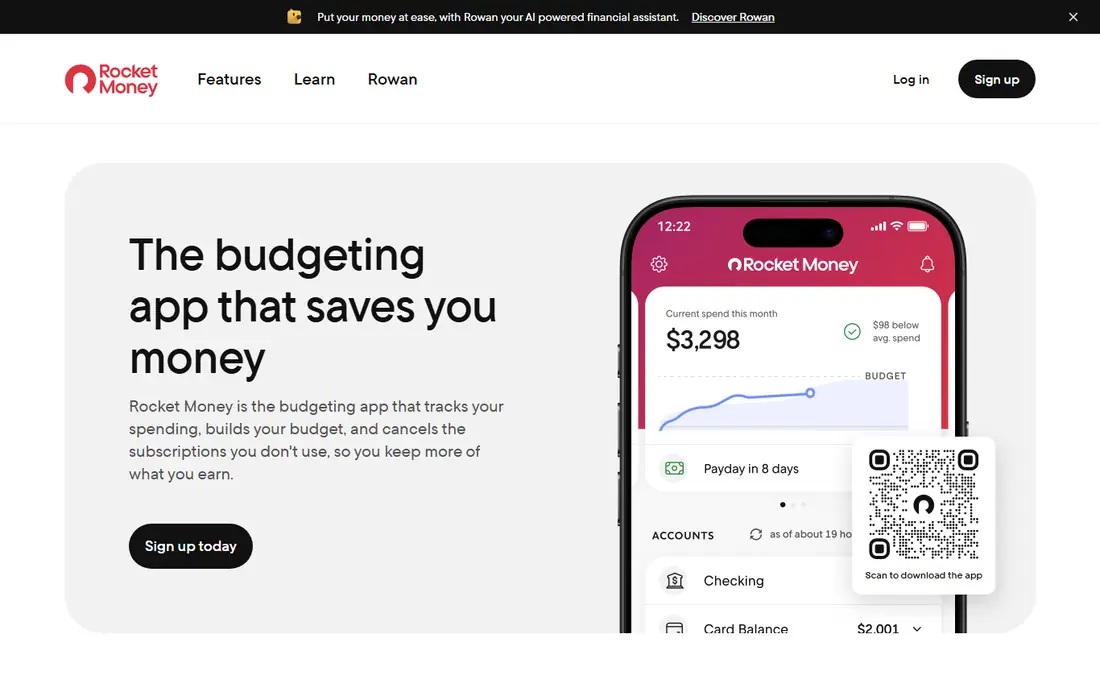
Rocket Money starts with a practical problem: subscriptions that renew quietly. The free tier finds recurring charges across linked accounts, tracks spending, and sends alerts for balance changes and bill increases. Premium adds net worth tracking, unlimited budgets, shared accounts, and a cancellation assistant that contacts providers on the user's behalf. That assistant is the feature most people actually use, because cancelling by phone is the part everyone puts off.
Two costs deserve attention. Premium pricing is presented as a sliding range, roughly $7 to $14 per month, so the final price depends on the amount chosen. Bill negotiation, where Rocket Money negotiates a lower bill, takes a percentage of the savings, commonly reported as 35 percent to 60 percent depending on the bill. Readers should check the exact share before accepting a negotiation, and should treat the free tier as the main product unless the Premium features solve a specific problem.
What we like- Free subscription detection and spending tracking
- Cancellation help on Premium
- Bill negotiation service available
Watch out for- Budgeting is thinner than dedicated budget apps
- Bill negotiation takes a share of savings
- Premium price varies by what the user chooses to pay
Starting priceFree; Plus $10 per month or $80 per year
Free planYes
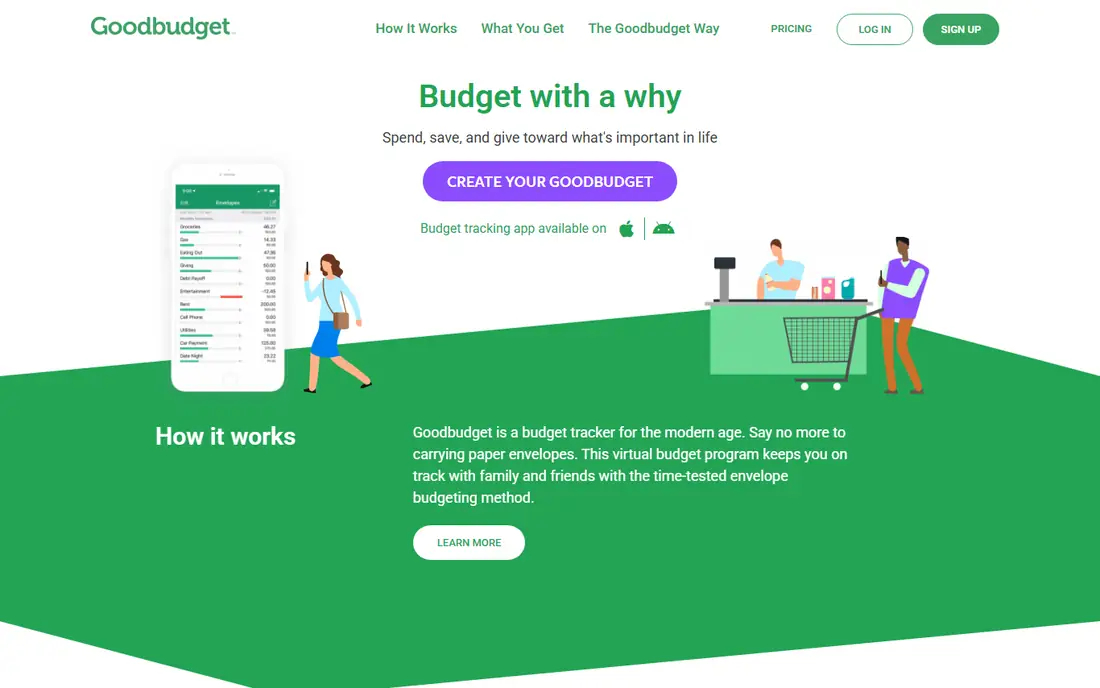
Goodbudget turns the old cash envelope method into software. Money is divided into envelopes for groceries, rent, transport, and anything else, and spending reduces the envelope balance. The free tier includes 20 envelopes, one account, and two devices, which is enough for a simple household budget. Plus, at $10 per month or $80 per year, adds unlimited envelopes and accounts, bank sync for US banks, and more devices.
The honest catch is effort on the free tier. Without bank sync, every transaction is entered by hand or imported, and that routine breaks down for people who will not keep it up. Goodbudget also does not try to be an investment tracker, so readers with portfolios will need a second tool. For couples who want a shared, simple system and are willing to enter spending, the envelope method is unusually good at stopping overspending before it happens, because an empty envelope is hard to ignore.
What we like- Clear digital envelope method
- Free tier covers 20 envelopes
- Works well for couples who share a budget
Watch out for- Bank sync requires Plus and covers US banks
- Manual entry on the free tier takes discipline
- Fewer investment features than rivals
Starting price$14.95 per month or $119.88 per year (Foundation)
Free planYes
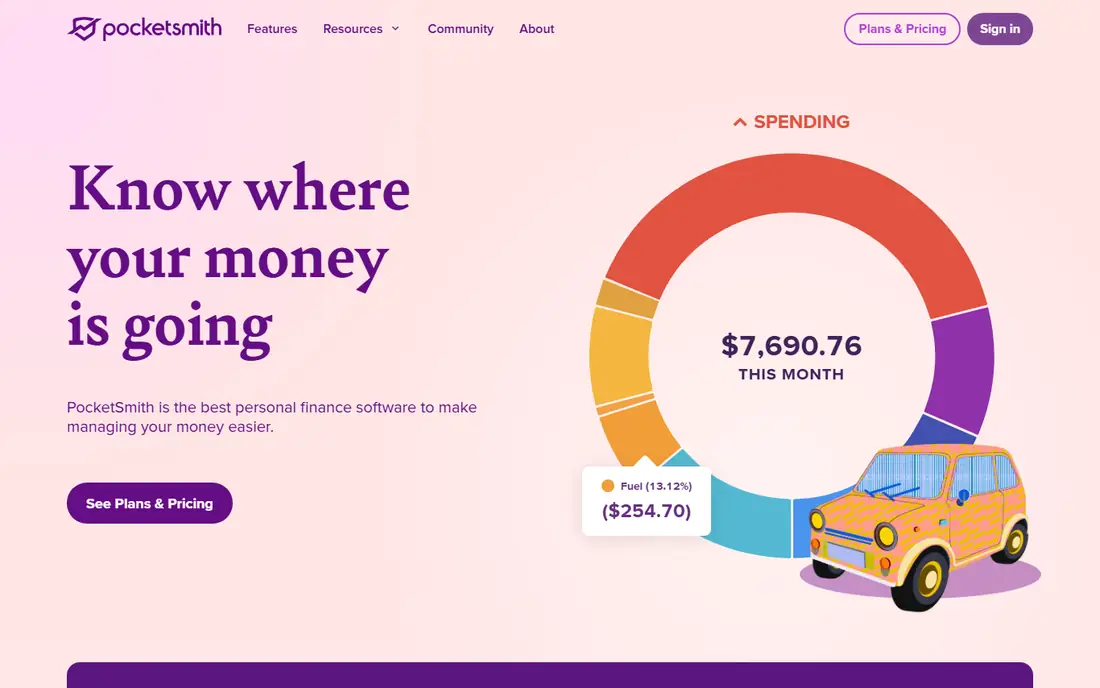
PocketSmith answers a different question from the rest of this list. Instead of asking what was spent last month, it projects bank balances months and years ahead, based on scheduled income, bills, and budgets. That forecast view helps readers plan for a large purchase, a career break, or retirement spending, and scenario planning lets them compare outcomes side by side. Support for banks outside the US is broader than many US-focused apps, which matters for international readers.
The price is the barrier. Foundation, the lowest paid tier, costs $14.95 per month or $119.88 per year and includes automatic bank feeds, 10 years of projection, and six connected banks from one country. Higher tiers raise those limits and extend projections to 30 years. The free tier allows manual imports, two accounts, and six months of projections, which is enough to test the forecast idea. Readers who only need a monthly budget will find cheaper options here. Readers who plan years ahead will find few rivals.
What we like- Cash flow forecasts up to 30 years on higher tiers
- Scenario planning
- Strong support for accounts outside the US
Watch out for- Higher starting price than most rivals
- Bank feed limits vary by tier and country
- Interface takes time to learn
#9Tiller
Best for: Spreadsheet-based tracking4.0/5 on
G2 (2 reviews, checked Oct 2026)
Visit tillerhq.com
Starting price$79 per year
Free planFree trial (30 days)
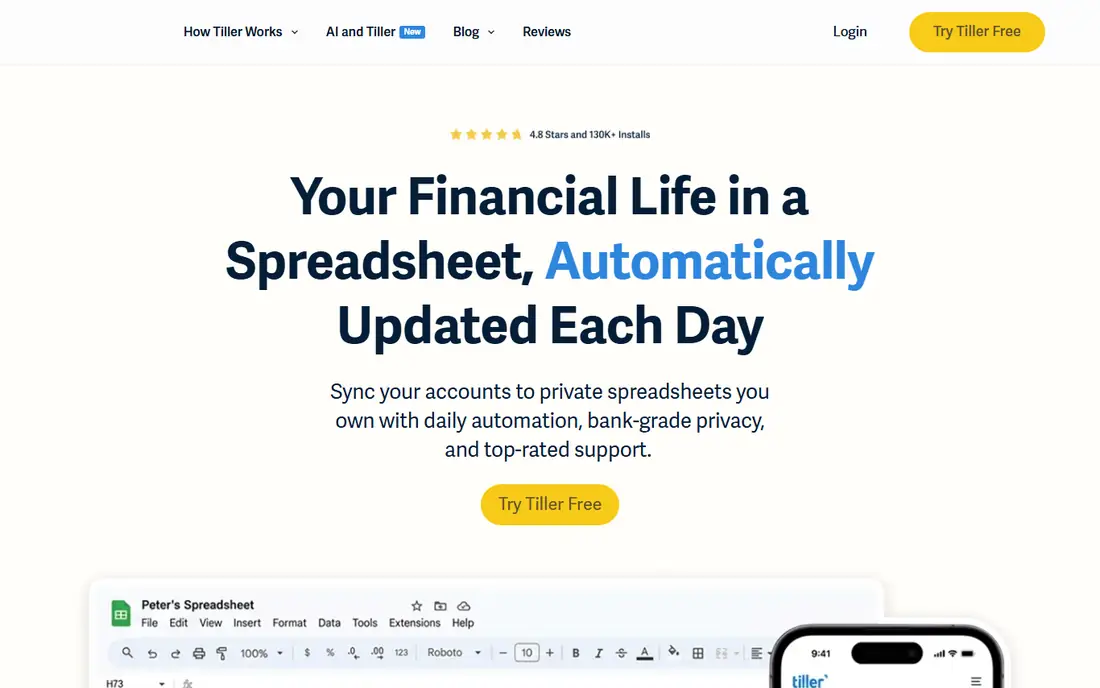
Tiller is for readers who already live in spreadsheets. It connects bank accounts and feeds transactions into Google Sheets or Microsoft Excel, where the user builds budgets, reports, and charts with ordinary formulas. Templates cover common setups, including a foundation template for budgeting and net worth, but the real value is control. Categories, tags, and reports can be shaped exactly to a household or small business, and the data remains in a file the user can copy, export, or keep.
That control is also the weakness. Tiller offers no guided budgeting method and no polished mobile app to match Monarch or Copilot. A reader who dislikes spreadsheets will abandon it quickly. At $79 per year after a 30-day trial, it costs less than YNAB or Monarch. Check bank support before subscribing, since feed availability varies by institution.
What we like- Bank feeds flow into Google Sheets or Excel
- Full control over categories, reports, and formulas
- Data stays in a spreadsheet the user owns
Watch out for- No hand-holding or built-in budgeting method
- Requires comfort with spreadsheets
- No permanent free tier
How we chose
We compared pricing pages, product documentation, and public user reviews on G2, Capterra, and Reddit, and we checked each vendor homepage to confirm the product exists and matches the category. Tools were judged on fit for the job, price transparency, bank connection coverage, budgeting depth, investment and net worth tracking, and how easy the data is to export or move. We did not claim hands-on testing. Where a price could not be verified from the vendor page or recent pricing coverage, the entry says so or uses a range, and readers should confirm the current price before subscribing.
What to check before you pay
Start with the job, not the app
List the one problem that matters most. If it is overspending, a method tool like YNAB or Goodbudget will help more than a dashboard. If it is not knowing total wealth, Monarch will answer faster. If it is planning years ahead, PocketSmith is the only tool here built for that first.
Check bank connections first
Every tool here depends on bank feeds, and feed coverage varies by country and institution. Use the free trial to connect every account that matters, including credit cards and loans, before paying. A tool that cannot connect a main bank is a poor purchase at any price.
Count the real cost for a household
Some tools charge per person, some per household. Copilot needs two subscriptions for a couple. Monarch and YNAB include sharing in one price. Multiply the monthly price by twelve and compare annual billing, since monthly billing often costs 30 percent or more above the annual rate.
Plan the exit
Ask how data exports before subscribing. Tiller and Quicken Classic keep data in files the user controls. Cloud apps vary in export formats, and a clean CSV export matters if the user later switches. Also check contract terms: most tools here bill monthly or annually with no long contract, but annual billing still means paying upfront for a year.
Frequently asked questions
What is the best personal finance software for most people?
Monarch Money fits the most households, because it combines budgeting, net worth, and investments in one dashboard with couple sharing included. Readers who want a stricter method should consider YNAB, and readers who want a free start should consider Rocket Money.
Is free personal finance software good enough?
For tracking spending and finding subscriptions, yes. Rocket Money covers subscription detection for free, and PocketGuard offers a limited free tier. For a strict budget or a household plan, a paid tool usually earns its price through better budgeting controls and support.
Do these tools replace a financial adviser?
No. They organize accounts, show spending, and project cash flow, but they do not give personal advice about investing, taxes, or debt. This is not financial advice. A qualified professional should review major decisions, especially around retirement, tax, and large debts.
How safe is connecting bank accounts to these apps?
These tools use third-party aggregators and bank-grade encryption, and most support multi-factor authentication. Risk cannot be reduced to zero, so use a unique password, turn on two-factor authentication, and review connected accounts regularly. Readers who are uncomfortable with bank links can use Goodbudget manual entry or Tiller with imported files.
What happened to Mint?
Mint shut down in March 2024. Many former Mint users moved to Monarch, Copilot, or Rocket Money, depending on whether they wanted a full dashboard, a design-led app, or subscription help. That closure is also a reason to check export options before committing to any new tool.
Sources we checked (10)
- https://www.quicken.com
- https://www.ynab.com
- https://www.monarchmoney.com
- https://copilot.money
- https://pocketguard.com
- https://www.rocketmoney.com
- https://goodbudget.com
- https://www.pocketsmith.com
- https://www.tillerhq.com
- https://www.quicken.com/blog/best-personal-finance-software-for-cash-flow-and-expense-tracking/
Is your product missing or out of date?
We review this list regularly. Vendors can request a listing, send updated pricing or ask about featured placement.

Shihab Mia · Founder, Rankite
Shihab has 5+ years in B2B and SaaS SEO. He writes Rankite's software buying guides from pricing pages, documentation and public user reviews. More about Shihab.