How we make this list: we compare pricing pages, product documentation and public user reviews. Rankite is independent; if a vendor ever pays for a featured spot, that listing is clearly labeled Partner.
Key takeaways
- Oracle AI Database and SQL Server 2025 remain the safest picks for mission-critical transactional workloads that cannot slow down.
- Snowflake, Spanner and Aurora win on elastic scale without managing servers, but their bills follow usage closely.
- PostgreSQL and MongoDB deliver serious performance for free or cheap, which is why they sit underneath so much enterprise software.
- Redis, CockroachDB and SingleStore each dominate one performance niche: in-memory speed, global distribution, and real-time analytics on live transactions.
Quick comparison
| Tool | Best for | Starting price | Free plan |
|---|
 Oracle AI Database Oracle AI Database | Mission-critical transactional workloads that cannot slow down | See website (custom enterprise licensing) | Free trial |
 Microsoft SQL Server Microsoft SQL Server | Windows-centric enterprise estates modernizing for AI | See website (per-core licensing or Azure pay-as-you-go) | Free trial |
 Snowflake Snowflake | Elastic analytics and AI workloads without managing infrastructure | See website (usage-based credits) | Free trial |
 Google Cloud Spanner Google Cloud Spanner | Global applications needing strong consistency at scale | See website (usage-based, from $0.030 per 100 processing units/hour) | Free trial |
 Amazon Aurora Amazon Aurora | Teams on AWS wanting MySQL or PostgreSQL compatibility with more headroom | See website (pay-as-you-go) | Free trial |
 MongoDB MongoDB | Applications with evolving schemas and heavy read/write scale | Free tier available; pay as you go on Atlas | Yes |
 PostgreSQL PostgreSQL | Teams that want enterprise-grade relational power without license fees | Free (open source) | Yes |
 Redis Redis | Caching, sessions and real-time features needing sub-millisecond response | See website (Redis Cloud usage-based) | Yes (free tier) |
 CockroachDB CockroachDB | Distributed applications that must survive region failures | See website (usage-based cloud or self-hosted) | Free trial |
 SingleStore SingleStore | Real-time analytics directly on transactional data | See website (custom and cloud pricing) | Free trial |
Is your product missing or out of date?
We review this list regularly. Vendors can request a listing, send updated pricing or ask about featured placement.
#1
Oracle AI Database
Best for: Mission-critical transactional workloads that cannot slow down
Visit oracle.com
Starting priceSee website (custom enterprise licensing)
Free planFree trial
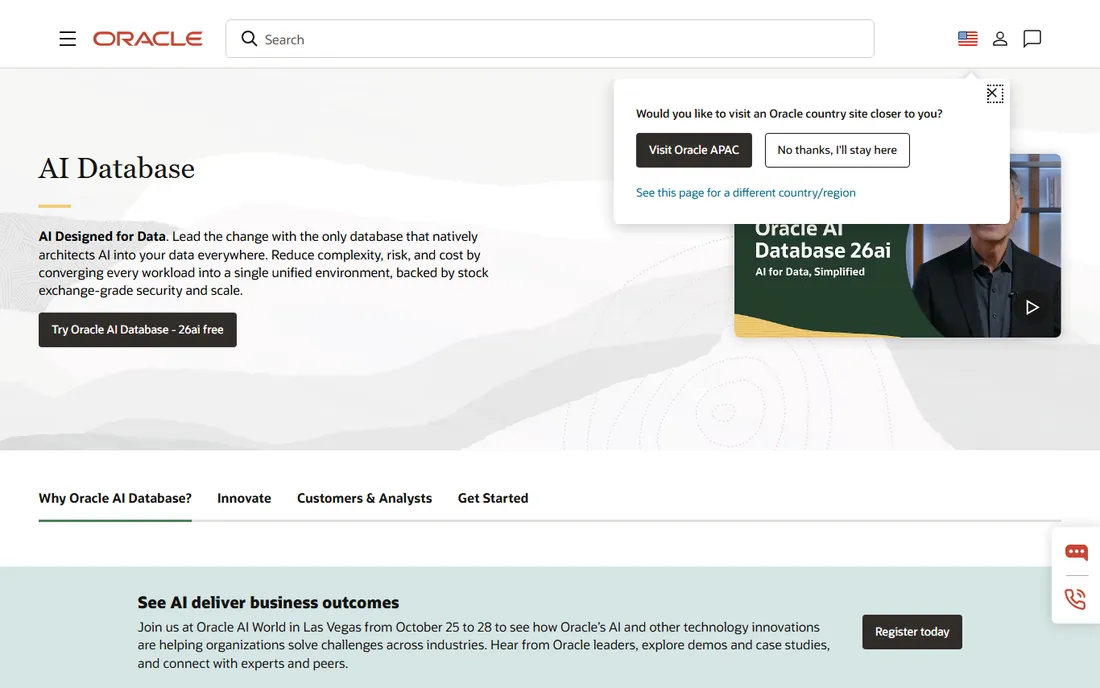
Oracle still sets the bar other enterprise databases are measured against. Now branded Oracle AI Database (version 26ai), it runs relational, document, graph, spatial and vector workloads in one converged engine. For raw transactional throughput it remains the reference implementation, and it backs that up with stock-exchange-grade availability tooling: Real Application Clusters, Data Guard and automatic storage management. It also runs across OCI, AWS, Azure and Google Cloud now, which softens the old lock-in complaint.
The honest catch is cost and complexity. Licensing is quote-based and famously intricate, and headline performance usually assumes Exadata or Oracle Cloud. Smaller teams get more database than they can operate. But for banks, telcos and retailers where a slow transaction means lost revenue, Oracle remains the conservative choice.
What we like- Top-ranked OLTP performance with decades of tuning behind it
- One converged engine for relational, JSON, graph and vector data
- Runs on-prem, on Exadata, or across major clouds
Watch out for- Licensing is famously complex and expensive
- The full performance story usually needs Exadata hardware or Oracle Cloud
#2
Microsoft SQL Server
Best for: Windows-centric enterprise estates modernizing for AI
Visit microsoft.com
Starting priceSee website (per-core licensing or Azure pay-as-you-go)
Free planFree trial
SQL Server 2025 keeps Microsoft's database firmly in the enterprise performance conversation. The 2025 release adds AI-native features: vector embeddings, semantic search with full-text search, and interfaces for local or cloud AI models. Underneath, batch mode processing and optimized locking push query throughput higher, while failover enhancements protect uptime. For shops already on Windows, Active Directory and .NET, nothing integrates as cleanly.
The trade-offs are familiar. Per-core licensing makes large deployments expensive, and while Linux support exists, the smoothest experience still runs on Windows with Azure services attached. Azure Arc pay-as-you-go licensing helps, and mirroring into Microsoft Fabric gives near-real-time analytics without ETL. If your enterprise already runs the Microsoft stack, SQL Server is hard to beat on integration. If not, licensing alone can push you toward open alternatives.
What we like- Deep integration with the Microsoft stack
- Built-in AI features like vector and semantic search in the 2025 release
- Mature high-availability tooling
Watch out for- Licensing remains per-core and pricey
- Best experience still assumes Windows and Azure
#3
Snowflake
Best for: Elastic analytics and AI workloads without managing infrastructure
Visit snowflake.com
Starting priceSee website (usage-based credits)
Free planFree trial
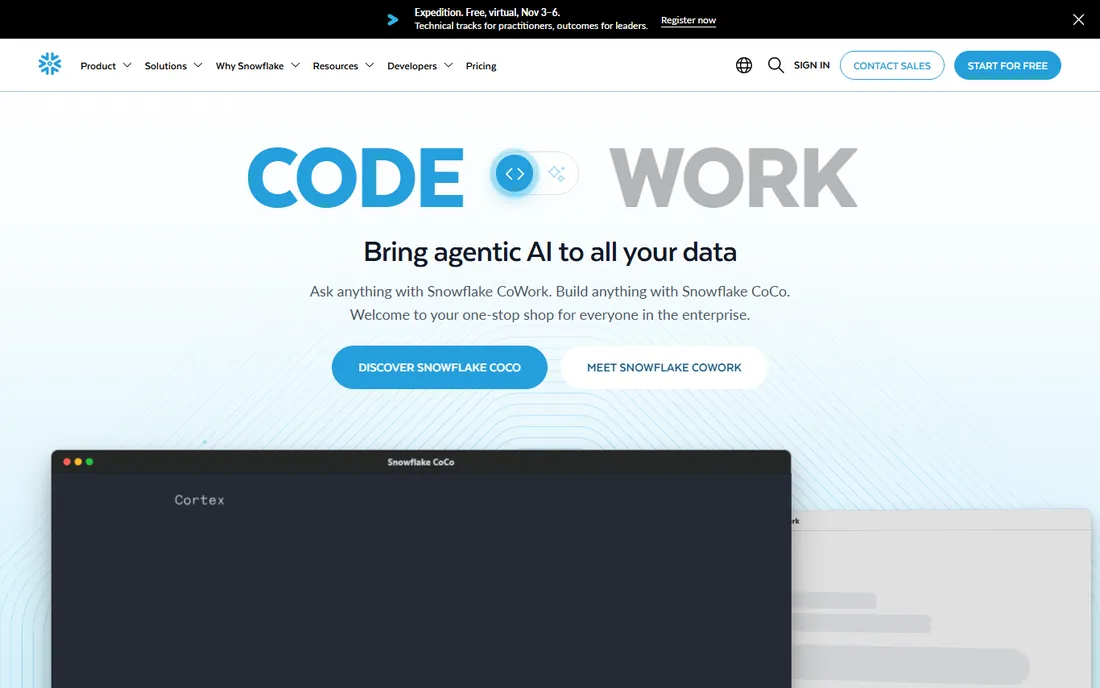
Snowflake changed what enterprises expect from analytics performance. Storage and compute scale independently, so heavy queries get more compute without reprovisioning, and Cortex AI agents now run directly on governed data. Concurrency is a genuine strength: hundreds of analysts can hammer the same tables without stepping on each other, because each workload gets isolated compute. Administration is close to zero, which is why lean data teams adopt it so fast.
The billing model is the thing to respect. Everything meters in credits, and a badly written query scanning terabytes costs real money every time it runs. Snowflake is an analytical engine first; it is not the database for millisecond transactional lookups or high-frequency writes. Teams that pair it with a proper OLTP database and govern queries get outstanding price-performance. Teams that treat it like an application database get a shocking invoice.
What we like- Compute scales independently of storage in seconds
- Near-zero administration
- Strong governance and cross-cloud data sharing
Watch out for- Usage-based billing punishes inefficient queries
- Not built for high-frequency transactional workloads
#4
Google Cloud Spanner
Best for: Global applications needing strong consistency at scale
Visit cloud.google.com
Starting priceSee website (usage-based, from $0.030 per 100 processing units/hour)
Free planFree trial
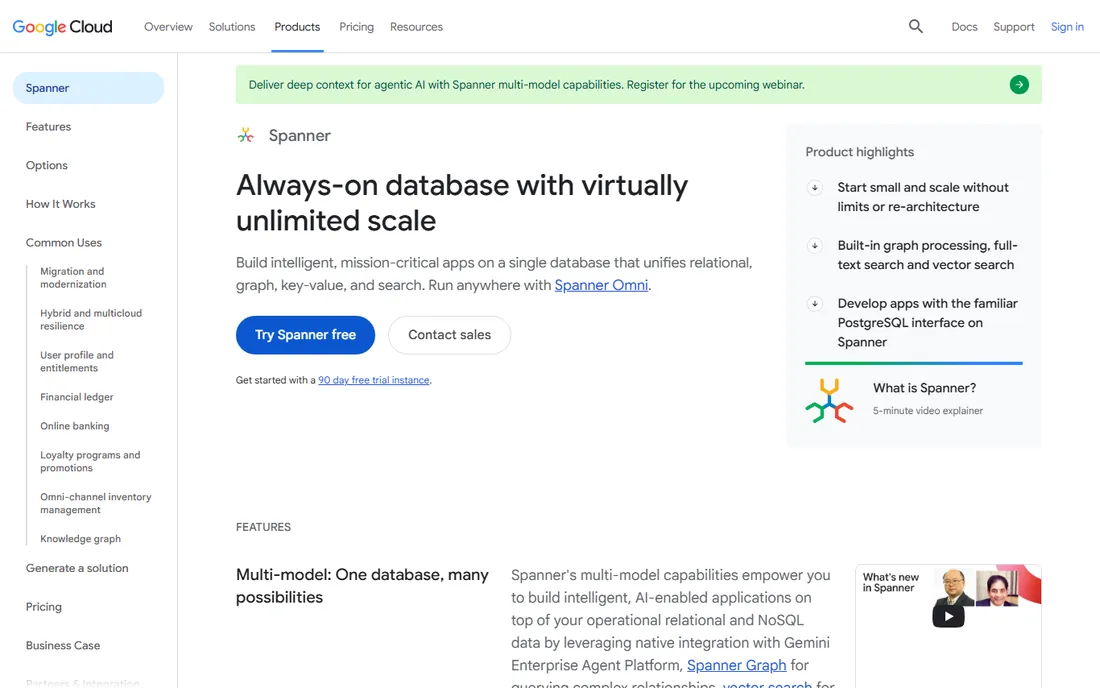
Spanner solves the problem that breaks most databases: staying strongly consistent while scaling horizontally across regions. Its TrueTime clock orders transactions globally, so applications see the same data everywhere. It now unifies relational, graph, key-value and full-text search models, and the built-in columnar engine runs analytics on live transactional data. Google positions it for financial ledgers, inventory systems and user-profile stores where correctness and scale both matter.
This is not a database you choose casually. Pricing starts around three cents per 100 processing units per hour per replica and climbs with multi-region configurations, which makes small deployments uneconomical. It is deeply tied to Google Cloud, though the downloadable Spanner Omni edition extends it to other infrastructure. For global enterprises that would otherwise build consistency on sharded MySQL, Spanner is worth it. For regional workloads, Aurora or CockroachDB usually cost less.
What we like- Horizontal scale with strong global consistency, a rare combination
- Up to 99.999% availability
- Multi-model support for relational, graph, key-value and search
Watch out for- Premium pricing that only makes sense at real scale
- Google Cloud centric, with Spanner Omni still maturing for other environments
#5
Amazon Aurora
Best for: Teams on AWS wanting MySQL or PostgreSQL compatibility with more headroom
Visit aws.amazon.com
Starting priceSee website (pay-as-you-go)
Free planFree trial
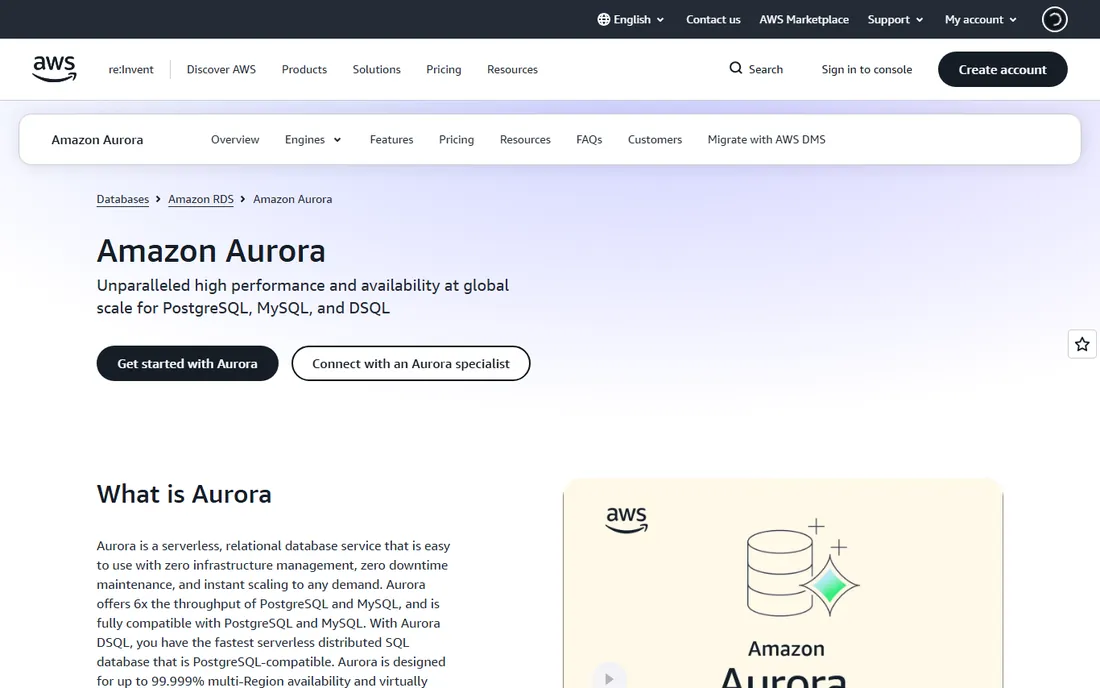
Aurora is AWS's answer to the most common enterprise database problem: MySQL and PostgreSQL workloads that outgrow a single server. AWS claims up to six times the throughput of stock MySQL and PostgreSQL, backed by distributed storage that replicates across availability zones. The serverless option removes capacity planning, and Aurora DSQL adds distributed SQL for multi-region writes. Because it speaks MySQL and PostgreSQL wire protocols, migrations are usually measured in days, not quarters.
Watch the I/O billing: Aurora charges for storage I/O on top of compute, and write-heavy workloads can surprise teams used to provisioned instances. Reserved capacity helps, but cost monitoring is not optional. Within AWS, though, Aurora is the default high-performance relational choice for a reason: it delivers genuine headroom over self-managed databases without asking teams to become database administrators.
What we like- Up to 6x the throughput of standard MySQL/PostgreSQL per AWS
- Serverless scaling with no capacity planning
- MySQL and PostgreSQL compatibility eases migration
Watch out for- Costs scale with I/O as well as compute, which surprises some teams
- Deepest value requires staying inside AWS
#6
MongoDB
Best for: Applications with evolving schemas and heavy read/write scale
Visit mongodb.com
Starting priceFree tier available; pay as you go on Atlas
Free planYes
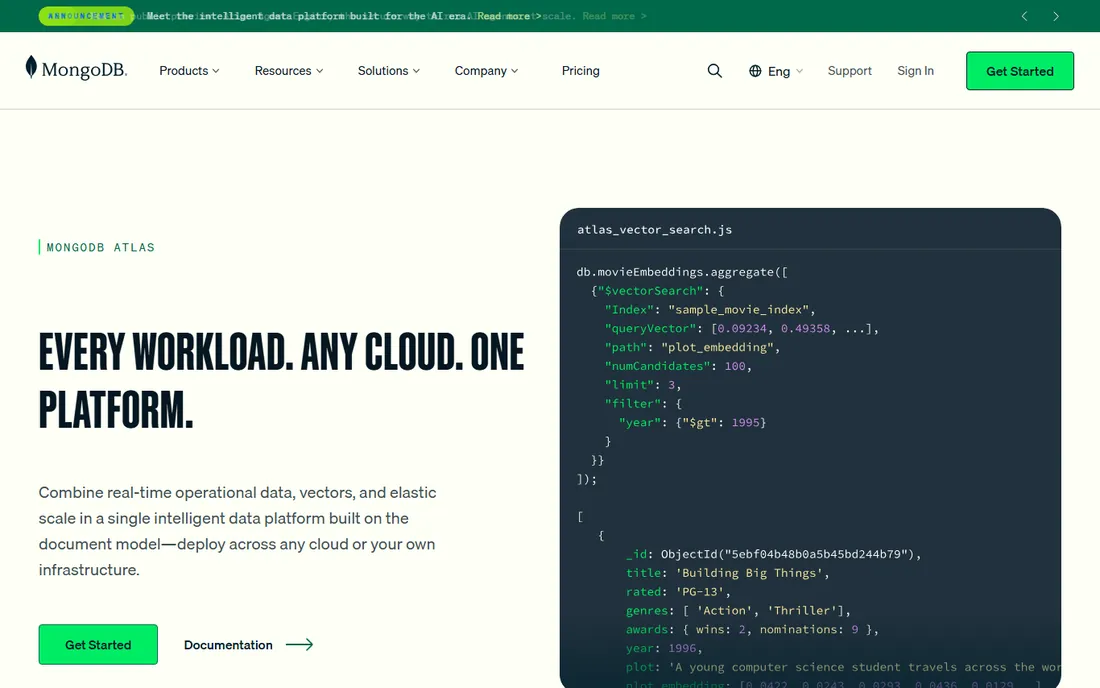
MongoDB remains the most widely deployed NoSQL database in enterprise stacks. The document model stores data the way applications use it, speeding development for catalogs, content platforms and mobile backends with evolving schemas. Atlas handles sharding, backups and scaling, and its free tier lets teams prototype without a credit card. Vector search, stream processing and in-platform analytics keep it competitive for AI-era workloads.
Performance honesty matters here. MongoDB scales reads and writes horizontally better than almost any relational database, but complex joins and analytical queries are not its strength, and multi-document ACID transactions, while supported, carry overhead. Atlas pricing is usage-based, and heavy workloads can cost more than a tuned PostgreSQL cluster. Choose MongoDB when your data is naturally document-shaped and access patterns favor operational speed over analytical depth.
What we like- Flexible document model that matches how applications think
- Horizontal sharding built in
- Atlas managed service with a genuinely free tier
Watch out for- Complex analytics and multi-document transactions lag relational databases
- Atlas costs grow fast at scale
#7
PostgreSQL
Best for: Teams that want enterprise-grade relational power without license fees
Visit postgresql.org
Starting priceFree (open source)
Free planYes
PostgreSQL is the quiet engine behind an enormous share of enterprise applications, and its performance story keeps improving. It handles complex queries, concurrent writes and JSONB workloads well, and extensions add vector search, time-series and geospatial capabilities. Version 19 is in beta as of late 2026, continuing a steady cadence of optimizer and parallelism improvements. For transactional and mixed workloads, a tuned PostgreSQL cluster embarrasses databases costing six figures a year.
The cost is operational, not financial. There is no vendor to call unless you buy support or run a managed service such as Aurora or AlloyDB. Built-in replication covers read scaling and failover, but true horizontal write scaling needs extensions like Citus or external sharding. Teams with solid database operations get world-class performance for the price of their engineers' time. Teams without it should budget for managed hosting from day one.
What we like- Completely free with no licensing traps
- Advanced features like JSONB, full-text search and extensions
- Proven reliability over decades
Watch out for- No vendor support out of the box
- Horizontal scaling needs external tooling
- You operate it yourself unless you pay for managed hosting
#8
Redis
Best for: Caching, sessions and real-time features needing sub-millisecond response
Visit redis.com
Starting priceSee website (Redis Cloud usage-based)
Free planYes (free tier)
When the requirement is speed measured in microseconds, Redis is usually the answer. It serves caching, sessions, leaderboards, rate limiting and real-time messaging at latencies disk-based databases cannot touch. Redis Cloud offers a free tier, and the Flex tier combines RAM with flash storage for terabyte-scale datasets at lower cost. Active-active geo-distribution gives local-speed reads across regions, and built-in vector search makes it a strong retrieval layer for AI applications.
The limits are physical. Memory costs more than disk, so very large datasets get expensive, and while persistence options exist, Redis is not a system of record for data you cannot afford to rebuild. Clustering and failover need care in self-managed deployments. As the speed layer in front of a durable database, Redis delivers the biggest latency improvement most applications will ever get from one decision.
What we like- Sub-millisecond latency as a matter of architecture
- Rich data structures beyond simple key-value
- Vector search for AI retrieval workloads
Watch out for- In-memory datasets get expensive at large sizes
- Persistence and clustering add operational complexity
Starting priceSee website (usage-based cloud or self-hosted)
Free planFree trial
CockroachDB brings Spanner-like architecture to teams that want PostgreSQL compatibility without Google Cloud. Data distributes automatically across nodes and regions, rebalancing as workloads change, and the database keeps serving through node and region failures. That resilience story is proven at serious scale: DoorDash runs over a petabyte of live data on it, and OpenAI uses it for identity infrastructure behind ChatGPT. The company now packages this as an agentic database cloud with automated operations, but the core remains distributed SQL done properly.
The main trade-off is physics: consensus across regions adds latency, so CockroachDB will never beat PostgreSQL on a single server. It wins when the alternative is downtime or the operational nightmare of manual sharding. Teams should also note the pricing evolution toward enterprise contracts. For global applications where availability is the performance metric that matters, it belongs on every shortlist.
What we like- PostgreSQL-compatible distributed SQL with automatic sharding and rebalancing
- Survives node and region failures without downtime
- Strong consistency across geographies
Watch out for- Higher latency than single-region databases by design
- Operational concepts take learning
- Pricing has shifted toward the enterprise tier
Starting priceSee website (custom and cloud pricing)
Free planFree trial
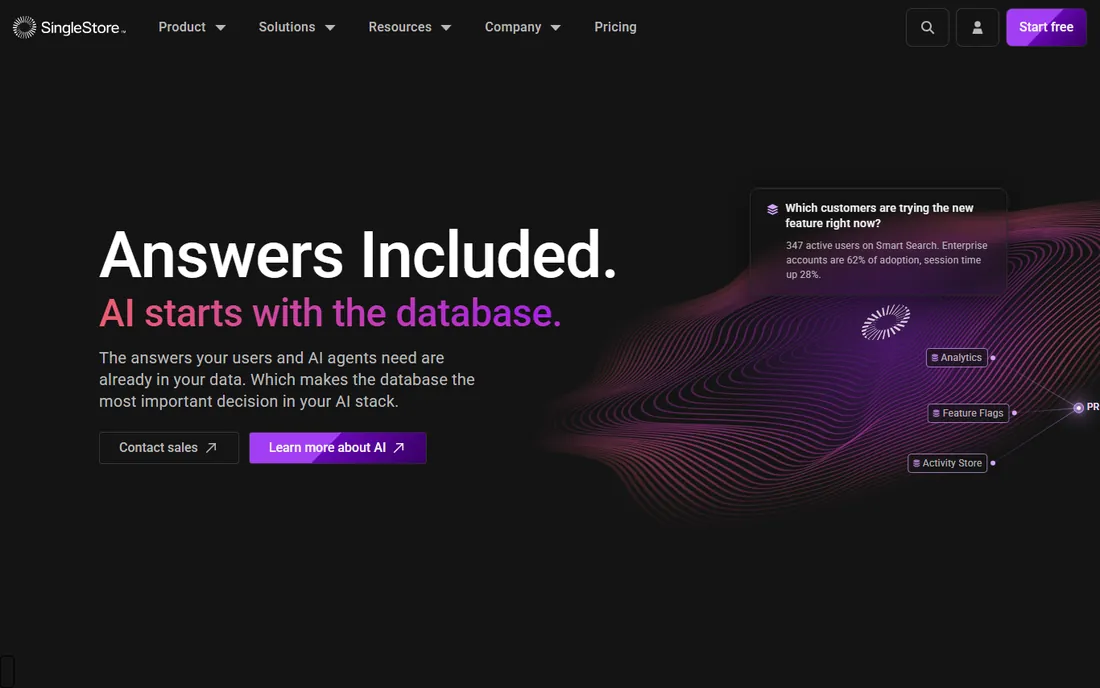
SingleStore built its reputation on HTAP: handling transactional and analytical workloads in a single engine so dashboards query live data instead of yesterday's warehouse extract. Ingestion and analytical query speeds on streaming data are genuinely impressive, which is why ad tech, fintech and SaaS companies use it for real-time personalization. MySQL wire compatibility lowers the migration barrier, and the Aura Intelligence layer adds natural-language querying for AI agents.
The honest framing is specialization. SingleStore is not trying to be everyone's primary database; it is the performance answer for workloads where analytics must run on data seconds old. The ecosystem of tooling and integrations is smaller than PostgreSQL's or Snowflake's, and pricing requires a conversation. For that specific real-time analytics problem, though, few databases keep up, and the ones that do usually cost more to operate.
What we like- One engine for transactions and analytics, no ETL pipelines
- Very fast ingestion and query on live data
- MySQL wire compatibility
Watch out for- Smaller ecosystem than the giants
- Pricing transparency lags competitors
- Best fit is narrower than general-purpose databases
How we chose
We ranked enterprise databases on sustained performance rather than marketing benchmarks: transactional throughput, analytical query speed, latency under load, availability architecture, and how performance holds as data and concurrency grow. We read vendor documentation and pricing pages, checked independent benchmark coverage and analyst evaluations, and weighed operational reality from public engineering write-ups. No vendor paid for placement, and we ignored vendor-run benchmarks that cannot be reproduced.
Every database vendor publishes a benchmark where they win, so treat performance marketing as a starting point, not evidence. The first question is what the benchmark measured: single-node throughput, distributed scale, analytical queries or mixed workloads behave nothing alike, and a database that dominates one can trail in another. The second is what hardware and configuration sat underneath, since vendor numbers usually assume tuned infrastructure you may not own.
The most useful evidence comes from your own workload: most vendors here offer free tiers or trials so teams can load a representative dataset and measure. Test with your query patterns, your concurrency and your data shape, because a benchmark on someone else's workload tells you little. Pay special attention to tail latency, not averages: the 99th percentile is what your users feel during peak load. And when a vendor claims a multiple like 6x, ask 6x of what, measured how, on which workload.
Where the money goes: licenses versus cloud bills
Enterprise database spending now splits into two models. Traditional licensing, the Oracle and SQL Server world, means large upfront or annual commitments, per-core or per-user counting, and support contracts. Costs are predictable but high, and true-ups when you grow can sting. The advantage is cost certainty for stable workloads and, with Oracle, the deepest performance tuning in the industry.
Cloud usage billing charges for what you consume: compute hours, storage, I/O operations and data transfer. It starts cheap and scales smoothly, but bills follow usage without a ceiling, and inefficient queries or unexpected traffic spikes show up as real money. The fix is governance: budgets, alerts, query monitoring and someone responsible for the bill. Most enterprises run both: steady transactional workloads on licensed capacity, analytics bursts on usage-based platforms.
Frequently asked questions
What is the fastest database for enterprise use?
It depends on the workload. For transactional throughput, Oracle AI Database and SQL Server lead on tuned infrastructure. For in-memory speed, nothing beats Redis. For analytics at scale, Snowflake, SingleStore and ClickHouse-class engines dominate. For globally distributed transactions, Spanner and CockroachDB are the reference choices. Match the database to the workload instead of chasing a single speed crown.
Should enterprises still buy Oracle or SQL Server in 2026?
Yes, when the workload justifies it. Both remain the safest choices for mission-critical transactional systems with strict availability and compliance requirements, and both have added genuine AI capabilities. The case against them is cost and lock-in, not performance. Teams with standard web application workloads usually get better value from PostgreSQL or a cloud-native service.
Is PostgreSQL really enough for enterprise workloads?
For most workloads, yes. PostgreSQL handles complex transactions, high concurrency and JSON data reliably, and managed services remove the operational burden. It needs help at the extremes: massive write scaling, global distribution and sub-millisecond latency each push teams toward specialized systems. Plenty of large companies run their core business on it.
How do cloud database costs compare to licensing?
Cloud databases start cheaper and scale with usage, which suits variable workloads, but heavy steady usage can exceed the cost of licensed software over a few years. Licensed databases cost more upfront but give predictable bills for stable workloads. The honest answer requires modeling your usage over three years, including staff time for self-managed options.
What is the difference between OLTP and OLAP databases?
OLTP databases handle day-to-day transactions: orders, payments and record updates, optimized for many small, fast writes with strong consistency. OLAP databases handle analysis: aggregations and reports over large datasets, optimized for reading massive amounts of data quickly. HTAP systems like SingleStore try to do both in one engine, which suits real-time dashboards but involves trade-offs in each direction.
Sources we checked (10)
- https://www.oracle.com/database/
- https://www.microsoft.com/en-us/sql-server
- https://snowflake.com/
- https://cloud.google.com/spanner
- https://aws.amazon.com/rds/aurora/
- https://www.mongodb.com
- https://postgresql.org/
- https://redis.com
- https://cockroachlabs.com/
- https://www.singlestore.com
Is your product missing or out of date?
We review this list regularly. Vendors can request a listing, send updated pricing or ask about featured placement.

Shihab Mia · Founder, Rankite
Shihab has spent more than a decade helping SaaS and e-commerce brands grow through search. He writes Rankite's software buying guides from pricing pages, documentation and public user reviews. More about Shihab.