How we make this list: we compare pricing pages, product documentation and public user reviews. Rankite is independent; if a vendor ever pays for a featured spot, that listing is clearly labeled Partner.
Key takeaways
- Brightflag is the only vendor here with published pricing (Standard from $12,000 per year) and leads on AI-driven invoice review.
- Thomson Reuters Legal Tracker remains the safe enterprise default, with the largest installed base among big corporate legal departments.
- SimpleLegal and Mitratech Acuity ELM Essentials fit mid-market teams that find full enterprise suites too heavy and too slow to deploy.
- Apperio and Lawcadia are the newer options for teams that want modern software without a six-month implementation project.
Quick comparison
| Tool | Best for | Starting price | Free plan |
|---|
 Brightflag Brightflag | Legal teams that want AI invoice review with published pricing | $12,000/year (Standard; usage-based fees apply) | No |
 Onit Onit | Legal operations teams that need deep workflow configurability | See website | No |
 Thomson Reuters Legal Tracker Thomson Reuters Legal Tracker | Large enterprises that want the proven incumbent | See website | No |
 SimpleLegal SimpleLegal | Mid-market teams modernizing from spreadsheets and email | See website | No |
 Mitratech Mitratech | Companies that want a choice between enterprise depth and small-business simplicity | See website | No |
 Wolters Kluwer ELM Solutions Wolters Kluwer ELM Solutions | Enterprises that want benchmarking data behind their spend decisions | See website | No |
 Apperio Apperio | Legal teams that want real-time visibility into spend as it happens | See website | No |
 Lawcadia Lawcadia | In-house teams that want matter management and spend control in one system | See website | No |
 Persuit Persuit | Legal departments rethinking how they select outside counsel | See website | No |
Is your product missing or out of date?
We review this list regularly. Vendors can request a listing, send updated pricing or ask about featured placement.
The best legal spend management software
#1
Brightflag
Best for: Legal teams that want AI invoice review with published pricing
Visit brightflag.com
Starting price$12,000/year (Standard; usage-based fees apply)
Free planNo
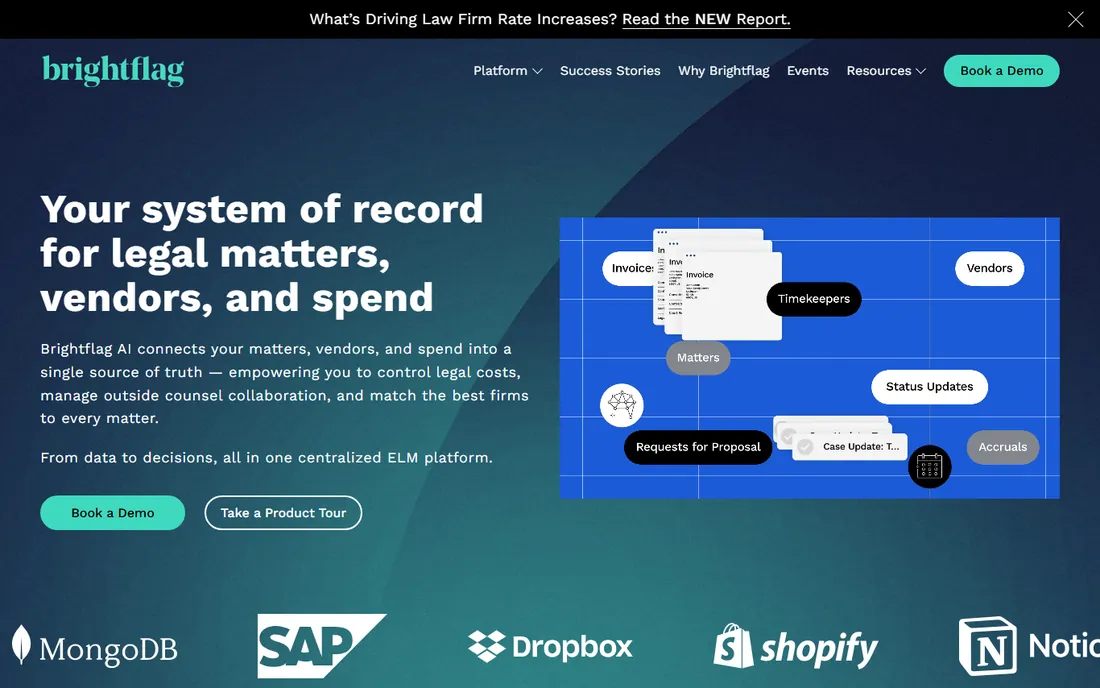
Brightflag is the vendor most likely to show you a price before the third demo. Standard starts at $12,000 per year and Enterprise at $36,000, with usage-based components on top. That transparency is rare in this category and a genuine advantage when you need budget approval. The product itself centers on AI-assisted invoice review: billing guidelines are applied automatically, and questionable line items get flagged before a human reviewer opens the invoice.
Founded in 2014 in Ireland, Brightflag has grown into one of the highest-rated options among corporate legal teams, with reviewers frequently citing cost savings from caught billing errors. The honest catch is the variable pricing: on large spend volumes, the per-dollar and per-matter fees add meaningfully to the base subscription, so model it against your actual annual legal spend. There is also no self-serve trial, which is standard for the category but worth knowing.
What we like- AI-driven invoice review that flags noncompliant line items
- Transparent published pricing
- Strong reviewer ratings for ROI
Watch out for- Usage-based fees add $0.004 per dollar of legal spend plus $0.05 per open matter
- No free trial to evaluate before the sales process
#2
Onit
Best for: Legal operations teams that need deep workflow configurability
Visit onit.com
Starting priceSee website
Free planNo
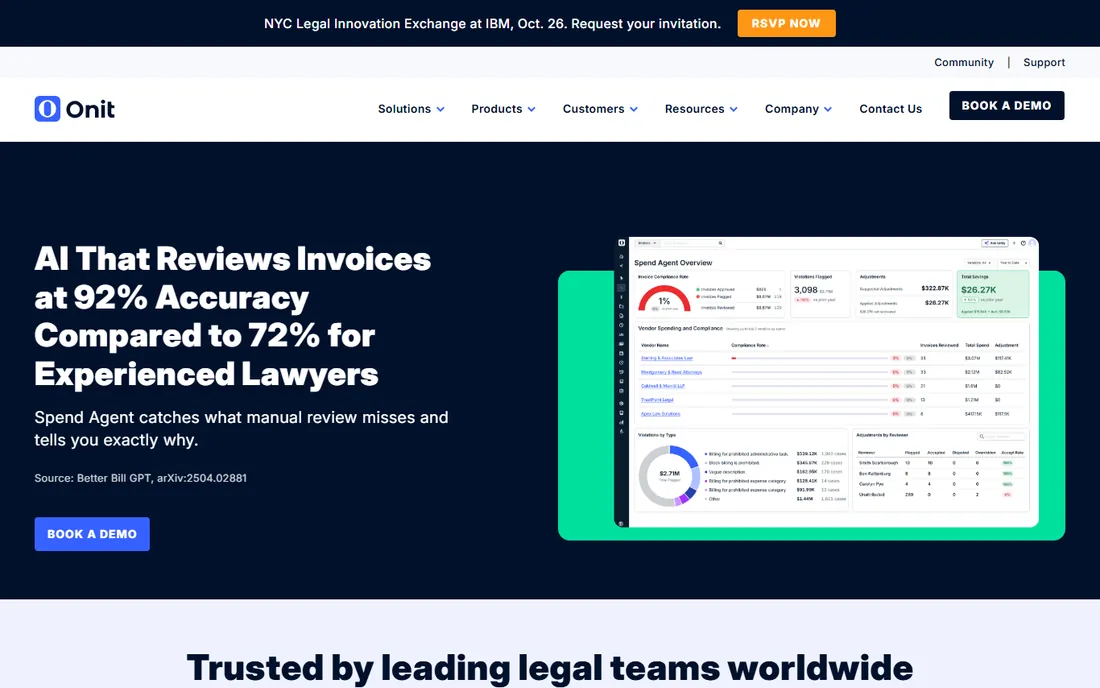
Onit sells configurability. Where some competitors give you a fixed e-billing workflow, Onit lets legal operations teams build approval chains, matter workflows, and spend controls that match how the department actually works. Reviewers praise the reporting and budget management, and the platform extends well beyond invoices into contract lifecycle management and legal automation.
That flexibility has a price beyond the quote. Implementations take longer because there is more to configure, and you will want someone internally who owns the system after go-live. Onit publishes no pricing, so expect an enterprise sales cycle. It fits sophisticated legal ops teams with the staff to wield the configurability; smaller teams often find it more system than they can feed.
What we like- Highly configurable workflows and business rules
- Strong reporting and budget management
- Broad ELM suite beyond e-billing
Watch out for- Quote-only pricing with no public numbers
- Configurability means longer, more expensive implementations
Starting priceSee website
Free planNo
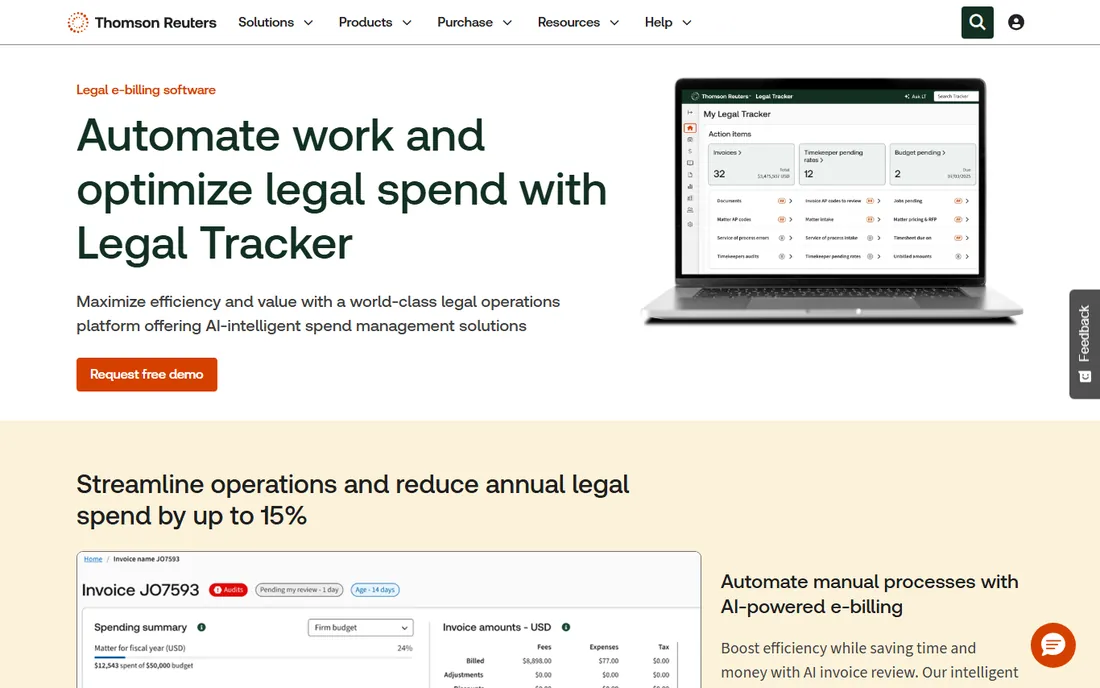
Legal Tracker is the incumbent, and in legal technology that counts for a lot. It is one of the most widely adopted e-billing and matter management systems in the world, with deep penetration among large corporate legal departments and a network of tens of thousands of law firms already submitting invoices through it. That network effect matters: your outside counsel probably already knows how to bill into Legal Tracker.
The trade-offs are the ones incumbents always carry. The interface shows its age, new users typically need training, and implementations can drag when global billing rules and multi-entity structures are involved. Pricing is quote-only. Choose Legal Tracker when reliability, vendor stability, and law-firm familiarity outweigh the appeal of newer interfaces.
What we like- Largest installed base among Fortune 500 legal departments
- Proven at huge invoice volumes
- Broad integration options including NetSuite
Watch out for- Interface feels dated and usually needs training
- Implementation projects can be resource-heavy
#4
SimpleLegal
Best for: Mid-market teams modernizing from spreadsheets and email
Visit onit.com
Starting priceSee website
Free planNo
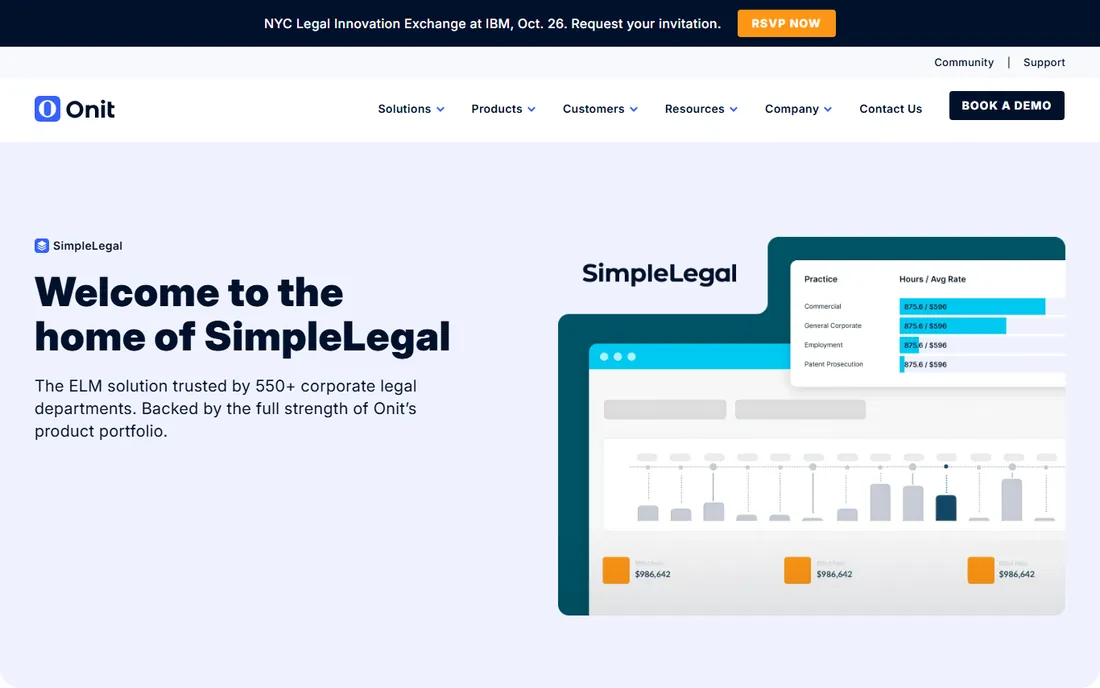
SimpleLegal exists for the legal team that finds Onit and Legal Tracker too much. It covers the essentials, electronic invoicing, matter management, budgeting, and reporting, in an interface that new users pick up quickly. Implementation timelines are shorter than the enterprise alternatives, which is exactly the point: many mid-market teams are moving off spreadsheets and email approvals, not off a legacy ELM system.
Note the ownership: SimpleLegal was acquired by Onit and now sits inside Onit's enterprise legal management lineup. That brings platform stability and a broader product ecosystem, though it also means the product roadmap follows Onit's priorities. Pricing is quote-only. It is the pragmatic pick for a first e-billing system when the team has no dedicated legal ops staff.
What we like- Straightforward e-billing that deploys faster than enterprise suites
- Clean, easy-to-learn interface
- Now backed by Onit's platform and resources
Watch out for- Less depth for complex global billing scenarios
- Advanced analytics lag the enterprise players
#5
Mitratech
Best for: Companies that want a choice between enterprise depth and small-business simplicity
Visit mitratech.com
Starting priceSee website
Free planNo
Mitratech covers both ends of the market, which is unusual. TeamConnect is the enterprise-grade option with highly customizable matter management that reviewers rate well for flexibility. Acuity ELM Essentials, by contrast, is positioned for small-business legal teams that need e-billing and spend control without enterprise overhead. Having both under one vendor simplifies the conversation if the company might grow from one to the other.
The lineup can confuse, though: buyers need to figure out early which product they are actually evaluating, because the implementation effort differs enormously. Pricing is quote-only for both. Mitratech suits organizations that want a vendor with decades of enterprise experience and a path that scales with the legal department.
What we like- TeamConnect offers deep customization for complex departments
- Acuity ELM Essentials serves smaller legal teams
- Long enterprise track record
Watch out for- Two-product lineup can confuse buyers
- Quote-only pricing across the board
#6
Wolters Kluwer ELM Solutions
Best for: Enterprises that want benchmarking data behind their spend decisions
Visit wolterskluwer.com
Starting priceSee website
Free planNo
Wolters Kluwer ELM Solutions, built around TyMetrix 360 and Passport, brings something the others cannot easily replicate: one of the largest pools of historical legal billing data in the industry. That data feeds rate benchmarking, so you can see whether a firm's proposed rates are above market, and predictive analytics for matter budgeting. For legal departments managing hundreds of millions in outside counsel spend, those benchmarks alone can justify the system.
The cost is complexity. This is an enterprise platform with an enterprise sales cycle, quote-only pricing, and implementations that reviewers describe as resource-intensive. Smaller teams will find it overwhelming. It belongs on the shortlist when the legal budget is large enough that a few percentage points of savings dwarf the software cost.
What we like- Massive historical spend database powers rate benchmarking and predictive analytics
- TyMetrix 360 is battle-tested at scale
- Global compliance depth
Watch out for- Enterprise sales process with no public pricing
- Implementations are among the heaviest in the category
#7
Apperio
Best for: Legal teams that want real-time visibility into spend as it happens
Visit apperio.com
Starting priceSee website
Free planNo

Apperio takes a narrower approach than the ELM suites: instead of focusing only on invoices after the fact, it tracks work in progress as law firms log it, giving the legal department live visibility into spend before the bill arrives. Founded in 2012 in the UK, it has built a following among in-house teams frustrated by learning what a matter cost only when the invoice lands sixty days later.
The trade is breadth. Apperio does spend visibility exceptionally well but does not try to be a full matter management or contract suite, so teams needing the whole ELM stack will pair it with other tools or choose a broader vendor. Pricing is not published. It fits legal departments whose core pain is surprise invoices rather than workflow complexity.
What we like- Live tracking of work in progress before invoices arrive
- Modern interface
- Faster deployment than legacy suites
Watch out for- No published pricing information
- Narrower feature set than full ELM suites
#8
Lawcadia
Best for: In-house teams that want matter management and spend control in one system
Visit lawcadia.com
Starting priceSee website
Free planNo

Lawcadia comes from Australia, founded in 2015, and has grown into a credible alternative to the US incumbents for in-house legal teams. The platform combines matter management, legal spend management, e-billing, and tools for engaging outside counsel, so a mid-size department can run its core workflows in one system. Integrations with Microsoft 365, iManage, and NetDocuments cover the document side.
As a smaller vendor, Lawcadia cannot match the partner networks or benchmark databases of Thomson Reuters or Wolters Kluwer, and pricing is quote-only. But buyers consistently cite ease of use and responsive support. It deserves a look from teams that want modern software and a vendor that still treats them like a flagship account.
What we like- Combines matter management, e-billing, and outside counsel engagement
- Modern cloud interface
- Strong in Australia, UK, and expanding markets
Watch out for- Smaller vendor with a thinner partner ecosystem
- No published pricing
#9
Persuit
Best for: Legal departments rethinking how they select outside counsel
Visit persuit.com
Starting priceSee website
Free planNo

Persuit attacks a different part of the problem. Rather than reviewing invoices after work is done, it runs competitive, data-driven RFPs when engaging outside counsel: firms submit comparable proposals, the department forecasts costs with more certainty, and the platform tracks bidding behavior and outcomes over time. For high-value matters, getting three competitive bids routinely saves more than months of invoice line-item review.
That focus is also the limitation. Persuit is not a full e-billing or matter management suite, so most buyers deploy it alongside an invoice review tool rather than instead of one. Pricing is quote-only. Consider Persuit when the biggest savings opportunity is in how work gets awarded, not in how invoices get checked.
What we like- Competitive RFP process for legal work drives measurable savings
- Forecasting tools show matter costs before engagement
- Captures structured engagement data
Watch out for- Focused on counsel selection rather than full e-billing
- Works best alongside, not instead of, an invoice review system
How we chose
We researched this category through vendor product pages and documentation, G2 comparison data, and practitioner-focused legal technology publications. Every tool listed is an active product serving corporate legal departments today; where acquisitions changed ownership, such as SimpleLegal joining Onit, we used the current product home. Pricing in this category is almost entirely quote-based, so we published the one verified public price we found, Brightflag's, and marked the rest as quote-only rather than repeating unverified estimates. We did not run hands-on trials; enterprise legal software is sold, not self-served.
Why these projects stall
Legal spend software fails more often from process gaps than from bad products, and the patterns repeat. First, billing guidelines go in dirty: if outside counsel guidelines are vague or contradictory, no invoice review engine can enforce them, AI or rules-based. Second, law firm adoption lags: firms that cannot or will not submit compliant electronic invoices blunt the whole system, so adoption planning belongs in the contract phase. Third, implementations drag when the legal department underestimates data cleanup; migrating years of matter history takes longer than the software setup. Fourth, shelfware: teams buy the enterprise suite, use only e-billing, and pay for modules nobody opens. Define the three outcomes you need, buy for those, and expand later.
What to ask on the demo call
The demo will look impressive regardless of vendor. These questions separate fit from theater.
How does invoice review actually work: rules, AI, or both?
Ask to see a real noncompliant line item get flagged, not a slide. Rules-based systems need your guidelines encoded precisely; AI-assisted systems like Brightflag's learn patterns but still need clean guidelines to start. Find out who maintains the rule set and how often it needs tuning.
What does implementation really take?
Ask for a reference customer of your size and matter volume, then ask that customer, not the salesperson, how long data migration took. SimpleLegal and Lawcadia typically deploy faster than Legal Tracker or TyMetrix; Onit's timeline depends entirely on how much you customize.
Can it enforce our billing guidelines automatically?
Get specific: block billing, vague time entries, rate increases without approval, expenses over thresholds. Ask what percentage of invoices typically pass without human touch after six months, and what happens to the ones that do not.
What is the total cost, including usage fees?
The subscription is only the start. Brightflag adds per-dollar and per-matter fees; others may charge by user, matter, or invoice volume. Ask for a written total-cost model based on your matter count and annual spend before you sign.
Frequently asked questions
How long does implementation take?
It ranges from weeks to the better part of a year. Mid-market tools like SimpleLegal or Lawcadia can go live in one to three months with clean data. Enterprise suites like Legal Tracker, Onit, or TyMetrix 360 typically take three to nine months once global billing rules, integrations, and historical data migration are included.
Will our law firms actually use it?
Most large firms already submit electronic invoices through at least one major platform, usually Legal Tracker or TyMetrix, because their biggest clients require it. Smaller firms may need onboarding help. Ask vendors about their law firm onboarding program and what percentage of invoices arrive as clean LEDES files versus PDFs that need conversion.
What is LEDES and why does it matter?
LEDES is the standard electronic format for legal invoices, and UTBMS codes classify the work described in each line item. Together they let software apply billing guidelines automatically instead of relying on humans reading PDFs. Any serious spend management deployment standardizes on LEDES; vendors that cannot ingest it cleanly are not worth evaluating.
Can the software enforce billing guidelines on its own?
Partly. Rules engines reliably catch clear violations like blocked time entries or unauthorized rate increases. Judgment calls, such as whether research time was reasonable, still need human reviewers. The realistic goal is reducing manual review volume by a large share, not eliminating it.
How is pricing usually structured?
Almost always quote-based, built from some combination of users, matters, invoice volume, and legal spend under management. Brightflag is the exception with published packages from $12,000 per year plus usage fees. Always ask for the total-cost model in writing, including implementation and any per-matter or per-dollar charges.
Sources we checked (8)
- https://www.g2.com/compare/brightflag-vs-onit-inc-onit-enterprise-legal-management
- https://Slashdot.org/software/comparison/Brightflag-vs-SimpleLegal/
- https://slashdot.org/software/comparison/Brightflag-vs-SimpleLegal-vs-Thomson-Reuters-Legal-Tracker/
- https://sourceforge.net/software/compare/Brightflag-vs-SimpleLegal-vs-Thomson-Reuters-Legal-Tracker/
- https://legalitcost.com/c/legal-expense-management/guide/pdf
- https://slashdot.org/software/comparison/Apperio-vs-Lawcadia/
- https://ccbjournal.com/blog/legal-tech-startup-spotlight-pursuit
- https://vocal.media/lifehack/top-10-e-billing-software-platforms-revolutionizing-legal-spend-in-2025
Is your product missing or out of date?
We review this list regularly. Vendors can request a listing, send updated pricing or ask about featured placement.

Shihab Mia · Founder, Rankite
Shihab has spent more than a decade helping SaaS and e-commerce brands grow through search. He writes Rankite's software buying guides from pricing pages, documentation and public user reviews. More about Shihab.