How we make this list: we compare pricing pages, product documentation and public user reviews. Rankite is independent; if a vendor ever pays for a featured spot, that listing is clearly labeled Partner.
Key takeaways
- CockroachDB, TiDB and YugabyteDB all offer free tiers that let you run a small distributed SQL database at no cost, which makes them the cheapest way to start with horizontal scaling.
- MongoDB Atlas (M0), DynamoDB (25 GB always-free) and SingleStore (Free Shared Edition) also give you genuinely free starting points on the NoSQL side.
- PlanetScale, Amazon Aurora and ScyllaDB have no free tier for their managed services, so budget for paid usage from the start.
- SQL options (CockroachDB, YugabyteDB, TiDB, PlanetScale, Aurora, Spanner, SingleStore) fit teams that want familiar SQL with horizontal scale; NoSQL options (DynamoDB, MongoDB Atlas, ScyllaDB) fit key-value, document and wide-column workloads.
- Almost every vendor here bills usage-based (request units, compute hours or storage), so model your workload before committing to an annual plan.
Here is the blunt version: most teams do not need a distributed database. A single Postgres or MySQL instance handles far more than people expect. But when your workload genuinely outgrows one node, whether from traffic, data size or a global user base, you need a database that scales horizontally by adding nodes instead of buying a bigger server. The ten options below all do that, and they split into distributed SQL databases and scalable NoSQL databases.
Quick comparison
| Tool | Best for | Starting price | Free plan |
|---|
 CockroachDB CockroachDB | Teams wanting PostgreSQL-compatible distributed SQL | See website (usage-based; Basic tier starts free) | Yes (Basic tier: 50M request units and 10 GB storage free monthly; $400 new-user credits) |
 YugabyteDB YugabyteDB | PostgreSQL workloads needing multi-region resilience | See website (pay-as-you-go and subscription) | Yes (free Sandbox tier) |
 ScyllaDB ScyllaDB | High-throughput NoSQL workloads with Cassandra compatibility | See website | Free trial (no credit card required) |
 TiDB TiDB | MySQL-compatible workloads that need elastic scale | See website (usage-based) | Yes (Starter: 5 GiB row storage, 5 GiB columnar storage, 50M request units free monthly) |
 PlanetScale PlanetScale | MySQL and Postgres teams wanting sharding without the pain | $5/month (single-node Postgres) | No |
 Amazon DynamoDB Amazon DynamoDB | AWS-native applications needing serverless key-value scale | See website (pay-as-you-go) | Yes (always-free: 25 GB storage, 25 read and write capacity units) |
 MongoDB Atlas MongoDB Atlas | Document workloads with flexible schemas | $8/month (Flex tier, 0-100 ops/sec) | Yes (M0: 512 MB storage, free forever) |
 Amazon Aurora Amazon Aurora | AWS teams wanting cloud-native relational scale | See website (pay-as-you-go, per instance-hour plus storage) | No |
 Google Spanner Google Spanner | Global applications needing strong consistency at any scale | See website (usage-based, per processing unit and storage) | Free trial (90-day instance with 10 GB storage) |
 SingleStore SingleStore | Real-time analytics and transactions in one engine | $0.99/hour (S-00 size, Standard edition) | Yes (Free Shared Edition cluster) |
Is your product missing or out of date?
We review this list regularly. Vendors can request a listing, send updated pricing or ask about featured placement.
The best scalable database software options
Starting priceSee website (usage-based; Basic tier starts free)
Free planYes (Basic tier: 50M request units and 10 GB storage free monthly; $400 new-user credits)
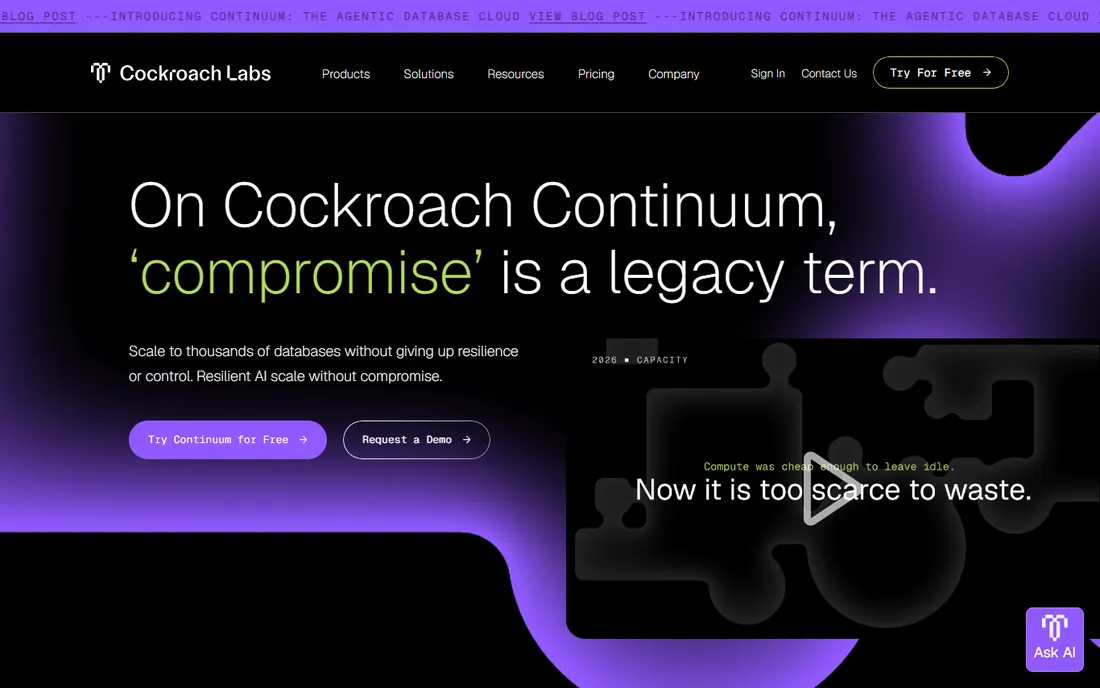
CockroachDB is the reference point for distributed SQL: it spreads the familiar relational model across nodes, zones and regions while keeping ACID guarantees. The company rebuilt its cloud offering around Basic, Standard and Advanced tiers, with Basic starting free, and new users get $400 in credits for the first 30 days.
The honest catch is cost modeling. Request-unit pricing is fair at scale but unfamiliar, and teams used to paying per instance need to learn a new mental model. Run your actual workload on the free tier first and watch the request-unit consumption before signing anything.
What we like- Speaks the PostgreSQL wire protocol, so existing drivers and ORMs work with minimal changes
- Automatic sharding and rebalancing with no manual intervention
- Survives node, zone and region failures by design
Watch out for- Usage-based pricing on request units can be hard to predict for new workloads
- Enterprise features like advanced security sit on paid tiers
#2
YugabyteDB
Best for: PostgreSQL workloads needing multi-region resilience
Visit yugabyte.com
Starting priceSee website (pay-as-you-go and subscription)
Free planYes (free Sandbox tier)
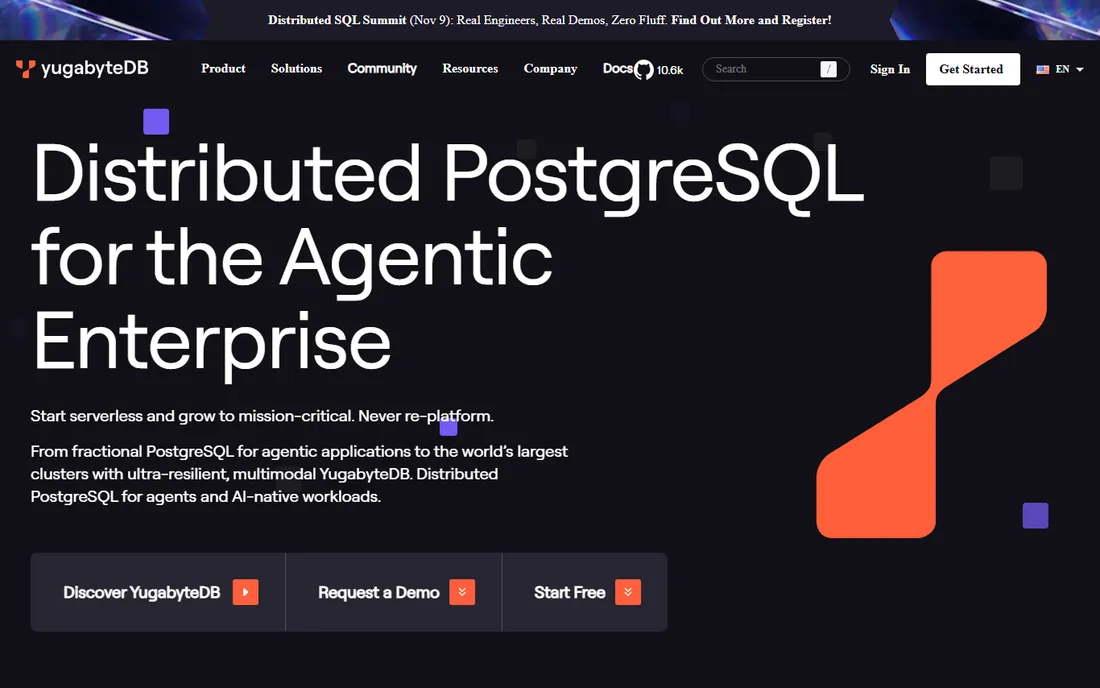
YugabyteDB takes a similar philosophy to CockroachDB but leans harder into multi-model support: relational, document, key-value and vector workloads in one engine. Its managed service, YugabyteDB Aeon, offers a free Sandbox tier with a single node, 2 vCPUs and 10 GB of storage.
This is a strong pick when data residency matters. YugabyteDB handles geo-partitioning natively, so you can keep EU data in the EU and US data in the US while running one logical database. Teams that just need single-region scale may find the operational surface larger than they need.
What we like- Full PostgreSQL compatibility with extensions, not a dialect
- Single-node Sandbox tier is free for learning and testing
- Native vector search and document APIs consolidate workloads
Watch out for- Paid pricing requires a sales conversation for most production configurations
- Multi-region setups need careful planning around data placement
#3
ScyllaDB
Best for: High-throughput NoSQL workloads with Cassandra compatibility
Visit scylladb.com
Starting priceSee website
Free planFree trial (no credit card required)

ScyllaDB is the performance play in the NoSQL world. It reimplements the Cassandra data model in C++ for dramatically better throughput per node, which means fewer nodes for the same workload and lower infrastructure bills. The managed ScyllaDB Cloud (now ScyllaDB X Cloud) offers a free trial to explore at no cost.
The trade-off is the commercial model. There is no forever-free tier, and pricing is not public, so you will go through a sales process. Teams already running Cassandra get the most value, since migration is the path of least resistance.
What we like- Drop-in Cassandra compatibility eases migration from Apache Cassandra
- Single-digit millisecond latency at millions of operations per second
- Free trial requires no credit card
Watch out for- No permanent free tier on the managed cloud service
- Pricing is not published and requires contacting sales
#4
TiDB
Best for: MySQL-compatible workloads that need elastic scale
Visit pingcap.com
Starting priceSee website (usage-based)
Free planYes (Starter: 5 GiB row storage, 5 GiB columnar storage, 50M request units free monthly)
TiDB is the MySQL answer to distributed SQL, built by PingCAP and proven at companies like Pinterest and Square. TiDB Cloud Starter gives each instance a free monthly quota, which is enough for prototypes, side projects and per-engineer dev databases, and it scales to zero when idle.
For teams already on MySQL, TiDB is the lowest-friction path to horizontal scale: no application rewrites, no new query language. The catch is the jump from free Starter to paid Essential, which is priced for production workloads, so validate your usage pattern on Starter before migrating real traffic.
What we like- MySQL wire compatibility means existing apps connect unchanged
- Starter tier is genuinely free with a monthly quota and up to five free instances per org
- Unifies transactions, analytics and vector search in one engine
Watch out for- Advanced features like change data capture require paid Essential or Dedicated tiers
- Dedicated production clusters start around $1,376/month
Starting price$5/month (single-node Postgres)
Free planNo
PlanetScale's story is sharding made manageable. For MySQL, it uses Vitess to shard across nodes; for Postgres, it built Neki for horizontal sharding. The platform's standout features are database branching (like Git branches for your database) and deploy requests for zero-downtime schema changes.
Be aware of the commercial history: PlanetScale removed its free Hobby tier in 2024, so every workload costs something. The $5/month single-node Postgres database is the cheapest entry point and suits development and small projects, while sharded production clusters cost significantly more.
What we like- Built on Vitess (the sharding system YouTube built for MySQL), so horizontal scaling is proven at extreme scale
- Database branching and deploy requests make schema changes safe
- $5/month single-node Postgres is a cheap starting point
Watch out for- No free tier since the Hobby plan was removed in 2024
- Sharding adds real complexity for teams that have never operated it
#6
Amazon DynamoDB
Best for: AWS-native applications needing serverless key-value scale
Visit aws.amazon.com
Starting priceSee website (pay-as-you-go)
Free planYes (always-free: 25 GB storage, 25 read and write capacity units)
DynamoDB is the default answer for key-value workloads on AWS. The always-free tier (25 GB storage, 25 provisioned read and write capacity units) never expires, which makes it genuinely free for small apps and prototypes.
The honest catch is data modeling. DynamoDB rewards single-table design and punishes ad-hoc queries; teams that treat it like a relational database end up frustrated and overcharged. Learn its access-pattern-first modeling approach before committing, or pair it with a relational database for the parts of your app that need flexible queries.
What we like- Virtually unlimited scale with single-digit millisecond latency
- Always-free tier covers 25 GB and modest throughput permanently
- On-demand mode bills purely per request with no capacity planning
Watch out for- AWS-only, so it locks you into one cloud
- Querying is limited compared to SQL and complex access patterns need careful data modeling
Starting price$8/month (Flex tier, 0-100 ops/sec)
Free planYes (M0: 512 MB storage, free forever)
MongoDB Atlas is the managed home of the document database, running on AWS, Azure and GCP with automated sharding for horizontal scale. The M0 free tier (512 MB, shared resources) is genuinely free forever, and the $8/month Flex tier covers dev workloads up to 100 operations per second.
Watch the pricing curve. Atlas looks cheap at the free and Flex tiers, but production dedicated clusters start around $57/month for M10 and climb steeply from there.
What we like- M0 free tier never expires and suits learning and prototypes
- Document model fits applications with evolving schemas
- Built-in search, vector search and stream processing reduce the need for extra systems
Watch out for- Costs escalate quickly once you need dedicated clusters (M10 starts around $57/month)
- SSPL licensing means it is not OSI-approved open source
Starting priceSee website (pay-as-you-go, per instance-hour plus storage)
Free planNo
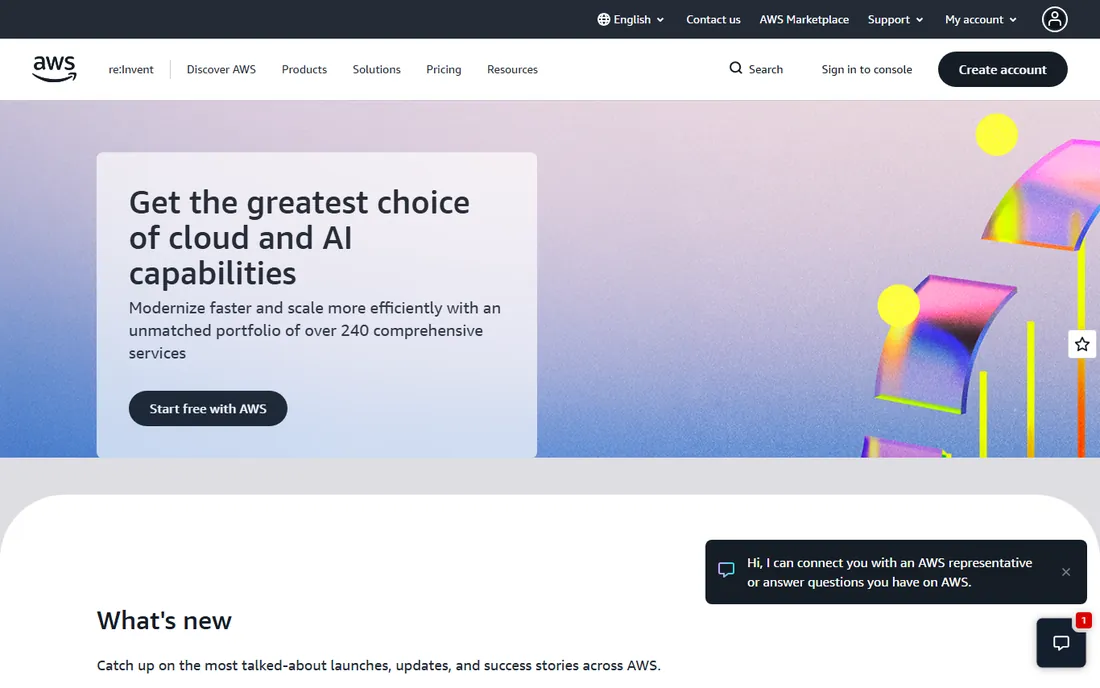
Aurora is AWS's cloud-native relational database, compatible with MySQL and PostgreSQL but rebuilt for the cloud with a distributed storage layer. It scales reads horizontally through replicas and handles storage growth automatically, which removes the two most common scaling headaches for relational workloads.
The honest catch is cost and lock-in. Aurora is not in the AWS free tier, and its pricing has more components than standard RDS. It is also AWS-only by design. Teams already committed to AWS get the most value; multi-cloud teams should look at CockroachDB or YugabyteDB instead.
What we like- MySQL and PostgreSQL compatibility with up to 15 read replicas and fast failover
- Storage auto-scales up to 128 TB with continuous backup
- Deep integration with the rest of AWS
Watch out for- Not included in the AWS free tier, so every cluster costs money from day one
- Aurora-specific pricing (I/O charges on standard clusters) can surprise teams used to RDS
Starting priceSee website (usage-based, per processing unit and storage)
Free planFree trial (90-day instance with 10 GB storage)
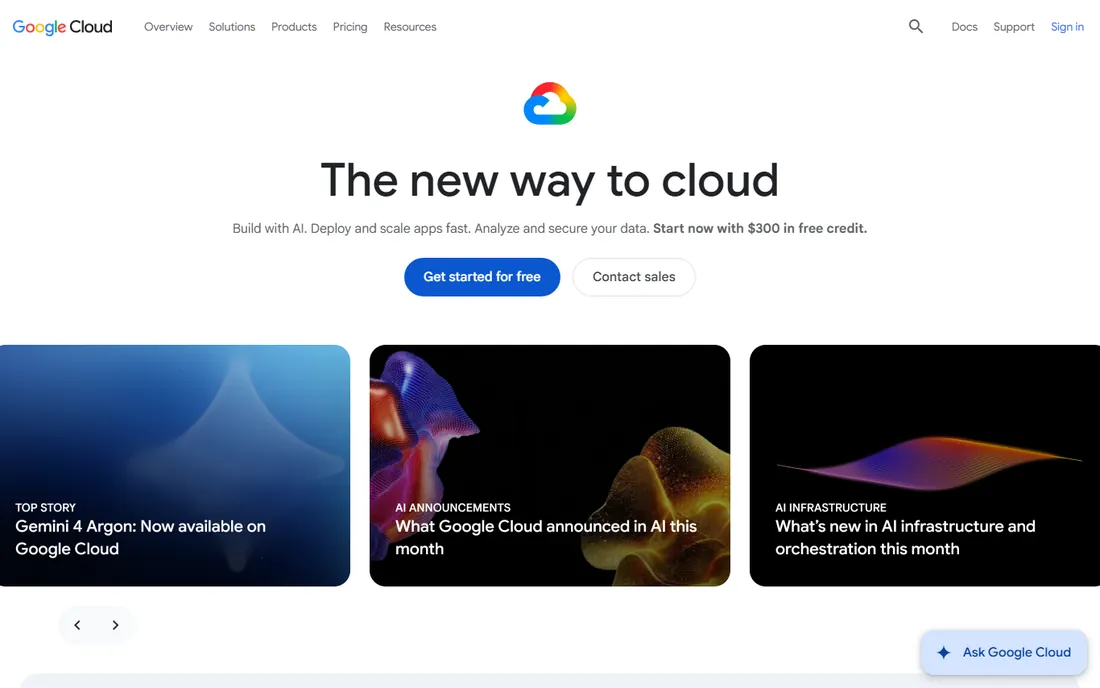
Spanner is the database that proved global strong consistency was possible at scale. It shards automatically across regions while keeping ACID transactions, which makes it the choice for applications that cannot tolerate eventual consistency across continents.
Google offers a 90-day free trial instance with 10 GB of storage, plus $300 in new-customer credits. Beyond the trial, Spanner is priced for enterprises: model your processing-unit and storage needs carefully, because it is easy to overprovision. Teams already on Google Cloud with global requirements get the most value.
What we like- Global strong consistency with 99.999% availability SLA
- Relational, graph, key-value and search models in one database
- 90-day free trial instance for evaluation
Watch out for- No permanent free tier
- Historically one of the more expensive options per unit of compute, so cost modeling matters
Starting price$0.99/hour (S-00 size, Standard edition)
Free planYes (Free Shared Edition cluster)
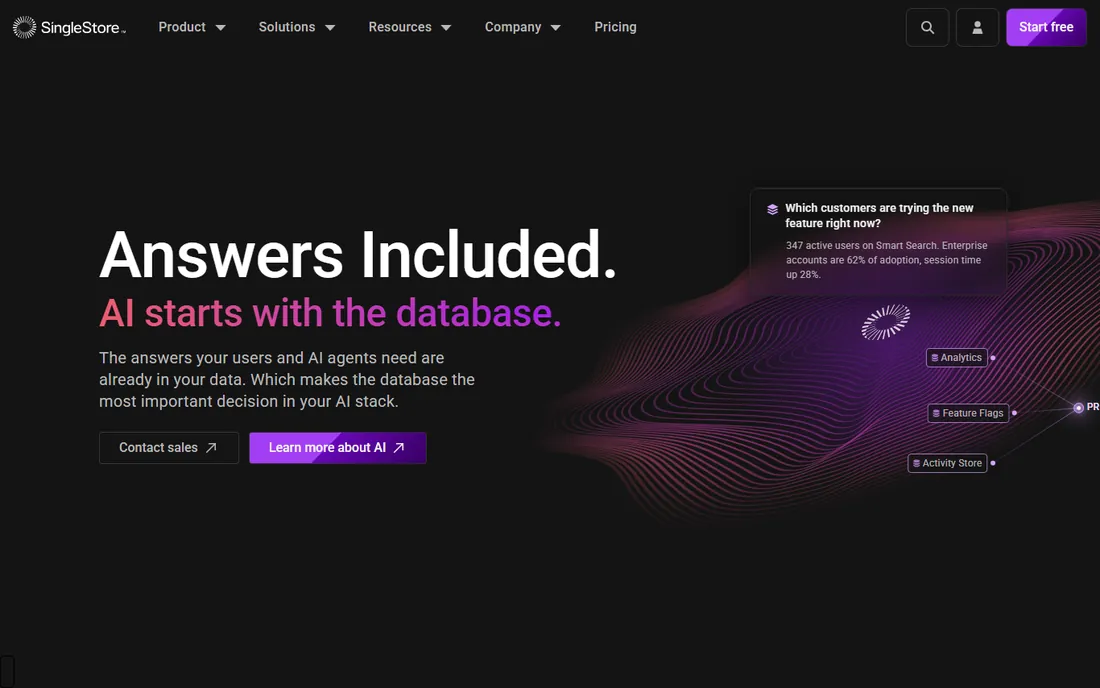
SingleStore built its reputation on HTAP: one engine that handles both fast transactions and analytical queries, so teams stop piping data between an OLTP database and a warehouse. The managed Helios service bills in compute credits (from $0.99/hour for the smallest size), and a Free Shared Edition cluster lets you prototype at no cost.
The pricing model takes some learning. Credits are consumed per hour based on deployment size, region tier and edition, so set up billing alerts early. For real-time dashboards, fraud detection and operational analytics, the single-engine approach genuinely simplifies architecture.
What we like- HTAP engine runs transactions and analytics on the same data with no ETL
- Free Shared Edition cluster for prototypes
- MySQL wire compatibility eases migration
Watch out for- Credit-based pricing is unfamiliar and needs monitoring
- Shared free clusters are limited to one region and not for production
What to check before you commit to a scalable database
First, confirm you actually need horizontal scale. A single well-tuned Postgres or MySQL instance handles thousands of transactions per second. Move to a distributed database when you have a concrete reason: data that exceeds one server, traffic that exceeds one server, or users spread across continents who all need low latency.
Second, pick your model deliberately. Distributed SQL (CockroachDB, YugabyteDB, TiDB, Spanner, Aurora, SingleStore, PlanetScale) keeps the relational model and SQL you know. NoSQL (DynamoDB, MongoDB Atlas, ScyllaDB) trades query flexibility for extreme scale on specific access patterns. Switching models later is expensive, so choose based on how your application actually queries data, not on marketing.
Third, test with your real workload on a free tier before signing anything. Most vendors here offer one: CockroachDB, TiDB, YugabyteDB, DynamoDB, MongoDB Atlas and SingleStore all have free entry points. Measure the actual request units, compute hours and storage your workload consumes, because usage-based billing punishes guesses.
Finally, check the operational details that bite later: backup and point-in-time recovery, data export (can you leave?), region availability, compliance certifications, and whether support is included or an add-on.
How scalable database pricing works
Nearly every database on this list bills usage-based, but the units differ. CockroachDB and TiDB charge request units (a blend of compute, storage and network). SingleStore charges compute credits per hour. Aurora charges instance-hours plus storage and sometimes I/O. DynamoDB charges per read/write request or provisioned capacity. Spanner charges processing units and storage.
This makes comparison shopping genuinely hard, which is why the free tiers matter: they let you measure your workload in the vendor's own units before paying. As a rule of thumb, steady predictable workloads are cheaper on provisioned or committed plans, while spiky workloads favor pure pay-as-you-go. Several vendors offer committed-use discounts or savings plans that cut 20 to 40 percent off on-demand rates.
Published starting prices are useful anchors: PlanetScale from $5/month, MongoDB Atlas Flex from $8/month, SingleStore from $0.99/hour. Everything else on this list starts with "see website" because pricing depends on configuration, so run the vendor's pricing calculator with your numbers.
How we chose
We researched each vendor's own website, pricing page and documentation, then cross-checked feature claims against public reviews on G2 and Capterra and engineering discussions on Reddit and Hacker News. We included only databases that are actively developed in 2026 and genuinely scale horizontally, whether through distributed SQL or managed NoSQL sharding. Fauna was on our initial shortlist but its managed service ended in 2025, so we replaced it with Amazon DynamoDB. No vendor paid for placement, and we did not claim hands-on testing of any product.
Frequently asked questions
Do I need a distributed database, or will Postgres scale enough?
For most applications, a single Postgres instance with read replicas goes a long way. Consider a distributed database when your data no longer fits on one server, your write throughput exceeds what one primary can handle, or you need low-latency writes from multiple continents. If none of those apply, keep it simple.
What is the difference between distributed SQL and NoSQL for scaling?
Distributed SQL (CockroachDB, YugabyteDB, TiDB, Spanner) keeps relational tables, joins and ACID transactions while spreading data across nodes. NoSQL (DynamoDB, MongoDB, ScyllaDB) scales by restricting the data model: key-value, document or wide-column access with limited joins. SQL is more flexible; NoSQL scales more cheaply for narrow access patterns.
Which scalable database is cheapest to start with?
The free tiers: CockroachDB Basic (50M request units and 10 GB free monthly), TiDB Starter, YugabyteDB Sandbox, DynamoDB (25 GB always free), MongoDB Atlas M0 (free forever) and SingleStore Free Shared Edition all cost nothing to start. PlanetScale starts at $5/month. Aurora, Spanner and ScyllaDB have no free tier, only trials.
Can I migrate from regular Postgres or MySQL to these?
Yes, with varying effort. CockroachDB and YugabyteDB speak the Postgres wire protocol; TiDB, PlanetScale and Aurora speak MySQL (Aurora also speaks Postgres). Most ORMs and drivers work unchanged, but you will need to review data types, sequences and any stored procedures. NoSQL migrations (to DynamoDB or MongoDB) usually require remodeling your data.
How do these handle multi-region deployments?
CockroachDB, YugabyteDB and Spanner were built for multi-region from the start, with data placement controls for residency. Aurora supports cross-region replicas; DynamoDB offers global tables; MongoDB Atlas supports multi-region sharded clusters. Check latency and consistency guarantees per vendor, since "multi-region" means different things everywhere.
What happens to my data if I want to leave?
This varies and matters. Open and wire-compatible options (CockroachDB, YugabyteDB, TiDB, PlanetScale) make export straightforward with standard tools like pg_dump or mysqldump. Proprietary managed services (DynamoDB, Spanner, Aurora) require more work to exit. Before committing, test the export path, not just the import path.
Sources we checked (17)
- https://www.cockroachlabs.com/
- https://www.yugabyte.com/pricing/
- https://docs.yugabyte.com/stable/faq/yugabytedb-managed-faq/
- https://www.scylladb.com/product/scylladb-xcloud/
- https://cloud.docs.scylladb.com/stable/cloud-setup/free-trial.html
- https://www.pingcap.com/
- https://www.pingcap.com/blog/integrating-tidb-cloud-serverless-driver-prisma-orm/
- https://planetscale.com
- https://planetscale.com/pricing
- https://aws.amazon.com/
- https://www.mongodb.com/
- https://www.mongodb.com/pricing
- https://cloud.google.com/
- https://cloud.google.com/spanner/pricing
- https://www.singlestore.com/
- https://www.singlestore.com/cloud-pricing/
- https://docs.singlestore.com/cloud/getting-started-with-singlestore-helios/
Is your product missing or out of date?
We review this list regularly. Vendors can request a listing, send updated pricing or ask about featured placement.

Shihab Mia · Founder, Rankite
Shihab has spent more than a decade helping SaaS and e-commerce brands grow through search. He writes Rankite's software buying guides from pricing pages, documentation and public user reviews. More about Shihab.