How we make this list: we compare pricing pages, product documentation and public user reviews. Rankite is independent; if a vendor ever pays for a featured spot, that listing is clearly labeled Partner.
Key takeaways
- AVEVA, Siemens, and Schneider Electric are the broad platform choices for plants standardizing on one OT vendor.
- Rockwell Automation's FactoryTalk suits Allen-Bradley-heavy plants that want one throat to choke.
- GE Vernova's Proficy covers HMI/SCADA, MES, and historians for manufacturers and utilities.
- Honeywell Forge targets process industries with analytics on top of control systems.
- Kepware is the universal translator for connecting industrial devices to software.
- Inductive Automation's Ignition wins fans with unlimited licensing and fast deployment.
Quick comparison
Is your product missing or out of date?
We review this list regularly. Vendors can request a listing, send updated pricing or ask about featured placement.
The best operational technology software
Starting priceSee website
Free planNo
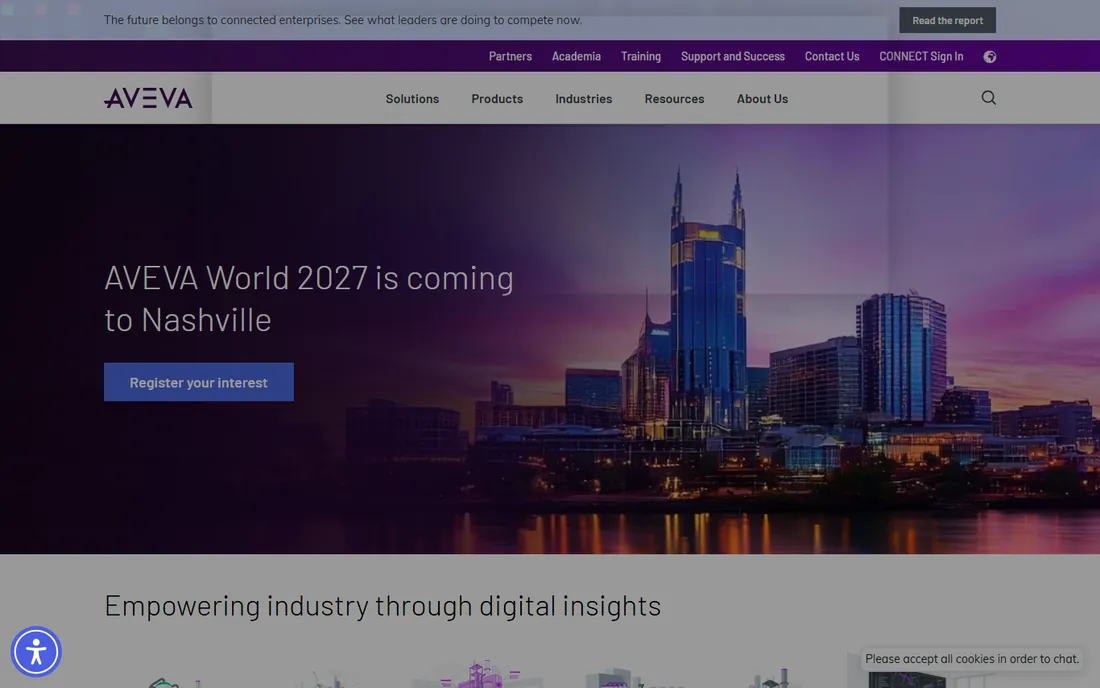
AVEVA assembled one of the widest industrial software portfolios through growth and acquisition, covering engineering design, HMI/SCADA, historians, MES, and asset performance. For a plant or enterprise standardizing on one vendor, that breadth means fewer integration seams: the design model, the operator screens, and the production records can all come from one stack.
The trade-off is the usual one for platform vendors. Licensing across the portfolio gets complicated, and getting full value requires integrators who know the products deeply. AVEVA suits organizations committing to a vendor relationship for the long term, not buyers shopping for a single point tool.
What we like- Broad portfolio from design to operations to optimization
- Strong historian and HMI lineage
- Large global installed base
Watch out for- Portfolio breadth means complex licensing
- Implementations need experienced integrators
Starting priceSee website
Free planNo
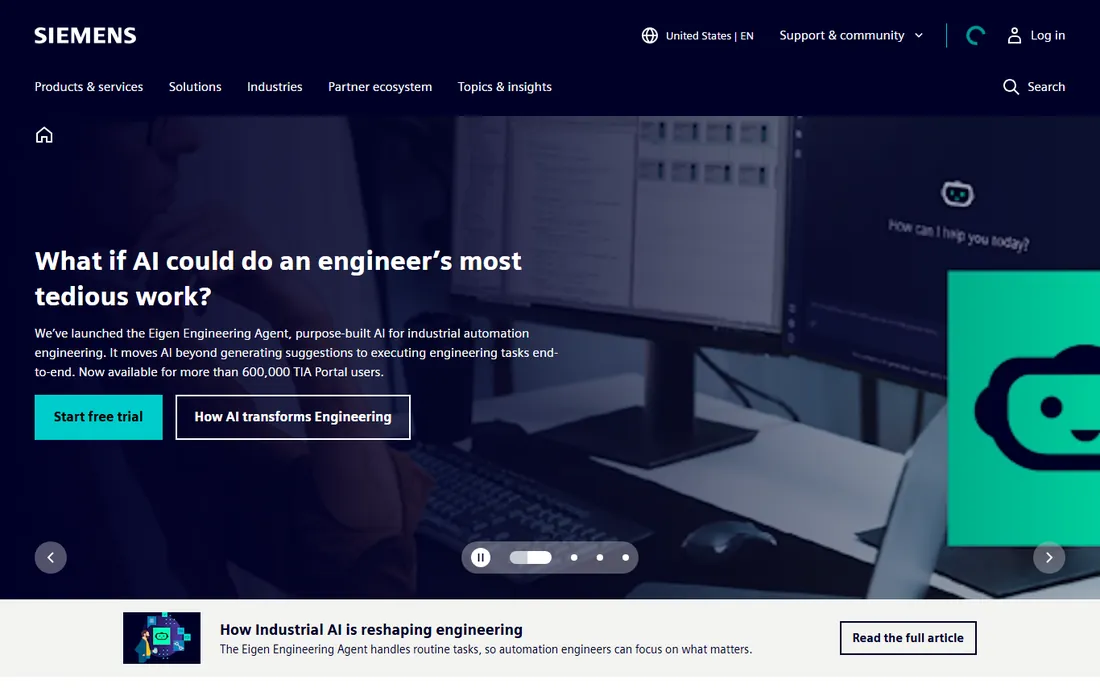
Siemens sells the digital factory as a system: PLCs, drives, and controllers on the hardware side with industrial software, from TIA Portal to MindSphere and Industrial Edge, on top. When the whole line is Siemens, the integration is genuinely tight, and the digital twin concept, a virtual model of the physical plant, is most mature here.
Step outside the Siemens hardware world and some of that advantage fades, though the software does work in mixed environments. Pricing is quote-based and enterprise-scale. Manufacturers already running Siemens automation who want the software to match rarely look elsewhere; mixed-hardware plants should evaluate openness carefully.
What we like- Deep integration between automation hardware and software
- Strong digital twin story
- Massive global support organization
Watch out for- Best value inside the Siemens ecosystem
- Pricing is enterprise and opaque
Starting priceSee website
Free planNo
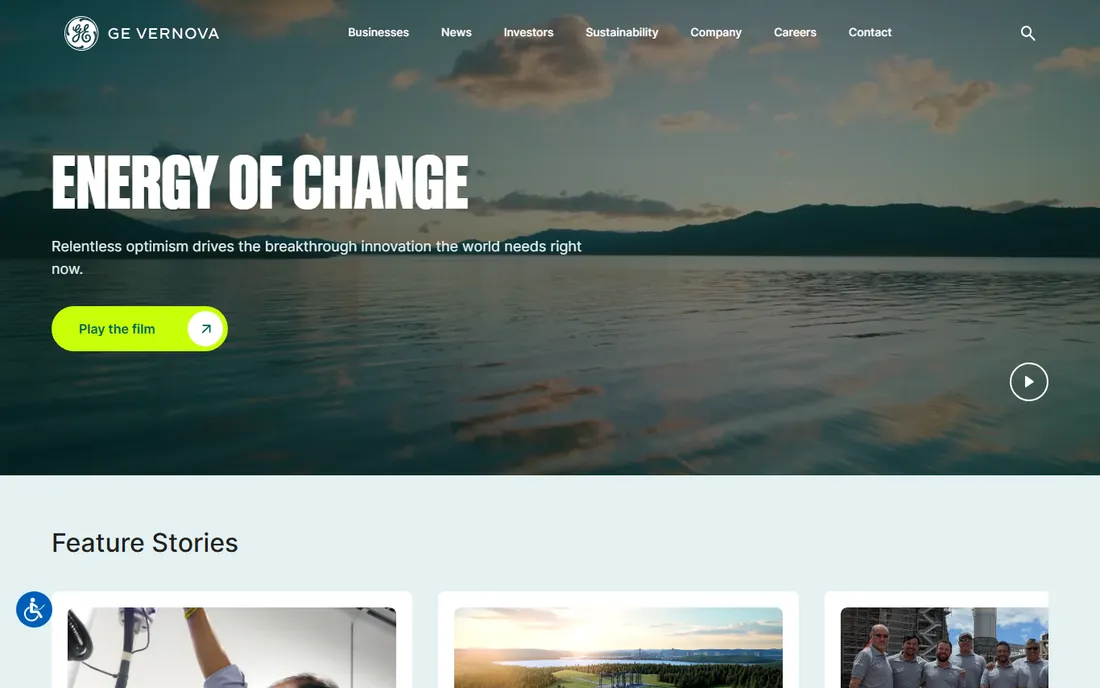
Proficy is GE's industrial software line, now part of GE Vernova's Digital business after the GE breakup. The portfolio covers the classic OT stack: iFIX and CIMPLICITY for HMI/SCADA, Proficy Historian for time-series data, Plant Applications for MES, and CSense for analytics. Utilities and process manufacturers have run on these products for decades.
The GE split means buyers should confirm roadmap commitments, though GE Vernova has invested in the portfolio including cloud-based MES. The products' age shows in places, with modernization still in progress. For plants that already run Proficy, continuity is the argument. New buyers should compare the modernization pace against AVEVA and Ignition.
What we like- Proven HMI/SCADA, MES, and historian products
- Strong in utilities and process industries
- 20,000+ customers cited by the vendor
Watch out for- Corporate home moved with the GE split, so watch the roadmap
- Interface modernization is ongoing
Starting priceSee website
Free planNo
Rockwell's FactoryTalk software exists to complete the Allen-Bradley hardware story. If your plant runs ControlLogix PLCs, FactoryTalk View for HMI, FactoryTalk Historian, and the MES modules slot in with minimal integration friction. The North American support and integrator network is the densest in the industry.
The ecosystem lock-in is real. In a mixed-hardware plant, much of the native advantage disappears while the licensing costs remain. Rockwell knows its audience: North American manufacturers standardized on Allen-Bradley who want one vendor accountable for the whole automation stack. That buyer should absolutely evaluate FactoryTalk first.
What we like- Native fit with Allen-Bradley controllers
- FactoryTalk covers HMI, MES, and analytics
- Strong North American support network
Watch out for- Weakest outside the Rockwell hardware ecosystem
- Licensing costs add up across the suite

#5
Schneider Electric (EcoStruxure)
Best for: EcoStruxure-based operations
Visit se.com
Starting priceSee website
Free planNo
Schneider Electric's EcoStruxure architecture layers IoT-enabled products, edge control, and software analytics across energy, buildings, and industry. For plants where energy management matters as much as production, power monitoring, drives, and process control from one vendor is a coherent story. The AVEVA partnership and investment further deepens the software side.
The portfolio grew by acquisition, and integration depth varies across product lines. Product naming can confuse even Schneider's own partners. Buyers should evaluate the specific products for their use case, energy, process control, or manufacturing execution, rather than buying the architecture diagram.
What we like- Strong in energy management and building-adjacent OT
- EcoStruxure spans power to process
- Global presence
Watch out for- Portfolio assembled from acquisitions with varying integration
- Complex product naming
Starting priceSee website
Free planNo
Honeywell Forge applies analytics to the data that process plants already generate: production insights, asset performance, quality prediction, and energy optimization, packaged as SaaS applications. The differentiator is domain depth; the models understand distillation columns and batch reactors, not just generic time series. Refining, chemical, and life sciences plants are the core audience.
As with all the automation giants, the tightest integration is with Honeywell's own control systems, though the platform connects more broadly. Pricing is enterprise and quoted. Process manufacturers drowning in historian data they cannot turn into decisions are the buyers who get the return.
What we like- Deep process-industry domain knowledge built in
- Analytics and optimization on top of control data
- Strong in refining, chemicals, and life sciences
Watch out for- Most valuable alongside Honeywell control systems
- Enterprise pricing
Starting priceSee website
Free planNo
KEPServerEX is the universal translator of industrial automation. It speaks the protocols of nearly every PLC, robot, sensor, and controller on the market and serves the data up via OPC UA, MQTT, REST, and other standards to SCADA, MES, historians, and cloud platforms. Almost every serious OT architecture includes it somewhere.
It does one job and does not pretend otherwise: there is no HMI, no historian, no analytics here. Licensing is per server deployment, which is refreshingly simple next to the platform vendors. If your problem is "get data out of these twenty different devices into our systems," Kepware is the default answer, and PTC's ownership has kept development steady.
What we like- Connects to an enormous range of PLCs, devices, and protocols
- The industry-standard OPC server
- Reliable and focused
Watch out for- It is connectivity plumbing, not an application platform
- Licensed per deployment
Starting priceSee website
Free planNo
Ignition built a devoted following by rejecting how SCADA vendors price. Instead of per-tag, per-client, per-screen licensing that punishes growth, Ignition licenses the server and lets you add unlimited tags, clients, and screens. For plants that watched traditional SCADA costs explode as they scaled, that model alone justifies the evaluation. Deployment is fast, the web-based architecture is modern, and the community is unusually enthusiastic.
The company is far smaller than Siemens or AVEVA, so buyers with strict vendor-viability requirements should do diligence. But the installed base is real and growing, including large enterprises. For new SCADA and MES projects where flexibility and cost control matter, Ignition is the most disruptive option on this list.
What we like- Unlimited tags, clients, and screens licensing model
- Fast to deploy
- Passionate user community
Watch out for- Smaller vendor than the giants
- Enterprise support expectations need checking
Starting priceSee website
Free planNo
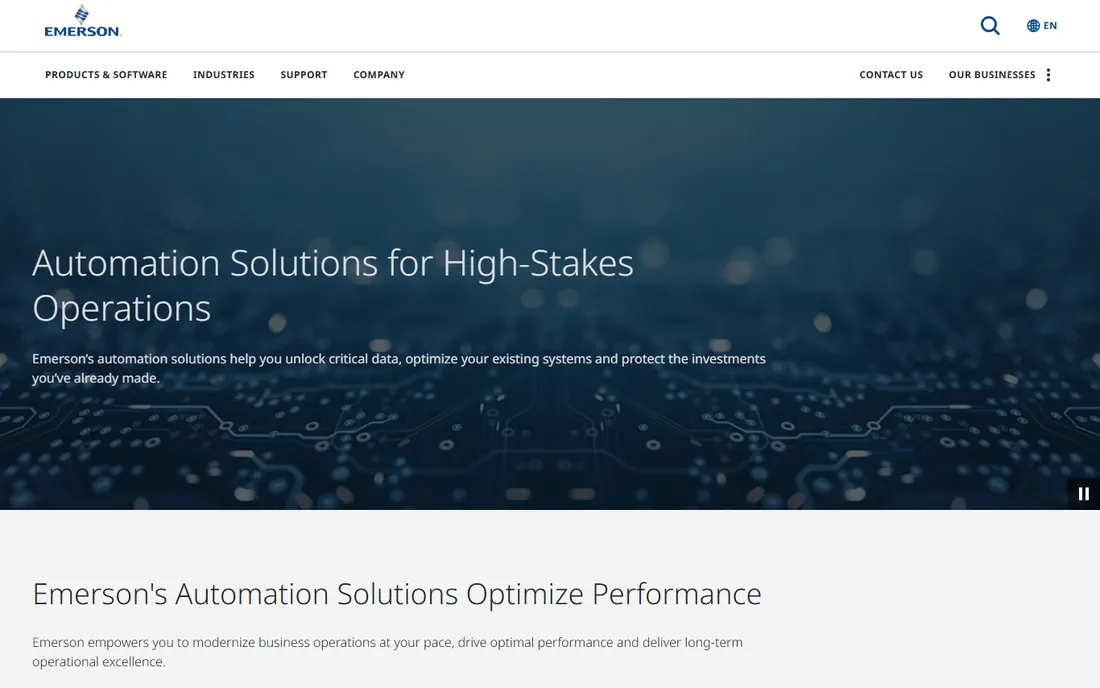
Emerson's DeltaV distributed control system is the standard in many process plants, particularly life sciences, chemicals, and refining. The software story centers on it: advanced process control, safety instrumented systems, asset management through AMS, and the data infrastructure around the DCS. Emerson's measurement instrumentation, pressure, temperature, flow, feeds the whole loop.
Like Rockwell, Emerson's software shines brightest in its own hardware world. Greenfield buyers choosing a DCS vendor are really choosing a decades-long relationship, and Emerson competes on lifecycle services as much as technology. For process plants already running DeltaV, the software path is set; for others, evaluate the total relationship, not just the application.
What we like- DeltaV DCS is a process-industry standard
- Strong measurement and control instrumentation
- Deep lifecycle services
Watch out for- DCS-centric worldview
- Best value in Emerson-automated plants
How we chose
We selected the OT software vendors that plants actually standardize on, verified through industry analyst coverage, trade press, and deployment references. We confirmed current product lines and corporate status through official sites, noting the GE Vernova transition and PTC's Kepware ownership. We weighted installed base, protocol and hardware openness, licensing sanity, and modernization pace, drawing on control engineer discussions in industry forums and user communities. All pricing in this category is quote-based.
What OT software really costs
Budget in the six to seven figures for plant-wide deployments, not the five figures of IT SaaS. Licenses scale with tags, clients, servers, or users depending on the vendor, and the software is often the smaller half of the project: integration services, hardware, and commissioning dominate. Ignition's unlimited model and Kepware's per-server pricing are the exceptions that prove the rule.
The expensive mistakes are under-scoping integration and skipping the pilot. Always run a pilot on one line or unit with production data before committing plant-wide. And negotiate the long term: OT systems live for 15 to 20 years, so support pricing, version upgrade rights, and escrow terms matter more than the first-year discount.
Buying guidance for OT teams
A few principles that separate successful OT purchases from expensive regrets.
Prioritize openness
Your plant will outlive any vendor relationship. Favor software with open protocols (OPC UA, MQTT), documented APIs, and exportable data. Proprietary lock-in that looked fine in year one becomes a ransom note in year twelve.
Separate IT security from OT reality
OT networks have safety constraints that IT security tools do not understand. Any software touching the control network must support the plant's segmentation strategy and safety requirements. Involve both the CISO and the process safety team before purchase, not after.
Count the integrator, not just the license
In OT, the system integrator relationship often matters more than the software brand. A great integrator with a good-enough platform beats a great platform with no local support. Evaluate the partner ecosystem in your region as part of the vendor decision.
Frequently asked questions
What is operational technology software?
Software that monitors and controls physical industrial processes and equipment: SCADA systems, historians, MES, HMI, asset performance, and the connectivity layers between them. It runs factories, refineries, utilities, and other industrial operations.
How is OT different from IT software?
OT prioritizes safety, uptime, and determinism over features and speed of change. Systems run for decades, downtime costs production directly, and changes require safety review. IT software prioritizes agility and user experience. The buying criteria, vendors, and support models differ accordingly.
What is the difference between SCADA, MES, and HMI?
HMI is the operator interface, the screens people watch and touch. SCADA supervises and controls equipment across a site. MES manages manufacturing execution: orders, materials, quality, and genealogy. They layer together, and vendors often bundle them.
How much does OT software cost?
Quote-based, scaling with plant size and scope. Point solutions like Kepware cost thousands; plant-wide SCADA/MES deployments run into six figures; enterprise multi-site platforms reach seven figures with services. Always budget integration and commissioning separately.
What is OPC UA and why does it matter?
OPC UA is the open standard for industrial data exchange between devices and software. It matters because it breaks vendor lock-in: any OPC UA-compatible device can talk to any OPC UA-compatible software. Make it a requirement in every purchase.
How long do OT software deployments last?
Fifteen to twenty years is normal. That longevity is why openness, vendor viability, upgrade rights, and long-term support terms matter more in OT than in any other software category.
Sources we checked (9)
- https://www.aveva.com
- https://www.siemens.com
- https://www.gevernova.com
- https://www.rockwellautomation.com
- https://www.se.com
- https://www.honeywellforge.ai/
- https://www.kepware.com
- https://www.inductiveautomation.com
- https://www.emerson.com
Is your product missing or out of date?
We review this list regularly. Vendors can request a listing, send updated pricing or ask about featured placement.

Shihab Mia · Founder, Rankite
Shihab has spent more than a decade helping SaaS and e-commerce brands grow through search. He writes Rankite's software buying guides from pricing pages, documentation and public user reviews. More about Shihab.
 AVEVA
AVEVA Siemens
 GE Vernova (Proficy)
 Rockwell Automation (FactoryTalk)
 Honeywell Forge
 Kepware (PTC)
 Inductive Automation (Ignition)
 Emerson