How we make this list: we compare pricing pages, product documentation and public user reviews. Rankite is independent; if a vendor ever pays for a featured spot, that listing is clearly labeled Partner.
Key takeaways
- Appsmith, ToolJet, and Budibase are the most direct open source answers to Retool, each with a visual builder, database connectors, and a free self-hosted edition.
- Refine is the pick for React developers who want low-code speed with standard TypeScript code they can deploy anywhere.
- NocoDB and NocoBase suit data-heavy business systems, while Windmill and Node-RED cover scripts, workflows, and event-driven automation.
- Read the license carefully: most platforms reserve SSO, audit logs, and AI features for paid editions, and some use copyleft licenses like AGPL or GPL.
Quick comparison
| Tool | Best for | Starting price | Free plan |
|---|
 Appsmith Appsmith | developer-built internal tools | Free | Yes |
 ToolJet ToolJet | AI-generated internal tools | Free | Yes |
 Budibase Budibase | all-in-one apps with built-in database | Free | Yes |
 Refine Refine | React developers building admin panels | Free | Yes |
 NocoBase NocoBase | data-driven business systems | Free | Yes |
 NocoDB NocoDB | spreadsheet-style database apps | Free | Yes |
 Windmill Windmill | scripts, workflows, and data pipelines | Free | Yes |
 Node-RED Node-RED | event-driven automation and IoT | Free | Yes |
Is your product missing or out of date?
We review this list regularly. Vendors can request a listing, send updated pricing or ask about featured placement.
Starting priceFree
Free planYes
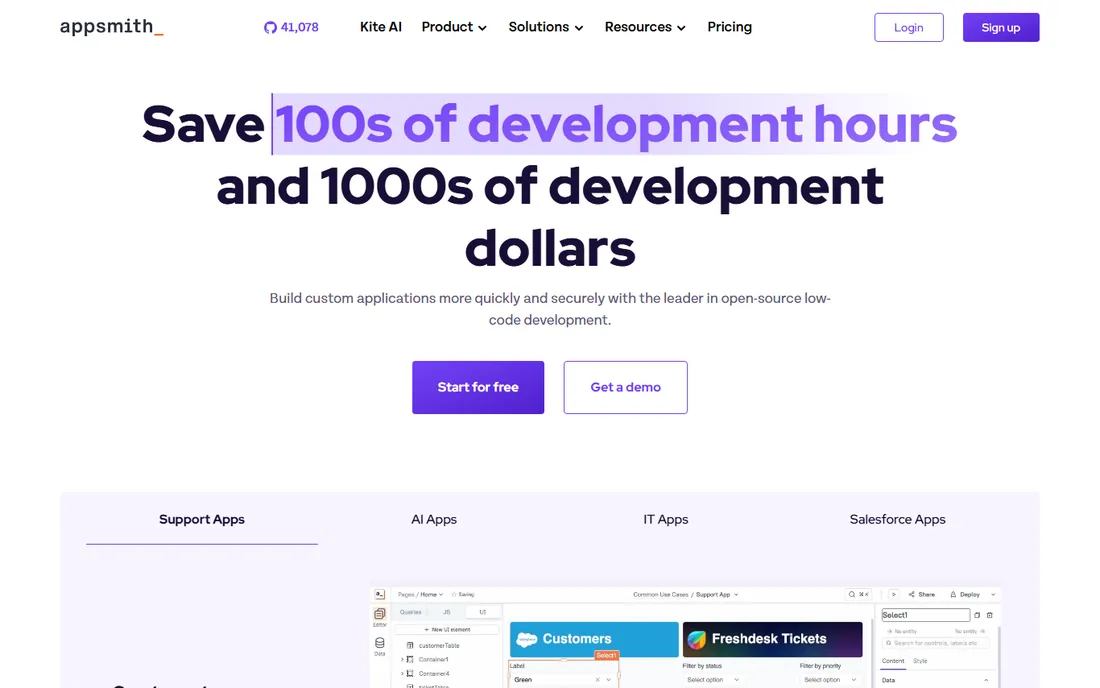
Appsmith is the most mature open source low-code platform for building internal tools like admin panels, dashboards, and approval flows. The Community Edition is fully maintained under the Apache 2.0 license and free to self-host. You get drag-and-drop widgets, complete JavaScript customization with a real IDE feel, and Git integration for version control, merging, and CI/CD style deployment.
The honest catch is the scope. Appsmith is developer-first: it assumes you are comfortable writing JavaScript and that you already have a database to connect to. Teams without engineers will find Budibase or NocoBase easier. But for teams that want a permissive license, real code ownership, and professional workflows, Appsmith remains the benchmark.
What we like- Open-source Community Edition under Apache 2.0
- Deep JavaScript customization and Git-based version control
- Broad database, SaaS, and REST/GraphQL connectivity
Watch out for- No built-in database, so you bring your own data source
- Advanced governance features sit in paid Business and Enterprise tiers
Starting priceFree
Free planYes
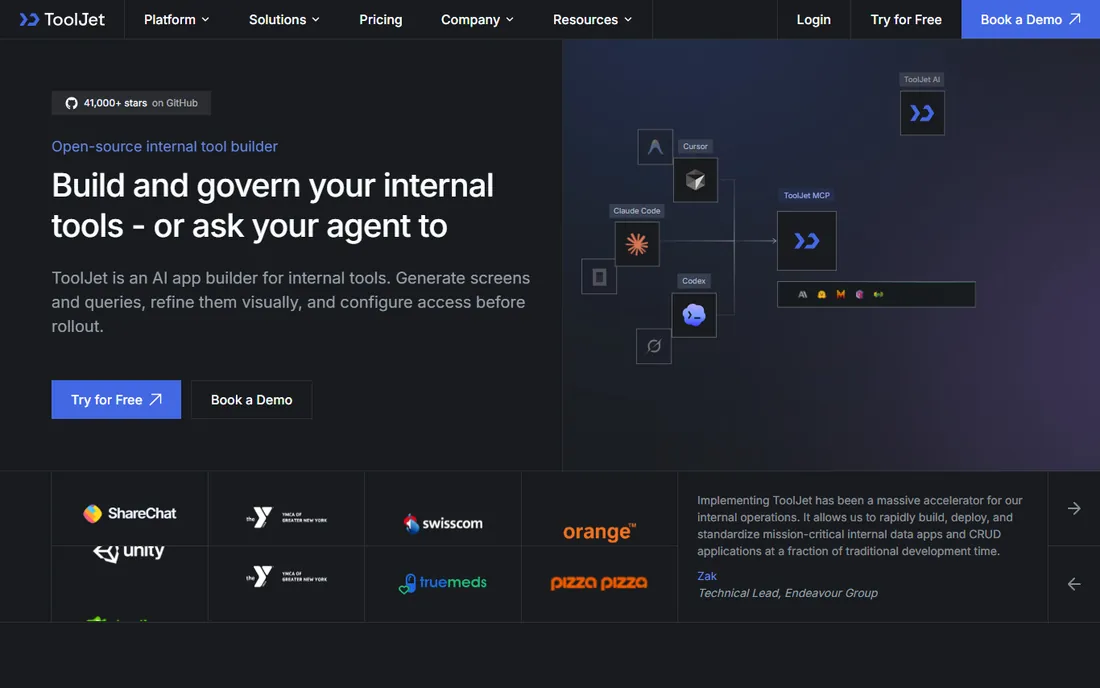
ToolJet is the fastest-moving option in this roundup. Describe the internal tool you need in plain English, and ToolJet AI generates a working draft with real components bound to real queries, ready to refine on the canvas. Every workspace includes ToolJet Database, a no-code table editor on top of PostgreSQL, so a tool can go live before anyone provisions a database.
ToolJet charges for the people who build, not the people who use, with $0 per builder to start. The pricing model is refreshingly honest, but note the AGPL-3.0 license on the open source edition, which has stricter terms than Apache 2.0 if you modify and distribute the software. For teams that want AI-assisted building plus self-hosting, ToolJet is the strongest choice.
What we like- AI turns a plain-English description into a working app draft
- $0 per builder to start with no credit card
- Built-in PostgreSQL database so you can ship without provisioning anything
Watch out for- Core is AGPL-3.0 licensed, which matters for companies redistributing the software
- Some builders find Appsmith's code editing more polished
Starting priceFree
Free planYes
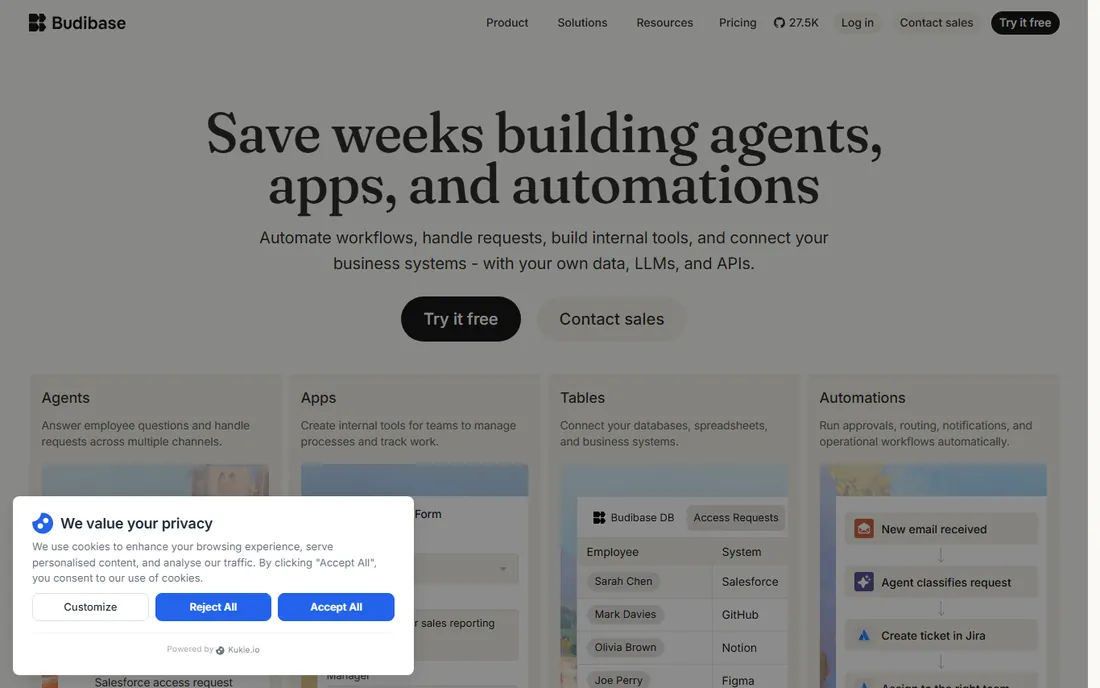
Budibase is the most self-contained option here. The built-in database means you can design data tables and build the app in one place without standing up Postgres first, and the automation engine handles approvals, routing, and notifications behind the scenes. It is open source, can be self-hosted on your own infrastructure, and carries ISO 27001 certification for security-conscious teams.
The trade-off is flexibility at the edges. Budibase leans no-code first, so developers who want to drop into custom JavaScript for complex logic may find it less natural than Appsmith or ToolJet. The GPL-3.0 license also deserves a read before you embed it in commercial products. For small and mid-size teams that want a complete platform without assembling pieces, Budibase is hard to beat.
What we like- Built-in database, so nothing external is required to start
- Automation engine for approvals, routing, and notifications
- Open source and ISO 27001 certified
Watch out for- GPL-3.0 license with a BSL commercial package, less permissive than Apache 2.0
- Complex JavaScript logic feels less native than on Appsmith
Starting priceFree
Free planYes
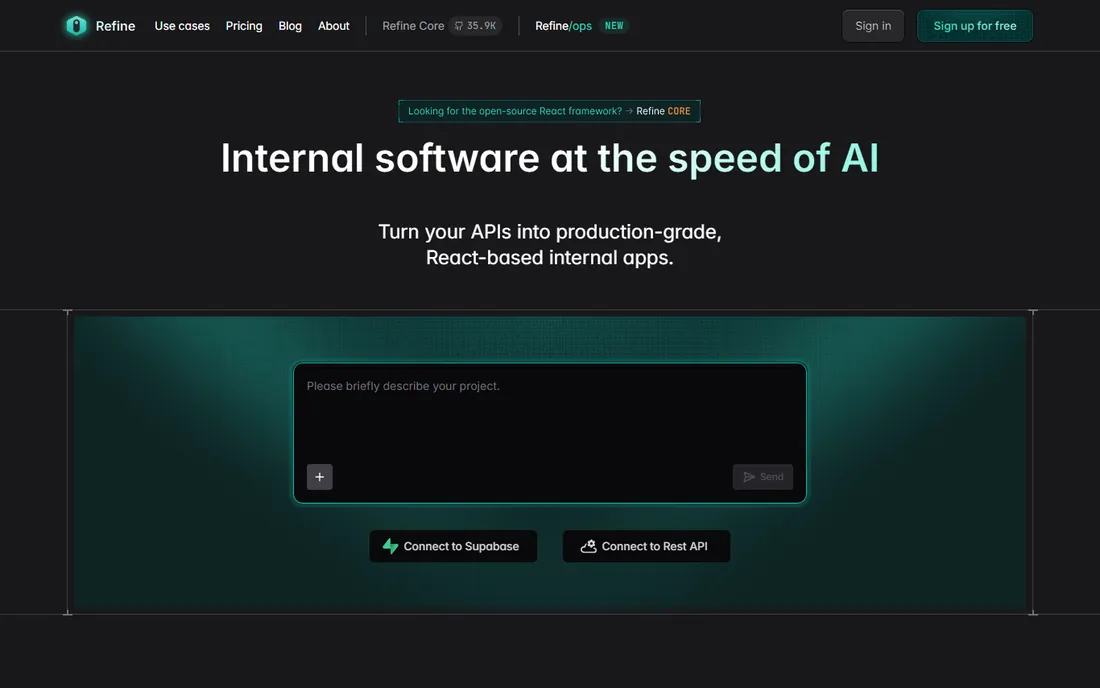
Refine takes a different path: instead of a drag-and-drop builder, it is an open source React framework that gives developers low-code speed while producing ordinary TypeScript code. Teams use it for admin dashboards, CRM and CMS platforms, HR systems, and customer ops tools, often replacing third-party SaaS. Because the output is standard code, there is no proprietary runtime to be locked into.
The honest catch is the audience. Refine assumes React developers, so it is not a tool for ops teams building their own apps. You also own the backend and hosting decisions. But for engineering teams that want low-code productivity without giving up code ownership, and with AI now helping generate layouts and CRUD logic, Refine is the most honest option on this list.
What we like- Standard React and TypeScript code you fully own, deployable anywhere
- Strong for CRUD-heavy admin panels and dashboards
- Self-hosting with fine-grained access control models
Watch out for- It is a framework, not a visual builder, so non-developers cannot build with it
- You choose and maintain the backend and hosting yourself
Starting priceFree
Free planYes
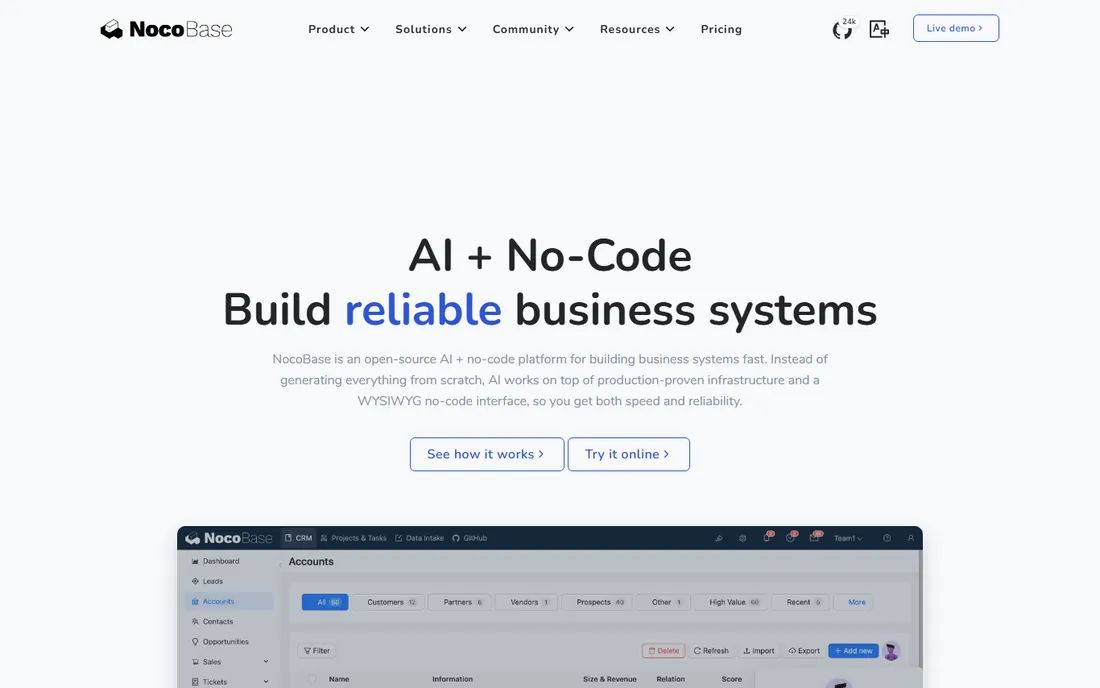
NocoBase is built for business systems with serious data models: permissions, workflows, relationships, and audit trails. The platform is data-model driven, so your data stays in standard relational structures in your own database, decoupled from the UI. The core and foundational plugins are fully open source, and the commercial model is unusual in a good way: buy-once licenses with no subscription, no per-user pricing, and no per-application pricing.
The trade-off is approachability. NocoBase expects you to think in data models first, which suits structured business systems but slows down a quick dashboard build. Its community is also smaller than the big three. For teams building a real internal system, an HR portal, an operations platform, a client portal, rather than a quick tool, NocoBase's architecture is worth the learning curve.
What we like- Data-model driven with your data staying in your own database
- Free open-source edition with buy-once commercial licenses and no per-user pricing
- Plugin architecture built on Node.js, React, and Koa
Watch out for- Learning curve is steeper than a pure drag-and-drop builder
- The ecosystem and community are smaller than Appsmith's or ToolJet's
Starting priceFree
Free planYes
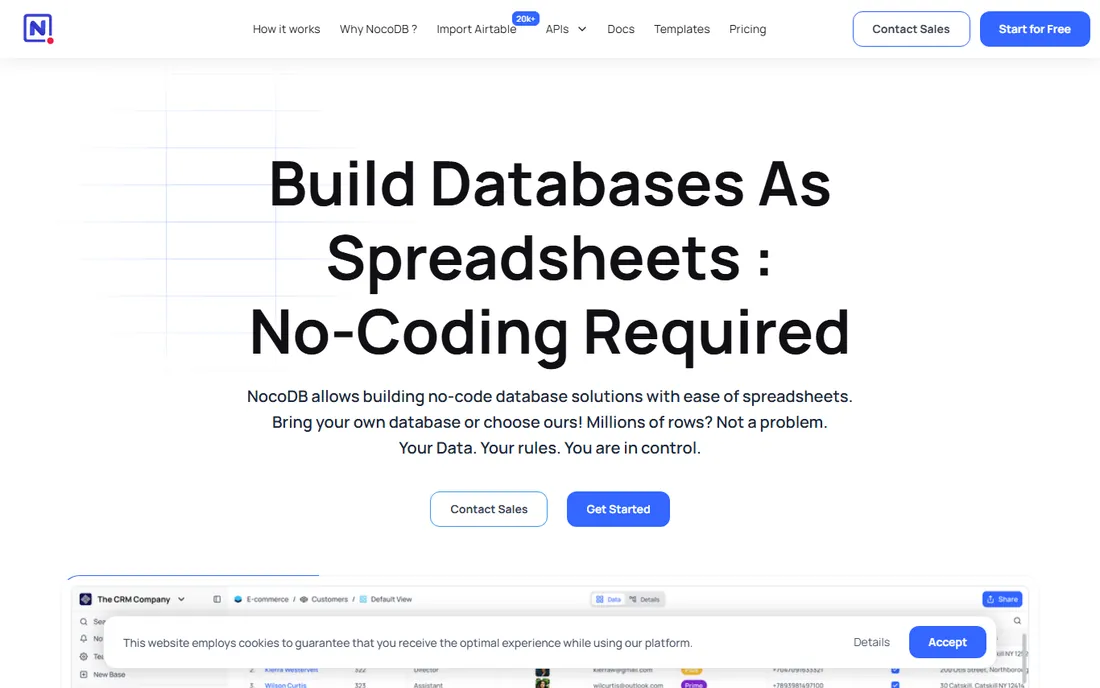
NocoDB is the open source answer to Airtable. Connect it to an existing Postgres or MySQL database, or start from scratch, and you get a spreadsheet-like interface with Kanban, form, gallery, and calendar views, plus auto-generated APIs for programmatic access. The company claims 35,000-plus organizations use it and millions of downloads, which tracks with its huge GitHub community.
The honest catch is scope: NocoDB gives you the data layer, not a full application builder with custom dashboards and workflows. For many teams that is exactly enough, and it pairs well with Appsmith or ToolJet on the front end. If your project is really about managing structured data with a friendly face, NocoDB is the simplest, most proven pick.
What we like- Turns any Postgres or MySQL database into a spreadsheet-style interface
- Kanban, form, gallery, and calendar views plus REST APIs
- Scales to millions of rows
Watch out for- It is a data layer, not a full app builder, so custom UIs need another tool
- Advanced features increasingly live in the paid cloud offering
Starting priceFree
Free planYes
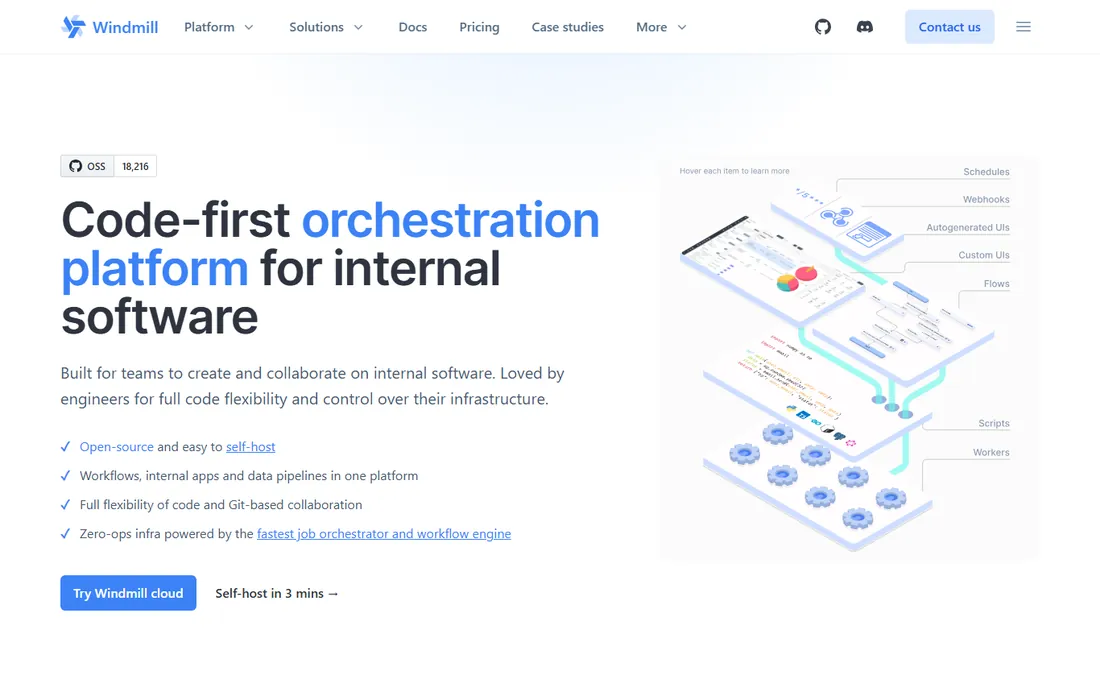
Windmill fills the gap the other tools leave open: scheduled jobs, ETL, internal scripts, and operational workflows. You write scripts in familiar languages, chain them into workflows with approval steps and error handling, and run everything on a self-hostable orchestration engine. It supports building with AI in the UI or locally from your editor with a CLI, and observability, inputs, logs, and results per run, is built in.
The trade-off is the audience. Windmill is unapologetically developer-first, and while it can build internal apps, its UI builder is not the product's strength. The self-hosted price is listed at $0, with an enterprise edition for larger deployments. Pick Windmill when your project centers on automation and scripts rather than dashboards.
What we like- Code-first orchestration for scripts, workflows, apps, agents, and data pipelines
- Self-hostable with Docker or Kubernetes from a single VPS upward
- AI-assisted building directly in the UI
Watch out for- Code-first means it is built for developers, not business users
- The visual app builder is thinner than the dedicated low-code platforms
Starting priceFree
Free planYes
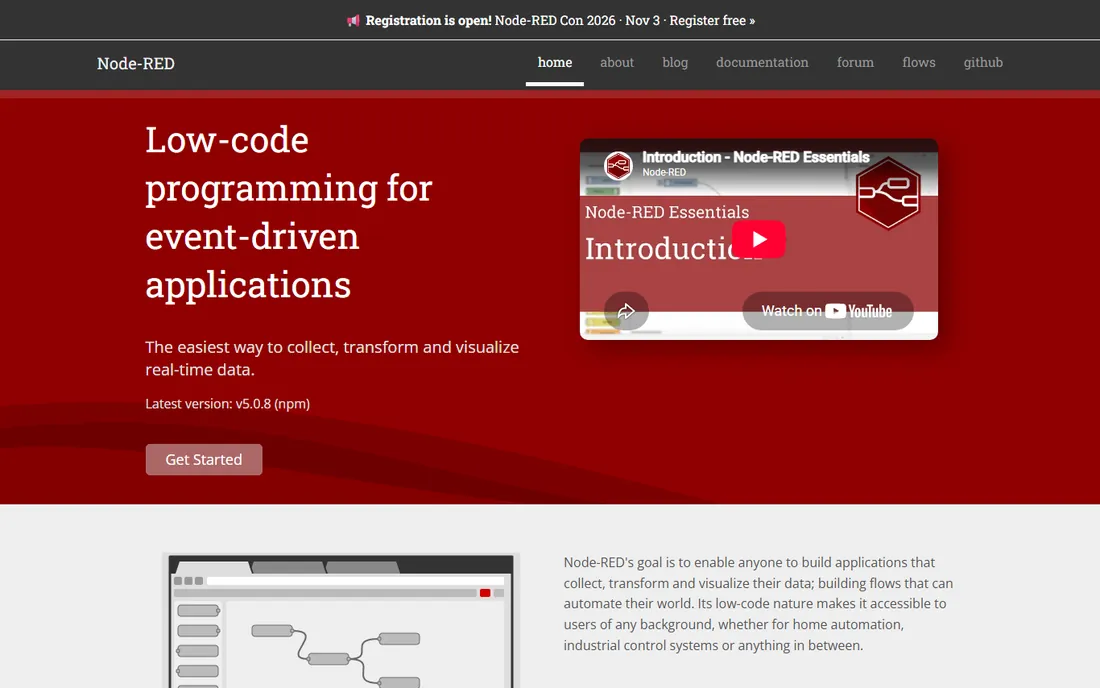
Node-RED is the veteran of this list: a flow-based, low-code programming tool for event-driven applications, originally built for wiring together IoT devices and APIs. You drag nodes onto a canvas, wire them together, and build applications that collect, transform, and visualize real-time data. The community has contributed more than 5,000 nodes and flows, so most integrations already exist.
The honest catch is that Node-RED is not an app builder. It will not produce a polished admin panel, and large flow diagrams can become difficult to maintain. But for device integrations, data pipelines, home automation, and industrial monitoring, nothing on this list matches its ecosystem. It is entirely free, open source, and backed by the OpenJS Foundation.
What we like- Entirely free and open source with a huge community
- More than 5,000 community nodes and flows to start from
- Proven in home automation, industrial systems, and data collection
Watch out for- Not designed for building polished business applications
- Flow-based programming can get hard to maintain at large scale
How we chose
We reviewed each platform's documentation, pricing pages, and license terms on the vendor's own site, then checked them against public reviews on G2, Capterra, and Reddit plus community activity on GitHub. We weighted genuine open source availability, self-hosting practicality, the honesty of the free edition, license permissiveness, and fit for small and mid-size teams rather than enterprise-only features. We did not test any of these tools hands-on, and license details reflect what vendors published at the time of writing.
The word open source hides real differences. These are the checks that matter before you build on one.
The license and what it allows
Apache 2.0, as with Appsmith and Refine, is the most permissive for commercial use. AGPL-3.0, as with ToolJet, and GPL-3.0, as with Budibase, add copyleft obligations that matter if you modify and distribute the software. Some platforms also split features between the open core and a commercial edition. Read the license page, not just the marketing page.
Where your data lives
The whole point of self-hosting is data control. Check whether the platform keeps your data in your own database, like NocoBase and NocoDB do, and whether telemetry can be disabled. Confirm that the self-hosted edition is genuinely complete and not a feature-limited teaser for the cloud product.
Who builds the apps
Visual builders like Budibase and NocoBase let operations staff build real tools. Developer-first platforms like Appsmith, ToolJet, and Refine move faster in engineering hands but leave non-technical teams waiting. Match the tool to the people who will actually build with it.
Where the free edition ends
Almost every platform reserves SSO, audit logs, advanced roles, and AI features for paid tiers. Map your must-haves, especially security and compliance requirements, against the free edition before you invest weeks of building.
When open source low-code is the wrong choice
These platforms shine for internal tools, dashboards, approval flows, and data management. They struggle with highly custom customer-facing products, real-time applications with unusual performance needs, and business logic so complex that working around the platform takes longer than writing the feature directly. If you find yourself fighting the builder more than using it, that is the signal to build with a standard framework instead. The advantage of the open source options above is that the exit is honest: you own the code and the data, so leaving does not mean starting over.
Frequently asked questions
What is the best open source alternative to Retool?
Appsmith, ToolJet, and Budibase are the three most direct open source alternatives to Retool. Appsmith is the most developer-focused with full JavaScript control, ToolJet leads on AI-assisted building, and Budibase is the simplest all-in-one with a built-in database. All three offer free self-hosted editions.
Is open source low-code really free?
The core platforms are free to self-host, but your time and infrastructure are not. Expect to run a server, handle updates, and manage backups yourself. Most vendors also sell cloud hosting and reserve enterprise features like SSO and audit logs for paid plans. Factor in the operational cost, not just the license price.
Can non-developers build with these platforms?
With some of them, yes. Budibase, NocoBase, and NocoDB are designed so operations staff can build real tools and manage data without writing code. Appsmith, ToolJet, Refine, Windmill, and Node-RED assume varying degrees of technical skill, from JavaScript to full development workflows.
What is the difference between low-code and no-code here?
Low-code platforms like Appsmith and Refine expect some coding for advanced logic but handle the repetitive parts visually. No-code-first options like Budibase and NocoBase aim to let non-developers build complete apps. In practice most teams land in the middle, building visually and adding code where needed.
Will I get locked in if I build on one of these?
Less than with proprietary tools, but the risk is not zero. Your data stays in standard databases with most of these platforms, which is the important part. Custom workflows and UI configurations may still need rebuilding if you switch platforms, so keep business logic documented and prefer tools that export cleanly.
Do these platforms work for customer-facing products?
They can, but they are optimized for internal tools. If you need a highly differentiated public interface, fine-grained performance control, or a fully custom stack, a standard framework like Refine or a custom build usually fits better. Use low-code where speed matters more than uniqueness.
Sources we checked (8)
- https://appsmith.com/
- https://tooljet.com/
- https://budibase.com/
- https://refine.dev/
- https://www.nocobase.com/
- https://nocodb.com/
- https://www.windmill.dev/
- https://nodered.org/
Is your product missing or out of date?
We review this list regularly. Vendors can request a listing, send updated pricing or ask about featured placement.

Shihab Mia · Founder, Rankite
Shihab has spent more than a decade helping SaaS and e-commerce brands grow through search. He writes Rankite's software buying guides from pricing pages, documentation and public user reviews. More about Shihab.