How we make this list: we compare pricing pages, product documentation and public user reviews. Rankite is independent; if a vendor ever pays for a featured spot, that listing is clearly labeled Partner.
Key takeaways
- Benchling is the standard for biotech and pharma R&D, with deep molecular biology tools built into the notebook.
- SciNote, LabArchives, and RSpace offer the most accessible starting points, with free tiers or open-source options for smaller labs.
- Signals Notebook and Labguru suit enterprises that need compliance, integrations, and scale.
- SciSure is the new name to know: the merger of eLabNext and SciShield into a unified scientific management platform.
Quick comparison
| Tool | Best for | Starting price | Free plan |
|---|
 Benchling Benchling | biotech and pharma R&D teams | See website | No |
 SciNote SciNote | regulated labs on a budget | See website | Yes |
 LabArchives LabArchives | academic research institutions | See website | Yes |
 RSpace RSpace | open-source research data management | See website | Yes |
 Labguru Labguru | all-in-one lab management | See website | No |
 Signals Notebook Signals Notebook | enterprise chemistry and biology | See website | Free trial |
 Labfolder Labfolder | easy ELN for small labs | See website | Free trial |
 SciSure SciSure | unified ELN, LIMS, and lab safety | See website | No |
Is your product missing or out of date?
We review this list regularly. Vendors can request a listing, send updated pricing or ask about featured placement.
The best ELN software
Starting priceSee website
Free planNo
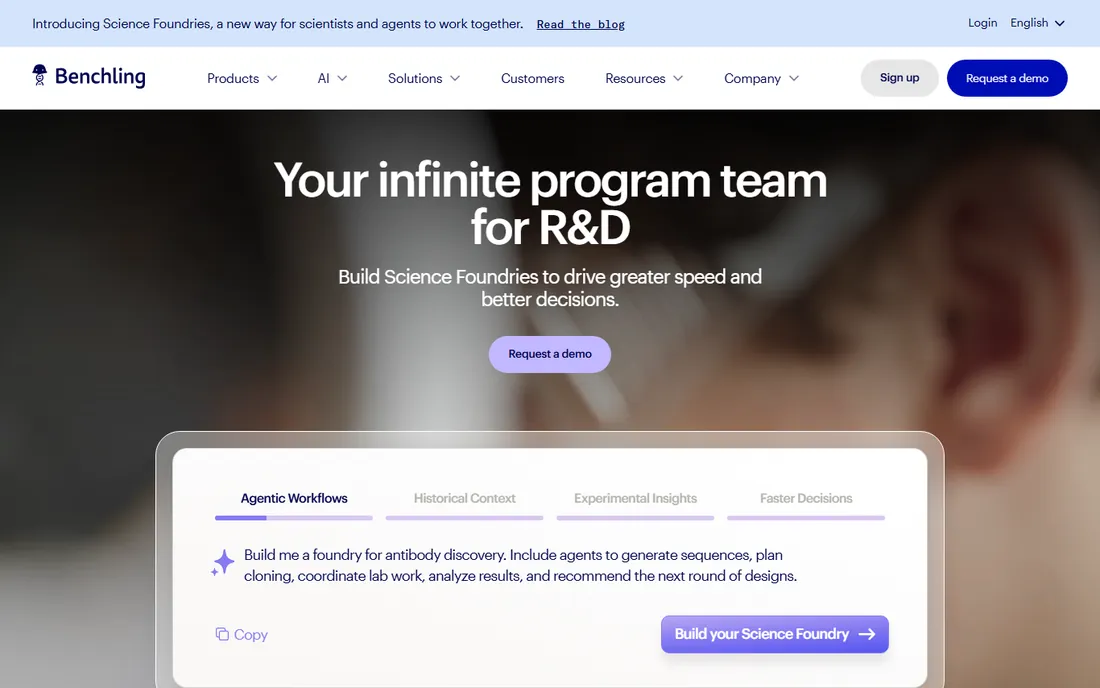
Benchling is the ELN that biotech runs on. Instead of a generic notebook with lab features bolted on, it was built around the actual work of life-science R&D: sequence design, plasmid mapping, cell line tracking, and sample management, all inside one cloud platform. The unified data model means experiments, samples, and results connect in ways that support analytics and machine learning downstream.
The honest catch is the audience and the price. Benchling is built for commercial biotech and pharma teams, not for a university group watching its budget, and pricing comes through sales conversations. For organizations doing serious discovery work, it is the category leader for a reason.
What we like- Purpose-built molecular biology suite, sequences, plasmids, CRISPR, inside the notebook
- Unified data model across experiments for computational science
- Strong automation and integration ecosystem
Watch out for- Pricing is quote-based and aimed at commercial R&D organizations
- More platform than a small academic lab needs
Starting priceSee website
Free planYes
SciNote is the value pick in ELN software. It combines a structured electronic lab notebook with inventory management, protocol templates, and the compliance tooling regulated labs need: electronic signatures, audit trails, timestamps, and access controls. The projects, experiments, and tasks hierarchy mirrors how research actually happens, and users report saving hours per week on documentation and reporting.
The honest catch is structure. The same hierarchy that keeps data organized can feel inflexible when your workflow does not fit it, and reviewers note that per-user licensing gets expensive for small teams where everyone needs access. For labs that need compliance without enterprise budgets, SciNote remains the first place to look.
What we like- Compliance features, electronic signatures, audit trails, and 21 CFR Part 11 support, at an accessible price
- Lab inventory management built in
- Mobile apps for bench-side data entry
Watch out for- The projects-experiments-tasks structure can feel rigid to some users
- Per-user pricing adds up as teams grow
Starting priceSee website
Free planYes
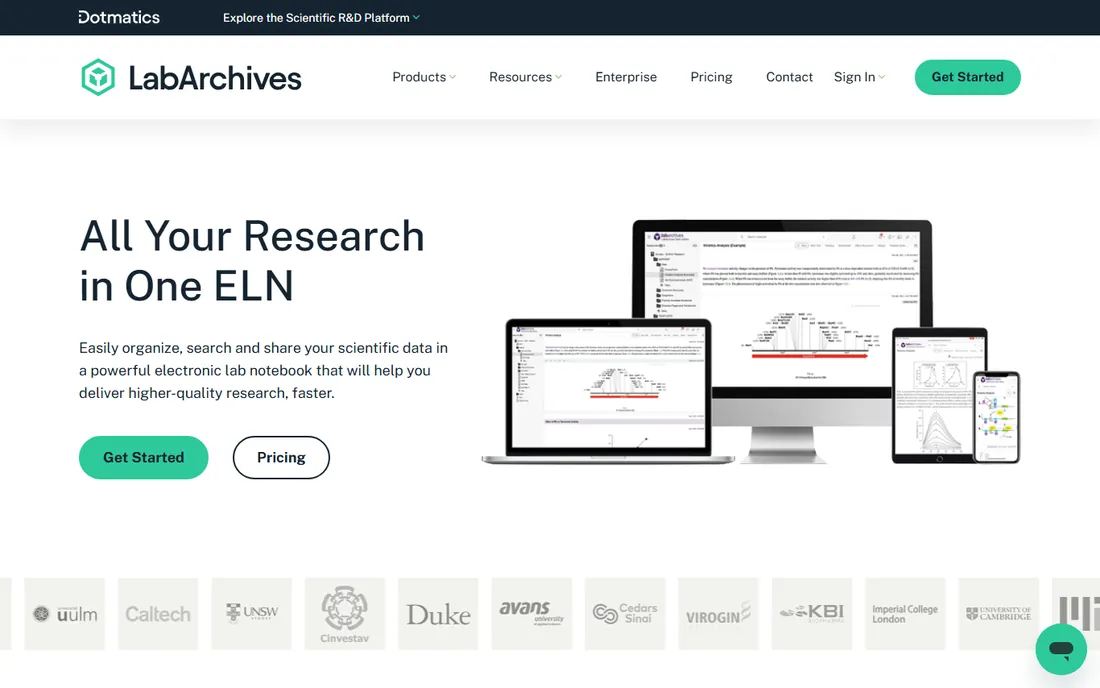
LabArchives is the academic workhorse. It gives research groups a straightforward cloud notebook for organizing, searching, and sharing scientific data, with the integrations scientists actually use, SnapGene for plasmid maps, GraphPad Prism for analysis, Microsoft 365 for documents, already built in. The free starting tier makes it easy for individual researchers and small groups to begin.
The honest catch is depth. LabArchives does the notebook job well but does not go as deep into specialized R&D workflows as Benchling or the enterprise suites. For universities and research institutes that need a dependable, compliant ELN their scientists will actually use, it is a proven choice.
What we like- Free tier to start, with paid plans that scale to institutions
- Strong integrations with SnapGene, GraphPad Prism, and Microsoft 365
- Compliance badges including SOC 2, ISO 27001, and 21 CFR Part 11
Watch out for- Less specialized for molecular biology than Benchling
- Enterprise features trail the biggest commercial suites
Starting priceSee website
Free planYes
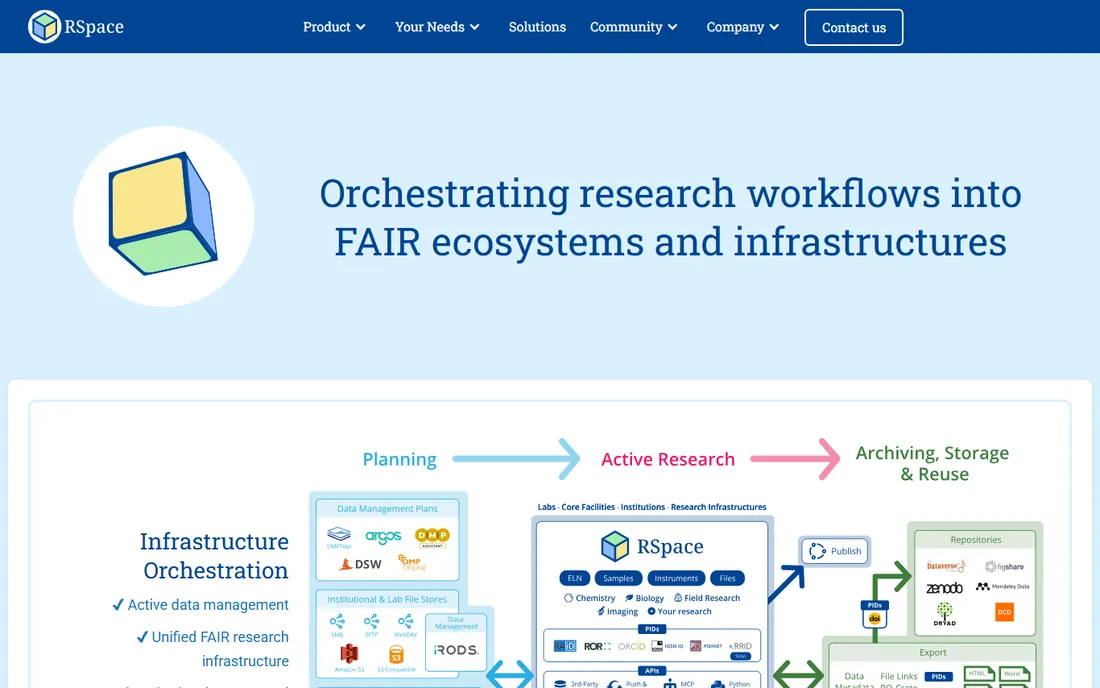
RSpace takes a different approach: open-source research data management infrastructure with a connected electronic notebook at its center. Beyond experiment documentation, it handles samples with persistent identifiers, organizes files across institutional storage, and supports the metadata and ontology standards that funding bodies increasingly require. It is built for the research data lifecycle, not just the notebook.
The honest catch is effort. Open source means flexibility and no license fees, but also more responsibility for deployment and maintenance than a managed SaaS product. For institutions and research groups that want control over their data infrastructure, RSpace is the serious open option.
What we like- Open-source foundation with ELN, sample management, and file management in one system
- Strong on research data infrastructure, persistent identifiers, and FAIR principles
- Fits institutional and European research workflows
Watch out for- Requires more technical involvement to deploy than cloud SaaS options
- Smaller support ecosystem than the big commercial vendors
Starting priceSee website
Free planNo
Labguru sells the lab, not just the notebook. Its platform combines the electronic lab notebook with sample tracking, inventory management, equipment scheduling, and workflow automation, all in one cloud system. The automation tools let labs build step-by-step workflows with triggers and rules, and customers report meaningful time savings once the system is running.
The honest catch is scope and sales. Buying Labguru means adopting a platform, with the onboarding that implies, and pricing comes through quotes rather than a simple price list. For labs that want one system for notebooks, samples, and inventory instead of three, the consolidation is worth it.
What we like- Combines ELN, LIMS, inventory, and automation in a single platform
- Workflow automation with customizable triggers and rules
- Strong customer satisfaction in small and mid-size labs
Watch out for- Quote-based pricing with no self-serve tier
- The breadth of features can mean a longer onboarding
Starting priceSee website
Free planFree trial
Signals Notebook, from Revvity Signals, is the enterprise ELN with the strongest chemistry credentials. The native ChemDraw integration, automatic stoichiometry calculations, and chemical search make it the natural choice for chemistry-heavy organizations, while real-time collaboration and open APIs connect it to LIMS, ERP, and instruments. The vendor offers a free trial and a purchasable Standard Edition for faster starts.
The honest catch is fit. This is enterprise software, and its chemistry depth is wasted on labs that do not need it. For pharma, biotech, and materials science organizations running regulated chemistry workflows, Signals Notebook is one of the safest bets in the category.
What we like- Native ChemDraw integration for chemistry workflows
- Cloud-native architecture with ten releases a year
- 21 CFR Part 11 compliance with electronic signatures and audit trails
Watch out for- Enterprise positioning and pricing
- Chemistry strengths matter less to pure biology labs
Starting priceSee website
Free planFree trial
Labfolder keeps the electronic lab notebook simple. It is fully browser-based, designed for individual researchers and small teams that want secure, compliant documentation without a complex platform. The vendor offers a free trial to explore before committing, and the product now sits under SciSure, which gives small labs a growth path into LIMS and lab safety tools later.
The honest catch is simplicity itself. Labfolder does not try to be a full lab informatics suite, so labs that outgrow it will need to move up. For getting started with digital records quickly and affordably, it does exactly what it promises.
What we like- Simple browser-based ELN with no installation
- Free trial and quote-based pricing for teams
- Now part of SciSure, with a path to broader lab management
Watch out for- Pricing details require a quote
- As a simpler tool it lacks the deep workflow features of enterprise suites
Starting priceSee website
Free planNo
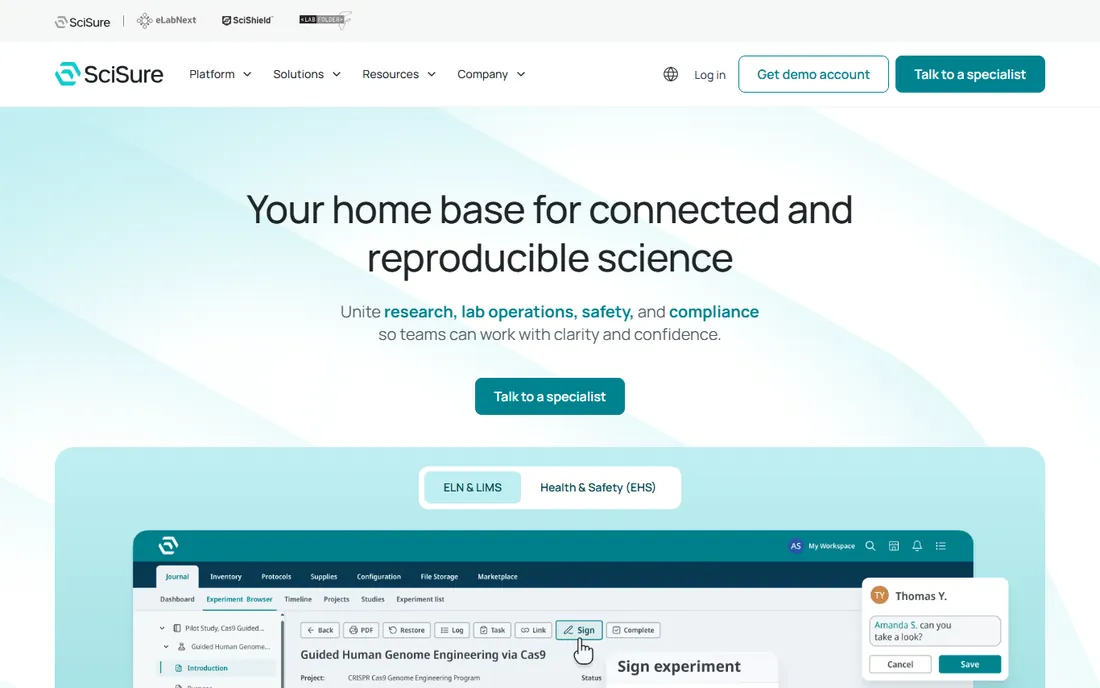
SciSure is the new name formed from the eLabNext and SciShield merger, and it represents the direction the ELN market is heading: one platform for the notebook, the sample data, and the safety compliance around them. The ELN and LIMS capabilities come from eLabNext's lineage, the health and safety module from SciShield, and the combination targets labs that want to stop stitching systems together.
The honest catch is that unified platforms ask for commitment. Smaller labs that only need a notebook should look at the lighter options on this list. For organizations standardizing lab operations across teams, SciSure's breadth is the point.
What we like- Unifies ELN, LIMS, and health and safety in one platform after the eLabNext and SciShield merger
- Strong compliance posture, ISO 27001, 21 CFR Part 11, GxP
- Marketplace of integrations and add-ons
Watch out for- A broad platform that may be more than a small lab needs
- Pricing is quote-based
How we chose
We reviewed each vendor's product pages, documentation, and pricing materials, then cross-checked with public reviews on G2, Capterra, SourceForge, and lab-focused communities. We weighted ELN maturity, compliance capabilities, pricing accessibility, and fit for different lab sizes, from academic groups to enterprise R&D. We did not test any of these tools hands-on, and most pricing in this category is quote-based, so we verified only what vendors publish and marked the rest as "See website."
What to check before you buy ELN software
An ELN becomes your lab's memory, so choose carefully. These checks separate good fits from expensive mistakes.
Match the notebook to the science
Molecular biology teams need sequence tools and sample registries, chemistry teams need structure drawing and stoichiometry, academic groups need simplicity and affordability. A generic notebook forces workarounds; a specialized one fits the workflow. Shortlist based on your actual experiments, not feature counts.
Verify the compliance story
If your lab works under GLP, GMP, or FDA regulations, confirm 21 CFR Part 11 support, electronic signatures, audit trails, and data integrity controls before you evaluate anything else. Ask for the vendor's validation documentation, not just a checkbox on a features page.
Plan the migration from paper
The hardest part of ELN adoption is moving existing records and changing habits. Ask vendors about import tools, training, and how other labs in your field handled the transition. A pilot with one team reveals more than any demo.
Check data ownership and export
Your research data must outlive any vendor relationship. Confirm you own your data, can export it in usable formats at any time, and understand what happens to it if you cancel. Open-source options like RSpace give you the most control here.
The consolidation trend in lab software
The ELN market spent 2026 consolidating. The eLabNext and SciShield merger into SciSure, and Labfolder joining the same company, follow a pattern: vendors are selling platforms that combine the notebook with sample management, inventory, and safety compliance. For buyers, this means fewer vendors to manage but bigger purchase decisions. If you only need a notebook, buy a notebook; if you are standardizing lab operations, the unified platforms are maturing into credible single-vendor answers.
Frequently asked questions
What is ELN software?
An electronic lab notebook replaces paper research notebooks with a digital system for recording experiments, managing data, and collaborating. Good ELNs add version control, audit trails, electronic signatures, templates, and integrations with lab instruments and software, making research records searchable, shareable, and compliant.
How much does ELN software cost?
Pricing is mostly quote-based and varies by user count, deployment, and modules. Accessible options like SciNote and LabArchives offer free tiers, mid-range tools price per user, and enterprise platforms like Benchling and Signals Notebook are quote-based. Budget for implementation and training on top of licenses.
Do I need an ELN or a LIMS?
An ELN documents experiments and research workflows; a LIMS tracks samples, tests, and laboratory operations. Many labs need both, which is why vendors increasingly bundle them. If your main problem is sample tracking and throughput, start with a LIMS; if it is documenting and sharing experiments, start with an ELN.
Are electronic lab notebooks FDA compliant?
They can be. Compliance depends on features like electronic signatures, audit trails, access controls, and data integrity, plus how your lab validates the system. Tools like SciNote, LabArchives, Signals Notebook, and Labguru are built to support 21 CFR Part 11 requirements, but your lab still needs its own validation process.
Can I migrate from paper notebooks to an ELN?
Yes, and most vendors have done it many times. The practical approach is to scan and archive historical paper records while starting new work in the ELN, often piloting with one team first. Ask vendors for migration tools and reference customers who made the same switch.
Is there a free ELN?
Yes. SciNote offers a free tier, LabArchives lets you start free, and RSpace is open source. Free tiers work for individuals and small teams; larger or regulated labs will usually need paid plans for compliance features, storage, and support.
Sources we checked (8)
- https://www.benchling.com/
- https://scinote.net/
- https://labarchives.com/
- https://www.researchspace.com/
- https://www.labguru.com/
- https://revvitysignals.com/products/research/signals-notebook-eln
- https://labfolder.com/
- https://www.scisure.com/
Is your product missing or out of date?
We review this list regularly. Vendors can request a listing, send updated pricing or ask about featured placement.

Shihab Mia · Founder, Rankite
Shihab has spent more than a decade helping SaaS and e-commerce brands grow through search. He writes Rankite's software buying guides from pricing pages, documentation and public user reviews. More about Shihab.