How we make this list: we compare pricing pages, product documentation and public user reviews. Rankite is independent; if a vendor ever pays for a featured spot, that listing is clearly labeled Partner.
Key takeaways
- Every low-code vendor rebranded as "agentic" in 2026: OutSystems, Mendix, Webflow, Bubble, and Glide all ship AI that builds alongside you, not just visual canvases.
- The category splits three ways: enterprise low-code (OutSystems, Mendix), no-code builders for non-developers (Bubble, Adalo, Glide), and design-led platforms (Webflow) plus open-source internal tools (Budibase).
- Free entry points are real: Bubble, Adalo, Glide, Budibase, and Mendix all offer free tiers, so you can validate an idea before spending anything.
- Governance is the enterprise dividing line: OutSystems and Mendix sell security, lifecycle management, and auditability that the simpler builders do not attempt.
Quick comparison
| Tool | Best for | Starting price | Free plan |
|---|
 OutSystems OutSystems | enterprise apps with AI governance | See website | No |
 Mendix Mendix | agentic workflows on existing systems | See website | Yes |
 Bubble Bubble | full no-code web and mobile apps | See website | Yes |
 Webflow Webflow | design-led sites with web apps | See website | Yes |
 Budibase Budibase | open-source internal tools | Free (self-hosted open source) | Yes |
 Glide Glide | apps from spreadsheets for operators | See website | Yes |
 Adalo Adalo | visual apps published to web and app stores | See website | Yes |
Is your product missing or out of date?
We review this list regularly. Vendors can request a listing, send updated pricing or ask about featured placement.
The best low code web app builder
Starting priceSee website
Free planNo
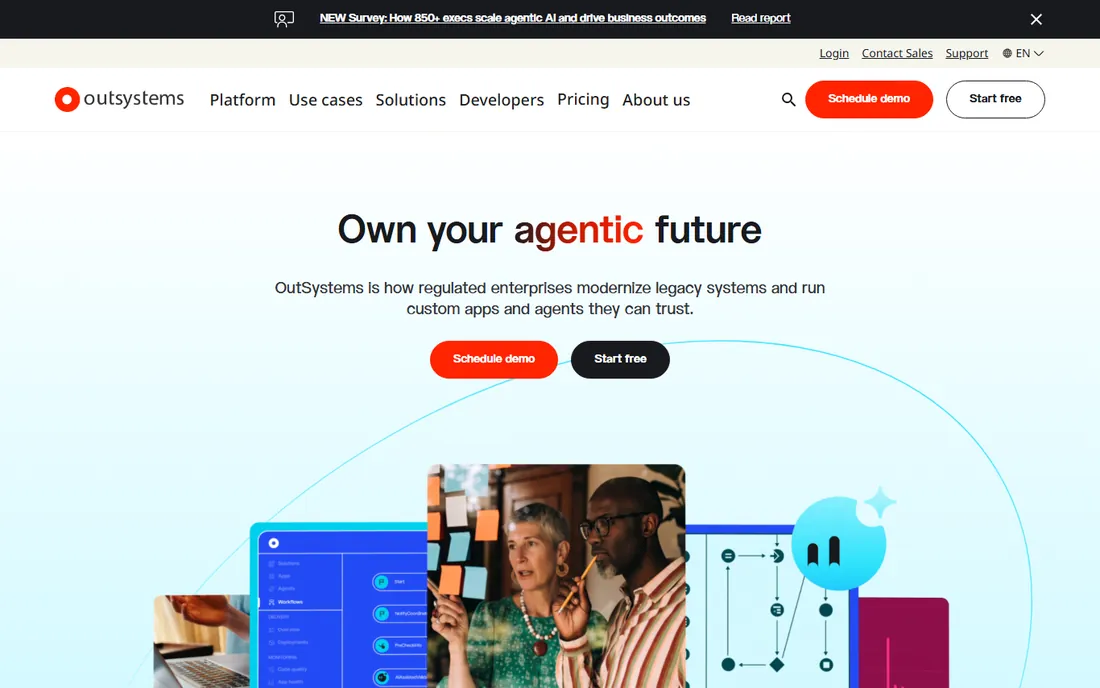
OutSystems spent 2026 completing its transformation from low-code platform to what it calls an agentic systems platform. The pitch: enterprises can build custom applications and AI agents with visual development, pre-built building blocks, and AI assistance through the whole lifecycle, without giving up security, governance, or performance. The new Agent Experience connects the platform to coding agents like Claude Code and Cursor so teams can modernize legacy systems with guardrails intact.
What keeps OutSystems at the top of analyst rankings is the completeness of the enterprise story. Automated governance and compliance, deep integrations with core systems, DevOps and lifecycle management, and deployment options that satisfy regulated industries are all native. Customers like Heineken, Bosch, and Honda build mission-critical systems on it, and the 2026 Gartner Magic Quadrant for AI-Augmented Low-Code Application Platforms names it a leader again.
The honest catch is accessibility. Pricing is quote-based and aimed at enterprises, with no free tier for experimenting. A small business that wants a customer portal will find it wildly oversized. But if you are an IT leader who needs to deliver custom applications at scale with auditability, OutSystems remains the reference platform.
What we like- Visual, model-driven development with full lifecycle management
- New Agent Experience brings governed AI development to tools like Claude Code and Cursor
- Recognized as a leader by Gartner and Forrester
Watch out for- Enterprise pricing with no self-serve tier
- More platform than a small team needs
Starting priceSee website
Free planYes
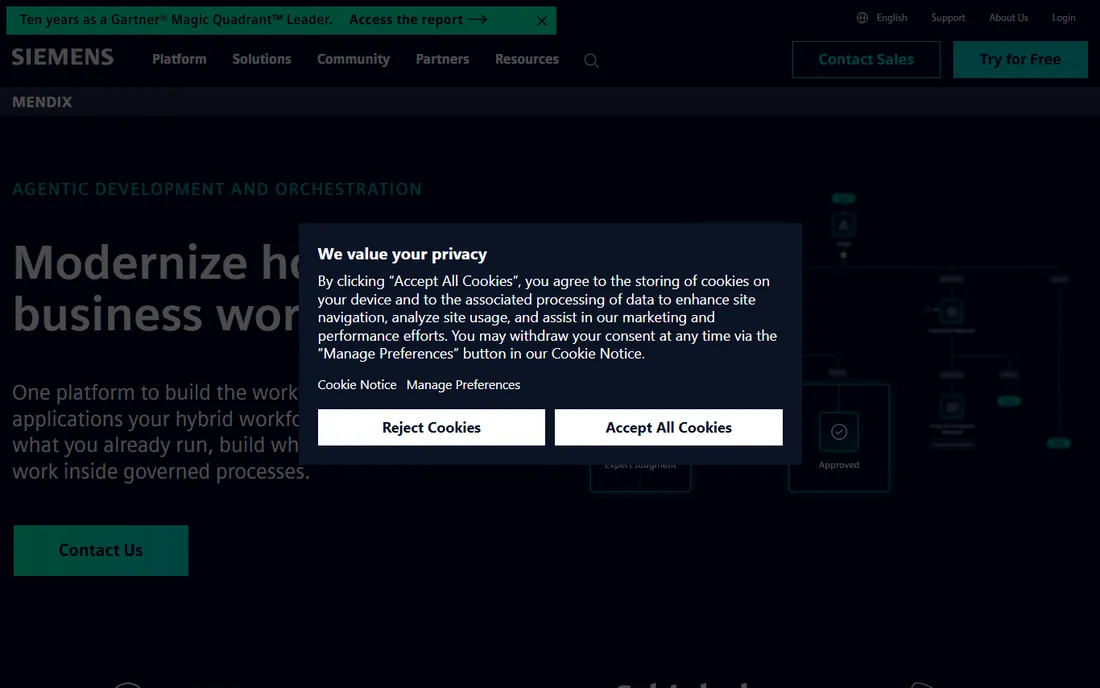
Mendix, part of Siemens, took a similar agentic turn in 2026 with a distinct emphasis: coordinate work across every system, person, and agent. The platform lets teams generate applications from prompts or requirements documents, review the logic visually rather than line by line, and orchestrate end-to-end processes where AI agents, employees, and systems each play their part. Governance is explicit: permissions, guardrails, approvals, and full traceability of agent actions.
The "modernize without replacing" message resonates with enterprises sitting on decades of core systems. Mendix extends those systems with modern experiences, connects data and processes across them, and deploys to public cloud, private cloud, or air-gapped environments with your choice of AI models. That openness, any model, any coding agent, deploy anywhere, is a genuine differentiator.
The trade-off is that Mendix is an enterprise platform with an enterprise buying process. The free tier lets you try the platform, but production use means a sales conversation and real budget. Citizen developers may also find the depth intimidating compared with simpler builders. For organizations modernizing complex operations with AI in the loop, it is one of the two strongest choices.
What we like- One platform for apps, workflows, and AI agents with strong governance
- Modernize around existing systems without rip-and-replace
- Deploy anywhere including air-gapped environments
Watch out for- Enterprise sales motion for serious use
- Learning curve for citizen developers
Starting priceSee website
Free planYes
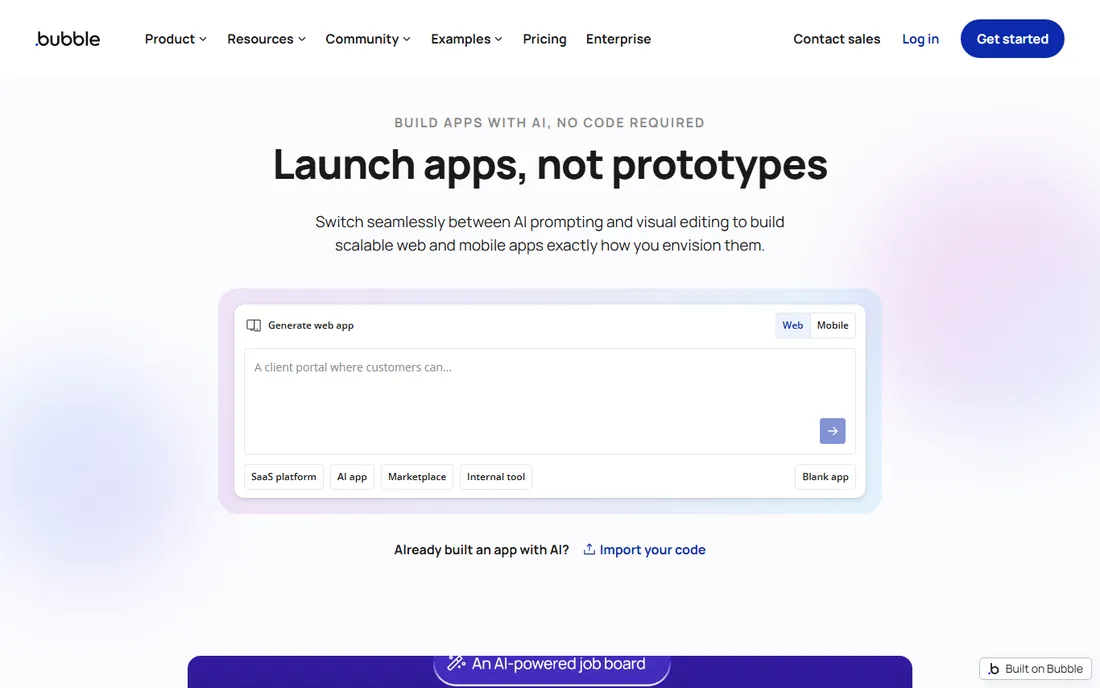
Bubble is the veteran no-code app builder, and in 2026 it repositioned around AI-assisted building while keeping its core strength: a visual programming environment where you design the interface, define the database, and wire up logic and API integrations without writing code. Thousands of startups have launched real businesses on it, from marketplaces to SaaS products.
What sets Bubble apart from simpler builders is depth. You are not assembling screens from templates; you are building application logic visually, which means the ceiling is much higher. The plugin ecosystem extends it further, and responsive design tools handle the front end. For a non-technical founder who wants to build a genuine web application rather than a form with a nice skin, Bubble remains the default recommendation.
The honest catch is the learning curve. Bubble's power comes with complexity, and new users should expect weeks of learning before building confidently. Pricing and performance at scale have also been long-running complaints, with workload-based pricing that can surprise growing apps. It is the most capable no-code option here, but capability has a cost in both learning and budget.
What we like- True visual programming with database, logic, and API connections
- Large template and plugin ecosystem
- One of the most proven no-code platforms for startups
Watch out for- Learning curve is steeper than simpler builders
- Performance and pricing at scale draw criticism
Starting priceSee website
Free planYes
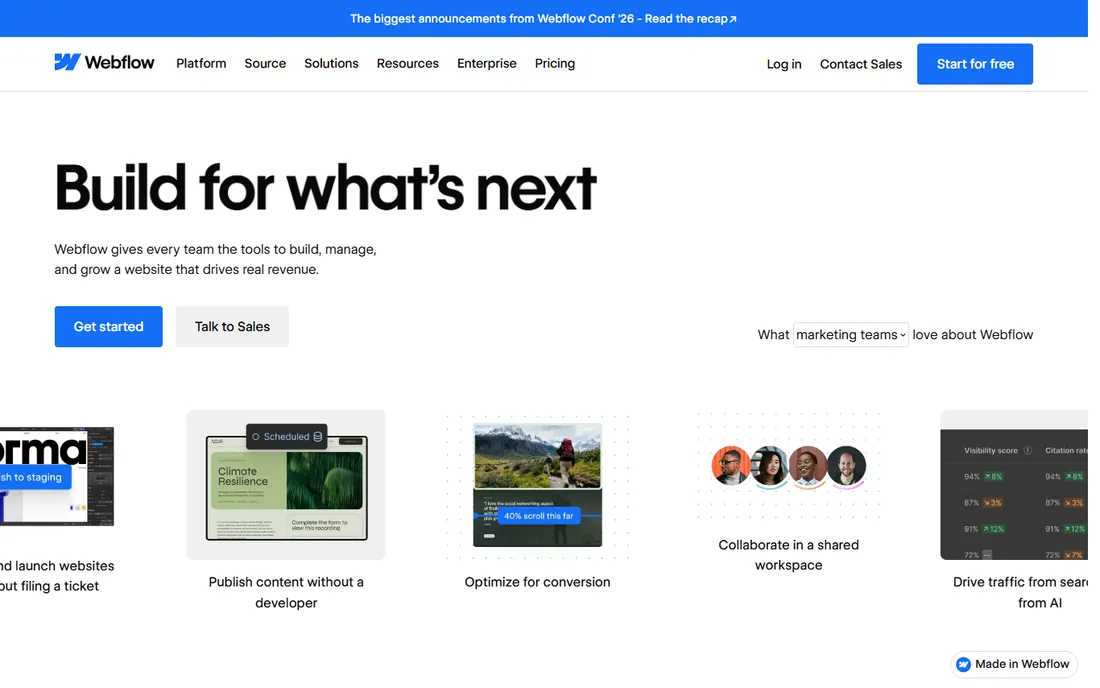
Webflow started as the designer's website builder and in 2026 became what it calls an agentic web platform. The big move for this category: you can now deploy web applications directly in Webflow, connecting APIs, custom logic, and real-time data without separate infrastructure. Marketing teams get the visual canvas, CMS, and AI-assisted content they love, and product teams can ship functional apps on the same platform.
The design pedigree is unmatched. No other tool here gives marketers and designers this level of visual control with production-grade hosting, and features like page branching, shared libraries, and AI-powered personalization serve serious marketing operations. The ability to put agents to work on the site through tools like Claude adds a modern layer.
The catch is that Webflow is still design-first. Its application logic is real but younger and thinner than Bubble's or the enterprise platforms'. Pricing can also stack: site plans plus workspace plans plus app usage add up. Choose Webflow when the project is a beautiful marketing site that needs real app functionality attached, not when you need deep backend logic.
What we like- Pixel-perfect visual design with clean code output
- Now hosts dynamic web apps alongside marketing sites
- Strong CMS, SEO, and AI-assisted content tooling
Watch out for- App logic is newer and thinner than dedicated builders
- Pricing stacks up across site and workspace plans
Starting priceFree (self-hosted open source)
Free planYes
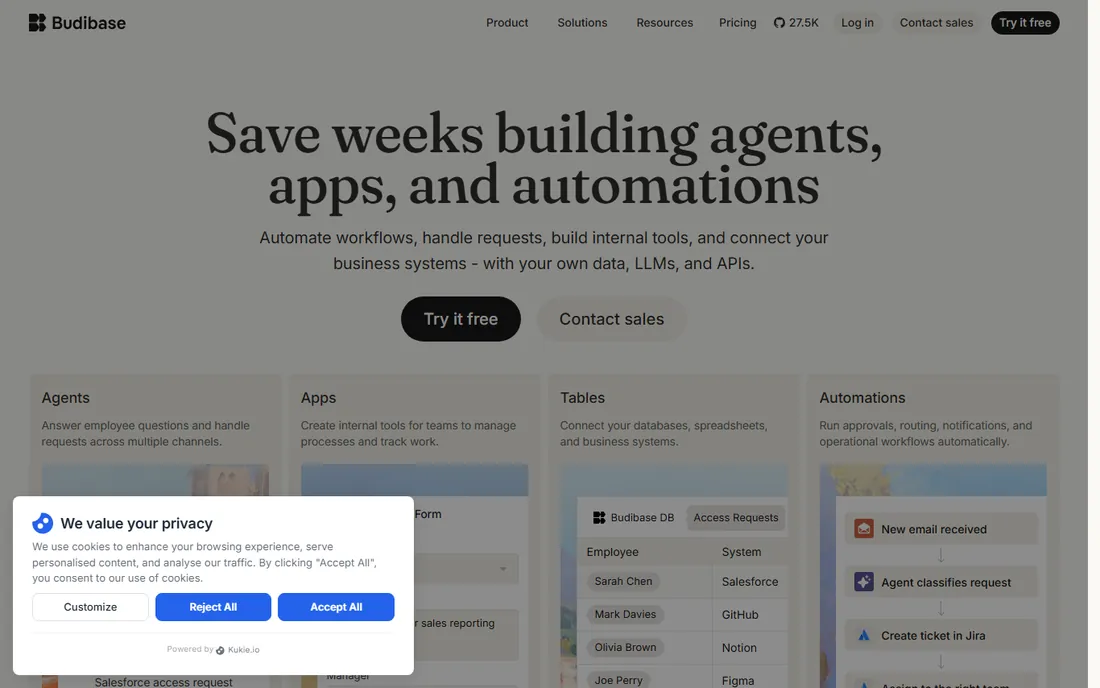
Budibase is the open-source answer to internal tooling. In 2026 it expanded from apps and workflows to AI agents that answer employee questions, route approvals, and act across business systems, all grounded in your own data, LLMs, and APIs. The pitch is simple: connect your databases and spreadsheets, build the tools your team needs, and host it yourself if data control matters.
The open-source model is the differentiator. You can self-host Budibase inside your own infrastructure, which settles security reviews that stall commercial SaaS purchases. Enterprise features like custom RBAC, SSO, SAML, backups, and audit logs are available, and ISO 27001 certification backs the security story. Governments and industry teams use it for real operations.
The honest catch is scope. Budibase is built for internal tools and operational workflows, not for customer-facing products with polished public UX. The template and integration ecosystem is smaller than the big commercial platforms. But for IT teams that need internal apps with AI agents and want to own the infrastructure, the value is outstanding, especially at the price of free.
What we like- Open-source with self-hosting for full data control
- Builds apps, workflows, and AI agents from your own data
- Enterprise security including SSO and audit logs
Watch out for- Aimed at internal tools, not customer-facing apps
- Smaller ecosystem than commercial rivals
Starting priceSee website
Free planYes
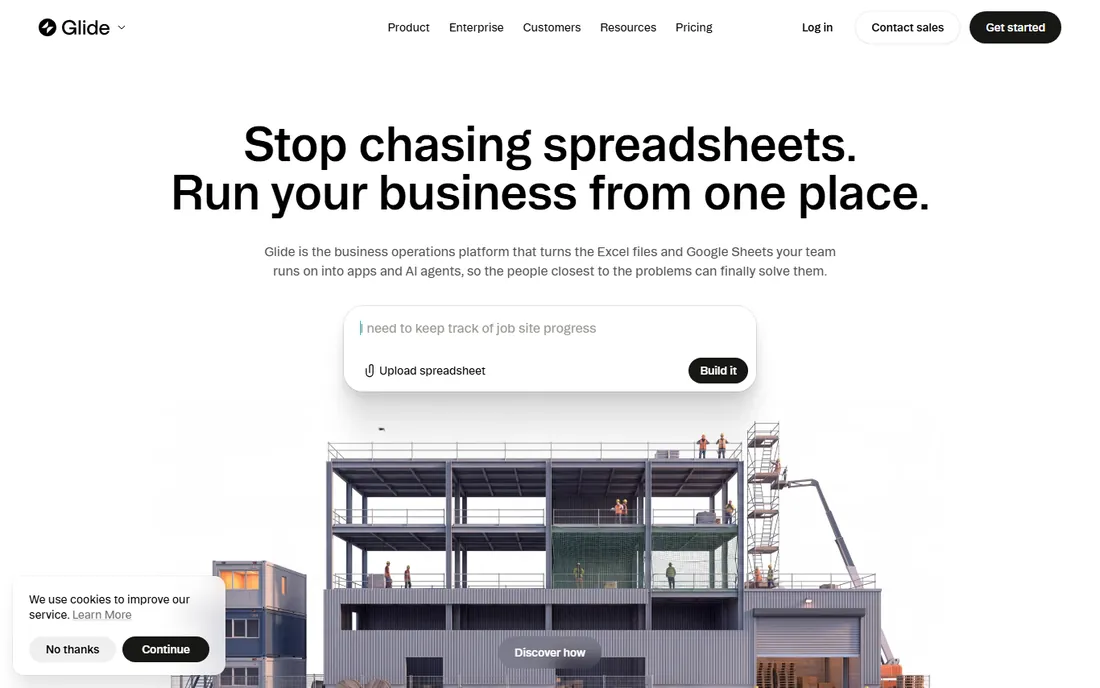
Glide's 2026 homepage says it plainly: turn spreadsheets into apps and agents you can trust to run your business. The platform takes the data teams already live in, Google Sheets, Excel, SQL databases, and generates working apps for desktop and mobile: field operations tools, executive dashboards, customer portals, all connected to the same live data. AI now builds alongside you, and the CEO's framing is that AI should know your apps well enough to work inside them.
The audience is operators, not developers. The people closest to the problem build the solution, which is why companies from Costco to Airbus show up in the customer stories. Security is taken seriously with SOC 2, GDPR, CCPA, and AES-256 encryption, and apps are private by default with granular access control.
The trade-off is creative range. Glide excels at data-driven operational apps and is less suited to novel consumer products or highly custom designs. It is also priced per user in ways that can add up for large field teams. But for the enormous category of "we run this on a spreadsheet and it is breaking," Glide is the fastest path to a real app.
What we like- Turns spreadsheets and databases into working apps in hours
- AI app builder tuned for internal business apps
- Strong security posture with SOC 2 and GDPR
Watch out for- Design flexibility trails Webflow and Bubble
- Best for data-driven apps rather than novel products
#7
Adalo
Best for: visual apps published to web and app stores
Visit adalo.com
Starting priceSee website
Free planYes
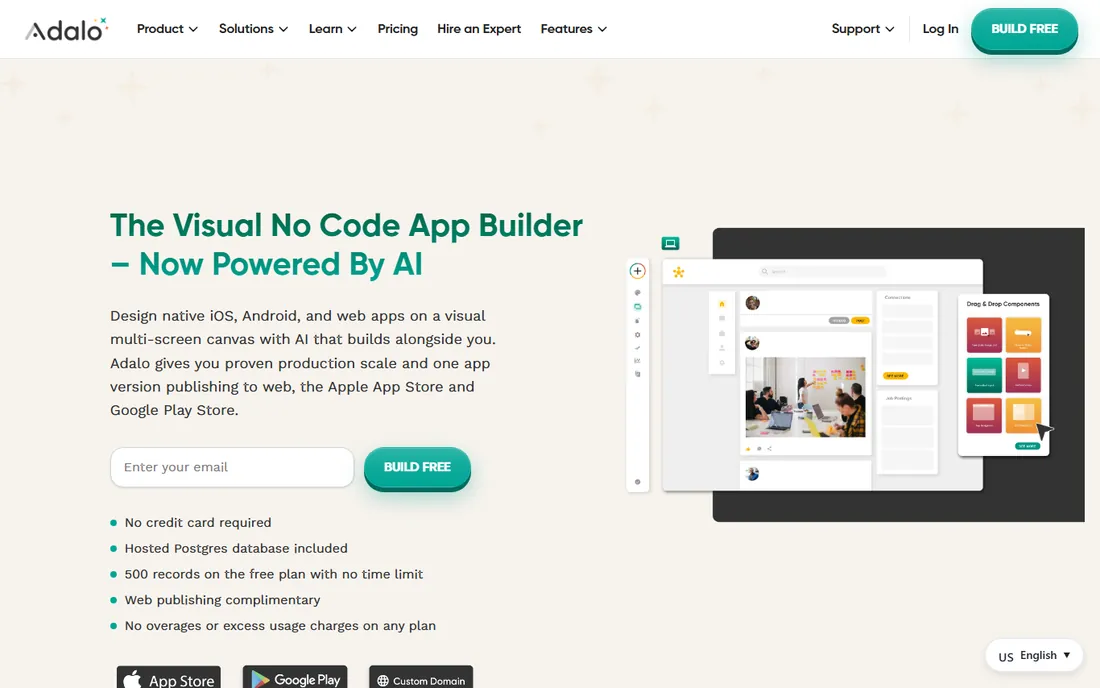
Adalo occupies the friendly middle of no-code: a visual canvas where you design screens, connect a hosted database, and publish the same app to the web, the Apple App Store, and Google Play. The 2026 platform adds Ada, an AI assistant for prompt-based building and editing, alongside the drag-and-drop builder that made it popular. Over a million apps have been created on the platform.
The free plan is genuinely usable: 500 records on a hosted Postgres database with no time limit, complimentary web publishing, and no overages. That makes Adalo one of the best places to validate a mobile app idea without spending. Integrations through Zapier and Make connect it to thousands of services, and an expert marketplace exists for those who want help.
The honest catch is the ceiling. Adalo's component system keeps things shippable but can frustrate builders who outgrow the building blocks, and the community and template ecosystem is smaller than Bubble's. Performance for complex apps is a common complaint. For straightforward mobile and web apps built fast by non-developers, though, it hits a sweet spot of simplicity and reach.
What we like- Visual multi-screen canvas with AI assistant for prompt-based building
- Publishes one app version to web, iOS, and Android
- Free plan includes hosted database with no time limit
Watch out for- Component system can feel limiting for complex apps
- Smaller community than Bubble
How we chose
We compared low-code and no-code platforms across the three real buyer types: enterprises needing governed application development, non-technical builders creating products, and operations teams building internal tools. We reviewed current vendor homepages and 2026 product announcements, cross-checked against analyst recognition (Gartner, Forrester) and independent comparisons, and weighted build depth, AI capabilities, governance and security, pricing transparency, and fit for small and mid-size US companies. We did not claim hands-on testing; all facts come from vendor-published material and independent reviews.
What to check before you build
Start with who will maintain the app in two years. A founder-built Bubble app is wonderful until the founder needs a developer to extend it; an OutSystems app is wonderful until the contract renews. Ask every vendor about code export, documentation, and what happens if you leave. The escape hatch matters more than the onboarding demo.
Separate prototypes from production
AI builders are fantastic at producing a working demo in an afternoon. Production needs authentication, permissions, backups, monitoring, and someone accountable when it breaks at 2 a.m. Before committing real users, confirm the platform covers those basics or plan for the rebuild. Tools like OutSystems, Mendix, and Budibase are built for production; simpler builders may need supplementation.
Price the success case
Free tiers and starter plans look cheap until the app works. Model the cost at one hundred users, at one thousand, and with the integrations you will actually need. Per-user pricing, workload units, and database row limits are the three mechanisms that turn a cheap prototype into an expensive product. Ask for the numbers in writing.
Check the data story
Where does your data live, who can access it, and can you get it out? Self-hosting (Budibase), exportable databases (Adalo's Postgres), and clear data processing terms matter more as the app becomes critical. If the platform cannot answer these questions cleanly, keep looking.
The agentic turn in low-code
The defining change of 2026 is that every platform added AI that builds with you rather than for you. OutSystems governs coding agents, Mendix orchestrates agents inside processes, Webflow puts agents to work on sites, Bubble and Glide generate apps from prompts, and Budibase ships agents that act on your data. The buying question shifted accordingly: not "how good is the visual builder" but "how well does the AI handle my real requirements, and what guardrails keep it honest." Test every AI builder on your hardest screen or workflow, inspect what it generated, and confirm a human can understand and modify the result.
Frequently asked questions
What is a low-code web app builder?
It is a platform that lets you build web applications with visual tools and minimal hand-coding: drag-and-drop interfaces, visual logic, and pre-built integrations replace much of traditional development. AI assistance is now standard across the category.
What is the difference between low-code and no-code?
Low-code platforms (OutSystems, Mendix) target professional developers and IT teams, offering visual development plus the ability to extend with code, with enterprise governance. No-code platforms (Bubble, Adalo, Glide) target non-developers, trading some depth for simplicity. The line blurs more every year.
Can I build a real business on a no-code platform?
Yes, thousands of startups run on Bubble, Adalo, and similar tools. The practical limits are scale economics (pricing at high usage), performance for complex apps, and hiring developers who can extend a visual codebase. Validate with no-code, and plan the production architecture once revenue justifies it.
How much does a low-code platform cost?
Free tiers cover experimentation on most platforms. No-code builders typically run $25 to $100-plus per month for production use. Enterprise low-code (OutSystems, Mendix) uses custom annual pricing that reflects the governance and support included. Open-source options like Budibase can be self-hosted for free.
Do I need developers to use these tools?
No-code builders are designed for non-developers, though complex apps still benefit from technical thinking. Enterprise low-code platforms assume professional developers or trained citizen developers. AI assistants lower the bar everywhere but do not remove the need to understand what the app should do.
What happens to my app if I stop paying?
It depends on the platform. Most SaaS builders suspend or take down the app when the subscription lapses. Open-source tools you self-host keep running. Before building anything critical, confirm the export options and the offboarding terms in writing.
Sources we checked (7)
- https://www.outsystems.com/
- https://mendix.com/
- https://bubble.io
- https://webflow.com/
- https://budibase.com/
- https://www.glideapps.com/
- https://adalo.com/
Is your product missing or out of date?
We review this list regularly. Vendors can request a listing, send updated pricing or ask about featured placement.

Shihab Mia · Founder, Rankite
Shihab has spent more than a decade helping SaaS and e-commerce brands grow through search. He writes Rankite's software buying guides from pricing pages, documentation and public user reviews. More about Shihab.