How we make this list: we compare pricing pages, product documentation and public user reviews. Rankite is independent; if a vendor ever pays for a featured spot, that listing is clearly labeled Partner.
Key takeaways
- Weekdone is free for up to 3 users, making it the cheapest genuine OKR tool for tiny teams.
- Tability ($6/user/month) and Mooncamp are the most startup-friendly full platforms.
- 15Five and Lattice are performance-management platforms with strong OKR modules, better for scaling teams.
- Perdoo, Profit.co and Quantive (WorkBoardAI) suit startups that want strategy depth from day one.
Quick comparison
| Tool | Best for | Starting price | Free plan |
|---|
 Weekdone Weekdone | Small startups that want simple OKRs with weekly status reporting | See website | Free (up to 3 users) |
 Mooncamp Mooncamp | Startups that want a modern OKR platform to grow with | See website | Free trial |
 Perdoo Perdoo | Strategy-first startups that want goals tied to a real strategy map | See website | See website |
 Lattice Lattice | Startups that want OKRs inside a full people platform | See website | No |
 15Five 15Five | Startups that want OKRs with engagement surveys and manager coaching | From $4/user/month (annual) | No |
 Quantive (WorkBoardAI) Quantive (WorkBoardAI) | Startups with serious strategy complexity or enterprise ambitions | See website | No |
 Profit.co Profit.co | Startups that want OKRs, performance and projects in one system | See website | See website |
 Tability Tability | Startups that want affordable OKRs with AI-assisted check-ins | $6/user/month | Free trial (14 days) |
Is your product missing or out of date?
We review this list regularly. Vendors can request a listing, send updated pricing or ask about featured placement.
The best OKR software for startups
Most startups do not fail at OKRs because the framework is wrong. They fail because goals live in a deck nobody opens, updates happen in Slack threads nobody reads, and by mid-quarter nobody remembers what the key results were. OKR software exists to fix exactly that: one place for goals, check-ins that take minutes, and visibility from founder to new hire.
These eight tools are the ones worth your evaluation time: dedicated OKR platforms, strategy execution suites, and performance platforms with real goal modules. All are current products with real startup customers.
#1
Weekdone
Best for: Small startups that want simple OKRs with weekly status reporting
Visit weekdone.com
Starting priceSee website
Free planFree (up to 3 users)
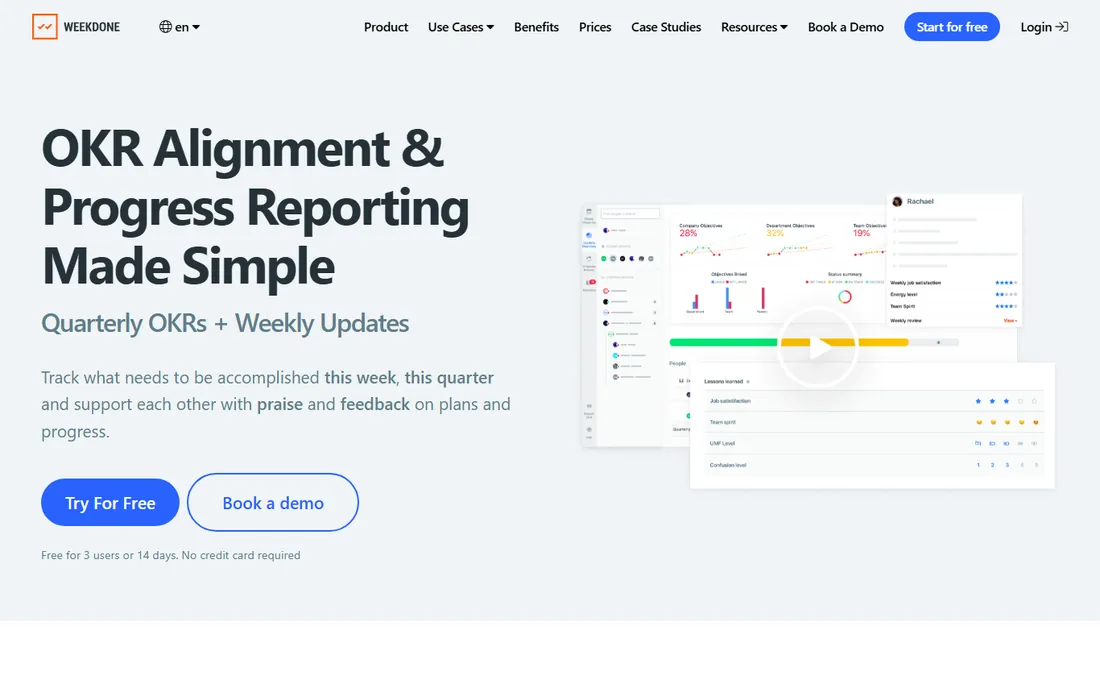
Weekdone pairs quarterly OKRs with weekly updates: track what needs doing this week and this quarter, give praise and feedback on plans and progress, and keep alignment visible with OKR trees, KPIs, initiatives and company-wide reports. Pulse surveys, 5-star check-ins, 1:1s and a social newsfeed round out the team-management side.
The free tier (up to 3 users, or a 14-day trial of everything) makes Weekdone the natural starting point for a founding team. It is deliberately simpler than the strategy suites below, which is a feature for teams that want OKRs running this week, not next quarter.
What we like- Free tier covers teams of up to 3
- Quarterly OKRs plus automated weekly status reports
- Visual OKR hierarchy trees, KPIs and pulse surveys included
Watch out for- Pricing for larger teams is not published on the homepage
- The feature set is simpler than strategy suites
- Scaling past the free tier requires a paid plan
#2
Mooncamp
Best for: Startups that want a modern OKR platform to grow with
Visit mooncamp.com
Starting priceSee website
Free planFree trial
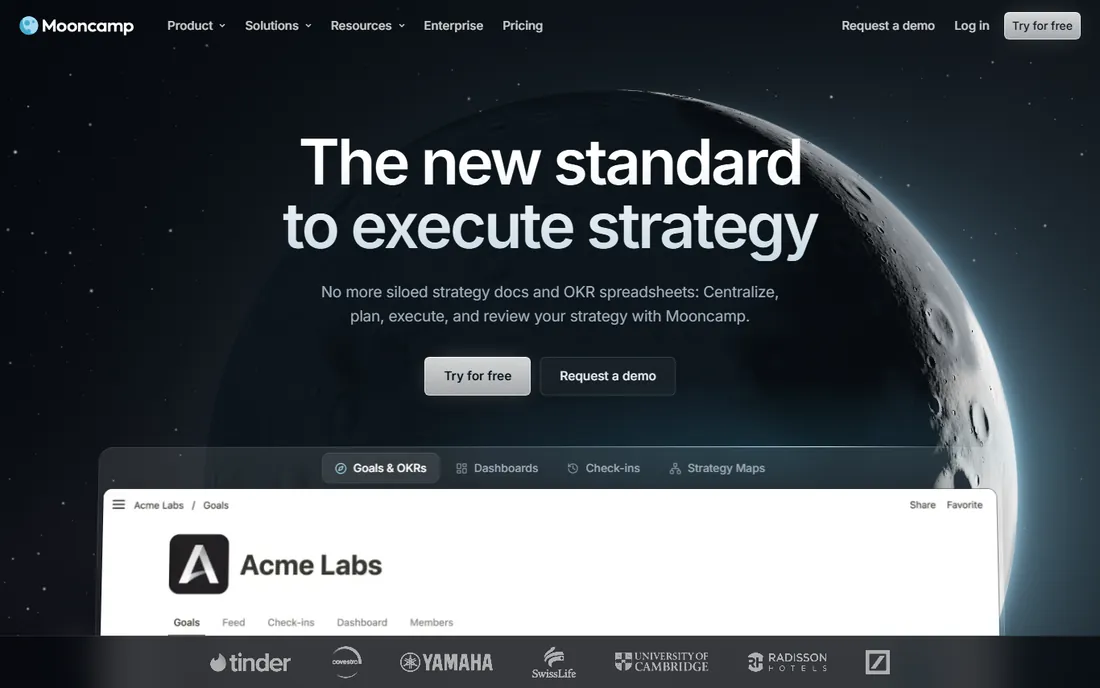
Mooncamp's pitch is centralizing strategy, goals and reviews: plan your strategy in one place, execute with OKR check-ins and accountability, and review with performance dashboards and alignment trees. Integrations pull progress in automatically, and the interface is built for the check-in rhythm that makes OKRs work.
"Try Mooncamp for free" is the homepage offer, with pricing on the pricing page. For startups that expect to grow into the platform (rather than outgrow a simpler tool), Mooncamp is a strong candidate.
What we like- Strategy planning, OKR check-ins, KPI trees and dashboards in one place
- Free trial with no credit card
- GDPR-friendly European vendor
Watch out for- Pricing is not published on the homepage
- The strategy breadth can be more than a seed-stage team needs
- Enterprise messaging may put off tiny teams
#3
Perdoo
Best for: Strategy-first startups that want goals tied to a real strategy map
Visit perdoo.com
Starting priceSee website
Free planSee website
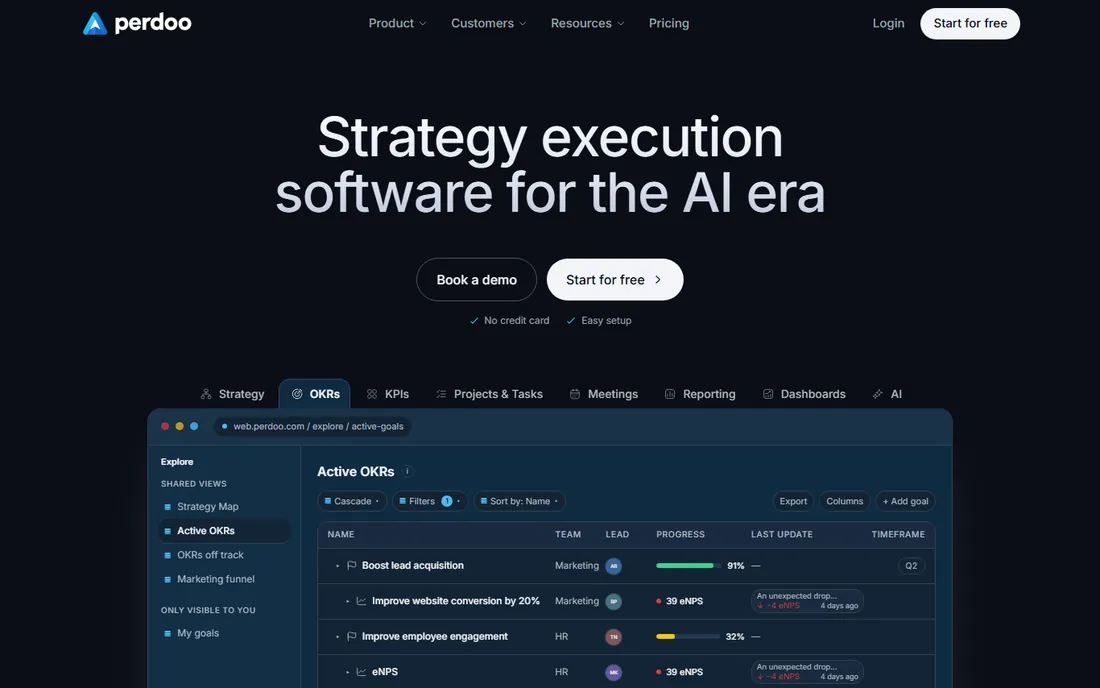
Perdoo treats OKRs as the execution layer of strategy: a strategy map shows how everything connects, objectives and key results sit under it, progress is pulled from your apps, and status reports generate themselves. The vendor positions it as a system of record for strategy that everyone can understand and contribute to.
For startups with a clear strategy they want the whole team executing against, Perdoo is purpose-built. For teams still finding product-market fit, a lighter tool may fit better until the strategy solidifies.
What we like- Strategy maps connect ultimate goals, pillars, objectives, key results and KPIs
- Auto-generated status reports from app integrations
- Research-backed methodology content
Watch out for- Pricing and free-tier terms are not published on the homepage
- The strategy-first framing suits structured teams more than chaotic ones
- Onboarding takes more thought than check-in tools
#4
Lattice
Best for: Startups that want OKRs inside a full people platform
Visit lattice.com
Starting priceSee website
Free planNo
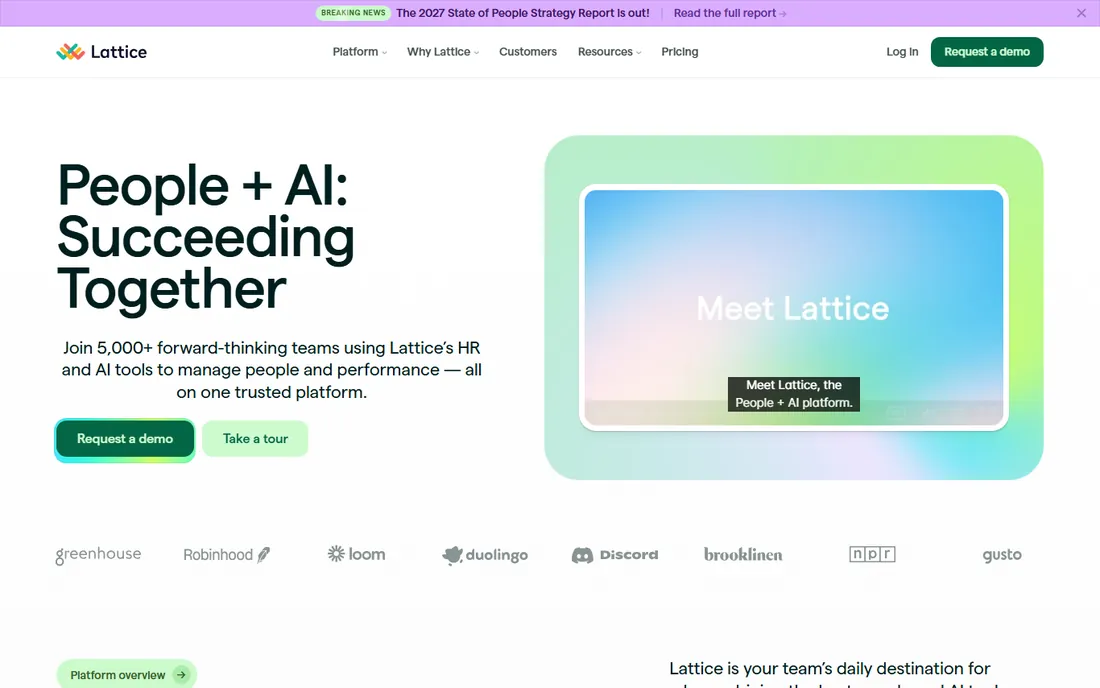
Lattice is the HR platform that includes goals: set OKRs and align them across the team, then run performance reviews, 1:1s, feedback and engagement surveys in the same place. The homepage emphasizes habits (1:1s, updates, feedback) turning into clarity and alignment, with an AI agent layer on top.
For a startup that is hiring and formalizing people processes anyway, running OKRs inside Lattice avoids a separate tool. For a team that just wants goals tracked, a dedicated OKR tool is leaner and cheaper.
What we like- Goals and OKRs alongside performance reviews, 1:1s, feedback and engagement
- Deep HRIS and productivity integrations
- Strong reputation for manager-friendly UX
Watch out for- Pricing is not published on the homepage
- It is a people platform first, OKR tool second
- Likely overkill for a team that only needs goals
#5
15Five
Best for: Startups that want OKRs with engagement surveys and manager coaching
Visit 15five.com
Starting priceFrom $4/user/month (annual)
Free planNo
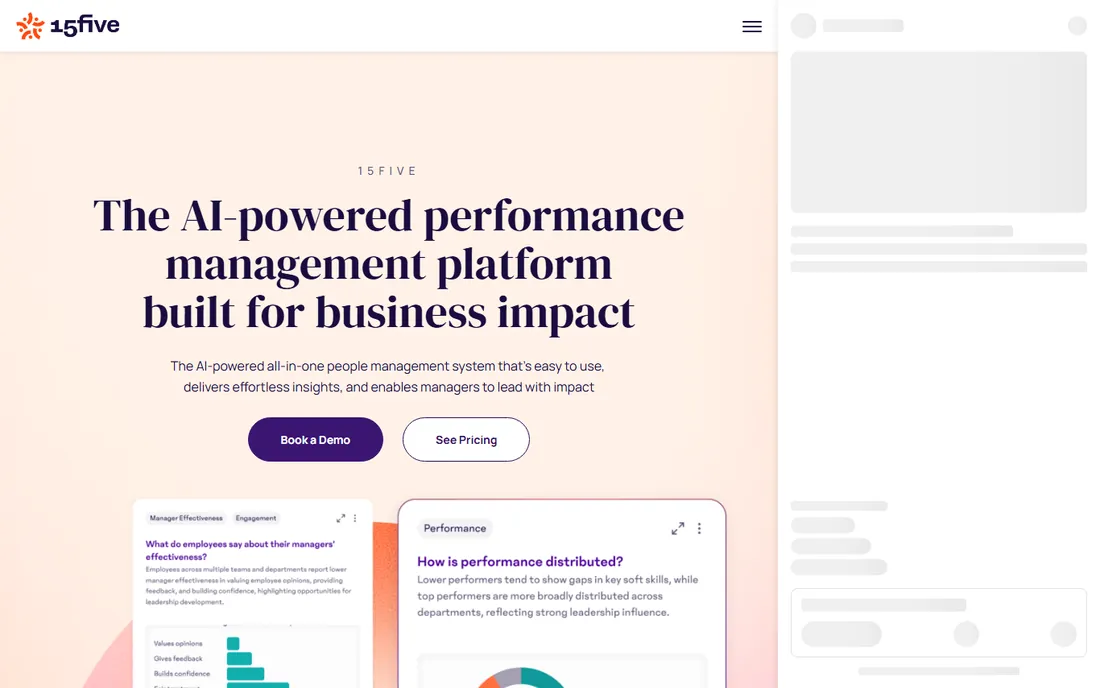
15Five unifies performance reviews, engagement surveys, 1:1s, check-ins, OKRs and compensation signals in one platform. The Perform plan ($11/user/month annually) includes OKRs, reviews and check-ins; the Engage plan ($4) covers surveys and analytics; the Total Platform plan ($16) bundles everything plus manager training.
The published pricing is a plus for startups budgeting carefully. Choose 15Five if performance management is the job and OKRs ride along; choose a dedicated tool if goals are the job.
What we like- Published pricing: Engage from $4, Perform from $11, Total Platform from $16 per user/month
- OKRs inside a continuous performance platform with reviews, 1:1s and feedback
- AI-powered insights
Watch out for- No free plan
- The OKR module is part of a broader platform, not the star
- The cheapest plan does not include performance reviews
#6
Quantive (WorkBoardAI)
Best for: Startups with serious strategy complexity or enterprise ambitions
Visit quantive.com
Starting priceSee website
Free planNo
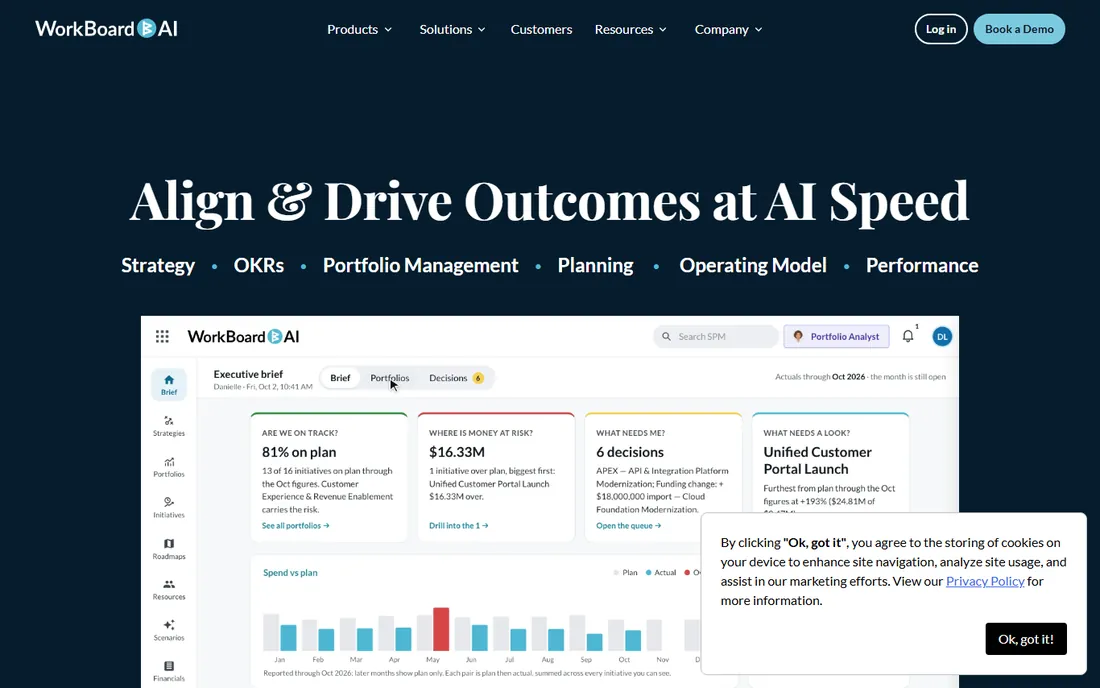
Quantive is the current brand of WorkBoard: an AI-native strategy execution platform covering long-range strategy, OKRs, strategic portfolio management, planning and performance. AI agents assist OKR creation, generate dashboards and reporting, and keep teams aligned; three AI agents run on an enterprise knowledge graph.
This is the heavyweight option. A startup with genuine portfolio complexity (multiple products, funded scale-up trajectory) can grow into it; a ten-person team should weigh whether the depth justifies the commitment. Pricing is quote-based via demo.
What we like- Full strategy execution platform: OKRs, portfolio management, planning and talent
- AI agents for OKR creation, retros and reporting
- Supports multiple frameworks (OKRs, OGSMs, Hoshin)
Watch out for- Pricing is not published on the homepage
- Enterprise positioning and feature depth exceed most startups' needs
- Demo-led sales motion
#7
Profit.co
Best for: Startups that want OKRs, performance and projects in one system
Visit profit.co
Starting priceSee website
Free planSee website
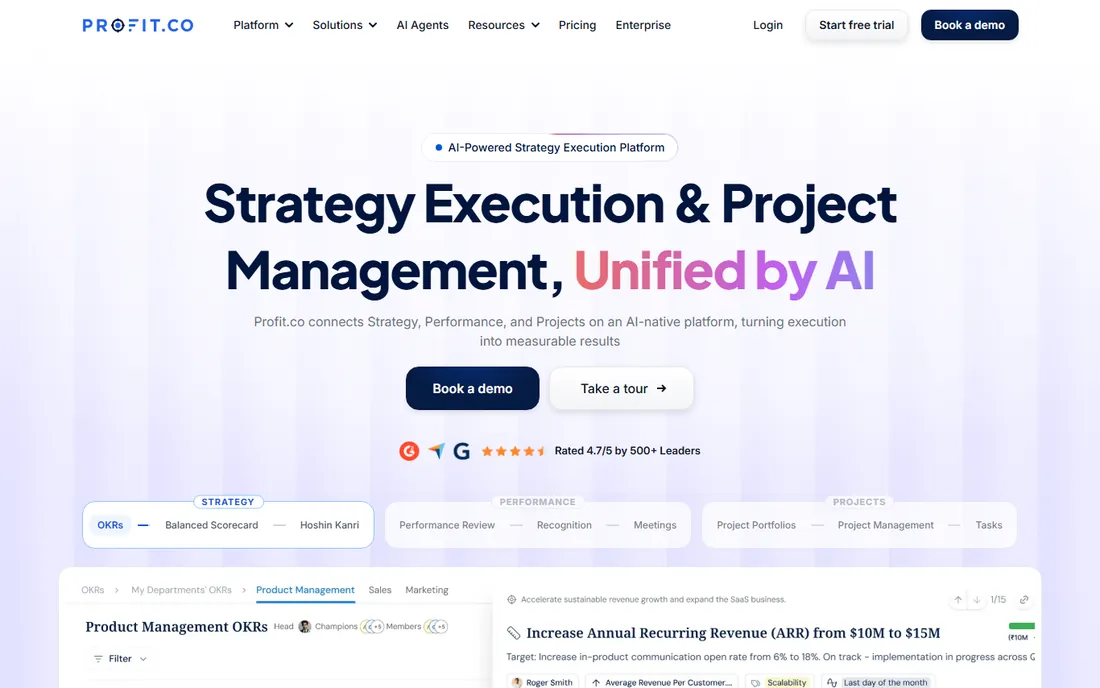
Profit.co is an all-in-one operating system: set goals, run OKRs with AI assistance, manage performance reviews and 360 feedback, track projects with Kanban/Gantt views, and pull everything into strategy dashboards with predictive forecasts. Over 100 integrations keep data flowing without manual updates.
For startups that hate tool sprawl, Profit.co's breadth is the appeal: one subscription covering goals, reviews and projects. For teams that prefer specialized tools, the same breadth is the risk. Pricing and trial terms are on the vendor's site.
What we like- Single platform for strategy, OKRs, performance reviews, 360 feedback and project/task management
- 100+ native integrations
- Supports OKRs, Balanced Scorecard and Hoshin Kanri
Watch out for- Pricing is not published on the homepage
- The breadth can overwhelm a small team
- The all-in-one pitch means compromises versus best-of-breed tools
#8
Tability
Best for: Startups that want affordable OKRs with AI-assisted check-ins
Visit tability.io
Starting price$6/user/month
Free planFree trial (14 days)
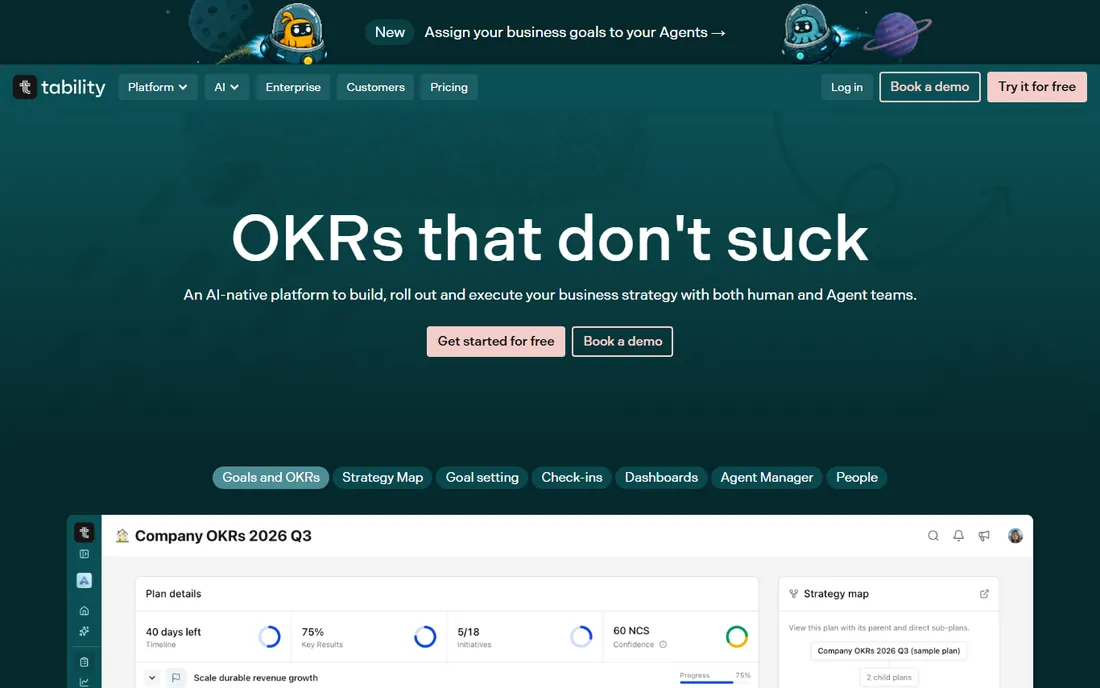
Tability is built for modern teams: set goals, assign them to humans or AI agents, monitor with live dashboards and scheduled agent check-ins, and let reports write themselves from execution data. Free read-only seats mean the whole company sees the strategy without everyone needing a paid seat. It is GDPR compliant with SOC 2-aligned practices.
At $6/user/month, Tability is among the cheapest full OKR platforms here, and the startup-specific messaging ("outperform teams 10x your size") fits. For a cost-conscious startup that wants AI help with the reporting overhead, it is the value pick.
What we like- Starts at $6/user/month with free read-only seats for the whole company
- AI plan editor, OKR generator and agent check-ins
- Integrations with Jira, Linear and Salesforce
- 14-day trial, no credit card
Watch out for- The AI-agent positioning is newer and less proven than classic OKR workflows
- Smaller vendor than the enterprise players
- The $6 tier's limits need checking on the pricing page
How we chose
We looked for current OKR and strategy-execution products with real startup relevance: dedicated OKR platforms, strategy suites, and performance platforms with genuine goal modules. For each we opened the vendor homepage, confirmed the product is current, and recorded pricing only where published. Tools that are OKR features inside project managers (Asana, Monday) did not make the cut; these eight are goal-first or people-first platforms.
Run a one-quarter trial before committing
OKR software fails when it becomes software the team ignores. The fix is procedural, not technical: pick one tool, run a single OKR cycle (one quarter), and judge it on adoption, not features. The questions that matter: did check-ins happen on time? Did the team look at the dashboards? Did 1:1s reference goals? A tool the team actually opens beats a better tool they do not.
Start with a free tier or trial (Weekdone's free-for-3, Tability's 14 days, Mooncamp's free trial), set a small number of objectives, and assign one owner to the process. If the quarter ends with goals updated and reviewed, you have your tool. If not, the problem was the ritual, and no software fixes that.
Choosing the right OKR software for your startup
Match the tool to your stage. Pre-seed to seed (under 15 people): Weekdone's free tier or Tability's $6 plan; you need check-ins and visibility, not strategy maps. Series A and beyond: Mooncamp or Perdoo for strategy depth, 15Five or Lattice if you are building people processes too.
Then check the practicalities: does it integrate with your stack (Jira, Linear, Slack, Google Workspace)? Can everyone see goals without a paid seat (Tability's free read-only seats are the standout here)? Is pricing published so you can budget? And run the one-quarter trial before rolling out company-wide.
Frequently asked questions
What is the difference between OKRs and KPIs?
OKRs (Objectives and Key Results) are a goal-setting framework: an ambitious objective plus measurable key results that define success, reset quarterly. KPIs (Key Performance Indicators) are ongoing health metrics you monitor continuously (revenue, churn, uptime). Most tools here handle both: OKRs for what you are trying to change this quarter, KPIs for what you must keep healthy.
How much should a startup pay for OKR software?
Very little at first. Weekdone is free for up to 3 users; Tability starts at $6/user/month with free read-only seats; 15Five's Perform plan is $11/user/month. A 20-person startup pays roughly $120/month on Tability. Do not buy an enterprise platform until you have outgrown the startup-priced ones; the framework matters more than the tool.
Can we just use spreadsheets for OKRs?
You can, and many startups start there. Spreadsheets break at the check-in rhythm: no reminders, no dashboards, no integrations, and the file becomes one person's job to maintain. Dedicated tools exist to automate exactly that overhead. If your spreadsheet OKRs are actually updated weekly, keep them; if not, the tool is the cheaper fix.
Do OKR tools integrate with Slack, Jira and Google Workspace?
Most do. Tability syncs from Jira, Linear and Salesforce; Perdoo pulls progress from your apps; Profit.co lists 100+ integrations; Lattice and 15Five connect with HRIS and collaboration tools. Check the specific integrations page for your stack before committing, since auto-updating key results from real data is the feature that makes the tool worth paying for.
How long does it take to roll out OKR software?
A basic rollout takes a day: invite the team, set company objectives, have everyone draft key results. The first full cycle takes a quarter, which is the real test: check-ins need to happen weekly, and someone must own the process. Most tools here offer onboarding help or OKR coaching; Weekdone even advertises free OKR coaching. Budget more time for the habit than the software.
Sources we checked (8)
- https://www.weekdone.com
- https://mooncamp.com/
- https://perdoo.com/
- https://lattice.com/
- https://www.15five.com
- https://quantive.com/
- https://profit.co/
- https://www.tability.io
Is your product missing or out of date?
We review this list regularly. Vendors can request a listing, send updated pricing or ask about featured placement.

Shihab Mia · Founder, Rankite
Shihab has spent more than a decade helping SaaS and e-commerce brands grow through search. He writes Rankite's software buying guides from pricing pages, documentation and public user reviews. More about Shihab.