How we make this list: we compare pricing pages, product documentation and public user reviews. Rankite is independent; if a vendor ever pays for a featured spot, that listing is clearly labeled Partner.
Key takeaways
- Workato, Boomi and MuleSoft are the integration-first platforms, aimed at IT-led automation programs; Boomi is the only one with public entry pricing, from $99 a month pay-as-you-go.
- UiPath is the only one here with a public entry price, from $25 a month, and the strongest RPA lineage for automating legacy systems.
- Power Automate wins on price and proximity for Microsoft 365 shops, with Premium from $15 per user per month.
- Zapier is the bottom-up play: a real free plan and plans from $19.99 a month, now with enterprise governance controls.
- Tray.ai and Tonkean are the AI-native challengers, both now positioning around agents and MCP governance rather than workflows.
Quick comparison
| Tool | Best for | Starting price | Free plan |
|---|
 Workato Workato | Enterprises running integration and automation at scale | See website | No |
 UiPath UiPath | Automating processes that span legacy apps, documents and people | From $25/month | Free trial |
 Tray.ai Tray.ai | AI-native teams building agents and integrations together | See website | Free trial |
 Boomi Boomi | Enterprises standardizing integration, data and agent governance | From $99/month (pay-as-you-go) | Free trial |
 Microsoft Power Automate Microsoft Power Automate | Organizations standardized on Microsoft 365 | From $15 per user/month | Free trial |
 Zapier Zapier | Bottom-up automation with new enterprise controls | From $19.99/month | Yes |
 MuleSoft MuleSoft | API-led integration programs inside the Salesforce ecosystem | See website | No |
 Pega Pega | Regulated industries automating core processes end to end | See website | No |
 Tonkean Tonkean | Operations teams orchestrating intake and approvals across systems | See website | No |
Is your product missing or out of date?
We review this list regularly. Vendors can request a listing, send updated pricing or ask about featured placement.
How we chose
We shortlisted the platforms that enterprise buyers actually evaluate: the iPaaS leaders, the RPA incumbent, the Microsoft-native option, the BPM veterans and the AI-native challengers. For each one we opened the live homepage, checked the vendor's own pricing page for current plans and entry rates, reviewed the 2026 product positioning, and scanned user reviews for recurring complaints about governance, pricing transparency and maintenance burden. We did not run hands-on trials. Platforms that had pivoted to AI agents were judged on their current positioning, not their legacy reputation.
#1
Workato
Best for: Enterprises running integration and automation at scale
Visit workato.com
Starting priceSee website
Free planNo
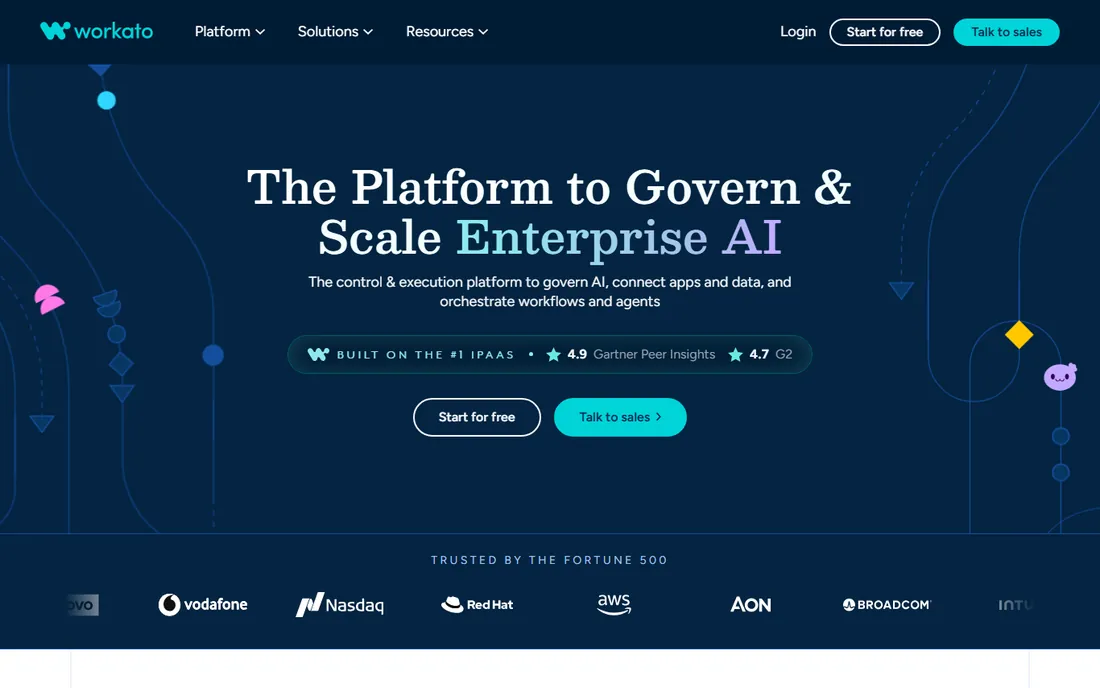
Workato positions itself as the number one iPaaS, and the 2026 story is about governing AI at scale: one runtime for workflows, integrations, agents, models and MCP servers, with centralized policy, approvals and cost controls. The connectivity story is strong, with thousands of apps, APIs, databases and MCP servers reachable without custom infrastructure.
For a no-code automation buyer, the practical question is who builds. Workato targets IT-led programs and fusion teams rather than citizen developers, and its pricing page describes a flexible model without publishing rates. There is no free plan. If your enterprise needs one governed platform for integrations and the agent layer above them, Workato is the incumbent choice. If you want departmental self-service, Zapier or Power Automate will be easier to start.
What we like- Unified platform for iPaaS, agents, MCP and API management
- Predictable pricing commitment
- Deep enterprise governance
Watch out for- No public pricing and no free tier, so evaluation starts with a sales conversation
#2
UiPath
Best for: Automating processes that span legacy apps, documents and people
Visit uipath.com
Starting priceFrom $25/month
Free planFree trial
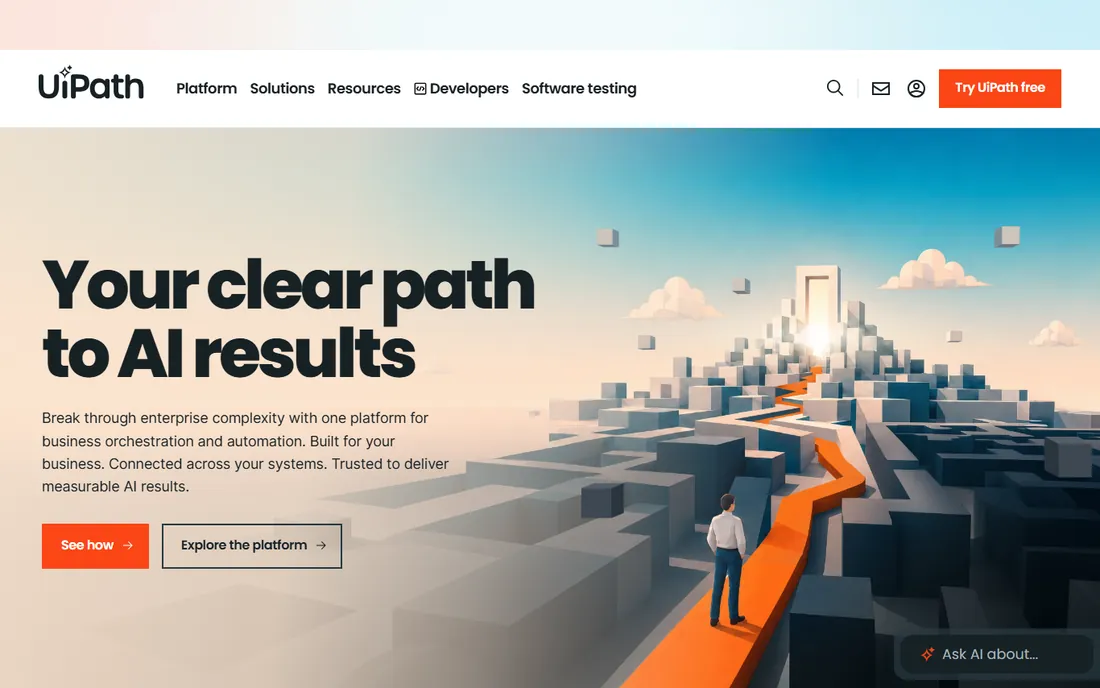
UiPath grew up as the RPA leader and has rebuilt itself as a business orchestration platform: AI agents reason, robots act on systems of record, and people step in where judgment matters, all on one canvas with a complete governance record. The three-layer model, orchestration, execution and governance, is aimed squarely at regulated industries that need an audit trail for every automated decision.
It is also the only enterprise platform here with a public price: Automation Cloud Basic starts at $25 a month for essential team automations, while Standard and Enterprise are quote-based. The Basic tier is deliberately limited, so treat it as an on-ramp rather than a production home. UiPath is the natural pick when automation has to touch systems with no API, heavy documents or human approvals.
What we like- Agents, robots and people orchestrated on one platform
- Public entry pricing
- Deep document understanding
Watch out for- The cheap Basic tier is limited
- Real enterprise automation is a Standard or Enterprise conversation
#3
Tray.ai
Best for: AI-native teams building agents and integrations together
Visit tray.ai
Starting priceSee website
Free planFree trial
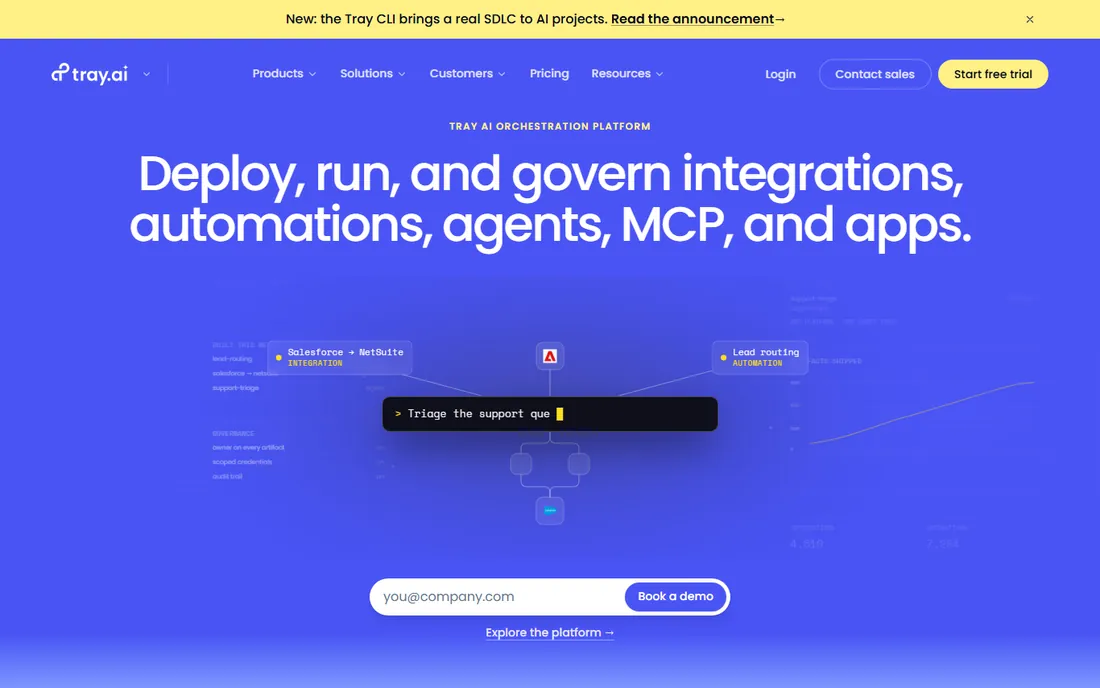
Tray.ai, formerly Tray.io, rebuilt its identity around AI orchestration: build agents with the Merlin builder, govern MCP with the Agent Gateway, integrate 700-plus apps, all with audit trails and RBAC baked in. The headless angle is distinctive: you can build with Claude Code or Codex and deploy to Tray's managed runtime, which fits how technical teams actually work now.
Plans run Pro, Team and Enterprise with a usage-based task model, and the pricing FAQ confirms a free trial exists while sending you to sales for a quote. There are no public rates. Tray.ai suits organizations that want to consolidate legacy iPaaS tooling into an AI-first platform. Teams that need published pricing or a self-serve start will find it frustrating.
What we like- AI-native platform with agent builder and MCP gateway
- 700-plus connectors
- Helix runs vibe-coded apps in production
Watch out for- Pricing is quote-based
- The product keeps expanding, which can blur what you are actually buying
#4
Boomi
Best for: Enterprises standardizing integration, data and agent governance
Visit boomi.com
Starting priceFrom $99/month (pay-as-you-go)
Free planFree trial
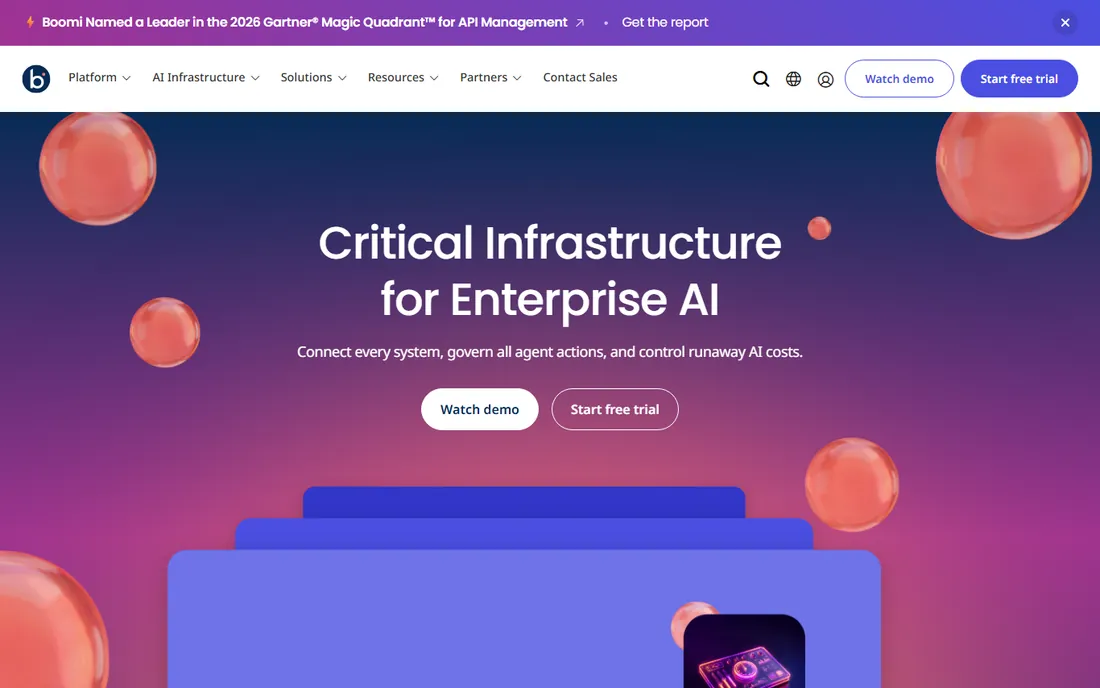
Boomi rebranded itself around data activation and AI-driven automation, but the core is what it has always been: enterprise-grade integration connecting applications, data and APIs across hybrid environments. The 2026 additions are agent management with no-code tools and MCP governance, aimed at enterprises that need to control their entire AI estate, including agents running behind the firewall.
The platform's strength is also its warning: Boomi programs tend to be substantial IT engagements, not weekend self-service projects. The pay-as-you-go option at $99 a month plus usage and the 30-day free trial make it easier to evaluate than most enterprise iPaaS vendors. Boomi fits large enterprises consolidating integration, data management and AI governance under one vendor.
What we like- Proven enterprise integration platform
- 30-day free trial and pay-as-you-go entry
- Agent management with no-code tools
Watch out for- Quote-based plans above pay-as-you-go
- Broad platform can mean long implementations and services dependency
#5
Microsoft Power Automate
Best for: Organizations standardized on Microsoft 365
Visit microsoft.com
Starting priceFrom $15 per user/month
Free planFree trial
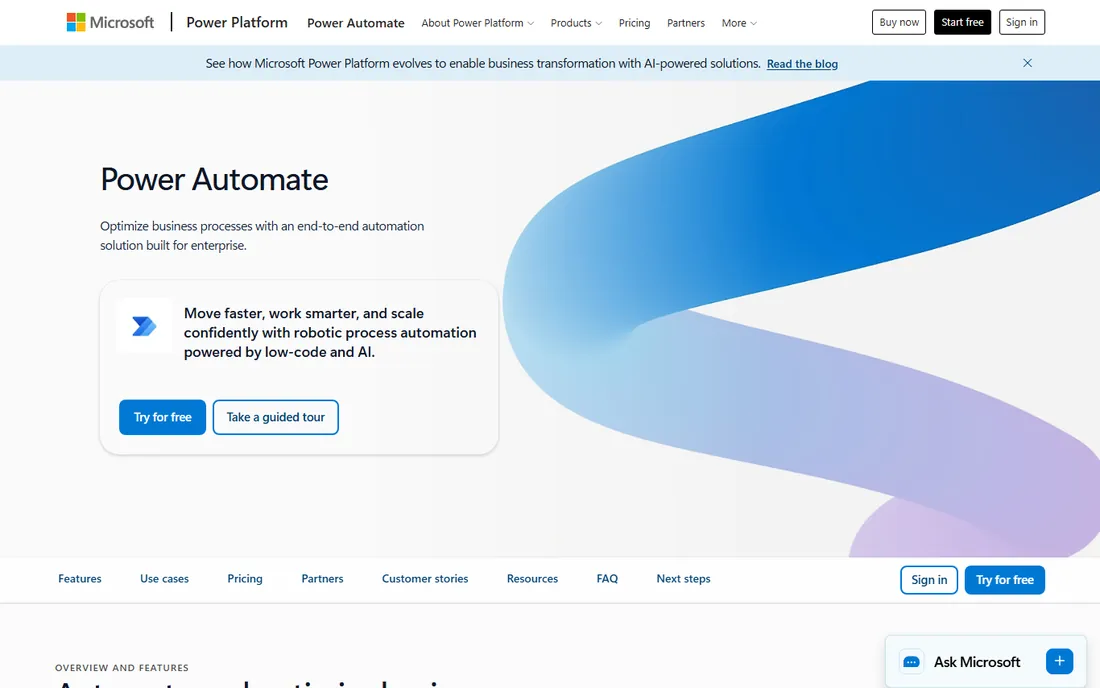
Power Automate is the value play in enterprise automation, and not by a small margin. Premium at $15 per user per month covers cloud flows, attended desktop flows, AI Builder credits and Dataverse entitlements. The 1,400-plus prebuilt connectors include depth in Microsoft systems that no third party can match, and the on-premises data gateway reaches systems behind the firewall.
The catch is the licensing maze. Per-user, per-bot, hosted process at $215 per bot per month, process mining add-ons and pay-as-you-go runs create a bill that needs modeling, not guessing. There is a 30-day free trial. If your company lives in Microsoft 365, start here and only look elsewhere when Power Automate's governance or connector coverage proves insufficient.
What we like- Cheapest credible enterprise option
- Deep SharePoint, Dynamics and Office connectors
- On-premises data gateway
Watch out for- Licensing is famously confusing
- Unattended RPA bots cost $150 each per month
#6
Zapier
Best for: Bottom-up automation with new enterprise controls
Visit zapier.com
Starting priceFrom $19.99/month
Free planYes
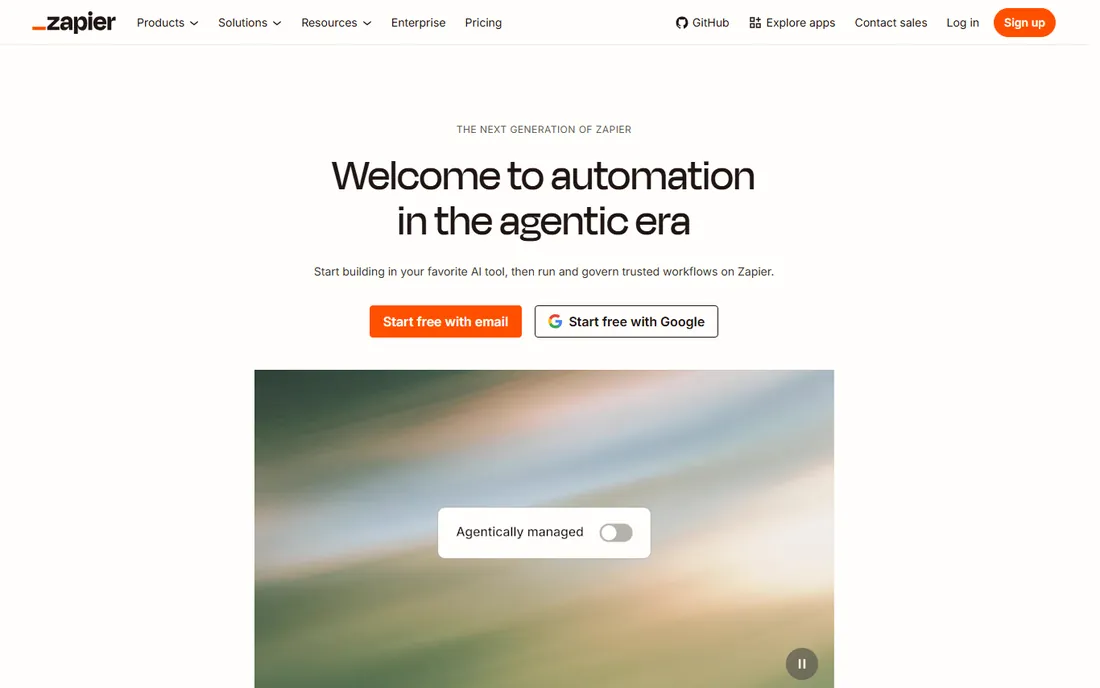
Zapier is the one everyone knows, and it has grown up. The 2026 platform pitches agentic automation: build in Claude or ChatGPT, run governed workflows on Zapier, connect AI assistants to your apps through Zapier MCP. Enterprise controls include SSO, SCIM, granular permissions, AI guardrails and full observability, which answers the security question that used to disqualify it.
Pricing is transparent: a free plan with 100 tasks a month forever, Professional from $19.99 a month, Team from $69, and a quote-based Enterprise. The 14-day trial of Professional needs no credit card. Zapier will not replace Workato or MuleSoft for complex integrations, but for departmental automation with IT oversight, it is the fastest credible start.
What we like- Real free plan
- 9,000-plus app integrations
- MCP and SDK connect AI tools to your workflows
Watch out for- Task-based pricing gets expensive at enterprise volume
- Deep logic still lags dedicated iPaaS platforms
#7
MuleSoft
Best for: API-led integration programs inside the Salesforce ecosystem
Visit mulesoft.com
Starting priceSee website
Free planNo
MuleSoft, part of Salesforce, built its name on API-led connectivity: reusable APIs in layered architecture so integrations get easier to maintain over time instead of harder. The 2026 headline is Agent Fabric, a control plane that finds every agent, MCP server and API in your estate, governs what they can do and controls what they cost.
This is fundamentally an IT platform. Business users are not building MuleSoft integrations on their own, and the sales-led pricing reflects an enterprise buying motion. But for organizations standardizing on Salesforce and serious about API reuse, MuleSoft's approach delivers compounding returns that point-to-point automation tools cannot. It belongs on the list because enterprise no-code strategies live or die on the integration layer underneath.
What we like- API-led connectivity is a mature, proven method
- Agent Fabric governs any agent across platforms
- Reusable API layers compound in value
Watch out for- Sales-led pricing with no free tier
- Typically an IT-owned platform, not a citizen-developer tool
#8
Pega
Best for: Regulated industries automating core processes end to end
Visit pega.com
Starting priceSee website
Free planNo
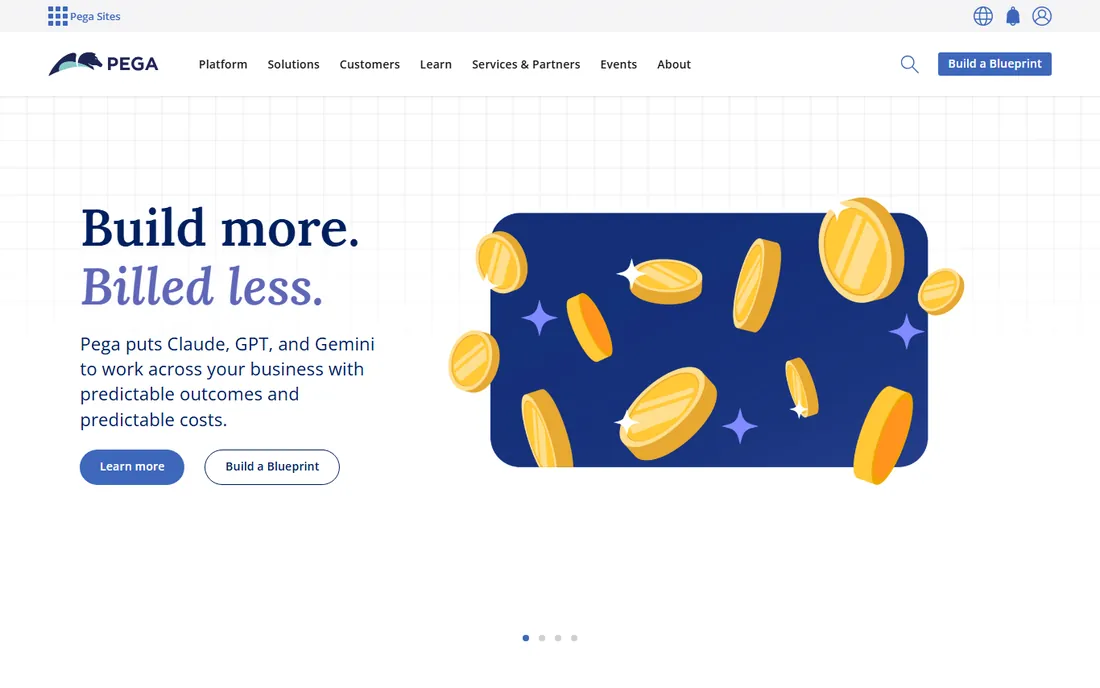
Pega is the heavyweight of the group: an AI-powered platform for enterprise transformation where automation, case management and customer engagement run on one architecture. The 2026 pitch centers on predictable AI agents that operate with context, compliance and human oversight from the start, plus Blueprint, an AI workspace that turns process designs into production-ready applications.
Pega wins in banking, insurance and government, where process complexity and regulatory scrutiny demand more than a workflow builder. The trade-off is weight: this is a platform you commit to, with implementation partners and enterprise contracts, not a tool you pilot in a week. Pricing is quote-based with no public tiers.
What we like- AI agents grounded in business rules with governance built in
- Blueprint designs apps from process models
- Strong in financial services and insurance
Watch out for- No public pricing
- Platform scope can overwhelm teams that just need workflow automation
#9
Tonkean
Best for: Operations teams orchestrating intake and approvals across systems
Visit tonkean.com
Starting priceSee website
Free planNo
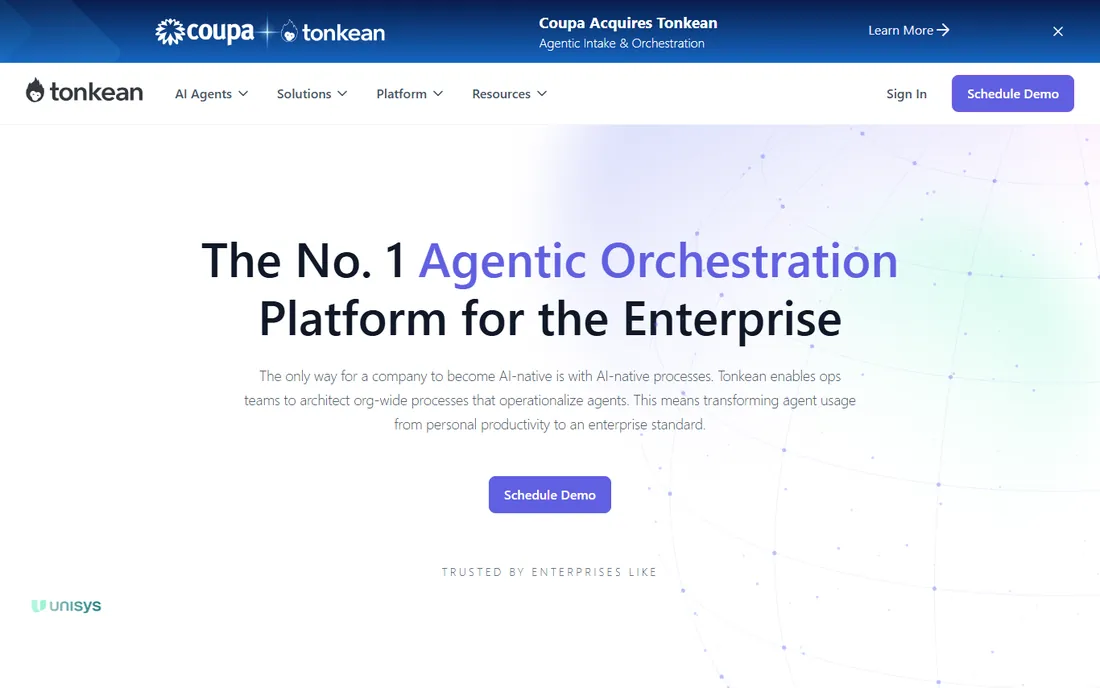
Tonkean calls itself an agentic orchestration platform, and its sweet spot is operational process: procurement intake, legal matter management, approvals and renewals, orchestrated across 250-plus applications without replacing the systems of record. The AI front door interprets plain-language requests and routes them to the right workflow, which drives the high adoption numbers the company reports.
This is not a general-purpose integration platform like Workato or Boomi. It is a process orchestration layer for shared-services teams, and that focus is the point. Tonkean does not publish pricing or plan details. If your automation problem is intake-to-resolution across departments, shortlist it. If you need raw integration horsepower, look at the iPaaS vendors instead.
What we like- No-code orchestration with an AI front door for requesters
- Strong procurement and legal workflow templates
- High reported adoption
Watch out for- Narrower use-case focus than full iPaaS platforms
- Pricing and plan details are not public
What to check before you sign
Start with who will build and maintain the automations. Citizen-developer tools like Zapier and Power Automate put building in the hands of business teams, with IT governing. iPaaS platforms like Workato, Boomi, MuleSoft and Tray.ai assume IT or fusion teams own the builds. Buying an IT platform when you need departmental self-service, or vice versa, is the most expensive mistake in this category.
Then check the pricing model, because they are all different. Zapier meters tasks. UiPath licenses users and robots. Power Automate mixes per-user and per-bot pricing. Workato and Tray.ai charge on usage with custom quotes. Model your actual volume, runs per month, users, bots, against the pricing page before you compare, and get the quote in writing.
Look at the connector story for your stack, not the total count. Every vendor claims thousands of connectors, but what matters is depth in your specific systems: your ERP, your HRIS, your legacy database, your on-premises apps. Ask for a reference customer with a similar stack, and ask how the vendor handles the systems that have no API at all.
Finally, verify the security posture. SSO, SCIM provisioning, audit trails, data residency and SOC 2 are table stakes for enterprise automation. Zapier and Tray.ai now publish credible compliance lists. MuleSoft and Pega inherit Salesforce-grade trust programs. Whatever the vendor claims, have your security team review the trust center before the pilot expands.
The governance question nobody asks until audit time
Here is the failure mode we see most often: a company buys an automation platform for speed, citizen developers build hundreds of workflows, and nobody knows who owns them, what data they touch or whether they still work. Two years later, an audit or an incident exposes a sprawling mess of shadow automation.
The platforms on this list have responded. Workato's governance layer covers every model, agent, workflow and API interaction. Zapier gives IT app-level controls, asset history and a kill switch on workflows. UiPath records every action in a regulator-ready business record. Tonkean's unified control plane manages processes across departments in one place.
Before you sign, ask the vendor three questions: who can see every automation and its data access in one place, how do you revoke a workflow's access when someone leaves, and what happens to automations nobody has touched in a year. The quality of those answers tells you more about enterprise readiness than any feature demo.
Frequently asked questions
What is the difference between iPaaS and no-code automation?
iPaaS platforms like Workato, Boomi and MuleSoft connect systems and data at an architectural level, usually built by IT. No-code automation tools like Zapier and Power Automate let business users build workflows across apps. The categories overlap now, but the buying team and the complexity they handle still differ.
How much do enterprise automation tools cost?
It ranges from Power Automate Premium at $15 per user per month and Boomi pay-as-you-go at $99 a month to six-figure annual contracts for Workato, MuleSoft and Pega. Zapier starts at $19.99 a month and UiPath at $25 a month, but enterprise usage with seats, bots and task volume pushes the real number up. Always model your volume against the pricing page.
Can business users really build automations without IT?
Simple workflows, yes. Multi-system processes with error handling, data mapping and security requirements usually need IT or a fusion team. The honest pitch of most enterprise platforms is that business users prototype and IT productionizes, with governance shared between them.
Which tool is best for Microsoft-centric companies?
Power Automate, by a wide margin. The connector depth in SharePoint, Dynamics 365, Teams and Dataverse is unmatched, licensing bundles with Microsoft 365, and it is the cheapest option here. Only look elsewhere if you need integration patterns Power Automate cannot handle.
Do these tools handle AI agents?
Increasingly, yes. Workato, Tray.ai, Boomi and Zapier all now govern agents and MCP connections. UiPath orchestrates agents alongside robots and people. Pega grounds agents in business rules. If agent governance is your main requirement, weight that capability above traditional workflow features.
Is Zapier enterprise-ready?
More than it used to be. SSO, SCIM, granular permissions, audit logs and data controls cover the standard enterprise checklist. The remaining concern is cost: task-based pricing at high volume can exceed the cost of a platform license, so model your run volume before committing.
Sources we checked (8)
- https://www.workato.com/pricing
- https://www.uipath.com/pricing
- https://tray.ai/pricing
- https://boomi.com/pricing
- https://powerautomate.microsoft.com/en-us/pricing/
- https://zapier.com/pricing
- https://www.mulesoft.com
- https://pega.com/
Is your product missing or out of date?
We review this list regularly. Vendors can request a listing, send updated pricing or ask about featured placement.

Shihab Mia · Founder, Rankite
Shihab has spent more than a decade helping SaaS and e-commerce brands grow through search. He writes Rankite's software buying guides from pricing pages, documentation and public user reviews. More about Shihab.