How we make this list: we compare pricing pages, product documentation and public user reviews. Rankite is independent; if a vendor ever pays for a featured spot, that listing is clearly labeled Partner.
Key takeaways
- OneSignal is the volume play: a generous free tier with unlimited mobile push sends, plus in-app messaging, email and SMS.
- MagicBell and Knock give you a prebuilt notification inbox with preferences, batching and cross-channel logic.
- Courier and Novu orchestrate delivery: one API, many providers, with failover and templating.
- Pusher Beams and Ably are realtime infrastructure first, with push and notifications riding on top.
- Firebase Cloud Messaging is free and unlimited for raw push, but you build the inbox and preferences yourself.
Quick comparison
| Tool | Best for | Starting price | Free plan |
|---|
 OneSignal OneSignal | Mobile and web push plus in-app messaging at scale | Free; Growth from $9/month | Yes |
 Pusher Beams Pusher Beams | Developer-friendly push with end-to-end encryption | From $29/month (free dev tier) | Yes |
 MagicBell MagicBell | A prebuilt notification inbox for your app | Free (Builder); Startup $249/month | Yes |
 Courier Courier | Orchestrating notifications across providers from one API | Free (Developer); Business $0.005 per send | Yes |
 Novu Novu | Open source notification infrastructure you can self-host | Free; Pro from $30/month | Yes |
 Knock Knock | Product teams needing cross-channel preferences and batching | Free (Developer); Starter $250/month | Yes |
 Ably Ably | Realtime infrastructure with notifications on top | Free; Standard from $29/month | Yes |
 Firebase Cloud Messaging Firebase Cloud Messaging | Free unlimited push for Android and iOS apps | Free (no per-message cost) | Yes |
Is your product missing or out of date?
We review this list regularly. Vendors can request a listing, send updated pricing or ask about featured placement.
The best software for in-app notifications
Starting priceFree; Growth from $9/month
Free planYes
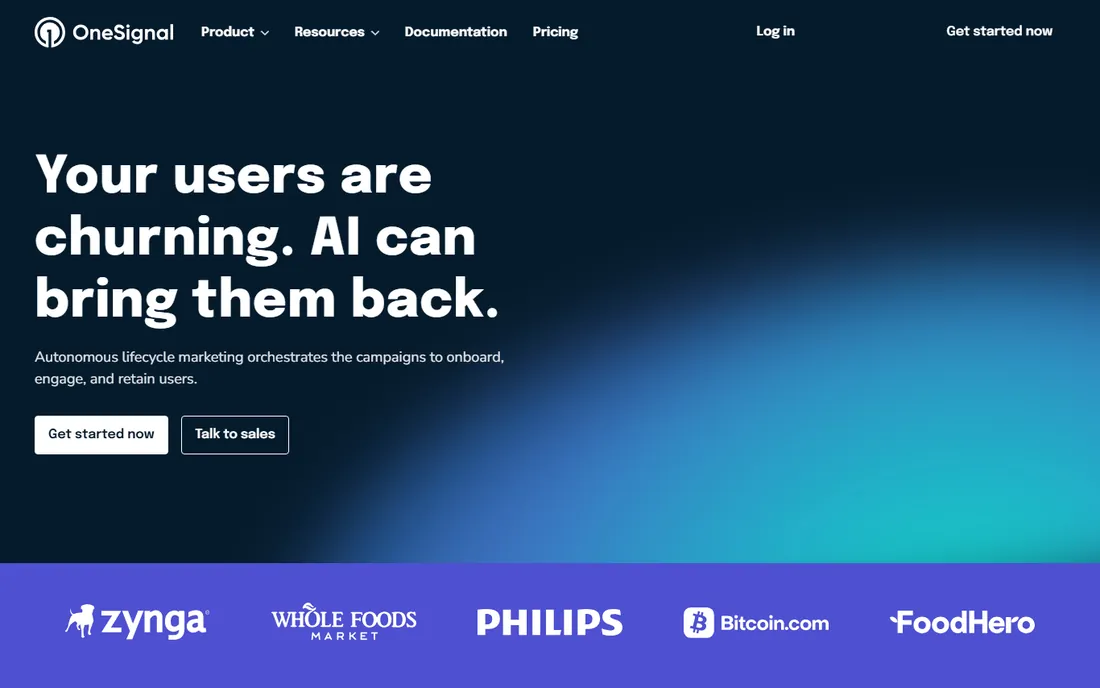
OneSignal is the default answer for a reason. The free tier includes unlimited mobile push sends, up to 10,000 web push subscribers and basic segmentation, which is more generous than nearly every competitor. On top of push you get in-app messages, email and SMS from the same dashboard, with 12-plus SDKs covering every major platform. For a small app finding product-market fit, the free tier can carry you a long way.
Growth starts at $9 per month and scales with subscribers, adding advanced segmentation, A/B testing, confirmed delivery and journeys. The trade-offs are the ones reviewers mention most: the preference model is subscription and tag based rather than a flexible per-user channel model, and debugging individual message delivery is thinner than on infrastructure-focused platforms like Knock. If your primary need is reaching a large audience cheaply, OneSignal is the value pick.
What we like- Generous free tier with unlimited mobile push sends
- In-app messaging, email and SMS alongside push
- Strong segmentation, A/B testing and analytics
Watch out for- Journeys and intelligent delivery need paid tiers
- Pricing scales with subscriber count
#2
Pusher Beams
Best for: Developer-friendly push with end-to-end encryption
Visit pusher.com
Starting priceFrom $29/month (free dev tier)
Free planYes
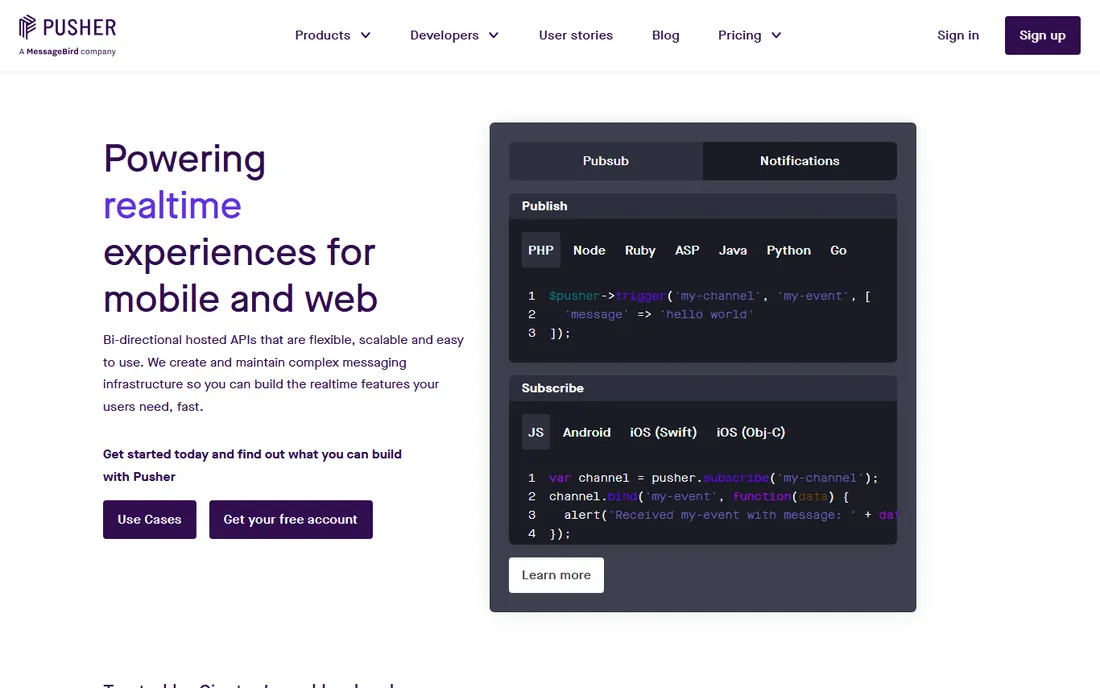
Pusher Beams is push notifications for teams that think in APIs. If your backend already uses Pusher Channels for realtime features, Beams slots into the same mental model: publish to interests, and the service handles APNs and FCM delivery, token management and retries. Its standout feature is end-to-end encryption for push payloads, which matters for healthcare, finance and other sensitive use cases.
Pricing starts at $29 per month for around 1,000 active devices, which is noticeably more per device than OneSignal's free tier or Firebase's free unlimited sends. There is a free development tier for building and testing. Beams is a transport layer, not a marketing suite: you will not find journey builders or send-time optimization here. Choose it when your developers want a clean API and encrypted delivery, not when marketing owns the roadmap.
What we like- Simple API familiar to Pusher Channels users
- End-to-end encryption option neither FCM nor OneSignal offers
- Dependable hosted delivery infrastructure
Watch out for- Pricier per device than alternatives
- Thin on marketing features like journeys and send-time optimization
Starting priceFree (Builder); Startup $249/month
Free planYes
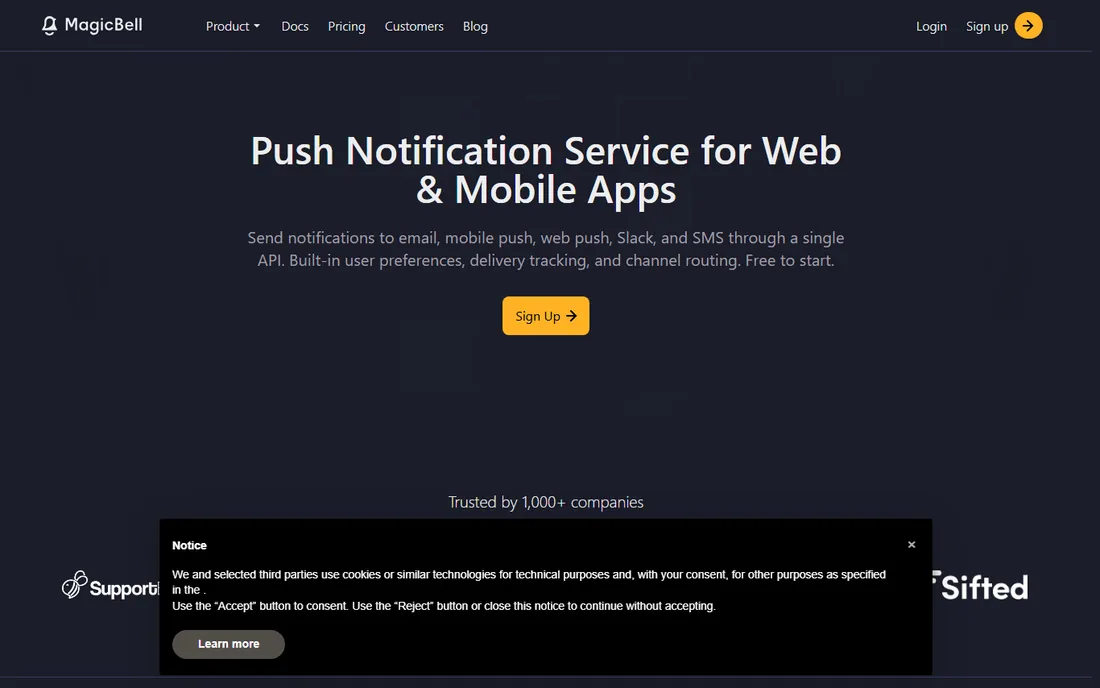
MagicBell answers a narrower question than OneSignal: how do I get a notification inbox inside my app this sprint? You get prebuilt inbox components for React, React Native and the web, plus a unified API that fans a notification out to in-app, email, mobile push, web push, SMS and Slack. Smart delivery rules and user preferences decide which channels fire, and deliveries are counted per channel per user.
Pricing is transparent: the Builder plan is free with 1,000 deliveries a month, Startup is $249 per month for 50,000 deliveries with overage at $0.0025 each, and Enterprise is custom. That $249 entry point is steep for a side project, which makes MagicBell a better fit for funded startups and SaaS companies than for hobby apps. If the inbox UI is the part you dread building, MagicBell removes weeks of work.
What we like- Drop-in inbox UI with React, mobile and web components
- One API for in-app, email, push, SMS and Slack
- Transparent per-delivery pricing
Watch out for- Paid tiers start high at $249 per month
- More than you need if you only want raw push
#4
Courier
Best for: Orchestrating notifications across providers from one API
Visit courier.com
Starting priceFree (Developer); Business $0.005 per send
Free planYes
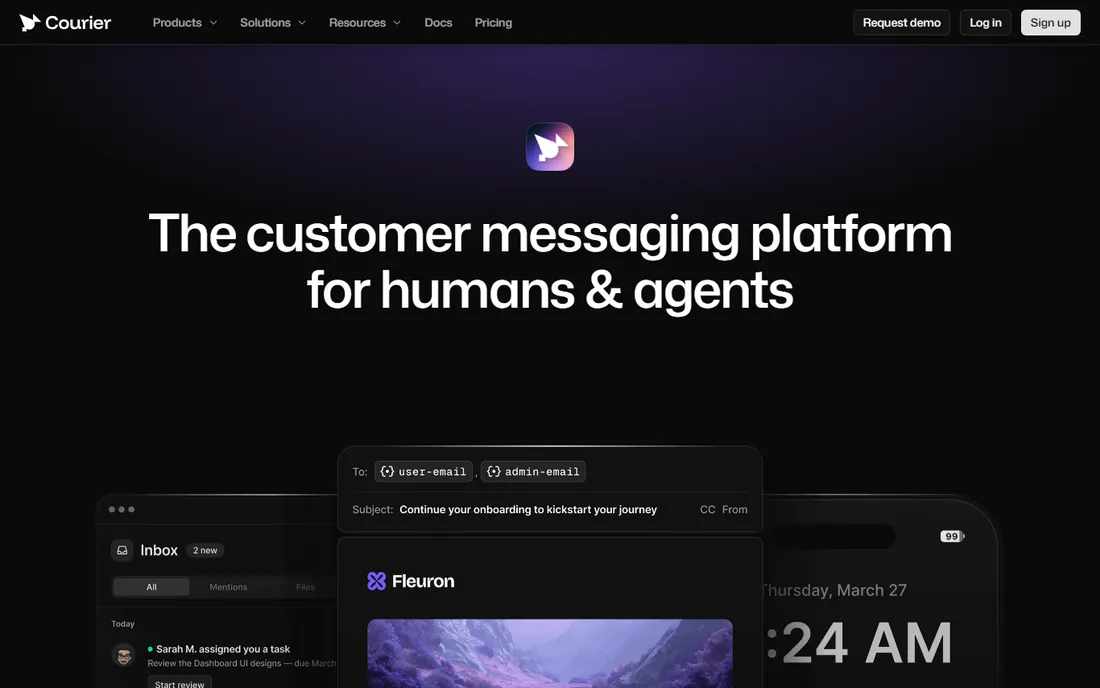
Courier sits one layer above the delivery providers. You keep your SendGrid, Twilio, Firebase or OneSignal accounts, connect them once, and send every notification through a single Courier API call. Courier handles routing, templating, retries and failover: if one provider has a bad afternoon, traffic shifts automatically. A visual designer moves notification templates out of your codebase, and hosted preferences apply across every channel.
The Developer plan is free for 10,000 sends a month, and Business is pure pay-as-you-go at $0.005 per send with no platform fee and no volume cap. Remember that provider costs sit on top: Courier bills for orchestration, Twilio or SendGrid bill for delivery. Courier is the right call when you already juggle several providers and want one throat to choke, failover included. If you only need Android push, FCM alone is simpler.
What we like- One API routes across 50+ providers with automatic failover
- Visual template designer plus hosted user preferences
- Pay-per-send with no platform fee on Business
Watch out for- You still pay your underlying providers separately
- It orchestrates delivery rather than being the transport itself
#5
Novu
Best for: Open source notification infrastructure you can self-host
Visit novu.co
Starting priceFree; Pro from $30/month
Free planYes
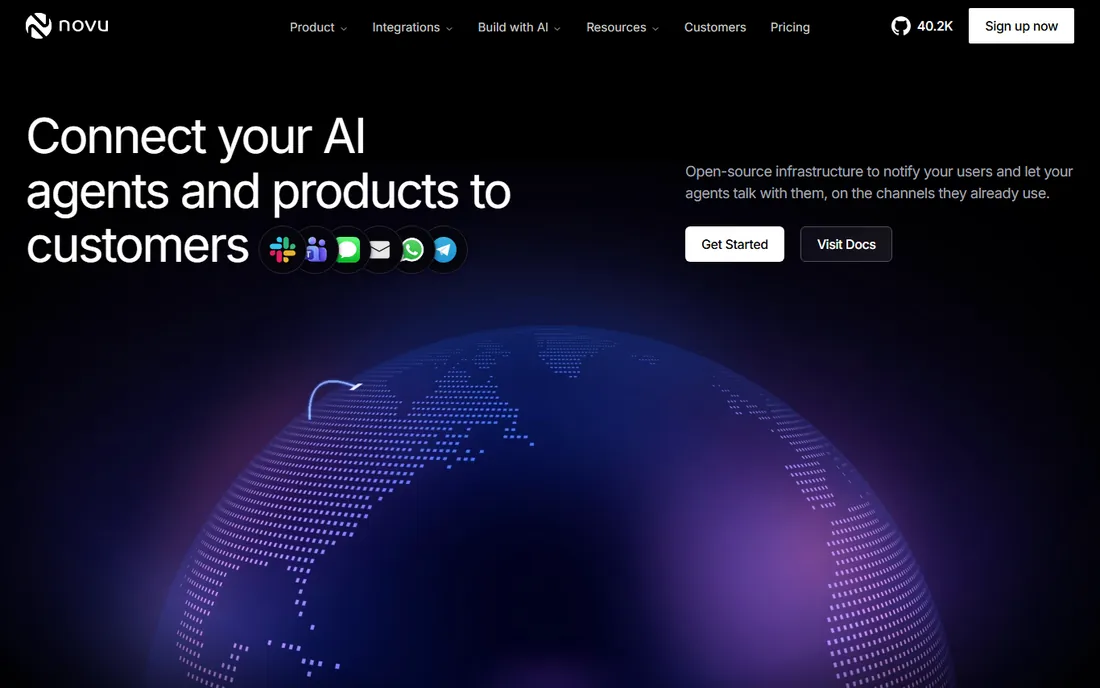
Novu is the open source answer to notification infrastructure. The core product is MIT-licensed on GitHub with tens of thousands of stars, so teams with data-residency or compliance requirements can self-host the entire stack. The cloud product unifies in-app notifications, email, SMS, push and chat behind one API, with workflows that handle digesting, delays, snoozing and user preferences. Billing is per workflow run, not per message: one trigger fanning out to several channels counts once.
The free tier covers 10,000 workflow runs a month, but activity retention is only 24 hours, which makes it a development tier rather than a production one. Pro starts at $30 per month with 30,000 runs and 7-day retention, while Team jumps to $250 per month. For engineering-led teams that want to own their infrastructure or avoid vendor lock-in, Novu is the most flexible option on this list.
What we like- MIT-licensed and self-hostable with a large open source community
- One API for in-app, email, SMS, push and chat
- Workflow-based orchestration with digesting and preferences
Watch out for- Free tier keeps only 24-hour activity retention
- The jump from Pro to Team pricing is steep
#6
Knock
Best for: Product teams needing cross-channel preferences and batching
Visit knock.app
Starting priceFree (Developer); Starter $250/month
Free planYes
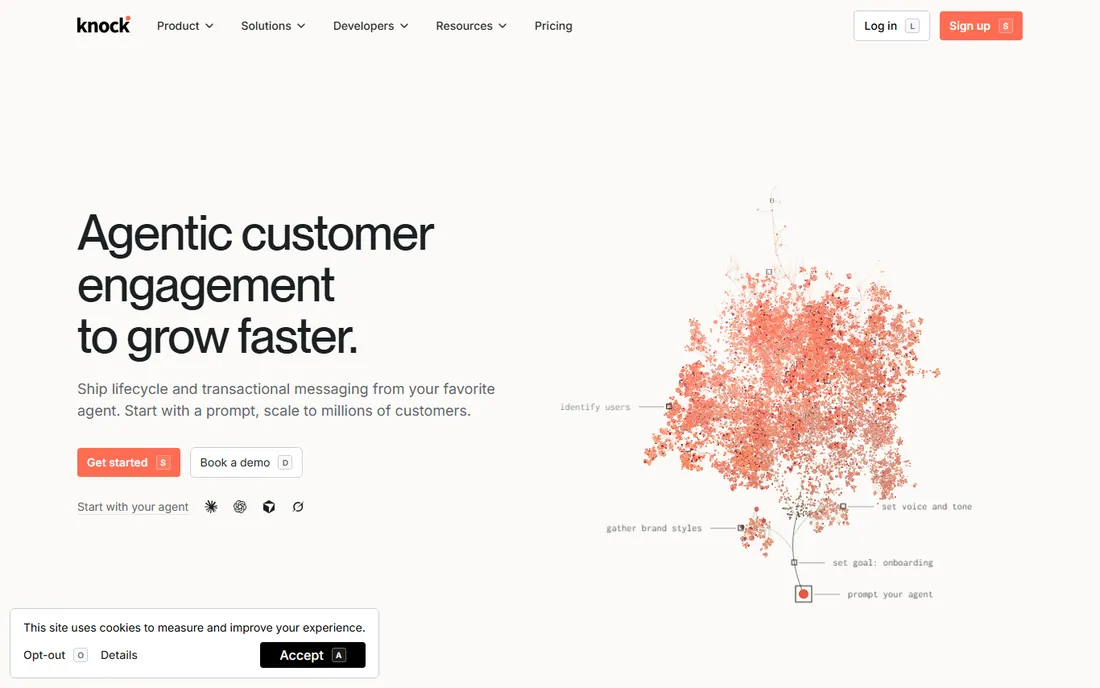
Knock is built for the transactional side of notifications: the order shipped, the password reset, the mention. Its preference model lets each user choose channels per notification type, and workflows support batching (one digest instead of twelve pings), delays and conditional logic. When something goes wrong, the observability tooling traces a notification end to end, which is exactly what you want at 2am.
The Developer plan is free with 10,000 messages a month, and Starter is $250 per month for 50,000 messages with overage at $0.005 each. That entry price puts Knock in the serious-SaaS bracket, and the ecosystem is smaller than OneSignal's. One practical pattern teams use: orchestrate with Knock and deliver push through OneSignal or FCM underneath. If your notifications are product-critical and preference logic is complex, Knock is worth the premium.
What we like- Flexible per-user, per-channel preference model
- Batching, delays and digest workflows built in
- Strong observability for debugging delivery
Watch out for- Paid entry at $250 per month is steep for small teams
- Smaller ecosystem than OneSignal
#7
Ably
Best for: Realtime infrastructure with notifications on top
Visit ably.com
Starting priceFree; Standard from $29/month
Free planYes
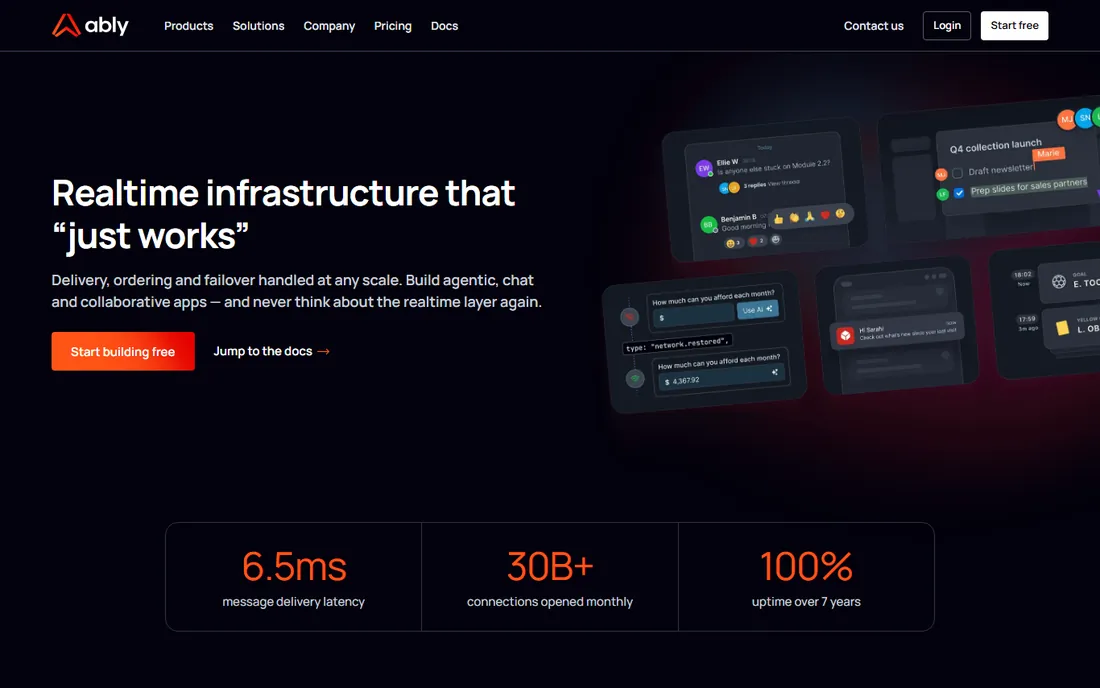
Ably is realtime infrastructure first and a notification tool second. Its pub/sub platform moves trillions of messages a month for customers like HubSpot and Intercom, with guarantees around ordering, exactly-once delivery and presence that notification specialists do not try to match. If your app already needs realtime sync, live dashboards or chat, running notifications over the same Ably connection is efficient.
Pricing is usage-based: a free tier for getting started, Standard from $29 per month, Pro at $399, with charges driven by messages, channel minutes and connections. You will need to model your usage to predict the bill. And Ably will not give you a prebuilt inbox UI or a preference center; you build those on top of the realtime layer. Choose Ably when realtime is the core need and notifications ride along, not when the inbox is the product.
What we like- Proven pub/sub at massive scale with ordering and delivery guarantees
- SDKs for every major platform
- Predictable performance under load
Watch out for- Usage-based pricing needs careful modeling
- Notification-specific features are thinner than specialists
Starting priceFree (no per-message cost)
Free planYes
Firebase Cloud Messaging is the free baseline the whole industry prices against. Sending push notifications costs nothing and has no limits, on the free Spark plan or any other. For Android apps already using Firebase Auth, Firestore or Analytics, FCM is the path of least resistance, and iOS delivery works through APNs. You only pay if adjacent services like Cloud Functions trigger the sends, billed separately.
What you do not get is everything around the send: no in-app inbox component, no hosted preference center, no journey builder, no cross-channel orchestration. Teams commonly pair FCM as the free transport with a platform like Courier, Novu or Knock for the logic on top. And on Android, FCM needs Google Play Services, which excludes some privacy-focused devices and the Chinese market. For raw push at zero cost, nothing beats it.
What we like- Completely free with no message or device limits on any plan
- Native on Android, solid iOS delivery via APNs
- Deep integration with the Firebase suite
Watch out for- No built-in inbox, preference center or journey builder
- Android delivery needs Google Play Services
How we chose
We read each vendor's pricing page, documentation and status pages, then cross-checked against current third-party comparisons and G2 and Capterra reviews. We confirmed free-tier limits, paid entry points and billing units (deliveries, sends, workflow runs, messages) as published in 2026. Platforms that shut down or pivoted away from notifications were excluded. We favored tools a small or mid-size product team can adopt: honest free tiers, clear pricing and SDKs for the platforms their users are on.
In-app notification platforms cluster into three jobs. Knowing which job you are hiring for prevents buying the wrong tool.
Inbox versus transport
Some tools give you the visible inbox: MagicBell and Knock ship prebuilt UI components your users see. Others are transport: FCM, Pusher Beams and Ably move the bytes, and you build the interface. Courier and Novu sit in the middle with orchestration plus inbox options. If your team dreads frontend work, buy the inbox. If your designers demand pixel control, buy transport and build.
Preferences and orchestration
The difference between amateur and professional notifications is preference handling. Can a user mute marketing but keep security alerts? Get a daily digest instead of twelve pings? Set quiet hours? Knock and Novu handle this natively, Courier offers hosted preferences, and OneSignal covers it with tags and segments. Also check batching and digesting: without them, a busy day in your app becomes notification spam.
Pricing that matches your volume
Billing units differ wildly. MagicBell and Courier charge per delivery or send, Novu charges per workflow run (channels inside the run are free), OneSignal scales with subscribers, and Ably meters messages, channel minutes and connections. Model your expected volume in the vendor's unit before comparing headline prices. A platform that looks cheap per send can be expensive per user if every notification fans out to five channels.
How notification pricing actually works
Nearly every platform follows the same shape: a free developer tier, a paid tier that extends retention and adds advanced features, and usage-based pricing beyond that. The free tiers here are genuinely useful: 10,000 sends on Courier, 10,000 workflow runs on Novu, 10,000 messages on Knock, 1,000 deliveries on MagicBell and unlimited mobile push on OneSignal and FCM.
Watch three gotchas. First, retention: Novu's free tier keeps activity logs for 24 hours, which is fine for development and useless for audits. Second, fan-out math: a notification to one user on three channels can count as three deliveries depending on the vendor. Third, the jump to paid: several platforms price their first paid tier around $250 per month (MagicBell Startup, Knock Starter, Novu Team), which is a real step for a small team. Start on free, measure your actual volume in the vendor's billing unit, and upgrade when the numbers say so.
Frequently asked questions
What is the difference between push notifications and in-app notifications?
Push notifications arrive on the device even when your app is closed, delivered through APNs on iOS or FCM on Android. In-app notifications appear inside your app while the user is active, usually in a notification center or inbox. Most products need both: push for re-engagement, in-app for anything the user should find later. Platforms like OneSignal, MagicBell and Knock cover both from one system.
Can I add an in-app notification inbox without building one from scratch?
Yes. MagicBell ships drop-in inbox components for React, React Native and the web, and Knock provides inbox UI kits plus the backend to feed them. Novu also offers an embeddable inbox component. You connect your user base, style the component to match your app and skip weeks of frontend and backend work.
Which is cheaper: OneSignal, Firebase or a platform like Courier?
It depends on what you count. Firebase Cloud Messaging is free with no message limits, so raw push costs nothing. OneSignal's free tier covers unlimited mobile push with paid Growth from $9 per month scaling by subscribers. Courier's Developer plan is free for 10,000 sends, then $0.005 per send, plus whatever your underlying providers charge. For pure push volume, FCM wins. For orchestration across providers, Courier's pricing is straightforward.
Do I need a notification platform if I already use Firebase?
FCM handles the transport for free, but it does not give you an inbox UI, user preferences, digesting, templating or multi-provider failover. Many teams keep FCM as the free delivery rail and add Courier, Novu or Knock for the logic layer. If your needs stop at simple push alerts, FCM alone is enough. If users ask for preference settings or digests, add a platform.
How do user notification preferences work across channels?
Good platforms keep one preference record per user that applies everywhere. A user mutes promotional email but keeps SMS for security codes, sets quiet hours, or picks a daily digest, and every channel respects it. Knock and Novu model this natively, Courier offers hosted preferences, and OneSignal handles it through tags and segments. Building this yourself means a preference database, an API and enforcement in every send path, which is why teams buy it.
Sources we checked (9)
- https://www.engagelab.com/blog/push-notifications-cost
- https://www.spotsaas.com/product/pusher-beams
- https://www.magicbell.com/pricing
- https://www.courier.com/guides/courier-vs-novu-notification-system
- https://www.courier.com/guides/courier-vs-knock-notification-system
- https://dev.to/beton/novu-pricing-teardown-2026-2oag
- https://www.courier.com/integrations/compare/firebase-fcm-vs-onesignal-push
- https://apiscout.dev/guides/best-push-notification-apis-firebase-fcm-vs-onesignal-vs-pusher-2026
- https://www.g2.com/products/ably-realtime/pricing
Is your product missing or out of date?
We review this list regularly. Vendors can request a listing, send updated pricing or ask about featured placement.

Shihab Mia · Founder, Rankite
Shihab has spent more than a decade helping SaaS and e-commerce brands grow through search. He writes Rankite's software buying guides from pricing pages, documentation and public user reviews. More about Shihab.