How we make this list: we compare pricing pages, product documentation and public user reviews. Rankite is independent; if a vendor ever pays for a featured spot, that listing is clearly labeled Partner.
Key takeaways
- The billing unit decides your bill: Zapier charges per action step, Make per operation, n8n per whole workflow run. The same automation can cost 10x different across them.
- Enterprise iPaaS (Workato, MuleSoft, Boomi, Celigo, Tray.ai) is quote-based and built for governed, high-volume integration; expect five-figure annual contracts.
- Self-serve automation (Zapier $19.99/mo, Make $9/mo, n8n cloud from €20/mo) covers most SMB integration needs at a fraction of iPaaS pricing.
- Microsoft shops should price Power Automate ($15/user/mo) before anything else: it is often already in the licensing bundle.
Quick comparison
| Tool | Best for | Starting price | Free plan |
|---|
 Workato Workato | Enterprise automation with governance and scale | See website | No |
 Boomi Boomi | Enterprise iPaaS with a low-cost entry point | From $99/month (usage-based, plus consumption) | No (30-day free trial) |
 MuleSoft Anypoint MuleSoft Anypoint | API-led integration in large enterprises | From $2,000/month (billed annually) | No (30-day free trial) |
 Celigo Celigo | Mid-market SaaS-to-SaaS integration | See website | No (30-day free trial) |
 Tray.ai Tray.ai | Enterprise workflow automation and AI agents | See website | No |
 Zapier Zapier | No-code teams that need the widest app catalog | From $19.99/month (Professional, billed annually, 750 tasks) | Yes |
 Make Make | Visual workflow building on a tight budget | From $9/month (Core, billed annually, 10,000 credits) | Yes |
 n8n n8n | Technical teams that want self-hosted control | Free self-hosted (Cloud from €20/month) | Yes |
 Microsoft Power Automate Microsoft Power Automate | Organizations already on Microsoft 365 | From $15/user/month (Premium, billed annually) | Yes |
Is your product missing or out of date?
We review this list regularly. Vendors can request a listing, send updated pricing or ask about featured placement.
Two tools can automate the same workflow while billing completely different things. A five-step automation running 100 times a day costs 500 tasks on Zapier, about 500 credits on Make, and 100 executions on n8n. The invoice gap is enormous, and it has nothing to do with features. Nine platforms, with the billing math that actually matters.
#1
Workato
Best for: Enterprise automation with governance and scale
Visit workato.com
Starting priceSee website
Free planNo
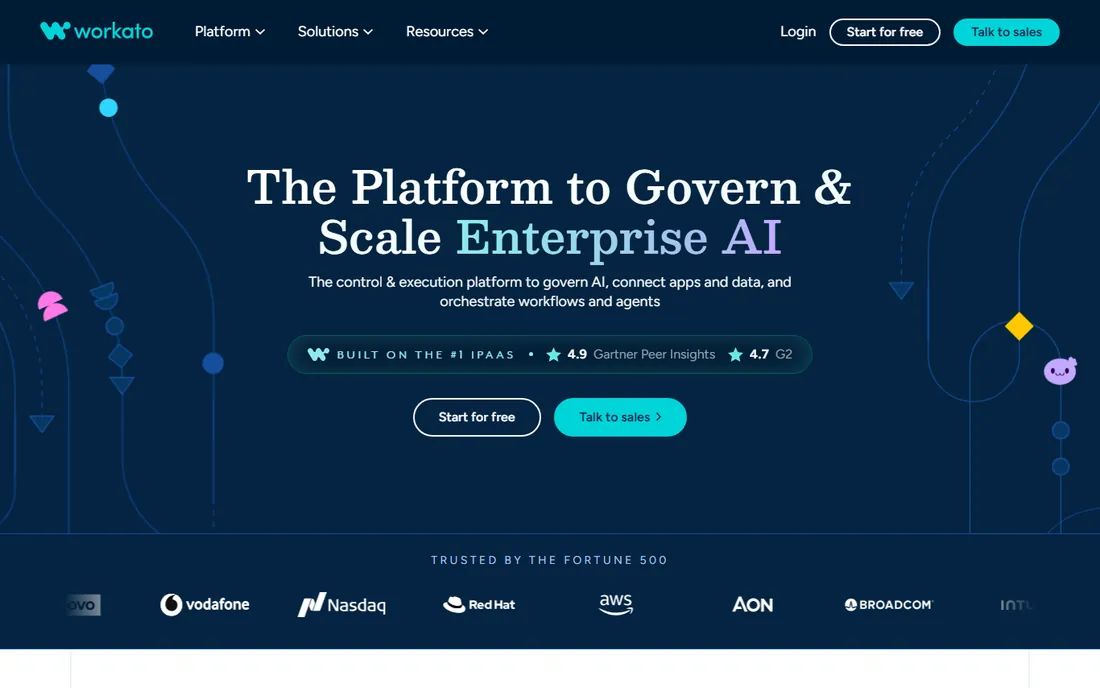
Workato is the enterprise answer to Zapier: the same recipe-style automation, rebuilt for IT governance. Business teams build integrations on 1,000-plus connectors while IT keeps SSO, role-based access, audit logs and environment controls. For companies standardizing automation across departments, that combination is the selling point.
The price puts it in a different market. Workato publishes no list price, and third-party analyses place entry contracts near $25,000 a year, climbing fast with usage. If your integration needs are a dozen SaaS-to-SaaS syncs, Make or Celigo will do the job for a tenth of the cost. Buy Workato when governance and scale are requirements, not preferences.
What we like- 1,000-plus connectors with an enterprise-grade recipe builder
- Strong governance, SSO and audit controls
- AI and agent capabilities built for business teams
Watch out for- Quote-only pricing with entry contracts commonly reported around $25,000 a year
- Overkill for simple point-to-point integrations
#2
Boomi
Best for: Enterprise iPaaS with a low-cost entry point
Visit boomi.com
Starting priceFrom $99/month (usage-based, plus consumption)
Free planNo (30-day free trial)
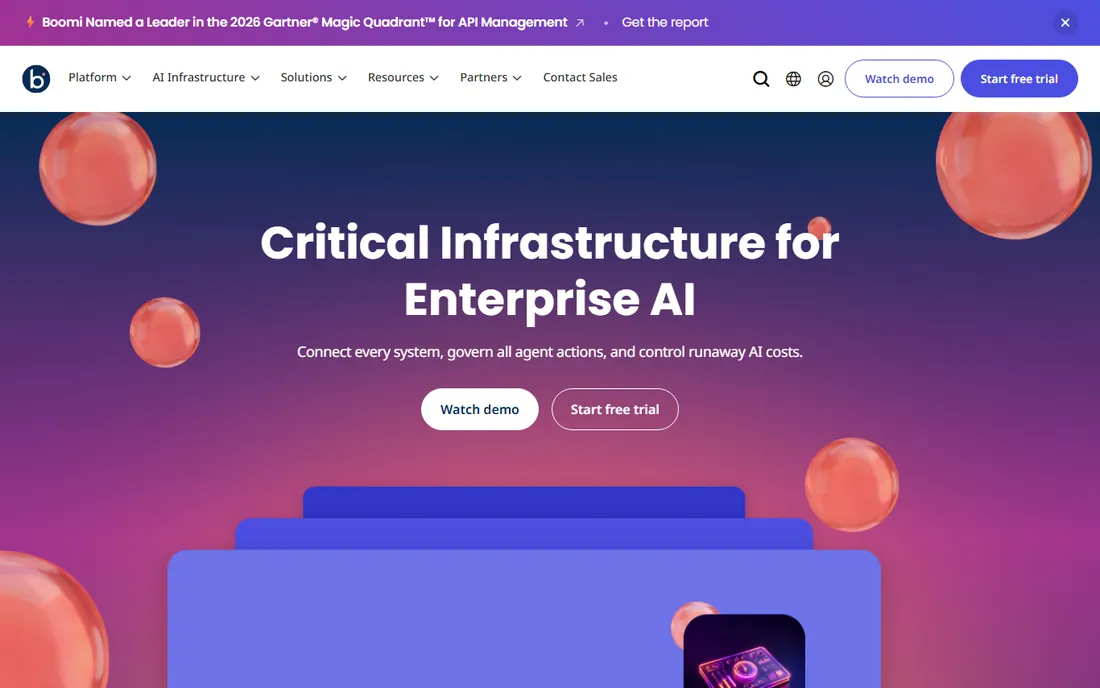
Boomi is the friendliest on-ramp to enterprise integration. The pay-as-you-go tier starts at $99 a month plus usage, which lets teams run real production integrations without an enterprise contract. The visual builder, process libraries and Atom runtimes cover application integration, B2B/EDI and data hub scenarios across hybrid environments.
Now owned by SAP, Boomi keeps its broad-enterprise positioning. The $99 entry covers modest volumes; serious enterprise deployments move to quoted tiers. It fits mid-market companies that need real iPaaS architecture, private ERP access and controlled releases, without MuleSoft's budget. For simple cloud-to-cloud syncs, it is still more platform than necessary.
What we like- Rare usage-based entry at $99 a month for an enterprise iPaaS
- 1,500-plus connectors with visual drag-and-drop building
- Lightweight Atom runtimes deploy anywhere
Watch out for- Enterprise tiers are quote-based and climb quickly
- The platform's breadth means a learning curve for simple jobs
Starting priceFrom $2,000/month (billed annually)
Free planNo (30-day free trial)
MuleSoft is what large enterprises buy when integration becomes architecture. The API-led approach treats every integration as a reusable API with a lifecycle: designed, published in Exchange, governed and monitored. For Salesforce-heavy enterprises running hundreds of integrations, the reusability compounds into real value.
The cost is legendary and the pricing model is the industry's most opaque. Entry is reported from $2,000 a month billed annually, but the vCore consumption model means real contracts run far higher, with analysts noting 55 to 65 percent discounts are common in negotiation. Never buy on the salesperson's example; model your compute consumption and negotiate hard. Everyone below enterprise scale should look elsewhere.
What we like- The reference platform for API lifecycle management: design, publish, govern and reuse APIs
- Anypoint Exchange turns integrations into reusable assets
- Deep Salesforce synergy
Watch out for- The most expensive platform here with the most opaque pricing (vCore consumption model)
- Implementations need specialized expertise
Starting priceSee website
Free planNo (30-day free trial)
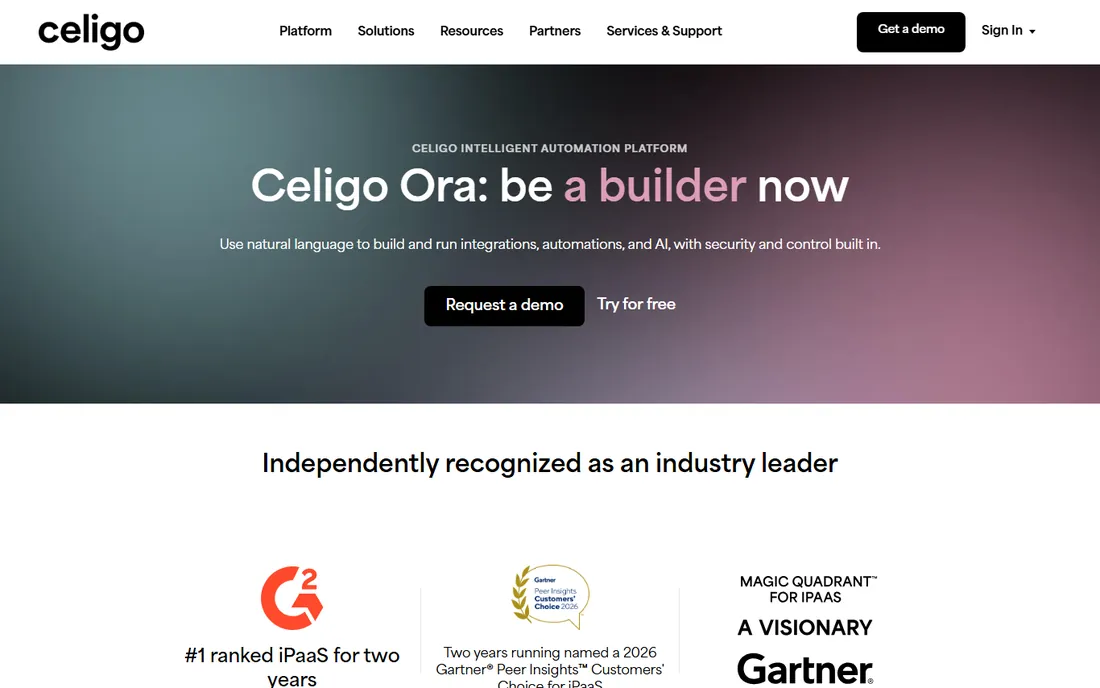
Celigo owns the mid-market integration niche, especially around NetSuite and ecommerce. Instead of a blank canvas, it ships prebuilt integration apps for common flows: order to cash, procure to pay, Shopify to NetSuite. The flat-rate endpoint pricing keeps costs predictable as transaction volume grows.
Pricing is sales-led, with third-party guides placing entry around $500 a month. The scope is deliberately narrower than Boomi or MuleSoft: SaaS application integration, not B2B/EDI or API management programs. For a mid-market company whose integration list is really "connect our ERP, store and CRM," Celigo is often the right-sized buy.
What we like- Purpose-built for NetSuite, Shopify and ecommerce integration patterns
- Flat-rate endpoint pricing model is predictable
- Prebuilt integration apps for common flows
Watch out for- Quote-based pricing with no public rates
- Narrower scope than full iPaaS platforms
#5
Tray.ai
Best for: Enterprise workflow automation and AI agents
Visit tray.ai
Starting priceSee website
Free planNo
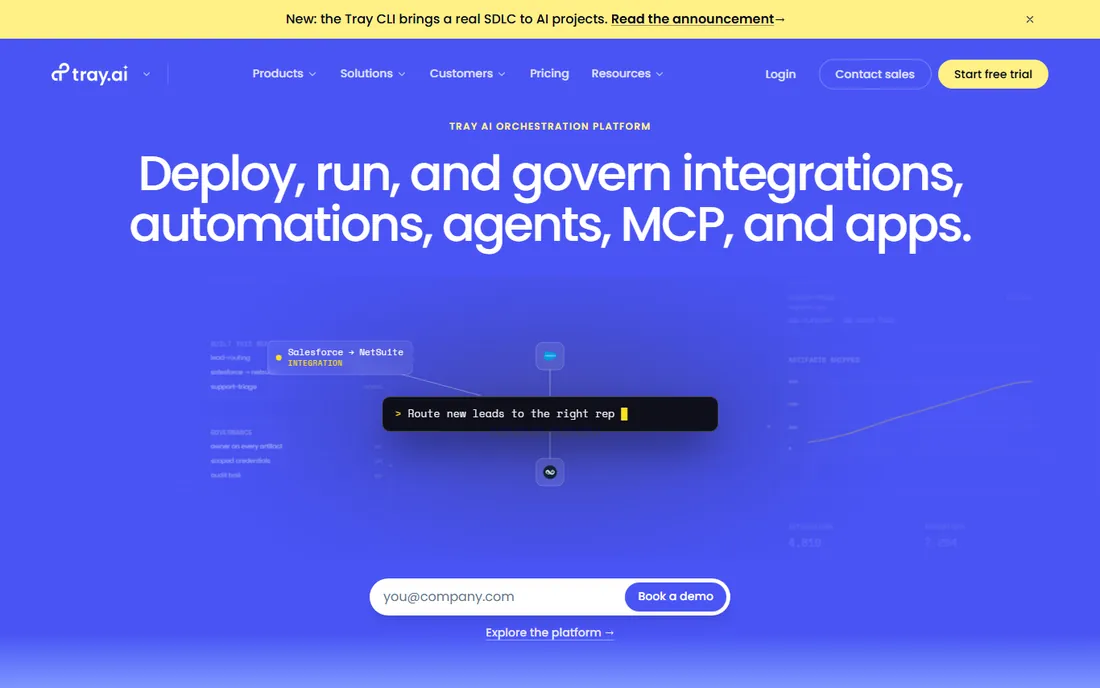
Tray.ai sits between Zapier-style automation and full iPaaS: a visual builder powerful enough for complex logic, sold to enterprises with governance needs and to SaaS companies embedding integrations in their products. The AI agent features push it beyond trigger-action logic into workflows that reason and decide.
Like Workato, it is quote-only and enterprise-priced. Smaller teams get equivalent workflow power from Make at $9 a month. Evaluate Tray.ai when your automations need real branching logic, scale and governance together, or when you are a SaaS vendor deciding between building and embedding integrations.
What we like- Visual builder that scales to genuinely complex multi-step workflows
- Strong embedded integration story for SaaS companies
- AI agent capabilities for autonomous workflows
Watch out for- Quote-only pricing aimed at enterprise budgets
- Overkill for straightforward integrations
#6
Zapier
Best for: No-code teams that need the widest app catalog
Visit zapier.com
Starting priceFrom $19.99/month (Professional, billed annually, 750 tasks)
Free planYes
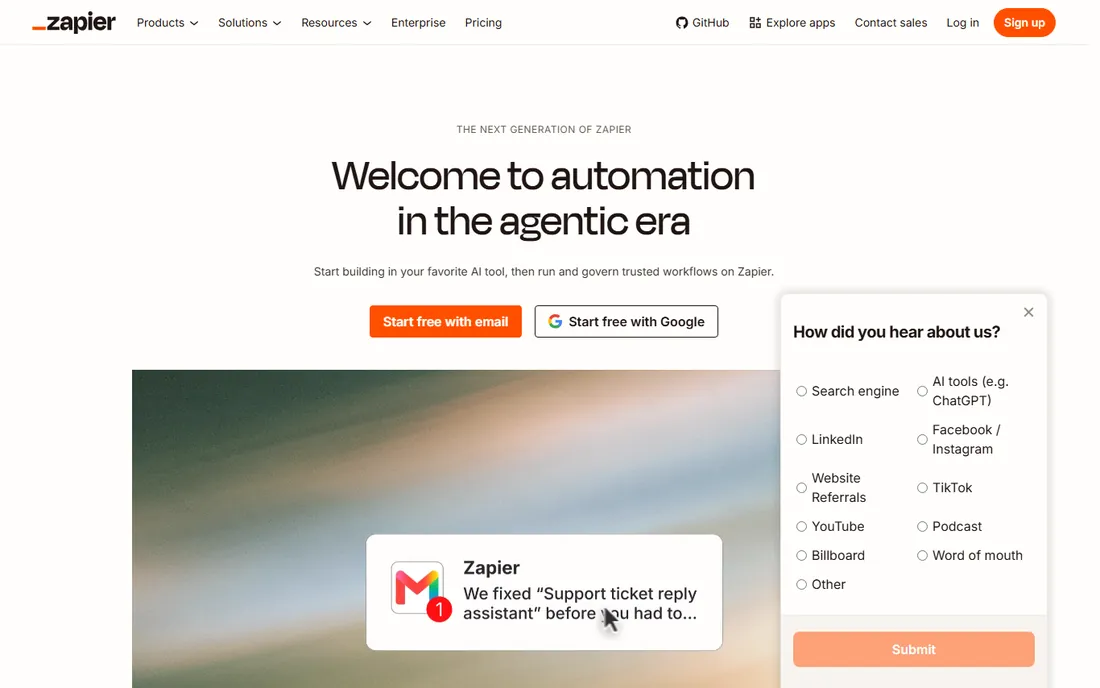
Zapier is the default because it connects to everything. With thousands more apps than any competitor, the integration you need probably exists already, and the builder is the easiest for business users. The free plan handles 100 tasks a month, and Professional starts at $19.99 a month billed annually for 750 tasks.
The billing unit is the catch every buyer must understand. Zapier counts each completed action step as a task, so a five-step workflow running daily burns 150 tasks a month. Triggers and filters are free, but actions are not, and costs climb steeply: 10,000 tasks runs about $129 a month. For simple automations it is unbeatable; for heavy multi-step workflows, Make or n8n will cost a fraction.
What we like- 7,000-plus app integrations, far more than any rival
- The gentlest builder for non-technical users
- Free plan covers simple two-step automations
Watch out for- Per-task billing punishes multi-step workflows
- The free plan caps at 100 tasks and two-step Zaps
- Costs escalate fast at volume
#7
Make
Best for: Visual workflow building on a tight budget
Visit make.com
Starting priceFrom $9/month (Core, billed annually, 10,000 credits)
Free planYes

Make is what Zapier users switch to when the task bill arrives. Core costs $9 a month billed annually for 10,000 credits, where one standard module action costs one credit, roughly thirteen times the operations per dollar of Zapier's entry tier. The visual builder shows the whole scenario as a flowchart, which suits complex logic with routers, filters and error handlers.
The trade-offs are catalog depth and approachability: fewer apps than Zapier, and the visual paradigm takes longer to learn than Zapier's linear steps. For teams comfortable with a slightly steeper builder, Make delivers enterprise-grade workflow complexity at SMB prices. It is the value default for serious automation on a budget.
What we like- 10,000 operations for $9 a month is the best value in cloud automation
- Visual scenario builder handles branching and error handling well
- Free tier gives 1,000 credits monthly
Watch out for- Smaller app catalog than Zapier
- The visual builder has a learning curve for non-technical users
#8
n8n
Best for: Technical teams that want self-hosted control
Visit n8n.io
Starting priceFree self-hosted (Cloud from €20/month)
Free planYes
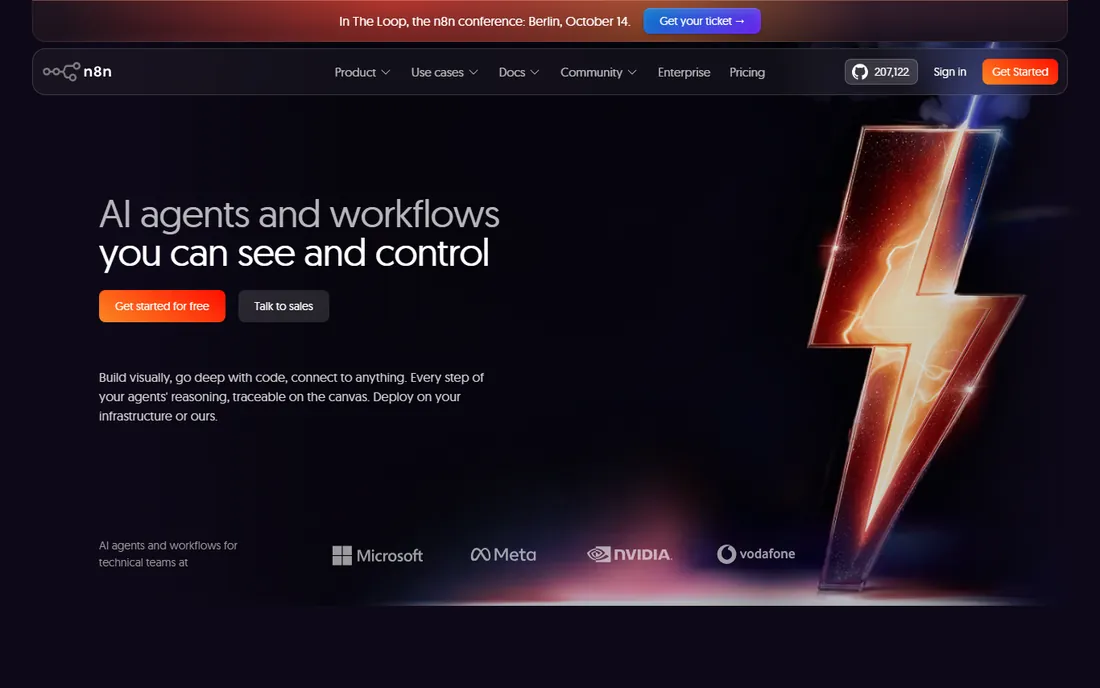
n8n is the developer's answer to automation pricing. The fair-code licensed Community edition self-hosts with no execution meter: run it on a five-dollar VPS and automate unlimited workflows with your data on your disk. The billing unit is the whole workflow run, so a 20-node workflow costs one execution versus roughly 20 tasks on Zapier. Cloud plans start at €20 a month billed annually for 2,500 executions.
The price of freedom is operations. You maintain the server, handle updates and own security. The ~400-plus node library covers the essentials but not Zapier's long tail. For teams with technical skills and data-privacy requirements, n8n is unmatched value. For pure business users, the self-hosting burden usually points back to Make or Zapier.
What we like- Self-hosted Community edition runs unlimited executions free on your own server
- Code-friendly with JavaScript and Python in every workflow
- Billing per workflow execution, not per step
Watch out for- Self-hosting means you own uptime, updates and security
- Smaller node library than Zapier's catalog
- Cloud pricing is in euros with execution caps
Starting priceFrom $15/user/month (Premium, billed annually)
Free planYes
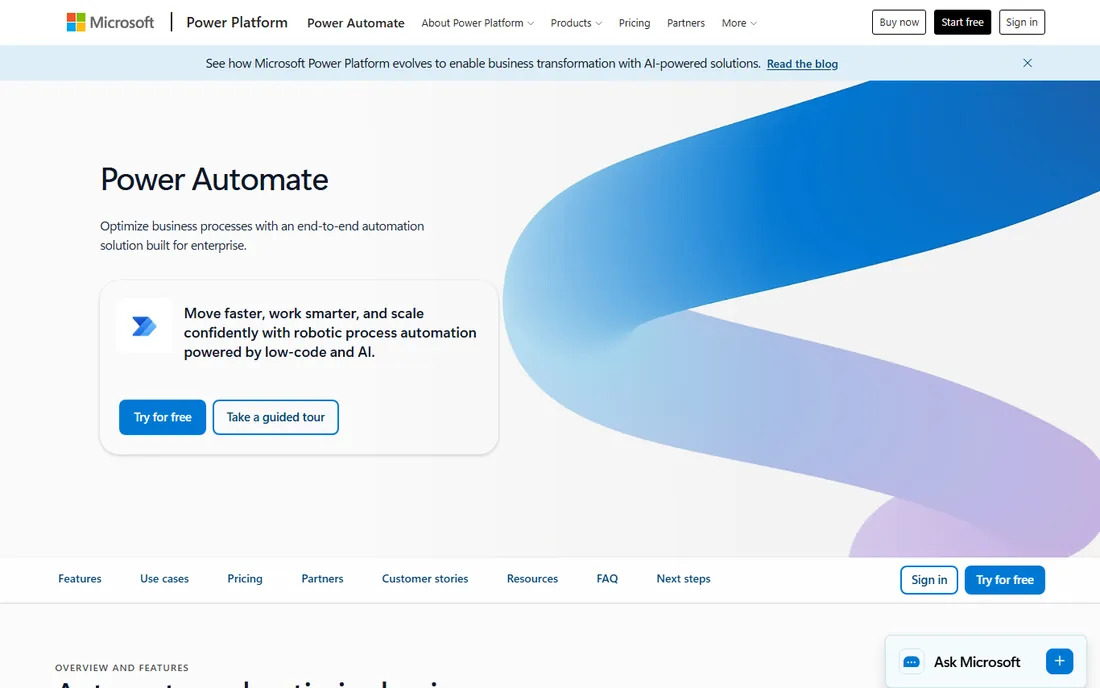
Power Automate's best feature is that you might already own it. Many Microsoft 365 plans include automation rights, and the Premium per-user plan at $15 a month adds the full connector catalog and RPA. Inside a Microsoft estate, the native hooks into Teams, SharePoint, Dynamics 365 and Azure Logic Apps make it the path of least resistance.
Outside that estate, the case weakens: per-user pricing scales poorly for broad automation, and the flow builder draws consistent usability complaints next to Make. But the first step for any Microsoft shop is checking what the current licensing already covers. You may be comparing paid alternatives against a tool you have already bought.
What we like- Often already licensed inside Microsoft 365 plans
- Deep integration with Teams, SharePoint, Dynamics and Azure
- RPA desktop flows included for legacy app automation
Watch out for- Per-user pricing adds up across large teams
- The builder frustrates compared with Make
- Best value only inside the Microsoft ecosystem
The billing unit decides your bill
Before comparing features, convert your workload into each platform's unit. Count how many times your automations run per month, multiply by the steps per run, and price it three ways: Zapier tasks (one per action step), Make credits (one per module action) and n8n executions (one per whole run). A 10-step workflow running 500 times a month costs about 5,000 Zapier tasks, 5,000 Make credits or 500 n8n executions. At entry tiers, that is roughly $89 on Zapier, $9 on Make, or free self-hosted on n8n. The platforms know this math favors them differently at different volumes, which is exactly why the units differ. Do the conversion with your real numbers; it takes ten minutes and it is the highest-value step in this entire purchase.
When you actually need an enterprise iPaaS
Most companies do not. If your integration list is SaaS-to-SaaS syncs built by business users, Make or Celigo will serve you for years. The enterprise iPaaS purchase earns its price under specific conditions: private ERP or mainframe access behind the firewall, B2B/EDI partner transactions, API programs with lifecycle governance, or regulatory audit requirements on every data flow. Those needs bring Boomi, MuleSoft, Workato or Tray.ai into the picture, along with their five-figure contracts and implementation timelines. A useful test: if IT security must approve every integration and the auditors ask about data lineage, you need iPaaS. If the question is just "sync Salesforce to Slack," you need a $9 subscription.
How we chose
We built this list from vendor pricing pages, product documentation and 2026 iPaaS comparisons, checked in October 2026. A tool made the cut only if it is actively sold today and serves real integration work, from no-code automation to enterprise API programs. Prices come from published vendor rates: Zapier's $19.99, Make's $9, n8n's €20 cloud starter, Power Automate's $15 and Boomi's $99 PAYG entry were all confirmed against vendor-published figures. Where a vendor does not publish pricing, we write See website instead of guessing. We did not run hands-on trials. The trade-offs reflect consistent reviewer feedback and the documented billing models.
Frequently asked questions
What is an API integration platform (iPaaS)?
Integration platform as a service: cloud software that connects applications and data sources without custom code for every link. It covers API management, data mapping, workflow automation and monitoring. The category spans no-code tools like Zapier, mid-market platforms like Celigo and Boomi, and enterprise suites like MuleSoft and Workato.
How much does an integration platform cost?
No-code automation runs $9 to $20 a month (Make, Zapier, n8n cloud). Microsoft Power Automate is $15 per user per month. Enterprise iPaaS is quote-based: Boomi's usage entry starts at $99 a month, MuleSoft from $2,000 a month billed annually, and Workato contracts commonly start near $25,000 a year. Implementation and usage overages add to every enterprise figure.
Should we use Zapier or an iPaaS like Workato?
Zapier and Make suit business-user automation between cloud apps. Workato, Boomi and MuleSoft suit IT-governed integration with private systems, B2B/EDI, API programs and audit requirements. Many companies run both: self-serve automation for teams and iPaaS for core systems, with a clear line between them.
What is the cheapest way to automate integrations?
Self-hosted n8n is free beyond server costs, with unlimited executions. In the cloud, Make's $9 Core plan gives 10,000 operations, the best paid value. Check existing licenses first: Power Automate may already be in your Microsoft 365 plan.
How do tasks, credits and executions differ?
Zapier bills per completed action step, so multi-step workflows cost more. Make bills per module operation, roughly equivalent per step but far cheaper per unit. n8n bills per whole workflow execution regardless of step count. Always convert your workload into each unit before comparing prices.
How long does implementation take?
No-code tools deploy in days. Mid-market iPaaS like Celigo or Boomi typically takes four to twelve weeks including mapping and testing. Enterprise platforms like MuleSoft commonly take three to nine months with architecture design and governance setup. Data mapping, not software installation, is the long pole.
Sources we checked (9)
- https://latenode.com/blog/ipaas-vendors
- https://albato.com/blog/publications/best-ipaas-alternative-workato-albato
- https://latenode.com/blog/workato-alternatives
- http://peliqan.io/blog/ipaas-tools/
- https://thedigitalprojectmanager.com/tools/best-ipaas-solutions/
- https://vendorbenchmark.com/blog/ipaas-pricing-benchmark-enterprise-comparison
- https://dev.to/stimlau/best-zapier-alternatives-in-2026-cheaper-and-more-powerful-16eg
- https://dev.to/stimlau/n8n-vs-zapier-in-2026-self-hosted-power-or-cloud-convenience-4lga
- https://dev.to/stimlau/6-best-make-alternatives-in-2026-tested-with-pricing-cmo
Is your product missing or out of date?
We review this list regularly. Vendors can request a listing, send updated pricing or ask about featured placement.

Shihab Mia · Founder, Rankite
Shihab has spent more than a decade helping SaaS and e-commerce brands grow through search. He writes Rankite's software buying guides from pricing pages, documentation and public user reviews. More about Shihab.