How we make this list: we compare pricing pages, product documentation and public user reviews. Rankite is independent; if a vendor ever pays for a featured spot, that listing is clearly labeled Partner.
Key takeaways
- Appium and Maestro are free, open-source frameworks that suit teams with developers who can write and maintain test code.
- Cloud platforms like BrowserStack, Sauce Labs, and Kobiton give you instant access to thousands of real devices, starting around $83 to $199 per month.
- TestMu AI (formerly LambdaTest) and Perfecto have moved toward AI-assisted test creation, which helps teams with less coding capacity.
- If you only need to test on devices you already own, a free framework plus a local device lab costs nothing but engineering time.
- Match the tool to your team's skills: codeless options help small teams start fast, while script-based frameworks scale better long term.
Quick comparison
| Tool | Best for | Starting price | Free plan |
|---|
 Appium Appium | Free cross-platform test framework | $0 | Yes |
 Maestro Maestro | Simple YAML-based mobile UI testing | $0 (framework) | Yes |
 BrowserStack App Automate BrowserStack App Automate | Real-device cloud testing at scale | $199 per month (per parallel, billed annually) | Free trial |
 Sauce Labs Sauce Labs | Enterprise-grade real device cloud | $199 per month (Real Device Cloud, billed annually) | Free trial (28 days) |
 TestMu AI TestMu AI | AI-assisted testing on real devices | See website | Free trial |
 Kobiton Kobiton | Mobile-first teams with own devices | $83 per month (Startup) | Free trial |
 Perfecto Perfecto | Large enterprises with complex needs | See website | Free trial |
 TestComplete TestComplete | Desktop-style scripted mobile testing | See website | Free trial |
Is your product missing or out of date?
We review this list regularly. Vendors can request a listing, send updated pricing or ask about featured placement.
Starting price$0
Free planYes
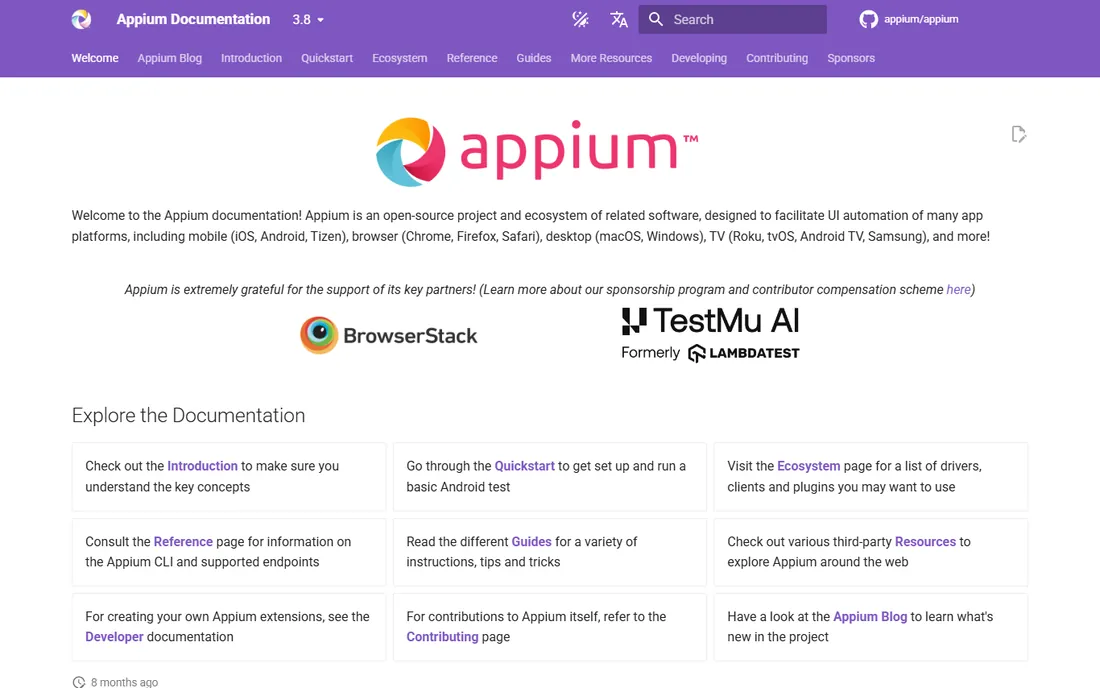
Appium is the standard open-source framework for mobile test automation, and it costs nothing. It implements the WebDriver protocol, so tests written in Java, Python, JavaScript, or other languages drive real iOS and Android apps the way a user would. If your team already writes automated tests for web with Selenium, Appium feels familiar.
The ecosystem is its strength. Appium Inspector helps you find element locators, it plugs into every major CI system, and cloud device platforms like BrowserStack and Sauce Labs all support it, so you can start locally and move to the cloud later. The OpenJS Foundation governs the project, which keeps it vendor-neutral.
The honest catch is that free means do-it-yourself. You supply the devices or emulators, you write and maintain the test code, and flaky tests are your problem to fix. Teams without dedicated automation engineers often stall here. But for teams with the skills, Appium remains the most flexible foundation available.
What we like- Completely free and open source
- Works with iOS, Android, and desktop
- Huge community and integrations
Watch out for- Requires coding skills and setup effort
- No devices included
- Test maintenance is on you
Starting price$0 (framework)
Free planYes
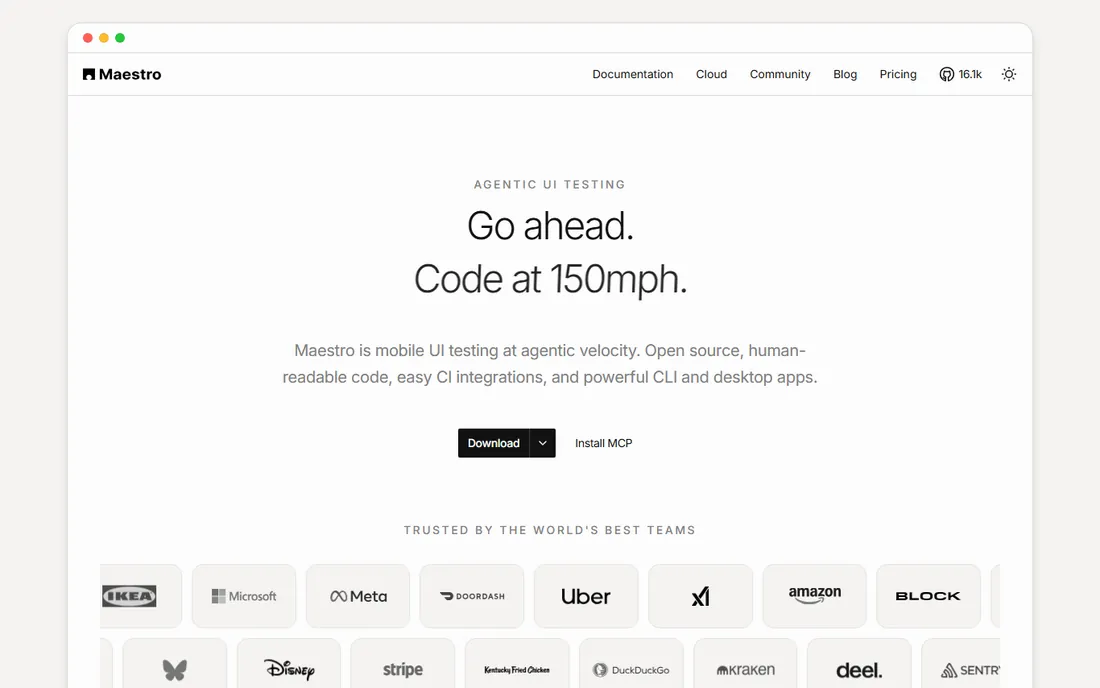
Maestro takes the opposite approach from Appium: instead of writing code, you describe test flows in simple YAML files. A login test is a short list of steps like tapping "Sign In" and asserting "Welcome back" appears. Developers can write their first test in minutes, and Maestro Studio provides a visual editor for building flows interactively.
Under the hood, Maestro drives apps through the accessibility layer, which makes it resilient to timing issues that make other frameworks flaky. It runs on emulators, simulators, and physical Android devices, and a Maestro Cloud option adds parallel execution for CI pipelines. For small teams that want automation without hiring a test engineer, the learning curve is the gentlest here.
The tradeoffs are youth and scope. The ecosystem is smaller than Appium's, physical iOS device support lags behind Android, and very complex test scenarios may outgrow YAML. But for straightforward end-to-end flows on a startup's app, Maestro gets you automated faster than anything else.
What we like- Tests written in plain YAML, no code needed
- Fast setup with Maestro Studio
- Tolerant of timing flakiness
Watch out for- Newer and smaller ecosystem than Appium
- IOS support on physical devices still limited
- Paid cloud is separate
Starting price$199 per month (per parallel, billed annually)
Free planFree trial
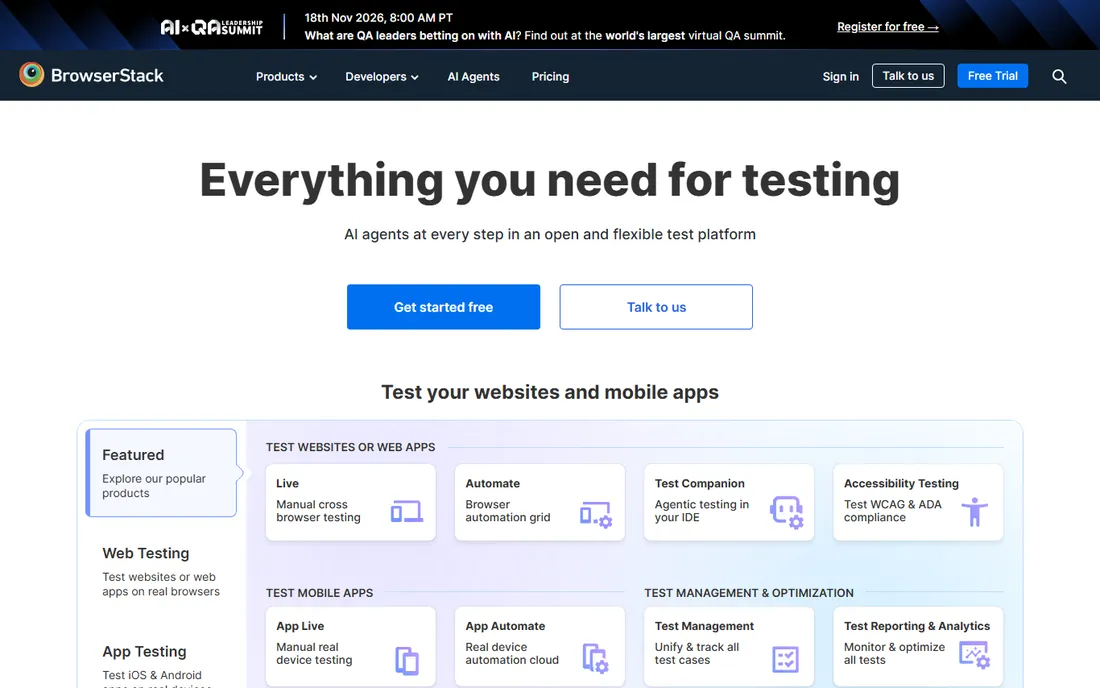
BrowserStack's App Automate lets you run mobile tests on thousands of real iOS and Android devices without owning any of them. Upload your app, point your existing Appium, Espresso, or XCUITest scripts at their cloud, and tests run in parallel across the device matrix you choose. For Paul's team, that Samsung model nobody owned is available in two clicks.
The platform is mature and well integrated. Jenkins, GitHub Actions, and other CI tools plug in directly, test results include video and logs, and the device coverage is among the broadest available. A free tier with limited testing minutes lets you evaluate before paying.
The catch is the pricing model. Plans start at $199 per month per parallel test session on annual billing, and running many tests in parallel multiplies the cost. Small teams can manage with one or two parallels; larger teams should budget carefully. Still, compared to buying and maintaining a device lab, the math usually favors the cloud.
What we like- Massive real device cloud
- Supports Appium, Espresso, and XCUITest
- Strong CI integrations
Watch out for- Pricing scales with parallel sessions
- Can get expensive for large teams
- Debugging remote devices takes practice
Starting price$199 per month (Real Device Cloud, billed annually)
Free planFree trial (28 days)
Sauce Labs is the veteran of cloud testing, founded by the creators of Selenium, and its platform now centers on AURA, an AI-driven release assurance system that writes, runs, and heals tests. The Real Device Cloud starts at $199 per month on annual billing and includes unlimited testing minutes, with a 28-day free trial to evaluate.
Beyond devices, Sauce Labs differentiates on analytics. AI-powered failure analysis pinpoints root causes across runs, flaky test detection saves debugging time, and the platform supports every major framework including Appium, Espresso, and XCUITest. Security certifications including SOC 2 and ISO 27001 make it a safe choice for regulated industries.
The honest catch is that Sauce Labs aims upmarket. The base plan is reasonable, but the AI features and advanced analytics that make headlines sit in enterprise tiers with custom pricing. Small teams get a solid device cloud; the full platform story is really for larger organizations.
What we like- Founded by the creators of Selenium and Appium
- 10,000+ real devices
- AI-powered failure analysis
Watch out for- Enterprise pricing for advanced features
- Interface can feel complex for small teams
Starting priceSee website
Free planFree trial
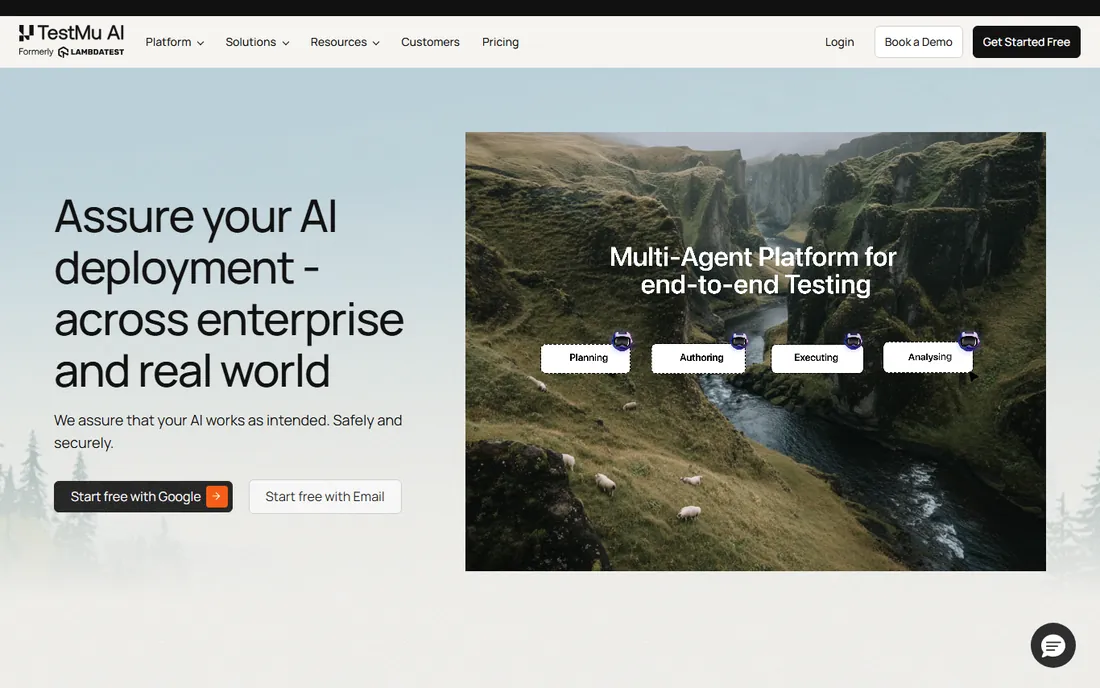
TestMu AI is the new name for LambdaTest, rebranded in January 2026 to reflect its shift toward AI-native testing. The platform combines a real device cloud of more than 10,000 devices with AI agents like KaneAI that can plan, author, and evolve tests from natural language prompts. Mention the old name once, since most reviews and tutorials still say LambdaTest.
For mobile teams, the pitch is speed: HyperExecute runs tests fast across the device cloud, 120+ integrations connect to your existing CI pipeline, and the AI features reduce the scripting burden on QA staff. The company reports over 3 million users, and its recognition in analyst reports suggests the platform is taken seriously at enterprise level.
The catch is transition noise. The rebrand is recent, so community reviews, pricing pages, and third-party comparisons are still catching up, and current pricing is not published on the site. If you evaluate it, get a written quote and confirm that the features you need carried over from the LambdaTest era.
What we like- AI test authoring with KaneAI
- 10,000+ real devices
- Rebranded platform with active development
Watch out for- Recent rebrand means documentation and reviews are in transition
- Pricing not publicly listed
Starting price$83 per month (Startup)
Free planFree trial
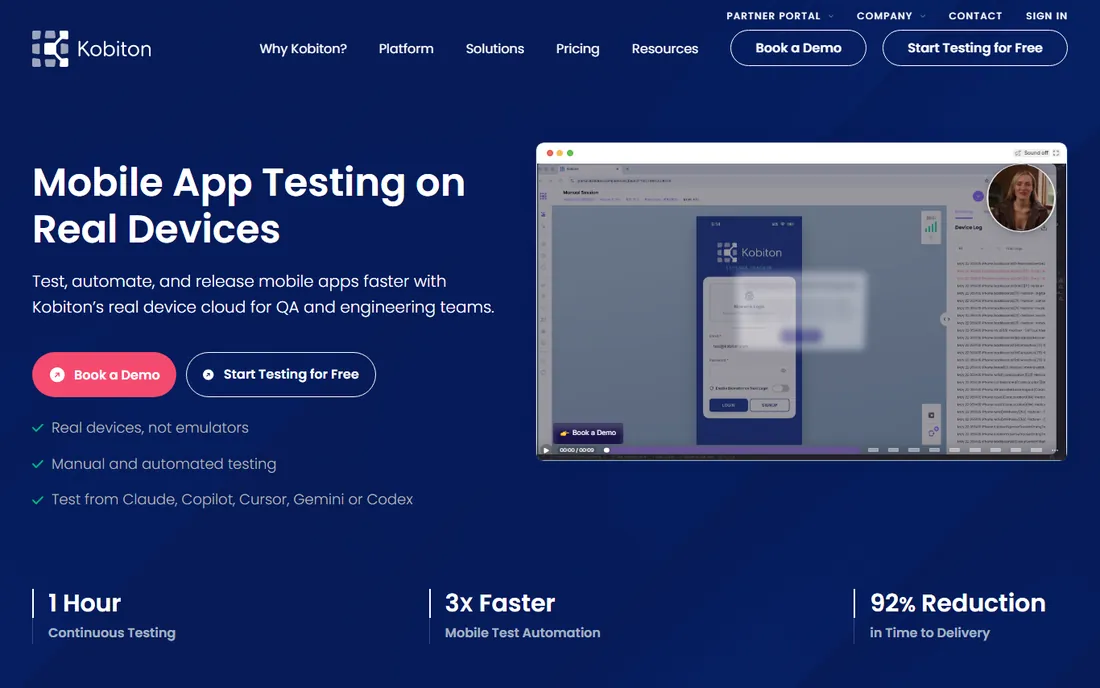
Kobiton stands out by letting you connect your own physical devices to its platform, not just use its shared cloud. For teams with specific device models or security requirements that rule out shared hardware, that flexibility is unique. The Startup plan begins at $83 per month, which undercuts the bigger clouds.
The platform leans into AI assistance: it can generate Appium scripts from manual sessions, heal tests when the UI changes, and offers no-code test creation for team members who do not write code. Session explorer gives an iMovie-like replay of test runs for fast debugging, and on-premises deployment is available for regulated environments.
The tradeoff is scale. Kobiton's shared device cloud is smaller than BrowserStack's or Sauce Labs', so exotic device needs may not be covered. It is best for mobile-focused teams that value the bring-your-own-device model and AI-assisted authoring over the largest possible device catalog.
What we like- Use your own devices in their cloud
- AI-assisted script generation and self-healing
- No-code testing options
Watch out for- Smaller device cloud than the giants
- Best features aimed at larger plans
Starting priceSee website
Free planFree trial
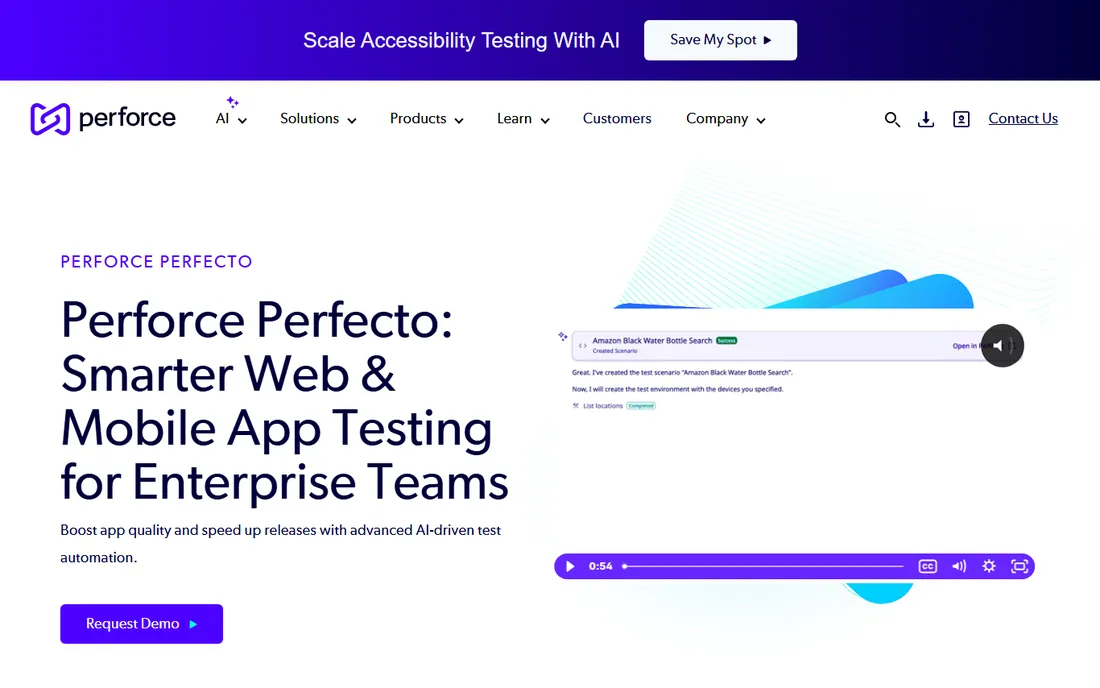
Perfecto, now part of Perforce, targets large enterprises with demanding mobile testing needs. Its platform combines real device testing with AI that automates test creation, execution, maintenance, and root cause analysis from a natural-language interface. For organizations testing complex apps across many devices and regions, that automation reduces the maintenance burden that usually grows with suite size.
Being under Perforce brings enterprise-grade support, security, and integration with the broader DevOps toolchain. The platform handles web, mobile, and desktop testing in one place, which suits companies standardizing on a single vendor.
The catch is accessibility. Pricing is quote-based with no public numbers, and everything about Perfecto, from sales process to feature set, is built for large organizations. A 25-person startup will find the buying process heavy and the price point far above the cloud alternatives. For enterprises, though, it belongs on the shortlist.
What we like- Backed by Perforce with enterprise support
- AI-driven test creation and maintenance
- Strong for complex apps
Watch out for- Quote-based pricing with no public figures
- Aimed at large organizations, not small teams
Starting priceSee website
Free planFree trial
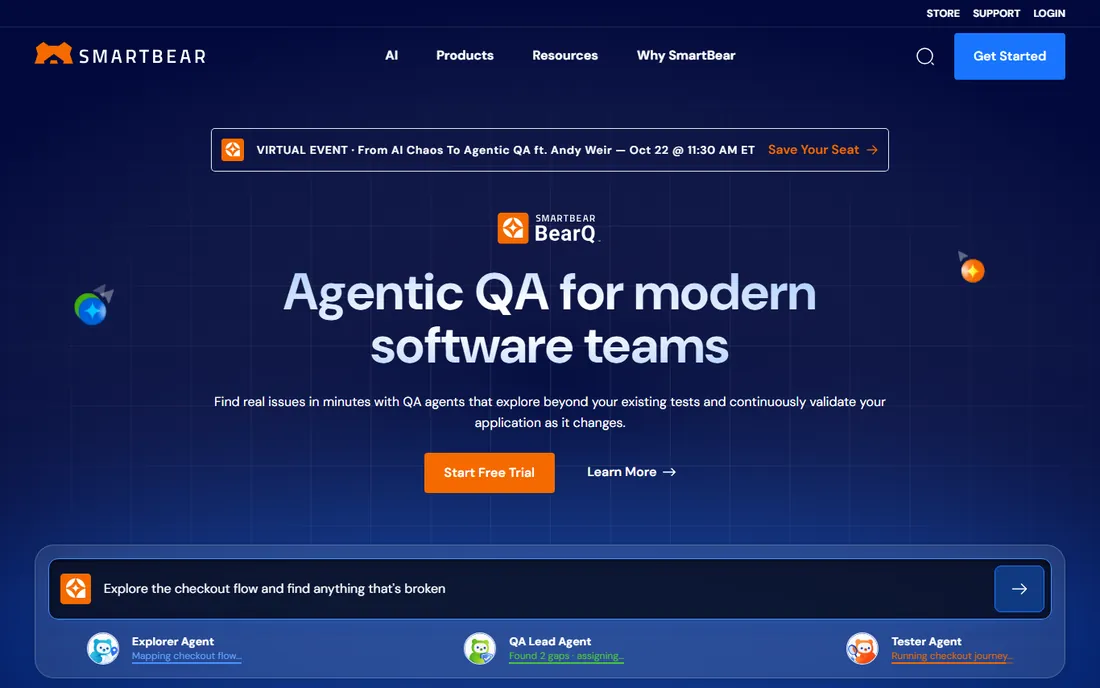
TestComplete from SmartBear is a functional UI testing tool that covers mobile alongside web and desktop. Testers can record interactions or write scripts in JavaScript, Python, or VBScript, and the object recognition engine is designed to keep tests stable across UI changes. For teams that test mobile apps as part of a larger desktop and web suite, one tool for everything has appeal.
SmartBear's ecosystem is the broader selling point: TestComplete fits alongside their API testing, test management, and performance tools, giving QA departments a single vendor. The 32,000 teams SmartBear cites include many mid-size companies, suggesting it fits organizations with formal QA processes.
The honest catch is that TestComplete is not a device cloud. It automates well but you supply the devices or emulators, and its heritage is Windows desktop testing, so mobile-first teams may find it less natural than the cloud platforms. Pricing is also not published, so expect a sales conversation.
What we like- Script or record tests without deep coding
- Supports native and hybrid apps
- Part of the broad SmartBear suite
Watch out for- Pricing not published
- Windows-centric tooling
- Less cloud device flexibility than pure cloud platforms
How we chose
We selected tools that cover the main ways teams automate mobile testing: open-source frameworks, cloud device platforms, and scripted testing suites. We checked current pricing on vendor sites and recent third-party pricing data, read documentation for platform and framework support, and weighed public reviews from G2, Reddit, and QA communities. We favored tools with verifiable current homepages and clear mobile automation capabilities, and we noted where vendors have recently rebranded so readers are not confused by old names in reviews.
Start with your team's skills. If you have automation engineers comfortable writing code, a free framework like Appium gives maximum control at zero license cost. If your team is small and mostly manual testers, a codeless or AI-assisted tool will get you automated months sooner.
Count your device needs honestly. Testing on emulators is free and fine for early development, but real devices catch the bugs that matter, especially around performance, sensors, and manufacturer quirks. If you need more than a handful of models, a cloud device platform beats buying phones.
Check framework compatibility. If you already have Appium scripts, every cloud platform here runs them, which makes switching vendors easy. Proprietary or codeless tools can lock you in, so ask how you export your tests before committing.
Finally, trial on your own app. Device cloud performance, debugging tools, and flakiness vary by app. Run a pilot with your real test suite during the free trial, measure how many tests pass reliably, and only then sign an annual contract.
Frameworks vs device clouds: which do you need
Frameworks like Appium and Maestro are free software that runs your tests. They do not provide devices, parallelism, or hosting. You run them on emulators, your own phones, or someone else's cloud. They suit teams with engineering capacity and existing infrastructure.
Device clouds like BrowserStack, Sauce Labs, and Kobiton provide the phones and the infrastructure. You bring your test scripts, or use their AI authoring, and they run everything at scale. They suit teams that want results without maintaining hardware.
Most maturing teams end up with both: an open-source framework for writing tests and a cloud platform for running them. That combination avoids vendor lock-in on the test code while getting the device coverage only a cloud can provide.
Frequently asked questions
What is the best free mobile automation testing tool?
Appium is the most capable free option, with broad platform support and a huge community. Maestro is the easiest free option, with YAML-based tests that non-programmers can write. Both are open source and cost nothing to use.
Do I need real devices or are emulators enough?
Emulators are fine for functional testing during development, but real devices catch issues with performance, battery, sensors, cameras, and manufacturer-specific behavior. Most teams use emulators for daily development and real devices for release testing.
How much does mobile test automation cost?
Free if you use Appium or Maestro with your own devices. Cloud device platforms typically start around $83 to $199 per month for basic plans, with costs rising as you add parallel test sessions. Enterprise platforms are quote-based.
Can non-programmers do mobile test automation?
Yes, more than before. Maestro's YAML flows, Kobiton's no-code testing, and AI-assisted authoring in TestMu AI and Perfecto all let manual testers automate without writing code. Complex scenarios still benefit from programming skills.
What is the difference between Appium and Espresso or XCUITest?
Appium is cross-platform: one framework for both iOS and Android. Espresso (Android) and XCUITest (iOS) are Google's and Apple's native frameworks, faster and more reliable on their own platforms but requiring separate test suites. Cloud platforms support all three.
How do I reduce flaky mobile tests?
Wait for elements explicitly instead of using fixed delays, use stable element locators, reset app state between tests, and retry genuinely flaky steps rather than whole suites. Tools with self-healing, like Kobiton and Sauce Labs, can also adapt to minor UI changes automatically.
Sources we checked (11)
- https://appium.io/
- https://maestro.dev/
- https://www.browserstack.com/
- https://saucelabs.com/
- https://testmuai.com/
- https://kobiton.com/
- https://perfecto.io/
- https://smartbear.com/
- https://saucelabs.com/pricing
- https://www.g2.com/products/browserstack/pricing
- https://kobiton.com/blog/top-mobile-app-testing-tools/
Is your product missing or out of date?
We review this list regularly. Vendors can request a listing, send updated pricing or ask about featured placement.

Shihab Mia · Founder, Rankite
Shihab has spent more than a decade helping SaaS and e-commerce brands grow through search. He writes Rankite's software buying guides from pricing pages, documentation and public user reviews. More about Shihab.