How we make this list: we compare pricing pages, product documentation and public user reviews. Rankite is independent; if a vendor ever pays for a featured spot, that listing is clearly labeled Partner.
Key takeaways
- Klaviyo is the default pick for Shopify and DTC brands, with a free plan and paid email plans from $20 per month.
- HubSpot's CRM is genuinely free forever, which makes it the cheapest way to add pipelines and service tools to a store.
- Omnisend and Drip are the strongest Klaviyo alternatives, starting at $16 and $39 per month respectively.
- Zoho CRM at $14 per user per month is the best value for stores that want a traditional sales CRM on a budget.
- Ecommerce CRMs price by contacts or profiles, not just seats, so your bill grows with your list even if your team stays the same.
Quick comparison
| Tool | Best for | Starting price | Free plan |
|---|
 Klaviyo Klaviyo | Shopify and DTC brands running email and SMS | $20 per month (Email, 500 profiles) | Yes |
 HubSpot HubSpot | stores that need sales, marketing, and service under one roof | $15 per seat/month (Starter, billed annually) | Yes |
 Omnisend Omnisend | ecommerce SMBs that want fast multichannel automation | $16 per month (Standard) | Yes |
 Drip Drip | DTC brands that want every feature at one flat price | $39 per month (up to 2,500 contacts) | Free trial (14 days) |
 ActiveCampaign ActiveCampaign | stores needing advanced automation plus a real CRM | $15 per month (Starter, billed annually) | Free trial |
 Zoho CRM Zoho CRM | budget-conscious stores that want a traditional CRM | $14 per user/month (Standard, billed annually) | Yes |
 Pipedrive Pipedrive | sales-driven stores with an active pipeline | $14 per user/month (Essential, billed annually) | Free trial (14 days) |
 Salesforce Salesforce | enterprise merchants and Shopify Plus brands | $25 per user/month (Starter Suite) | Free trial |
Is your product missing or out of date?
We review this list regularly. Vendors can request a listing, send updated pricing or ask about featured placement.
The best CRM software for ecommerce
Starting price$20 per month (Email, 500 profiles)
Free planYes
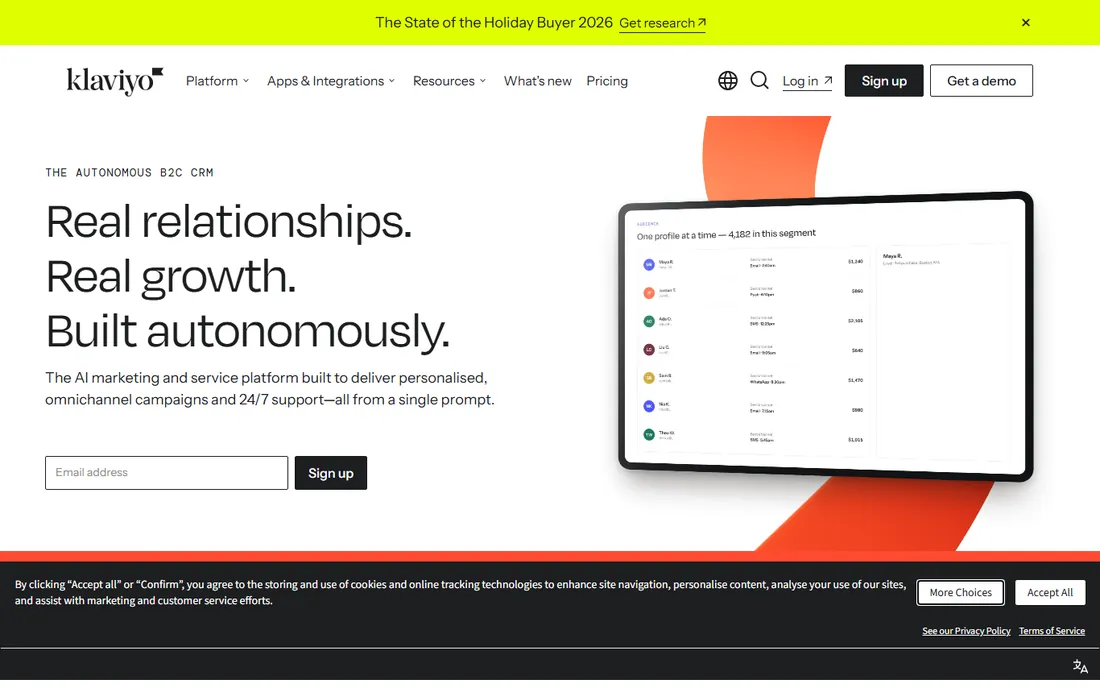
Klaviyo calls itself the B2C CRM, and for Shopify stores that description is fair. It pulls purchase history, browse behavior, and checkout activity in real time, then turns that data into segments and automated flows: welcome series, abandoned cart, post-purchase, win-back. The segmentation is where it earns its keep. You can target people who bought a specific product twice but have not ordered in 90 days, and that kind of precision is what lifts repeat revenue.
The pricing model is the thing to understand before you commit. Klaviyo bills by active profiles, anyone you can email, not just subscribers, and it auto-bumps you to the next tier when your count crosses a threshold. The Email plan starts at $20 per month for 500 profiles and climbs steeply: around $150 at 10,000 profiles and $720 at 50,000. SMS, WhatsApp, reviews, and analytics each cost extra on top.
For a growing DTC brand with someone to manage it, Klaviyo is still the strongest ecommerce CRM on the market. Just keep your list clean, suppress inactive profiles, and budget for the add-ons. The free plan covers 250 profiles and 500 monthly sends, which is enough to test the platform on a new store.
What we like- Deepest native Shopify integration in the category
- Predictive analytics like CLV and churn scoring built in
- 350+ integrations with real-time behavioral data
Watch out for- Billing by active profiles gets expensive as your list grows
- SMS, reviews, and analytics are all priced separately
#2
HubSpot
Best for: stores that need sales, marketing, and service under one roof
Visit hubspot.com
Starting price$15 per seat/month (Starter, billed annually)
Free planYes
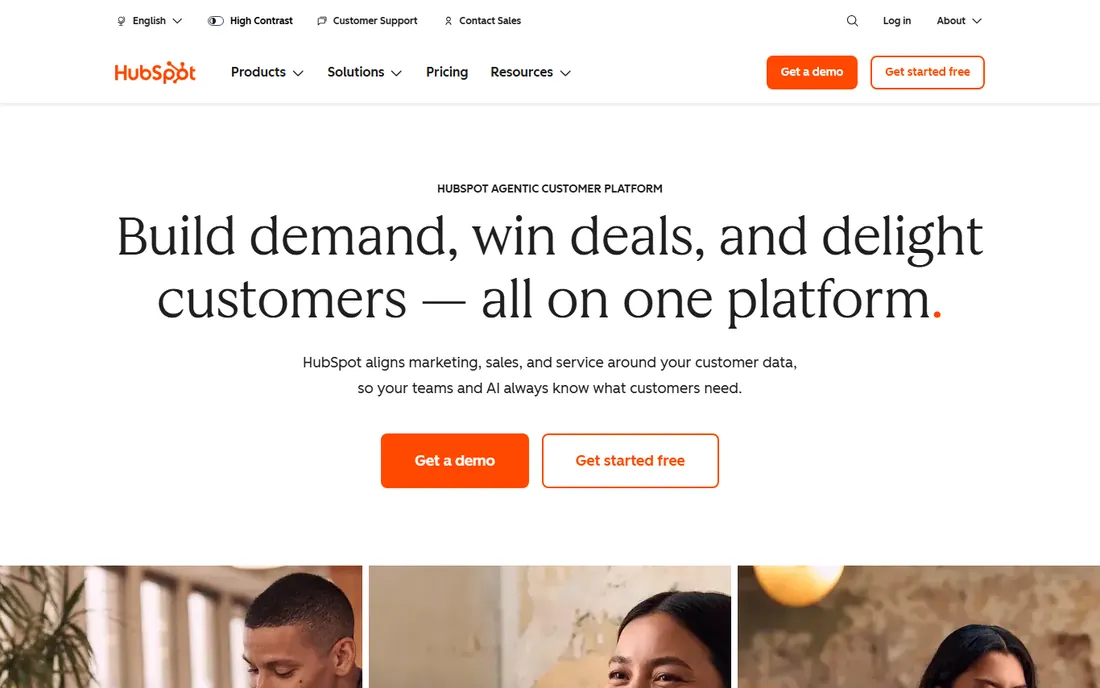
HubSpot is the best all-rounder for stores that need more than email. The free CRM includes contact management, deal pipelines, email tracking, meeting scheduling, and basic reporting for unlimited users, which no other tool on this list matches. The Shopify integration syncs orders, products, and abandoned carts, and the 2026 updates added real-time cart and order status sync.
Where HubSpot pulls ahead of Klaviyo is breadth. If your store has a sales team, a support desk, or B2B wholesale accounts alongside DTC, HubSpot keeps all of that in one record instead of three tools. The marketing automation, service tickets, and sales pipelines share the same contact database, so nothing falls between systems.
The tradeoff is cost at scale. The free plan is generous, but serious marketing automation lives in the paid Marketing Hub tiers, and those are priced per seat with contact tier add-ons. For a pure DTC email play, Klaviyo gives you more ecommerce-specific firepower per dollar. For a store that is growing into a real company with teams, HubSpot is the safer long-term platform.
What we like- Free CRM is permanently free with unlimited users
- Two-way Shopify sync covers orders and abandoned carts
- Scales from free to enterprise on one platform
Watch out for- Paid marketing features get expensive fast
- The free tier limits automation depth
#3
Omnisend
Best for: ecommerce SMBs that want fast multichannel automation
Visit omnisend.com
Starting price$16 per month (Standard)
Free planYes
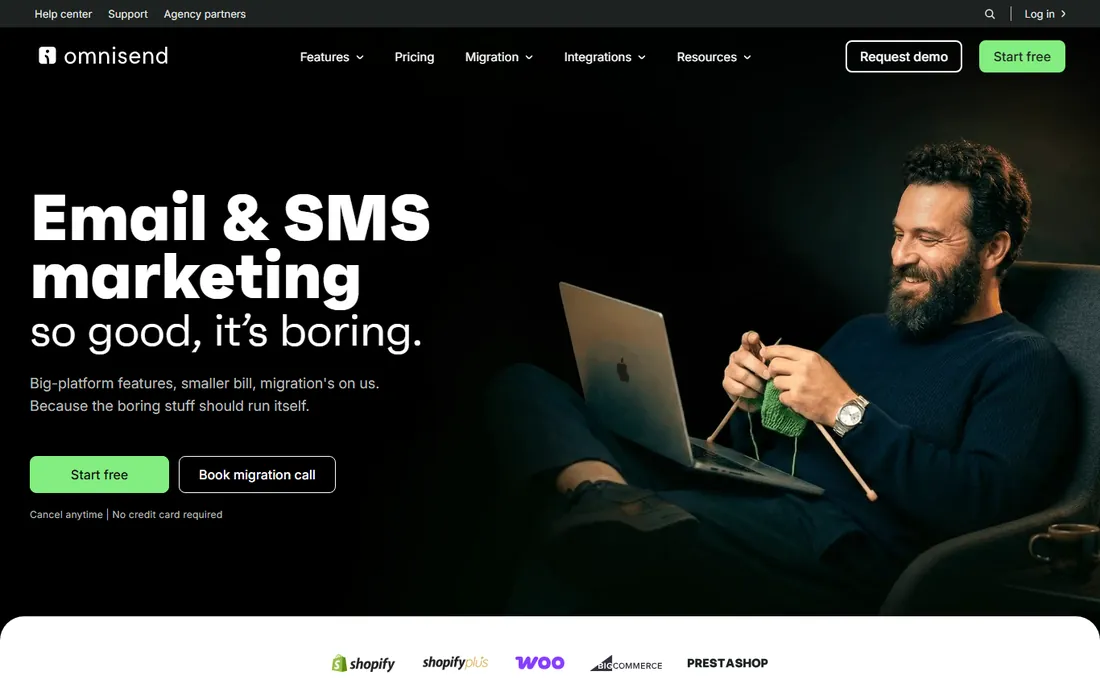
Omnisend is the pragmatic Klaviyo alternative for smaller stores. It combines email, SMS, and web push in one platform with pre-built automation workflows for welcome, abandoned cart, and post-purchase, and most stores can go from signup to sending in a couple of days. The free plan is genuinely useful: 500 emails and push notifications plus 60 SMS per month at no cost.
The Standard plan starts at $16 per month and adds unlimited web push, a customer success manager, and 24/7 support. That undercuts Klaviyo significantly at small list sizes, and the platform is simpler to operate, which matters if you do not have a dedicated email marketer. Segmentation, A/B testing, and popups are included rather than gated.
The honest limitation is ceiling. Omnisend does not have a sales pipeline CRM, its analytics are thinner than Klaviyo's, and the Pro plan at $59 per month is where the best features live. For stores under a few thousand contacts doing straightforward lifecycle marketing, it is excellent value. For data-heavy personalization at scale, Klaviyo justifies its premium.
What we like- Pre-built ecommerce workflows get you live in days
- Free plan includes email, SMS, and push
- 24/7 support even on lower tiers
Watch out for- Best features gated behind the $59 Pro plan
- No built-in sales CRM pipelines
#4
Drip
Best for: DTC brands that want every feature at one flat price
Visit drip.com
Starting price$39 per month (up to 2,500 contacts)
Free planFree trial (14 days)
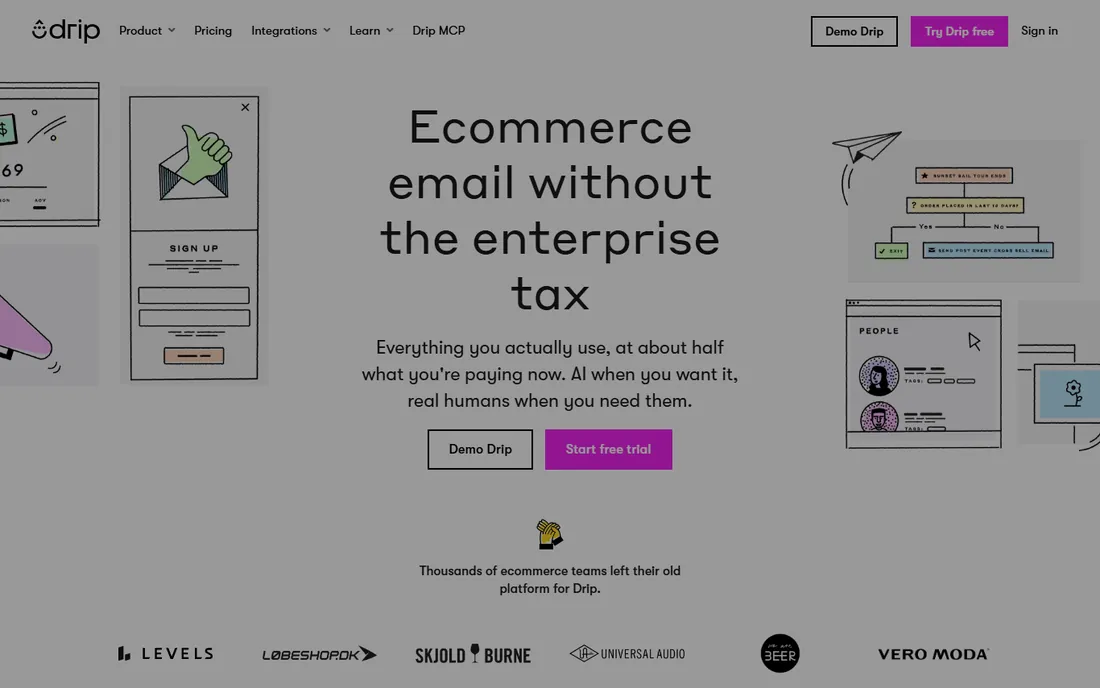
Drip takes the opposite approach to feature gating: every plan includes every feature, starting at $39 per month for up to 2,500 contacts. The visual workflow builder handles branching logic, goals, and split testing, with pre-built playbooks for the standard ecommerce flows. Real-time sync with Shopify, WooCommerce, and BigCommerce keeps segments current the moment a shopper acts.
What sets Drip apart is measurement. Instead of stopping at open rates, it tracks revenue per person, so you can see exactly which emails and flows drive sales. The platform has attributed more than $1.5 billion in revenue across its customer base, and the onsite suite, popups, quizzes, and spin-to-win, is built in rather than bolted on.
The catch is the same one Klaviyo has: the price scales with your contact count, and there is no free tier to fall back on, only a 14-day trial. At 2,500 contacts Drip at $39 undercuts Klaviyo's $60 meaningfully, but the gap narrows as lists grow. Pick Drip if you want pricing simplicity and full features from day one without wondering which plan includes what.
What we like- All features included on every plan with no gating
- Visual workflow builder with revenue attribution
- Free migration from other platforms
Watch out for- No free plan, only a trial
- Pricing jumps with contact count just like Klaviyo
Starting price$15 per month (Starter, billed annually)
Free planFree trial
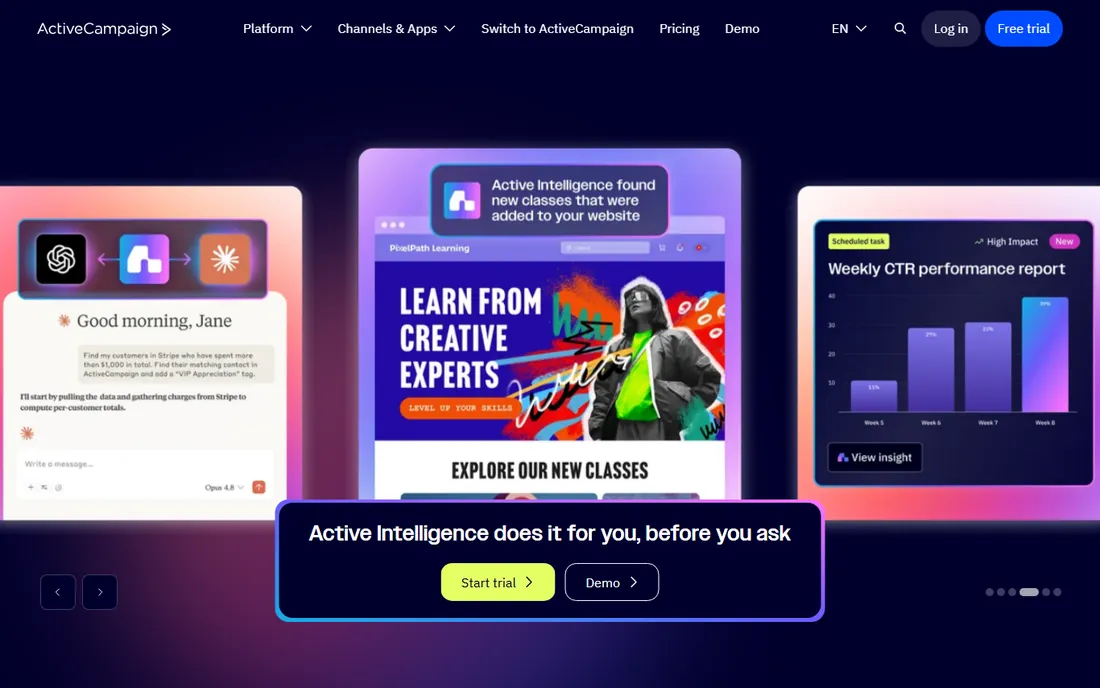
ActiveCampaign sits between the ecommerce specialists and the traditional CRMs. Its automation builder is the deepest here, with conditional logic, goal tracking, and split testing that go beyond what Klaviyo and Omnisend offer, and every plan includes a standard sales CRM with contact profiles and pipelines. The Starter plan begins at $15 per month billed annually for 1,000 contacts.
For stores that sell through funnels, webinars, or a mix of content and commerce, ActiveCampaign is often the better fit than a pure ecommerce tool. The automation handles complex nurture sequences that the ecommerce-first platforms were not designed for, and the CRM side manages wholesale or B2B deals alongside DTC customers.
The tradeoffs are usability and ecommerce depth. The builder takes real time to learn, and product catalog features like product blocks start at the $49 Plus plan, so the entry price is not the whole story for stores. There is no free plan, only a trial. Choose ActiveCampaign when your marketing is more sophisticated than standard cart recovery.
What we like- Most powerful automation builder in this price range
- Built-in sales CRM with pipelines
- AI tools help build automations faster
Watch out for- Learning curve is real for the automation builder
- Ecommerce product blocks require the $49 Plus plan
#6
Zoho CRM
Best for: budget-conscious stores that want a traditional CRM
Visit zoho.com
Starting price$14 per user/month (Standard, billed annually)
Free planYes
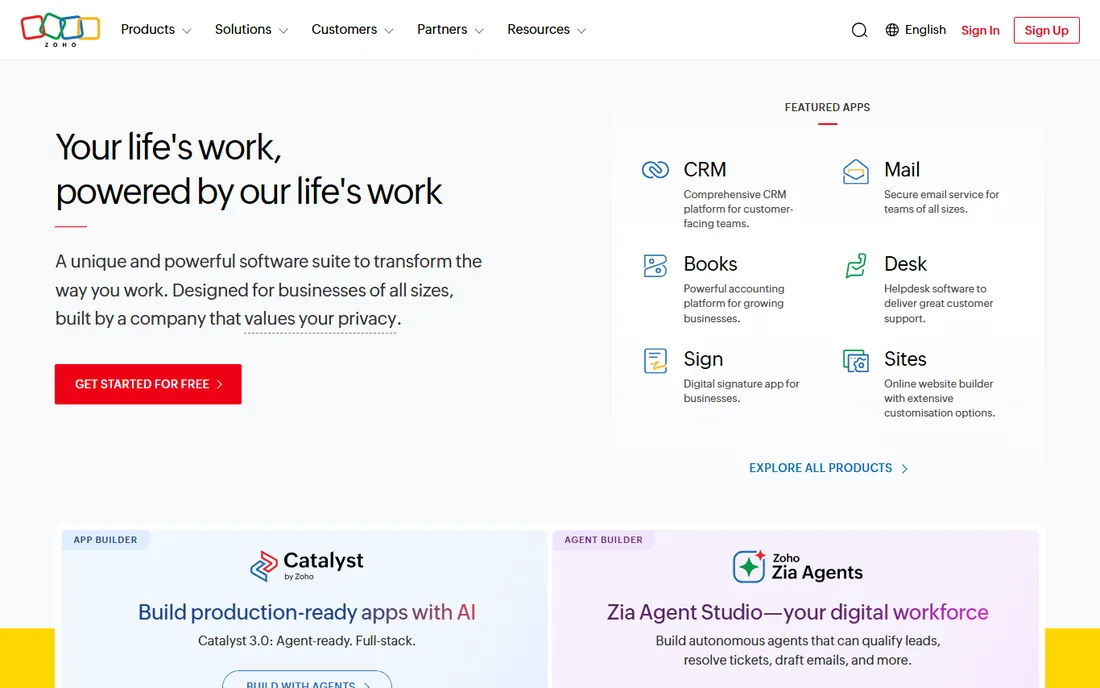
Zoho CRM is the value play for stores that think in terms of a sales CRM rather than an email platform. The Standard plan at $14 per user per month includes workflow automation, multichannel communication, and custom modules that competitors charge two or three times more for. A free plan covers up to three users, which is enough for a founder-led store to run on indefinitely.
The Zoho ecosystem is the strategic reason to pick it. Zoho One bundles CRM with email marketing, analytics, helpdesk, inventory, and dozens of other apps for a low per-user add-on, so a growing store can assemble a full business stack without a patchwork of vendors. The Shopify extension syncs customers, orders, and product data natively.
The honest cost is complexity. Zoho's interface carries more modules and settings than Pipedrive or HubSpot, and the ecommerce sync needs more configuration than Klaviyo's plug-and-play connector. If your team will invest the setup time, Zoho delivers the most CRM per dollar on this list. If you want something running this afternoon, look at Omnisend or HubSpot instead.
What we like- Enterprise-grade automation and customization at SMB prices
- Free plan for up to 3 users
- Zoho One bundles dozens of business apps cheaply
Watch out for- Interface is busier than modern alternatives
- Ecommerce integrations need more setup than Klaviyo's native sync
Starting price$14 per user/month (Essential, billed annually)
Free planFree trial (14 days)
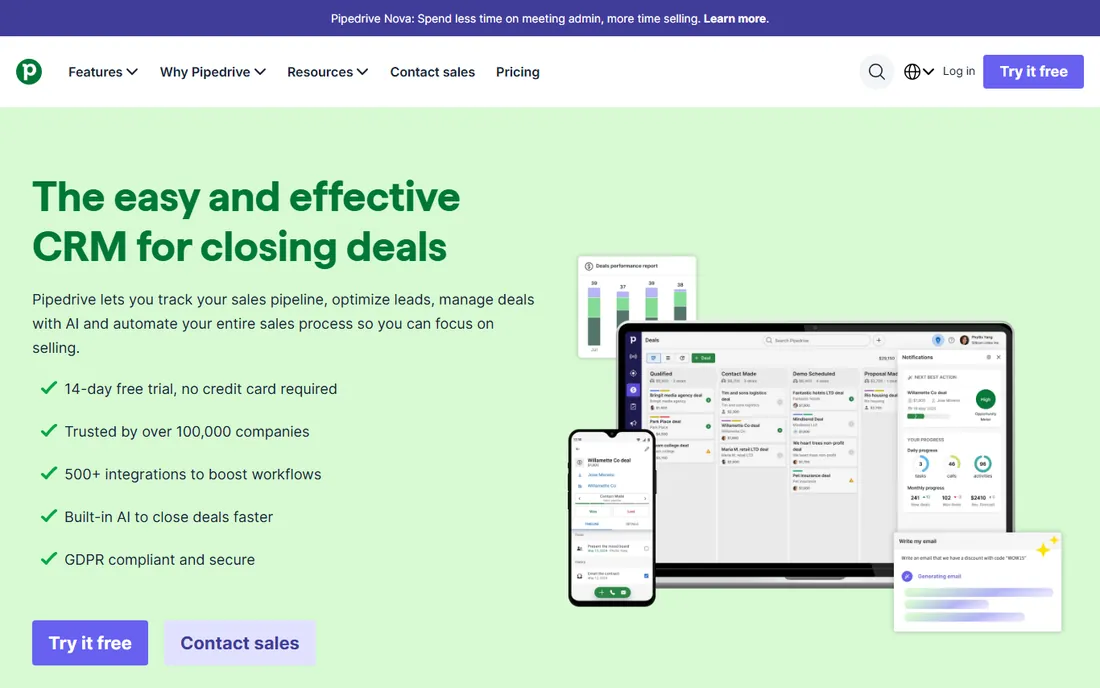
Pipedrive is the pipeline specialist. Reps drag deals between stages, set activity reminders, and see exactly what needs attention, and the interface is designed so nothing quietly falls through the cracks. For stores with a wholesale arm, a B2B sales team, or high-ticket products sold over the phone, that focus is exactly right.
The Essential plan starts at $14 per user per month billed annually, with a 14-day trial and no credit card required. Setup takes hours, not weeks, and the 350-plus integrations cover Shopify, QuickBooks, and the usual marketing tools. Teams that have bounced off heavier CRMs tend to stick with Pipedrive because reps actually use it.
The limitation is category fit. Pipedrive is a sales CRM first: it does not do ecommerce email automation, cart recovery, or behavioral segmentation natively. Most DTC stores pair it with Klaviyo or Omnisend for the marketing side and use Pipedrive for the human-led deals. Buy it for the pipeline, not as your only customer platform.
What we like- Visual pipeline that sales reps actually adopt
- Minimal setup, fast to learn
- 350+ integrations including Shopify connectors
Watch out for- No free plan
- Built for B2B sales motion, weaker on ecommerce marketing automation
Starting price$25 per user/month (Starter Suite)
Free planFree trial
Salesforce is the enterprise answer. The Starter Suite begins at $25 per user per month, but the real story is the platform: unmatched customization, Einstein AI analytics, and an AppExchange with thousands of ecommerce connectors. For Shopify Plus merchants running omnichannel, multi-region, or B2B-plus-DTC operations, nothing else matches its depth.
The Commerce Cloud pairing is the strategic draw. Large brands run storefront, order management, and CRM on Salesforce infrastructure with a single customer record across every touchpoint. The reporting and forecasting capabilities are in a different league from the SMB tools on this list.
The honest math is that the sticker price is a fraction of the total cost. Implementation, administration, and training typically run two to three times the license cost, and you need dedicated CRM resources to get value from it. For most businesses under 100 people, Zoho CRM Enterprise at $40 per user delivers most of the practical CRM functionality at a fraction of the deployment cost. Buy Salesforce when your complexity demands it, not before.
What we like- Deepest customization and reporting in the industry
- Massive AppExchange ecosystem
- Handles complex multi-channel and international operations
Watch out for- Implementation cost and complexity are significant
- Overkill for most stores under 100 people
How we chose
We focused on platforms with real ecommerce depth: native Shopify or WooCommerce integrations, purchase behavior tracking, and automation built around the customer lifecycle, not generic B2B pipelines. We checked each vendor's pricing page and current third-party pricing roundups from 2026, read merchant reviews on G2, Capterra, Shopify's app store, and Reddit, and weighed integration quality, contact-based pricing fairness, automation depth, and fit for small to mid-size store economics. We did not run hands-on trials; all prices were verified against vendor pages or pricing roundups current as of October 2026.
Do you even need a separate CRM if you use Shopify?
Shopify stores customer profiles and order history, but it is not a CRM. There is no pipeline management, no behavioral segmentation, no automated lifecycle campaigns, and no unified view of support interactions. If your marketing is "send a newsletter when we remember," Shopify alone is fine. The moment you want abandoned cart recovery, post-purchase flows, win-back campaigns, or a sales pipeline for wholesale accounts, you need a CRM layer.
The good news is that the integration is the easy part. Klaviyo, Omnisend, HubSpot, and Zoho all have native Shopify connectors that sync customers, orders, and products in under an hour. The hard part is data hygiene: deduplicating customer records, mapping consent status correctly, and validating emails before import. Budget time for cleanup, because every platform on this list performs badly on dirty data, and the fanciest automation in the world cannot fix a duplicated, unconsented contact list.
How to choose an ecommerce CRM without overpaying
Match the tool to your actual revenue motion. Pure DTC email and SMS revenue points to Klaviyo, Omnisend, or Drip. A store with salespeople, support tickets, or wholesale accounts points to HubSpot, Zoho, or Pipedrive. An enterprise operation points to Salesforce. Buying a sales CRM when you needed lifecycle marketing, or vice versa, is the expensive mistake this category produces most often.
Then model pricing on your contact count, not your team size. Ecommerce CRMs bill by profiles or contacts, so project your list size 12 months out and price every finalist at that tier, including the add-ons: SMS credits, analytics, reviews. Klaviyo's $20 entry price and $720 price at 50,000 profiles are the same product; only your list changed. Finally, trial with real data. Import a segment of actual customers, build one abandoned cart flow, and check the revenue attribution before you migrate your whole list.
Frequently asked questions
What is an ecommerce CRM?
An ecommerce CRM is customer relationship software built for online stores. It tracks purchase history, browsing behavior, and cart activity, then automates personalized marketing like abandoned cart recovery and post-purchase follow-ups. Unlike B2B CRMs built around sales pipelines, ecommerce CRMs are built around high-volume behavioral data and lifecycle automation.
Does Shopify have a built-in CRM?
Shopify has customer profiles and order history, but not a full CRM. It lacks pipeline management, behavioral segmentation, marketing automation, and unified support history. Most growing stores add a dedicated CRM or marketing automation platform once they need cart recovery, lifecycle campaigns, or wholesale pipeline tracking.
What is the best free CRM for ecommerce?
HubSpot's free CRM is the strongest free option, with unlimited users, contact management, deal pipelines, and a Shopify integration at no cost. Omnisend's free plan is the best free ecommerce marketing option, with email, SMS, and push included. Klaviyo's free tier works for very small lists but caps at 250 profiles.
How much does an ecommerce CRM cost?
Entry plans run $14 to $25 per user per month for traditional CRMs like Zoho, Pipedrive, and Salesforce Starter. Ecommerce marketing platforms bill by contacts: roughly $16 to $39 per month at small list sizes, scaling to hundreds per month as your list grows. Always price at your projected 12-month list size, not today's.
Should I choose Klaviyo or HubSpot for my store?
Choose Klaviyo if email and SMS revenue is your priority and you want the deepest Shopify integration with predictive analytics. Choose HubSpot if you need sales pipelines, a helpdesk, or B2B features alongside ecommerce, and you want one platform for the whole company. Many mid-size brands end up using both.
Can a CRM really recover abandoned carts?
Yes, and it is one of the highest-ROI automations in ecommerce. A standard sequence, SMS within the first hour, email within the hour, a second email on day one, and a final email on day three, typically recaptures 15 to 30 percent of abandoned carts when run on clean customer data. Every platform on this list except Pipedrive includes cart recovery automation.
Sources we checked (9)
- https://fitsmallbusiness.com/best-crm-for-shopify/
- https://www.drip.com/blog/omnisend-alternatives
- https://www.omnisend.com/blog/ecommerce-crm/
- https://www.omnisend.com/blog/klaviyo-pricing/
- https://www.omnisend.com/blog/aweber-alternatives/
- https://saasrat.com/zoho-crm/alternatives
- https://research.com/software/guides/pipedrive-vs-zoho-crm
- https://www.shopify.com/za/blog/what-is-klaviyo
- https://www.consio.ai/blog/best-crm-for-ecommerce
Is your product missing or out of date?
We review this list regularly. Vendors can request a listing, send updated pricing or ask about featured placement.

Shihab Mia · Founder, Rankite
Shihab has spent more than a decade helping SaaS and e-commerce brands grow through search. He writes Rankite's software buying guides from pricing pages, documentation and public user reviews. More about Shihab.