How we make this list: we compare pricing pages, product documentation and public user reviews. Rankite is independent; if a vendor ever pays for a featured spot, that listing is clearly labeled Partner.
Key takeaways
- ActiveCampaign and Klaviyo offer the deepest automation, but they are built for teams ready to invest time and money in email as a revenue channel.
- Mailchimp, AWeber, and GetResponse are the most approachable starting points, with free plans and entry prices under $20 a month.
- Kit is the clear pick for creators and newsletter businesses, with a free plan covering up to 10,000 subscribers.
- Drip and Klaviyo are the ecommerce specialists, with abandoned cart flows and purchase-based triggers built in from day one.
- Brevo stands out on pricing: it charges for emails sent rather than contacts stored, which suits large lists that send infrequently.
Quick comparison
| Tool | Best for | Starting price | Free plan |
|---|
 ActiveCampaign ActiveCampaign | advanced marketing automation | See website | Free trial (14 days) |
 Mailchimp Mailchimp | beginners and all-in-one marketing | See website | Yes (250 contacts) |
 Kit Kit | creators and newsletter businesses | See website | Yes (up to 10,000 subscribers) |
 Drip Drip | ecommerce drip campaigns | See website | Free trial (14 days) |
 Klaviyo Klaviyo | ecommerce email and SMS | See website | Yes (250 profiles) |
 GetResponse GetResponse | all-in-one marketing with webinars | $15.58/month (billed annually) | Yes (free account) |
 AWeber AWeber | small businesses new to email | $12.49/month (billed annually) | Yes (500 subscribers) |
 Brevo Brevo | budget-friendly multichannel marketing | See website | Yes (free plan) |
Is your product missing or out of date?
We review this list regularly. Vendors can request a listing, send updated pricing or ask about featured placement.
The best email drip campaign software
Starting priceSee website
Free planFree trial (14 days)
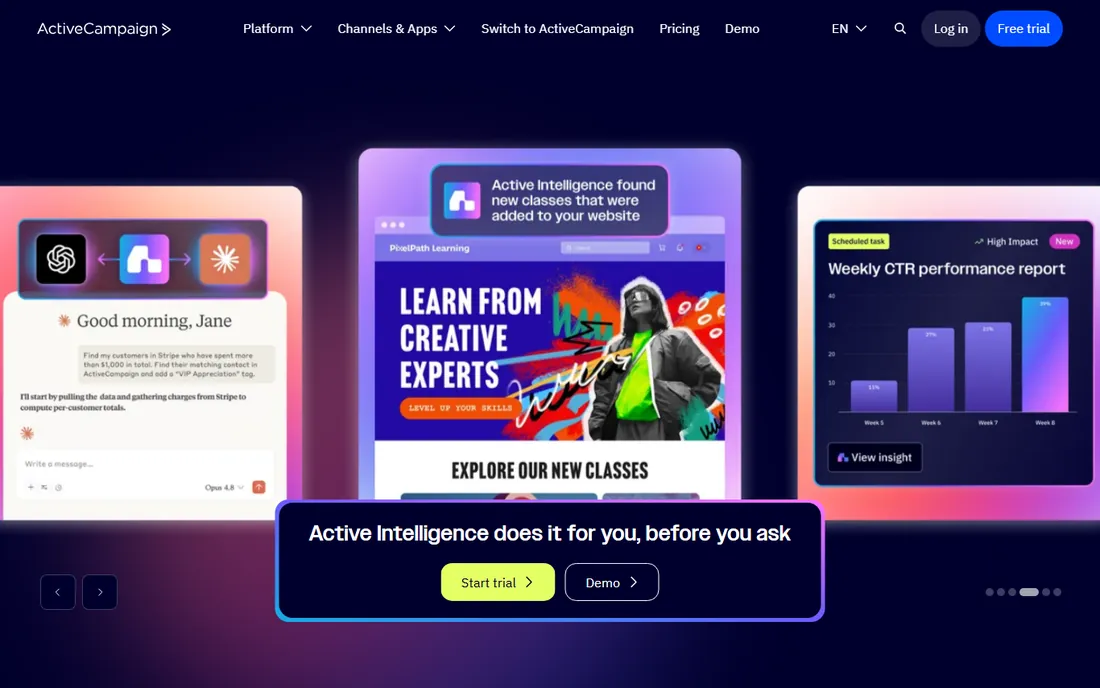
ActiveCampaign is the automation-first choice for teams that outgrow simple newsletter tools. Its visual builder lets you design multi-step drip campaigns triggered by page visits, purchases, tag changes, or custom events, with conditional splits that route each subscriber down a different path. The platform also bundles a built-in CRM, lead scoring, and predictive sending, so sales and marketing can work from the same contact record.
The honest catch is complexity and price. There is no fixed entry price on the pricing page because cost depends on your contact count and plan tier, so you will need to go through the quote flow to know what you will pay. The Starter plan limits you to 5 actions per automation, which pushes serious users toward Plus or Pro. ActiveCampaign fits businesses that treat email as a core revenue channel and have someone willing to learn the platform. If you just want a welcome series and a monthly newsletter, it is more tool than you need.
What we like- Visual automation builder with 950+ ready-made recipes
- Deep segmentation and conditional content
- 1,000+ integrations
Watch out for- Pricing requires a custom quote based on contact count
- Learning curve is steep for beginners
Starting priceSee website
Free planYes (250 contacts)
Mailchimp is the best-known email platform on this list, and for many small businesses it is the first tool they ever try. The interface is friendly, the template library is large, and setting up a welcome series or abandoned cart flow takes minutes rather than hours. Because Mailchimp has grown into a full marketing platform under Intuit, you also get landing pages, signup forms, social posting, and SMS as add-ons in the same account.
The free plan covers up to 250 contacts with basic sending, which is enough to start but small enough that growing businesses hit the paid tiers fast. Mailchimp's pricing scales with contact count, and the bill can surprise you once your list passes a few thousand subscribers. Automation depth also lags the specialists: Essentials allows only short flows, while the fuller automation features sit on Standard and Premium. Mailchimp is a fine choice for general small business marketing, but heavy automation users will find more power elsewhere.
What we like- Easy drag-and-drop builder with 300+ templates
- Marketing automation flows included on paid plans
- 300+ integrations including Shopify and WooCommerce
Watch out for- Costs rise quickly as your list grows
- Automation features are gated behind higher tiers
Starting priceSee website
Free planYes (up to 10,000 subscribers)
Kit, formerly ConvertKit, is built for creators who make a living from their audience. The platform centers on visual automations that welcome new subscribers, deliver lead magnets, run launch sequences, and sell digital products, all without touching code. You can also sell digital products, paid newsletters, and subscriptions directly through Kit, which keeps your email list and your revenue in one place.
The free plan is the most generous here: up to 10,000 subscribers with broadcasts, landing pages, and forms, though automations and sequences require a paid plan. Paid pricing is based on active subscriber count with unlimited sends, and annual billing includes two months free. The tradeoff is focus: Kit is designed for bloggers, podcasters, authors, and course creators, not for B2B teams that need CRM pipelines or sales automation. If your business is your audience, Kit is the natural home for your drip campaigns.
What we like- Generous free plan for up to 10,000 subscribers
- Visual automations built for creator workflows
- Sell digital products and paid newsletters in-platform
Watch out for- Paid pricing is subscriber-based and climbs with list size
- Less suited to traditional B2B companies
Starting priceSee website
Free planFree trial (14 days)
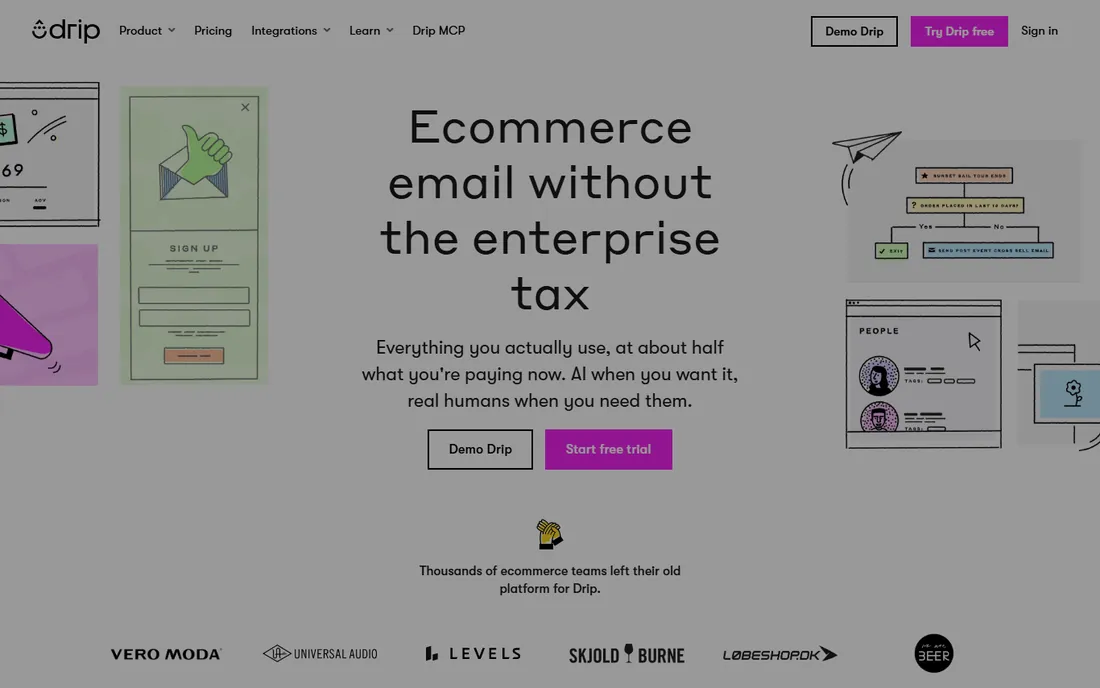
Drip was built for one job: turning online stores into repeat buyers through email. Its workflow library ships with ready-made automations for abandoned carts, browse abandonment, post-purchase follow-ups, and win-back campaigns, each wired to real store data like products viewed and orders placed. Segmentation updates dynamically as customers shop, so your campaigns stay relevant without manual list management.
Drip offers a 14-day free trial with no credit card required and nearly full feature access, but there is no free-forever tier. Pricing is based on active contacts and monthly email volume, which you configure on the pricing page. All paying customers get email support, and plans at $99 per month and above add live chat. Drip is a strong pick for Shopify and WooCommerce stores that want ecommerce automation without enterprise complexity, though non-ecommerce businesses will find it less of a fit.
What we like- Prebuilt ecommerce workflows for carts, win-backs, and post-purchase
- Deep Shopify and WooCommerce integrations
- 14-day trial needs no credit card
Watch out for- No permanent free plan
- Pricing scales with list size and send volume
Starting priceSee website
Free planYes (250 profiles)
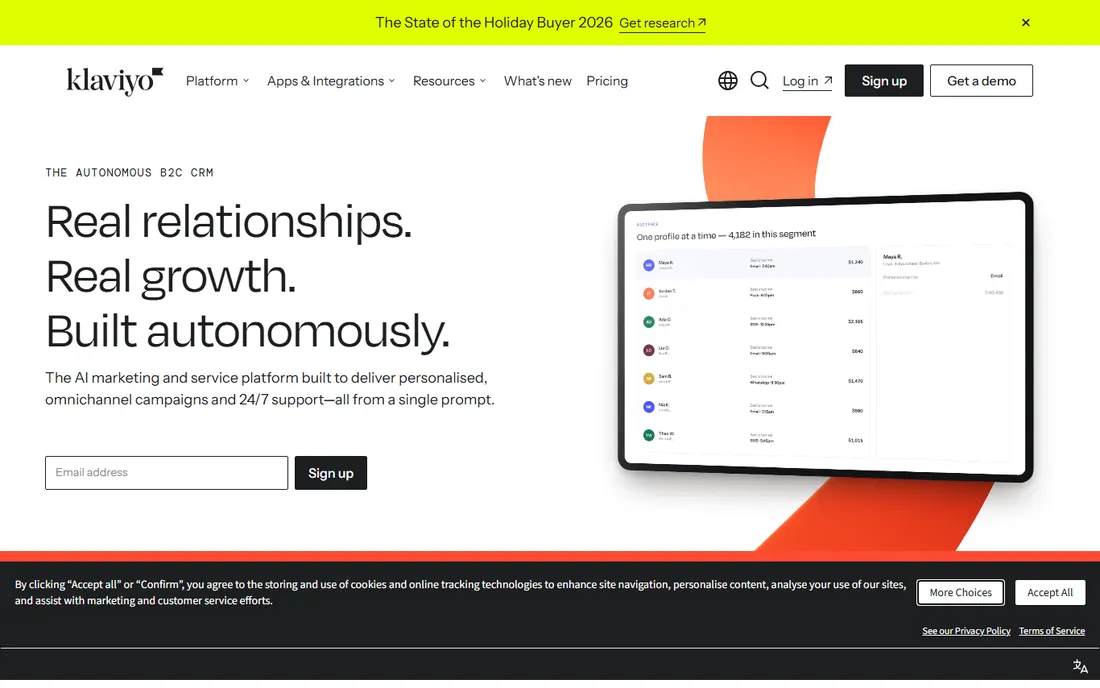
Klaviyo is the default email and SMS platform for Shopify stores, and its reputation there is earned. The integration syncs products, orders, and browsing behavior in real time, powering flows for abandoned carts, price drops, back-in-stock alerts, and post-purchase cross-sells. Email and SMS live in the same automation, so a cart reminder can go out by email first and follow up by text, all from one customer profile.
The free plan covers up to 250 profiles with 500 emails per month, enough to test the platform on a new store. Paid pricing scales with active profiles and message volume, and costs climb noticeably once your list grows into the tens of thousands, which is the most common complaint in user reviews. Klaviyo suits ecommerce brands that treat email and SMS as their highest-ROI channels. If you run a content site or B2B business, the ecommerce focus means you will pay for data plumbing you never use.
What we like- Best-in-class Shopify integration with real-time data
- Email and SMS in unified flows
- Predictive analytics for churn and lifetime value
Watch out for- Pricing scales steeply with contact count
- Can be overkill for simple newsletters
Starting price$15.58/month (billed annually)
Free planYes (free account)
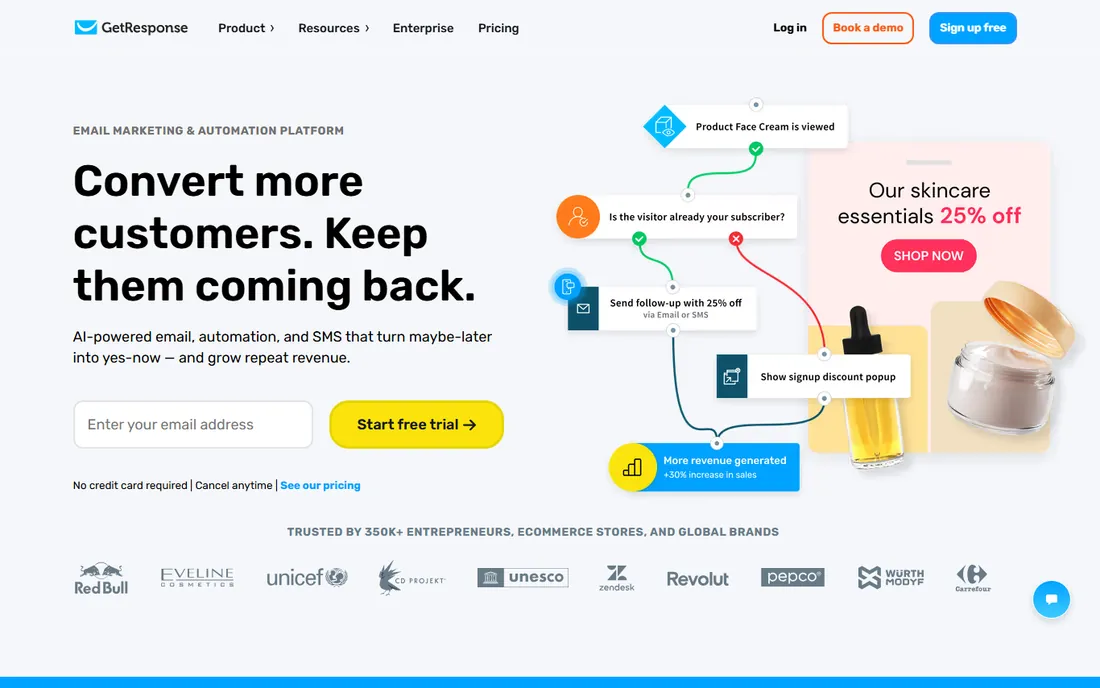
GetResponse has been around since 1998 and has grown into a full marketing suite that still starts under $20 a month. The Starter plan is $19 per month, or $15.58 per month billed annually, with unlimited monthly email sends, a landing page builder, signup forms, and one automation workflow. Higher tiers add unlimited workflows, advanced segmentation, abandoned cart recovery, sales funnels, and webinars, which few competitors bundle at these prices.
New accounts start with a free plan that includes a 14-day trial of premium features, so you can test the automation builder before paying. The tradeoff is depth: the workflow builder handles standard drip sequences well but lacks the conditional logic and CRM integration of the pricier specialists. GetResponse fits small businesses and course creators that want email, landing pages, and webinars in one affordable subscription rather than best-in-class automation.
What we like- Cheapest verified entry price on this list
- Built-in webinars, funnels, and landing pages
- Free account with 14-day trial of premium features
Watch out for- Automation builder is less flexible than ActiveCampaign or Klaviyo
- Interface shows its age in places
Starting price$12.49/month (billed annually)
Free planYes (500 subscribers)
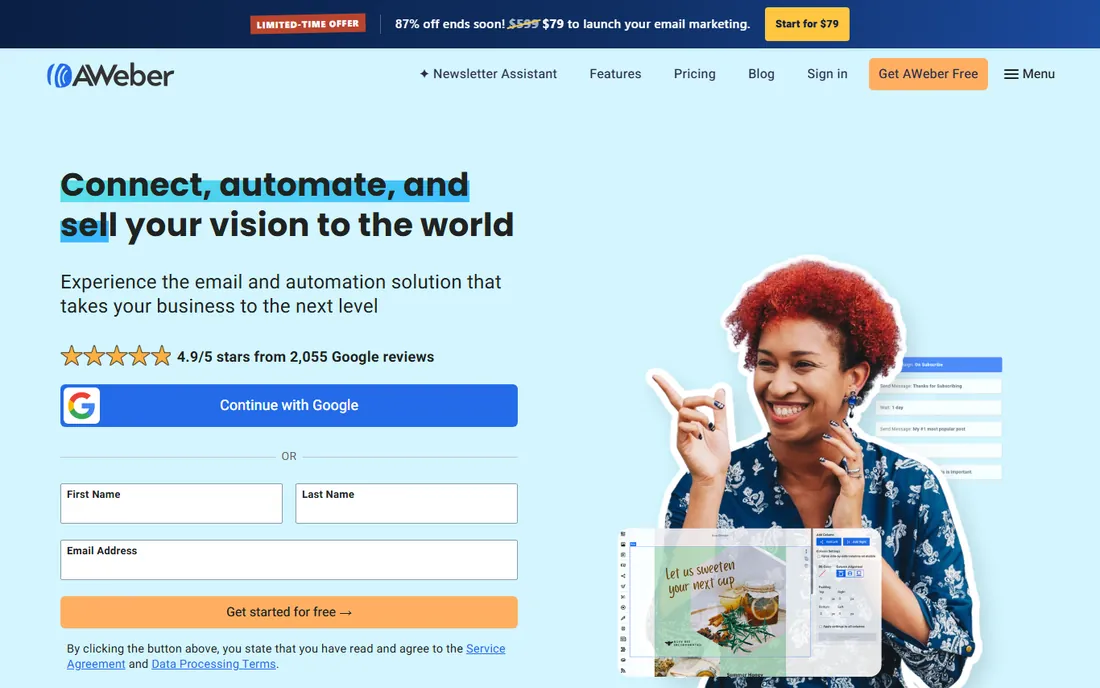
AWeber keeps things simple on purpose, which is exactly what first-time email marketers need. The platform offers ready-made automation campaigns you can customize and activate, covering welcome series, abandoned carts, and re-engagement without building from scratch. The drag-and-drop builder, landing pages, signup forms, and web push notifications cover the essentials, and support is available around the clock by phone, chat, and email.
Pricing is transparent: the free plan covers up to 500 subscribers and 3,000 emails per month with no time limit, the Lite plan is $12.49 per month billed annually, and Plus is $19.99 per month billed annually. AWeber integrates with more than 750 tools including Shopify, WordPress, and PayPal. The limitation is ambition: if you later need complex branching logic or a built-in CRM, you will outgrow it. For a small business sending its first drip campaigns, though, AWeber's simplicity is a feature, not a flaw.
What we like- Simple setup with prebuilt automations
- Free plan covers 500 subscribers and 3,000 emails monthly
- 24/7 phone, chat, and email support
Watch out for- Automation features are basic compared to ActiveCampaign
- Template designs feel dated
Starting priceSee website
Free planYes (free plan)
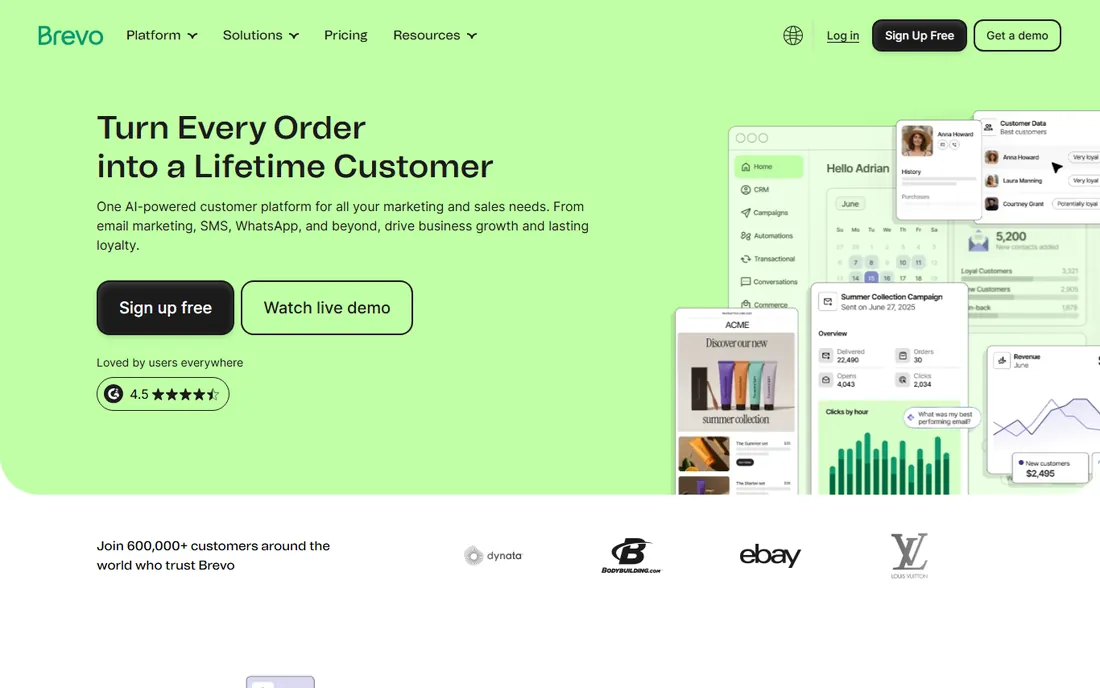
Brevo, formerly Sendinblue, stands out with a pricing model that charges for emails sent rather than contacts stored. That makes it unusually cheap for businesses with large lists that email infrequently, a combination every other tool on this list punishes. The platform bundles email campaigns, SMS, WhatsApp, live chat, and a sales CRM, so it can replace several subscriptions at once.
The free plan requires no credit card and covers core email features with a daily sending limit. Paid plans start with a monthly email volume allowance and add marketing automation, A/B testing, landing pages, and multi-user access as you move up. The catch is comparability: because pricing is send-based, you need to estimate your monthly volume to know your real cost. Brevo fits budget-conscious teams with big lists, infrequent sends, or a need for SMS and chat alongside email.
What we like- Pricing based on emails sent, not contacts stored
- Free plan with no credit card required
- Email, SMS, WhatsApp, and CRM in one platform
Watch out for- Entry pricing is volume-based and harder to compare
- Advanced automation sits on higher tiers
What to check before you buy drip software
Start with the automation builder, because that is where you will spend your time. Look for visual workflow editors, prebuilt templates for welcome series and abandoned carts, and triggers based on behavior like page visits and purchases rather than just list joins. Test whether you can add conditional branches and wait steps easily, since real drip campaigns need both.
Next, understand the pricing model, because it varies more here than in most software categories. Most tools charge by contact or subscriber count, which means your bill grows every time your list grows. Brevo charges by emails sent instead, which favors large quiet lists. Kit charges by active subscribers with unlimited sends, which favors frequent senders. Model your cost at your current list size and at double that size before you commit.
Finally, check deliverability support and integrations. Every vendor claims high delivery rates, so look for concrete features: SPF and DKIM setup help, dedicated IPs on higher plans, and spam testing tools. Confirm a native integration with your store or CRM, whether that is Shopify, WooCommerce, WordPress, or Salesforce, because a drip campaign is only as good as the data triggering it.
How we chose
We focused on platforms with real drip and automation features, not just newsletter senders, and verified each one is live and independently maintained. Pricing comes from the vendors' own pricing pages, checked in October 2026; where a vendor's pricing page required a custom quote or did not display numbers, we wrote "See website" rather than guessing. Feature details come from official documentation and homepages. We also weighed public reviews on G2 and Capterra and practitioner discussions on Reddit to see how these tools perform for small and mid-size businesses. We did not test the tools hands-on; this comparison rests on documented features, current pricing, and the consensus of working marketers.
Four drip sequences to build first
Whatever tool you choose, start with the same four automations. A welcome series introduces new subscribers to your business over three to five emails and typically earns the highest engagement of any campaign you will ever send. An abandoned cart or browse abandonment flow recovers revenue you are already losing, and it is the fastest way to prove the value of your new platform.
Add a post-purchase sequence that thanks buyers, suggests complementary products, and asks for a review at the right moment. Finally, build a re-engagement campaign that identifies subscribers who have gone quiet and either wins them back or removes them, because a smaller engaged list outperforms a large cold one on every metric that matters. Get these four running before you build anything fancier.
Frequently asked questions
What is email drip campaign software?
Email drip campaign software sends a series of automated emails based on triggers and timing rather than manual sends. A new subscriber might get a welcome email on day one, a product guide on day three, and a discount on day seven, all without anyone pressing send. The "drip" name comes from messages dripping out on a schedule or in response to behavior like cart abandonment.
Which drip campaign tool has the best free plan?
Kit offers the most generous free plan, covering up to 10,000 subscribers with broadcasts, landing pages, and forms. AWeber's free plan covers 500 subscribers and 3,000 emails per month with no time limit. Mailchimp, Klaviyo, and Brevo also offer free tiers, while ActiveCampaign and Drip provide 14-day free trials instead of permanent free plans.
Is Mailchimp good for drip campaigns?
Mailchimp handles basic drip campaigns well, with automation flows for welcome series, abandoned carts, and re-engagement. Its limits show on the lower tiers: the Essentials plan caps flows at a few steps, and deeper branching logic requires Standard or Premium. Businesses that need complex conditional automation usually graduate to ActiveCampaign, Klaviyo, or Drip.
How much does drip campaign software cost for a small business?
Entry prices run from about $12 to $20 per month for lists under 1,000 subscribers, with AWeber at $12.49 and GetResponse at $15.58 per month on annual billing. Costs rise with list size on every contact-based platform, so a 10,000-subscriber list can cost several times more. Brevo's send-based pricing is the exception and can be cheaper for large lists that email rarely.
Should a creator choose Kit or ActiveCampaign?
Creators who monetize an audience usually do better with Kit, which is built for newsletters, digital products, and launch sequences with a free plan up to 10,000 subscribers. ActiveCampaign suits creators who also run a services business and need CRM features, lead scoring, and complex segmentation. Most pure content creators find ActiveCampaign's power unnecessary for the price.
Can I switch email platforms without losing my subscribers?
Yes. Every tool on this list offers list importing, and most provide free migration services: Kit and AWeber both advertise free migrations handled by their teams. Export your contacts, tags, and suppression lists from your old platform first, set up authentication records like SPF and DKIM on the new one, and warm up your sending gradually to protect deliverability.
Sources we checked (16)
- https://activecampaign.com/
- https://www.activecampaign.com/pricing
- https://mailchimp.com/
- https://mailchimp.com/pricing/marketing/
- https://kit.com
- https://kit.com/pricing
- https://drip.com/
- https://www.drip.com/pricing
- https://www.klaviyo.com
- https://www.klaviyo.com/pricing
- https://www.getresponse.com
- https://www.getresponse.com/pricing
- https://www.aweber.com
- https://www.aweber.com/pricing.htm
- https://brevo.com/
- https://brevo.com/pricing/
Is your product missing or out of date?
We review this list regularly. Vendors can request a listing, send updated pricing or ask about featured placement.

Shihab Mia · Founder, Rankite
Shihab has spent more than a decade helping SaaS and e-commerce brands grow through search. He writes Rankite's software buying guides from pricing pages, documentation and public user reviews. More about Shihab.