How we make this list: we compare pricing pages, product documentation and public user reviews. Rankite is independent; if a vendor ever pays for a featured spot, that listing is clearly labeled Partner.
Key takeaways
- Quartzy remains the default for academic labs because the core software is free and ordering runs through the same system.
- SciNote and Benchling bundle inventory with an electronic lab notebook, which suits labs that want one system for experiments and stock.
- Labguru and Genemod fit growing biotech teams that need inventory, ELN, and LIMS in one governed platform.
- Labsistant is the budget pick for small labs leaving spreadsheets, with a real free tier and transparent per-lab pricing.
Quick comparison
| Tool | Best for | Starting price | Free plan |
|---|
 Quartzy Quartzy | Academic labs that order and track in one place | See website | Yes |
 SciNote SciNote | Labs that want a notebook and inventory in one system | See website | Yes |
 Labguru Labguru | R&D teams that need ELN, LIMS, and inventory together | See website | No |
 Benchling Benchling | Biotech companies with complex R&D data | See website | Yes (academic) |
 Genemod Genemod | Biotech startups that want to be running next week | See website | No |
 LabCollector LabCollector | Labs that want to buy only the modules they need | See website | No |
 SciSure SciSure | Labs that need ELN, LIMS, and lab safety in one system | See website | No |
 CloudLIMS CloudLIMS | Testing labs in regulated industries | See website | No |
 Freezerworks Freezerworks | Biobanks and labs centered on sample storage | See website | No |
 Labsistant Labsistant | Small academic and startup labs leaving spreadsheets | $49/month (Team, per lab) | Yes |
Is your product missing or out of date?
We review this list regularly. Vendors can request a listing, send updated pricing or ask about featured placement.
The best lab inventory management software
#1
Quartzy
Best for: Academic labs that order and track in one place
Visit quartzy.com
Starting priceSee website
Free planYes
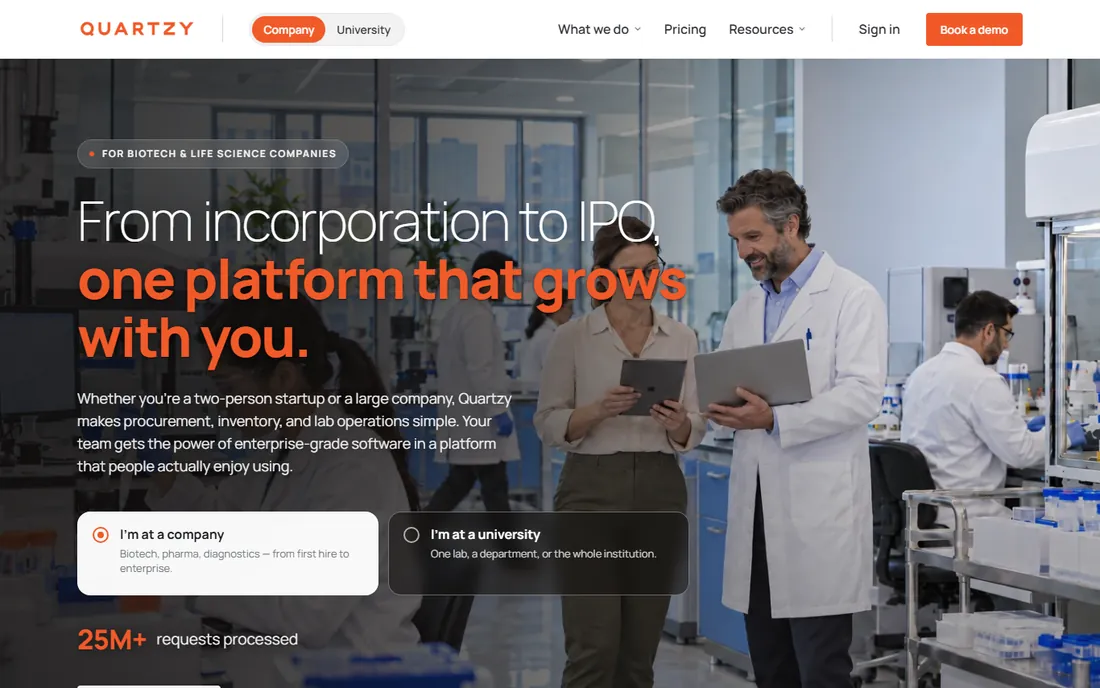
Quartzy is the name most academic labs already know, and the reason is simple: the software costs nothing for the lab. You track reagents, lots, and locations, route purchase requests through manager approvals, and order from a catalog of more than 20 million products across thousands of brands. Items land back in inventory with lot and expiration data when they arrive. That closed loop from request to receipt is what spreadsheets cannot do.
The platform has grown upmarket. Newer features cover spend visibility by team, project, and grant, approval rules by budget or dollar threshold, and integrations with accounting systems like QuickBooks Online and NetSuite. A managed purchasing add-on called BioPASS puts a dedicated buyer on your account. The honest trade-off: Quartzy earns its money when you buy supplies through them, so labs that source heavily outside the catalog get less of the magic. Finance teams in larger organizations may also outgrow the free tier and need the paid spend controls.
What we like- Core inventory and ordering software is free for labs
- 20M+ product catalog with approvals
- Barcode check-in and expiration alerts
Watch out for- Advanced spend controls and analytics sit in paid tiers
- Ordering works best through their supplier network
#2
SciNote
Best for: Labs that want a notebook and inventory in one system
Visit scinote.net
Starting priceSee website
Free planYes
SciNote starts from the electronic lab notebook and builds outward. Experiments are organized as projects, tasks, and protocols, and inventory items link directly to the experiments that use them. When a protocol consumes a reagent, the stock record reflects it. That connection between what you did and what you used is exactly what auditors and PIs ask for. The platform supports electronic signatures, audit trails, and access controls for FDA 21 CFR Part 11, which matters for GLP and GMP environments.
A free tier makes it easy to trial with a real team, and the company counts regulated organizations including the FDA and USDA among its users. Mobile apps for iOS and Android let bench scientists check off protocol steps and log usage at the bench. The weak points are familiar from reviews: the interface can feel dated next to newer entrants, and teams that need heavy customization sometimes hit walls.
What we like- ELN and inventory in one platform
- Free tier for small teams
- 21 CFR Part 11 compliance tools
Watch out for- Interface shows its age in places
- Advanced compliance features cost more
#3
Labguru
Best for: R&D teams that need ELN, LIMS, and inventory together
Visit labguru.com
Starting priceSee website
Free planNo
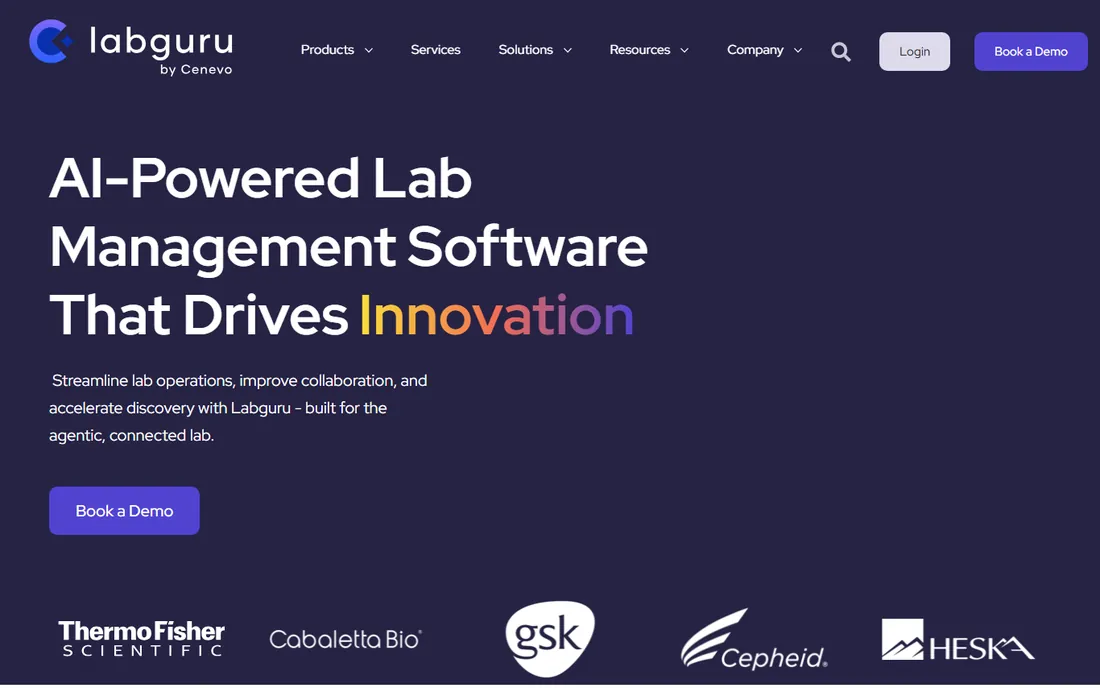
Labguru sells one system instead of three. The platform combines an electronic lab notebook, a LIMS for samples and workflows, and inventory management with barcode tracking, low-stock notifications, and storage location mapping. Automation is the differentiator: you can build step-by-step workflows with triggers and rules, and a scripting tool lets technical teams extend the system. Data lives in SOC-compliant AWS data centers, and the platform supports FDA 21 CFR Part 11 sign-off workflows.
The company reports over 800 customer companies. The catch is pricing opacity. There is no public price list, so budgeting requires a sales conversation, and small labs may find the quote lands above their budget. Teams should also plan training time for the automation features, which are powerful but not self-explanatory.
What we like- Unified ELN, LIMS, and inventory
- Strong automation and workflows
- Responsive support from PhD scientists
Watch out for- Quote-based pricing with no public plans
- Learning curve on advanced features
Starting priceSee website
Free planYes (academic)
Benchling is the platform serious biotech R&D teams graduate to. It models biomolecules, small molecules, cell lines, animals, and reagents in a unified data structure, then connects that data to experiments, workflows, and analytics. The inventory side tracks samples and reagents with the same rigor as the science, and an open platform with APIs and custom apps connects instruments and third-party software. AI features now help draft experiments and analyze results.
The academic free tier is genuinely useful and has seeded Benchling into university labs worldwide, which means many new hires already know it. Enterprise customers include large pharma names. The downside is that Benchling is priced like enterprise software and sold like it: expect a quote process, implementation services, and annual contracts. A five-person academic lab that just needs to track antibodies will find it heavy. For biotech companies where data integrity and scale matter, few alternatives match it.
What we like- Free tier for academic labs
- Strong data modeling for biologics and small molecules
- Broad integrations
Watch out for- Enterprise pricing is opaque and high
- Overkill for simple reagent tracking
#5
Genemod
Best for: Biotech startups that want to be running next week
Visit genemod.net
Starting priceSee website
Free planNo
Genemod pitches speed. The company claims labs can be running the platform within a week, and the visual-first design shows freezers, racks, and boxes the way the lab physically looks. ELN, LIMS, inventory, and equipment share one data model, so a sample record connects to the experiment that created it and the freezer slot that holds it. Recent releases add AI agents that plan multi-step bench work across notebook, inventory, and orders, with every action logged and saved only after human sign-off.
Compliance coverage includes SOC 2 Type II, HIPAA readiness, and 21 CFR Part 11. For a startup that needs audit-ready records without hiring an informatics team, that combination is attractive. The honest caveats: Genemod is newer and smaller than Benchling or Labguru, so reference checks matter. Pricing is not published.
What we like- Fast onboarding with visual freezer mapping
- ELN, LIMS, and inventory in one data model
- Built-in AI agents
Watch out for- Younger company with a smaller customer base
- Pricing not published
Starting priceSee website
Free planNo
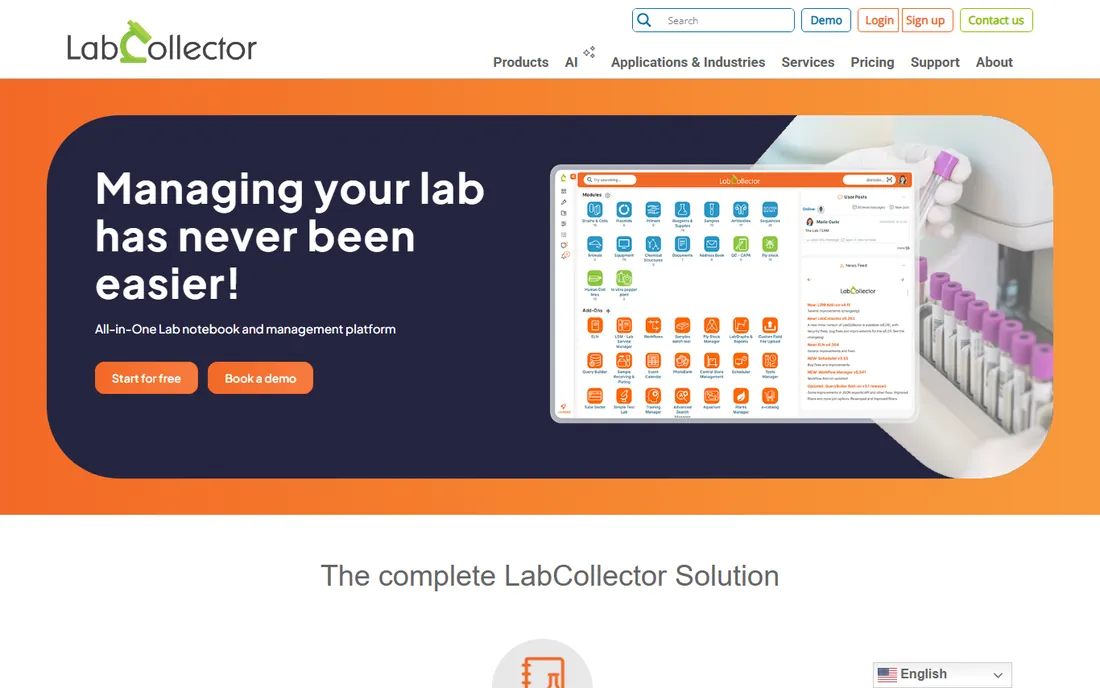
LabCollector takes the opposite approach from the all-in-one platforms: a core LIMS with independent modules you add as needed. The ELN add-on handles experiments, the equipment scheduler manages bookings, a workflow manager designs lab processes graphically, and a data logger connects sensors for temperature and humidity monitoring. Chemistry labs get structure search, which many general LIMS tools lack. Every plan includes a year of dedicated support and upgrades.
The modular model suits labs with unusual needs. A biobank can add sample management and quality modules without paying for features a chemistry lab would use. Custom fields on every module let you shape the database to your workflows. The trade-off is cost and cohesion. Modules are priced separately, so a fully loaded system can exceed the price of a bundled competitor, and the interface feels functional rather than polished. For labs that know exactly which pieces they need, though, the pick-and-choose model is hard to beat.
What we like- Modular add-ons for ELN, equipment, workflows, and more
- Strong chemistry support
- One year of support included
Watch out for- Module pricing adds up
- Interface less modern than newer rivals
#7
SciSure
Best for: Labs that need ELN, LIMS, and lab safety in one system
Visit scisure.com
Starting priceSee website
Free planNo
SciSure is the current name for the company formerly known as eLabNext, which also absorbed SciShield. The platform now covers four areas: an electronic lab notebook, a LIMS for samples and inventory, health and safety (EHS) for chemical inventories and inspections, and integrations. That safety module is the differentiator. Labs can manage chemical inventories, safety workflows, and compliance documentation in the same system that holds their experiments, with audit-ready traceable records.
Compliance is the selling point: ISO 27001 certification, GDPR, FDA 21 CFR Part 11, GxP, and HIPAA support. The company reports 55,000-plus laboratories on the platform. The rename means older reviews and forum threads reference eLabNext, so search both names when doing diligence. Pricing is quote-based. For labs where EHS compliance is a real burden, having it unified with research data is worth the enterprise sales process.
What we like- Combines ELN, LIMS, and EHS
- Strong compliance certifications
- Used by 550,000+ scientists
Watch out for- Rebrand from eLabNext may confuse
- Pricing not published
Starting priceSee website
Free planNo
CloudLIMS is a web-based SaaS LIMS aimed squarely at testing laboratories: cannabis, clinical diagnostics, environmental, food and beverage, water, and similar regulated verticals. The pitch is a single subscription with no extra charges, covering workflow configuration, instrument integration, report templates, legacy data migration, and unlimited technical support as complimentary services. A built-in quality management system and patient and client portals round out the package.
For a testing lab, the value is compliance without consultants. The platform supports the standards each vertical needs, and AI features flag QC anomalies and forecast sample volumes and reagent demand. The honest limit is scope: this is not a research ELN, and discovery labs will find it rigid. Pricing is quote-based despite the zero-upfront-cost framing, so budget for the subscription conversation. If you run a testing lab and dread audit season, it fits.
What we like- Zero upfront cost model
- Built-in QMS
- Strong regulatory compliance support
Watch out for- Aimed at testing labs, less suited to research
- No public pricing
Starting priceSee website
Free planNo
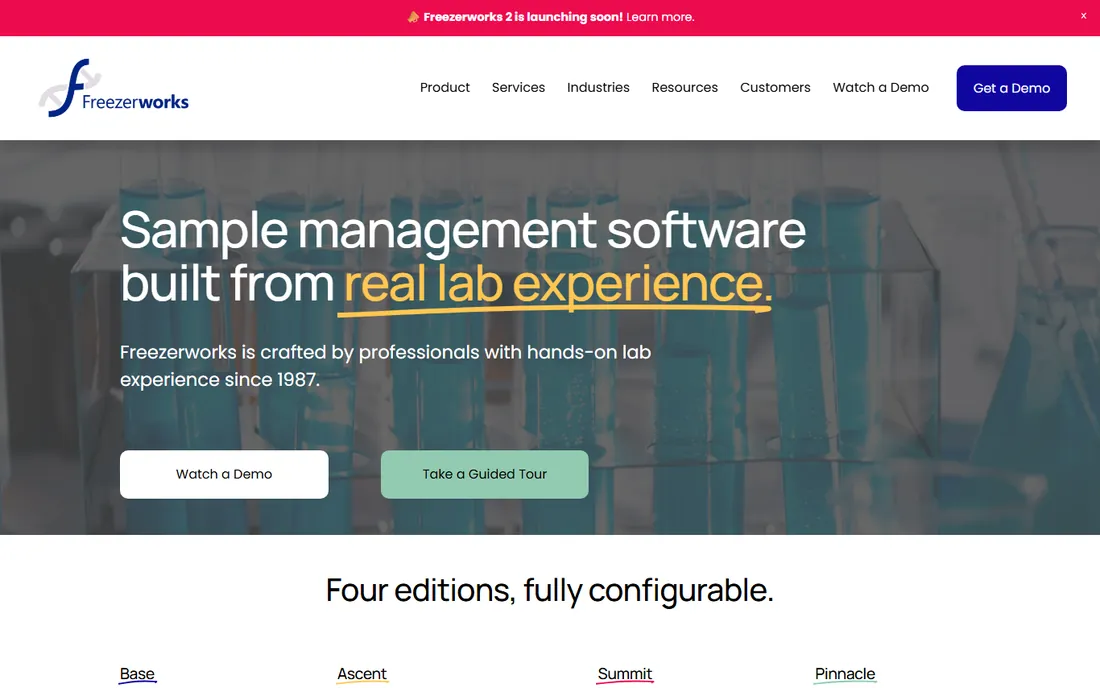
Freezerworks has been doing sample management since 1987, and it shows. The software is built around the realities of freezers, accessioning, aliquots, and chain of custody. Four editions scale from individual teams (Base) to multi-group organizations (Ascent), multi-tenancy biobanks (Summit), and full study management (Pinnacle). The data model is highly configurable, which matters when your accession procedures change mid-study.
The company emphasizes Good Practice standards including 21 CFR Part 11, and IT departments like that it is easy to maintain. The trade-off is focus. Freezerworks is a sample management system first, not a general lab operations platform: ordering, experiments, and equipment are not its strengths. Pricing is quote-based. For biobanks, biorepositories, and clinical labs where samples are the business, its depth beats the generalists. For a research lab that needs ordering and notebooks too, pair it with something else or look elsewhere.
What we like- Deep sample management from decades of lab experience
- Four editions for different scales
- Highly configurable
Watch out for- Sample-first design, weaker on general lab operations
- Quote-based pricing
Starting price$49/month (Team, per lab)
Free planYes
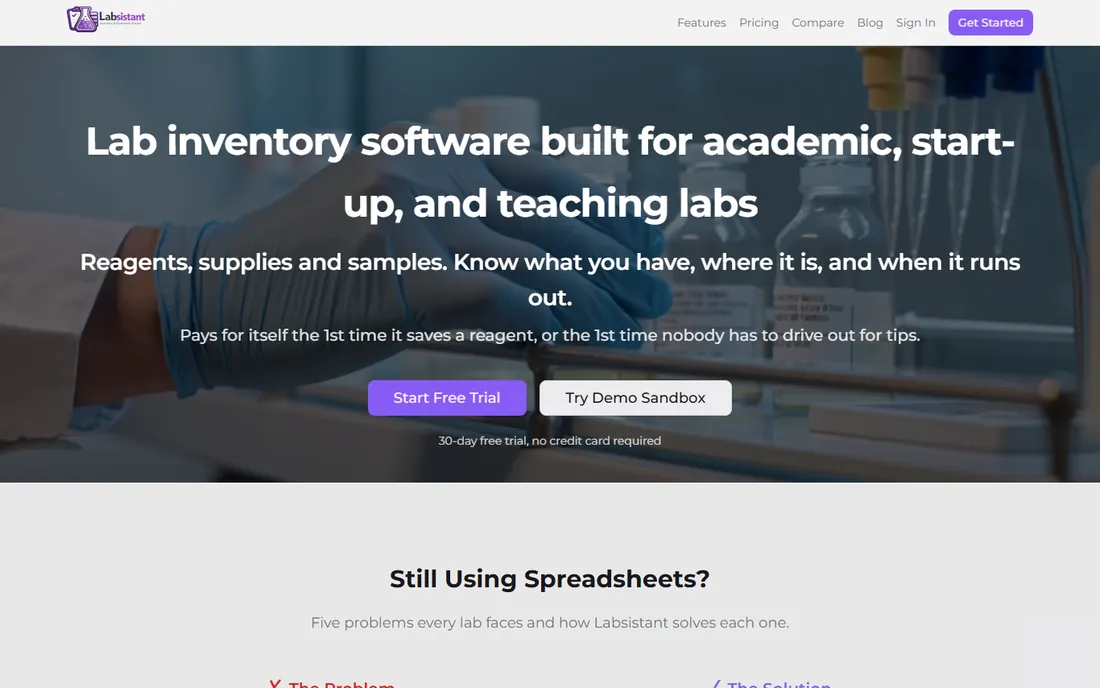
Labsistant is built for the labs the big platforms ignore: academic groups, startups, and teaching labs that still track inventory in spreadsheets. The free tier covers two users, 50 items, and five storage locations with stock and expiration alerts, which is enough to run a small lab. The $49-a-month Team plan, priced per lab rather than per seat for up to 10 users, adds unlimited items and locations, an AI assistant called Edna that answers questions and drafts reports, and usage analytics. The $149 Lab plan adds sample lineage and thaw history.
Setup is the selling point: import your existing spreadsheet, and the system maps columns, works out freezers and shelves, and shows you everything it understood before creating anything. Every plan includes a 30-day free trial with no credit card. The honest limits: it is a newer product with fewer third-party integrations than the established players, and labs with heavy compliance needs should verify the audit trail depth. For a small lab that wants to stop losing reagents to expired stock, the free tier alone is worth the afternoon it takes to set up.
What we like- Genuinely useful free tier
- Transparent per-lab pricing
- AI assistant for questions and reports
Watch out for- Newer product with fewer integrations
- Samples need the $149 Lab plan
What to look for before you buy
Start with the inventory model. Reagent tracking means lots and expirations. Sample tracking means lineage, aliquots, and freezer positions down to the box slot. Equipment tracking means bookings and maintenance. Most labs need at least two of the three, so check that the platform models your actual objects, not just generic items.
Then check compliance. If you work under GLP, GMP, or clinical regulations, you need audit trails, electronic signatures, and 21 CFR Part 11 support. Quartzy and Labsistant handle the basics; SciNote, Labguru, Genemod, SciSure, CloudLIMS, and Freezerworks go deeper. Ask the vendor which of their customers passed audits with the system, not just whether the feature list mentions compliance.
Barcode support matters more than demos suggest. Ask whether the system prints labels, scans with a phone camera, and handles check-in and check-out at the bench. A platform with great dashboards and painful labeling will not get used.
Pricing models vary wildly. Labsistant charges per lab, most others charge per user or quote annually. Get the per-user price in writing, ask about implementation fees, and confirm what happens to your data if you leave. Export to CSV or Excel should be standard, not a favor.
Finally, run a real pilot. Import a slice of your actual inventory, let two bench scientists use it for two weeks, and watch what breaks. The platform that survives contact with your messiest freezer is the one to buy.
Getting off spreadsheets without losing data
The spreadsheet is the real competitor for most of these tools. Labsistant and Quartzy both offer import paths that map your columns before creating records, which removes the biggest migration fear. SciNote and Labguru offer onboarding help, and LabCollector's support year covers the transition.
Clean the data before you import. Deduplicate item names, standardize units, and decide your location hierarchy: room, freezer, rack, box, slot. Most failed implementations trace back to messy imports, not bad software. Assign one person to own the migration and give them the authority to enforce naming conventions.
Expect a transition period, not a cutover day. Run the new system alongside the spreadsheet for two to four weeks, reconcile weekly, and retire the spreadsheet only when the team trusts the new counts.
How we chose
We started from the tools labs actually discuss on G2, Capterra, and Reddit, then verified each product on its own site in October 2026. Prices come from published vendor pricing pages; where vendors do not publish prices, we say so. We favored tools with real inventory depth over general ELN or LIMS products that treat stock as an afterthought, and we mixed established platforms with newer entrants. We did not run a lab on any of these systems or test paid plans hands-on.
Frequently asked questions
Do I need a LIMS or just inventory software?
If you only track reagents and supplies, inventory software like Quartzy or Labsistant is enough. If you track samples through experiments, need chain of custody, or work under regulated conditions, you need LIMS features. Tools like Labguru, SciSure, and CloudLIMS bundle both so you do not have to decide upfront.
Is lab inventory software 21 CFR Part 11 compliant?
Many of these tools support it, including SciNote, Labguru, Genemod, SciSure, CloudLIMS, and Freezerworks, through audit trails, electronic signatures, and access controls. Compliance depends on how you configure and validate the system, so ask the vendor for validation documentation and customer references in your industry.
How long does implementation take?
Simple inventory tools can be running in days: Labsistant and Quartzy are designed for self-service setup. Platforms with ELN and LIMS, like Labguru and SciSure, typically take weeks with vendor onboarding. Enterprise deployments of Benchling or CloudLIMS with instrument integrations can take months.
Can I import my existing spreadsheet?
Yes. Labsistant, Quartzy, SciNote, and LabCollector all offer import tools or assisted onboarding. Clean your data first: deduplicate names, standardize units, and define your storage hierarchy before importing.
Is there really a free option?
Yes. Quartzy's core software is free for labs, SciNote and Benchling offer free tiers, and Labsistant has a free plan for up to two users. Free tiers usually limit users, items, or advanced features, so check the limits against your lab's size before committing.
Sources we checked (12)
- https://www.quartzy.com/
- https://scinote.net/
- https://labguru.com/
- https://www.benchling.com/
- https://genemod.net/
- https://www.labcollector.com/
- https://www.scisure.com/
- https://cloudlims.com/
- https://freezerworks.com/
- https://www.labsistant.com/
- https://www.procuredesk.com/quartzy-alternatives/
- https://www.g2.com/categories/lab-inventory-management/free
Is your product missing or out of date?
We review this list regularly. Vendors can request a listing, send updated pricing or ask about featured placement.

Shihab Mia · Founder, Rankite
Shihab has spent more than a decade helping SaaS and e-commerce brands grow through search. He writes Rankite's software buying guides from pricing pages, documentation and public user reviews. More about Shihab.