How we make this list: we compare pricing pages, product documentation and public user reviews. Rankite is independent; if a vendor ever pays for a featured spot, that listing is clearly labeled Partner.
Key takeaways
- Fivetran remains the safest default for managed ELT with 700+ connectors, but its Monthly Active Row pricing punishes high-churn data.
- Matillion and Azure Data Factory are the natural picks inside the Snowflake and Azure ecosystems respectively.
- Stitch and Hevo Data are the value plays for straightforward replication, at $100 and $239 per month to start.
- Informatica, Talend, SnapLogic and Boomi serve enterprises that need governance, complex transformations or hybrid deployments.
- AWS Glue fits teams already committed to Amazon's cloud who prefer serverless, pay-per-use ETL over another subscription.
Quick comparison
| Tool | Best for | Starting price | Free plan |
|---|
 Fivetran Fivetran | Managed ELT with 700+ connectors | Free tier; usage-based from ~$500/month (Standard) | Yes (500,000 MAR/month) |
 Matillion Matillion | ELT inside cloud data warehouses | Usage-based (credits) | Free trial |
 Informatica Informatica | Enterprise data governance and integration | See website | No |
 Talend Talend | Hybrid integration, now part of Qlik | See website | Free trial |
 Stitch Stitch | Simple, affordable ELT replication | $100 per month (Standard) | Free trial (14 days) |
 Hevo Data Hevo Data | Value ELT with near real-time sync | $239 per month (Starter, billed annually) | Yes (1M events/month) |
 SnapLogic SnapLogic | Visual pipelines for mixed teams | See website | Free trial |
 Boomi Boomi | Application and data integration together | See website | Free trial |
 Azure Data Factory Azure Data Factory | ETL inside the Microsoft ecosystem | Pay as you go | Free trial |
 AWS Glue AWS Glue | Serverless ETL on Amazon's cloud | Pay as you go | Free trial |
Is your product missing or out of date?
We review this list regularly. Vendors can request a listing, send updated pricing or ask about featured placement.
Starting priceFree tier; usage-based from ~$500/month (Standard)
Free planYes (500,000 MAR/month)
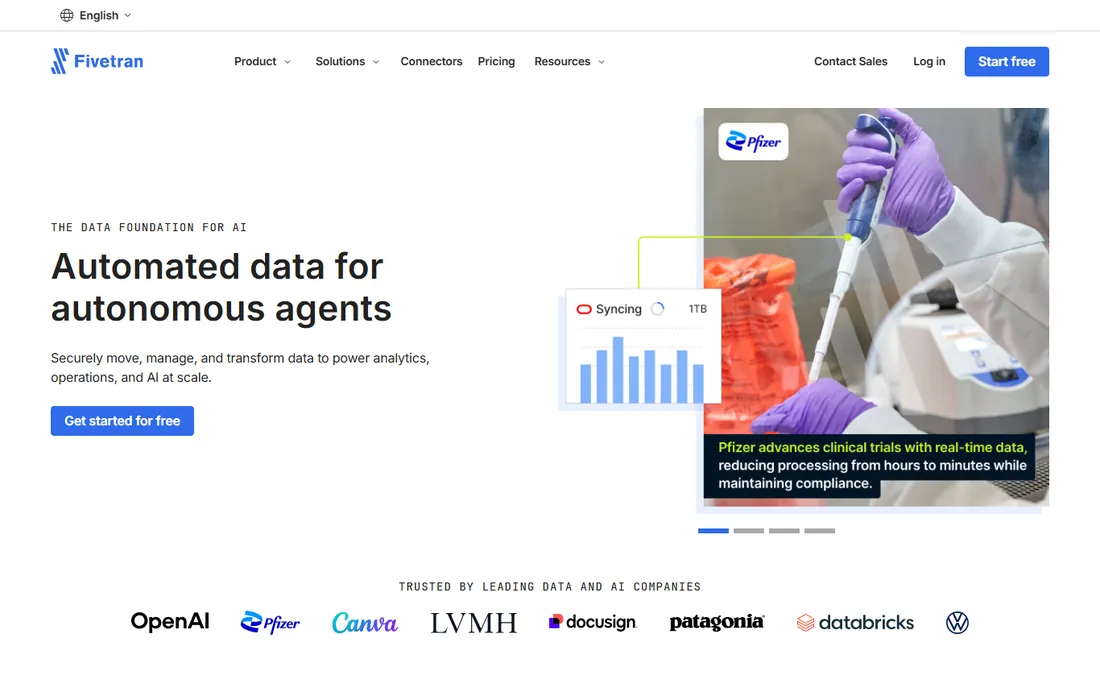
Fivetran is the default answer when a data team wants pipelines that just run. You connect a source, pick a destination, and Fivetran handles extraction, schema drift and incremental syncs without ongoing care. The connector library is the deepest in the managed category, covering SaaS apps, databases and event streams, and the free tier's 500,000 Monthly Active Rows are enough to pilot several sources.
The honest catch is the pricing model. You pay per Monthly Active Row per connection, deletes now count toward the total, and costs climb steeply once marketing or product data with high churn enters the picture. Teams regularly find Fivetran 3 to 5 times more expensive than alternatives at 10M+ rows a month. Fivetran fits teams that value zero-maintenance pipelines and can keep row volumes under control.
What we like- 700+ fully managed connectors with automatic schema handling
- Free tier covers pilots
- Reliable syncs with minimal maintenance
Watch out for- Monthly Active Row pricing escalates fast with volume
- Per-connection billing replaced account-level tiers
- 1-minute syncs need Enterprise
Starting priceUsage-based (credits)
Free planFree trial
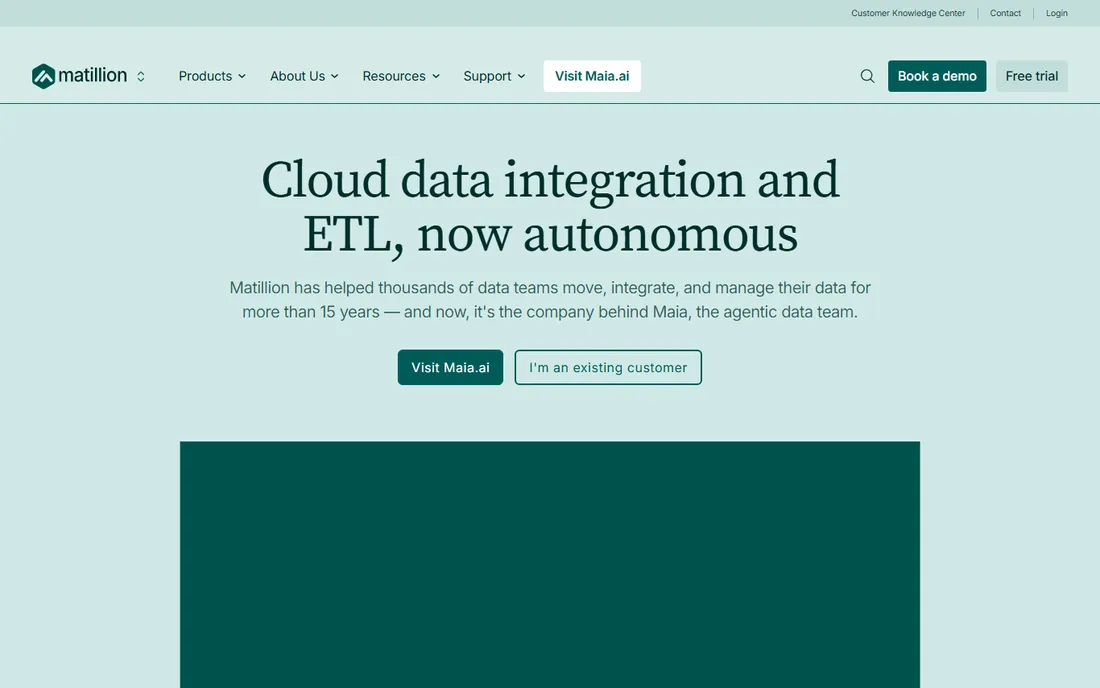
Matillion was born inside the cloud data warehouse, and it still thinks that way. Instead of moving data through its own engine, it pushes transformation work down into Snowflake, BigQuery, Redshift or Databricks, which keeps large jobs fast and warehouse-native. The visual designer suits data engineers who want real transformation logic, not just replication.
The trade-off is scope and pricing clarity. Matillion is weaker than Fivetran on long-tail SaaS connectors, and its credit-based pricing takes modeling to forecast. It shines brightest for teams already standardized on one cloud warehouse. Matillion fits data teams that need serious in-warehouse transformation alongside ingestion.
What we like- Push-down ELT that uses the warehouse's own compute
- Strong transformation designer
- Flexible pay-as-you-go via cloud marketplaces
Watch out for- Tied to specific cloud warehouses
- Credit pricing is hard to forecast
- Less of a pure SaaS-connector play than Fivetran
Starting priceSee website
Free planNo
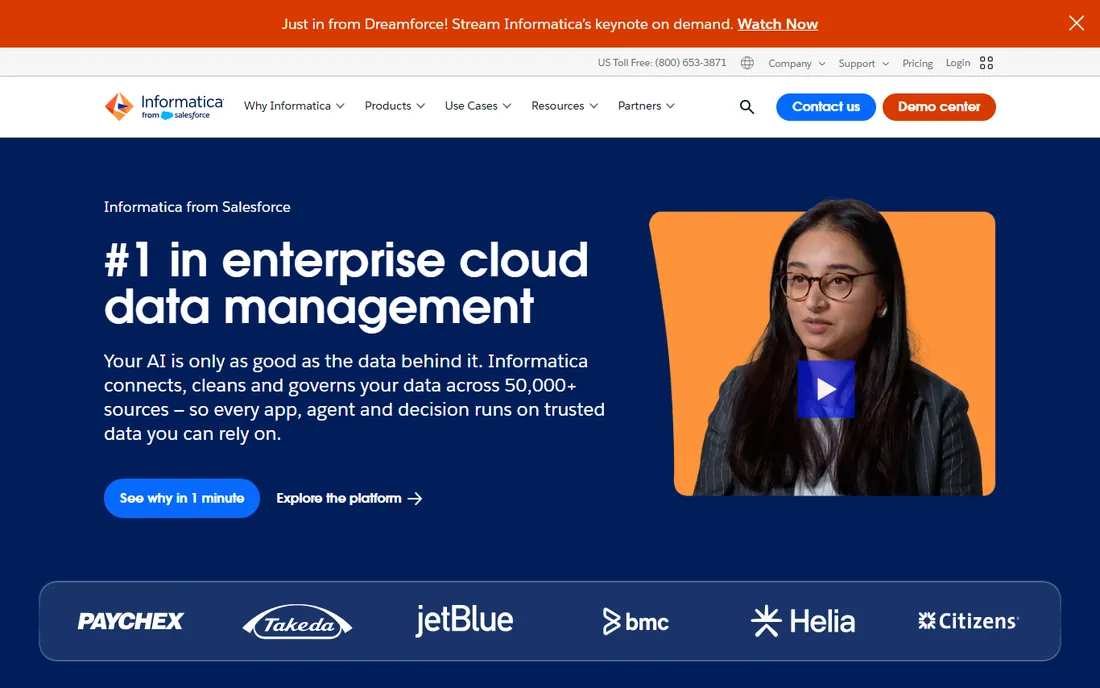
Informatica has been doing data integration since before the category had a name. The Intelligent Data Management Cloud combines ETL/ELT with data quality, cataloging, lineage and governance, which is why banks, insurers and healthcare companies standardize on it. When auditors ask where a number came from, Informatica has the answer.
The catch is weight. This is enterprise software with enterprise sales cycles, quoted pricing and implementations that need experienced partners. For straightforward SaaS-to-warehouse replication it is far more than necessary. Informatica fits large organizations where governance and compliance are non-negotiable parts of data integration.
What we like- Deepest governance, lineage and data quality tooling
- Massive connector and transformation library
- Trusted in regulated industries
Watch out for- Quote-only pricing with enterprise sales cycles
- Complex platform with real learning curve
- Overkill for simple replication jobs
Starting priceSee website
Free planFree trial
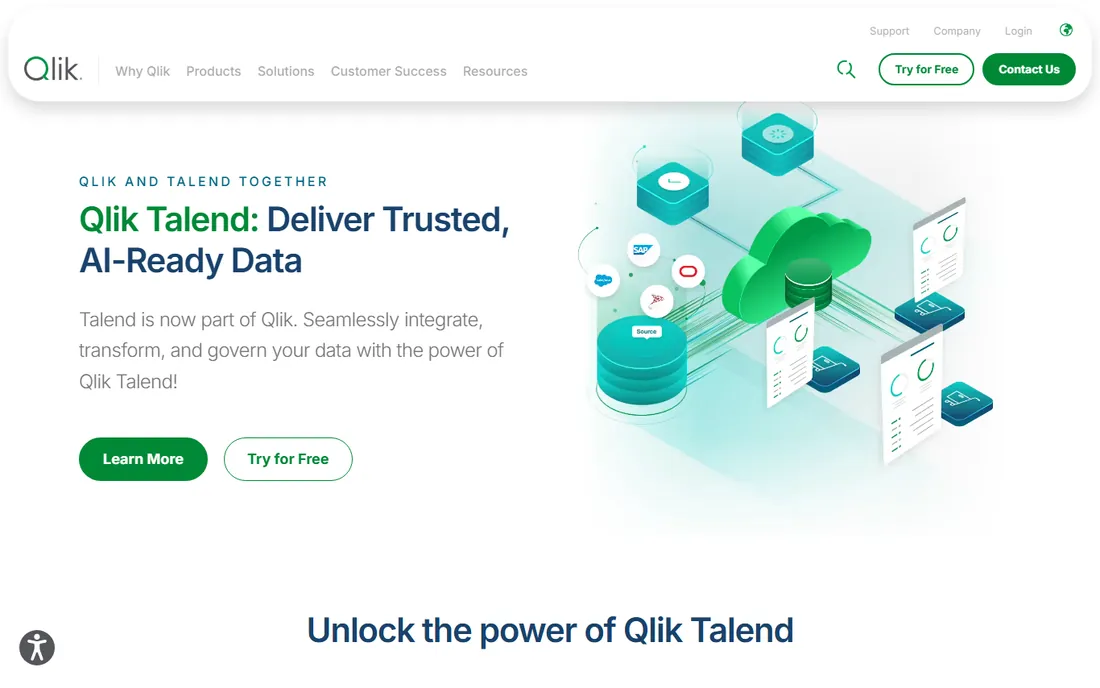
Talend, now part of Qlik, plays in both the open-source world and the enterprise suite. The platform covers data integration, application integration and API management, which appeals to enterprises consolidating integration vendors. The open-source Studio still gives developers a free way to build jobs, and the Qlik ownership ties integration to analytics.
The downside is focus. The product lineup is sprawling enough to confuse buyers, and the cloud data integration offering competes with vendors that were born in the cloud. Pricing for Talend Cloud is quote-based. Talend fits enterprises that want one vendor for data and application integration, especially with existing open-source Talend jobs.
What we like- Broad integration suite spanning ETL, application and API integration
- Open-source roots with a large community
- Now backed by Qlik's analytics
Watch out for- Quote-based pricing for the cloud suite
- Product lineup is sprawling
- Cloud offering less mature than born-in-cloud rivals
Starting price$100 per month (Standard)
Free planFree trial (14 days)
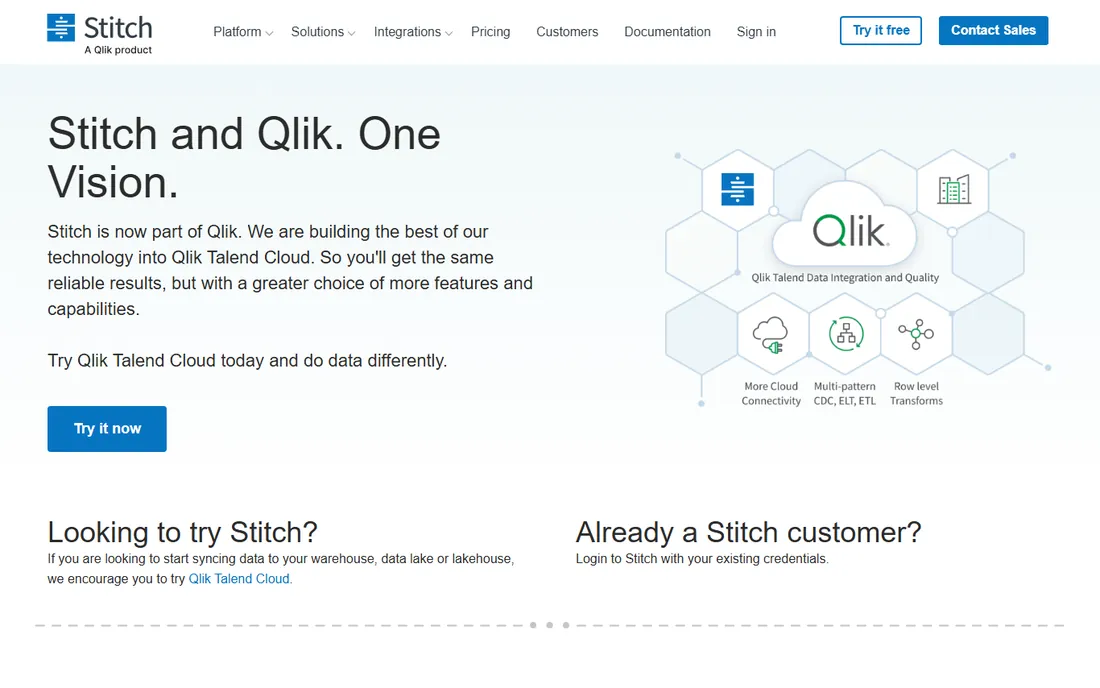
Stitch is Talend's simpler sibling, and the budget pick for straightforward replication. You get a clean interface, row-based pricing starting at $100 a month for 5 million rows, and fully managed pipelines with no infrastructure to babysit. For teams moving standard SaaS sources into a warehouse, it does the job with minimal fuss.
The limitations are connectors and transformation. Stitch covers around 100+ sources versus Fivetran's 700+, and serious transformation needs an external tool like dbt. The Standard plan allows only one destination. Stitch fits cost-conscious teams with standard sources and simple replication needs.
What we like- Simplest setup in the category
- Transparent row-based pricing from $100/month
- Fully managed with no infrastructure
Watch out for- Fewer connectors than Fivetran
- Limited transformation capabilities
- Single destination on the Standard plan
Starting price$239 per month (Starter, billed annually)
Free planYes (1M events/month)
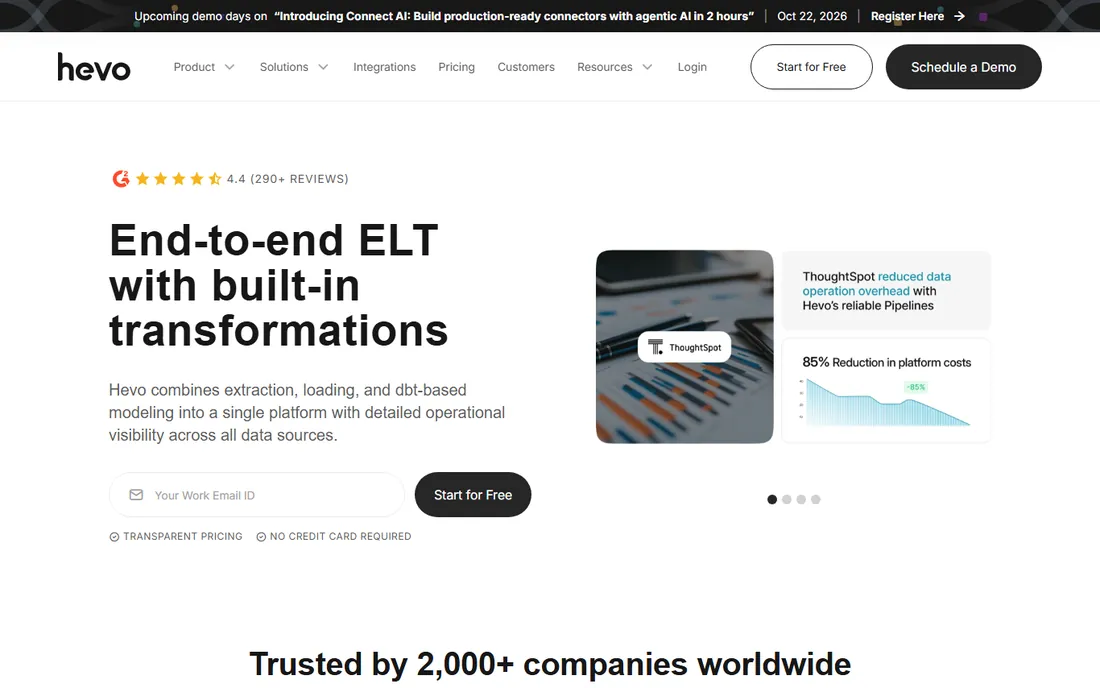
Hevo Data is the value alternative teams reach for when Fivetran's row-based bill stings. The free tier processes a million events a month, paid plans start at $239, and pipelines can run near real time. Setup is genuinely no-code, with automatic schema mapping and monitoring that non-engineers can follow.
The catch mirrors Fivetran's: event-based pricing means high-churn tables get expensive, and there is no automatic throttle, so bills grow with success. Advanced capabilities sit on higher tiers. Hevo fits startups and mid-size teams that want managed ELT at a lower entry price and can model their event volumes.
What we like- Generous free tier with 1M events a month
- Near real-time pipelines on higher plans
- Simple no-code setup with 150+ connectors
Watch out for- Event-based pricing punishes high-churn tables
- Advanced features need higher tiers
- Smaller ecosystem than Fivetran
Starting priceSee website
Free planFree trial

SnapLogic's visual pipeline builder is the friendliest here for non-engineers. Pipelines are built from prebuilt connectors called Snaps, snapped together on a canvas, which makes data flows readable to analysts and business users, not just engineers. The platform covers both data integration and application integration, with AI assistance for building pipelines.
The trade-off is that visual development has limits. Very complex transformation logic is harder to express and maintain on a canvas than in code, and pricing is quote-based with an enterprise sales process. SnapLogic fits organizations where data integration needs to be a team sport across technical and semi-technical staff.
What we like- Drag-and-drop pipeline designer anyone can read
- Large library of prebuilt connectors (Snaps)
- Handles data and application integration
Watch out for- Quote-only pricing
- Visual approach gets unwieldy for very complex logic
- Enterprise sales process
#8
Boomi
Best for: Application and data integration together
Visit boomi.com
Starting priceSee website
Free planFree trial
Boomi started in application integration and grew into data movement from that direction. The platform connects SaaS apps, on-premise systems and trading partners, with ETL-style data pipelines as part of a broader integration suite. For enterprises with hybrid estates and B2B/EDI needs, that breadth is the point.
The catch is focus. If you only need SaaS-to-warehouse ELT, Boomi is more platform than the job requires, and pricing is quote-based. It earns its place when application integration, API management and data pipelines need to live under one roof. Boomi fits enterprises consolidating integration around a single vendor.
What we like- Strong in application and B2B/EDI integration
- Large connector library
- Good for hybrid cloud and on-premise estates
Watch out for- Quote-based pricing
- ETL is one capability among many
- Can feel heavyweight for pure data pipeline work
Starting pricePay as you go
Free planFree trial

If your company already lives in Azure, Data Factory is the path of least resistance. The cloud ETL service orchestrates data movement across 100+ connectors, integrates natively with Synapse, Databricks and Azure SQL, and bills pay-as-you-go with no platform subscription. For Microsoft shops, procurement is trivial since it rides the existing Azure agreement.
The limitation is ecosystem gravity. Outside Azure the value drops, and the mapping data flows and expression language take learning. Debugging failed pipeline runs is clunkier than in purpose-built ELT tools. Data Factory fits enterprises standardized on Microsoft that want ETL on the Azure bill.
What we like- Native integration with Azure services and Microsoft 365 data
- Pay-as-you-go with no subscription
- Visual pipeline designer plus code options
Watch out for- Best value only inside Azure
- Learning curve for the expression language
- Monitoring and debugging lag dedicated tools
Starting pricePay as you go
Free planFree trial
AWS Glue is the serverless ETL service for teams already committed to Amazon's cloud. You define jobs in Python or Scala (or visually), Glue provisions the compute, and you pay for what the job consumes. The data catalog, crawlers and integration with S3, Redshift and Athena make it a natural hub for AWS analytics architectures.
The catch is that Glue assumes engineers. The learning curve is real, cost forecasting takes effort, and non-AWS sources are second-class citizens. For pure SaaS-to-warehouse ELT, managed tools are simpler. Glue fits data engineering teams on AWS that want programmable, serverless ETL without another vendor contract.
What we like- Serverless with no infrastructure to manage
- Pay per use
- Deep integration with S3, Redshift and the AWS analytics stack
Watch out for- Developer-centric with a real learning curve
- Costs are hard to predict at scale
- Weaker for non-AWS sources
How we chose
We did not run hands-on tests for this guide. We compared vendor pricing pages, documentation, public reviews on G2 and Capterra, and independent pricing analyses, and we verified that each product is available today as an enterprise data integration or ETL/ELT platform. Published prices are shown where vendors publish them; several enterprise vendors price by quote. We weighted connector depth, transformation capability, pricing transparency and fit for enterprise requirements like security and governance.
The connector count on the marketing page matters less than whether your specific sources are covered well. Shortlist two or three vendors, then test your hardest source: the one with the weird API, the high-churn table, or the on-premise database behind a firewall. A vendor with 700 connectors that handles your edge case poorly loses to one with 150 that handles it well.
Pricing model beats sticker price
Row-based, event-based and credit-based pricing all punish different workloads. High-churn tables hurt on Fivetran and Hevo; heavy transformations hurt on credit-based Matillion; per-connection minimums hurt accounts with many small sources. Model your actual volumes, including deletes and re-syncs, before comparing plans.
Transformation: inside or outside
Decide where transformation logic lives. Fivetran and Stitch expect you to transform in the warehouse with dbt or SQL. Matillion pushes transformation into the warehouse natively. Informatica, Talend and SnapLogic do heavy transformation inside the platform. Pick the model your data team already knows, because retraining is the hidden cost.
Governance and deployment
Enterprises should check deployment options early. Informatica, Talend and Boomi support hybrid and on-premise deployments for regulated data. Cloud-native tools are SaaS-only, which simplifies operations but may not pass security review in banking or healthcare. Ask about SOC 2, HIPAA and data residency before the pilot, not after.
ETL vs ELT vs reverse ETL
The terms describe where transformation happens. Traditional ETL transforms data before loading it into the warehouse, which suits heavy cleansing on the way in. Modern ELT loads raw data first and transforms it inside the warehouse, which is what Fivetran, Stitch, Hevo and Matillion do, and it keeps the raw data available for reprocessing.
Reverse ETL moves data the other way: from the warehouse back into operational tools like CRMs and ad platforms. None of the tools on this list specialize in it, so if activating warehouse data in Salesforce or HubSpot is a core need, budget for a dedicated reverse ETL tool alongside your pick here.
Frequently asked questions
What is the difference between ETL and ELT?
ETL transforms data before loading it into the destination, while ELT loads raw data first and transforms it inside the data warehouse. ELT has become the standard for cloud warehouses because cheap storage and compute make it practical to keep raw data and transform on demand.
How much does enterprise ETL software cost?
Managed ELT starts around $100 a month with Stitch and $239 with Hevo, while Fivetran's usage-based pricing typically reaches $500+ a month at moderate volumes. Enterprise suites from Informatica, Talend, SnapLogic and Boomi are quote-based and usually run into five or six figures annually. Cloud-native options like Azure Data Factory and AWS Glue bill pay-as-you-go.
Do I need ETL if I have a data warehouse?
If data only comes from one place, no. ETL earns its keep when you combine many sources: SaaS apps, databases, files and event streams. The moment someone is manually exporting CSVs into the warehouse every week, an ETL tool pays for itself in saved time and fewer errors.
Can these tools handle real-time data?
Some can. Fivetran offers 1-minute syncs on Enterprise, Hevo offers streaming pipelines on higher plans, and AWS Glue supports streaming ETL. Most managed ELT tools sync on schedules from minutes to hours. True sub-second streaming usually needs a dedicated streaming platform rather than batch ETL.
What about open-source ETL tools?
Airbyte and Meltano are the notable open-source options. They are free to self-host but you own the infrastructure, monitoring and connector maintenance. For enterprises, the managed tools on this list usually win on total cost once engineering time is counted.
How do I avoid surprise bills with usage-based pricing?
Model your volumes before signing, including deletes, re-syncs and schema changes, since all of them count toward row or event totals. Set up billing alerts on day one, start with a small set of sources, and re-measure after the first full month. Prefer vendors that let you cap spend or throttle pipelines.
Sources we checked (6)
- https://www.integrate.io/blog/fivetran-cost/
- https://hevodata.com/learn/fivetran-faqs/
- https://www.integrate.io/blog/stitch-pricing/
- https://hevodata.com/learn/data-integration-tools/
- https://improvado.io/blog/hevo-data-alternatives
- https://www.bladepipe.com/blog/data_insights/debezium_vs_airbyte_vs_fivetran_vs_stitch_vs_bladepipe/
Is your product missing or out of date?
We review this list regularly. Vendors can request a listing, send updated pricing or ask about featured placement.

Shihab Mia · Founder, Rankite
Shihab has spent more than a decade helping SaaS and e-commerce brands grow through search. He writes Rankite's software buying guides from pricing pages, documentation and public user reviews. More about Shihab.