How we make this list: we compare pricing pages, product documentation and public user reviews. Rankite is independent; if a vendor ever pays for a featured spot, that listing is clearly labeled Partner.
Key takeaways
- Fivetran is the default enterprise pick for hands-off ELT, but its consumption pricing can surprise teams with chatty sources; Airbyte and Estuary are the open-source-flavored alternatives worth pricing against it.
- If you need true change data capture (CDC) with sub-minute latency, start with Striim, Qlik Replicate or Fivetran HVR rather than a batch ELT tool.
- Small teams on a budget should look at Matillion Data Loader, Portable and Rivery before signing an enterprise contract.
- Replication bills scale with data volume and sync frequency, so always trial on your heaviest tables before committing to an annual plan.
Quick comparison
| Tool | Best for | Starting price | Free plan |
|---|
 Fivetran Fivetran | Enterprises and mid-size companies wanting fully managed ELT | See website (consumption-based, billed on monthly active rows) | Free trial (14 days) |
 Airbyte Airbyte | Engineering-led teams that want open-source control | See website (consumption-based for Cloud; self-hosted is open source) | Yes (self-hosted open-source edition) |
 Qlik Replicate Qlik Replicate | Enterprises doing real-time CDC from Oracle, SQL Server, SAP and mainframes | See website (quote-based) | No |
 Striim Striim | Real-time streaming replication and analytics use cases | See website (quote-based) | Free trial |
 Estuary Estuary | Teams wanting real-time ELT without enterprise contracts | See website (consumption-based) | Free trial (30 days, no credit card) |
 Hevo Data Hevo Data | Small and mid-size teams that want ELT running this week | See website (plan-based on events processed) | Free trial |
 Matillion Data Loader Matillion Data Loader | Cloud data warehouse users wanting free SaaS ELT | See website (Data Loader has a free tier) | Yes (free tier for Data Loader) |
 Rivery Rivery | Data teams that want ELT plus orchestration in one tool | See website (credit-based) | Free trial |
 Portable Portable | Teams with niche or long-tail sources nobody else connects | See website (fixed-fee plans; free plan for manual syncs) | Yes (free plan for manual data flows) |
 Fivetran HVR Fivetran HVR | Enterprises with heavy, log-based CDC requirements | See website (quote-based) | No |
Is your product missing or out of date?
We review this list regularly. Vendors can request a listing, send updated pricing or ask about featured placement.
The honest truth about data replication pricing
Here is the blunt version of what vendors put on page six of their pricing docs: you do not pay for replication software, you pay for the volume and frequency of your own data. Two companies can use the same tool and get bills that differ by a factor of fifty, because one syncs a 200-row settings table hourly and the other replicates a clickstream every sixty seconds. Every tool on this list moves data from A to B. The real differences are latency (batch vs. change data capture), how much pipeline babysitting each one demands, and what the meter runs on.
The ten products below cover the real market: managed ELT leaders, CDC specialists for enterprise databases, and open or low-cost options for smaller teams. Pick your latency requirement first, then your budget tolerance, and the shortlist almost writes itself.
#1
Fivetran
Best for: Enterprises and mid-size companies wanting fully managed ELT
Visit fivetran.com
Starting priceSee website (consumption-based, billed on monthly active rows)
Free planFree trial (14 days)
Fivetran is the default pick for a reason: you connect a source, pick a destination, and the pipeline mostly runs itself. Schema changes that would break a hand-built pipeline get handled automatically, and the connector catalog covers the SaaS apps most companies actually use. For a data team of two supporting a whole company, that hands-off quality is the whole pitch.
The catch is the meter. Fivetran bills on monthly active rows, so a noisy source or an aggressive sync schedule turns into a bill nobody forecasted. Trial it on your heaviest tables, not your smallest, and ask sales for a realistic estimate based on your row counts before you sign anything annual.
What we like- Largest connector library in the category (500-plus sources)
- Fully managed pipelines with automatic schema migration handling
- Strong documentation and SOC 2 compliance story
Watch out for- Consumption pricing can spike with high-volume or chatty sources
- Limited transformation (dbt-based) compared with full ETL suites
#2
Airbyte
Best for: Engineering-led teams that want open-source control
Visit airbyte.com
Starting priceSee website (consumption-based for Cloud; self-hosted is open source)
Free planYes (self-hosted open-source edition)
If Fivetran's consumption meter makes you nervous, Airbyte is the natural counter-quote. The open-source edition runs on your own infrastructure, so the software cost is zero and you pay only for compute. The connector builder and community contributions mean oddball sources get covered faster than most vendors manage.
The trade is operational. Somebody on your team now owns the Airbyte deployment: upgrades, monitoring, retries at 3 a.m. Teams with real DevOps capacity love that trade. Teams without it should price Airbyte Cloud against Fivetran before assuming self-hosted is cheaper once engineer time is counted.
What we like- Open-source core you can self-host and inspect
- Large and growing connector catalog with community contributions
- No per-connector fees, which suits teams with many small sources
Watch out for- Self-hosting means you own upgrades, monitoring and scaling
- The managed Cloud price still needs a quote for larger volumes
#3
Qlik Replicate
Best for: Enterprises doing real-time CDC from Oracle, SQL Server, SAP and mainframes
Visit qlik.com
Starting priceSee website (quote-based)
Free planNo
Qlik Replicate, formerly Attunity Replicate, is the veteran of this list. Where ELT tools poll your database on a schedule, Replicate reads the database transaction log and streams changes as they happen. That makes it the right choice for operational replication: keeping an Oracle database and a warehouse in near lockstep, or feeding a real-time dashboard.
This is enterprise software in the old sense. Expect a sales process, a quote, and a more involved setup than clicking "connect" in a SaaS UI. But if your source is a mainframe, SAP or a heavily loaded Oracle instance, the modern ELT tools on this list often cannot do the job at all, and Replicate can.
What we like- True log-based change data capture with very low latency
- Deep support for legacy and enterprise databases including mainframes
- Mature product with decades of Attunity engineering behind it
Watch out for- Quote-only pricing and an enterprise sales process
- Heavier to set up and tune than modern SaaS ELT tools
#4
Striim
Best for: Real-time streaming replication and analytics use cases
Visit striim.com
Starting priceSee website (quote-based)
Free planFree trial
Striim sells speed. Its pitch is continuous, real-time data movement with processing applied to the stream itself, so you can filter, enrich and transform data in flight instead of landing everything and cleaning it later. Fraud detection, live operational dashboards and real-time personalization are the classic use cases.
The honest catch is that Striim is a streaming platform, not a plug-and-play ELT tool. Expect a bigger implementation effort and an enterprise contract. If your latency requirement is measured in minutes, a batch tool is simpler and cheaper. If it is measured in seconds, Striim earns its place on the shortlist.
What we like- Sub-second end-to-end latency for streaming pipelines
- In-flight stream processing (filtering, enrichment) before data lands
- Strong change data capture from enterprise databases
Watch out for- Enterprise pricing with no public numbers
- More complex to operate than batch ELT
#5
Estuary
Best for: Teams wanting real-time ELT without enterprise contracts
Visit estuary.dev
Starting priceSee website (consumption-based)
Free planFree trial (30 days, no credit card)
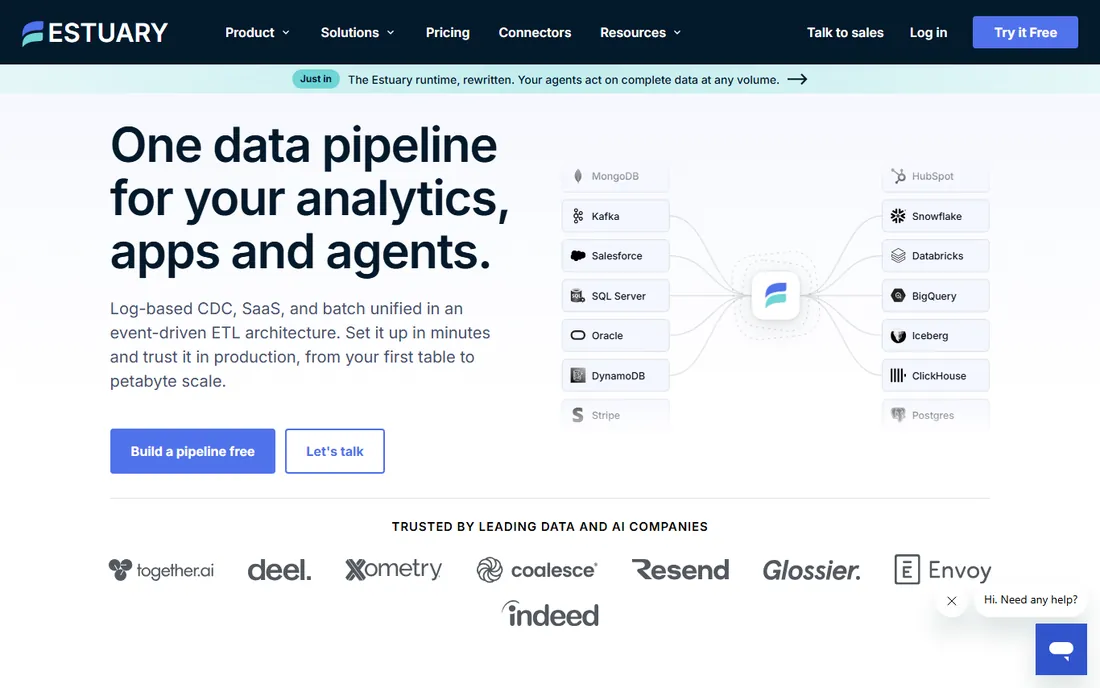
Estuary is the newest name here and the most interesting challenger. It combines real-time change data capture with ELT pipelines in one system, built on an open-source core called Flow. The idea is to give smaller teams the streaming capability that used to require Striim-level budgets, with a free tier that lets you prove it on real data.
The trade is maturity. The connector catalog is smaller than Fivetran's or Airbyte's, and the company is younger, so reference customers at real scale are thinner. For a team that wants real-time pipelines without an enterprise sales cycle, that trade is often worth it. Just verify your specific sources are supported before you build plans around it.
What we like- Real-time CDC combined with ELT in one platform
- Open-source core (Flow) with a managed cloud
- Generous free tier for getting started
Watch out for- Younger company with a smaller connector catalog than the leaders
- Fewer public reference customers at enterprise scale
#6
Hevo Data
Best for: Small and mid-size teams that want ELT running this week
Visit hevodata.com
Starting priceSee website (plan-based on events processed)
Free planFree trial
Hevo Data built its reputation on speed of setup. A small data team can connect Shopify, Salesforce or Postgres and land data in BigQuery or Snowflake the same afternoon, with a UI that does not assume you are a data engineer. The event-based pricing tiers are easier to reason about than pure consumption meters.
The honest weakness is depth. Oddball sources and edge-case transformations are where Hevo shows its limits next to the bigger catalogs. For the mainstream stack most SMBs run, that rarely matters. For a sprawling enterprise source list, it does.
What we like- Fast setup with pre-built integrations for common sources
- Transparent event-based pricing tiers
- Reverse ETL features for pushing warehouse data back to SaaS apps
Watch out for- Connector depth is thinner than Fivetran or Airbyte
- Very high volumes can push you into enterprise pricing quickly
#7
Matillion Data Loader
Best for: Cloud data warehouse users wanting free SaaS ELT
Visit matillion.com
Starting priceSee website (Data Loader has a free tier)
Free planYes (free tier for Data Loader)
Matillion Data Loader is the easiest yes on this list for warehouse-first teams. The SaaS loader carries a free tier, setup is no-code, and it is designed around the cloud warehouses companies already pay for. If your job is "get Salesforce and Postgres into Snowflake," this does it without a sales call.
Know what you are buying. Data Loader is the simple ingestion product; the heavy transformation work lives in the paid Matillion platform. Growing teams should check where the free tier's limits land against their actual volumes, because outgrowing it mid-year is the usual story.
What we like- Genuinely free tier for the SaaS data loader
- Native-feeling integration with Snowflake, BigQuery, Redshift and Databricks
- Simple no-code pipeline setup
Watch out for- The free tier has volume limits that growing teams outgrow
- Advanced transformation needs the paid Matillion ETL platform
#8
Rivery
Best for: Data teams that want ELT plus orchestration in one tool
Visit rivery.io
Starting priceSee website (credit-based)
Free planFree trial
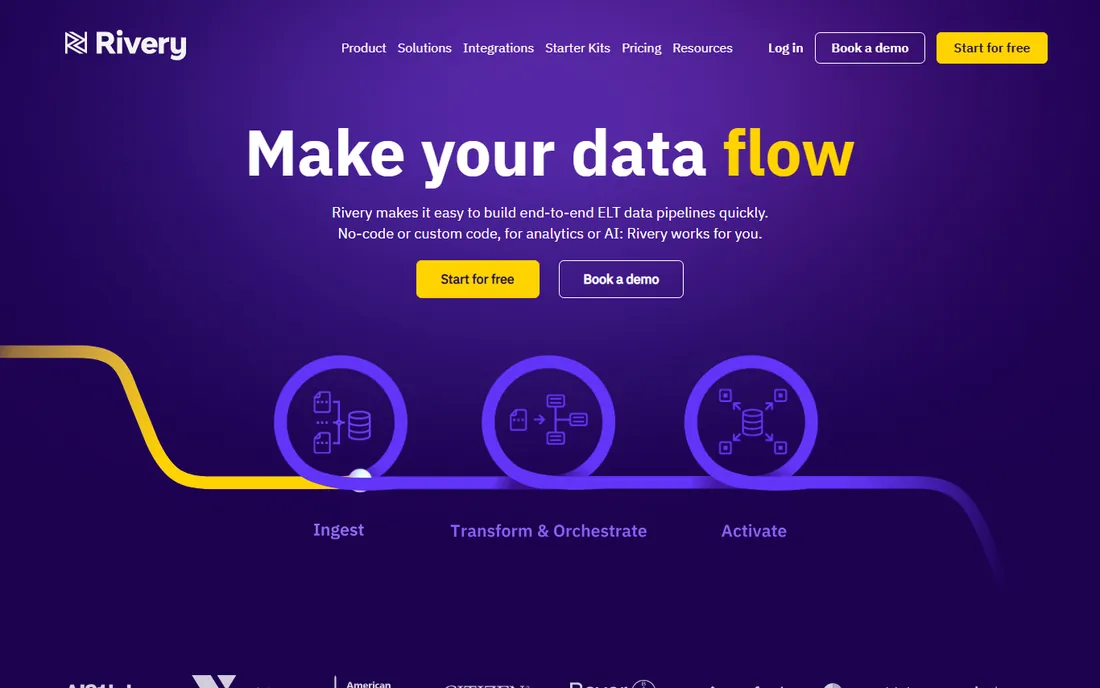
Rivery's angle is consolidation. Instead of buying an ELT tool plus a separate orchestrator plus a reverse ETL tool, Rivery bundles ingestion, transformation orchestration and reverse ETL into one platform with one credit meter. For lean data teams, fewer vendors means fewer contracts and fewer 2 a.m. alerts.
The catch is that consolidation always involves compromise. No single product is the best at all three jobs, and Rivery's connector catalog is smaller than Fivetran's. One thing to know: Boomi acquired Rivery in late 2024 and now positions it as Boomi Data Integration, though the Rivery site and product continue to operate. Teams that mainly need ingestion should compare it against a pure ELT tool; teams that need the full bundle should trial the orchestration piece seriously, not just the connectors.
What we like- Combines ELT ingestion with workflow orchestration and reverse ETL
- Visual pipeline builder that stays readable at scale
- Credit-based pricing that covers ingestion and orchestration together
Watch out for- Smaller connector catalog than the category leaders
- The all-in-one scope means a steeper learning curve
#9
Portable
Best for: Teams with niche or long-tail sources nobody else connects
Visit portable.io
Starting priceSee website (fixed-fee plans; free plan for manual syncs)
Free planYes (free plan for manual data flows)
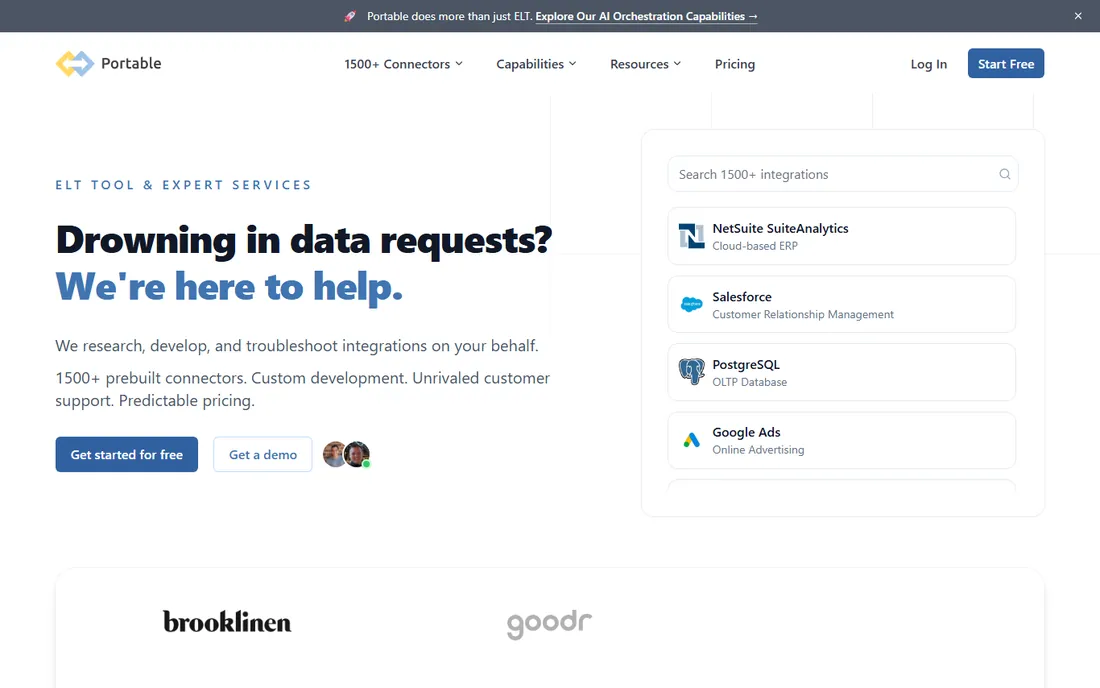
Portable wins the connectors nobody else bothers with. While every ELT vendor builds the same 150 popular integrations, Portable built its business on the long tail: thousands of niche SaaS apps and APIs, plus custom connectors its team builds for you on request. If your stack includes an obscure industry app that Fivetran will never prioritize, Portable is often the only managed answer.
The model is refreshingly simple: fixed-fee pricing with no data volume caps, so your bill does not move when your data grows. The trade is scope. Portable does extraction and loading only, with no transformation layer, so you will pair it with dbt or your warehouse's native tooling. For teams whose problem is "nobody connects to our systems," that is a trade worth making.
What we like- Largest long-tail connector catalog in the category (1,500-plus prebuilt)
- Builds custom connectors on request in days
- Fixed-fee pricing with no volume overages
Watch out for- No built-in transformation, extraction and loading only
- Smaller company with less brand recognition than the leaders
#10
Fivetran HVR
Best for: Enterprises with heavy, log-based CDC requirements
Visit fivetran.com
Starting priceSee website (quote-based)
Free planNo
HVR was the independent CDC specialist until Fivetran acquired it, and it now lives on as Fivetran HVR. The technology is log-based capture designed for serious volumes: big Oracle, SQL Server and DB2 estates where you cannot afford to hammer the source database with queries. Its agent architecture distributes the work instead of centralizing the load.
This is not a self-serve SaaS signup. Expect an enterprise process, a quote, and real infrastructure planning. But for the specific problem it solves, high-volume log-based replication with minimal source impact, there are few alternatives. Teams choosing between Fivetran's SaaS ELT and HVR should be clear about which latency and volume profile they actually have.
What we like- Log-based CDC built for high-volume enterprise databases
- Agent-based architecture that keeps load off source systems
- Now backed by Fivetran's resources and roadmap
Watch out for- Enterprise sales process with no public pricing
- More infrastructure to manage than pure SaaS ELT
Batch ELT vs. change data capture: pick your latency first
The single most useful cut through this market is latency. Batch ELT tools (Fivetran, Airbyte, Hevo, Matillion Data Loader, Rivery, Portable) extract data on a schedule: every few minutes at best, hourly or daily in practice. That is fine for analytics, reporting and anything where yesterday's data answers today's question.
Change data capture tools (Qlik Replicate, Striim, Estuary, Fivetran HVR) read database logs and stream changes continuously, with latency measured in seconds. That is what you need for operational replication, real-time dashboards and event-driven systems. CDC costs more and demands more setup, so do not buy it for a reporting job. And do not buy batch ELT for a real-time job and hope the schedule is "fast enough." Decide the latency your use case actually requires, then shop only in that half of the list.
What to check before you sign a replication contract
Start with your three heaviest sources, not your three easiest. Every vendor demos beautifully on a small Postgres database and a Shopify store. Your bill and your headaches come from the 400 GB Oracle instance, the chatty event stream and the SaaS app with API rate limits. Trial on the hard sources or do not trial at all.
Second, model the pricing on your real volumes. Consumption pricing (Fivetran, Airbyte Cloud, Estuary) rewards quiet sources and punishes noisy ones. Event or credit pricing (Hevo, Rivery) is easier to forecast but has tier cliffs. Run your actual row counts and sync frequencies through the vendor's calculator, or get the estimate in writing from sales.
Third, check schema-change handling and historical syncs. Sources change: columns get renamed, types shift, tables appear. Ask how the tool handles each case, and how it does the initial historical load (some tools take days on large tables). Fourth, confirm your destinations and regions: not every tool supports every warehouse, and data residency requirements can rule out vendors with limited regional deployment. Finally, look at the contract terms. Annual prepay discounts are real, but so is the risk of outgrowing a tier mid-year. A quarterly true-up clause or a short initial term is worth more than a 10 percent discount.
How we chose
We started with the searches buyers actually run: data replication software, CDC tools, ELT tools and database replication software. For each candidate we checked the vendor's own pricing page and product documentation, read public reviews on G2, Capterra and Reddit, and compared connector catalogs, latency models, deployment options and company-size fit. Products that were shut down or folded into an acquirer's suite were replaced with live alternatives. Where pricing could not be verified on the vendor's page, we wrote "See website" instead of guessing.
Frequently asked questions
What is the difference between data replication and ETL?
Replication keeps a target system continuously in sync with a source, often in real time via change data capture. ETL extracts data on a schedule, transforms it, then loads it into a warehouse, usually for analytics. Modern ELT tools blur the line, but the latency model is the real distinction: replication is continuous, ETL is scheduled.
Do I need CDC or is batch ELT enough?
If your use case is analytics, dashboards refreshed hourly or daily, or data science, batch ELT is enough and cheaper. If you need operational systems in sync, sub-minute freshness or event-driven triggers, you need CDC. Most buyers overestimate their latency requirement; check what the business decision actually waits on.
How much does data replication software cost?
It depends on volume and frequency, not on the tool's list price. Small teams often start free or under a few hundred dollars a month on tools like Matillion Data Loader, Portable or Estuary's free tier. Mid-size companies commonly pay from several hundred to a few thousand dollars monthly on Fivetran, Airbyte Cloud or Hevo. Enterprise CDC (Qlik Replicate, Striim, Fivetran HVR) is quote-based and typically starts in the tens of thousands annually.
Can I replicate from on-premises databases to the cloud?
Yes, and it is one of the most common use cases. Qlik Replicate and Fivetran HVR specialize in it, including mainframes and legacy systems. The SaaS ELT tools support on-premises sources through secure agents or tunnels. Check the vendor's documentation for your specific database version before committing.
What happens when my source schema changes?
Good tools detect schema changes and adapt: new columns get added, type changes get handled or flagged. Weaker tools break the pipeline or silently drop data. This is one of the main things you are paying for with a managed tool, so test it deliberately during a trial by renaming a column in a test source.
Is open-source data replication safe for production?
Airbyte's and Estuary's open cores run in production at real companies, but "safe" depends on your team. Open source shifts the operational burden to you: upgrades, monitoring, scaling and incident response. If you have the engineering capacity, it is a legitimate and often cheaper path. If you do not, the managed version of the same tool is the honest comparison, not the free one.
Sources we checked (10)
- https://fivetran.com
- https://airbyte.com
- https://www.qlik.com
- https://www.striim.com
- https://estuary.dev
- https://hevodata.com
- https://www.matillion.com
- https://rivery.io
- https://portable.io
- https://www.fivetran.com
Is your product missing or out of date?
We review this list regularly. Vendors can request a listing, send updated pricing or ask about featured placement.

Shihab Mia · Founder, Rankite
Shihab has spent more than a decade helping SaaS and e-commerce brands grow through search. He writes Rankite's software buying guides from pricing pages, documentation and public user reviews. More about Shihab.