How we make this list: we compare pricing pages, product documentation and public user reviews. Rankite is independent; if a vendor ever pays for a featured spot, that listing is clearly labeled Partner.
Key takeaways
- First Due is the broadest modern platform, combining records, scheduling, preplanning, inspections and training in one system.
- ESO is the data and compliance heavyweight, with strong incident reporting as departments transition from NFIRS to NERIS.
- Emergency Reporting remains the long-standing cloud records system trusted by thousands of smaller agencies.
- Staffing and scheduling are often bought separately: Aladtec and Vector Scheduling specialize in fire-service workforce management.
Quick comparison
| Tool | Best for | Starting price | Free plan |
|---|
 First Due First Due | Departments that want records, scheduling, preplanning and inspections in one platform | See website | No |
 ESO ESO | Agencies that prioritize data quality, analytics and NERIS readiness | See website | No |
 Emergency Reporting Emergency Reporting | Small to mid-size departments wanting a proven cloud records system | See website | No |
 Vector Solutions Vector Solutions | Departments bundling training, scheduling and compliance in one vendor | See website | No |
 ImageTrend ImageTrend | Agencies and states needing deep data collection and EMS integration | See website | No |
 PSTrax PSTrax | Apparatus, equipment, narcotics and station operations checks | See website | No |
 Aladtec Aladtec | Fire, EMS and dispatch workforce scheduling | See website | No |
 Active911 Active911 | Fast digital alerting and response coordination | See website | No |
 Operative IQ Operative IQ | Fleet, inventory and asset management for fire and EMS operations | See website | No |
Is your product missing or out of date?
We review this list regularly. Vendors can request a listing, send updated pricing or ask about featured placement.
Most fire software buying goes wrong before the demo
Here is the blunt version: fire departments usually buy software the way they buy apparatus, by talking to the neighboring department and picking what they picked. That works for trucks. It fails for software, because the neighboring department has different staffing, different call volume and a different records clerk. The right question is not which system is best. It is which system fits a department of your size, your mix of career and volunteer staffing, and your state's reporting requirements.
Fire department software is really several products wearing one label: records management (NFIRS/NERIS incident reporting), scheduling and staffing, inspections and pre-incident planning, training and certifications, apparatus and inventory checks, and alerting. Some vendors cover all of it. Most cover two or three pieces well. The nine below cover the real market across those jobs.
#1
First Due
Best for: Departments that want records, scheduling, preplanning and inspections in one platform
Visit firstdue.com
Starting priceSee website
Free planNo
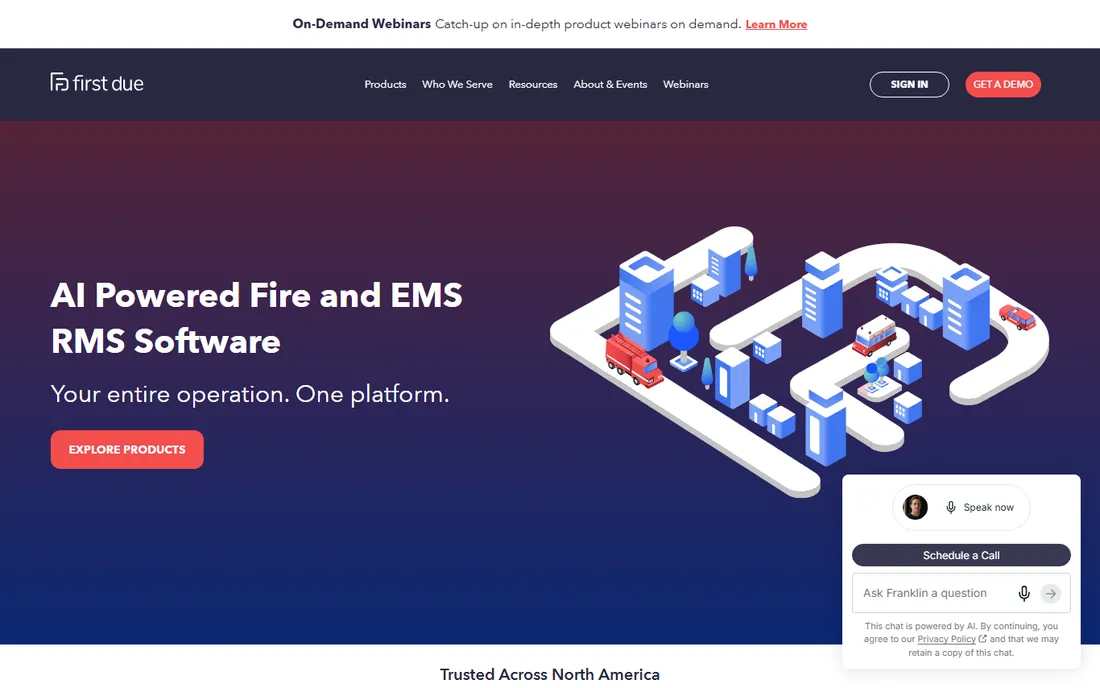
First Due has become the reference point for modern fire software by refusing to be a point solution. One platform covers NFIRS/NERIS incident reporting, ePCR, pre-incident planning, fire prevention and inspections, scheduling, asset and inventory management, training records and analytics. For a chief tired of five logins, that consolidation is the pitch.
The platform's growth, including large agency and statewide deployments, suggests it scales. The consideration is the flip side of breadth: rolling out everything at once is a major project, so most departments phase it in. Start with records and scheduling, then add preplanning and inspections. Demo the mobile experience specifically, since field usability decides whether the data going in is any good.
What we like- True all-in-one scope: incident reporting, ePCR, preplanning, inspections, scheduling, assets, training and analytics in one cloud system
- Modern interface designed for tablets and field use
- Strong momentum with large agencies and statewide adoption
Watch out for- All-in-one means a bigger implementation and more change management
- Pricing is quote-based and reflects the platform breadth
#2
ESO
Best for: Agencies that prioritize data quality, analytics and NERIS readiness
Visit eso.com
Starting priceSee website
Free planNo
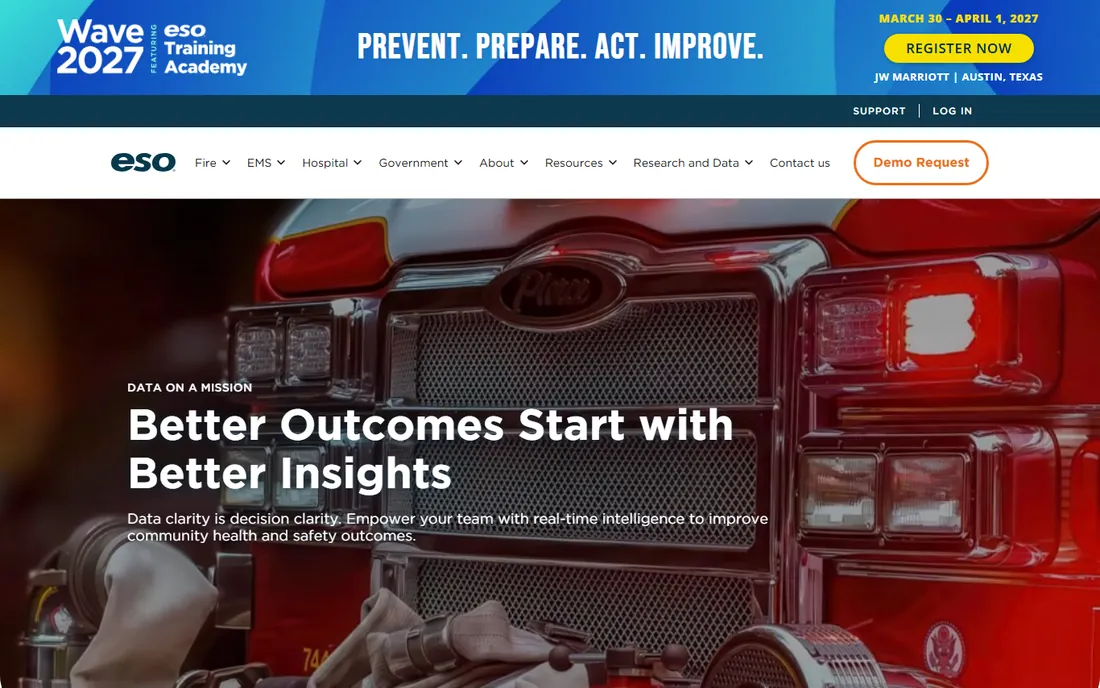
ESO built its reputation on data. The company's fire RMS and ePCR products feed an analytics layer that departments and states actually use for decision-making, and its guidance through the NFIRS-to-NERIS transition has been a real differentiator as the national reporting standard changes. For agencies where reporting accuracy and state compliance are non-negotiable, ESO is the serious pick.
Smaller departments sometimes find ESO more system than they need, and the sales process reflects an enterprise vendor. But the data quality argument is concrete: clean incident data affects ISO ratings, grant applications and staffing justifications. If your department lives or dies by its numbers, shortlist ESO and ask for the NERIS migration plan in writing.
What we like- Deep records and analytics with a genuine data-first culture
- Strong ePCR and fire RMS with NERIS transition support
- Large customer base across fire and EMS
Watch out for- The product breadth can feel complex for small volunteer departments
- Quote-based pricing with enterprise weight
Starting priceSee website
Free planNo
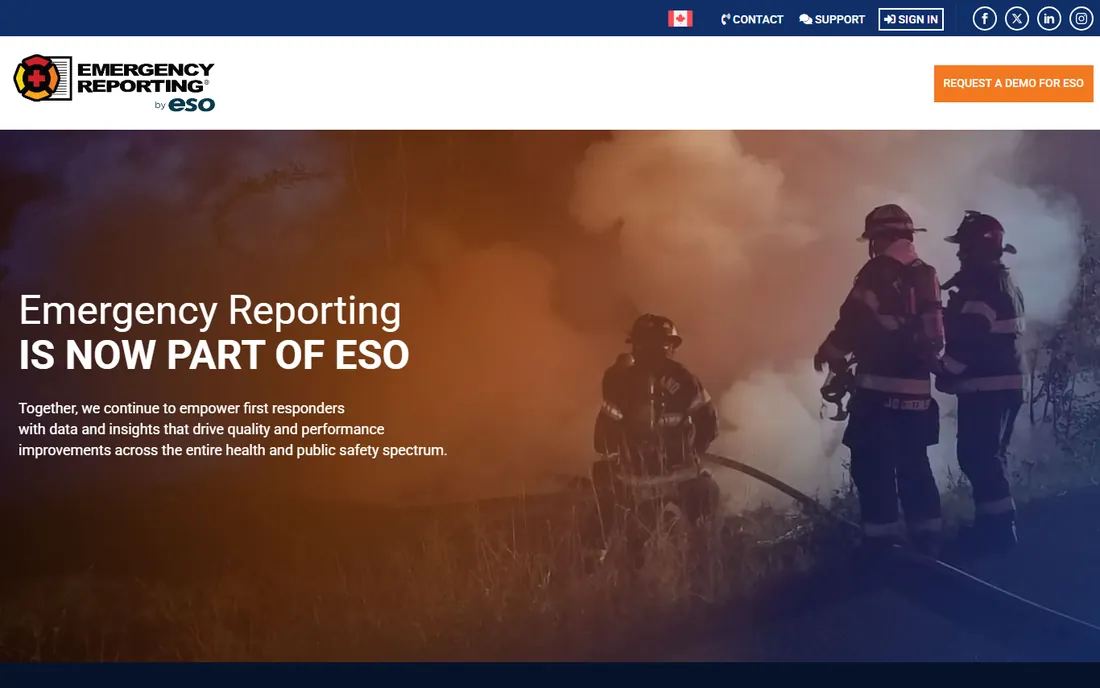
Emergency Reporting has been the default cloud records system for smaller fire agencies for years, and defaults persist for a reason. It covers the core records job: NFIRS incident reporting, inspections, hydrants, personnel and training records, maintenance and inventory. Departments without IT staff can run it, and the price point has historically fit small-agency budgets.
The honest knock is modernity. The interface feels dated next to First Due, and the analytics depth does not match ESO. But for a volunteer or combination department that needs reliable, compliant records without a big implementation, the proven track record counts. Ask about the NERIS transition timeline for your state before renewing or signing.
What we like- Long track record as a cloud-native fire RMS with thousands of agency customers
- Covers incidents, inspections, hydrants, training and maintenance in one system
- Approachable for departments without IT staff
Watch out for- Interface shows its age next to newer platforms
- Advanced analytics are thinner than ESO or First Due
#4
Vector Solutions
Best for: Departments bundling training, scheduling and compliance in one vendor
Visit vectorsolutions.com
Starting priceSee website
Free planNo
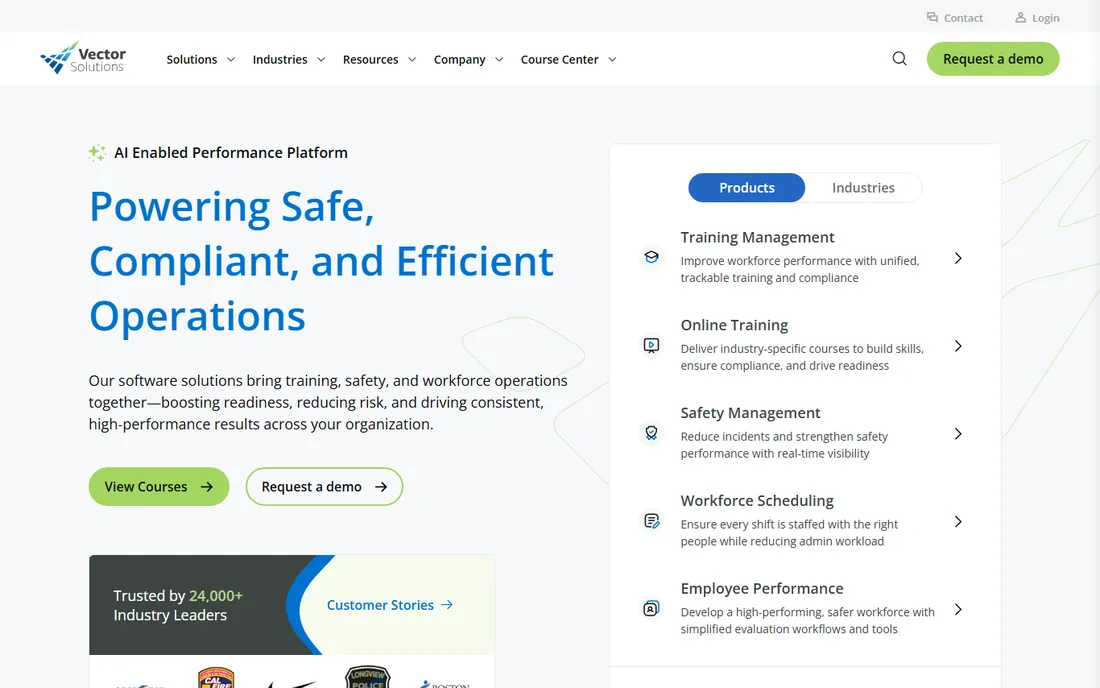
Vector Solutions approaches the fire department from the people side. TargetSolutions is one of the most widely used fire and EMS training platforms, with online courses, credential tracking and ISO training-hour documentation. Vector Scheduling (formerly CrewSense) handles the complex shift, callback and overtime rules of fire service staffing. Together they cover the workforce side of the department.
What it is not is a records management system. Departments typically pair Vector's training and scheduling with a separate RMS like ESO or Emergency Reporting. The value of the bundle is one vendor for everything people-related: training, certifications, scheduling and policy management. Price the pieces you need individually before accepting the bundle quote.
What we like- Combines TargetSolutions training, Vector Scheduling and related compliance tools under one roof
- Deep course library for fire and EMS continuing education
- Strong on certifications and credential tracking
Watch out for- The bundle can exceed what a department needs, and unbundled pricing varies
- Records management is not the core strength
#5
ImageTrend
Best for: Agencies and states needing deep data collection and EMS integration
Visit imagetrend.com
Starting priceSee website
Free planNo
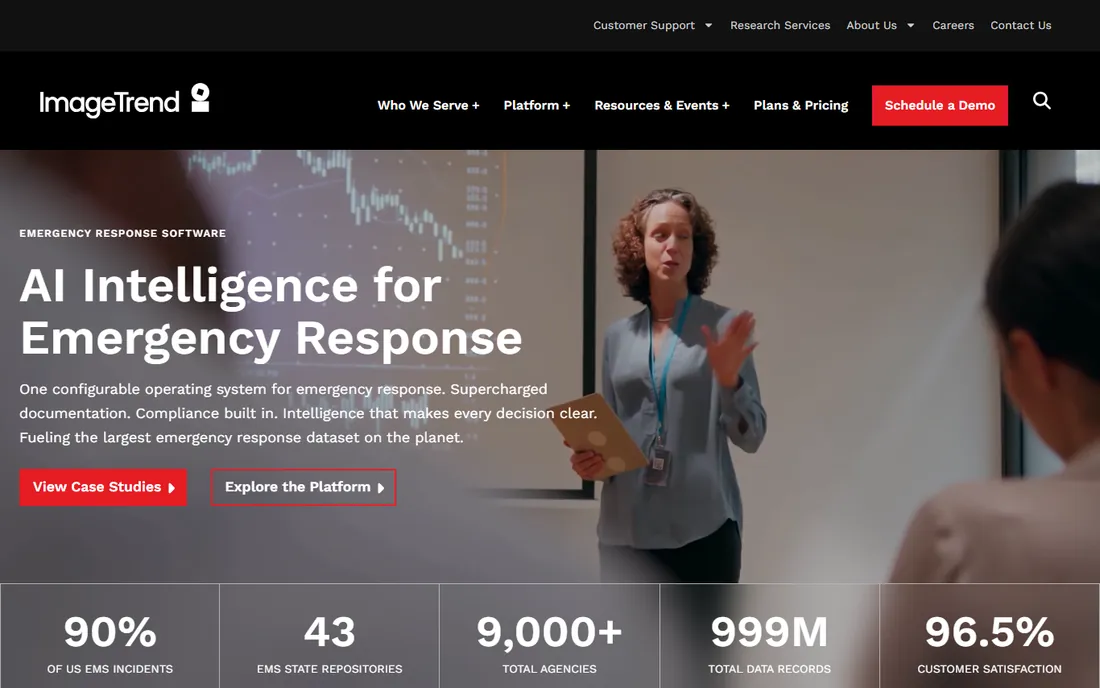
ImageTrend operates at the data-infrastructure level of public safety software. Its platform collects and manages incident, EMS, inspection and licensing data, and it is used by many state-level agencies, which matters when your department reports upward. The configurability handles reporting requirements that off-the-shelf RMS products cannot.
That power has a cost in complexity. ImageTrend implementations need knowledgeable administrators, and the product fits agencies with real data needs better than small departments wanting simple records. If your department runs EMS transport and needs patient-care reporting integrated with fire records, or your state standardizes on ImageTrend, it is a natural fit.
What we like- Powerful data ecosystem used at agency and state levels
- Strong EMS and patient-care reporting alongside fire records
- Flexible configuration for complex reporting requirements
Watch out for- Configuration depth means implementations need expertise
- Smaller departments may find it heavyweight
#6
PSTrax
Best for: Apparatus, equipment, narcotics and station operations checks
Visit pstrax.com
Starting priceSee website
Free planNo
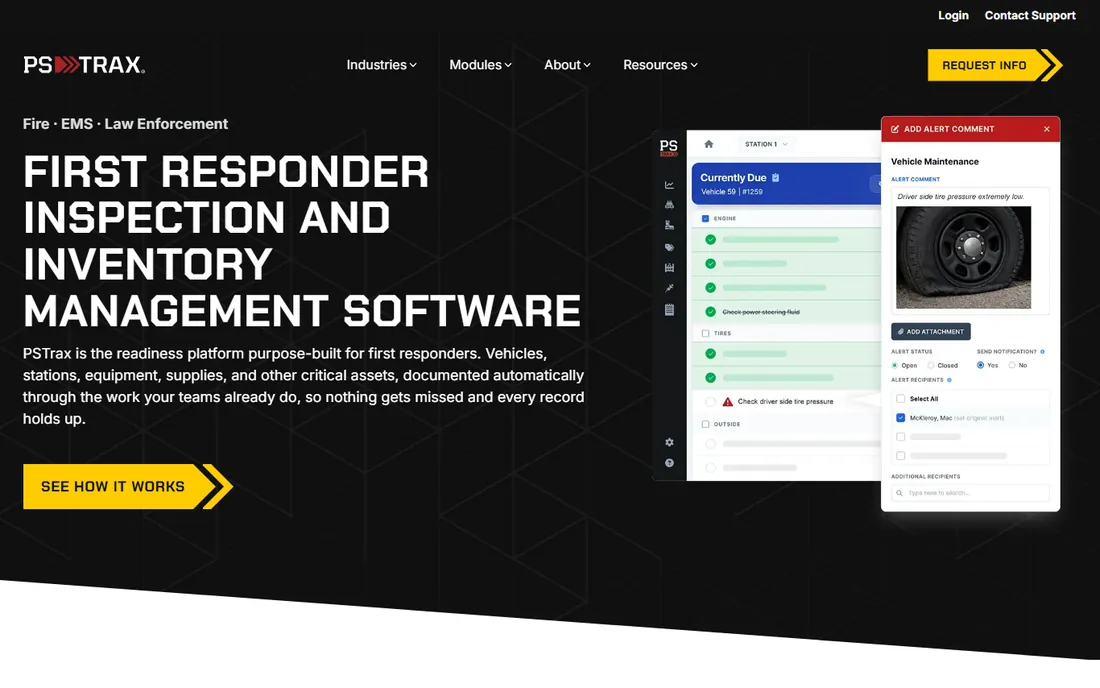
PSTrax does one job and does it well: the daily checks that keep a fire department running and compliant. Apparatus checklists, SCBA and PPE inspections, station inventory, controlled-substance logs and maintenance tracking live in one system built for how crews actually work. For accreditation and ISO purposes, having audit-ready check records matters.
Nobody buys PSTrax as their only software. It sits alongside the RMS and scheduling system, handling the operations layer. The buying question is whether your department's check compliance is a real problem. If trucks roll with expired equipment because paper checksheets got lost, PSTrax pays for itself in risk reduction. If your checks are already disciplined, it is a nice-to-have.
What we like- Purpose-built for daily operations checks: apparatus, SCBA, PPE, inventory and controlled substances
- Checklists and compliance tracking designed for fire service workflows
- Audit-ready records for accreditation
Watch out for- Narrow scope by design, so it pairs with an RMS rather than replacing one
- Pricing is quote-based
Starting priceSee website
Free planNo
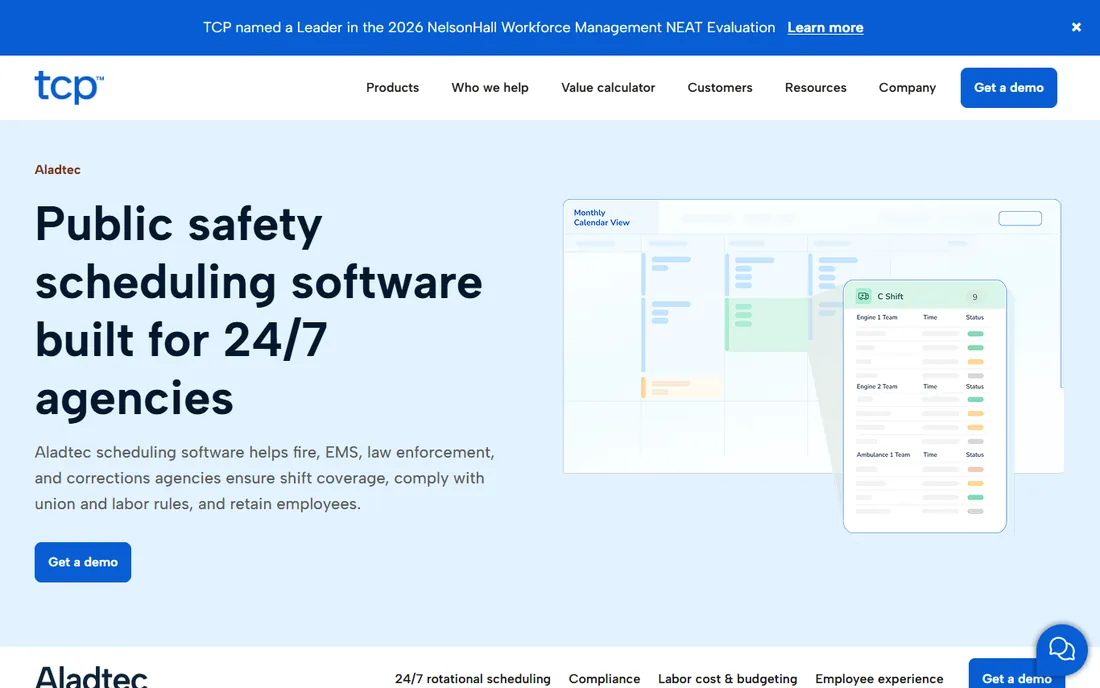
Aladtec is the scheduling specialist that fire departments actually use. Fire service scheduling is genuinely hard: 24/48 and Kelly rotations, minimum staffing rules, overtime equalization, shift trades with approval chains, callback lists and FLSA compliance. Aladtec handles those natively instead of forcing them into generic scheduling software.
Now part of Vector Solutions, Aladtec keeps its focused identity. It will not run your incident reports or inspections, and it does not try to. Departments buy it to fix the scheduling chaos: the spreadsheets, the phone trees, the overtime grievances. If staffing is your pain point, demo the shift-trade and overtime workflows with your actual union rules loaded.
What we like- Scheduling built specifically for public safety shift patterns (24/48, Kelly days, rotations)
- Time-off, overtime, shift trades and payroll export in one system
- Accessible pricing for mid-size departments
Watch out for- It is a scheduling specialist, not a full department platform
- Very large agencies may need deeper workforce analytics
Starting priceSee website
Free planNo
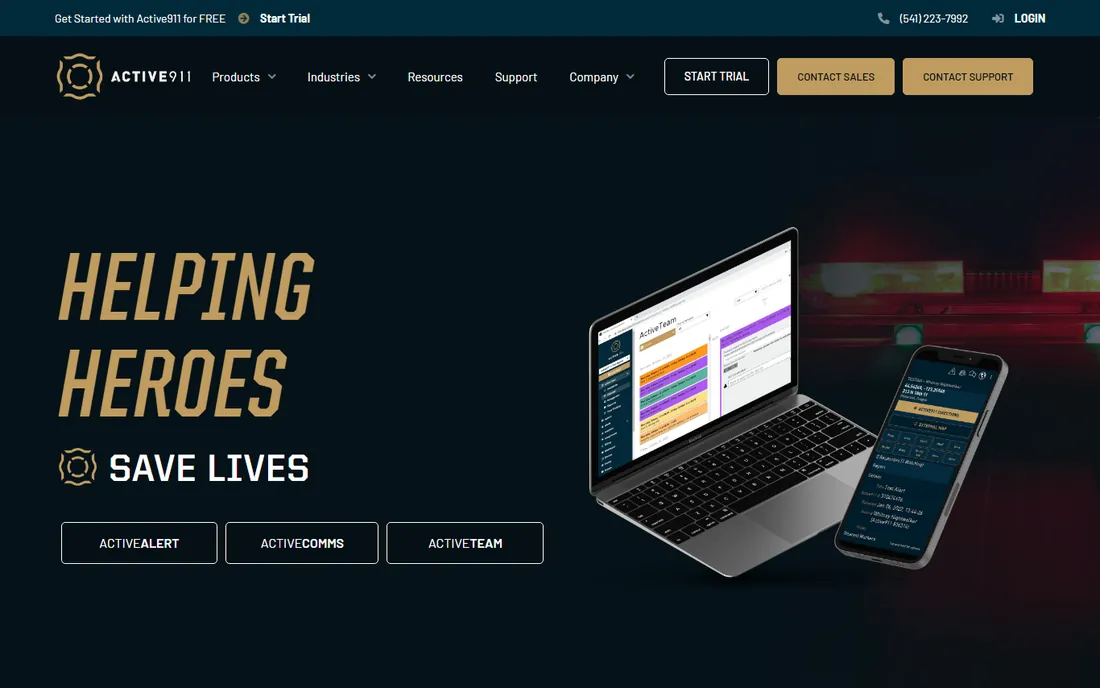
Active911 answers the most time-critical software question in the fire service: getting the right people to the right place fast. When a call drops, responders get the alert with maps, hydrant locations, preplan data and crew responses on their devices. For volunteer departments where responders come from home or work, that coordination is the difference between a full crew and a short one.
It is a complement, not a platform. Active911 does not do incident reporting, scheduling or inspections. Departments run it alongside their RMS. The buying decision is usually easy: the per-agency cost is modest, the CAD integration is the technical question, and the value shows up on the first working fire. Volunteer and combination departments should evaluate it regardless of their RMS choice.
What we like- Purpose-built alerting for fire and EMS with mapping, hydrant and preplan data on the responding device
- Widely adopted by volunteer departments
- Affordable per-agency pricing
Watch out for- Alerting and response only, so it complements rather than replaces RMS and scheduling
- Dependent on CAD integration quality
#9
Operative IQ
Best for: Fleet, inventory and asset management for fire and EMS operations
Visit operativeiq.com
Starting priceSee website
Free planNo
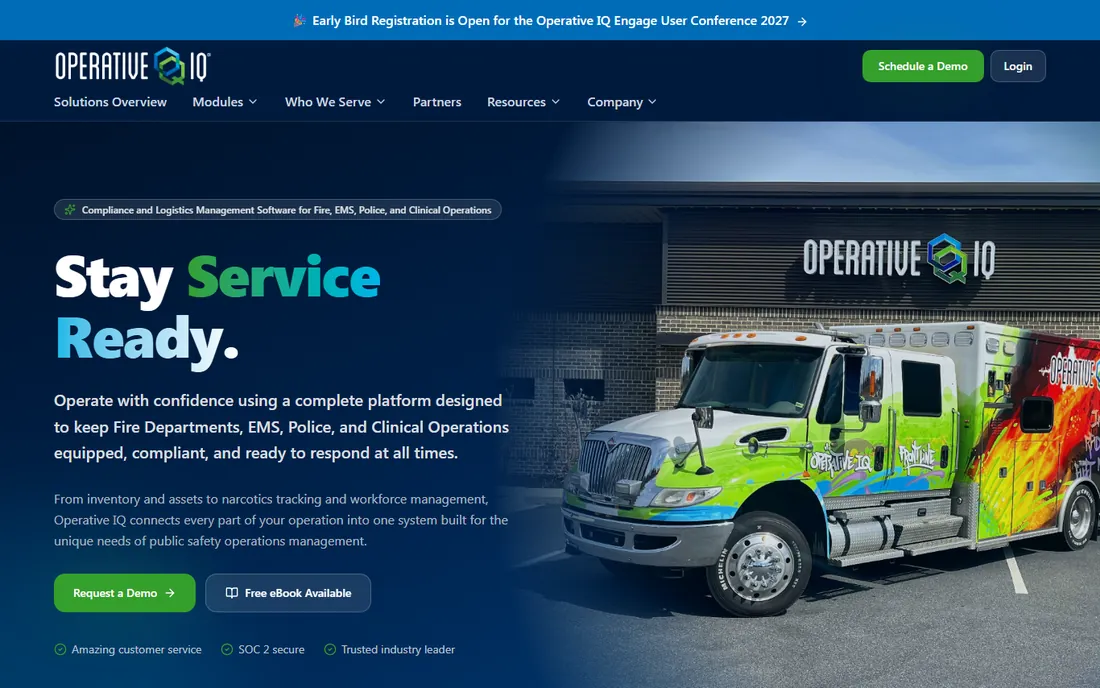
Operative IQ covers the stuff: vehicles, equipment, medical supplies, pharmaceuticals and narcotics, with the tracking and compliance that fire and EMS operations require. Fleet maintenance scheduling, inventory par levels, asset assignments and controlled-substance chain of custody live in one system designed for the regulatory reality of the fire service.
Like PSTrax, this is a specialist that joins a stack rather than anchoring it. Larger departments and EMS transport agencies get the most value, where fleet and inventory scale makes spreadsheets dangerous. Smaller departments should weigh it against the asset modules inside their RMS or all-in-one platform. If narcotics compliance or fleet maintenance is a known weakness, the specialization justifies itself.
What we like- Deep inventory and fleet management built for fire and EMS, including narcotics tracking
- Asset lifecycle and maintenance workflows
- Integrates with operational systems
Watch out for- Specialized scope means it is one piece of a larger software stack
- Smaller departments may manage with simpler tools
Matching the software to your department type
Volunteer departments have different needs than career metros, and the buying mistake is purchasing metro software for a volunteer roster. Volunteer and small combination departments should prioritize simplicity and price: Emergency Reporting for records, Aladtec for scheduling, Active911 for alerting. The systems must work with minimal IT support and volunteers who use them a few times a month.
Mid-size career and combination departments are the contested middle. This is where the all-in-one pitch lands: First Due for the full platform, or ESO for records plus Vector/Aladtec for the people side. The deciding factor is usually staffing complexity and state reporting requirements. Get both vendors to demo your state's reports, not generic ones.
Large metros and multi-agency systems buy for standardization and data. ESO and ImageTrend lead on the data side; First Due leads on the unified platform side. Statewide NERIS deployments are reshaping this tier, so ask every vendor how they handle the transition, what it costs, and what happens to historical NFIRS data.
The NERIS transition every buyer must ask about
The national incident reporting standard is moving from NFIRS to NERIS, and this affects every records purchase you make now. Any vendor you consider should be able to explain their NERIS support clearly: which modules are compliant today, what the migration path looks like for your historical data, and whether the transition costs extra.
This is also a data hygiene moment. Departments with years of messy NFIRS data should ask vendors how the migration handles incomplete or inconsistent records. The vendors investing seriously in NERIS (ESO and First Due have been the most vocal) are signaling where the market is going. A vendor with no clear NERIS story is a red flag regardless of how good the demo looks.
Beyond compliance, use the transition to fix workflows. Incident reporting quality depends on field usability: if firefighters cannot complete reports on a tablet at the station kitchen table, the data will be bad in any system. Demo the report-writing experience on a tablet, with gloves-on realism about how it gets used, before you commit.
How we chose
We started with the searches fire service leaders actually run: fire department software, fire records management software, fire department scheduling software and NFIRS/NERIS reporting software. For each candidate we checked the vendor's own site and documentation for fire-service-specific capability (incident reporting, NERIS support, scheduling rules, inspections, preplanning, alerting), compared feature depth and integration options, and weighed fit by department type, from volunteer companies to large metros. Where pricing was not published on the vendor's site we wrote "See website" rather than guessing.
Frequently asked questions
What is fire department software?
Software for fire service operations, usually covering several of these areas: incident records management (NFIRS/NERIS), scheduling and staffing, inspections and pre-incident planning, training and certifications, apparatus and inventory checks, and emergency alerting. Most departments run two to four systems covering different areas.
How much does fire department software cost?
Pricing is quote-based across the category and scales with department size, module count and user count. Small departments often spend modest four-figure annual amounts on a records system plus scheduling, while large agencies spend deep into five figures for platform deployments. Alerting tools like Active911 are typically the most affordable piece. Get itemized quotes per module.
What is the difference between NFIRS and NERIS?
NFIRS is the long-standing National Fire Incident Reporting System. NERIS, the National Emergency Response Information System, is its modern replacement, designed for better data quality and analytics. Departments are transitioning now, so every records purchase should include the vendor's NERIS migration plan and timeline.
Should a small volunteer department buy an all-in-one platform?
Usually not at first. Volunteer departments get more value from best-of-breed pieces that are simple to learn: a proven records system, a scheduling tool built for fire shifts, and an alerting app. All-in-one platforms make sense when the department has the administrative capacity to implement them.
What is a fire RMS?
A records management system: the software where incident reports, inspections, hydrant records, personnel files, training records and inventory live. It produces the state and national reports (NFIRS/NERIS) and the internal analytics on response times, call types and resource use. ESO, Emergency Reporting and First Due all include RMS functionality.
How do departments handle scheduling for 24/48 shifts?
With scheduling software built for fire service patterns. Generic schedulers struggle with Kelly days, platoon rotations, minimum staffing rules and overtime equalization. Aladtec, Vector Scheduling and the scheduling modules in First Due and ESO handle these natively. Demo with your actual rotation and union rules, not the vendor's sample data.
Sources we checked (11)
- https://www.firstdue.com
- https://www.eso.com
- https://www.emergencyreporting.com
- https://www.vectorsolutions.com
- https://www.imagetrend.com
- https://www.pstrax.com
- https://www.aladtec.com
- https://www.active911.com
- https://www.operativeiq.com
- https://www.g2.com/categories/fire-department
- https://www.capterra.com/fire-department-software/
Is your product missing or out of date?
We review this list regularly. Vendors can request a listing, send updated pricing or ask about featured placement.

Shihab Mia · Founder, Rankite
Shihab has spent more than a decade helping SaaS and e-commerce brands grow through search. He writes Rankite's software buying guides from pricing pages, documentation and public user reviews. More about Shihab.