How we make this list: we compare pricing pages, product documentation and public user reviews. Rankite is independent; if a vendor ever pays for a featured spot, that listing is clearly labeled Partner.
Key takeaways
- HST Pathways is the ASC-native category leader, with scheduling, clinical, billing and inventory built for outpatient surgery from the start.
- Multi-specialty centers that want one EHR across the practice and the surgery center should look at eClinicalWorks, AdvancedMD and CureMD.
- Surgical Notes pairs its EHR with revenue cycle services, which suits centers that want billing help, not just billing software.
- Casetabs and StreamlineMD are the lighter, more modern options for centers that find the big platforms heavy.
Quick comparison
| Tool | Best for | Starting price | Free plan |
|---|
 HST Pathways HST Pathways | ASCs that want scheduling, clinical, billing and inventory in one native system | See website | No |
 Surgical Information Systems Surgical Information Systems | Multi-site ASC groups and larger operators needing enterprise depth | See website | No |
 eClinicalWorks eClinicalWorks | Practices that run an ASC alongside their clinic | See website | No |
 AdvancedMD AdvancedMD | Independent practices with surgery center operations | See website | No |
 Surgical Notes Surgical Notes | ASCs that want software plus revenue cycle services | See website | No |
 MedSys MedSys | Single and multi-specialty ASCs wanting a focused, purpose-built system | See website | No |
 StreamlineMD StreamlineMD | Centers wanting a modern, lighter-weight ASC EHR | See website | No |
 Casetabs Casetabs | Surgery centers prioritizing coordination across surgeons, staff and vendors | See website | No |
 CureMD CureMD | Practices needing EHR, practice management and billing in one affordable system | See website | No |
Is your product missing or out of date?
We review this list regularly. Vendors can request a listing, send updated pricing or ask about featured placement.
What the right ASC software changes on a Tuesday morning
Picture the administrator of a four-OR surgery center at 7 a.m. The schedule has two add-on cases, anesthesia needs the updated preference cards, the front desk is verifying benefits for tomorrow's patients, and billing is chasing three claims that denied for authorization. In a center running on a generic EHR or a patchwork of systems, that morning is phone calls and spreadsheets. In a center on ASC-native software, the schedule, the chart, the preference cards and the claim share one record.
Ambulatory surgery center software is not hospital software shrunk down. ASCs live on throughput: fast room turnover, tight preference-card management, anesthesia documentation that keeps pace, and billing that captures every implant and supply. The nine platforms below cover the genuine ASC market, from the category specialists to the broader EHRs with real ASC footprints.
#1
HST Pathways
Best for: ASCs that want scheduling, clinical, billing and inventory in one native system
Visit hstpathways.com
Starting priceSee website
Free planNo
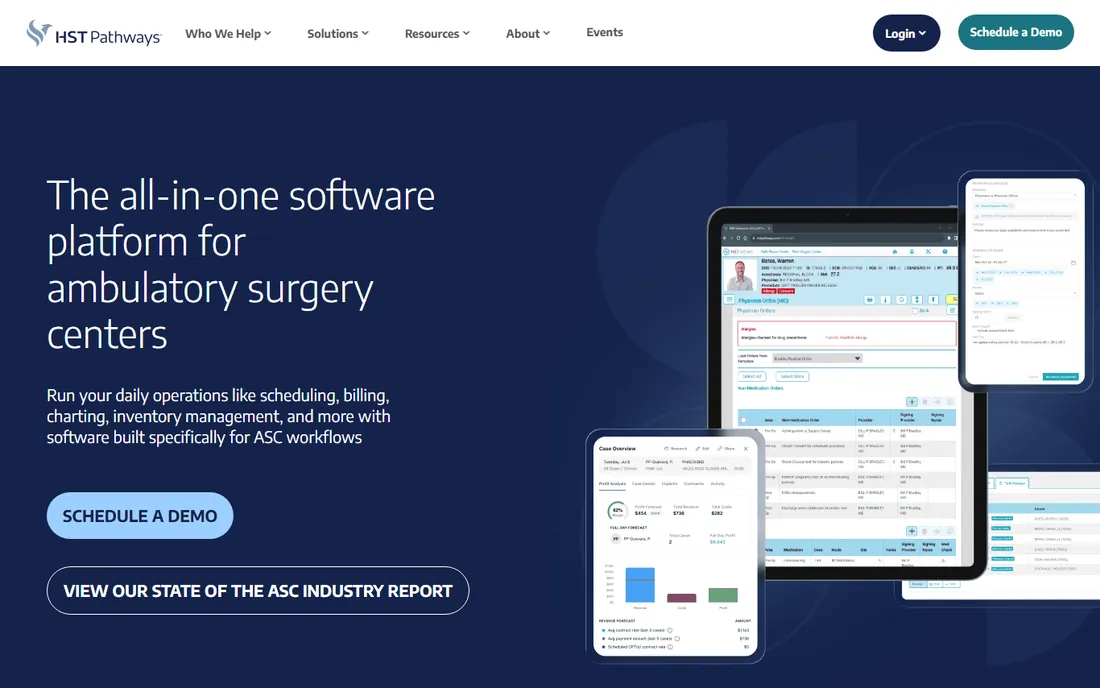
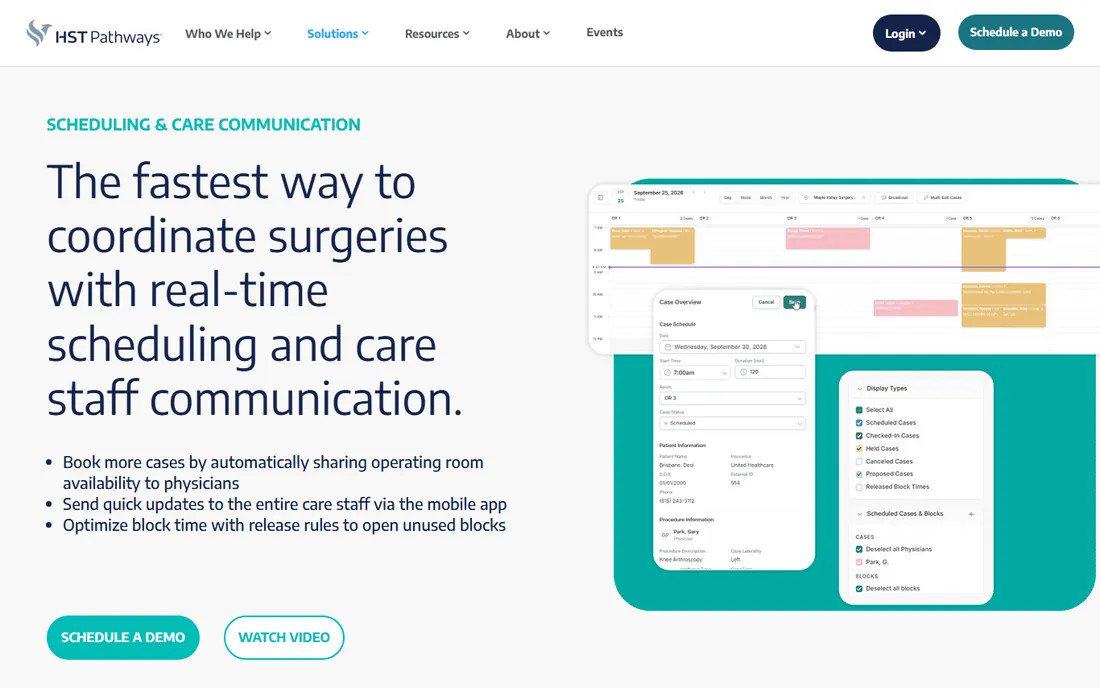
HST Pathways is the name that comes up first in ASC software conversations, and the reason is focus. The company builds only for surgery centers, so the product assumes the ASC workflow: case scheduling with block management, pre-op and PACU charting designed for fast turnover, anesthesia documentation, implant and supply tracking tied to the case, and billing that follows the same record. Nothing is a hospital module repurposed.
The platform covers the business side too: patient engagement and reminders, online payments, inventory management and analytics. It can be bought as a suite or in modules, which helps centers that want to start with scheduling and billing and add clinical later. For a single-specialty or multi-specialty center that wants one vendor for the whole operation, this is the default shortlist entry.
What we like- Built only for ASCs, so workflows match outpatient surgery instead of hospital processes
- Modules for scheduling, EHR, billing, inventory and patient engagement share one database
- Strong presence across single and multi-center operators
Watch out for- Pricing is quote-based and implementations take planning
- Centers with unusual specialty mixes should verify fit in the demo
#2
Surgical Information Systems
Best for: Multi-site ASC groups and larger operators needing enterprise depth
Visit sisfirst.com
Starting priceSee website
Free planNo
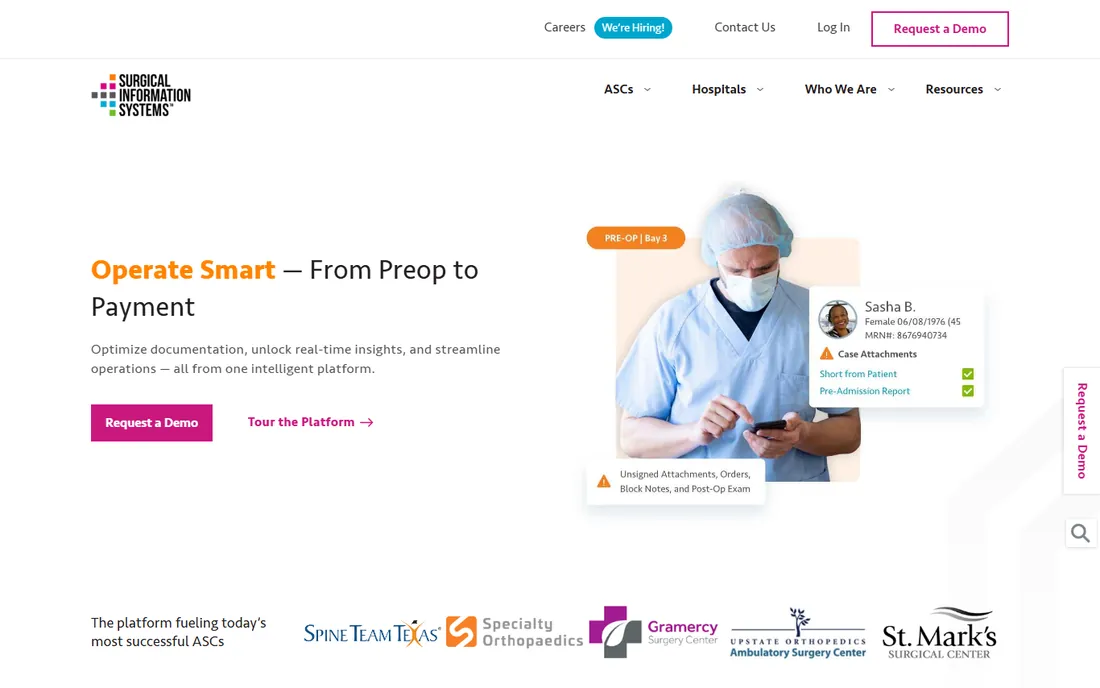
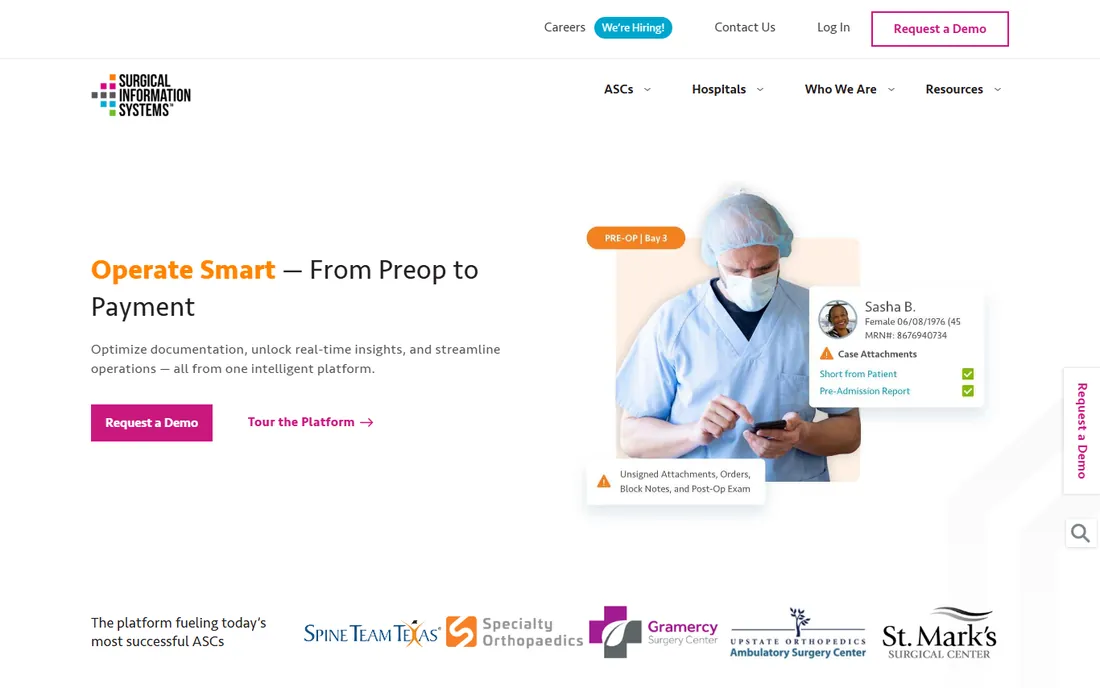
Surgical Information Systems, known as SIS, has served the ASC market for decades, and its footprint skews toward larger operators and multi-center groups. The platform spans the full case lifecycle: scheduling, registration, clinical documentation for nursing, anesthesia and surgeons, materials management, billing and business intelligence. Centralized reporting across centers is the draw for groups standardizing operations.
The trade-off is the one that comes with enterprise software everywhere: implementation is a project, training is real, and the price reflects the depth. A two-OR single-specialty center will likely find lighter options faster to value. A group rolling up centers or a joint venture with a health system will appreciate the standardization and the interoperability.
What we like- Long-established ASC specialist with deep scheduling, clinical and revenue cycle modules
- Scales across multi-center organizations with centralized reporting
- Strong interoperability story for health system partnerships
Watch out for- Enterprise weight means longer implementations and real training needs
- Smaller single centers may find it more system than they need
Starting priceSee website
Free planNo
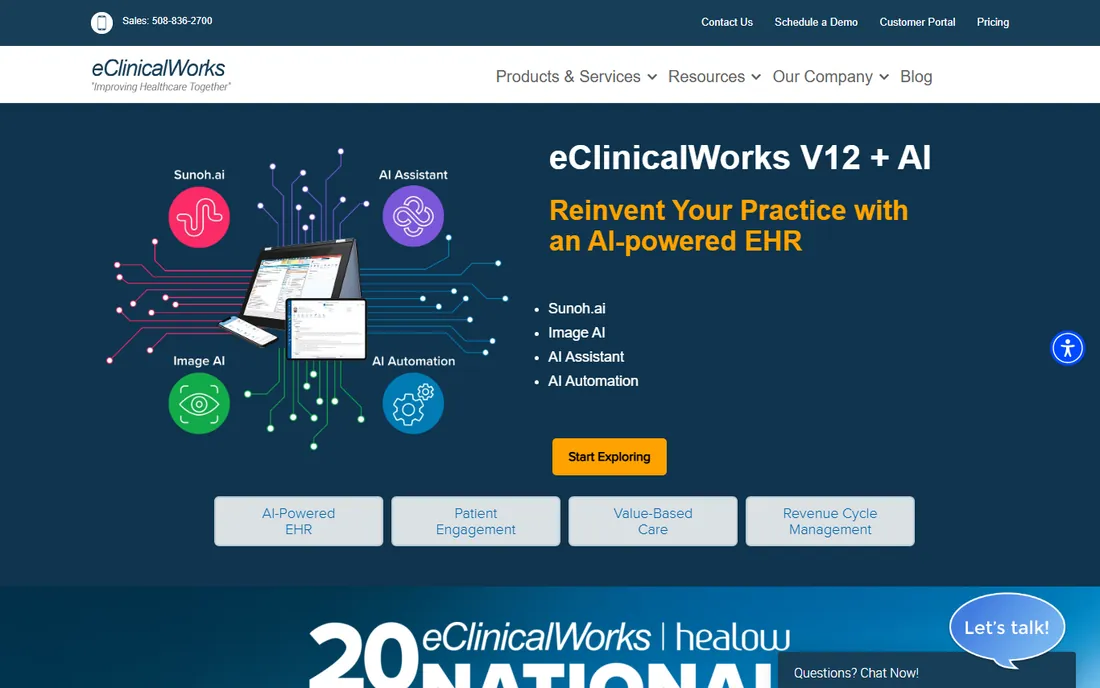
Many ASCs are extensions of a surgical practice, and when the practice already runs eClinicalWorks, extending it to the center is the path of least resistance. The platform covers scheduling, documentation, orders, billing and patient engagement in one cloud system, and its sheer install base means staff familiarity and third-party integrations are easy to find.
The honest limitation is specialty depth. eClinicalWorks is a general ambulatory EHR, and while it supports surgical workflows, it does not think in ASC terms the way HST or SIS do. Preference cards, block scheduling and implant tracking may need configuration or add-ons. If the practice and the center must share one system, it is a strong fit. If the center stands alone, compare it directly against the ASC natives.
What we like- One of the largest ambulatory EHR footprints in the US, so hiring staff who know it is easy
- Practice management, EHR and revenue cycle in one system
- Cloud-based with patient engagement tools included
Watch out for- ASC-specific workflows are not as deep as the ASC-native platforms
- Large product surface means configuration matters
Starting priceSee website
Free planNo
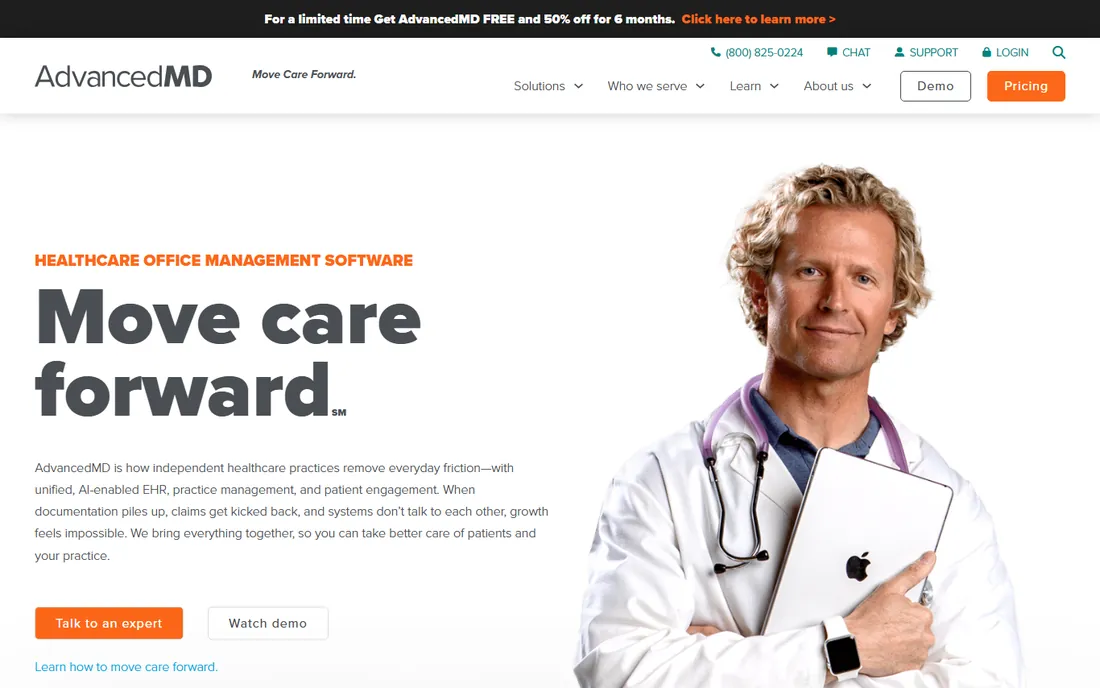
AdvancedMD pitches the independent practice that wants one system for everything, and for groups that own their ASC, the surgery center rides along. The billing side is the standout: a built-in clearinghouse, automated charge capture, denial management and reporting that gives administrators a clear view of the revenue cycle. Scheduling and documentation cover the clinical workflow.
Like eClinicalWorks, this is a generalist. The ASC-specific pieces (block time, preference cards, anesthesia workflows, implant tracking) exist but are not the product's center of gravity. Centers should demo the surgical scheduling and supply tracking specifically rather than accepting the general scheduling demo. For practice-owned centers that value one vendor and strong billing, it belongs on the list.
What we like- Unified practice management, EHR and clearinghouse-backed billing in one cloud platform
- Strong revenue cycle tools with automation around claims and denials
- Scales from small groups to larger organizations
Watch out for- Not ASC-specific, so surgical scheduling and preference management need setup
- Pricing is quote-based with tiers that add up
Starting priceSee website
Free planNo
Surgical Notes takes a different angle: it sells the EHR and the revenue cycle together. The platform covers scheduling, clinical documentation, anesthesia and billing, and the company also offers coding, transcription and full revenue cycle management as services. For centers whose billing operation is a constant headache, handing both the software and the collections to one ASC-focused vendor is appealing.
The consideration is the bundle. If your in-house billing team is strong, you may not want the service layer, so clarify what the software costs standalone. And any bundled arrangement deserves a careful look at contract terms and data ownership. But for centers that would rather focus on cases than claims, the combined offer is genuinely differentiated.
What we like- Combines an ASC EHR with outsourced billing and transcription services
- Coding and claims expertise specific to ASC reimbursement
- Single vendor for documentation and collections
Watch out for- Bundling services with software can complicate switching later
- Centers with in-house billing may pay for services they do not need
#6
MedSys
Best for: Single and multi-specialty ASCs wanting a focused, purpose-built system
Visit medsys.com
Starting priceSee website
Free planNo
MedSys is one of the quieter ASC-native vendors, and that can be an advantage. The product covers the core ASC loop: scheduling with block management, clinical documentation, anesthesia charting, billing and inventory, with preference cards and supply tracking that reflect how surgery centers actually work. Mid-size centers often find the implementation and support more personal than the enterprise vendors.
The trade is ecosystem. A smaller vendor means fewer third-party integrations and a smaller user community to learn from. Before committing, verify the interfaces your center needs: clearinghouse, anesthesia devices, accounting export and any health system partner connections. If those check out, the focused product and attentive support are a good combination.
What we like- ASC-specific scheduling, clinical and billing in one focused product
- Preference card and inventory management built for surgical workflows
- Responsive support sized for mid-market centers
Watch out for- Smaller vendor footprint means fewer peer references than the leaders
- Integration list is narrower than the big EHR platforms
Starting priceSee website
Free planNo
Some centers look at the enterprise ASC platforms and see more software than they will ever use. StreamlineMD is built for them. The product covers scheduling, clinical documentation and billing with an interface designed for quick adoption, and implementations move faster because there is less to configure. Staff training time drops, which matters in centers with turnover.
The limitation is ceiling. Multi-center groups with centralized materials management, complex payer contracts and deep analytics will outgrow it. Single centers and small groups that want to get live quickly and keep the workflow simple are the fit. Demo the billing and reporting depth honestly against your payer mix before deciding.
What we like- Modern interface that staff tend to adopt quickly
- Covers scheduling, documentation and billing without enterprise overhead
- Implementation is typically faster than the big platforms
Watch out for- Depth in complex multi-center scenarios is thinner
- Reporting and analytics are less extensive than SIS or HST
#8
Casetabs
Best for: Surgery centers prioritizing coordination across surgeons, staff and vendors
Visit casetabs.com
Starting priceSee website
Free planNo
Casetabs approaches the ASC problem from the coordination side. Surgery centers run on communication: schedule changes, vendor reps bringing implants, anesthesia assignments, patient instructions. Casetabs centralizes that coordination with case scheduling, messaging and workflow tools that connect everyone involved in a case, including people outside the center.
It is important to understand what it is not: Casetabs is not a full clinical EHR or a billing system. Centers typically run it alongside their documentation and billing platforms. The value is fewer phone calls, fewer day-of surprises and a single view of the day's cases. For centers where coordination chaos is the real problem, that is worth more than another documentation module.
What we like- Coordination-first design connecting surgeons, anesthesia, staff, vendors and patients around the schedule
- Strong communication and case management tools
- Modern cloud product with fast onboarding
Watch out for- Not a full EHR or billing replacement, so it usually pairs with other systems
- Centers wanting one database for everything should look elsewhere
#9
CureMD
Best for: Practices needing EHR, practice management and billing in one affordable system
Visit curemd.com
Starting priceSee website
Free planNo
CureMD is the value play among the broader EHRs. It bundles electronic health records, practice management and medical billing in one cloud platform, with specialty templates and a price point that undercuts the larger ambulatory vendors. For a surgical practice opening or running a modest ASC, the economics are attractive.
The caveat mirrors the other generalists: this is not ASC-native software. Block scheduling, preference cards, implant tracking and anesthesia workflows need evaluation in the demo, not assumption. Centers with straightforward single-specialty volume and tight budgets get the most from it. Complex multi-specialty centers should weigh the savings against the workflow gaps.
What we like- All-in-one EHR, practice management and billing at a price point below the big ambulatory EHRs
- Cloud-based with patient engagement features
- Specialty content including surgical templates
Watch out for- ASC-specific depth is limited compared to the ASC natives
- Smaller market presence in the surgery center segment specifically
The features that actually decide an ASC purchase
Start with scheduling, because the schedule is the center's nervous system. You need block time management, add-on and emergent case handling, conflict alerts for rooms and equipment, and real-time visibility for surgeons, anesthesia and staff. Ask each vendor to demo a messy day: two add-ons, a room conflict and a surgeon running late. The quality of that demo tells you more than any feature checklist.
Clinical documentation comes next. Pre-op, intra-op, PACU and discharge charting should flow without re-entry, and anesthesia documentation must keep pace with fast turnover. Preference cards deserve their own demo: they drive supply pulls, setup and billing, and a weak preference-card system creates daily friction.
On the business side, verify three things. Billing should handle ASC facility claims, implant carve-outs and payer-specific rules, with denial tracking and patient estimates. Inventory should tie implants and supplies to the case for both cost capture and reordering. And reporting should answer the administrator's real questions: block utilization, on-time starts, supply cost per case and days in A/R. If a vendor cannot show those four reports live, keep looking.
Implementation, contracts and the questions to ask references
ASC software implementations fail on data and workflow, not on software quality. Ask each vendor how long a center your size typically takes to go live, what the center's staff must provide (and when), and how historical cases and preference cards migrate. Preference-card migration alone can make or break the first month.
On contracts, clarify the pricing model: per-provider, per-case, per-module or flat. Per-case pricing looks cheap until volume grows; per-provider pricing punishes centers with many part-time surgeons. Ask about the term length, renewal increases and who owns your data on exit, including the export format. Healthcare software contracts are sticky by design, so read the exit clause before the feature list.
Finally, call references. Ask for two centers of your size and specialty mix that went live in the last year. Ask what broke in the first 90 days, how support responded, and what the administrator would do differently. Vendors will give you happy references; the useful signal is in how they describe the rough patches.
How we chose
We started with the searches ASC leaders actually run: ambulatory surgery center software, ASC EHR, surgery center scheduling and billing software. For each candidate we checked the vendor's own site and documentation for ASC-specific capability (block scheduling, preference cards, anesthesia charting, implant tracking, ASC billing), compared feature depth and integration options, and weighed fit by center size, from single-specialty centers to multi-site groups. Where pricing was not published on the vendor's site we wrote "See website" rather than guessing.
Frequently asked questions
What is ambulatory surgery center software?
Software built for outpatient surgery centers, covering case scheduling, clinical documentation (including anesthesia), preference cards, inventory and implant tracking, billing and reporting. ASC-native platforms design these workflows for fast room turnover and outpatient reimbursement, unlike hospital systems adapted down.
How much does ASC software cost?
Nearly all vendors quote per deal based on providers, cases, modules and implementation, so published prices are rare. Expect the cost to scale with center size and module count, plus a real implementation project. Get per-provider versus per-case pricing modeled against your actual volume before comparing quotes.
Can a regular EHR work for a surgery center?
A general ambulatory EHR can work when the practice and the center share one system, and vendors like eClinicalWorks, AdvancedMD and CureMD serve that model. The gaps are usually block scheduling, preference cards, implant tracking and anesthesia workflow depth. Demo those specifically rather than assuming the general EHR covers them.
What is the difference between HST Pathways and SIS?
Both are ASC-native with full scheduling, clinical, billing and inventory. HST Pathways is often described as the more modern, unified platform and is widely adopted across center sizes. SIS has deeper enterprise roots and skews toward multi-center groups. Centers should demo both against their actual scheduling and reporting needs.
Do I need separate billing software for an ASC?
Most ASC platforms include billing, and several vendors (notably Surgical Notes) pair software with revenue cycle services. What matters is ASC-specific billing competence: facility claims, implant carve-outs, payer rules and denial management. If your denials are high, evaluate the vendor's billing depth, not just the documentation.
How long does ASC software implementation take?
It varies by vendor and center size, but plan on several months for the enterprise platforms once data migration, preference cards, interfaces and training are counted. Lighter platforms can go live faster. Ask each vendor for a timeline based on a center your size, and ask references what the real timeline was.
Sources we checked (11)
- https://www.hstpathways.com
- https://www.sisfirst.com
- https://www.eclinicalworks.com
- https://www.advancedmd.com
- https://www.surgicalnotes.com
- https://www.medsys.com
- https://www.streamlinemd.com
- https://www.casetabs.com
- https://www.curemd.com
- https://www.g2.com/categories/ambulatory-surgery-center
- https://www.capterra.com/ambulatory-surgery-center-software/
Is your product missing or out of date?
We review this list regularly. Vendors can request a listing, send updated pricing or ask about featured placement.

Shihab Mia · Founder, Rankite
Shihab has spent more than a decade helping SaaS and e-commerce brands grow through search. He writes Rankite's software buying guides from pricing pages, documentation and public user reviews. More about Shihab.