How we make this list: we compare pricing pages, product documentation and public user reviews. Rankite is independent; if a vendor ever pays for a featured spot, that listing is clearly labeled Partner.
Key takeaways
- Medical dictation in 2026 splits into two camps: classic speech recognition you dictate into (Dragon Medical One, Mobius Conveyor, Philips SpeechLive) and ambient AI that writes notes from the visit itself (Abridge, Suki, DeepScribe, Sunoh.ai).
- Sunoh.ai says more than 100,000 healthcare providers use its AI scribe; Abridge says 300+ health systems trust its platform; DeepScribe says it covers about 90% of community oncology centers.
- Every vendor in this roundup sells on custom quotes rather than public pricing, which makes demos and pilots the real price-discovery step.
- Practices that want to dictate on their own terms should start with Mobius or Philips SpeechLive; health systems standardizing documentation belong with Abridge, Suki, or DeepScribe.
Quick comparison
| Tool | Best for | Starting price | Free plan |
|---|
 Dragon Medical One Dragon Medical One | clinicians who want proven speech recognition inside any EHR | See website | No |
 Abridge Abridge | health systems standardizing on ambient documentation | See website | No |
 Suki Suki | multi-specialty organizations wanting one AI assistant | See website | No |
 DeepScribe DeepScribe | oncology practices and specialty groups | See website | No |
 Sunoh.ai Sunoh.ai | small and mid-size practices trying ambient AI without commitment | See website | Free trial |
 Mobius MD Mobius MD | clinicians who dictate from their phone into any computer | See website | Free trial |
 Philips SpeechLive Philips SpeechLive | practices needing dictation plus a transcription workflow | See website | Free trial |
Is your product missing or out of date?
We review this list regularly. Vendors can request a listing, send updated pricing or ask about featured placement.
The best medical dictation software
The medical dictation market quietly bifurcated. On one side, refined speech recognition still dominates: you speak, the software types, and you stay in control of every word. On the other, ambient clinical intelligence listens to the visit and drafts the note for you, shifting the clinician's job from dictating to reviewing. Both approaches are legitimate, but they suit different temperaments, workflows, and budgets. These seven cover the full spread.
#1
Dragon Medical One
Best for: clinicians who want proven speech recognition inside any EHR
Visit nuance.com
Starting priceSee website
Free planNo
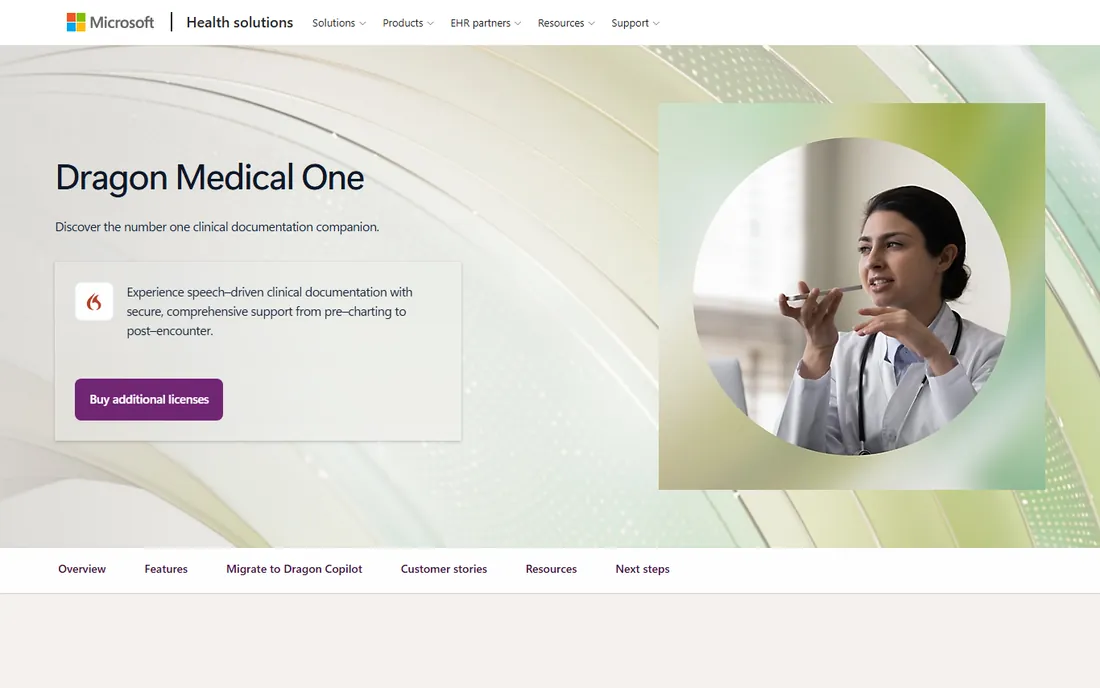
Dragon Medical One is the incumbent that defined clinical speech recognition, now sitting inside Microsoft's healthcare portfolio. It is a secure cloud platform: clinicians dictate directly into the EHR, navigate by voice command, and carry one voice profile across every workstation, which removes the retraining friction that plagued older desktop dictation. The companion PowerMic Mobile app turns a smartphone into a wireless microphone, so any workstation becomes a dictation station.
What keeps Dragon in the conversation is control. Ambient tools ask you to review what they heard; Dragon does exactly what you say, with shortcuts and AutoTexts that turn repetitive paragraphs into a phrase. Clinicians who document complex cases or distrust AI-generated summaries tend to prefer that determinism. The honest catch is direction of travel: health systems are pouring budgets into ambient AI, and Dragon's enterprise sales motion means smaller practices face a heavier buying process than with the newer vendors.
What we like- Cloud-based with a single voice profile that follows you across workstations
- Deep EHR integration and medical vocabularies refined over decades
- PowerMic Mobile turns a phone into a secure dictation mic
Watch out for- Enterprise licensing with no public pricing
- Ambient-AI competitors now draft notes with less effort from the clinician
#2
Abridge
Best for: health systems standardizing on ambient documentation
Visit abridge.com
Starting priceSee website
Free planNo
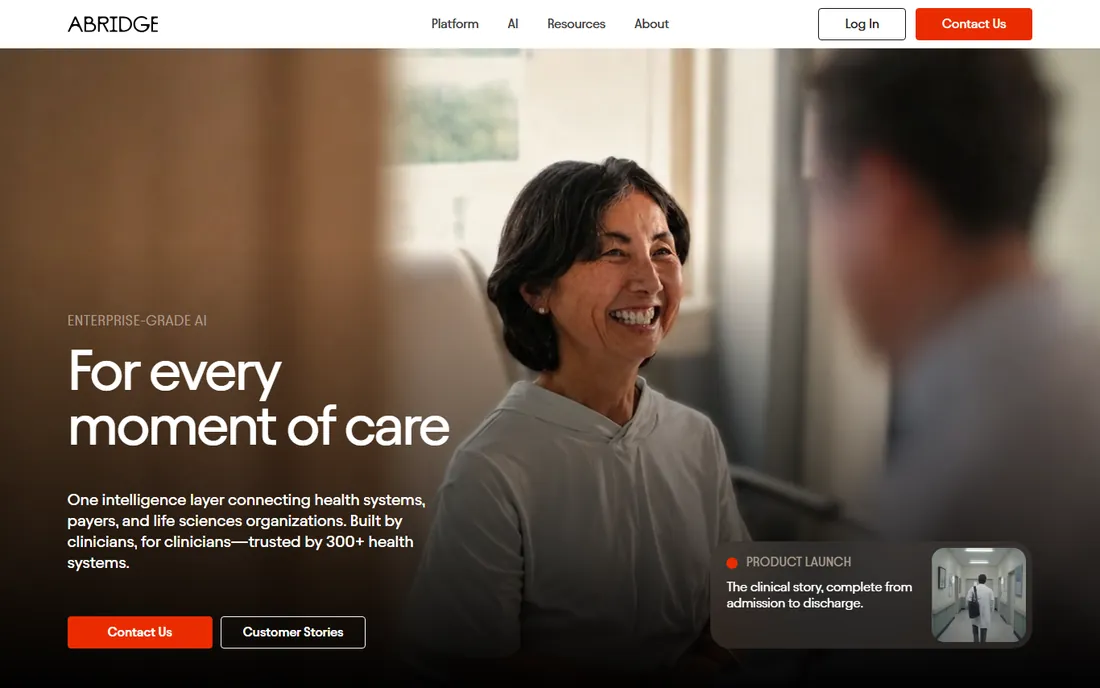
Abridge has become the enterprise face of ambient clinical documentation. Its platform captures the patient-clinician conversation and turns it into structured notes integrated with the EHR, with a contextual reasoning engine that goes beyond notes to draft medication, lab, imaging, and referral orders in real time. The company's own homepage is dense with outcome claims from partners: an 86% reduction in documentation effort at one health system, a 55% decrease in burnout, and Best in KLAS awards for ambient AI in both 2025 and 2026.
Abridge's pitch is the full care workflow: pre-visit summaries, in-encounter capture with decision support, and post-visit coding and patient summaries. Health systems get a single intelligence layer rather than a point tool. The trade-off is that this is a health-system sale: custom pricing, enterprise onboarding, and a product roadmap driven by large customers. Solo practices and small groups will find the buying process disproportionate to their needs.
What we like- Trusted by 300+ health systems with Best in KLAS 2025 and 2026 for ambient AI
- Contextual reasoning engine that also drafts orders
- Strong published outcome data
Watch out for- Enterprise-focused with custom pricing
- Smaller practices get less attention than large systems
#3
Suki
Best for: multi-specialty organizations wanting one AI assistant
Visit suki.ai
Starting priceSee website
Free planNo
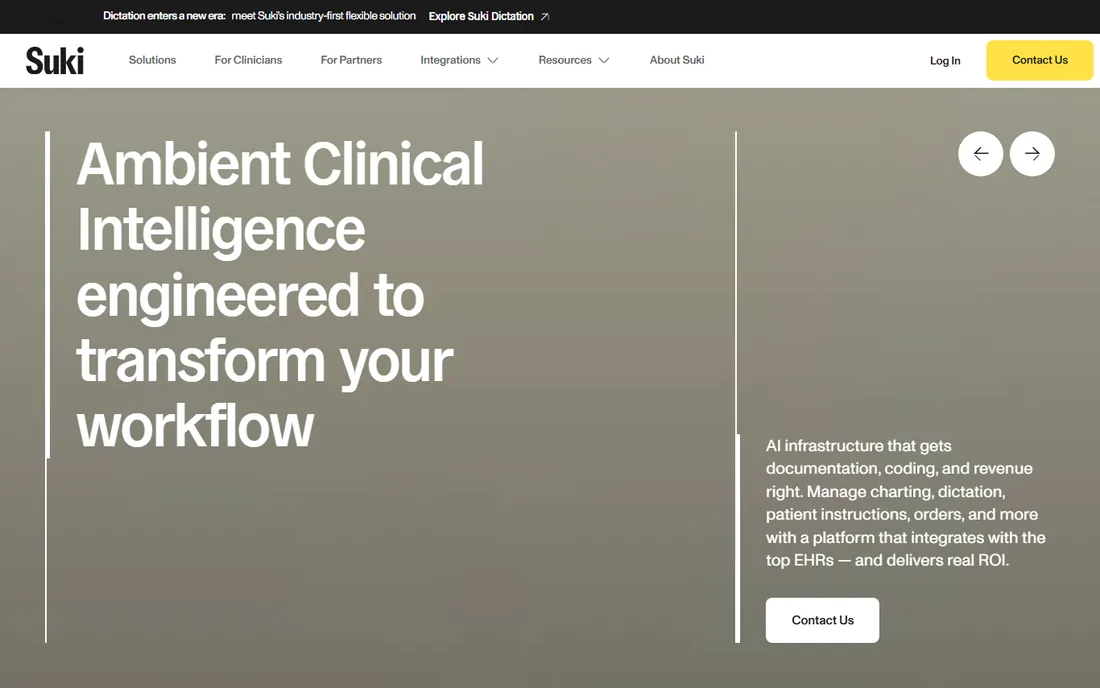
Suki positions itself as the AI assistant for clinicians rather than just a note-writer. Its ambient platform handles documentation, dictation, coding, orders, patient instructions, and clinical questions, with what it describes as the most embedded real-time integrations across the four leading EHRs. The company claims 400+ healthcare systems and partners, an 81% increase in practice satisfaction, a 41% reduction in note-taking time, and $1,688 in average incremental monthly revenue per user.
Where Suki separates from pure scribes is the workflow layer: referrals, scheduling setup, and revenue-cycle tasks are being folded into the same assistant, which matters for organizations trying to reduce admin burden beyond notes. Suki also offers a developer platform so healthtech partners can embed its capabilities. The honest catch is the same as Abridge's: this is enterprise software sold through enterprise channels, and organizations that only need dictation will pay for ambition they do not use.
What we like- Spans documentation, coding, orders, and clinical Q&A in one assistant
- Deep integrations with Epic, Oracle Health, athenahealth, and MEDITECH
- 400+ healthcare systems and partners
Watch out for- Enterprise pricing with no public numbers
- Breadth can mean longer deployment than single-purpose tools
Starting priceSee website
Free planNo
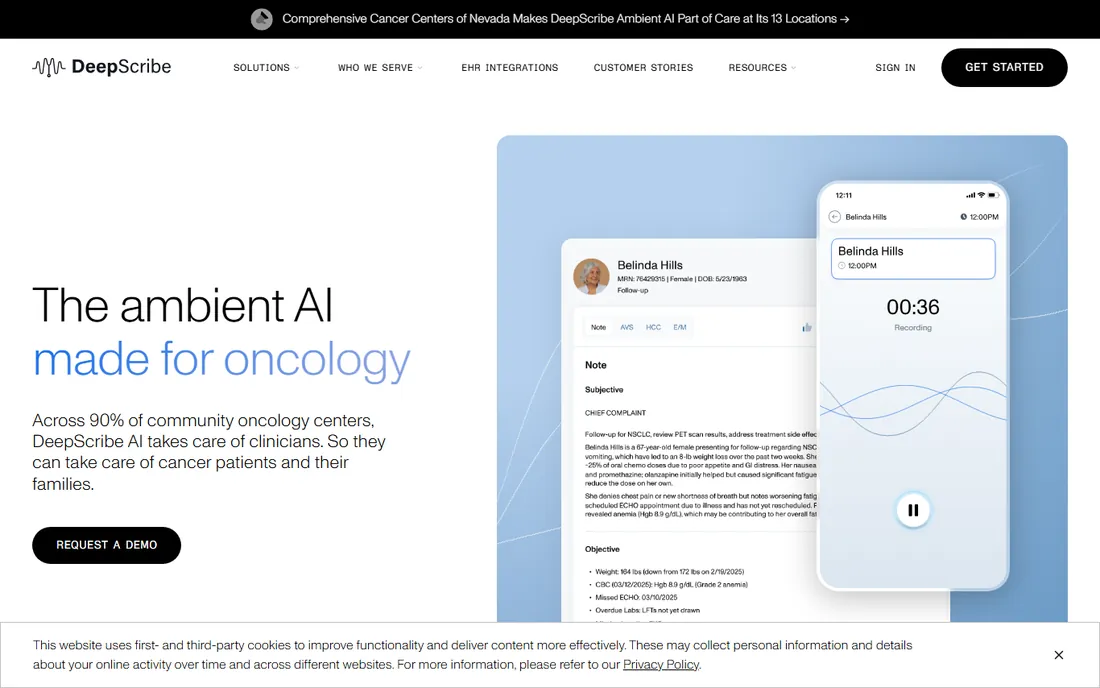
DeepScribe started as a general ambient scribe and has sharpened into the specialty play, most visibly in oncology. Its current platform covers the whole oncology workflow: SmartPrep pulls together the relevant patient data before the visit, the AI scribe documents the encounter, and automated coding captures diagnoses with what the company describes as greater depth. It says it reaches about 90% of community oncology centers and 40% of all US cancer visits, and embeds directly inside OncoEMR and iKnowMed.
Specialty depth is the differentiator here. Oncology notes involve longitudinal complexity, staging, regimens, and prior authorizations that general-purpose scribes flatten; DeepScribe's customization studio and context-aware notes are built for that. The company cites a 98.8 overall performance score in a 2025 KLAS spotlight report. The catch is focus: a general internal-medicine practice gets more product attention from Suki or Sunoh, and pricing is enterprise quote-based.
What we like- Specialty-tuned for oncology with pre-visit SmartPrep and automated coding
- Embedded in OncoEMR and iKnowMed
- 98.8 overall score in a 2025 KLAS spotlight report
Watch out for- Oncology-first positioning may limit appeal for general practices
- Enterprise pricing
#5
Sunoh.ai
Best for: small and mid-size practices trying ambient AI without commitment
Visit sunoh.ai
Starting priceSee website
Free planFree trial
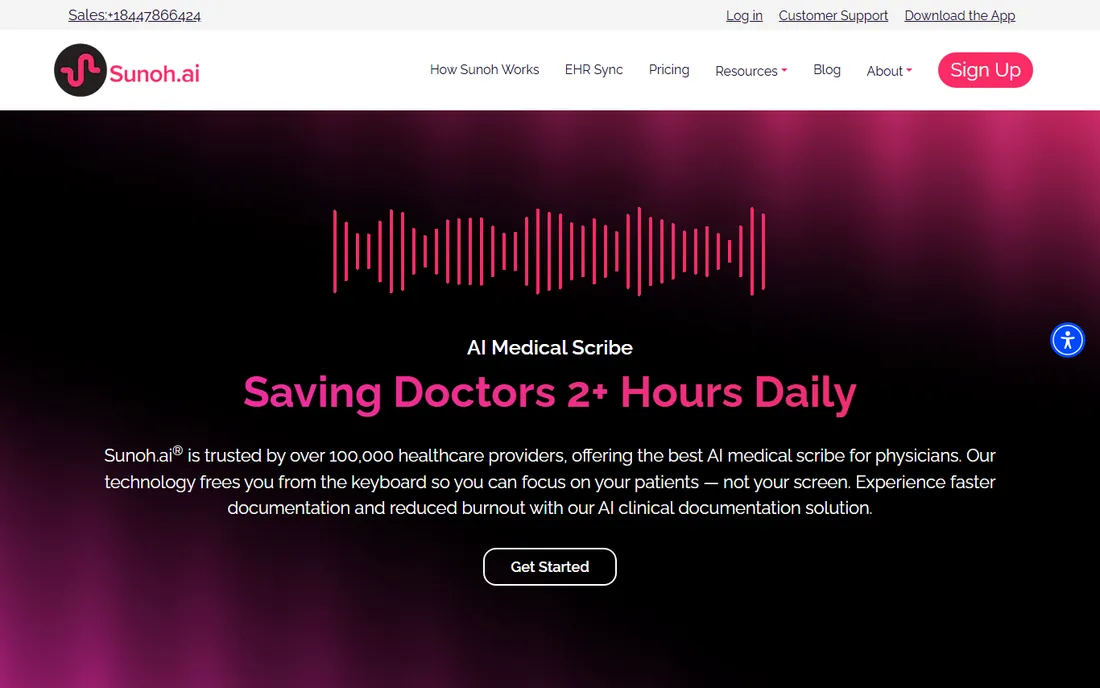
Sunoh.ai, from eClinicalWorks, is the most accessible ambient scribe on this list. The pitch is simple: start with no commitment, let the AI listen to visits, and get draft clinical notes, dialogue flows, and order-entry assistance in seconds. The company claims more than 100,000 healthcare providers use it and advertises savings of two or more documentation hours daily, with multilingual encounters (including Spanish conversations turned into English notes) as a genuine strength.
Integration is broad rather than shallow: the company lists athenahealth, Cerner, eClinicalWorks, Epic, ModMed, Practice Fusion, and Tebra, plus a free EHR Sync browser extension for browser-based EHRs not natively supported. Naturally the eClinicalWorks integration is the most mature, since it is the same company's product. Pricing is not published, which is the main frustration; expect a sales conversation. For practices that want to test ambient AI before committing budget, Sunoh's low-friction entry is the easiest on-ramp here.
What we like- Sign up with no commitment
- Trusted by 100,000+ providers per its homepage
- Multilingual support including Spanish-to-English documentation
Watch out for- Pricing not published
- EClinicalWorks integration is deepest, others vary
#6
Mobius MD
Best for: clinicians who dictate from their phone into any computer
Visit mobius.md
Starting priceSee website
Free planFree trial
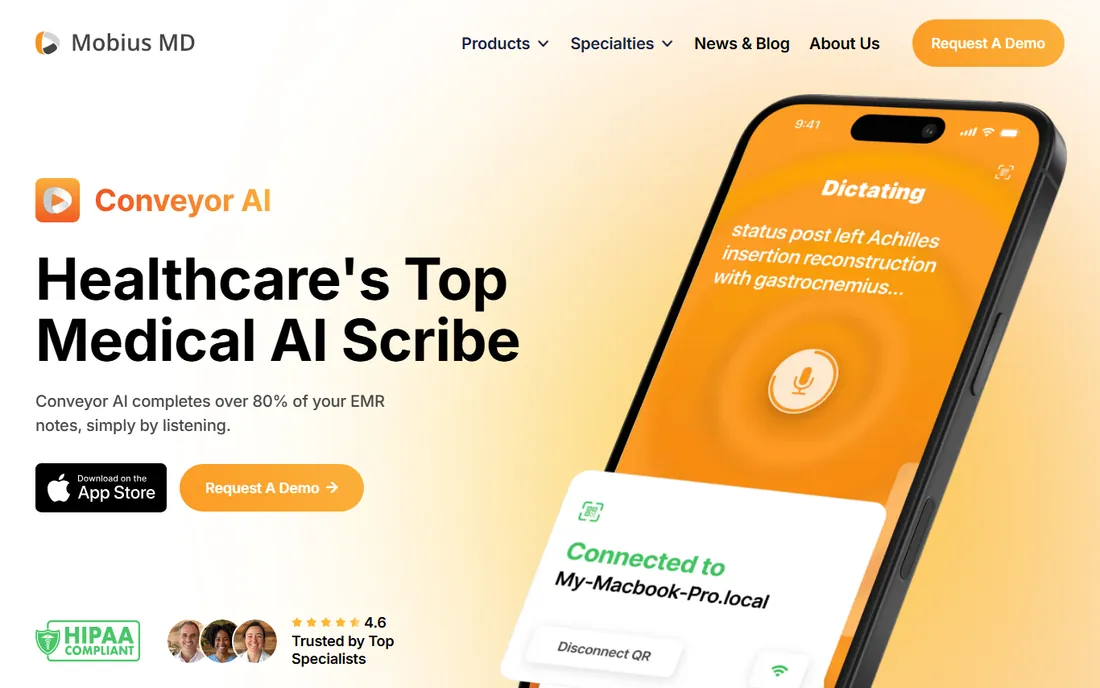
Mobius MD serves clinicians who found Dragon too heavy or too expensive. Its Conveyor product turns an iPhone or iPad into a microphone that dictates into any software on any Mac or PC: pair the phone, place the cursor in the EMR, and speak. The company also offers a fully automated AI scribe, Conveyor AI, that listens to encounters and generates most of the EMR note, plus the classic Mobius Clinic mobile app with medical dictation built in.
Mobius is refreshingly direct about its audience: busy providers who want unlimited dictation on a month-to-month subscription, HIPAA-compliant, with personal vocabularies and custom macros. Its homepage even courts former Dragon users with testimonials from clinicians who switched for price or Mac support. The honest catch is vendor size: support is reportedly responsive, but you are betting on a smaller company than Microsoft or Philips. For solo practitioners and small groups, that trade usually pays off in cost and flexibility.
What we like- Phone-as-microphone dictation into any EMR on Mac or PC
- Free trial with no hidden costs
- AI scribe option alongside classic dictation
Watch out for- Smaller vendor than Nuance or Philips
- Pricing not published on the homepage
#7
Philips SpeechLive
Best for: practices needing dictation plus a transcription workflow
Visit speechlive.com
Starting priceSee website
Free planFree trial
Philips SpeechLive comes from Speech Processing Solutions, the company behind the Philips dictation brand, and it thinks about dictation as a workflow, not just an app. You record via browser voice recorder, smartphone app, or Philips dictation hardware like the SpeechMike; recordings can be routed automatically to in-house assistants, teams, or external transcription services; and AI-powered speech recognition plus an AI assistant can convert and refine dictations into finished text.
That workflow layer is the reason to pick SpeechLive over a pure recognition tool: practices that still employ transcriptionists or outsource transcription get a managed pipeline with backup, recovery, and audit-friendly handling, hosted on Microsoft Azure with published regional hosting locations. Speech recognition is available in many languages but sits as a service on top of the dictation core. Pricing is quote-based, and the free trial is the sensible starting point. Practices that want dictation-plus-human-transcription orchestration will find little else this polished.
What we like- Cloud dictation with browser voice recorder and smartphone apps
- Routes recordings to assistants or transcription services
- Microsoft Azure hosting with regional data centers
Watch out for- Speech recognition is an add-on service rather than the core
- Pricing requires a quote
How we chose
We required every product to be live and actively sold in 2026 with an official homepage we could open and verify directly. We included both classic speech-recognition dictation and ambient AI scribes, since buyers searching for medical dictation software now encounter both and need to understand the difference. Pricing comes only from each vendor's own site; all seven use custom quotes, which is why the comparison shows "See website" throughout. We did not test any product hands-on. Judgments draw on vendor documentation, published customer counts, and third-party recognition such as KLAS awards that vendors cite on their own pages.
Dictation or ambient AI: pick your workflow first
The single most useful decision in this category is not which vendor, but which interaction model. Classic dictation (Dragon Medical One, Mobius Conveyor, Philips SpeechLive) keeps the clinician authoring the note: you speak deliberately, the software transcribes, and what you said is what gets documented. It suits specialists with complex findings, anyone who distrusts AI summarization, and workflows built around templates and macros.
Ambient AI (Abridge, Suki, DeepScribe, Sunoh.ai) flips the job: the system listens to the natural conversation and drafts the note, and the clinician reviews and signs. It suits high-volume visit schedules and clinicians who want to face the patient instead of the screen. The review step is real work, though, and note quality varies by specialty and audio environment.
Also weigh your EHR. Deep integrations matter more than feature lists: confirm your EHR is on the vendor's supported list and ask how notes actually land in the chart during the demo. eClinicalWorks users get the smoothest ride with Sunoh; Epic-heavy systems should press Abridge and Suki on their embedded workflows.
A note on accuracy claims
Every vendor in this space advertises impressive accuracy and time-savings numbers. Treat homepage statistics as directional: they reflect the vendor's best customers, not the median practice. The meaningful test is a pilot with your own clinicians, your own specialties, and your own exam-room acoustics. Most vendors on this list offer trials or demos; use them to measure review-and-correct time, not just transcription quality, because that is where the real hours go.
Frequently asked questions
What is the best medical dictation software?
For classic speech recognition, Dragon Medical One remains the enterprise standard. For ambient AI that drafts notes from the visit, Abridge, Suki, and DeepScribe lead, with Sunoh.ai the easiest to trial. Budget-conscious solo practitioners often land on Mobius MD, while practices with transcription workflows fit Philips SpeechLive.
Is medical dictation software the same as medical transcription software?
They overlap but differ. Dictation software converts your spoken words into text, usually in real time. Transcription software or services produce a finished document from a recording, often with human review. Ambient AI scribes are a third category: they listen to the visit and generate structured clinical notes. Many products now blend all three.
How much does medical dictation software cost?
All seven tools in this comparison use custom quotes rather than public pricing, which is typical for healthcare software. Costs vary with provider count, specialties, EHR integration, and whether you choose classic dictation or ambient AI. Trials and demos are the practical way to get numbers for your practice.
Is medical dictation software HIPAA compliant?
The vendors on this list all describe HIPAA-compliant architectures: encrypted hosting, business associate agreements, and audit controls. Compliance also depends on how your practice uses the tool, so confirm BAAs and data-handling terms during procurement rather than assuming the software alone covers you.
Can AI scribes replace human medical scribes?
For many practices they reduce the need, especially for routine documentation, and vendors report multi-hour daily savings. Human scribes still matter where real-time judgment, complex procedures, or patient interaction support is needed. Most practices that switch keep a review step in the workflow regardless.
Which medical dictation software works with Epic?
Abridge, Suki, DeepScribe, and Sunoh.ai all list Epic among their supported EHRs, and Dragon Medical One integrates with major EHRs including Epic. Confirm the depth of the integration during a demo, since "supported" can range from basic note import to fully embedded workflows.
Sources we checked (7)
- https://www.nuance.com/healthcare/provider-solutions/speech-recognition/dragon-medical-one.html
- https://www.abridge.com/
- https://suki.ai/
- https://deepscribe.ai/
- https://sunoh.ai
- https://mobius.md/
- https://www.speechlive.com/
Is your product missing or out of date?
We review this list regularly. Vendors can request a listing, send updated pricing or ask about featured placement.

Shihab Mia · Founder, Rankite
Shihab has spent more than a decade helping SaaS and e-commerce brands grow through search. He writes Rankite's software buying guides from pricing pages, documentation and public user reviews. More about Shihab.