How we make this list: we compare pricing pages, product documentation and public user reviews. Rankite is independent; if a vendor ever pays for a featured spot, that listing is clearly labeled Partner.
Key takeaways
- ShipStation ($14.99/month) is the most complete all-around pick, covering parcel and freight with 200+ carriers and up to 90% rate discounts.
- Pirate Ship is genuinely free with no monthly fees, making it the best shipping app for small business owners who mainly ship USPS and UPS.
- Shippo's free Starter plan (30 labels a month) is the cheapest way to start; paid plans begin at $19 a month.
- ShipWorks ($189/month) and Ordoro are built for volume and operations depth, not for casual shippers.
Quick comparison
| Tool | Best for | Starting price | Free plan |
|---|
 ShipStation ShipStation | growing ecommerce brands shipping parcel and freight | $14.99/month | Yes |
 Pirate Ship Pirate Ship | small businesses wanting free UPS and USPS rates | $0/month | Yes |
 Shippo Shippo | low-volume sellers needing a free starter plan | $0/month | Yes |
 Stamps.com Stamps.com | offices combining mail, stamps, and package shipping | $14.99/month | Free trial (30 days) |
 EasyPost EasyPost | developers building shipping into their own software | $0.08 per label | No |
 ShipWorks ShipWorks | high-volume Windows-based warehouses | $189/month | Free trial (30 days) |
 Ordoro Ordoro | merchants combining shipping with inventory management | $0/month | Yes |
Is your product missing or out of date?
We review this list regularly. Vendors can request a listing, send updated pricing or ask about featured placement.
The best shipping software
Shippo reports that more than 200 million shipments move through its platform every year (goshippo.com). The category is crowded, but the right choice narrows fast once you know your monthly volume, which carriers you use, and whether you also need inventory or warehouse tools. Here are the seven best shipping software options for 2026, with pricing verified from each vendor's own site.
Starting price$14.99/month
Free planYes
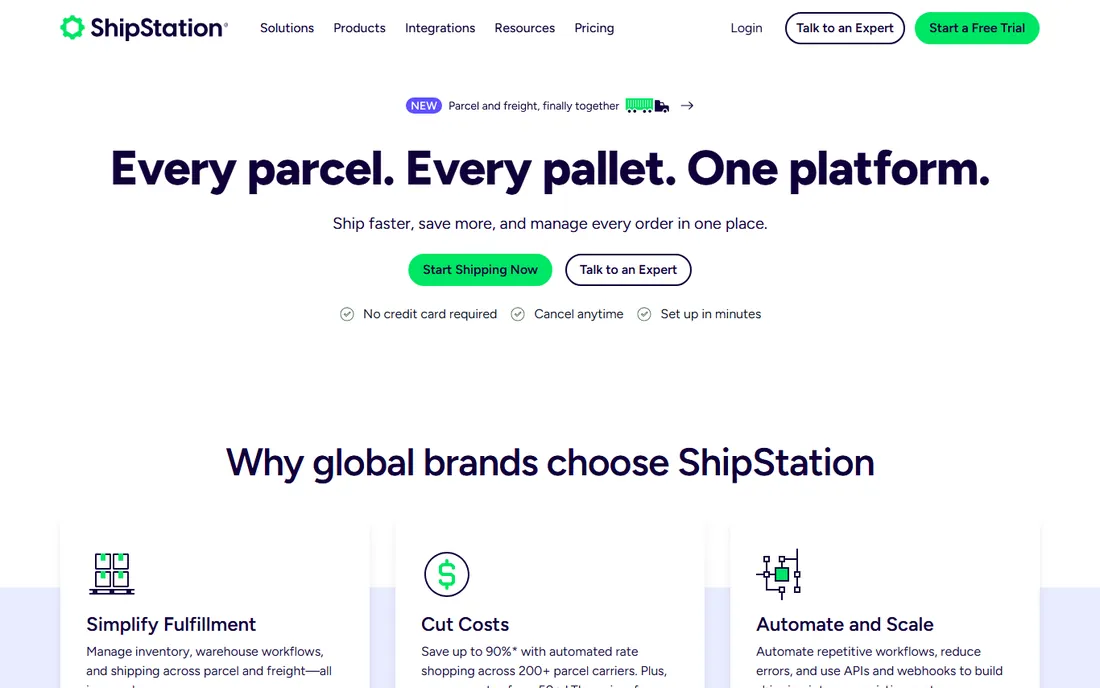
ShipStation is the default answer for a reason. It pulls orders from 400+ integrations, rate-shops across 200+ parcel carriers and 50+ LTL carriers, and automates the repetitive parts of fulfillment with rules, batch processing, and branded tracking. The vendor reports 1.3 million customers served, 1.5 trillion packages shipped, and deliveries to 195 countries. Freight quoting, bills of lading, and cargo insurance sit in the same dashboard as parcel labels, which few competitors match.
Pricing is tiered by monthly shipment volume: Starter at $14.99 a month for 50 shipments, Standard at $29.99, and Premium at $349.99, with volume sliders between and beyond. There is also a free plan with chatbot support, and every paid plan carries a 90-day money-back guarantee. The honest catch is the step pricing. Cross your shipment cap and the next tier costs meaningfully more, so fast-growing stores should model their volume a few months out. ShipStation is owned by Auctane, the same parent as Stamps.com and ShipWorks, so the product family overlaps more than the marketing suggests.
What we like- Parcel and freight in one workflow
- 200+ parcel carriers plus 50+ LTL carriers
- Up to 90% off standard list rates
- 90-day money-back guarantee
Watch out for- Shipment caps push you into higher tiers as you grow
- Phone support starts on the Standard plan
- Free plan is limited to chatbot support
Starting price$0/month
Free planYes
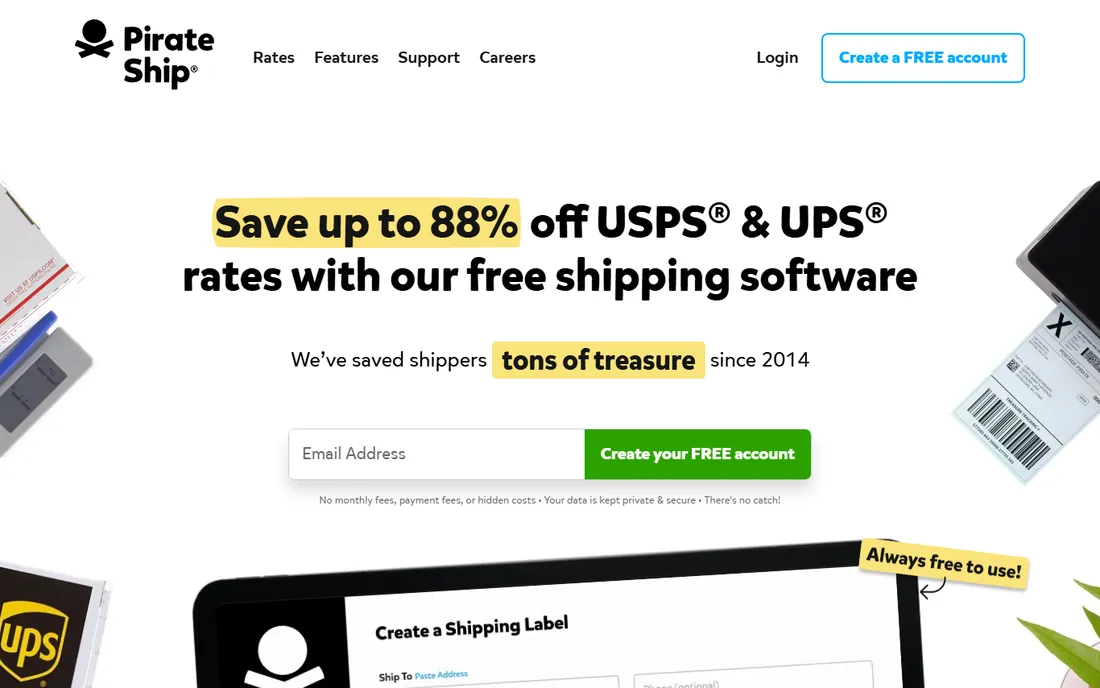
Pirate Ship keeps its pitch simple: the software is free because the carriers pay them, not you. You get access to deeply discounted UPS and USPS rates, side-by-side carrier comparison, bulk label printing, package presets, and integrated shipment tracking, all in a clean web app. There are no monthly fees, no minimums, and no contracts, which is why it has become the go-to recommendation for Etsy sellers, eBay sellers, and small shops shipping a few dozen packages a week.
The trade-offs are real but predictable. The carrier lineup stops at UPS and USPS, so FedEx and DHL loyalists should look elsewhere. There is no public API, so you cannot wire it into a custom order system the way you can with Shippo or EasyPost. Automation is limited to presets and batch tools rather than rule engines. For the best shipping app for small business use at low to mid volume, though, free is hard to argue with, and the support team has a strong reputation among small sellers.
What we like- Completely free with no monthly fees or markups
- Deep pre-negotiated UPS and USPS discounts
- Live chat support 14 hours a day, 7 days a week
Watch out for- Only UPS and USPS, no FedEx or DHL
- No public API for custom integrations
- Automation is basic compared with paid platforms
Starting price$0/month
Free planYes
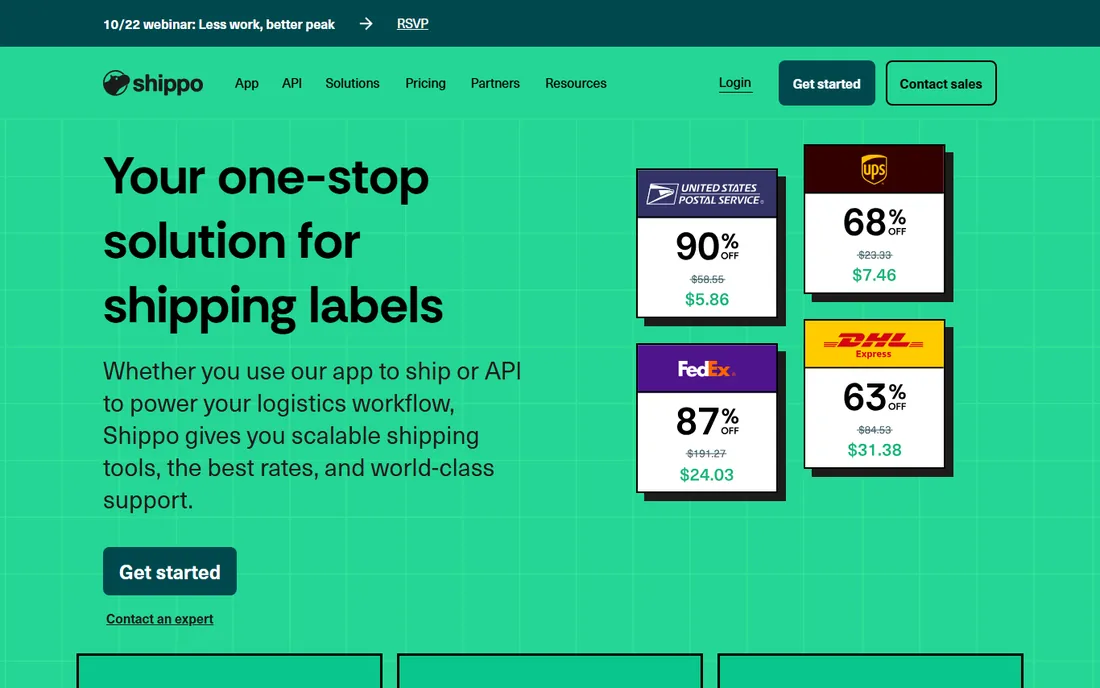
Shippo splits its personality between a friendly web app for small sellers and a well-documented API for developers. The Starter plan is free and covers 30 labels a month with discounted rates from 40+ global carriers, unlimited store connections, return labels, tracking, and automations. That is a genuinely usable free tier, not a demo. Paid Pro plans start at $19 a month ($17 billed annually) for up to 200 labels and scale to $199 a month for 5,001 to 10,000 labels, with Premier as a custom quote.
The vendor cites 4.6 million customers, potential savings of 90% on labels, and more than $12 billion in annual merchandise volume moving through the platform. The catches are in the details. The free plan supports a single user, and if you connect your own negotiated carrier account on Starter, Shippo charges $0.05 per label. Pro adds branded tracking pages, packing slips, and phone support. For sellers shipping between 30 and a few hundred packages a month, Shippo hits a sweet spot of price and capability.
What we like- Free Starter plan with 30 labels a month
- 40+ carriers with discounts up to 90%
- Developer-friendly API plus an easy web app
Watch out for- Free plan allows only one user
- Connecting your own carrier account costs $0.05 per label on Starter
- Paid tiers step up with volume
#4
Stamps.com
Best for: offices combining mail, stamps, and package shipping
Visit stamps.com
Starting price$14.99/month
Free planFree trial (30 days)
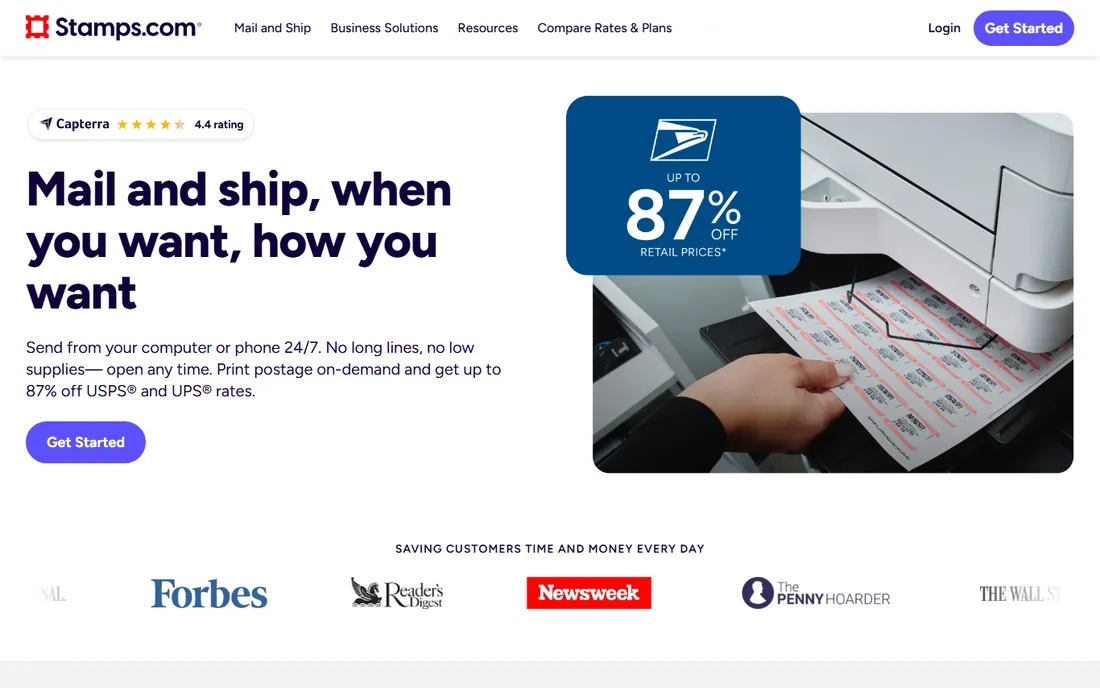
Stamps.com is the veteran of this list, nearly 30 years old and serving more than 4 million customers per its own site. Its distinction is that it handles mail, not just parcels. You can print postage stamps, First Class Mail, Certified Mail with electronic return receipts, and shipping labels for USPS, UPS, DHL Express, and GlobalPost from the same account, all from your desktop or phone. New accounts get a welcome kit with a free scale and supplies, plus a 30-day risk-free trial.
Pricing runs Basic at $14.99 a month, Professional at $29.99, and Enterprise at $49.99. The Basic plan is modest: one user, 25 stamps, and 10 labels a month. The honest catch is fit. If you only ship parcels, multi-carrier tools like ShipStation or Shippo give you more automation for similar money. Stamps.com earns its place for law firms, real estate offices, healthcare billing desks, and anyone still mailing letters and certified documents alongside packages. It is also part of Auctane, so expect the same corporate family as ShipStation.
What we like- Prints USPS stamps, Certified Mail, and shipping labels from one account
- Up to 87% off USPS rates
- Free scale and supplies with the welcome kit
Watch out for- Monthly fee applies even in slow months
- Basic plan caps at 1 user, 25 stamps, and 10 labels
- USPS-centric compared with multi-carrier rivals
#5
EasyPost
Best for: developers building shipping into their own software
Visit easypost.com
Starting price$0.08 per label
Free planNo
EasyPost is infrastructure, not an app. One API integration connects your platform to more than 100 carriers for labels, rate shopping, CASS-certified address verification, tracking webhooks, and insurance. The vendor's customer logos include Walmart, Home Depot, Dell, and Starbucks, and it now layers AI-driven rate analysis on top. The EasyPost Wallet lets you buy postage at up to 88% off retail rates across carriers on a single invoice, including newer regional carriers.
Pricing is pay-per-use: $0.08 per label on the developer plan, with the service fee waived for the first 3,000 Wallet carrier labels per month under their published terms. Bringing your own carrier accounts runs $20 a month plus $0.08 per label. Tracking APIs cost $0.01 to $0.03 per shipment, and insurance runs a flat 1% of shipment value. The catch is audience. If you do not have developers, the API-first design is a non-starter, and per-label fees reward volume while punishing experimentation. For platforms and 3PLs, though, it is the most capable shipping backbone here.
What we like- One API for 100+ carriers with rate shopping, tracking, and insurance
- Wallet rates up to 88% off retail on one invoice
- Flat 1% shipment insurance across carriers
Watch out for- Built for engineers, not operations staff
- Label pricing is pay-per-use with no free tier
- Advanced features like branded tracking cost extra per shipment
Starting price$189/month
Free planFree trial (30 days)
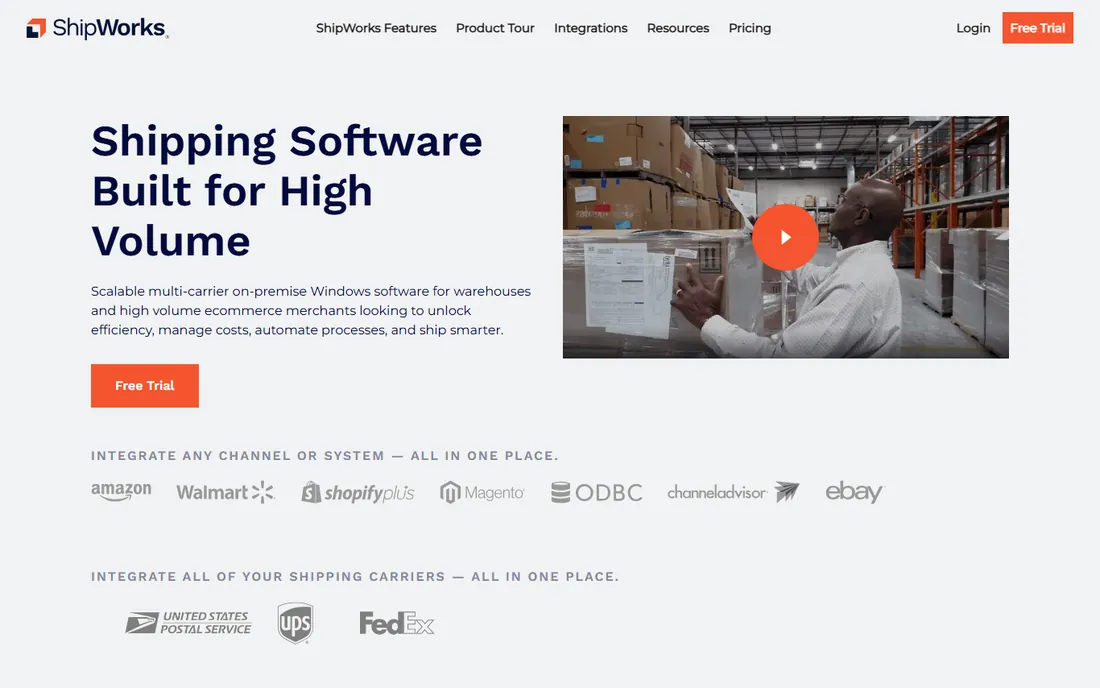
ShipWorks is the old hand of warehouse shipping, with 20 years of product evolution behind it. It is Windows-installed software with cloud components, designed for warehouses and high-volume merchants that need raw throughput: the vendor claims 2x faster download speeds than SaaS-only tools and 16,000 labels per hour of print speed. Features include intelligent order routing, scan-to-ship, batch processing, a Best Rate Tool, and 70+ built-in integrations with carts, marketplaces, ERPs, and WMS platforms.
Every plan includes unlimited users, unlimited computers, and unlimited phone, email, and chat support from a US-based team. Pricing starts at $189 a month for the Ecommerce Professional plan (5,000 shipments), rising to $389, $639, and $799 for warehouse tiers up to 50,000 shipments. A 30-day free trial is available. The honest catch is the platform bet. Windows-only on-premise software is a deliberate choice for control and speed, but it means you own the installation, and the entry price is far above cloud alternatives. This is for serious warehouse operations, not for a spare-room packing desk.
What we like- On-premise Windows software built for speed (16,000 labels an hour)
- Unlimited users and computers on every plan
- US-based white-glove support
Watch out for- Windows only, no cloud-native option
- $189 a month starting price is steep
- You manage the local install and database
#7
Ordoro
Best for: merchants combining shipping with inventory management
Visit ordoro.com
Starting price$0/month
Free planYes
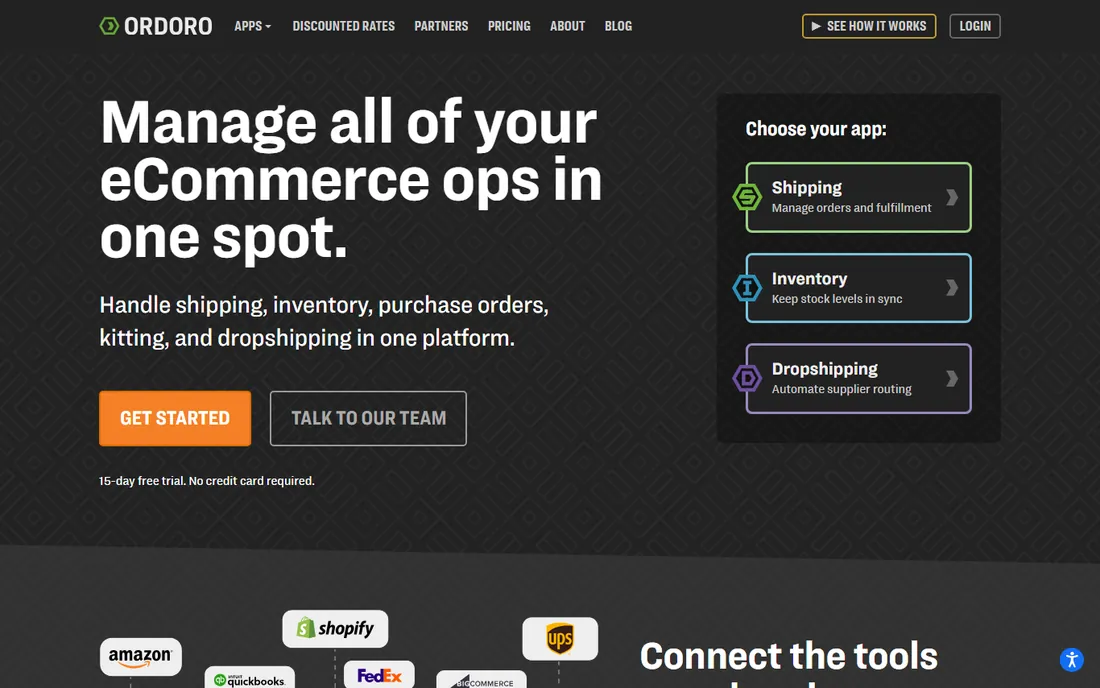
Ordoro positions itself as the operational backbone for ecommerce merchants rather than just a label printer. Three modular apps cover shipping, inventory, and dropshipping, so you can start with one and add the others as the business grows. The shipping app includes discounted carrier rates, barcode scanning, pack verification, return labels, and automation rules on paid tiers. Inventory adds stock sync across channels, purchase orders, kitting, and warehouse transfers. Dropshipping adds supplier routing and vendor portals.
The Shipping Essential plan is free for up to 100 orders a month with one sales channel and one user. Advanced shipping is $59 a month and Premium is $149. The inventory app starts at $349 a month and dropshipping at $299, and bundles are quoted by the sales team. A 15-day free trial requires no credit card. The catch is the cost curve. Ordoro is excellent if you genuinely need shipping plus inventory in one system, but if you only need labels, the free shipping plan is thin and the paid tiers cost more than pure shipping tools.
What we like- Shipping, inventory, purchase orders, kitting, and dropshipping in one platform
- Free Shipping Essential plan
- Modular apps you can combine as you grow
Watch out for- Free plan limited to 1 channel, 1 user, and 100 orders a month
- Inventory app starts at $349 a month
- Combined apps get expensive quickly
When free shipping software stops being enough
Free tools like Pirate Ship and Shippo's Starter plan cover labels and discounts beautifully, but they hit walls at predictable points. The first wall is automation: when you are manually choosing services for hundreds of orders, rule-based rate shopping and batch processing start paying for themselves. The second wall is channels: free plans cap the number of connected stores, so multi-channel sellers outgrow them fast. The third wall is people: single-user free plans break the moment a second person needs to print labels.
The practical test is labor cost. If your team spends more than a few hours a week on shipping busywork, a $15 to $60 monthly plan that automates it is cheaper than the free tool. If you are still packing boxes yourself a few evenings a week, stay free and put the savings into postage.
What to weigh before you pick shipping software
Shipping software is one of the few tools that pays for itself in postage discounts alone, but the pricing models differ enough that the wrong pick costs real money.
Carrier mix first
List the carriers you actually use before comparing anything else. Pirate Ship covers UPS and USPS deeply but nothing else. EasyPost and ShipStation cover 100+ and 200+ carriers respectively. If your negotiated FedEx rates are the backbone of your margins, make sure the tool supports your own carrier accounts and does not quietly route you to its discounted rates instead.
Volume-based pricing math
Most tools price by monthly shipment or label count. Map your last three months of volume against the tiers, then check what happens when you exceed a tier: Shippo auto-upgrades you, Ordoro locks the account or charges overages, and ShipStation jumps to the next price band. Seasonal sellers should pay special attention, since a holiday spike can land you on an expensive tier for one month.
Free plans are real, but read the limits
Pirate Ship is free at any volume. Shippo gives 30 free labels a month. Ordoro gives 100 free orders a month on one channel. ShipStation has a free plan with chatbot support. Each of these is genuinely useful, but each has a ceiling designed to convert you to paid. Know the ceiling before you build your workflow on top of it.
Automation depth
Entry-level automation means presets and batch printing. Mid-level means rules that pick carriers and services automatically. Advanced means barcode-driven warehouse workflows, pick lists, and pack verification. Match the depth to your operation: a solo seller needs presets, a five-person packing team needs rules, and a warehouse needs scan-to-ship.
Mail versus parcels
If your business still sends letters, invoices, or certified documents, Stamps.com is the only tool here that treats mail as a first-class citizen. The parcel-focused tools assume everything you send is a box or a poly mailer. Offices that do both should not force a parcel tool to handle mail.
Inventory and warehouse needs
ShipWorks and Ordoro bundle shipping with inventory, purchasing, and warehouse workflows. That integration is worth real money if you currently reconcile stock in spreadsheets. If you do not need inventory management, you are paying for shelfware, so stick with a pure shipping tool.
How we chose
We searched the shipping software category and shortlisted established platforms alongside free and developer-focused options. For each tool, we opened the vendor's official homepage and pricing pages to confirm the product exists today and to record current prices from the vendor's own site. Where pricing was not published, we marked it as See website rather than repeating third-party claims. We weighed features against the needs of small and mid-size businesses: carrier coverage, rate discounts, automation depth, integrations with Shopify, Amazon, and other channels, and the honesty of free plans and trials. Public reviews on G2, Capterra, and Reddit informed our sense of each product's strengths and rough edges. We did not test any software hands-on; every price and feature claim comes from the vendor's own published pages.
Frequently asked questions
Do I need shipping software, or can I just buy labels from carrier websites?
You can buy labels directly from USPS, UPS, or FedEx, but you will usually pay retail rates and juggle multiple sites. Shipping software aggregates your orders, compares discounted rates across carriers in one screen, and automates label printing and tracking. For more than a few shipments a week, the postage savings alone typically cover the cost.
How do the discounted rates actually work?
Vendors negotiate bulk rates with carriers and pass them to their users. Shippo advertises up to 90% off, ShipStation up to 90% off standard list rates, Stamps.com up to 87% off USPS, and EasyPost up to 88% off retail through its Wallet. Your actual discount depends on the service, weight, and zone, so compare rates for your typical shipments rather than trusting the headline number.
Can I use my own negotiated carrier accounts?
Yes, on most paid plans. ShipStation, Shippo (Pro), EasyPost (BYOCA), and Ordoro (Premium) all let you connect your own carrier accounts alongside their discounted rates. This matters if you have negotiated rates that beat the platform discounts. Free plans usually restrict or surcharge own-carrier labels.
Does shipping software work with Shopify, Amazon, and eBay?
Yes. All seven tools import orders from major sales channels. ShipStation lists 400+ integrations, Shippo offers unlimited store connections, and the rest cover the major marketplaces either directly or through integrations. Check the specific channel list if you sell on a smaller platform.
What about returns?
Return label support varies. Shippo includes return labels on every plan, Ordoro adds returns management on Premium, ShipStation offers a branded returns and exchanges portal on Standard and above, and Pirate Ship supports return labels through its standard workflow. If returns are a big part of your business, compare the returns portals directly rather than assuming they are equal.
Which is the best shipping app for small business on a budget?
Pirate Ship is the cheapest capable option because it is completely free with no monthly fees. Shippo's free Starter plan is the next best starting point if you want a fuller feature set or might add carriers later. Move to a paid plan when automation or multi-user access would save your team more time than the subscription costs.
Sources we checked (13)
- https://shipstation.com/
- https://shipstation.com/pricing/
- https://www.pirateship.com/
- https://goshippo.com/
- https://goshippo.com/shipping/shipping-label-pricing
- https://www.stamps.com/
- https://www.stamps.com/pricing/
- https://www.easypost.com/
- https://www.easypost.com/pricing/
- https://www.shipworks.com/
- https://www.shipworks.com/pricing/
- https://www.ordoro.com/
- https://ordoro.com/pricing
Is your product missing or out of date?
We review this list regularly. Vendors can request a listing, send updated pricing or ask about featured placement.

Shihab Mia · Founder, Rankite
Shihab has spent more than a decade helping SaaS and e-commerce brands grow through search. He writes Rankite's software buying guides from pricing pages, documentation and public user reviews. More about Shihab.