How we make this list: we compare pricing pages, product documentation and public user reviews. Rankite is independent; if a vendor ever pays for a featured spot, that listing is clearly labeled Partner.
Key takeaways
- B2B ecommerce has a dirty secret: almost nobody publishes a price. Of the major vendors, only BigCommerce lists B2B pricing publicly. Budget for a sales conversation everywhere else.
- BigCommerce B2B Edition is the transparent pick: Scale at $399/month ($299 annual) with customer pricing rules, quotes and multi-storefront; Performance from $1,499/month.
- Shopify Plus (from $2,300/month on a 3-year term) suits brands running B2B and direct-to-consumer on one platform with a huge app ecosystem.
- OroCommerce (free open-source Community Edition), Adobe Commerce, Sana Commerce, Salesforce, SAP and NetSuite serve enterprises where ERP integration, quotes and account hierarchies run the operation.
- WooCommerce B2B is the budget route: free open-source software for WordPress-based wholesalers, with hosting and plugins as the real cost.
Quick comparison
| Tool | Best for | Starting price | Free plan |
|---|
 Shopify Plus Shopify Plus | Brands running B2B and direct-to-consumer together | From $2,300/month (3-year term) | No |
 BigCommerce B2B Edition BigCommerce B2B Edition | Mid-market distributors that want pricing transparency | From $399/month (Scale) | No |
 Adobe Commerce Adobe Commerce | Enterprises with complex catalogs and custom workflows | See website | No |
 OroCommerce OroCommerce | B2B-first operations that want purpose-built workflows | See website (Community Edition free) | Yes (Community Edition) |
 Sana Commerce Sana Commerce | Companies running SAP or Microsoft Dynamics ERP | See website | No |
 Salesforce B2B Commerce Salesforce B2B Commerce | Enterprises already living in Salesforce | See website | No |
 SAP Commerce Cloud SAP Commerce Cloud | SAP S/4HANA enterprises with complex B2B scenarios | See website | No |
 NetSuite SuiteCommerce NetSuite SuiteCommerce | Businesses already running NetSuite ERP | See website | No |
 WooCommerce B2B WooCommerce B2B | Small wholesalers already on WordPress | Free (open source; hosting extra) | Yes |
Is your product missing or out of date?
We review this list regularly. Vendors can request a listing, send updated pricing or ask about featured placement.
B2B ecommerce platforms handle wholesale ordering: customer-specific pricing, quotes, bulk ordering, credit terms, account hierarchies and ERP integration. Nine tools below, from open-source to enterprise.
#1
Shopify Plus
Best for: Brands running B2B and direct-to-consumer together
Visit shopify.com
Starting priceFrom $2,300/month (3-year term)
Free planNo

Shopify Plus is the pragmatic choice for brands that sell both ways: one admin, one inventory, one customer record, with B2B storefronts offering custom catalogs, volume pricing, payment terms and company accounts alongside the DTC store. Deployment is measured in weeks, not quarters, and the app ecosystem fills most gaps.
The trade is depth. Distributors with complex quoting, credit limits and ERP-driven pricing will find B2B-native platforms more complete. But for manufacturers and brands where wholesale is a channel rather than the whole business, Shopify Plus is the fastest path to a working B2B portal.
What we like- One platform for B2B wholesale and DTC retail
- Massive app ecosystem and fast deployment
- Custom catalogs, tiered pricing and payment terms built in
Watch out for- $2,300/month entry is steep for pure wholesalers
- B2B features are strong but less deep than B2B-native platforms
- Transaction fees without Shopify Payments
#2
BigCommerce B2B Edition
Best for: Mid-market distributors that want pricing transparency
Visit bigcommerce.com
Starting priceFrom $399/month (Scale)
Free planNo
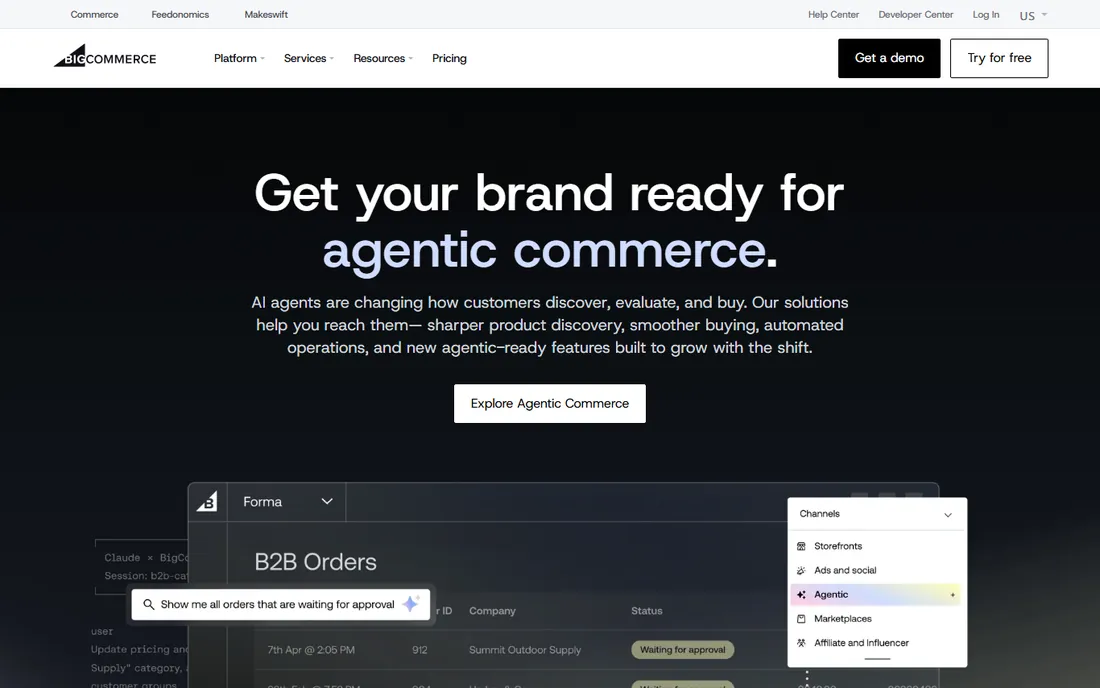
BigCommerce earns its place by publishing prices: Scale at $399 a month ($299 annual) includes B2B essentials, with Growth and Performance tiers above. The B2B Edition covers customer-specific pricing, bulk ordering, quote-to-order workflows, shared shopping lists and multi-storefront management, with native connectors to NetSuite and SAP.
It is the honest mid-market pick: real B2B functionality without a six-figure quote. Companies outgrow it when customization needs get exotic, at which point Adobe Commerce or OroCommerce take over. For distributors that want to buy software, not a consulting project, start here.
What we like- The only major B2B platform with published pricing
- Customer pricing rules, quotes and multi-storefront
- Open API architecture with native ERP connectors
Watch out for- Enterprise B2B features need Performance tier ($1,499+/month)
- App ecosystem smaller than Shopify's
- Design flexibility needs developer help
#3
Adobe Commerce
Best for: Enterprises with complex catalogs and custom workflows
Visit adobe.com
Starting priceSee website
Free planNo
Adobe Commerce (the former Magento Commerce) is the customization king. If your B2B operation has pricing logic, approval workflows or catalog structures that no SaaS product anticipates, Adobe Commerce can be shaped to fit: custom everything, from quote negotiation to requisition lists to negotiated checkout flows.
That freedom costs money: custom licensing, agency implementation, and continuous maintenance. Total platform costs run roughly 40% above simpler SaaS options by some estimates. It suits enterprises with the development resources to wield it. Everyone else should buy a product that already does what they need.
What we like- Near-unlimited customization for catalogs, pricing and checkout
- Company hierarchies, shared catalogs and quote workflows
- Strong PWA and headless options
Watch out for- Custom pricing with significant platform costs
- Needs experienced developers or an agency
- Upgrades and maintenance are ongoing work
#4
OroCommerce
Best for: B2B-first operations that want purpose-built workflows
Visit oroinc.com
Starting priceSee website (Community Edition free)
Free planYes (Community Edition)
OroCommerce is the only platform here built exclusively for B2B. Everything B2B buyers ask for, request-for-quote workflows, customer price lists, corporate account hierarchies, approval chains, arrives native rather than bolted on. The open-source Community Edition is genuinely free, with paid enterprise editions adding support and advanced features.
It is the thinking buyer's enterprise pick: deeper B2B functionality per dollar than Adobe Commerce, without the SaaS compromises of adapted B2C platforms. The ecosystem is smaller, so vet implementation partners carefully. For distributors and manufacturers, it belongs on every shortlist.
What we like- Designed for B2B from day one: RFQs, quoting, price lists, account hierarchies
- Free open-source Community Edition
- Strong workflow automation
Watch out for- Enterprise edition is quote-based
- Smaller ecosystem than Adobe or Shopify
- Implementation still needs expertise
Starting priceSee website
Free planNo
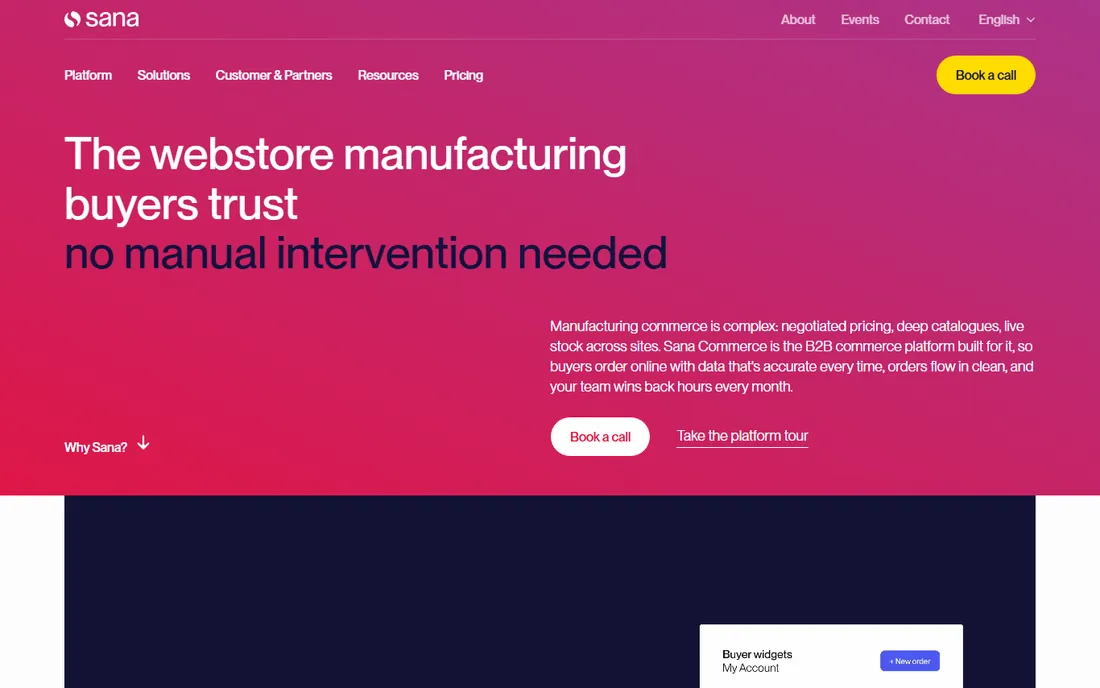
Sana Commerce takes a radical approach: instead of syncing with your ERP, the webstore runs on it. Pricing, inventory, order history and customer data come straight from SAP or Microsoft Dynamics in real time, which eliminates the integration layer where most B2B projects fail.
The flip side is dependence: your ERP's data quality and availability directly determine the storefront experience. For manufacturers and distributors whose ERP is already the system of truth, it is the cleanest architecture available. For companies with messy ERP data, fix the ERP first.
What we like- ERP-native: the storefront reads pricing, inventory and customer data live from your ERP
- No sync middleware to maintain
- Strong for manufacturers
Watch out for- Custom pricing across multiple editions
- Tied to your ERP, so ERP problems become storefront problems
- Less flexibility outside the ERP model
Starting priceSee website
Free planNo
Salesforce B2B Commerce makes sense for one buyer: the company already committed to Salesforce. Then the pitch is compelling: price books, contract rates and account hierarchies native to the CRM, commerce data enriching every sales and service workflow, Einstein AI recommending products. Pricing is custom and GMV-based.
Outside the Salesforce world, there is little reason to choose it over more focused platforms. Inside it, the integration value is real and hard to replicate. Evaluate it alongside your Salesforce account team, not as a standalone commerce decision.
What we like- Native CRM integration: commerce data flows into Sales and Service Cloud
- Einstein AI for recommendations
- Price books and contract pricing
Watch out for- Custom GMV-based pricing
- Full value needs the Salesforce ecosystem
- Implementation is an enterprise project
#7
SAP Commerce Cloud
Best for: SAP S/4HANA enterprises with complex B2B scenarios
Visit sap.com
Starting priceSee website
Free planNo

SAP Commerce Cloud is the enterprise end of the spectrum: the commerce platform for companies whose entire operation runs on SAP. Real-time inventory and pricing from S/4HANA, complex approval workflows, corporate account structures and global scale come standard.
There is no pretense of simplicity: custom pricing, long implementations, and a product that assumes SAP everywhere. For SAP-centric manufacturers and distributors, it is the natural and often the only serious choice. For everyone else, it is the wrong tool at the wrong price.
What we like- Deepest SAP ERP integration available
- Bulk ordering, approval workflows and corporate hierarchies
- Proven at massive enterprise scale
Watch out for- Custom enterprise pricing
- Heavyweight implementation
- Only makes sense for companies already standardized on SAP
#8
NetSuite SuiteCommerce
Best for: Businesses already running NetSuite ERP
Visit netsuite.com
Starting priceSee website
Free planNo
NetSuite SuiteCommerce extends NetSuite ERP into commerce: the webstore shares the same item, inventory, pricing and customer records as the ERP, so B2B pricing rules and availability are always accurate. For the hundreds of thousands of businesses on NetSuite, it removes an entire integration project.
The storefront itself is less flexible than headless alternatives, and you are deepening NetSuite commitment. But the operational simplicity of one system for ERP and commerce is worth real money. NetSuite users should evaluate it before considering any external platform.
What we like- Native NetSuite integration: real-time inventory, pricing and order management
- Single system for ERP, CRM and commerce
- B2B account hierarchies
Watch out for- Custom pricing
- Design flexibility trails best-of-breed storefronts
- NetSuite lock-in
Starting priceFree (open source; hosting extra)
Free planYes
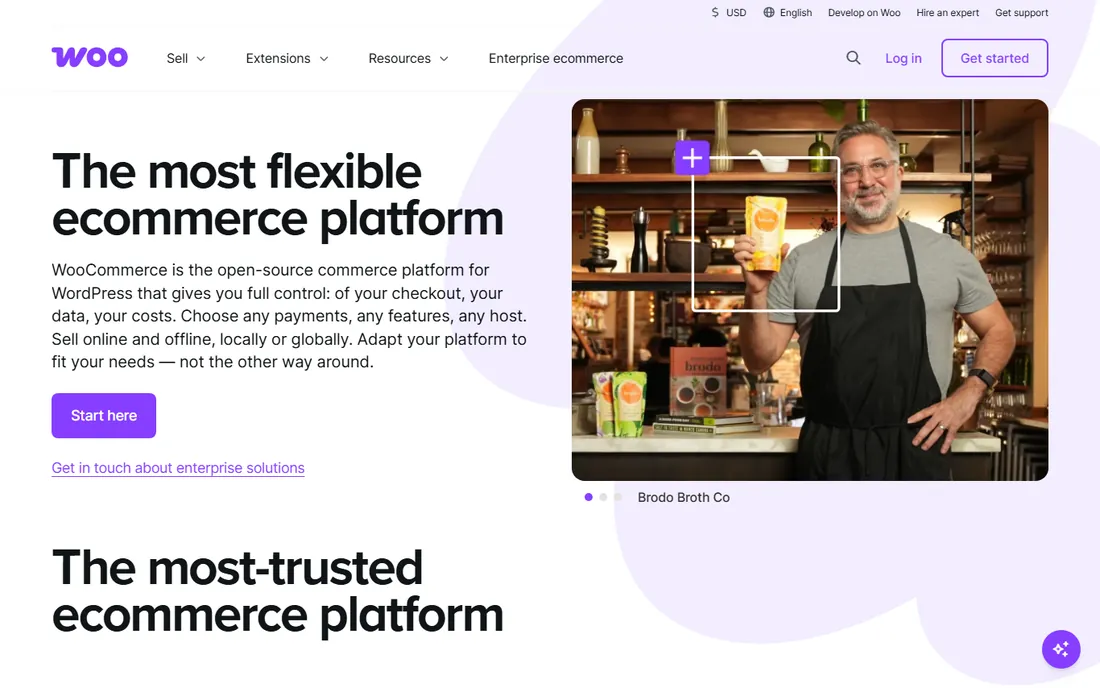
WooCommerce with B2B plugins is the budget route to wholesale ecommerce. The core software is free and open source; plugins add customer-specific pricing, quote requests, bulk order forms and tax-exempt checkout. Hosting, a theme and premium plugins are the real costs, typically hundreds to low thousands per year.
It suits small wholesalers and manufacturers already on WordPress who need a working B2B portal without enterprise budgets. The ceiling is real: complex ERP integration, high-volume performance and advanced workflows eventually demand a dedicated platform. But as a starting point, nothing is cheaper.
What we like- Free open-source core with a huge plugin ecosystem
- B2B plugins add tiered pricing, quotes and bulk ordering
- Full ownership of data and code
Watch out for- B2B features come from plugins of varying quality
- You own hosting, security and maintenance
- Scaling needs technical resources
How we chose
We were honest about the category's pricing opacity: we checked vendors' own pages and report published prices only where they exist (BigCommerce, Shopify Plus, WooCommerce). Everything else is marked quote-based rather than filled with agency marketing figures. We covered the three architectural approaches (SaaS suites, ERP-native, open source) and weighted B2B-native functionality, quote workflows, pricing-rule depth and ERP integration quality over B2C feature checklists. Reviews from G2 and B2B commerce practitioners informed the strengths and weaknesses.
B2B-native versus B2C-adapted: the architecture question
Some platforms were built for B2B (OroCommerce, Sana Commerce, NetSuite SuiteCommerce); others adapted B2C commerce to wholesale (Shopify Plus, BigCommerce, WooCommerce with plugins). The difference shows in eight capabilities: customer-specific pricing, quote and RFQ workflows, bulk ordering, credit limits and payment terms, account hierarchies with buyer roles, approval chains, tax exemption handling, and ERP-driven catalogs.
B2B-native platforms do all eight out of the box. Adapted platforms cover most through apps, plugins or configuration, with varying elegance. If your operation needs all eight deeply, buy B2B-native. If you need three or four plus a great DTC store, an adapted platform is faster and cheaper. Count your non-negotiables before you shop.
The ERP integration is the real project
The subscription is rarely the biggest cost in B2B ecommerce; the ERP integration is. If your pricing, inventory and customer terms live in an ERP, connecting it to the storefront is where projects succeed or fail: data mapping, real-time versus batch sync, error handling, and ongoing maintenance.
This is why ERP-native options (Sana Commerce, NetSuite SuiteCommerce, SAP Commerce Cloud) exist: they eliminate the integration layer entirely. If you choose a standalone platform, budget the integration as its own project with its own owner, and ask every vendor for reference customers on your exact ERP. A beautiful storefront with wrong inventory is worse than no storefront.
Frequently asked questions
What is a B2B ecommerce platform?
Software that lets businesses sell to other businesses online: wholesale storefronts with customer-specific pricing, bulk ordering, quote requests, credit terms, approval workflows and ERP integration. It differs from B2C ecommerce in serving known business accounts rather than anonymous shoppers.
How much does B2B ecommerce software cost?
From free (WooCommerce open source, OroCommerce Community Edition) to $399/month (BigCommerce Scale) to $2,300/month (Shopify Plus) to custom enterprise quotes (Adobe, SAP, Salesforce, Oracle). Implementation and ERP integration usually exceed the subscription cost. Budget the project, not just the license.
Shopify Plus versus BigCommerce for B2B: which is better?
Shopify Plus ($2,300/month) wins for brands running B2B alongside DTC with a huge app ecosystem and fast deployment. BigCommerce B2B (from $399/month) wins on published pricing, B2B-native depth and open architecture for pure distributors. Choose Shopify for unified commerce, BigCommerce for wholesale-first operations.
What is the best B2B ecommerce platform for small wholesalers?
WooCommerce with B2B plugins (free software, low hosting costs) for WordPress users; BigCommerce Scale ($399/month) for a managed platform with real B2B features; OroCommerce Community Edition (free) for B2B-native workflows with technical resources. All three avoid enterprise quotes.
Do I need ERP integration for B2B ecommerce?
If your pricing, inventory or customer terms live in an ERP, yes: manual sync does not scale and errors cost real money. ERP-native platforms (Sana, NetSuite SuiteCommerce) eliminate the integration; otherwise budget it as a separate project. If you have no ERP, skip this concern entirely.
Are there open-source B2B ecommerce platforms?
Yes. OroCommerce Community Edition is free and B2B-native; WooCommerce is free with B2B plugins; Adobe Commerce has an open-source edition (Magento Open Source). Open source means no license fees but you own hosting, maintenance and implementation.
Sources we checked (4)
- https://www.softwareworld.co/b2b-ecommerce-platform-software/
- https://www.commercepundit.com/blog/best-b2b-ecommerce-platforms-in-2026-8-compared/
- https://wizcommerce.com/blog/best-b2b-ecommerce-platforms/
- https://www.shopify.com/enterprise/blog/b2b-ecommerce-platforms
Is your product missing or out of date?
We review this list regularly. Vendors can request a listing, send updated pricing or ask about featured placement.

Shihab Mia · Founder, Rankite
Shihab has spent more than a decade helping SaaS and e-commerce brands grow through search. He writes Rankite's software buying guides from pricing pages, documentation and public user reviews. More about Shihab.